
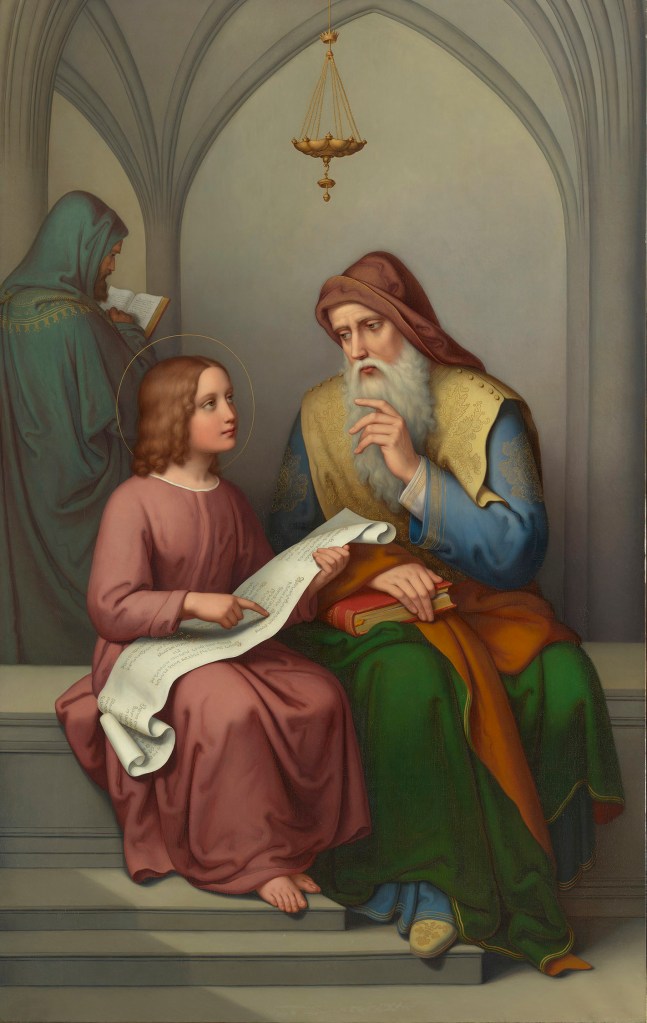
Marie Ellenrieder, Christ in the Temple, 1849. Royal Collection Trust.
My next stop on the journey through early modern German art will be The Nazarenes, this Monday, 12 May at 6pm. If you’ve never heard of them, don’t worry, but they are rather wonderful and should be known! Nevertheless, a striking feature of the History of Art is its ability to forget artists who were, in their day, remarkably successful. And the Nazarenes really were successful – especially in Britain. It’s just that very few paintings have made their way into public collections anywhere outside Germany. Not only that, but tastes changed very quickly after their initial success. John Ruskin’s Modern Painters would turn out to be an enormously important and influential book: amongst other things it includes an early defence of the paintings of Turner. However, when the first volume was initially sent to the publishers – the prestigious John Murray – it was turned down: apparently Murray said that they might have been more interested if it had been written about the Nazarenes. As Ruskin was concerned with nature, God and society, he would surely have been interested in their work, as they ticked at least two of these three boxes – God and society. They would also turn out to be an important influence on British art, as we shall see on Monday. Apart from anything else, their clear, crisp colours and strong simple outlines are a balm for troubled eyes – and trust me, I should know. I must apologise for this post being rather late. I got back from Paris on Thursday, and meant to finish writing it yesterday. However, I went out for an hour or so to have an eye test and order some new glasses, but only got home some 10 hours, four nurses and three doctors later after minor laser eye surgery. I’m fine, it was a precautionary measure, but I lost a day’s work unexpectedly.
Today I want to write about Marie Ellenrieder. Strictly speaking, she wasn’t one of the Nazarenes, who, like the Pre-Raphaelites, were effectively a ‘Brotherhood’. However, she knew them, and her work is strongly influenced by theirs. I’ll go into more detail on Monday, of course. The following week (19 May) I will move onto German Impressionism, and then, to conclude this series, on 26 May I’m looking forward to enjoying the sculptures of Ernst Barlach – whose work will be the main Aspect of Expressionism I will be discussing. In Paris I saw two superb exhibitions dedicated to Cimabue and Artemisia Gentileschi, and I’ll be talking about them in June: do keep your eye on the diary for more details.
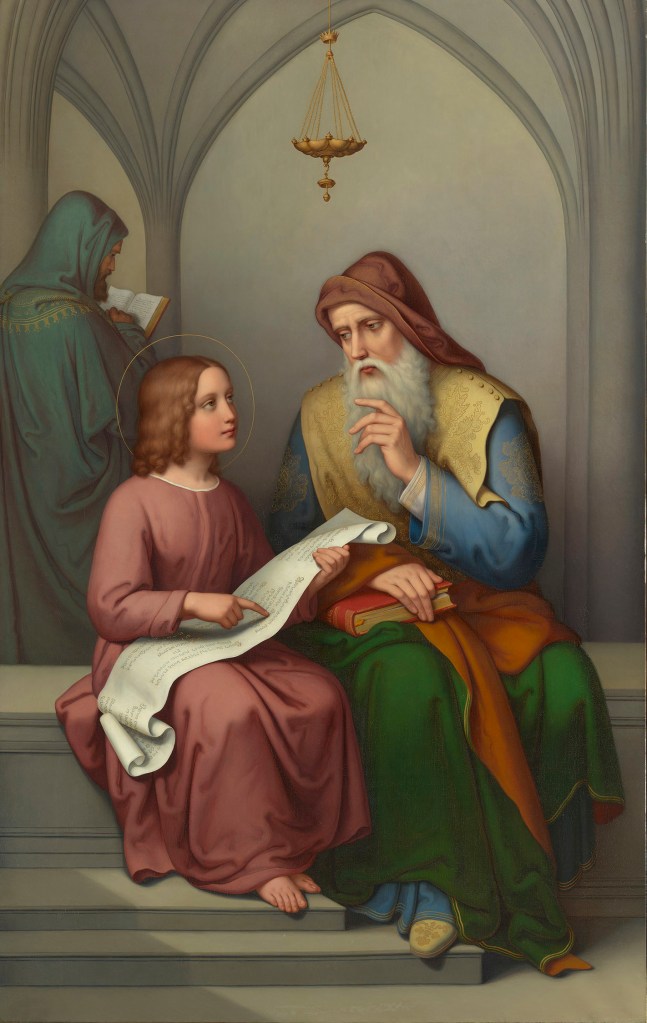
In light, crisp, clear colours Marie Ellenrieder is depicting a story whose consequences I discussed just a month or so ago, looking at Simone Martini’s Christ discovered in the Temple. As I said in that post, I think Martini was painting what happened next – after Mary and Joseph had found Jesus. When he was 12, according to the Gospel of St Luke, the family went to celebrate the Passover in Jerusalem. On the way home Mary and Joseph realised that Jesus was not with the rest of the group – so they returned to the city, and eventually, after three days, they found him in the temple, ‘sitting in the midst of the doctors, both hearing them, and asking them questions. And all that heard him were astonished at his understanding and answers’ (Luke 2:46-47). Ellenrieder has a very particular take on the story, and one that differs from the medieval and renaissance versions. Unlike ‘traditional’ images she does not show the moment of discovery, with Mary and Joseph to the side, or in the background, nor does she show a large group of doctors – there are usually at least four, or how could Jesus appear ‘in the midst’ of them? In Ellenrieder’s version he isn’t even in between the two who are present, one of whom isn’t paying him any attention anyway. In a similar way to Simone Martini, I think she is extending the range of the narrative, but whereas he takes the story beyond the moment of ‘discovery’, Ellenrieder has arrived to witness a scene beforehand. Jesus is only really communicating with one of the doctors, which makes me wonder if he has only recently entered the Temple. Let’s see if that makes sense!

The interaction between the old man and the 12-year-old boy is very direct, and very personal. It could be a scene of one-on-one tuition, although one in which the tables are turning. The man, with his long, white beard, is assumed to be both old and wise. On his lap rests a hefty tome with his right hand lying on top, the forefinger tucked into one of the pages to keep his place (there is also a bookmark ribbon marking another page). He looks towards Jesus, his left hand raised to emphasize a point in his argument. Jesus looks up towards him, holding an unrolled scroll, pointing towards the text with his right forefinger. His sanctity is evident – a simple gold ring circles his head as a halo – and his Christianity is subtly alluded to. Whereas the older man has his head covered by a russet-red hood, Jesus’s centrally parted and neatly combed hair is there for all to see. I don’t know when the tradition started – but long before Ellenrieder was alive – but Jewish boys would often start to wear a yarmulka (or kippah, or skull cap) at the age of three. Jesus is twelve – admittedly not yet thirteen, when he would be obligated to follow the commandments of the Torah, but the point is clearly made. In medieval and renaissance iconography, scrolls are usually used by characters from the Old Testament – i.e. Jews – whereas codices (books with pages that turn, rather than unroll) were not developed until the 2nd or 3rd century, and so are associated with Christianity. With Jesus pointing to a scroll, Ellenrieder could be implying that he has a profound understanding of the Old Order from an original text, rather than a ‘modern’ commentary. The glance that passes between the two suggests that this is the case. The old man’s head is tilted, and, to me at least, his gaze seems to imply a sense of doubt, with an idea coming into his head that had not been there before. The tentative positioning of his left hand is similarly not decisive – it is not the bold statement of an unequivocal truth, or the secure gesture of a well-practiced argument. The Doctor’s face is pale, his cheeks hollowed, and there are a few dignified wrinkles (the Nazarenes were not too worried about excessive lifelike veracity, but were more interested in communicating an idea as simply and directly as possible). Jesus has a perfect, porcelain complexion, unmarked but glowing with health – and youth. He looks up into the old man’s eyes with just a hint of a smile, showing conviction, understanding, and even love. His hand casts a shadow on the scroll: it is illuminated from above, as if by his Father in heaven. However, the words on the scroll are not legible. They are neither Latin nor Hebrew characters, but I suspect Ellenrieder is painting something ‘other’ to suggest the latter. Jesus wears a simple red robe, as was traditional, although it is not yet covered with a blue cloak. Perhaps that is because he has not yet formally begun his teaching – and wouldn’t, until after the Baptism. The old man, on the other hand, wears a subtle range of colours – russet, yellow, pale blue, orange and green.

Sometimes I find details in a painting a marvel in and of themselves – and this is one such detail. Above all, I love the poise of the man’s hand directly in front of his beard so that its insecurity is framed by his age and experience. The subtle articulation of the fingers, each one different – with the index finger opening out and the ring finger curling in – surely creates the sense of hesitation. And then there are the colours – the pale lemon yellow of the tabard, which is buttoned on both sides along the shoulders, and the way that this colour is picked up in the patterning of the Wedgwood-blue sleeves. There is a similar pattern on the tabard in a more muted, neutral colour. Above all, though, it is the expression, as if asking ‘how is this possible, from someone so young?’ But then, as it says in Psalm 8, verse 2, ‘Out of the mouth of babes and sucklings hast though ordained strength…’ Maybe that’s the verse that Jesus is pointing at. He would certainly know this text later – in Matthew 21:16 he says ‘have ye never read, Out of the mouth of babes and sucklings thou hast perfected praise?’ He could even be asking that now.

The bottom of the painting has some further, subtle pointers to Jesus’s status – and more delicate detailing. Notice how he wears no shoes, whereas the Doctor has delicate yellow pumps, the same colour as the tabard and with similar decoration. The blue/yellow colour chord is there, as it the contrast between the green cloak and its deep amber lining. Jesus being unshod is presumably a reference to Luke 10:4, in which he instructs his followers ‘Carry neither purse, nor scrip, nor shoes’. I quoted an equivalent text (Matthew 10:10) when talking about Martini’s painting, in which the 12-year-old wears sandals (‘nor shoes’ does not necessarily proscribe other footwear…). In the same painting, Simone’s Joseph, like Ellenrieder’s old man, also happens to wear yellow(ish) shoes.
Being younger than the Doctor, Jesus’s legs are shorter, and rest on a higher step. The Doctor’s feet are split between two lower levels. Oddly, perhaps, the old man is on a slightly higher level of the bench or parapet on which both are seated: it does not appear to be continuous. I don’t think there’s a meaning to this, though, and I’m also not entirely sure that it was a deliberate choice on the part of the artist. What was intentional, though, is the lighting. Not only does it shine from above, brilliantly illuminating the scroll and Jesus’s pointing right hand, but it also leads our eyes into the painting, going from the lit floor at the bottom right and up the steps which lead toward Jesus himself, as does the diagonal arrangement of the feet.
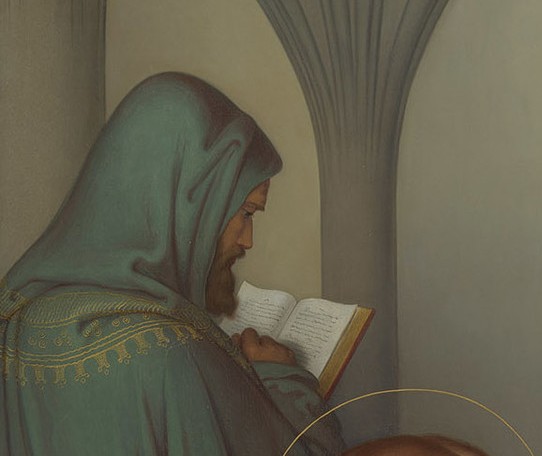
But what of the man in the background? He is also Jewish – his head is covered – and although he is not, seemingly, an ‘elder’, as his beard is relatively short and dark, he is clearly a mature man who is focussed on scripture. His right hand is raised ready to point to an unclear word, or to keep his place in case he is distracted. Has he turned away, or has he not yet become interested in the prodigy? It would be impossible to say, without the artist’s explicit statement, and I’m not sure to what extent Ellenrieder explained her own work. He is clearly significant, though, and is neatly framed by the architectonic elements – which give him prominence, whilst also asking their own questions.
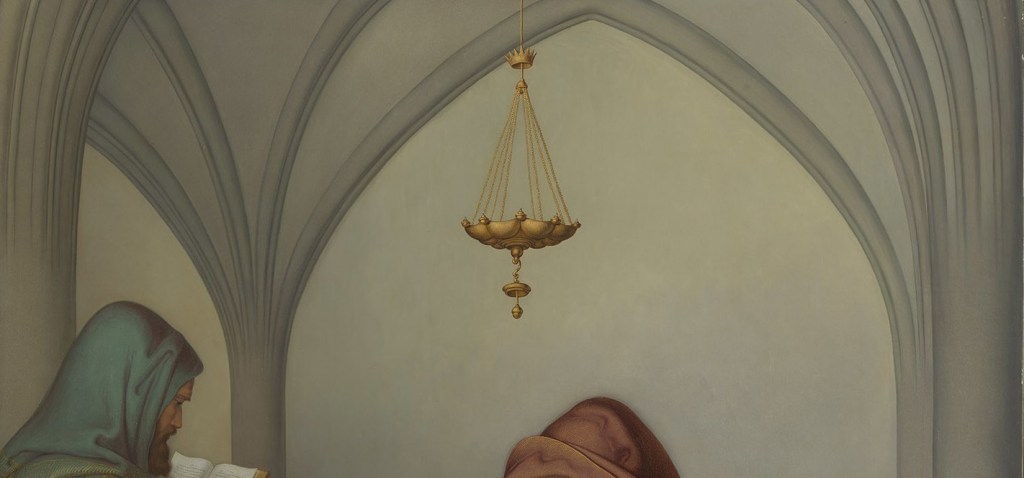
Where, exactly, are we? The biblical text suggests we are in the ‘temple’ – but this looks for all the world like a gothic church with pointed arches and ribbed vaulting. It is, admittedly, an unusual form of architecture, as the columns have no capitals, but that’s not unknown, and anyway, maybe Ellenrieder was using her imagination, and seeking something simple. We are looking from the right of centre of one particular arch – columns frame the painting at the left and right. A lantern hangs in between them, to the left of the point of a blind arch on the back wall. The lantern – exquisitely formed – is presumably hanging from the centre of the vaulting in this particular bay. However, medieval paintings – notably medieval Flemish paintings – tended to show the temple with romanesque architecture, acknowledging some form of time frame: Romanesque was ‘old’ (so implied the Old Order), Gothic was ‘new’ (and was used for the New). So why did Ellenrieder choose Gothic? Is it simply, as in other choices here, that she wasn’t too bothered about medieval tradition? This would go against the Nazarene’s ideas: they were interested in the supposed purity and faith of medieval artists, as we shall see on Monday. Maybe she had something else in mind – and of course, I suspect that she did. I’ve talked about this painting more than once in a number of series about women artists, and it’s always reminded me of something, but until recently I couldn’t remember what that was. The cool grey stone and the lighter grey walls are reminiscent of the architecture of Brunelleschi in Florence, but translated into Gothic (curiously, Brunelleschi’s ‘Renaissance’ was doing was neo-Romanesque, rather than neo-Roman, but let’s not go into that right now). But I have seen this architecture somewhere before.
I first came across Marie Ellenrieder in Konstanz, in South-West Germany, which, for four years, was the location of my ‘country house’. She was born there in 1791. At the age of 22 she started her studies at the Academy of Fine Arts in Munich – and was, as it happens, the first woman to be admitted to any German academy. Nine years later she went to Rome, a study trip which lasted more or less two years, until 1824. It was there that she met the Nazarenes, becoming especially influenced by the founder of the group, Johann Friedrich Overbeck. After other travels she returned to Konstanz in the 1840s, where she continued to paint, and teach, until her death in 1863. This particular painting dates to 1849, and so must have been painted in Konstanz. It was bought that year by Prince Albert, and Queen Victoria bought another of her paintings at the same time: both can be seen in Osborne House, the royal residence on the Isle of Wight. Albert’s interest was not explicitly because she was German – he had come across her on one of his visits to Rome – but he presumably got to know her work through the German artists there in whom he was interested and who were, after all, his contemporaries. If it was painted in Konstanz, I’m not sure how it got to Rome – but that is by the by… Konstanz is the clue.
Medieval Konstanz was a very important diocese, and the only place in Germany which has ever hosted a Papal Conclave – back in 1417. The diocese included most of present-day Switzerland – stretching as far as St Gottard in the South, but also going as far North in Germany as Stuttgart. It also stretched from Bern in the West to Ulm in the East… Its Cathedral – now a Minster – was (and remains) magnificent, even though Konstanz ceased to be a Bishopric in 1821. Somewhere along the line the cloister lost two of its wings. The remaining two flank the church and chapter house in an L-shape, and frame one corner of the town’s main square. Here is a photo of the interior, together with a slightly truncated version of Ellenrieder’s Christ in the Temple:


Notice the gothic arches, and the bench running along the back, at the base of a blind arcade. Notice also the way in which the ribs of the vault overlap, the spaces they create, and their cool, grey colouring. But more than anything else, look at the columns: it’s clear to me that there are no capitals. This is a section of the cloister which is deeper than others, hence the free-standing column on the right of the photo – elsewhere it is only one bay deep – not unlike the painting. I can’t help thinking that Jesus and the Doctor are in this cloister, seated in one of the arches that lead into the open space in the middle, and imagined as seated on a similar bench to the one which runs along the back wall. This is Ellenrieder’s ‘mother church’, still a cathedral while she was growing up. What better place to imagine as the Temple than the oldest and most majestic building in the city of her birth? Admittedly she has slightly changed the profile of the arch, and includes a different transition from column to ribs – but I think these are small details. Her imagination has taken her to Jesus’s arrival in the Temple, having left his earthly step-father to ‘be about [his] Father’s business’. This could be the first interaction with one of the people there. The old man might then alert the younger man, and they could then summon others, who will be ‘astonished at his understanding and answers’. Eventually, when Mary and Joseph arrive, they will find Jesus ‘sitting in the midst of the doctors’. At least, that’s what I think is happening.
 dr richard stemp