
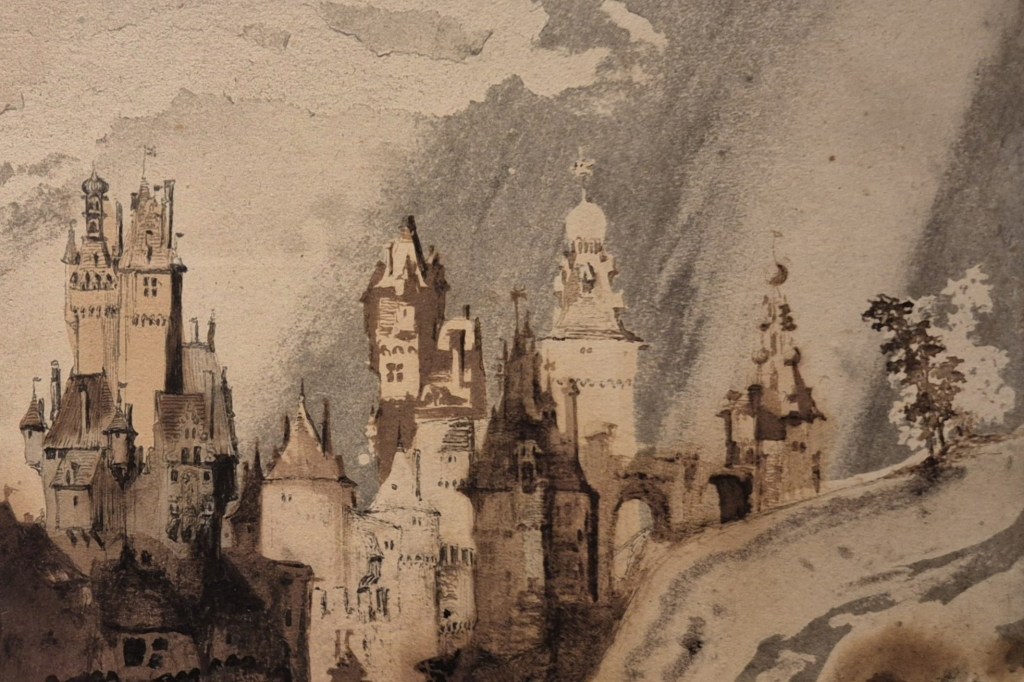
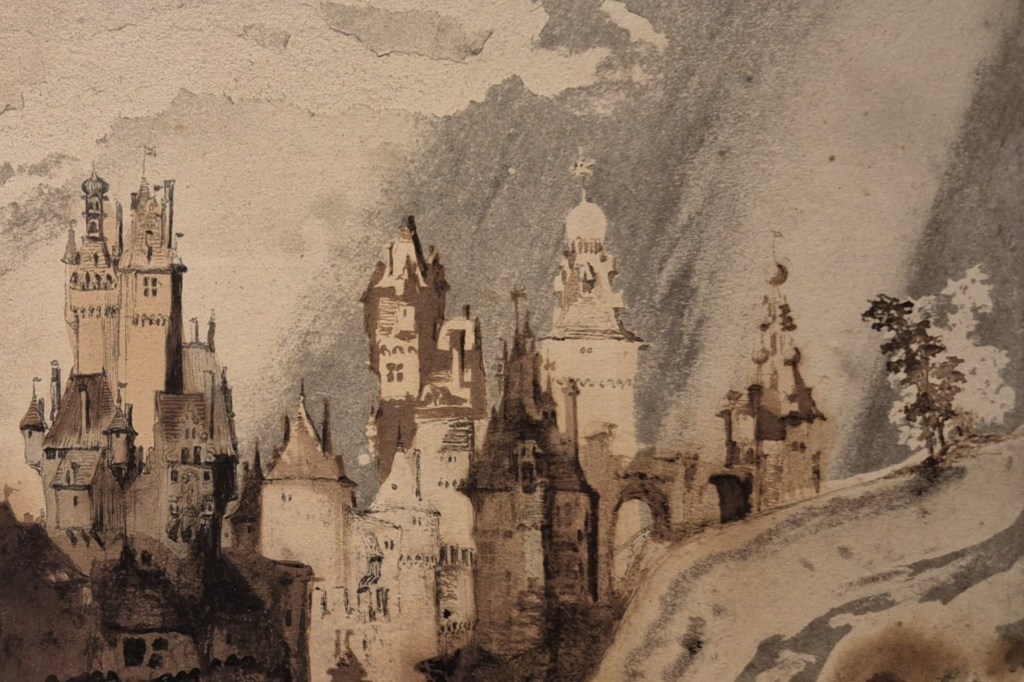
Victor Hugo, The Cheerful Castle, c. 1847. Maisons de Victor Hugo Paris/Guernsey.
This week – Monday 2 June at 6pm, to be precise – I am looking forward to talking about the truly astonishing drawings by Victor Hugo in the Royal Academy’s aptly named exhibition Astonishing Things. If I’m honest, I went to see it because I had to (well, I had been asked to take a private group round), but came out wishing I’d got there earlier. I also realised that I should encourage you all to go as well: it’s fantastic! Some of the exhibits are simply good observational drawings – and well worth seeing as a result. Others are so totally original that they look 60 or even 100 years ahead of their time. The techniques employed are both fascinating and original, and while the complex mind of the master novelist can be traced in the story-like elements of some, others are so remarkable and so baffling that even the curators of the exhibition can’t fully explain them – so do please join me if you can, and we can marvel together! Today, as an introduction, I’m going to concentrate on three of the simpler examples.
A prior booking has stopped me talking the following Monday, but then, on 16 June, I will introduce the Artemisia Gentileschi exhibition which is at the Jacquemart-André in Paris until 3 August. The day after that, 17 June at 1pm, I am giving a FREE lunchtime talk at the newly refurbished lecture theatre in the newly refurbished Sainsbury Wing of the National Gallery: Seeing the Light: the Art of Looking in and around Duccio’s ‘Maestà’ – please do come if you can! Then, on 23 June, we will be Revisiting Cimabue, looking back to an exhibition which was at the Louvre, but sadly has already closed.
After over four years of giving these Zoom talks the time has finally come for me to put up my prices: from now on each talk will be £12 (bearing in mind that some organisations were charging more even back in 2020!). However, I’m holding them at £10 each if you book for all three of my Three Sainsbury Stories together – which you can do on that link. Alternately, you can book them individually. More information is on the following links: Opening up the North (30 June), At home in the Church (7 July) and Across Italy… (14 July). Enough plans for now – but keep an eye on the diary in case there are any more!
I would always encourage you, when in a museum, art gallery or exhibition, to look at the art rather than read the label. We seem to be a profoundly verbal culture, and people always spend more time reading the labels than looking at the art: they could have stayed home and read a book! But in this case, although I was instantly attracted to this drawing by its delicacy and refinement, the atmosphere it captures, and the bravura technique, it was the title that really grabbed my attention: The Cheerful Castle. What a delightful idea! Who imagined that a Castle could be Cheerful? Well, a fantastic storyteller, for one. But how would you go about showing that ‘cheer’ in a drawing?

The eponymous edifice is situated upon an uneven, rocky ridge, which slopes slowly down from right to left, before plummeting into a ravine. The background is light and airy, but undefined. White clouds, totally unthreatening, are hovering in the sky. Behind them blocky forms and vague diagonals suggest that maybe we are only someway up a mountain range: there may still be peaks high above our point of view. The castle itself has many turrets and towers, with a wide assortment of differently shaped rooves, finials and oriels, battlements and crenelations. There is no sense that we are looking at a real building, something that Victor Hugo saw in real life: this is an invention, an elaborate dream summoned from his imagination.

If we were to approach the castle from the bottom of the hill on the left, we would first have to cross a bridge which passes over a valley – or maybe moat. A guard house rises to the right of it, with a pitched roof and two chimneys. It could be a barbican: to the right there is a sloping line of crenelations leading to the main body of the building. The drawing here is at its darkest, a sense of threat and foreboding, perhaps, which might help to keep intruders at bay. The forms are smudged in part – Hugo liked to experiment with technique, and here he has wet the drawing to create an atmospheric mist around the edges of the darkest walls. Just visible is a flight of steps coming down towards us on this side of the building, to the left of a large, light, open niche, which is defined by dark shadows, suggesting that it is very deep. Above it the ink is at its blackest, marking ivy, or other vegetation, which is growing over these rocks, or lower walls. In contrast to all this darkness, the castle rises, as in a fantasy, all lightness and specific detail above the dark imprecision of its foundations. This lightness – and the detail – are the first things which convey cheerfulness.

Most of the structure is light, and delicately drawn. With the exception of a massive square tower built on a steep slope, sunlight seems to capture every varied surface. The darker forms serve as a foil, a dark repoussoir encouraging our eyes to look towards the light, and so further into the space of the drawing. Another bridge leads over two arches to a more elaborate guard house on the far right, a pale tower with a tall, spire-like roof, topped with an onion dome and a weathervane. Windows project from the spire, the gradually shifting slope of its sides mapped out by the most delicately delineated rows of tiles. Elsewhere the tiny touches of the pen pick out lines of bricks, small apertures, more crenelations, machicolations, cantilevered projections and a wide variety of flat and curved walls; rough and smooth surfaces; conical or flat, sloping rooves; belfries, flags and chimneys. What we see is plentiful and varied, light and delightful against the barely darker background – a miraculous, fairy-tale vision. This visual playfulness and jokey profusion is surely the essence of Cheerful. The role this delicacy plays becomes clearer if we compare our first castle to a second, from another drawing.

Compared to the wealth of detail and the precision with which The Cheerful Castle is articulated, this second fortress is far more moody, a looming presence emerging from the clouds, big, bold and blocky, more ruinous, crumbling even, and scarcely habitable. It has a far more aged air, and the weather is foreboding. Diagonal lines going from top right to bottom left suggest that rain could be lashing down, although the strong contrast of light and shade on the walls implies that the sun is breaking through gaps in the turbulent clouds. Like a flash of lightening, this creates a sense of revelation, as if we can finally see the true state of affairs: this is what the castle has come to. However, we should remember that in each case we are only looking at part of the image. Here is a second detail of the drawing from which this gloomy fortress is taken.

You can just see the castle looming on the left – but bottom right the atmosphere is altogether different. In both drawings Hugo has used black and brown ink and wash – which means that he has covered some the paper with a thin layer of colour (i.e. ink) using a brush, but without leaving any brushstrokes. In this second drawing there are also watercolours, which pick out the delicate leaves and petals of plants and flowers. They wind their way around a block of stone on which is carved an angel in high relief. Its wings are wrapped around its feet and shoulders, but folded high above its head. It looks down, arms crossed and resting on… a cross? Or the hilt of a sword? It could be either… or both. Is this a fragment of decoration from the ruined castle, or something else? Seeing the drawing as a whole might help.

The plant – a sort of imaginary vine or ivy with unexpected flowers – borders the drawing at the bottom and on the right, and thus frames the vision of the distant castle. The angel, in sharper focus – perhaps because it is closer, and not wrapped around with clouds – does not share the colours of the plants. It uses the same palette as the castle, implying that it belongs to the same world: a fragment then – of the castle’s story, if not of its structure. This is The Castle with the Angel of about 1863, and although I described the first drawing as showing a fairy-tale castle, this drawing is itself more like a fairy tale, I think. The colourful flowers around a desolate castle are reminiscent – to my mind at least – of the impenetrable screen of roses which grew around Sleeping Beauty. The angel is melancholy: could this be a memorial sculpture? Or does it give us a clue about what has happened to the castle? Could it even be some kind of guardian spirit who has been turned into stone? However verbose he might have been, Victor Hugo didn’t always explain what he was about, and some of the drawings remain especially obscure. Nevertheless, the author of Les Misérables and Notre Dame de Paris (which Anglophones know better as The Hunchback of Notre Dame – a title the author detested) clearly knew how to tell a story, and he could do it with images as well as words.
If I wanted to be especially fanciful, I could see these two drawings as being part of the same fable. The Cheerful Castle could be a nostalgic look back to the good old days, with The Castle with the Angel showing the lamentable state we are in now, waiting for the heroine or hero to rescue us. Or it could be the other way round: once the foe has been vanquished, and the gloom banished, The Cheerful Castle could be the Happy Ever After. However, given that the two drawings were created about 16 years apart, I think it is safe to say that neither was Hugo’s intention. I do want to compare The Cheerful Castle to a third drawing, though.

It has a completely different feel to it, I think. Even in this detail you get a sense that you know where you are: on a broad river, or lake, in a deep valley cut through the hills. It doesn’t show a ‘castle’ as such, although there is a ruined tower on an island, its form, features and the fall of light perfectly reflected in the mirror-like surface of the water. Another structure – which could be the ruins of a castle – stands on the slope rising up to the right. The two buildings are defined differently. The tower has sharp edges, clearly defined detail, and shading mapping out the three-dimensional structure. The castle, on the other hand, is only defined as an area of dark grey, its form defined by ‘colour’ rather than line. It is further away, and in the shadows – effectively just a silhouette. The light, coming from the top right, and some way behind us, brilliantly illuminates the escarpment on the other side of the water. Between the tower and the right bank, a sailboat sits becalmed, its sail slack, curving down towards the deck. Dark streaks come down from the top of the detail.

In context we can see that these streaks are a sign that the weather is taking a turn for the worse – they are dark clouds and distant downpours. It is an extensive landscape, much of which is actually water. The top of the brightly-lit escarpment is especially dark and cloudy. This is another example of Hugo’s technical brilliance. Having wet the paper, the ink spreads freely, and yet he only allows that to happen at the top of the distant slopes – not too much is left to chance. A different technique creates the streaking clouds: he has dragged dark ink down the page with a piece of fabric, creating this remarkable, atmospheric effect. The drawing, dating to 1847, is called La Tour des Rats. It’s a real place, and one which Hugo had seen: a tower on the Rhine which inspired poems by Robert Southey and, as ‘The Mouse Tower’, Henry Wadsworth Longfellow. It is a place of myth and fable, involving a bishop being eaten by rats (or mice) which have swum over the river to get him. And yet, of the three drawings, it has a greater sense of ‘fact’ about it – quite simply because Hugo had actually been there. It is a highly romanticised view, admittedly, but it is real.
The three drawings could be seen as representatives of three different modes of drawing – or three different moods. The Cheerful Castle shows many of the features of ‘The Picturesque’. According to 18th Century theory, this term was used to describe landscapes which appear naturalistic, and include irregular forms, variety in texture and detail, and which often featured ruins – they delight the eye, and are pleasurable in their diversity. ‘The Picturesque’ was differentiated from ‘The Sublime,’ which shows grandeur and provokes awe, reminding us how small we are compared to the enormity of the natural world: there is often a real sense of danger. In some ways, La Tour des Rats is closer to the Sublime, given the size and scale of the valley, the dark threatening quality of the weather and the ominous presence of the ruins. For the 18th Century, ‘The Beautiful’ would be a third category – with calmer, smoother, rounded surfaces, relaxing and welcoming. None of these three drawings really match that, though. However, I would suggest that The Castle with the Angel is ‘fabulous’ – in its original sense, that is, meaning that it is related to fables. The curling, coloured foliage and flowers are more alive than the monochrome castle and angel – as if the stones are asleep in the past. It is a highly ‘illustrative’ drawing – although it is left up to us to decide which narrative is being illustrated. This freedom of interpretation just makes the imagery richer, though.
All three drawings show castles, of a sort, and yet all three are different. ‘What’s in a name?’, as Juliet asks. ‘That which we call a rose by any other name would smell as sweet’. And while this may be true, after centuries of horticulture, roses may small as sweet, but they don’t all smell the same. It seems that something similar is true for castles. It will be interesting to see how many other genres of drawing – and castles – Victor Hugo’s work can encompass when we discover it on Monday.
 dr richard stemp
I would like to receive the newsletters. Please subscribe judyanderson491@gmail.com. Many thanks!
LikeLike
Hi Judy,
You can do this yourself by typing your email address into the box on the home page of this site:
Thanks,
Richard
LikeLike