
Johannes Vermeer, Woman Writing a Letter, with her Maid, c. 1670. National Gallery of Ireland, Dublin.
Today’s painting was my real ‘discovery’ of the Rijksmuseum’s Vermeer, a painting I hardly knew, and might not even have seen before. I think I had been to the National Gallery of Ireland twice, very briefly, before my recent visit, and most of my time was taken up with Caravaggio. Of course when I was there a couple of weeks ago this painting wasn’t – but it will return soon. Vermeer ends this Sunday, and I will celebrate its enormous success the following day, 5 June at 6.00pm, by talking about The ‘Other’ Vermeers, the nine paintings which were not included in the exhibition. I will put them in the context of all the others – so you will see the entire known oeuvre, even if the 28 I discussed before (because they were in the exhibition) will flash past fairly quickly! In case I’ve never mentioned it before, the best resource for anything related to ‘the Sphinx of Delft’ is Essential Vermeer – a website that literally (and pictorially) covers everything: it is an extraordinary act of dedication. After Vermeer I’m having a week off, then on 19 July I will talk about the National Gallery’s rich and rewarding Saint Francis of Assisi, before figuratively heading off to the Holburne Museum in Bath on 26 July to talk about the recently-opened exhibition, Painted Love: Renaissance Marriage Portraits. And for those of you who really like to plan, in July I have carelessly booked my Monday afternoons without time for a breather before 6pm, so will give a series of three talks on Tuesday evenings… There is more information about them, and about a short course for the Wallace Collection, and visits to Glasgow and Hamburg with Art History Abroad, in the diary.
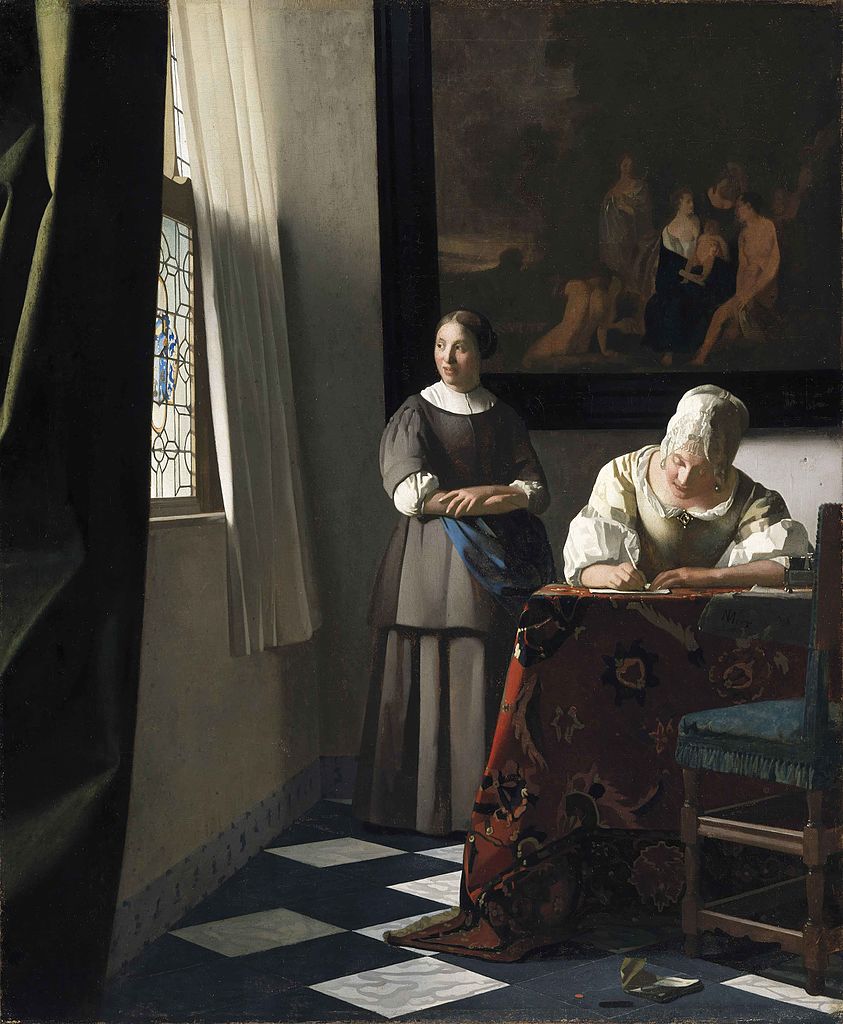
So why was this painting such a ‘discovery’? At first glance it is a ‘typical’ Vermeer, set in the usual corner of the usual room, with a standard selection of his repertoire of decorative elements: a large painting hanging on the back wall; shut windows with a geometric pattern of leading; white and black marble floor tiles on a diagonal; a chair with its back to us; a table covered in a rug; a lady writing a letter; a maid looking out of the window. Nothing remarkable there. But as ever with Vermeer the normal, everyday scene has been stripped down to its essentials, no surplus details, nothing that allows it to sit in the mundane, and yet it manages to remain ‘everyday’. As ever, it is quiet, calm and still. And yet, underneath the surface… well, we’ll get to that.

Vermeer has the remarkable ability to make even the banal appear sublimely beautiful. There is a long, green curtain in the foreground. It’s not clear what the function of this curtain is, but it goes from top to bottom of the painting, and implies, apart from anything else, that this is a room with a very high ceiling – we can’t see the top of the curtain. It may serve to partition off the back of the room, but it has been drawn aside to allow us to see the maid and her mistress. There must be another window closer to us, as the green curtain is lit from the front left, the highlights defining the folds in the fabric, one of which has a noticeable kink, making it look just that little bit more real. Of course, judging by at least one other Vermeer, and a number of paintings by his contemporaries, this might represent a curtain in front of the painting itself – a trompe l’oeil trick to impress us with Vermeer’s mimetic skills. Not that we need that. The white curtain (which is definitely in the room) is enough to assure us of his technical ability. It hangs from its unseen rail just off the vertical, falling over the lower part of the casement window which pushes it in a little. Outside the window a lower shutter is closed, and so no light enters. At the top the curtain is luminous as a result of the transmitted light, some of which seeps through at the level of the horizontal of the casement, but it is dark below: a beautiful contrast. However, the edge of the curtain folds back from the window, and reflects the light entering the left-hand pane – so he shows us the effects of transmitted and reflected light on one piece of fabric. Light reflecting back from the white walls also picks up the crests of the vertical, shadowed folds, making them stand out from the rest of the drape. In the central section of window’s pattern of straight and curved leads – a variant of a type that occurs in several of the paintings I will show you on Monday – there is a stained-glass coat of arms: we are in a noble household. We might have known that, though, from the height of the ceiling.

If Vermeer paints square floor tiles they are always on a diagonal – De Hooch often painted them parallel to the walls. Like the high ceiling and the coat of arms, the black and white ‘marble’ also implies wealth and sophistication. A row of blue and white Delft tiles makes up the wainscotting, but the imagery is not really legible. Unlike other paintings, the tiles do not appear to convey any of the meaning, but sweep our eye into the depth of the room. The chair, angled away from us, and parallel to the diagonal tiles, also directs our attention inwards, although the objects lying on the floor beside it might hold our attention for a while.

There must be a reason for these things to be there, because, unlike some of his contemporaries, Vermeer seems to have striven to eliminate the anecdotal and unnecessary. The small red disk is a wax seal from a letter, which seems to have been opened, read, and discarded. To the right of it, and a little closer to us, is a dark stick of something, presumably sealing wax, which will have to be retrieved when the lady has finished writing. And then, of course, there is the discarded letter itself. Or maybe it’s just the crumpled ‘wrapper’ – the equivalent of an envelope – and more paper. There is actually a considerable amount of paper, which could either be a very long letter, or a rather short book: both have been suggested. If it is a book, it could be one of the several guides to letter writing that circulated in Dutch Republic in the 17th Century, some of which included templates for set letters, ‘insert name as appropriate’.

Our attention is focussed on the lady writing the letter. With the right, lower shutter closed, the back wall is in shadow. Her white puffed sleeves and headdress catch the brilliant light from the un-shuttered window, and she shines out against the dark wall and the lower part of the picture frame. However, the light does reach the back wall to our right, and the shadow on that side of her headdress and her left shoulder makes her form stand out boldly there too. The quill pen in her right hand also catches the light, while her foreshortened right arm and the left arm parallel to the picture plane both lead our eyes towards the letter. She looks down at it with intense focus, her face framed by two pearl earrings. There is another jewel, glinting on her bodice, and her chemise is elegantly tucked behind it. The bodice itself is a delicate light jade in colour, while the headdress, apparently simple, has elements of lace or an embroidered decoration. This makes it clear that she is the lady of the house, as it contrasts with the darker, more homely garb of the maid, which is more simply cut and has no jewellery or decoration. The maid looks to our left, while her blue apron is swept to the right, drawing our attention back to the table just where the white pattern in the cloth catches the sunlight. The maid’s shoulders are framed by the broad, dark picture frame, and her head sits comfortably in front of the bottom left corner of the painting: the maid and the painting are connected in some way, if only visually. Vermeer was always obsessively concerned with the precise positioning of every element of his compositions, so that we can see everything we need to clearly, and with the right emphasis. Conversely, if it’s better that we don’t see something, or if it will add to the mystery, he will hide it.
How would you interpret the maid’s mood? I am constantly astonished by the variety of readings any one image can get. I have read – somewhere, I can’t remember where – that the maid is smiling. I cannot see that. Her arms are crossed – either with patience, or the opposite, almost clinging on because of the tension. She looks through the window towards the outside world, the source of the discarded letter, and the destination of the reply which she will have to deliver. Even an unchaperoned lady could receive letters, which is precisely what made them so dangerous, and the maid is there to do her mistress’s bidding – even if it goes against the strictly appropriate. Meanwhile, the lady continues to write with quiet determination. I cannot see it any other way.

I mentioned the Delft tiles leading our eye into the depths of the room: the sunlit top of the windowsill, the dark bars of the window frame and the leading do the same. One of the most commonly asked questions about Vermeer’s technique concerns the camera obscura. Forget it, he might have borrowed some visual effects from it, but his paintings were constructed using a pragmatic, practical perspective. For about half of his paintings its clear that he stuck a pin into the vanishing point, and then stretched a string covered in chalk or charcoal across the painting. He then ‘plucked’ it, like a guitar string, snapping it back against the canvas to draw a line – although no trace of this last step remains. We can tell from the windows and the tiles where the vanishing point is, though, even without the ‘snapped’ lines, and the occasional pinprick in the canvas. It sits next to the lady’s left eye, close to the brilliantly-lit bridge of her nose. The vanishing point is theoretically what we are looking at, and so our attention is drawn towards the lady and the fact that she is looking at something, towards her focus on the letter she is writing. Just above is the painting, hanging on the back wall. Although it is not especially clear, it is possible to make out two figures who appear to be naked. One, on the left, sits near to the maid, her legs not visible. Another sits, higher up, above the lady’s head, one of her feet drawn up. She is looking at a lady holding a baby. We can’t see the woman on the left’s legs because she is sitting on the bank of a river, and her feet are in the water. The other naked woman has lifted one of her feet to dry it, as she, too, has been in the river. They were rescuing the baby, who was caught in the reeds in a Moses basket. The basket gets its name from the baby, though, rather than the other way round: this is a painting of The Finding of Moses.
Unlike some other paintings in the background of Vermeer’s works we do not know who painted this one, although it could be part of the collection which his mother-in-law, Maria Thins, had inherited. It has been suggested that the artist might have been by Peter Lely, known as a portraitist for both Charles I and II of England and Scotland, but who was Dutch in origin. He trained in Haarlem, before coming to London in the 1640s. Here is a detail from the Vermeer, and another from a Finding of Moses by Lely which was sold by Christie’s in 2006: you can decide for yourselves if the style, if not the exact composition, is similar, and, therefore, if Lely might have painted Vermeer’s lost original.
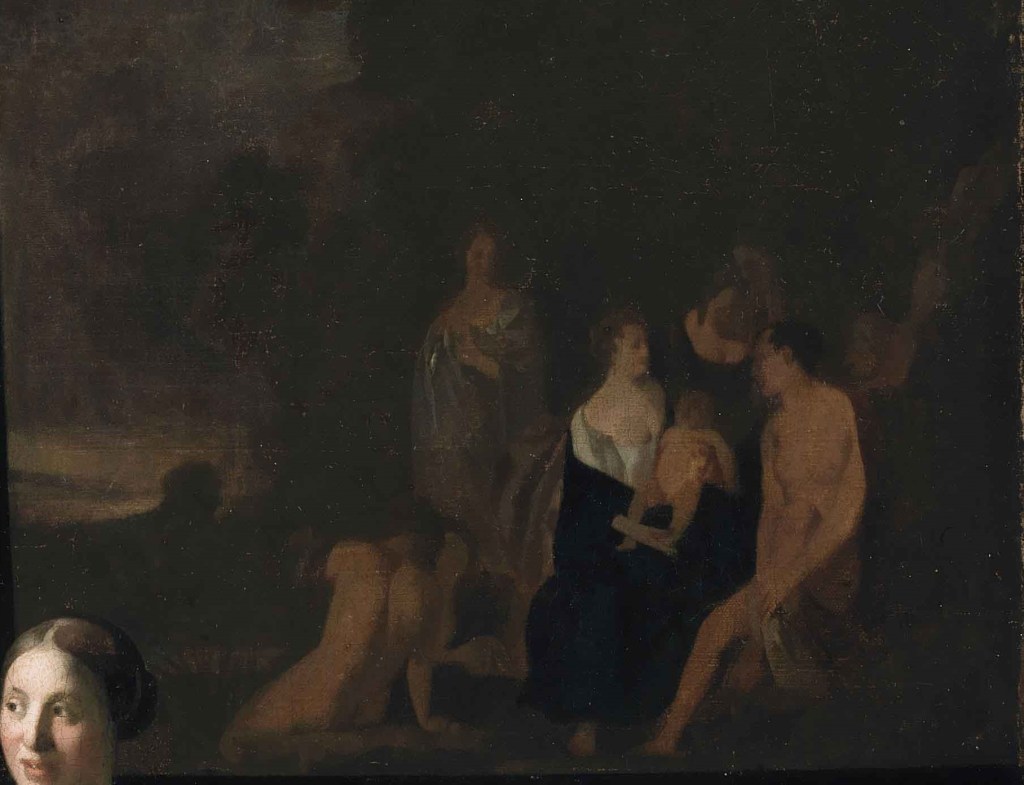
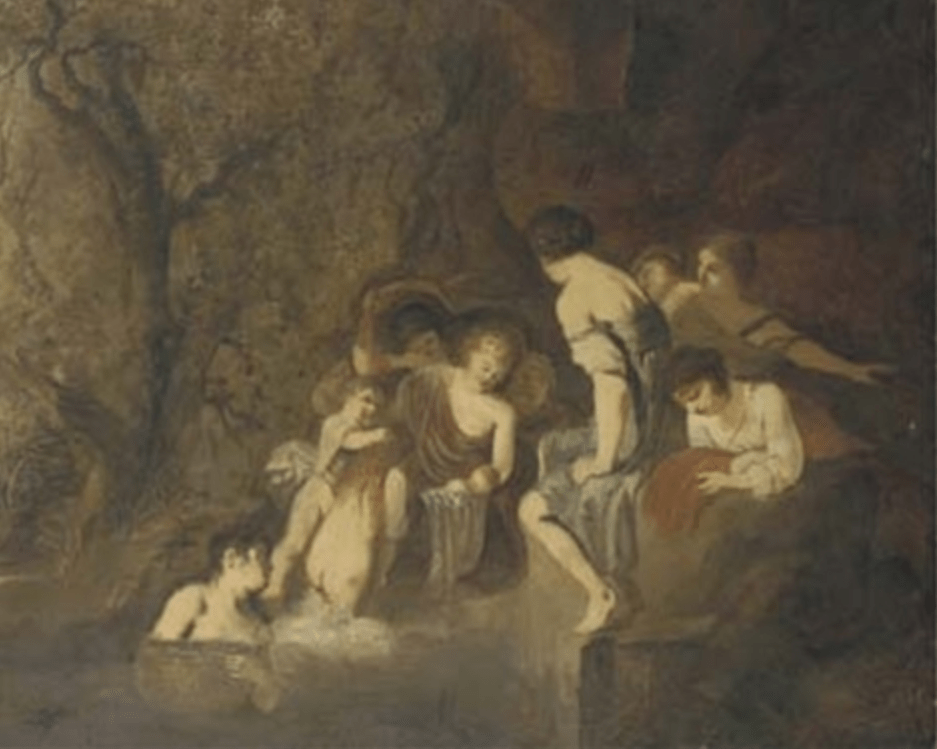
The same image also occurs – although on a far smaller scale – in the background of The Astronomer in the Louvre (which we will look at on Monday). The scale is not important, though, apart from reminding us that Vermeer was not painting exactly what he saw. He was making it up, based on things he could see, or had seen, changing the scale to suit the situation, and changing the floor, the windows, the shutters, the curtains, like a designer dressing the stage for a drama as it unfolds before our eyes.
The Finding of Moses probably has a different implication in each of Vermeer’s paintings. Moses was popular with the Dutch in the 17th century, as they associated themselves with the Israelites in Egypt. In the same way that Moses led them out of captivity and on towards the Promised Land, the Dutch had thrown off the shackles of oppressive rulers – in their case, the Spanish – with the added advantage that, according to them, they were already in the Promised Land: the Dutch Republic. However, here I think the aspect of story in question is very different. Moses was, in some ways, a miraculous baby, found floating among the bullrushes – an unexpected baby, if you like, adopted by the daughter of the Pharoah. How could that possibly be relevant to Vermeer’s painting though? Let’s have another look at it, but with an added line. It becomes blatantly clear that the ‘unexpected baby’ is directly above the head of the lady writing the letter, and the line, drawn from the baby and through the vanishing point of the perspective – the theoretical focus of our attention – continues down through the lady’s hand and the chair leg to the discarded letter, and what is, potentially, a letter-writing manual.

What is the connection between the unexpected baby, the woman, and the letter on the floor? And what situation might a standard template for a love letter not suit? Or maybe I am directing your attention too specifically, and we should consider a different aspect of the Moses story? Should we be thinking about his discovery as a precursor of the miraculous birth of Jesus? That’s up to you: you’ve got all of the elements now, you can write your own story. That’s precisely what Vermeer does. He shows you everything you need, but doesn’t tell you what to think. That is why his paintings are so vital: they are profoundly beautiful, and intriguingly enigmatic. As far as I am concerned, though, the calm, ordered surface of this painting is revealed as a fiction – there is a repressed storm of emotion which is only just being held in check – and that was what I had not expected to see, my ‘discovery’, if you like. I suspect that the maid is even more aware of it than her mistress. But look at them again, and decide for yourselves.

 dr richard stemp
Fascinating.
Will I ever be able to view it any other way now!
LikeLike
Ah…. well, keep trying! Who knows what I might have missed, or what assumptions I might have made?!
LikeLiked by 1 person
Always interesting , thank you Richard
LikeLike
Thank you, Johanna – I hope all is well with you!
LikeLike
With reference to the maid, I find her fascinating. I don’t see her smiling either, but I do see some complex emotions playing in her. I see her in her safe space, looking out at the world with some trepidation, but also anticipation. I see excitement under the surface. I think that maid has lived a pretty dull life up to now and things are about to get “interesting”. She’s a little worried and scared, but there’s part of her that’s up for it. Her mistress is completely absorbed in writing the letter about what is about to bubble up to the surface, probably involving a baby or pregnancy as you mentioned. The maid, that glorious creature, is thinking “Oh boy, here we go” and part of her is going to enjoy it.
I’ve liked Vermeer for a few decades, and noodled around Delft a bit back in the day. But I’ve never been to the Dublin Gallery and this painting wasn’t really on my radar. I love it. Thank you for introducing me to it.
Thank you too, for helping keep me sane while I was isolated here in the White Mountains of NH during covid. Beautiful place, but I couldn’t visit the National Gallery in London or anywhere else for that matter. I remained on my own on a ridge deep in the woods. I did online courses offered by NG some of which you taught, and I swear it kept me from going completely feral up here. I was here in the US, my husband trapped in Canada, and the best we could do for most of the first year was drive to the border and wave at each other. (We got within a few feet of each other one time and CA border police came and took him away. With lights and sirens for effect) You were instrumental in making that time bearable, and I can’t thank you enough.
Anyway I LOVE that maid.
LikeLike
Thank you Barbara – you’re so right: the maid is endlessly fascinating! And I am so glad to hear that the National Gallery, and the blogs, helped you through that difficult time – thank you so much for taking the time to let me know, it means a lot. They certainly kept me going! All best wishes for the future.
LikeLike
You have created a veritable ‘treasure trail’ Richard. Thank you so much. One thought does occur : Moses was found by Pharaoh’s daughter ; he had no known father. Could this be a source of the emotional scene Vermeer has painted, do you think ?
LikeLike
Absolutely!
LikeLike