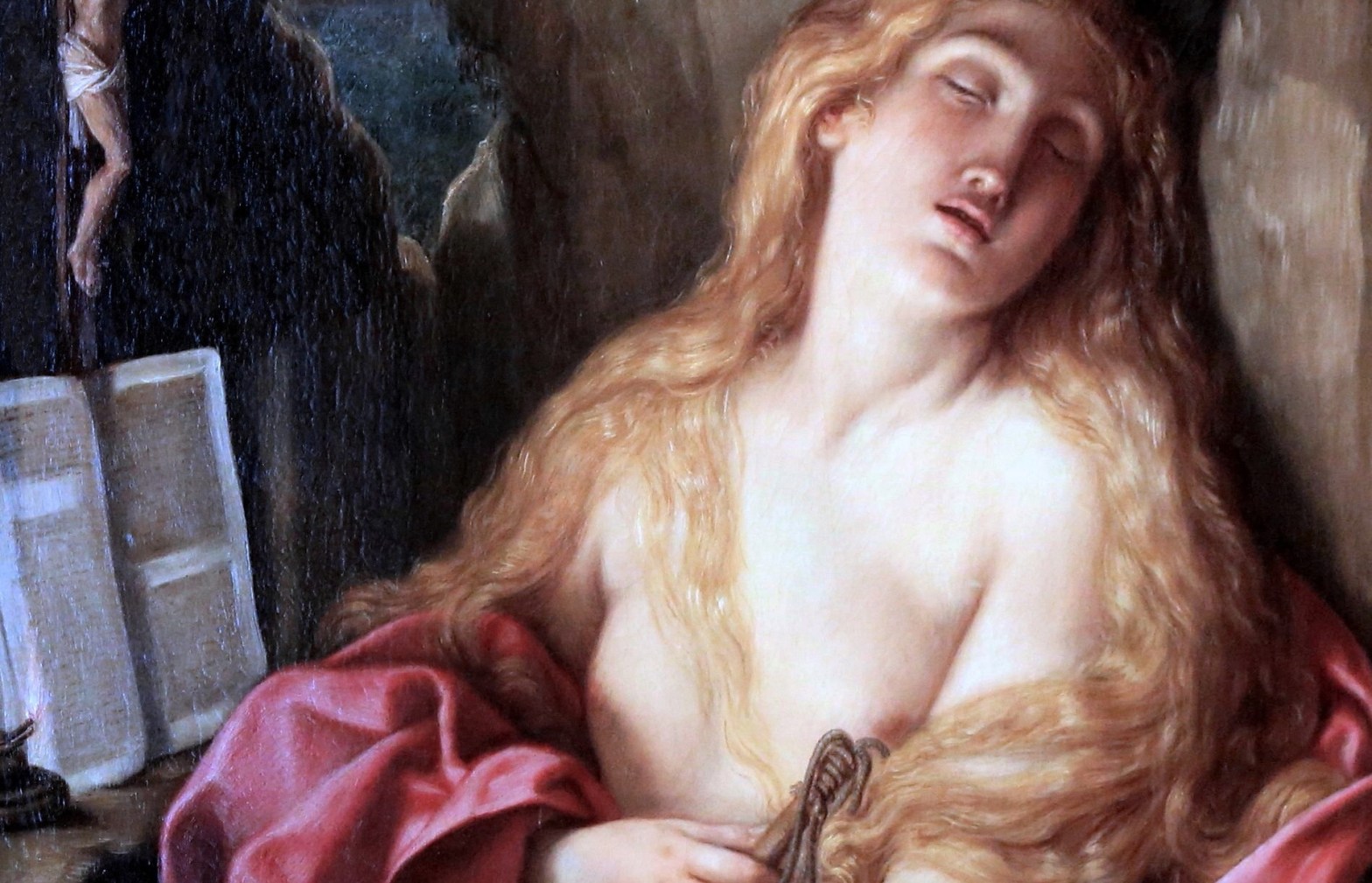
Elisabetta Sirani, The Penitent Magdalene, 1663. Musée des Beaux-Arts et d’Archéologie, Besançon.
I first got to know today’s painting when I wrote about it back in November 2020, but only saw it for the first time in the flesh (flesh being the operative word) the week before last, when I was in Hamburg. It features in the exhibition Ingenious Women, which is the subject of my talk this Monday, 6 November at 6pm. The painting is every bit as brilliant as the not-so-terribly-good reproductions had led me to believe, and confirmed the sense I had that Elisabetta Sirani really was a great artist. The exhibition as a whole is superb, and a great contribution to the field. It looks at the work of about 30 different women, some of whom are more famous than others (Sofonisba Anguissola, Rachel Ruysch and Angelica Kauffman are among the better known, Michaelina Wautier and Catharina Treu perhaps less familiar). It is hung thematically, exploring background, training, and opportunity, examining the different strategies the artists employed – consciously or otherwise – to develop their careers, and how they were enabled to a greater or lesser degree by the men in their lives who were also artists. This approach is not without its criticisms – but I’ll explain what I mean by that on Monday. The following week I’ll be back at the National Portrait Gallery, looking at The Georgians, and then will dedicated two talks to Hans Holbein. You can either book both together, at a discount, or each one individually. Part 1, Religion & Reform, will be on Monday 20 November, while Part 2, Realism & Royalty – an introduction to the Queen’s Gallery exhibition which opens soon – will follow on Monday 27. It’s all in the diary, of course. But back to the re-post of a blog which is now nearly 3 years old. I was starting from an assumption that all artists were men. Bear with me. I also hadn’t put the name of the artist at the top of the post…
Typical! You take a subject as sensitive and emotive as the penitence of Mary Magdalene, a woman struck with remorse at her sinful past, an existence spent earning money from the debauchery of the flesh, and you turn it into an excuse for men to stare at a display of the very flesh that has caused her downfall, a voluptuous, sensuous image that contradicts the very nature of the profound changes in this woman’s life, and that goes as far as to question the title of the painting itself. In short you objectify her. Typical indeed, and only to be expected from a paternalistic society in which men paint for men, for their own private pleasure. But before you get too outraged, there is just one small problem with this attitude…
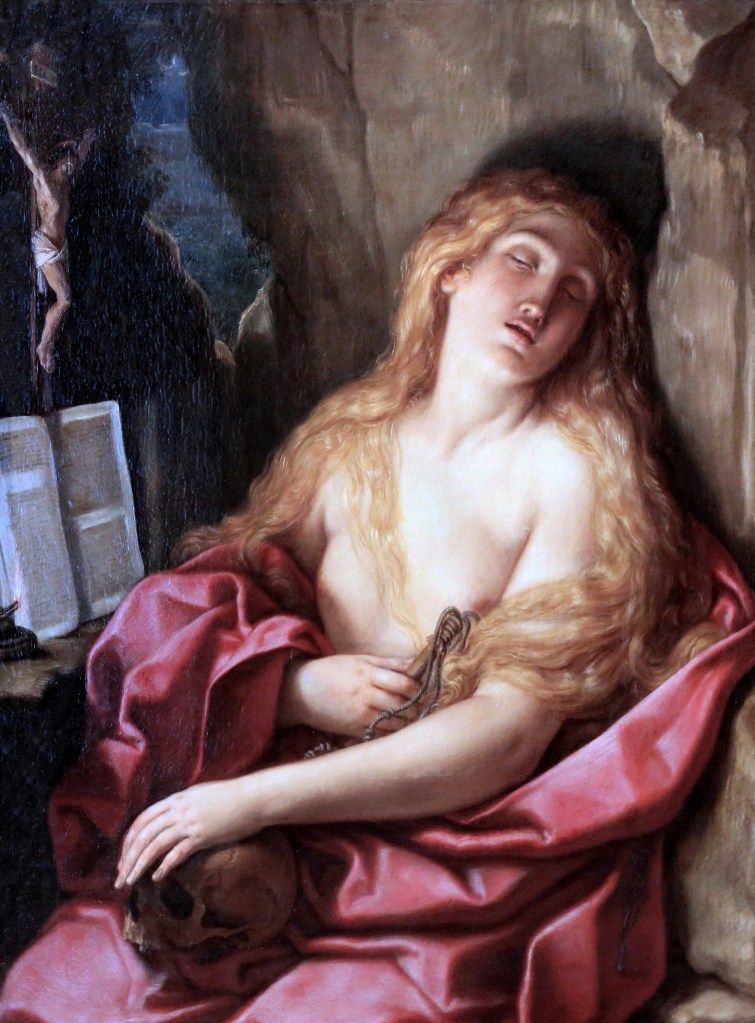
The problem is, that it was painted by a woman – Elisabetta Sirani. It questions the notion that art might be gendered – or, to put it another way, that women might paint women in a different way than men would. I’m not saying that painting isn’t gendered, by the way, but… well, it’s complicated.
Sirani was a very successful artist. I have talked about her before, back in May, with Picture Of The Day 62 – Portia, but, in case you don’t have time to read up about her there, here’s a brief reminder. She was born in 1638 in Bologna – and that was where she seems to have spent her entire life. It’s quite possible she never left the city. I say entire life, but she died, tragically young and under unexplained circumstances, at the age of 27, leaving behind over 200 paintings. Like her older contemporary, Artemisia Gentileschi, she was trained by her father, who was an artist, and like Artemisia her earliest surviving work was painted when she was 17. By 20 Elisabetta was already enormously successful, and soon after she founded an academy for women artists [n.b. in the last three years – since I first wrote this – this assumption has been questioned]. Her early death was mourned by artists and intelligentsia alike, and she was buried in great pomp in San Domenico, one of Bologna’s most important churches, alongside the city’s most famous artistic son, Guido Reni, who had trained her father.
If we can believe what we see in this painting, having repented and mended her ways, Mary Magdalene has retreated to a cave to read the bible and contemplate Christ’s sacrifice on the cross, while meditating on death, and mortifying the flesh. This should not be in doubt. The bible stands open at the left of the painting on a ledge which also supports a candle stick. We can just see the base of the candle, though not the flame itself, which illuminates the scene with a supernatural brilliance.

The precise fall of this light is beautifully traced across the painting, while a second light source, the moon, silvers the edges of the cave, and can just be glimpsed in the sky outside. Within, the candle illuminates the underside of the right arm of the delicately carved and coloured crucifix, against the base of which the bible is leaning. The wound in Christ’s chest is lit, revealing a dash of red blood, as are the side of his face around the eye socket, and his halo. The light even flicks across the edges of the titulus attached to the top of the cross, on which the letters I.N.R.I. (Iesus Nazarenus Rex Iudeorum – Jesus of Nazareth, King of the Jews) are summarily sketched. It also casts a shadow from the surprisingly low-slung loincloth, and defines the firm thigh muscles of the saviour’s tautly bent right leg. It’s not just the Magdalene who is sensuously depicted. The candle illuminates Mary’s chest and neck, models the contours of her face with delicate sensitivity, and casts a shadow onto the wall of the cave behind her. Her golden hair glows around her face, falling copiously over both shoulders.
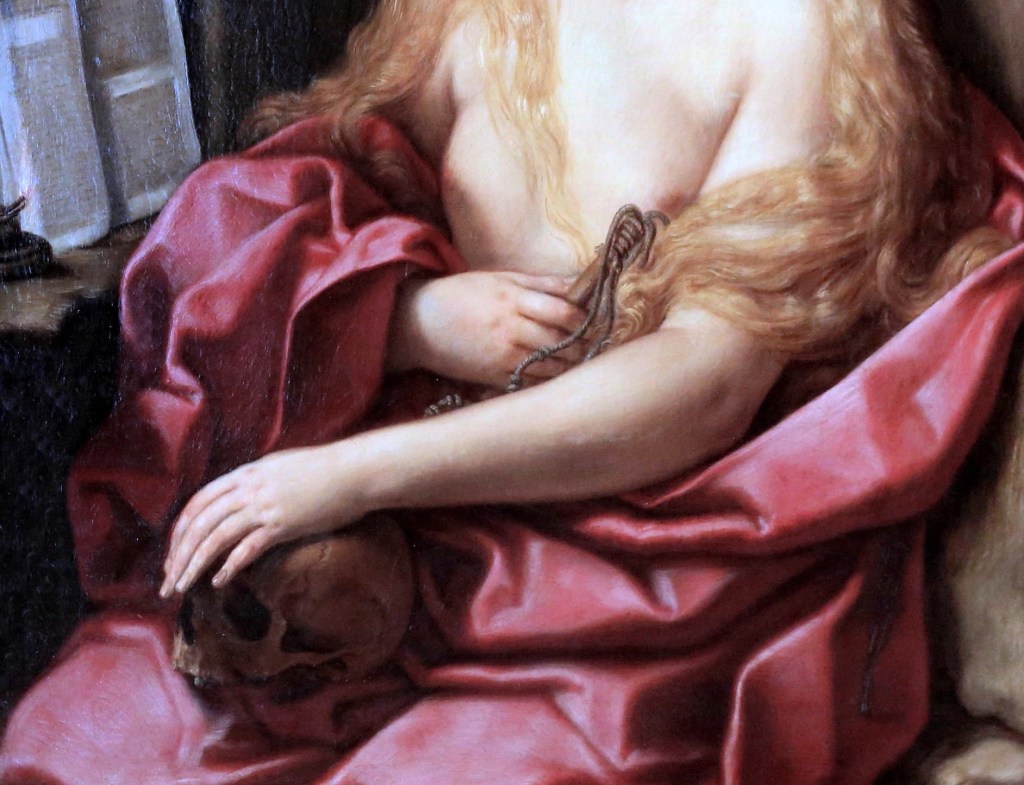
A strand of hair crosses her chest, and lies between her breasts, while another wraps around her left arm, and under the knotted cat o’ nine tails. She holds the whip in her right hand, the end of its handle resting provocatively close to her left nipple (the other nipple is caressed by a shadow from her pink robe, which frames, but doesn’t clothe, her torso). Her left hand is poised on top of a skull, the symbol of her meditations upon death and of the transience of flesh, which sits almost too comfortably in her lap.
To understand the extreme sensuality of this painting, surely it would be useful to know more about the life of Mary Magdalene? The problem is that none of it is in the bible. What we are looking at is a fiction, but one that was believed for well over a millennium. If we do go as far as to read the bible, we will find the first mention of the Magdalene in Luke’s Gospel, at the beginning of Chapter 8. Here are the first two verses:
And it came to pass afterward, that he went throughout every city and village, preaching and shewing the glad tidings of the kingdom of God: and the twelve were with him, And certain women, which had been healed of evil spirits and infirmities, [including] Mary called Magdalene, out of whom went seven devils…
Immediately before this, in chapter 7, Jesus was at dinner with the Pharisee Simon, when the following episode occurred – I’ll give you verses 37 and 38, and the very last verse of the chapter, verse 50:
And, behold, a woman in the city, which was a sinner, when she knew that Jesus sat at meat in the Pharisee’s house, brought an alabaster box of ointment, And stood at his feet behind him weeping, and began to wash his feet with tears, and did wipe them with the hairs of her head, and kissed his feet, and anointed them with the ointment…. And he said to the woman, Thy faith hath saved thee; go in peace.
Of course, there is no connection between this episode, and the fact that, immediately afterwards, in the next chapter, Mary Magdalene is mentioned for the first time. Or is there? Well, if you keep reading, and presuming you’ve already read Matthew and Mark, after Luke you would get to the Gospel According to St John. And this is what you would read in Chapter 11, verses 1 & 2:
Now a certain man was sick, named Lazarus, of Bethany, the town of Mary and her sister Martha. (It was that Mary which anointed the Lord with ointment, and wiped his feet with her hair, whose brother Lazarus was sick.)
Now, Luke doesn’t say that his ‘woman… which was a sinner’ was called Mary, but in John 11 she has done exactly the same thing – so maybe she was called Mary, and maybe indeed she was the sister of Lazarus and Martha. However, in the next chapter (12), in the first three verses, John tells us:
Then Jesus six days before the passover came to Bethany, where Lazarus was, which had been dead, whom he raised from the dead. There they made him a supper; and Martha served: but Lazarus was one of them that sat at the table with him. Then took Mary a pound of ointment of spikenard, very costly, and anointed the feet of Jesus, and wiped his feet with her hair: and the house was filled with the odour of the ointment.
So, is John’s mention of the event in Chapter 11 referring to what would happen later in Chapter 12, or what we might already have read in Luke 7? Mary would certainly become associated with precious ointment. Mark’s Gospel, chapter 16, verse 1, tells us that after the Crucifixion,
And when the sabbath was past, Mary Magdalene, and Mary the mother of James, and Salome, had bought sweet spices, that they might come and anoint him.
And this is why Mary always has a jar with her after she has visited Jesus’s tomb in paintings of the Noli me tangere, which is recounted in John 20 – have a look back to the version by another of Italy’s great 17th Century women, Fede Galizia: 104 – Don’t touch!
Basically, we are discussing the identities of three people: (1) Luke’s ‘woman… which was a sinner’ from Chapter 7; (2) ‘Mary, called Magdalene’ from Luke, Chapter 8, and (3) Mary, sister of Martha and Lazarus, from John, Chapters 11 & 12. However, way back in 591, the year after he became Pope, Gregory the Great delivered a homily for Easter in which he conflated these three women, and Mary Magdalene was identified as the sister of Martha, a former sinner who had repented, only to became one of Christ’s most ardent followers. It wasn’t until 1969, under Pope Paul VI, that the Roman Catholic Church finally recognised them as three separate people. But for the History of Art that is almost irrelevant: from 591 – 1969, as far as the Roman Catholic Church was concerned, Mary Magdalene was a repentant sinner. And for most people, that meant a repentant prostitute. That effectively includes the whole of European art since the fall of the Western Roman Empire (less a century or so), which includes everything in the National Gallery in London, for example. For that matter, it also includes today’s painting from the Musée des Beaux-Arts et d’Archéologie, Besançon. But why would a woman like Elisabetta Sirani, who knew all too well the problems that women faced, choose to paint the Magdalene like this? Well, I’m afraid I’ll have to leave you to think about that. People are more complex than we might expect [but maybe it’s one of the things I will think about on Monday].

 dr richard stemp
Maybe it’s a problem that we all expect a truly repentant sinner must look like Donatello’s haggard and emaciated statue of Mary Magdalena. That’s how a lady after years of repentance might realistically look like. But what if all those paintings of beautiful and luscious ladies are depicting them just shortly after having changed their lives ? At this point they might not have yet lost their beauty. (And realistically, who would spend money for a portrait of an old and haggard woman ? I doubt if I would.)
LikeLike
I agree with you completely – perhaps only the church (in Donatello’s case, the Baptistery in Florence) would want an image that is truly penitential and haggard. But regardless of the time since repenting, and even if it is shortly after they have repented, wouldn’t they cover themselves up? Sackcloth would suffice, or even their hair (a story attributed to Mary Magdalene but borrowed from St Mary of Egypt). But here, there is no penitence visible in terms of the display of the body. If you want that, the best image of the penitent Magdalene I know is Giotto’s, part of the sequence in the lowest tier of the ‘north’ wall in the Scrovegni Chapel in Padua.
This is precisely where the complexity lies. If this portrayal were painted by a man, we would accuse him of objectifying the woman. Painted by a woman, is the same true? Or is this an acknowledgement of the self? Or is she flaunting the naked female flesh to get more money out of the feeble men? Pandering to the market, as it were – and if so, is that a strength or a weakness? As we don’t know Sirani’s motivation, we cannot say.
LikeLike
Great post Doc. Thanks so much. The work makes me consider how unhelpful it is to try and put any one definition onto the work of the past. Was Elisabetta Sirani creating what she felt? Sure seems like it. Was she creating for sales? Both and more besides? Is the work a demonstration of the insidious impact of the Patriarchy or a repudiation of it?
Plus, your mention of Pope Gregory’s homily underscores how individuals craft church dogma.
LikeLike
Thank you – and yes, interpretation is not easy! However, it’s worthwhile remembering that the idea that an artist is painting what, or how, they feel is a really modern one, relating to romanticism in the early 19th Century, and is problematic as a tool for interpretation before then.
LikeLike
Hi Richard
Am I right in thinking that Bologna supported women artists, even a century earlier with Lavinia Fontana being such a successful artist. And if so why was Bologna so ahead of the curve- pardon the pun.
Fiona Marshall
LikeLike
You are indeed right! Babette Bohn has written a book about the phenomenon. Here’s an article by her about it, and why Bologna was so important for women:
https://artherstory.net/celebrating-bolognas-women-artists/
Bologna has the oldest university in Europe (some would say, the world), and admitted female students earlier than others – and as a result was open to women’s creativity. Also, a 15th Century nun, Caterina de’ Vigri, was known as an artist, even if her work was not entirely accessible. She was first beatified and later canonised, and is one of the very few artists ever to be recognised as a Saint by the Roman Catholic church. As a result, she was a perfect precedent for the women who followed, which included one of the earliest known female sculptors, Properzia de’ Rossi, in the early 16th Century.
LikeLike
Thank you Richard for your reply and the link. The book looks great. Very expensive, but with Christmas around the corner I can drop a heavy hint😅
We have a beautiful painting of Sirani’s in our National Gallery here in Dublin, ‘Virgin and Child’ that she pained for her friend, an engraver, Lorenzo Tinti. It’s a beautiful painting . It’s so sad that she died so young.
Thanks again for your great article on Sirani.
Fiona M
LikeLike
Yes, I remember being delighted to see it when I was over for the Lavinia Fontana exhibition – thank you for reminding me!
LikeLike
We have the most FANTASTIC exhibition on at the moment in the National Gallery of Ireland (running until 14th Jan. ’24 on John Lavery. Such a prolific painter, with a fulfilled and adventurous life. Well worth a visit.
Fiona Marshall
LikeLike