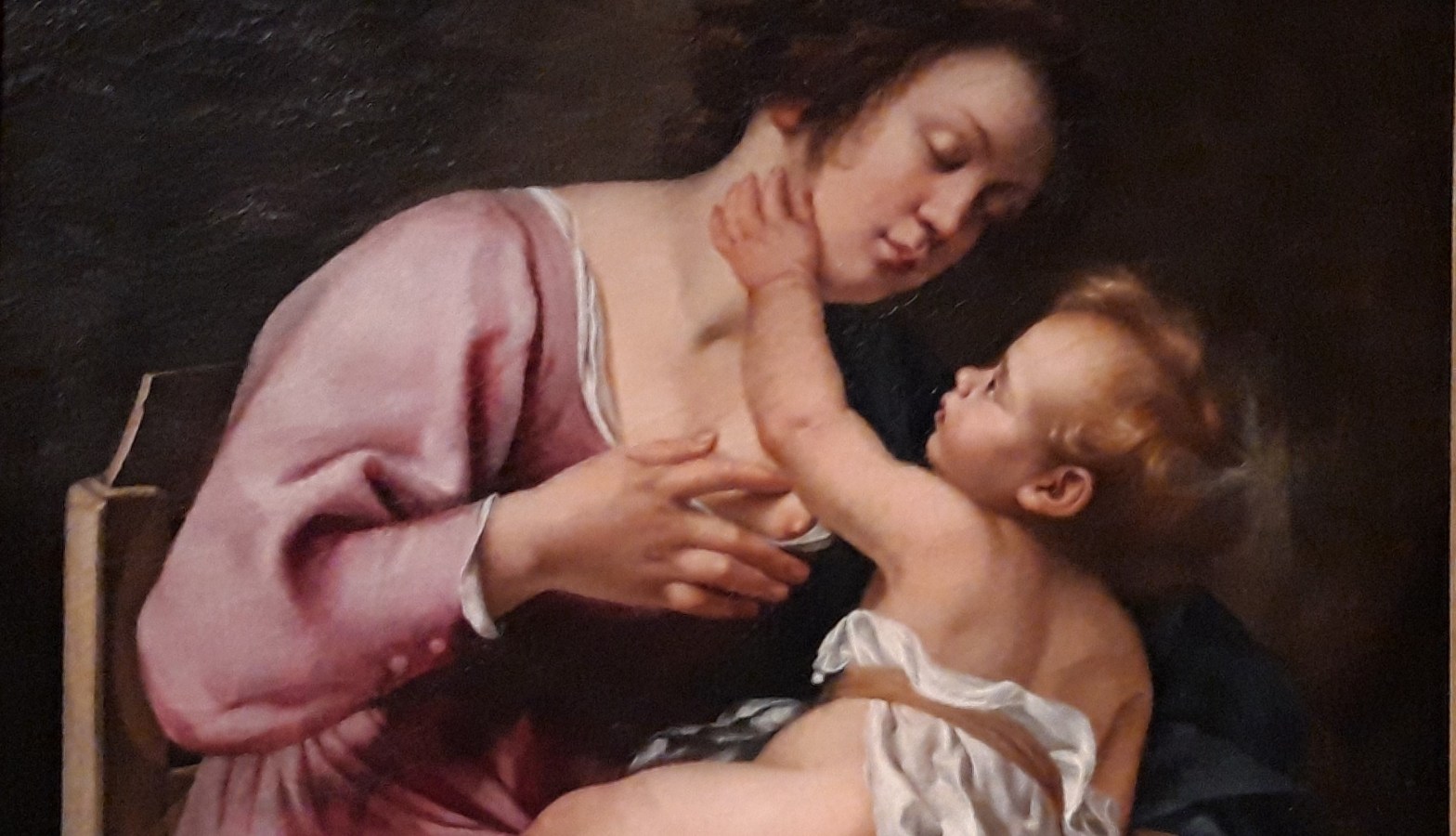
Artemisia Gentileschi, Madonna and Child, c. 1613-14. Galleria Spada, Rome.
Artemisia Gentileschi truly was a remarkable woman, and a great artist. When I first posted this blog (in the Autumn of 2020) I had already written about her twice (Picture Of The Day 17 and POTD 69), but she is always worth coming back to. And, given her current fame, curators like to do just that. There is still time to catch the exhibition Artemisia, Heroine of Art at the Musée Jacquemart-André, which I will be talking about this Monday 16 June, for example. Her strength of character is well known, and frequently discussed. The fortitude and determination of the women she paints is also rightly celebrated, notably in a number of images of Judith and Holofernes. But amidst the focus on her personal life and misfortunes, on her strength and on the strength of her subjects, and on her genuine understanding of the plight of women which was born of personal experience (something which no male artist could possibly have had), I can’t help thinking that today’s painting has not received the attention it deserves. Apart from anything else, I think it is a wonderfully beautiful image, its delicacy, and the affection it depicts, matched by a beautifully conceived composition.
On Tuesday 17 June at 1pm (the day after my talk about Artemisia) I will be giving a FREE lunchtime talk at the newly refurbished lecture theatre in the newly refurbished Sainsbury Wing of the National Gallery: Seeing the Light: the Art of Looking in and around Duccio’s ‘Maestà’ – please do come if you can! Apologies for those of you who can’t get to London – but as it won’t be streamed or recorded, I have realised that I will be able to repeat it online on a Monday I wasn’t expecting to be free – Monday 4 August at 6pm. Before then, though, I will be talking about the major influence on Duccio: on 23 June, I will be Revisiting Cimabue, looking back to an exhibition which was at the Louvre, but sadly has already closed.
After over four years of giving these Zoom talks the time has finally come for me to put up my prices: from now on each talk will be £12 (bearing in mind that some organisations were charging more even back in 2020). However, I’m holding them at £10 each if you book for all three of my Three Sainsbury Stories together – which you can do on that link. Alternatively, you can book them individually. More information is on the following links: Opening up the North (30 June), At home in the Church (7 July) and Across Italy… (14 July). Enough plans for now – but keep an eye on the diary in case there are any more!

There really aren’t any good photos of this painting… but I have replaced the one I used years back here and at the end as it gives a better sense of the colours as I remember seeing them – most recently in the exhibition in Paris. The Madonna fills the full space of the painting, bringing her closer to us, and making the subjects more immediate, more ‘present’. The Christ Child sits on her lap in a position more sophisticated than we would expect for a toddler – but then, this is the Son of God.

She sits on a low chair, and in order to prevent her son from slipping off her lap, her feet are tucked to one side, so her right thigh remains horizontal. Her left knee is not so strongly bent, allowing the child to lean on her left thigh, which is slightly higher. The overlapping zig-zags of her legs – one in dark shadow, and another in brilliant light (the chiaroscuro developed by the recently-deceased Caravaggio being used to full advantage) is then echoed by the ‘v’ of her blue cloak, lying over the seat of the chair, swept back by her leg, and curving out and around, a fuller expression of the folds seen in the pink robe. She is seated on this cloak, and we see it again tucked around her left arm, framing the leg in the dark shadows, and enclosing the form of the child. Her left arm supports him, but doesn’t hold him – almost as if she is wary of the touch – and the gap between her thumb and forefinger opens up to reveal a deeply shadowed hollow, allowing the brilliant white fabric loosely held around Jesus – a hint of the shroud to come, perhaps? – to shine out.

There is another deep void between them, a dark shadow that makes them look entirely sculptural, and seems to represent the gap in their respective experience – she would have been little more than a girl, whereas he is the Son of God. And it is he who bridges the divide, his left arm reaching up to touch her neck with delicacy and with concern, as he looks into her eyes with ineffable love. There is a sense of divine understanding in this look, and in this gesture, which, like the elegant way in which he reclines, is far beyond his human years. Mary looks down with humility, as she offers her breast between her middle- and forefingers. The thin, white hem of her chemise, seen again at her wrist, create another link to her son, as this hint of whiteness echoes the white fabric which enfolds him.

The dark space between them forms a diagonal which reaches to the top right corner of the painting. Their torsos and her legs are roughly parallel to this line, while his arm, and the gaze between the two, follow an opposing diagonal. That this was a hard-won composition can be seen from the numerous pentimenti – or changes – which are now visible: a phantom elbow and some transparent drapery curving out from her waist can be seen against the back of the simple chair, and the dark background around their heads appears to be filled with other ghostly presences, almost as if adding to their sanctity, which is defined by their haloes, hers almost solid, his, an undefinable glow.


Hard-won, yes, but not entirely original, as it happens. Ultimately it is derived from a print attributed to the School of Marcantonio Raimondi, the first engraver to base his works on other people’s paintings (and usually, on Raphael’s). It shouldn’t surprise us that Artemisia was inspired by a print. The painting is dated ‘About 1613-14’ in the catalogue of the National Gallery’s 2020 exhibition, and 1612 in the catalogue from the Jacquemart-André. However, some authorities date it earlier – around 1609 – when Artemisia would have been 16. I don’t doubt the NG’s later date. Apparently, X-rays of this painting suggest that, as well as the Raimondi engraving, a later painting which she would have seen in Florence was probably another source for this image, and she didn’t get to Florence until late 1612 or early 1613. But something that is worth bearing in mind is that, as a woman, she would not have been able to move freely through the city, and certainly, as a girl, she would not have been allowed out on her own. So her first knowledge of art would have come directly from her father, Orazio, who trained her, and from small, portable works of art – such as prints – which could have been owned, or borrowed, by the family. But she has not simply copied the print. Apart from the obvious omission of Joseph, she extends the reach of the child to touch his mother’s neck, tucks his right elbow within her enfolding arm, and ensures that they look at each other. Artemisia alone is responsible for the intimacy, and for the love between mother and son, that are such important features of the composition.
Why these changes? Should we read something about Artemisia’s own life from them, as people tend to with so many of her paintings? Probably not. Dating from her early years in Florence, shortly after she married and moved away from Rome, her experience as a mother at this stage was short-lived and harsh. She had five children, but only two of them survived infancy, and only one reached adulthood. The first, Giovanni Battista, was born in September 1613, but lived little more than a week. The second, Agnola, arrived in December of the following year, but died before she could be baptised. This means that by the time the Madonna was painted, Artemisia would have had next to no personal knowledge of breastfeeding. Of love, and of loss, on the other hand, she was only too aware.
The subject itself is more common than you might realise: the Madonna Lactans – the Madonna breastfeeding, or about to feed. It was popular in medieval times, and survived into the 16th Century for a number of reasons. One, which seems oddly contemporary, is that some were aware of the benefits of maternal breastfeeding, and were concerned that aristocratic women were all too willing to hand their babies over to wet nurses. But that is probably irrelevant here. The genre is one of the ways in which Mary could be shown as a good role model for all women: a good mother, not only pure, but also willing to stay at home and look after her baby. However, feeding the infant Christ can also be seen as the source of some of her influence. I’ve always been fascinated by a rather unusual painting attributed to Lorenzo Monaco (I have no doubts about the attribution – I can’t imagine who else could have painted it) which is currently in the Cloisters in New York, but which was originally painted for Florence Cathedral.
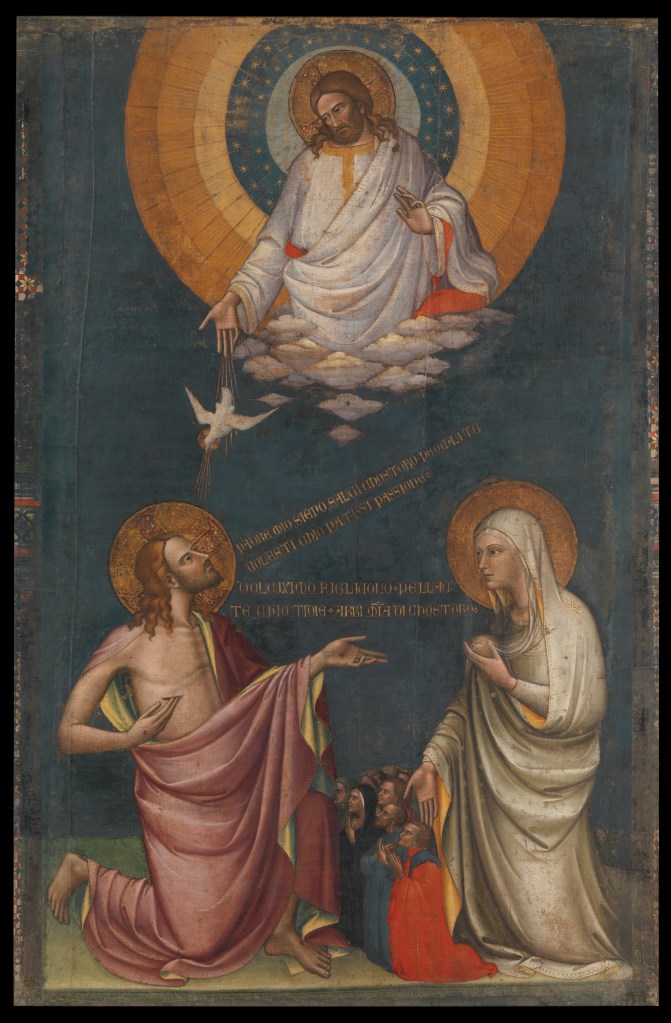

The painting shows the Holy Trinity, with God the Father at top centre, gesturing towards God the Son at bottom left, the Holy Spirit flying between, as if released from the Father’s right hand. Christ gestures to the wound in his chest, while indicating his mother, who holds something in her left hand, and gestures to a group of diminutive individuals kneeling in prayer before Jesus. The gestures tell us they are interceding with the Father, asking him to be merciful to us mere mortals. Jesus asks him something, referring to the wound, and to his mother, in support of his request, while Mary’s concern is for the people. The text, written onto the background, makes everything clear.
“My Father, let those be saved for whom you wished me to suffer the Passion,” says Jesus, as Mary addresses him: “Dearest son, because of the milk that I gave you, have mercy on them.” Even from the detail above it might not be entirely obvious that Mary is displaying her right breast. For one thing, accuracy when depicting human anatomy was never Lorenzo’s concern, and for another, it is not something you would expect to see in a church. But what the painting really makes clear is that Mary’s physical nourishment of Jesus with the milk from her breast was seen as equivalent to the way in which Jesus nourishes us spiritually with the blood and water that flowed mingled down from the wound in his chest. She shares his role in our redemption, and as such, was given a wonderful title, Co-Redemptrix, which went out of fashion in the 16th Century. I’m not at all sure that Artemisia would have been aware of any of this as she painted her Madonna, though. For her, and for her audience, the intimacy between mother and son, and the devotional nature of the image, would have been its chief charms. More abstruse elements of theology are all very well and good in a church, but wouldn’t make art sellable to the great and the good of 17th Century Florence, Artemisia’s target audience. Nevertheless, the theology of the Madonna Lactans hovers somewhere in the background of this beautiful image, which, I can safely say, is one of my favourites. To find out the others – which are not necessarily so endearing – why not join me on Monday?

 dr richard stemp
Hi Richard, I know you will likely not remember this but months ago I wrote you on Facebook to tell you how much I enjoy your lectures and also to say that I had started taking courses with the National Gallery London, and that I felt like I was being thrown into the North Sea with all of these marvelous new painters being introduced to me. You took the time to write back and say something along the lines of “but think of all the wonderful new things there are to learn.” So earlier this month, I was at the National Gallery in London with Sian Walters and Jane Adams (who I am working with now), having tea, and we were talking about you. It’s certainly a small world. Sian introduced me to Jane maybe 6 months ago, as I was desperately trying to find someone (anyone!) who was following in the footsteps of AWA. I’ve partnered with Jane now, and I know she wrote to introduce herself to you. I really enjoyed your talk on Artemisia today, and so appreciate that you mentioned Artemisia Gold. We hope to carry on the work of Jane Fortune. Thanks for being a wonderful new teacher for me, I always look forward to hearing from you. Very best regards, Susan Glimcher
LikeLike
Thank you, Susan! I’m so glad you enjoyed it. It’s great to hear that you are in touch with Jane – as indeed am I now!
LikeLike