
Bartolomé Bermejo, St Michael Triumphs over the Devil, 1468. The National Gallery, London
Today I’m reposting something from the early days of this Blog. It was written on the very first day of Lockdown 1 – the day that everyone in the UK was told to stay at home. I’ve gone back to this one because the painting I was writing about will feature in my talk this Monday, 14 July at 6pm – Sainsbury Story 3: In Church and at Home. It is hung in one of the National Gallery’s new thematic rooms, this one dedicated to Gold and its use in European art from 1260-1550, thus spanning the entire range of dates included in the new hang of the Sainsbury Wing. I’m then off on holiday, but back on Monday 4 August to repeat my National Gallery lunchtime talk Seeing the Light: the art of looking in and around Duccio’s Maestà. I’ll then be acting for a few weeks – appearing in Dial M for Murder and See How they Run! at the Manor Pavilion Theatre in Sidmouth. But I will return to the wonderful Walker Art Gallery on Monday 25 August for A stroll around the Walker V: The 18th Century. By then – but not much before – I’ll know what I’m doing next. Do keep your eye on the diary though, just in case something spontaneous comes up!
I’ve left this post pretty much as it was, although I have improved the images. We had nothing to do, and the few people who’d found the blog by then (at this point still on my Facebook Page) were being very active asking questions and making suggestions for what they would like me to talk about next (I still welcome suggestions, by the way, if anyone has any). The last comment is very much of its time – and relates to the instructions we had been given about not passing on the virus. If only we’d known then that it was primarily airborne.
Originally posted on 23 March 2020:
Thank you all for all your thoughts, suggestions and queries. I’m building up quite a backlog of material, whether it’s the vengeance of the vegetables, or the continued presence of deceased dogs in art… but today I’m going to reply to a question arising from yesterday’s painting, which was ‘Why such feminine attributes on archangel Raphael? The ballet feet, long hair tied back, beautiful soft face?’ It reminded me of today’s painting, Bermejo’s St Michael Triumphs over the Devil, which I also thought about yesterday because of its connection with Superman.

The connection might at first sight seem obvious – a Superhero has come to the rescue, after all, but that’s not what I was thinking about. Nevertheless, it bears consideration. The Superhero in this case is the Archangel Michael, whose various responsibilities include weighing the souls at the Last Judgement, and defeating the Devil. He is in command of God’s army in the Book of Revelation, making sure all the rebellious angels are vanquished. Rather than the ‘S’ of Superman, Michael has the Heavenly Jerusalem reflected in his golden breastplate.

Even if gold would not in any way be effective as armour, it doesn’t tarnish, so it is pure and unchanging, just like God: it is a symbol of his divine authority. It also reflects beautifully, allowing Bermejo to show off his brilliance as a painter – just look at the way the red of the lining of the cloak is reflected in his calves (in the next detail down).
Unlike Superman (or St Michael’s close equivalent, St George) there is no damsel in distress (not that St George’s damsel was especially distressed – but that’s another story). In this case it is a man, whose kneeling position in this instance tells us he is a normal, everyday human, adopting a position of humility. This is the position adopted by most donors – i.e. the people who gave money for the painting – in religious works. Also know as the patrons, these are the people who commissioned the works of art. The donor of this work was Antonio Juan, Lord of Tous, not so terribly far from Valencia in Spain. He kneels down leafing through his book of psalms, and has carefully held it open at two pages, Psalms 51 and 130. The first of these starts, ‘Have mercy upon me, O God, according to thy loving kindness’ – so he’s clearly worried that he might have done something wrong – while the second says, ‘Out of the depths have I cried unto thee, O Lord’. It must have been this ‘cry’ that Michael has responded to.

What does he need saving from? Well, the Devil, naturally, which is fashioned here out of everything most unpleasant. It always reminds me of one of the monsters made by Sid Philips, the psychopath neighbour in Toy Story.
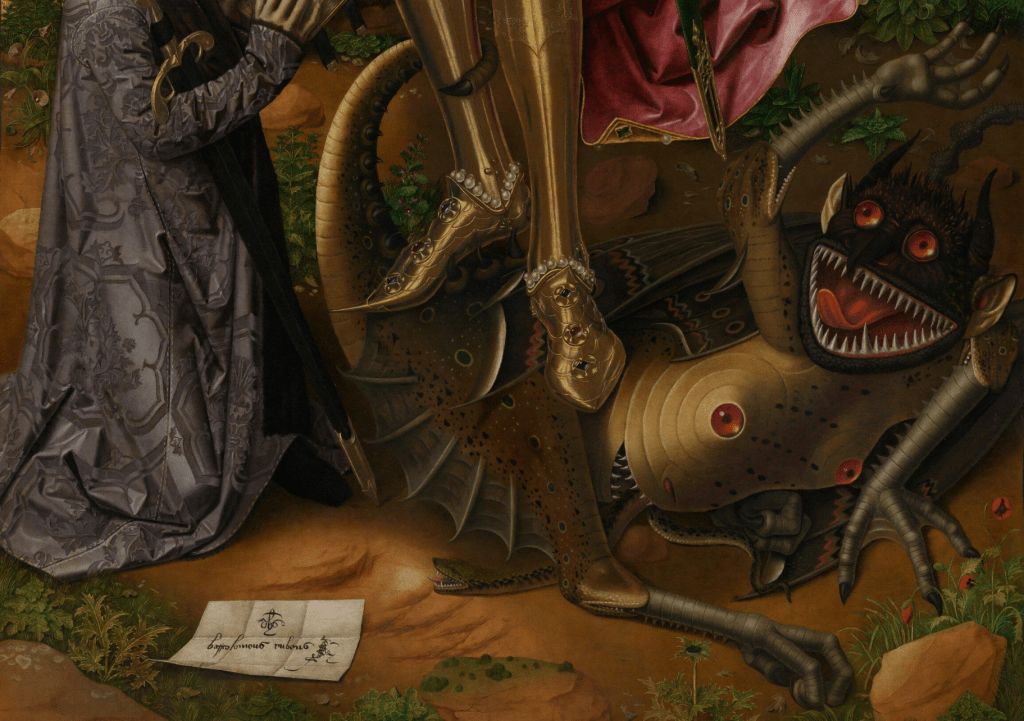
It has at least four eyes – two in its face and two on its nipples. They are red, and with the black pupils they echo the poppies, which are symbols of sleep, and therefore also death. It also has two mouths. The one in its stomach has a snake for a tongue. Lizard mouths form the elbow joints, and the rest is a combination of bat wings, claws, spikes and scales, everything generally unpleasant. And yet, to my eyes, it remains faintly absurd, even comical. There is no doubt to me that he will be defeated. Michael holds his rock crystal shield in his left hand, and raises his right over his head, ready to strike. I suspect that, once his arm has swung round, the head of the Devil will be sliced straight off.
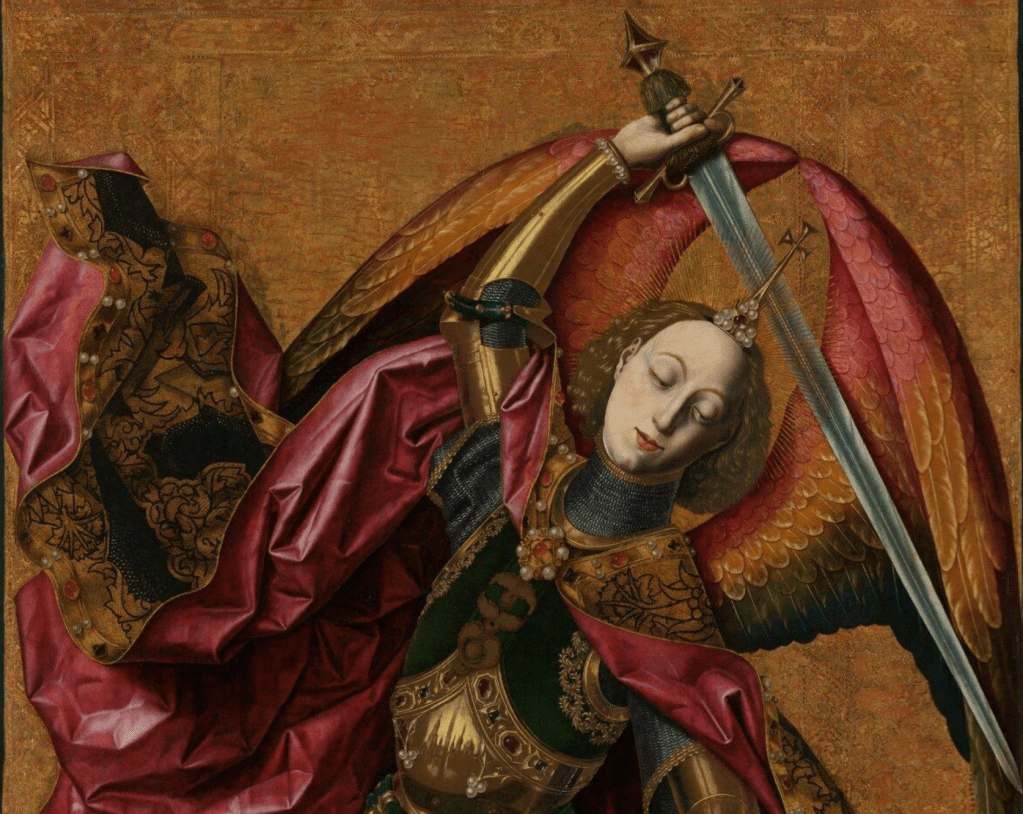
Michael has certainly not wasted any time: he’s only just landed. Look at his cloak (this is the real connection with Superman) – it’s still floating up in the air, and at any moment, it will come swishing down by his side, in the same way that Superman’s cloak flows out behind him in flight, and then, as he lands, falls down heavily and wraps around him. Or maybe I’m just imagining that.
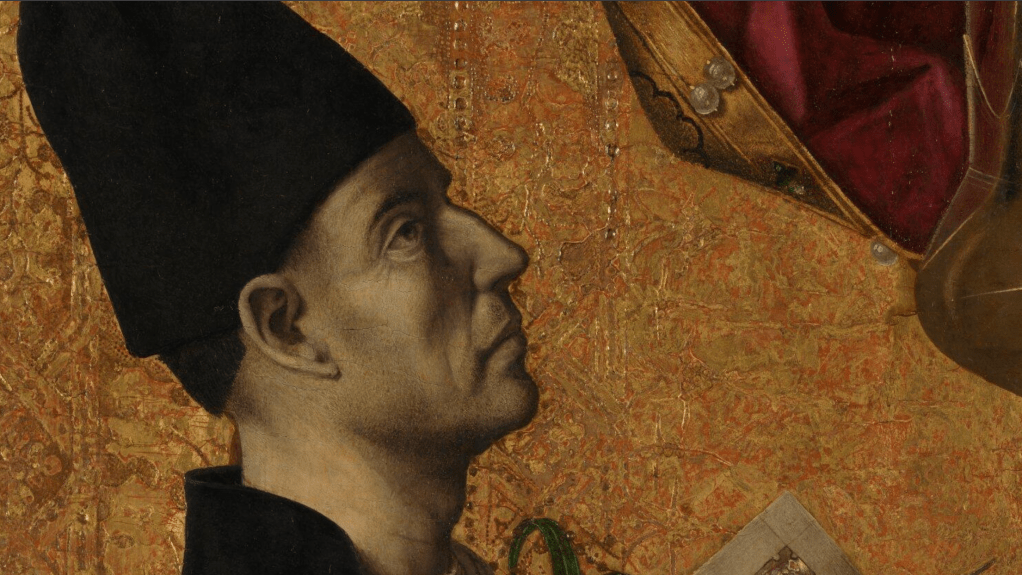
But what of the femininity? Compare the details of the faces. Antonio Juan has wrinkles in the corners of his eyes, is dark and swarthy (he was a Spaniard, after all), has hollow cheeks, a slightly hooked nose and more than a hint of five-o’clock shadow – he hasn’t shaved for a day or two.

Michael on the other hand is blond and blemish free, with a perfect complexion, a high forehead, arched eyebrows, a long, straight nose, red, almost cupid’s-bow lips and a rounded, dimpled chin. In fact, he has all the marks of perfect female beauty as described by François Villon (1431-63?) in Le Testament:
…that smooth forehead,
that fair hair,
those arched eyebrows,
those well-spaced eyes,
that fine straight nose,
neither large nor small,
those dainty little ears,
that dimpled chin,
the curve of those bright cheeks,
and those beautiful red lips.
(This quotation is from the Penguin Book of French Verse, I, and is quoted in Lorne Campbell’s superb entry on The Arnolfini Portrait in his catalogue of Fifteenth Century Netherlandish Paintings in the National Gallery)
But why should these ideal feminine features apply to a man called Michael? Are we talking Renaissance gender fluidity here? Not necessarily. After all, he’s not a man, he’s an angel, and unlike us, he hasn’t fallen – he’s in a state of Grace, without Original Sin. It’s only the sinful who, at a certain point, would continue to grow old, get ill and die… Antonio Juan needs help because he is sinful, the marks of that being the swarthiness, the stubble and the wrinkles. And yet – you might still be asking – does Michael have to look so girly? Just think about Shakespeare. Quite apart from the fact that all the girls were played by boys, more than one character talks about young men as if they were girls, with no beard and high voices, and before they have a beard they are clearly not enough of a man to be a lover. This is also Flute’s complaint in A Midsummer Night’s Dream: ‘Let me not play a woman. I have a beard coming’. Curiously perhaps (and yet, in another way, it is obvious) these features are shared, so often, with those of the Virgin Mary. Like the Archangel Michael she is free from Original Sin, and, as a result, in Roman Catholic belief, she never died. She watches over us, a mother to us all. The fact that Michael has these features (as do other angels – we saw Raphael yesterday) shows us that he is pure, and perfect, and that with him, we are in very safe hands. I’m assuming that those hands are very clean.
 dr richard stemp
Dr. Stemp, thank you so much for the work you do, it is quite wonderful. A question about today’s re-post; do you have any idea what the paper below Antonio Juan says or might be referencing? You might have addressed this in the first post, apologies if that is the case. Appreciate your time and break a leg in the coming weeks! “See How They Run!” is a favorite.
LikeLike
Thank you! And apologies for the delay in getting back to you. I didn’t say any more in the first post – this is literally re-posted, a repeat from before. The paper simply says IHS Bartolomeus Rubeus – an abbreviation of the name of Jesus, followed by Bermejo’s signature, in a Latin form – ‘Bartholomew Red’ – which is what ‘Bermejo’ means. It was a nickname: he probably had red hair, or a ruddy complexion…
LikeLike