
The Limbourg Brothers, January, from Les Très Riches Heures du Duc de Berry, 1411-16. Musée Condé, Chantilly.
After a wonderful week in Liverpool with Artemisia, I’ve just been to Chantilly, about half an hour by train from Paris, to see a remarkable exhibition developed around an even more remarkable manuscript: Les Très Riches Heures du Duc de Berry. This is all the more imporantant given that, when a facsimile was made in 1984 (current price €3000-€7000, apparently), it was stated that the manuscript would no longer be shown to anyone – not even specialists in the field. “Maybe a visiting head of state might be able to see it”, they said, with the implication that if they wanted to they’d have to ask nicely! Even before then it was probably only seen by 5 or 6 specialists each year… Although it has been seen once in public since then (about 20 years ago), the current exhibition gives unprecedented access, thanks to necessary work to conserve the fragile masterpiece: the 12 calendar pages are all on view, having been taken out of the binding. The Très Riches Heures are joined by as many books belonging to the Duc de Berry as could be located, illuminating (literally… and metaphorically, practically and pictorially) his life and times, his interests, and the role the Limbourg brothers played in the manuscript’s production and in the development of manuscript illumination generally. To give this exhibition the time it deserves I will be delivering two talks. As the title suggests, it is a very richly decorated book of hours: a prayer book related to the different religious church services which take place at different times of the day (the canonical hours) and of the year. The first talk will therefore be dedicated to Good Times: the book itself, and will be this Monday, 15 September, at 6pm. The following Monday, 22 September, I will talk about The Duc de Berry: the man himself – putting the Hours into the context explored by the rest of the exhibition.
After these talks, I will turn to another much-heralded exhibition which opens in Florence later this month: Fra Angelico at the Palazzo Strozzi and San Marco. I will give four talks relating to what promises to be the autumn’s ‘must-see’ blockbuster. The first two are on sale now, and the second two will go on sale after the first, with a reduction in price for those who have just seen it:
6 October, Fra Angelico 1: A Melting Pot
20 October, Fra Angelico 2: As seen at the Palazzo Strozzi
27 October, Fra Angelico 3: At home in San Marco
3 November, Fra Angelico 4: Students and Successors
But for now, I’d like to start with the image that gets the good times rolling – the illustration for the month of January in the calendar at the beginning of the Très Riches Heures.

As I will be talking about the manuscript as a whole on Monday, I’m just going to focus on this particular image today. Painted on parchment with the richest of pigments in a medium of gum Arabic (or maybe tragacanth) mixed with water, the illuminations are also decorated with the finest gold leaf. The initial impact is of wealth and of profusion – these ‘heures’ really are ‘très riches’ – especially in this, the first image from the manuscript. It is an illustration of a regular event in the Duke of Berry’s life in the month of January. At the top is a semi-circle, with rich blues and golds, some figures and a latticework of gold lines. Below this is a depiction of a feast, in which some characters wear the same blues that are seen at the top. The Duke himself, seated behind the table on the right, is in this rich blue (and yes, it’s ultramarine), with the added expense of gold. Others are in reds, greens, and whites, and are gathered around the table, which is covered in a white cloth and laden with food. Yet more appear to enjoy the throng as they push their way in, and some even appear to be arriving on horseback (but don’t trust everything you see).
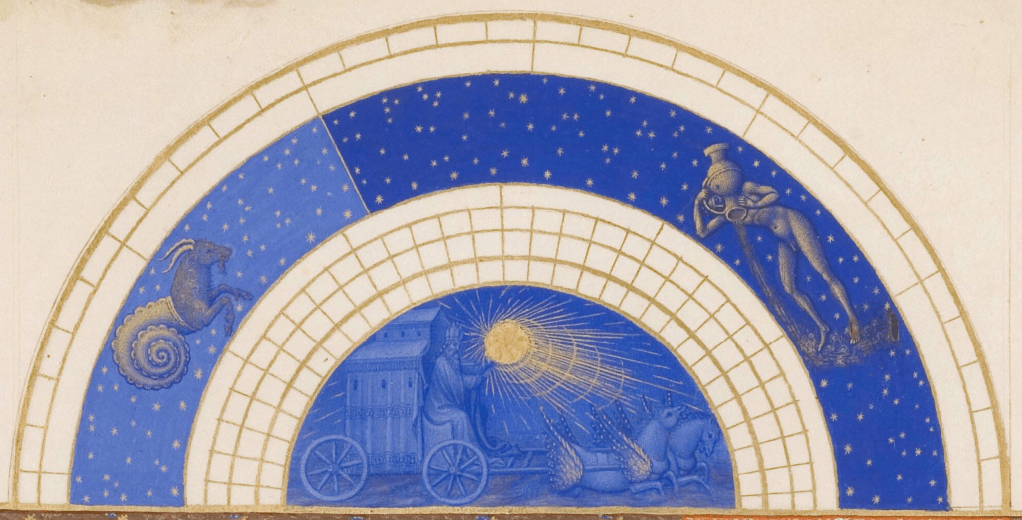
The top section of the imagery – the semicircle, or lunette – might not, at first glance, be easy to interpret, but it is what marks this out as a calendar. On one side a goat emerges from a shell and on the other a figure pours water. The location of these figures against a blue background covered in gold dots gives us an important clue: they are stars in the night sky. These are the constellations that cover the month of January. The first is Capricorn, which means ‘horned goat’, but is usually shown as a ‘sea goat’ with a curving fish’s tail. Here, rather than a tail, it has a seashell – or conceivably, and octopus’s tentacle. The second is the ‘water bearer’, Aquarius. In the Western astrological systems nowadays Capricorn has the dates 22 December – 19 January, while Aquarius covers 20 January – 18 February. However, this calendar tells us that these dates have not always been fixed. The ‘latticework’ is divided into 31 sections – because there are 31 days in January – and the division between Capricorn and Aquarius comes between what would be the 11th and 12th of January. In other months the dates, and the names of the constellations, are included in these white boxes, but not here: the calendar remained unfinished as a result of the death of the patron – and all three of the artists, Paul, Jean and Herman de Limbourg – in 1416, presumably as the result of plague. As we will see on Monday, the manuscript was completed – as far as it would ever be – by other artists. In the central section of this lunette a bright gold disk sheds light all around, but more so to the lower right. It appears above a form of chariot, pulled by horses with golden wings. This is the chariot of the sun, driven by Phoebus, whose name means ‘bright’: the name was an epithet used by Homer for Apollo, the god of the sun. As the sun crosses the sky, the days pass, and we go from the beginning to the end of the month.

Below the unfinished calendar, we see an image which is chosen to represent the month down on earth. We are in a large room in which the floor is covered with elaborately depicted rush matting. The room is heated by a monumental fireplace which dominates the top right of this detail. A trestle table covered with a white, patterned table cloth stretches two thirds of the width of the image, projecting beyond the picture field so that we cannot see how wide it is – but my guess would be that the Duc de Berry – whose blue and gold robe can be seen both above and below the table – is probably meant to be sitting in the middle. Notice how, at the very top of this detail, there is a sliver of red directly above his head: we will see what that is later. The table is laden with plates, and food, and on the left of the picture a credenza is piled high with golden vessels. People are holding cups and bowls, and there are flagons which presumably contain beer or wine. The man at the bottom left in the bright blue robe is holding both a bowl and a lidded cup: he may well be the Duke’s official cupbearer. This is clearly some form of celebration. January, the first month of the New Year, was associated with parties and gift giving. This could either be New Year’s Day itself, 1 January, or the Feast of the Epiphany on 6 January. Either would fit, but given that this is the Duc de Berry, we are witnessing the étrenne – an exchange of gifts celebrated on New Year’s day, a custom among the royal family of Valois (and elsewhere). Although you can’t see any gifts changing hands in the illumination, it would certainly be one of the ways in which the Duke had acquired so many gold vessels. One New Year the Limbourg Brothers gave the Duc de Berry a book. Only it wasn’t a book, it just looked like a book – a facsimile if you like – a block of wood carved and covered and painted to look exactly like a book. It was a form of trompe l’oeil – a clever work of art (a sculpture in this case) designed to trick the eye into thinking it really was a book. However, you couldn’t leaf through any pages, as there weren’t any. You couldn’t even get into it. As Michael Camille pointed out in a brilliant article published in 1990, this was exactly the experience everyone had of the Très Riches Heures after 1984 – until now, that is! At the top left of the detail above are the people I mentioned earlier who appear to be arriving on horseback – which seems highly inappropriate given the crowded nature of the interior.
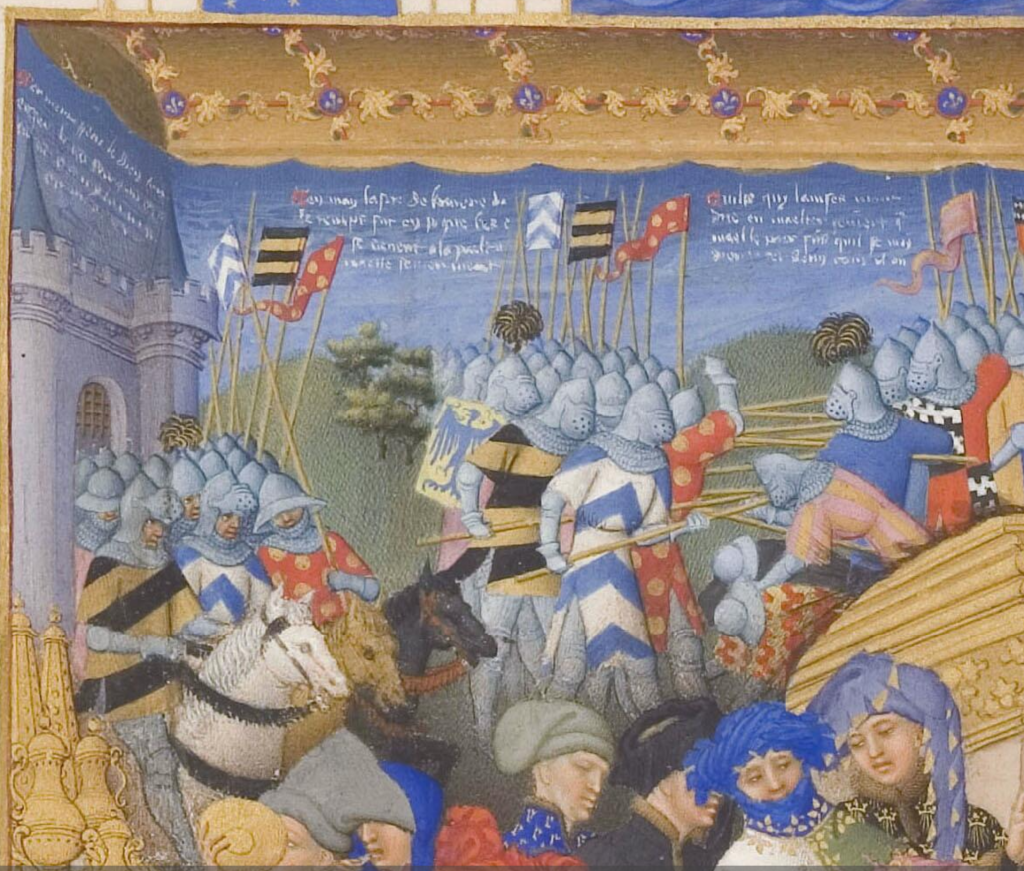
The blue at the very top here is the bottom of the semicircular calendar. The gold horizontal feature, which is decorated, and curves away from us, is the ceiling of the room in which the feast is taking place. However, the golden brown colour appears to give way to a blue sky. Two details help us to interpret this. First, the top of the blue is scalloped, curving down and back up to and from specific points: this is a piece of fabric hanging from fixtures at the top of the wall. There are also three sets of four lines of white writing. On the far left, apparently above a gateway with a portcullis, the writing slopes down from left to right: the perspective suggests that this writing must be ‘written’ on the left wall of the room. What we are looking at is, in fact, a tapestry hanging from the top of the wall, and wrapped around the corner to hang in front of the left wall as well. It is long enough to hang down behind the people in the room, and, as the colours used for the real people and the people in the tapestry are the same, it is easy to confuse them. I’m sure this is a game the artists are playing – what is real and what is imaginary? In fact, the tapestry also hangs over the fireplace which projects into the room at the bottom right of this detail. There is a golden brown cornice above the blue headdresses of the two men at the bottom right, and the tapestry seems to be scrunched up over it, tumbling down to the left of the fireplace. Two ranks of foot soldiers, flags raised behind them, charge at each other with spears, while men on horseback, carrying the same flags as the men on the left, arrive from the gateway to support them. The words on the tapestry can be read, and at the top right of the illustration (to the right of this detail) are the words ‘de troyes le grant’, medieval French for ‘of Troy the great’: this is a tapestry depicting the Trojan War. The manuscript was being created during a civil war between two branches of the French Royal Family, the Bourguignons and the Armagnacs, which in itself impacted the 100 Years’ War with England – the tapestry of war might therefore be a very deliberate contrast to the amicable celebrations taking place in the foreground.
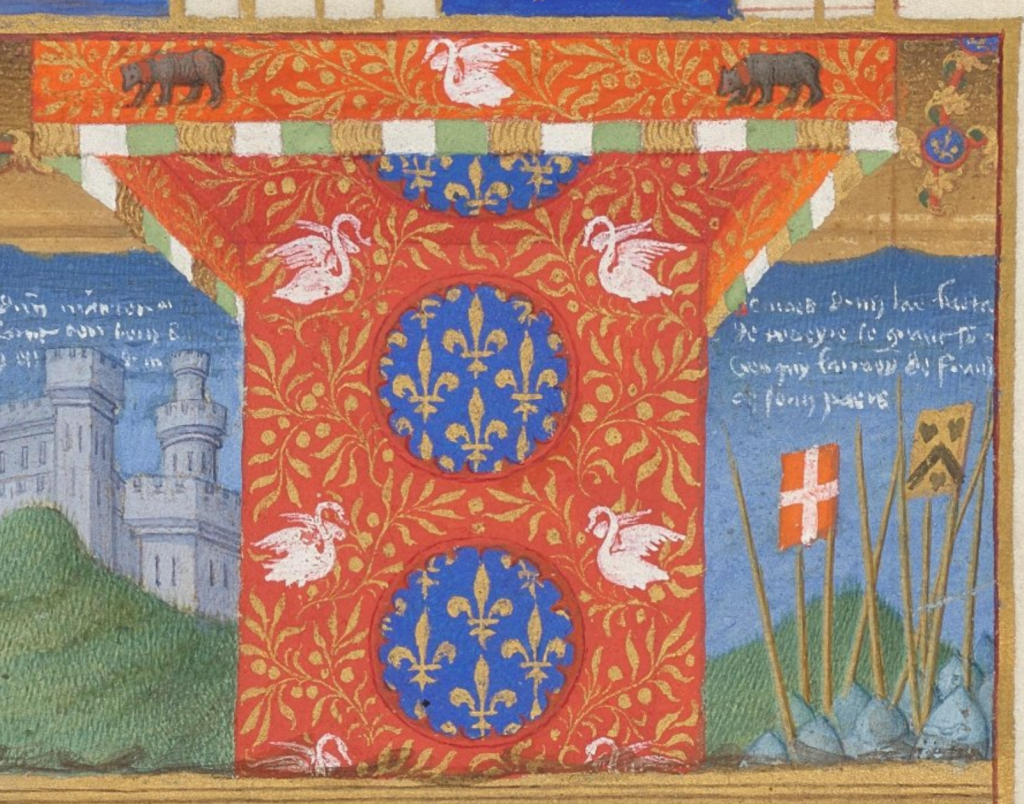
The gold-brown bar at the bottom of this detail is the top of the fireplace, whereas the line going up the right-hand side (and across to the left) is the ‘picture frame’: this is the top right corner of the image. The green hills, and, on the right, the helmets, pikes and flags are all part of the tapestry, with the second of the four lines on the right including the words ‘de troyes le grant’ – although it would take quite a while to get your eye in to be able to read that. The undulating profile at the bottom of the tapestry tells us that it has been bunched up over the mantelpiece. The tapestry clearly wasn’t designed for this room, but, like so many courtly luxuries, it could have been be packed up and transferred to any room in any palace – wherever it might be needed, according to the demands of ceremony or festivity. The bottom of the red fabric, which is hanging vertically in front of the tapestry, also seems to be piled up on the mantelpiece. It is topped with an equivalent canopy fringed in red, white and green. This is a throne canopy, with its cloth of state – the same as a cloth of honour you would see in paintings of the Virgin and Child. It tells us that the man sitting below is royalty, while the gold fleur de lis on the blue background tell us that he is a member of the royal family of France. The swans and bears (top left and right) were personal emblems of the Duc de Berry: this is precisely how the patronage of the Hours was identified when they were acquired by Henri d’Orléans, Duc d’Aumale, in 1856 – the date taken to mark the ‘rediscovery’ of the manuscript. Obviously I’ll talk more about the Duc de Berry – The Man Himself – the week after next, and we’ll see plenty more bears and swans then.

But how about the feast itself? The table may be laden with plates and dishes, but how many people are actually eating? Two men stand in front of the table, one of whom is wielding a knife. On the left a man in red and white also has a knife, and is cutting some of the food. They are the Duke’s carvers, responsible for cutting the meat into slices. Given that there are no knives and forks (they weren’t yet in common use) everything had to be finger food. There are more people standing behind the table, but, having eliminated all of them, you will realise that only two people are seated: the Duke, on the right, in blue, and a man wearing a red cloak over a white, hooded robe, on the left. He is identified by some as Martin Gouge, a canon from Bourges (where the Duc de Berry had one of his castles, and where he would be buried), who in 1402 became the Duke’s treasurer and, in 1406, the Bishop of Chartres. However, others suggest that this is Cardinal Alemanno Adimari, Archbishop of Pisa, who had been negotiating for a peace in the civil war between the Armagnacs and Bourguignons, and who was on his way to the Council of Constance. Given that he is dressed in red, it seems more likely that he is a Cardinal rather than a Bishop… Directly above him, two men are dressed in elaborate clothes, with richly coloured and decorated hats. Their arms are extended and their hands raised. At first it might look as if they are greeting the Duke. However, we should remember that it is January, and it is cold outside: they have only just arrived, and they are warming their hands at the fire. Behind them (to our left) are two other guests who are not dressed nearly so elaborately.

The first two men (with blue hats) sport the ‘must-have’ headgear of the day, known as a chaperon. These included three elements: a round bourrelet, a long ‘tail’, called the liripipe, and sort of cape or patte, which flopped over the head rather than the shoulders. The man with the lighter blue version has his liripipe, copiously fringed with gold, hanging over one shoulder, whereas the man next to him, with the brighter, richer blue, has wrapped it round his neck like a scarf: it clearly was cold outside. The artists emphasize the excessive amount of this bright blue material by making it hide the face of the man behind, who wears a far more modest black – and his headgear would appear to be just the bourrelet, without either patte or liripipe. He may have a small fur collar and cuffs, but there are none of the gold decorations which the two guests in front of him display. At the back of this group of four men, the last has far more ‘workaday’ headgear, a modest grey cap. It is baggy, perhaps, but not really tailored or decorated. This face appears in other works by the Limbourg Brothers – and it is usually assumed to be a self portrait by Paul. Yes, he has a bright blue collar, with gold decorations – but maybe this was a gift from the Duke, in recognition of his service? And am I wrong in seeing the letter ‘P’ embroidered on it? I suspect there’s another visual game going on here. If that is Paul, then who is the man in black? And why is his face hidden? Maybe it is another of the Limbourg brothers (Jean has been suggested), with the artist, Paul, rendering his brother ‘anonymous’ by covering his face (but beware of such identifications: the attribution of individual folios in the manuscript is strongly contested!)

Hats are often relevant – whether worn or not. The two young men in the foreground, and the usher in red behind the table, all have the ‘pudding bowl’ haircuts fashionable for young men at the time, with stubble and paler skin where the hair has been shaved from backs of their necks and above their ears. Their lack of headgear marks a lower status, however richly they are apparelled. The host himself wears a bearskin hat – a reminder of his emblem, and an indication that he is, himself, the ‘bear’ (more about that on 22 September, though). There is a small gold bear standing on the far end of the ship-shaped salt cellar at the far right, with a swan standing on the nearer end. Items such as this, and the damask tablecloth, are mentioned in the inventory made after the Duke’s death in 1416 – and this inventory is one of the exhibits currently on show in Chantilly! Also listed in it are “plusiers cayers d’unes très riches heures qui faisoient Pol et ses frères, très richement historiez et enluminez…” – or, ‘several gatherings of a very rich book of hours, richly historiated and illuminated, that Paul and his brothers made’. This entry, first identified in 1881, gives us the manuscript’s now-familiar name – Les Très Riches Heures – and tells us that it was, indeed, created by Paul, Jean and Herman de Limbourg.
The Duke sits by the fire in front of a circular firescreen, with sparks shooting up behind it. It is towards this that the new arrivals are holding up their hands on the left and right. It has exactly the same effect as the The Virgin and Child before a Firescreen, by a follower of Robert Campin, in the National Gallery, which was painted just a couple of decades later. The firescreen frames the Duke, thus emphasizing his presence and status. However, given its larger size, and the fact that the Duke is off-centre, it doesn’t look as much like a halo. The usher in red behind the table wears a very expensive gold collar and carries a staff of office. Above his head, in gold, are written the words ‘aproche, aproche’ – basically ‘come on in!’ He welcomes the new arrivals to the feast, and invites them to approach and greet the host. However, I’m sure these words are also encouraging us to enter the magical world of the book – this is the first page, after all. If you can make it to Chantilly before 5 October it really is worthwhile – and there may not be another chance in the next 20 years or more to see this masterpiece. However, if it’s just not possible, there are two websites where you can examine the manuscript in detail in the privacy of your own home:
Les très riches heures du Duc de Berry as part of the virtual library of medieval manuscripts.
Les Très Riches Heures on the Château de Chantilly website – with ‘turnable’ pages! I’d go for this one.
And of course, we will explore its riches as fully as possible on Monday, so please, ‘aproche, aproche!’ And in case you were wondering, this is what the illumination looks like when you turn the first page:

 dr richard stemp
The man in blue at bottom left is wearing a sporran like pouch with what appears to be false genitalia protruding. Is this the intent? It is rather strange.
LikeLike
He is – and yes, it is rather strange. I deliberately didn’t mention this as I have no idea what it is! But there are others surprisingly ‘rude’ details elsewhere in the manuscript… A man on the right of ‘January’ also has a similar object.
LikeLike
Dear Richard,
I was very pleased to find this invite when I cam back from Tuscany last
night. Unfortunately I missed your first lecture on the Heures, as I
was still away, but hope to catch next week’s.
Your lectures, and particularly those you gave a few years ago for the
National Gallery Stories of Art course are always a joy, and you have
taught me a great deal about looking for the particular, and even the
amusing, in Renaissance Art; that being so, I thought I would mention to
you that last week I went to the Basilica of St Francis in Arezzo, to
see the fresco cycle of the Legend of the True Cross. I am sure you
have seen it many times, and know how exquisite it is, so I won’t bore
you talking about that.
However, there are other excellent frescoes in the basilica, including
someattributed Spinello Aretino and Andrea di Nerio in the Guasconi
chapel, including a fresco of the baptism of Christ; in it, Christ is
standing up to his knees in water, with his arms crossed over his chest,
and looking miserably cold! Two angels are standing on the bank, each
holding a large cloak or towel, presumably to bundle him into when he
gets back on dry land! After being transported by the Legend cycle, it
was quite nice to find something to chuckle over, too.
Best wishes,
Sue Lelliott
LikeLike
Thanks for getting in touch, Sue – I’m so glad to hear you enjoyed Piero – and others – in Arezzo. It certainly is a wonderful place! All best wishes for all the looking in the future!
LikeLike