
Fra Angelico, The Forerunners of Christ with Saints and Martyrs, about 1423-4. The National Gallery, London.
So far I have discussed most of what can be seen in the glorious Fra Angelico exhibition/s in Florence, covering the first room in San Marco and most rooms in the Palazzo Strozzi. However, if you manage to get to Florence, there is always more to see, and that is the reasoning behind the third and fourth talks. This week, on Monday 27 October at 6pm, we will be At home in San Marco, even though Fra Angelico didn’t actually change his allegiance from his own ‘house’ as a friar, San Domenico, just outside Fiesole. He was certainly at home there, and I will start with the work he produced for that convent, before moving back down the hill to San Marco. The majority of the talk will be about the frescoes he and his workshop carried out in the cells and communal spaces there. The week after (3 November) we will will thinks about his Students and Successors, looking at the work he executed outside of Florence towards the end of his life – in Orvieto and Rome – and introducing some of the assistants who worked alongside him (including Benozzo Gozzoli and Zanobi Strozzi). The talk will also cover the so-called ‘School of San Marco’ – artists associated with the convent in the 16th Century who could, as both artists and Dominicans, be counted as Fra Angelico’s ‘successors’. These include Fra Bartolomeo, Fra Paolino, and Suor Plautilla – the first Florentine woman recognised as having had a successful career as an artist.
I’ll need a week off after that for a change of gear, with two talks about exhibitions at the National Gallery: Radical Harmony – Helene Kröller-Müller’s Neo-Impressionists on 17 November, and the week after (24 November), Wright of Derby: From the Shadows. I’ve nearly settled on the talks for December, but keep changing my mind – so keep your eyes on the diary for more information.

Today though, having talked about two of the panels from the predella of Fra Angelico’s first major altarpiece (or, at least, the first that survives) I will move on to a third – the one to the right of centre. I had originally intended to cover the whole panel, but there’s so much in it I’ve decided I’ll have to look at it in two posts. This week we’ll look at the top row of figures, with the others to follow next week – and I’ll add in the last two smaller panels at the far left and right as a coda. Trust me, with a couple of notable exceptions the people represented in them are really rather obscure – unless you are a Dominican historian.

At first glance, the structure of this panel looks much the same as the one I discussed last week. Apart from the fact that everyone is facing to our left (because they are looking towards Jesus in the centre of the predella) there are, again, three rows of holy figures kneeling in prayer or adoration. We know that they are all holy, as all have haloes, and, once you get closer, you will see that, as before, the haloes in the lower two rows are ringed with black, but in the top row they are not. However, if you look back at last week’s panel – The Virgin Mary with the Apostles and Other Saints – there is a difference. In that composition there was more space, with figures like the Virgin Mary, St Jerome, and St Paul the Hermit slightly isolated from the others. In this panel the composition is more crowded, and even though one or two figures stand out, on the whole they appear more tightly packed. Indeed, last week’s panel included 52 individuals. This week, there are 65… I can’t explain why this should be, apart from the fact that, in Hamlet’s words (Act 1 Scene 5) ‘There are more things in Heaven and Earth, Horatio, than are dreamt of in your philosophy’. OK, so Shakespeare had not been born when this was painted, but you get the idea – and that’s why I’ve decided to talk about the panel over two posts. The haloes tell us that these figures are holy, and the word ‘saint’ comes from the Latin ‘sanctus’, which also means ‘holy’. However, not all of these figures are Saints, in the traditional sense.
Unlike last week, when I started with the characters nearest to Jesus, who would therefore appear to be the most important, I want to start with those furthest away, at the top right. This will make it far easier to understand what they have in common, and so to work out who some of them are.

The ease of identification is the result – as it was for some of the otherwise obscure Saints last week – of having their names clearly painted on the panel. Two of the characters here have scrolls on which their names are inscribed – we would call them Zeccharia and Habakkuk. They are Old Testament prophets – people from the Jewish scriptures whose prophecies Christians interpret as referring to the coming of Jesus Christ. Even without their names, we would suspect that they are Old Testament prophets, as they hold scrolls. It’s not a hard and fast rule, but more often than not anyone holding a scroll comes from the Old Testament, and anyone with a Codex (a book with turnable pages, as opposed to one you unroll – basically what we would now call a ‘book’) is from the New. That’s quite simply because scrolls came before codices, the latter appearing in the 1st century, and developing to become more dominant by the 4th – thus paralleling the development of Christianity itself. Each of the two prophets points to his scroll, and looks at the other – but neither seems that happy. It could be that they disagree about what will come to pass, but I suspect it’s because they know that things will go badly before they get better: the Messiah will suffer before we are redeemed. The other two in this detail are also thought of as prophets – Daniel’s name is written just below the gold neckline of his robe, while Jonah’s is written on his book – the Book of Jonah (thus demonstrating that the scrolls vs. codices distinction is not clear cut). Why did Fra Angelico use their names rather than symbols to identify them? Well, he’s got to fit 65 people onto this panel, and there probably wasn’t space for a den of lions, let alone a whale.

More prophets in this detail: Joel has his name on his shirt, like Daniel, while Ezekiel’s is on his rather fancy hat. Isaiah and Jeremiah on the other hand have theirs on their scrolls. David’s is on his harp, which is odd, as it is unnecessary. He is wearing a crown, and and everyone here is a prophet. Only two Kings are thought of as prophets, David and Solomon, and David was the one who played the harp (he is believed to have written the Psalms). He would be instantly identifiable, even without the name. However, there are two more here who must remain anonymous: the men in yellow and black. With no name and no identifying features we would be guessing. Nevertheless, they have haloes – so must be ‘holy’. On reflection, this might appear odd. In the Catholic church such Old Testament figures were rarely given the title of ‘Saint’. However, in the Greek Orthodox faith they were – Agios Esaias would be St Isaiah, for example. Because of the close ties between Venice and Constantinople, this tendency crossed the Mediterranean, and there are churches in Venice dedicated to St Moses and St Job as a result. For Fra Angelico’s painting, it is clear that the forerunners of Christ are worthy of a place in heaven, and also that as holy men they should have haloes too.
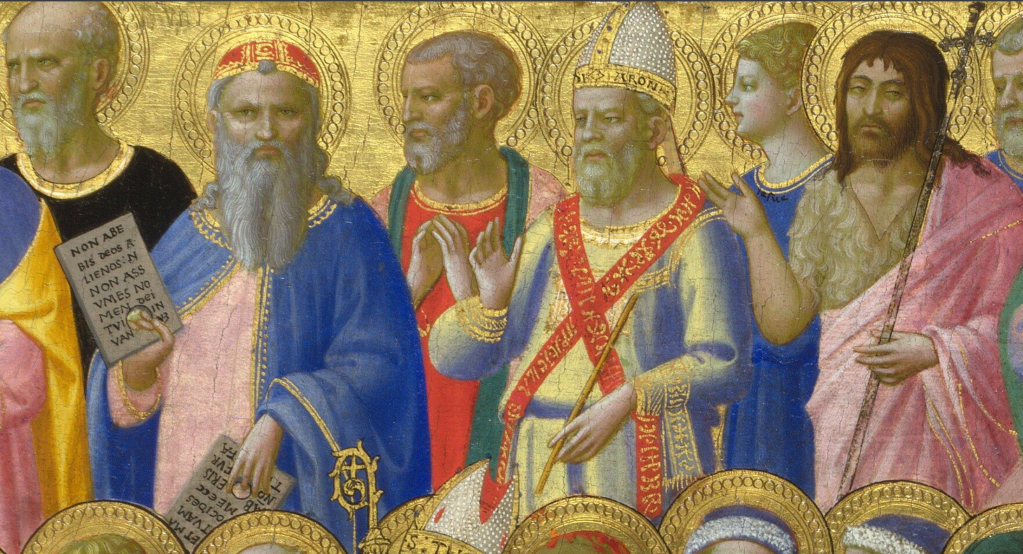
Getting closer to the centre, and so to Jesus in the central panel, there are two more unidentified people, in black and red. The character in blue is Joshua – his name, written as ‘Jesue’, is on his blue robe (but I couldn’t read that until I found out what it said from Dillian Gordon’s catalogue entry!). The identity of the figure at the left of this detail should be straightforward: a man holding two stones slabs – which we tend to call ‘tablets’ – with writing on them. The one in his right hand is held up towards us, and is inscribed ‘NON ABEBIS DEOS ALIENOS’ – ‘you shall have no other gods’. This is the first of the ten commandments, held by Moses. His brother Aaron, the High Priest, is further to our right. Apart from the fact that the gold band around his hat is labelled ‘ARON’, this type of conical headgear – not unlike the papal triple tiara, but without the three crowns – was often used to represent the High Priest in Italian art. The crossed bands over his chest also suggest a priestly air, as does the otherworldliness of the blue/yellow cangiante robe, even if he is not wearing the breastplate of 12 precious stones with which he is often depicted. The final figure here might come as a bit of a surprise. It is, undoubtedly, St John the Baptist. He wears a camel skin robe under a pink cloak, and carries a staff topped with a cross, picked out in silver leaf. This is an entirely traditional way of representing him. He also looks out and gestures towards our left – so towards Jesus – as if to say ‘Behold the Lamb of God’, the words with which he recognised Jesus as the saviour. I’m not convinced he’s looking at us, though – he seems to be looking over my right shoulder. John the Baptist is an entirely New Testament character, even if he did quote Isaiah (‘I am a voice crying in the wilderness’) – but he was one of the forerunners of Christ. Indeed, because of the quotation from Isaiah 40:3 in John 1:23 he is often regarded as the last in the line of the Old Testament prophets, and is sometimes referred to as the Precursor – the man who came immediately before the Saviour – hence his place among the forerunners of Christ.

One last group – for today. The man in red remains unidentified but the others do not – even if there is some question as to who one of them is. On the right, holding a knife, the silver blade of which has largely worn away, is Abraham, prepared to sacrifice his son, Isaac (who is not seen). The colour combination of a pink robe covered by a blue cloak, lined with yellow, is especially attractive, I think. The man holding the house-shaped box is also well known, although it’s worthwhile bearing in mind that the object he holds is symbolic, or a model. Made up of small sections of light brown material, the ‘roof’ also has a series of dots. These are nails, hammering together planks of wood, and together they make the ark. This is Noah, although clearly you couldn’t get a pair of every animal into this tiny model. It has a hole in the roof – presumably for the raven and the dove to fly out, and for the dove to fly back in.
So, who are the last two? Who would be closest to Jesus in this image? An old man (he has long white hair, and a long white beard), wearing pink and pale blue. All of the people we have discussed so far are probably kneeling: we cannot know that for sure, as we cannot see as far down as their knees, but as the bottom row in this panel – and in the one we saw last week – are all kneeling on two knees, it seems likely. This figure is one of only four in the two panels who are kneeling on one knee, with the other raised (there was an unknown Franciscan and St Peter in last week’s panel, and we’ll get to the fourth next week). This makes him take up more space, and overall he also seems a little larger than the others, suggesting that he must be important in some way. Not only that, but we can see one of his feet – the only visible foot in this panel (and it may be relevant that he is not wearing shoes). It’s also worthwhile noting that, going from left to right, these characters are in the order they appear in the Old Testament – until you get to St John the Baptist, that is. Indeed, those with large, easily identifiable names or symbols are all in order – with the exception of Zechariah and Habakkuk… which might explain their debate. I did wonder if the small names in black could have been added later, but Dillian Gordon points out that, ‘The inscriptions identifying the figures, written in minute white letters on a black background or black letters on a white background, following the Dominican colours, are clearly contemporary. It would have been extremely difficult, not to say impossible, to add them neatly once the altarpiece was in situ’. I should have thought of that. It would have involved clambering over the altar – but I’ll come back to it next week! However given that the figures on the left – at least – are in ‘chronological order’, it would imply that the man on the far left of the panel should have come first – and indeed he did. This is Adam. I’ve always found it surprising that, in paintings of The Harrowing of Hell, the first person out is the first person in: Adam. Even the man responsible for the fall is forgiven, and enters heaven. So who is that who comes just after him? It’s interesting that Dillian Gordon isn’t sure – and I can see why. She suggests that it is either Eve, or Abel. My first response is that this figure has short hair, and so is probably male – but then, so do some of the female martyrs we will see next week. However, the hairstyle and the face look more like those of a young man to me – the cheeks have less of a rosy glow, and the hair doesn’t seem to have been ‘dressed’ in any way – unlike the women. Also, if Adam is fully dressed, in pink and blue, why would Eve be wearing animal skin? I’m sure it’s Abel, Adam’s able son.

However, he has three ears of wheat which appear to be tied to his right thumb (the left hand is covered by his animal skin: I wanted this pale area to be the lamb that he sacrificed, but you can see that it really isn’t, if you zoom in close enough on the National Gallery’s website). This doesn’t seem to make sense, as ‘Abel was a keeper of sheep, but Cain [his brother], was a tiller of the ground’ (Genesis 4:2). So it might make more sense if this were Cain holding wheat, although as Cain was the first murderer (a result of the first example of sibling rivalry) he seems even less likely to get into heaven. I am convinced that it is Abel. I do think Eve is in the painting, though, and we’ll come back to her next week, and I do have circumstantial evidence that this is Abel.

As I’ve said before, Fra Angelico’s Fiesole Altarpiece was painted for the high altar of the church of San Domenico, just outside of Fiesole. San Domenico was the second Dominican convent in the area of Florence, and was the ‘daughter house’ of the first, Santa Maria Novella. The detail above was painted between 1367 and 1369 by Andrea Bonaiuti in the Chapter House, now known as the ‘Spanish Chapel’, of Sant Maria Novella. I wrote about it over five years ago when discussing The Devils – although I have trimmed them off the right hand side of the image to make the remaining section clearer. Jesus has beaten down the gates of hell, crushing a devil beneath them, and has taken Adam by the hand to lead him out.
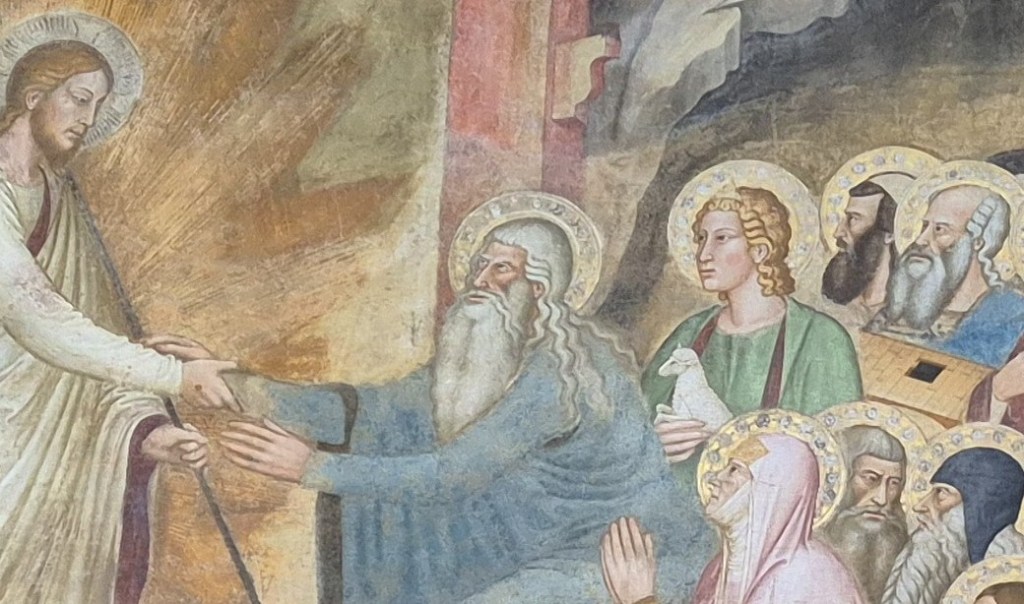
Immediately behind Adam is a young man in green carrying a lamb – surely Abel’s sacrificial lamb – and he is followed by Noah, clutching the model ark with a hole in the roof, not unlike the one we’ve seen before. This is effectively – with the exception of one unidentifiable figure – the same order as in Fra Angelico’s painting. This fresco could even have been his model. As the mother convent of his own, it is extremely likely that Fra Angelico would have been familiar with the Chapter House in Santa Maria Novella, and as an artist, he would have been especially interested in the work of his artistic forerunners. I can only assume that the three ears of wheat in the Fiesole predella panel are a reference to an obscure element of Dominican theology… unless you know otherwise?

Further back Aaron and Moses are standing next to David, and beneath the latter’s harp is St John the Baptist, who, as a relatively recent arrival, still appears to be making his way to the back, introducing the saviour to people who would never have seen Jesus in the flesh before. Again, the arrangement is not entirely dissimilar to Fra Angelico’s composition. I think Eve is also one of the number, as is Mary’s mother, St Anne – but not in this detail: I will come back to them next week. Before then, though, we will explore San Domenico, and it’s daughter house, San Marco, in the talk on Monday.

 dr richard stemp
One thought on “259 – There are more things in Heaven and Earth…”