
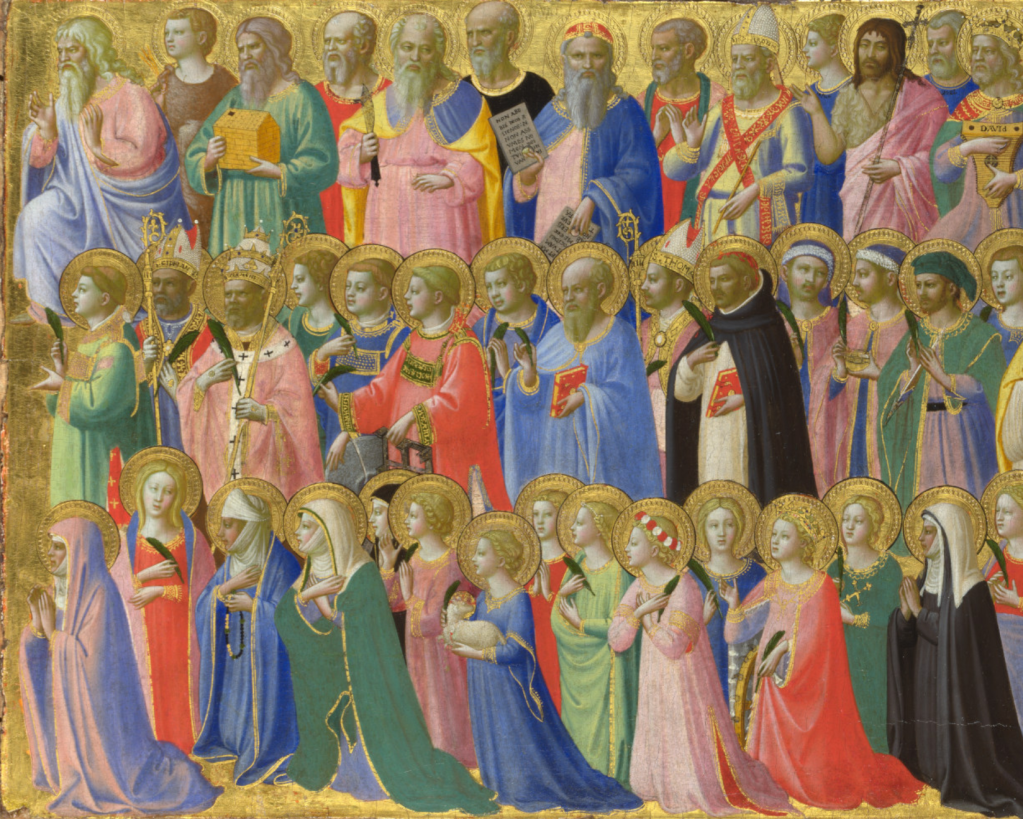
Fra Angelico, The Forerunners of Christ with Saints and Martyrs and The Dominican Blessed, about 1424-25. The National Gallery, London.
This week I reach the end of my exploration of the Fra Angelico exhibition in Florence, looking at his Students and Successors on Monday, 3 November at 6pm. This will include popping back into the Palazzo Strozzi to see the last section of the exhibition I haven’t covered, dealing with the work that he – and his workshop – carried out in Rome. It will also introduce the ‘School of San Marco’ with a rich array of paintings by artists who flourished in the 16th century whose work, like the work of Fra Angelico himself, can best be seen in San Marco itself. If you haven’t managed to catch all four of the talks, I did a slightly reduced version for ARTscapades, and they are still available as ‘catch up’ recordings of two study evenings which I named (slightly inaccurately it turns out) as ‘Origins’ and ‘Influence’.
After so much time among religious orders, I will take a week off before switching to political radicals, with the socially engaged and artistically engaging works of Seurat and his Neo-Impressionist circle. The talk, Radical Harmony, will introduce the National Gallery’s popular exhibition of Helene Kröller-Müller’s Neo-Impressionists on Monday 17 November. I will then move back a century, and to the Enlightenment, with another National Gallery exhibition, Wright of Derby: From the Shadows on 24 November. The last two talks this year will look at two single-painting exhibitions, Double Vision: Vermeer at Kenwood (at Kenwood House, Hampstead) and Caravaggio’s Cupid (at the Wallace Collection), on 1 and 15 December respectively. They’ll go on sale soon, so keep your eye on the diary!

If you read last week’s post you’ll realise that I’m playing catch up. Last week I wanted to talk about all of this painting, the panel to the right of centre of the predella from Fra Angelico’s Fiesole Altarpiece, but I realised that there was just too much to say. So this week I will look at the rest of this panel, and cover the two outer panels as well – although maybe not in quite so much depth. Having talked about the top row of figures already – the forerunners of Christ – what remains are the Saints and Martyrs. I’ll start in the centre row, going from left to right, and then carry on with the bottom row from right to left… I’ve found a different digital file for this week – one which is embedded in the online catalogue entry by Dillian Gordon – and I’m using that here as it isn’t cropped as close as the other version available on the NG’s website. If you look closely you can see the wooden edge of the panel, and the barb where the engaged frame has been removed. Using this one allows you to see the figures round the edges more fully.

The five figures we can see clearly in this detail are all carrying palm leaves – a symbol of victory over death, and often held by angels who are about to hand them to someone who is being martyred: these people are all martyrs, they were all killed because of their beliefs. At the front of the group, on our left, is the protomartyr, the first person to be killed because he was Christian: St Stephen. His story is told in the Acts of the Apostles, Chapters 6 and 7. A deacon in the early church, he criticized the Sanhedrin for not following God’s law, and this led to him being being dragged out of the city of Jerusalem and stoned. He is often shown with a stone, or stones, resting on his head or shoulders, and there is one, looking like a small white blob, at the top of his back where the green robe joins his gold collar. Behind him are Sts Cyprian and Clement, a bishop and a pope respectively, whose names are written on the gold bands of their hats. The next two, in blue and red, have the same robes as St Stephen, with a small, patterned rectangle in front of their chests, apparently hung over their shoulders. They must also be deacons. One supports a millstone, and the other, a grill: the latter is perhaps one of the better known saints, St Lawrence. The other is St Vincent of Saragossa, who was thrown into the sea with this millstone tied around his neck. However, as so often in the attempt to murder Saints, this didn’t work: even tied to a millstone his body floated to the surface.

Moving further back the first two of of these martyrs cannot be identified, but they are followed by St Thomas Becket, Archbishop of Canterbury, whose name is on his mitre. He was a widely revered figure, and, with a feast day on 29 December, he was a regular part of the extended Christmas celebrations. There was a chapel dedicated to him in Santa Maria Novella, the mother church of San Domenico for which this predella was painted, which might explain his inclusion here. Next to him is the early Dominican martyr, St Peter, his head and shoulder red with the blood from wounds inflicted by the cleaver (head) and dagger (back) with which he was killed. The two men in pink, with blue hats (rather than the red, which becomes more common) are the brothers Cosmas and Damian, doctors, who are best known as patron saints of the Medici family because, unlike the Medici, they were actually medics. However, at the time this was painted the Medici had not yet attained the level of power, or patronage, for which they are now famous, and the inclusion of Cosmas and Damian in this image relates to their high status within the church from as early as the 4th century.

In this detail, the man holding an arrow at the far left is assumed to be St Sebastian – even though he is fully dressed. This seems unusual in Tuscany, where he is almost always depicted in little but a loin cloth (however, he is often shown as a young, well-dressed nobleman in the Marche – notably in paintings by Carlo Crivelli). It is not as if a saint couldn’t be shown nearly naked: the hermit Onuphrius on the opposite panel is wearing nothing but a garland of leaves around his waist, for example. The bishop saint, holding a heart with ‘yhs’ (an abbreviation of ‘Jesus’) inscribed on it many times is St Ignatius, Bishop of Antioch, and the soldier with a silver helmet could be St George – but there are plenty of other soldiers to choose from, if we’re honest, and without a dragon we can’t be sure. It is suggested that the man with blood round his forehead could be San Miniato – but he had his head chopped off at the neck, so this wound would seem irrelevant. St Nicasius of Rheims had the top of his head removed, but he doesn’t seem to have been revered much outside of France. However, his story is told in the Golden Legend, apparently – and as that was compiled by a Dominican, Jacopo da Voragine, it would have been well known among the Dominicans who commissioned (and painted) this altarpiece. The identification of St Christopher seems more secure, even if he doesn’t appear in the way you might expect (the Christ Child is not sitting on his shoulder). As a giant who acted as a ferryman across a deep river, he usually carries a staff, which, given his size, is often shown as an uprooted tree – and he is certainly carrying one here. Also, given that he was regularly striding through water, he tends to have bare legs. This figure is one of the four in the predella who are kneeling on one knee rather than two (I mentioned them last week), and this allows Fra Angelico to show that he does indeed have bare legs. Finally, we have Sts Sixtus II and St Erasmus, another pope and bishop, who once more are identified by the inscriptions on their hat bands. However, for three of the martyrs here there is no possibility of guessing who they are – which again begs the question: did Fra Angelico know? Given that there is no documentation for the altarpiece, it is very hard to say. In most commissions for altarpieces, or any church decoration, the patron would get advice from a religious figure, and usually someone from the church for which the work was being commissioned, to help in deciding who or what should be included, and this advisor could also make suggestions to the artist. But in this case, the artist was one of the patrons, as he was painting for his own church. He, and all of his fellow friars, were very well educated… so they could have discussed it amongst themselves. Alternatively, they could have turned to the prior – or some especially gifted theologian among their number – for advice. It seems likely that the Fiesole Altarpiece as a whole was one of the first paintings that Fra Angelico executed on taking the Dominican habit – and I wonder if he is including all of these saints, martyrs, and forerunners of Christ as part of his preparation, or as ‘revision’ of what he has learnt so far having joined the order? I even wonder if these are the ‘notes’ he is taking to visualise – and so learn – who all the saints and martyrs were.

Apart from the Virgin Mary, in the position of honour at Christ’s right hand (at the top right of the left-hand panel), this is the first time we have seen any women. So here they are, finally, on ‘the distaff side’ – at the left hand of Jesus. Unfortunately, though, there is very little that is certain, and few clues to identify the paltry number of figures represented – but then, this was an all-male convent. The woman carrying the cross is St Helen, mother of the Emperor Constantine, who travelled to the Holy Land and discovered the True Cross – the Cross on which Jesus was crucified. Her name is also written on her crown: Sancta Lena. Behind her is a nun carrying a lighted candle. This is St Bridget of Sweden – who we will see on Monday in a later painting by Fra Angelico: the reason for the candle will become clear. Before founding her own order (the Bridgettines), she had been a Franciscan tertiary – one of whom is shown in the Franciscan habit, with a rope belt, just next to her… This could be one of her companions, I suppose, but there is nothing to say precisely who it is.

Again, with the exception of St Catherine, with her wheel, in the centre of this detail, it is hard to tell who any of the figures are – although the woman carrying a cross just next to her is probably St Margaret of Antioch. However, like St George, without her dragon we can’t be sure (there are some tentative suggestions for more of these saints in the catalogue entry, if you would like to follow them up). The fact is, although the names of many saints were known, it’s not as if anyone had researched them and their history. The Golden Legend, the collection of stories of the lives of the saints which I mentioned earlier, was gathered together in the 1260s by Jacopo da Voragine, a Dominican friar and later Archbishop of Genoa. The fact that he was a Dominican is probably not coincidental – but everyone knew the Golden Legend anyway: it was one of the texts which was used to teach people to read.

Even at the front of the group, closest to Jesus, the identification of these women is not obvious – with the exception of St Agnes. She is usually shown carrying a lamb (‘agnus’ in Latin), but here it has become, specifically, agnus dei, the Lamb of God, with the addition of a crossed halo and a red wound in the chest. This is relatively rare, but not unknown. Two of the women are not carrying palms leaves – so they must be saints who were not martyrs. The catalogue suggests they could be Mary and Martha – i.e. Mary Magdalene, identified since the time of Pope Gregory the Great as Martha’s sister – but I can’t see any signs or symbols which could confirm that. Neither is wearing red, nor are there signs of penitence, to imply that one of them could be the Magdalene. Nor is there a jar of precious ointment, which, with her long red hair, is her main attribute. Even the identity of the woman at the front of the group is not clear. She is not a martyr – unlike the woman in red next to her, who is holding a palm leaf. The first female martyr is said to be St Thecla, a follower of St Paul, although as her life is first reported in the apocryphal Acts of Paul and Thecla, dating to the second half of the second century, her feast day was removed from the General Roman Calendar in the 1960s. Nevertheless, she is still revered in some churches, and would have been, generally, in the 15th century. It would certainly make sense to have the female protomartyr just below St Stephen, her male equivalent. However, if this is her, this is the first time I have seen her in a painting. This leaves one last woman, the closest woman to Jesus after the Virgin Mary, but who would that be? The National Gallery catalogue states, quite simply, that it is ‘Saint Anne (diagonally opposite the Virgin)’. This would make sense, but there is no visual evidence to support the identification, nor have I ever come across ‘diagonally opposite’ as a category. Not only that, but I can’t think of another representation of St Anne by Fra Angelico, and I have a feeling that the Dominicans weren’t especially interested in the story of the Virgin’s origins. The Immaculate Conception was a specifically Franciscan doctrine, and the feast day was not approved for the church as a whole until 1476 – and that was by a Franciscan Pope, Sixtus IV. Not only this, but St Anne usually – but not always – wears red: this woman wears a cangiante blue/pink robe. You could argue, of course, that Fra Angelico doesn’t always use the ‘standard’ colours, and indeed, that these colours weren’t ‘official’ anyway. For example, he dresses St Peter in yellow and pink rather than yellow and blue, as we saw when we looked at the opposite panel a couple of weeks ago. However, the blue/pink colours of this woman’s robes are the same blue and pink as the clothes worn by Adam, two rows above her. If Adam leads the forerunners of Christ, who better to lead the only row of women than Eve? A comparison with Andrea Bonaiuti’s Harrowing of Hell (also known as The Descent into Limbo, by the way) might help here, as it did last week.

In Bonaiuti’s painting, Adam is wearing a long blue robe. At his left side (the ‘distaff side’) – just in front of him from our point of view – is a woman in pink. Who else would this be at the front of the gathering than Eve? Fra Angelico’s work for San Marco makes several references to paintings in Santa Maria Novella – most notably the Crucifixion – and I think this is another example. I’m sure that, in this predella panel, he is painting Eve – he’s even chosen to paint Adam and Eve in similar blues and pinks. Bonaiuti shows another woman, in red, in the top row, and this is a similar red to the one worn by St Anne in Masolino and Masaccio’s Virgin and Child with St Anne in the Uffizi. Having said that, I can’t see any reason why St Anne should be placed here in the crowd. At Noah’s left hand, this woman is far more likely to be Mrs Noah, who had a far greater presence in Christian mythology than she does in the Bible.


The remaining two panels include characters we have already met, and who we will meet again when we discuss the School of San Marco in the talk this coming Monday. Narrower than the other panels, they were placed at the base of the two pilasters on either side of the altarpiece. They frame the rest of the predella, and all of the people depicted have something in common: they are members of the Dominican Order, the Order of Preachers. You can see this clearly: they are all wearing the black and white habit – although, if you look closely, a few people are wearing minor variants, a result of their differing status within the order. They kneel in adoration of Jesus and of the heavenly host – which they frame – and, in doing this, they are effectively the predecessors of the Dominican intercessors who are present in the frescoes of Fra Angelico we saw in last Monday’s talk: people setting a good example which we should follow. And the people depicted here are especially good. All but two have beams of light radiating from their heads – and at this point in history, that means that they are on their way to Sainthood, but haven’t got there yet, so are not worthy of a full halo. They have been beatified as a result of their sanctity, but, as yet, no miracles have been performed in their name, so they have not yet been canonised as Saints – although after this image was painted, some were.

This is the bottom row on the left hand panel. The four women at the front wear a white tunic and scapular just like the men above them, but rather than the black, hooded, cappa they have a black cloak, and a black veil over their heads. They are Dominican nuns – considered the secondary order, with the friars as the primary order. Behind them is a man who appears to be one of the friars, but he is wearing a black scapular, rather than a white one. He is a member of the tertiary order – the third order of Dominicans. He follows the Rule of St Dominic, but does not live in the convent – he lives at home, and carries out the normal life of a layman, while remaining entirely devout.
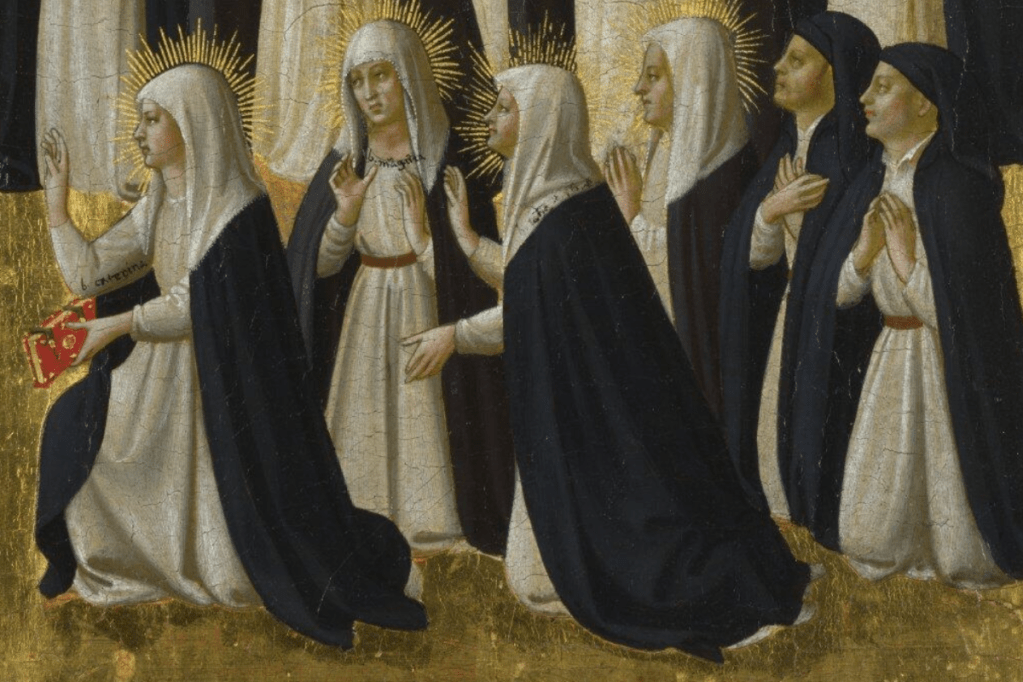
On the other side there are four more women, but they have a white veil over their heads, rather than a black one. Rather than nuns, they are female tertiaries – who, like the male tertiaries, also live outside a convent while following the Rule. Behind them are two men dressed a bit like the others in black and white, but we can see their belts clearly: they are not wearing the scapular, and nor are they wearing the cappa. They wear a cloak without a hood, but they do have black hats. Also, unlike the others in these two panels, they do not have the radiance of the Blessed. In some way they must be related to the commission, they could even be the patrons of the altarpiece. As I’ve said before, though, the Fiesole Altarpiece was paid for by the bequest of Barnaba degli Agli (hence the appearance of St Barnabas, the ‘fourteenth apostle’, on the altarpiece and in the predella). These may be some of his relatives. Dillian Gordon suggests they could be Jacopo and Domenico, two of his sons, as he left his ‘right of patronage’ of the convent to them: their appearance here makes perfect sense. If you want to know more about the Blessed who can be identified it would be worthwhile consulting the catalogue yourselves, as I only want to mention three of them.

All are labelled, either in black or white script, and usually against their white or black clothing: the writing reflects their Dominican heritage. However, this man, in the top row, and closest to the centre on Jesus’s left – so the highest in status on this particular panel – has his name written on his open book. His mitre – the two-pointed hat – tells us he was a bishop, and the open book suggests he was either a preacher, or was learned (or both). That might not help much, as this is the Order of Preachers, so they all preached, and they all had to be learned in order to preach orthodox beliefs as part of their mission to combat heresy. However, they had to learn from someone. Even a scholar as great as St Thomas Aquinas had a master – and this is the man. The Blessed Albertus Magnus, as he is named here (c. 1200-1280), was a German Dominican who wanted to align Aristotelian philosophy with Christian belief, a task that St Thomas Aquinas perfected. He was finally canonised, as St Albert the Great, in 1931.


Two rows below him is the most important of the women in the right panel. She is named as ‘b. caterina’ – Beata (or Blessed) Catherine. Look at the delicacy with which she is painted – the tiny dots of white marking the fringing all around the hem of her headdress, for example, and the gilding of her bible, including the edges of the leaves of parchment. A Dominican tertiary who used her freedom to travel widely and speak truth to (male) power, in 1461 she was canonised as St Catherine of Siena (1347-80) by Pope Pius II – notably a Sienese pope. In 1939 she became co-patron of Italy (alongside St Francis, thus bridging the two major mendicant orders), and since 1999 she has also been one of the patrons of Europe. At the beginning of the 16th century a convent for nuns was dedicated to her on the opposite corner of the piazza from San Marco, and that is where the artist of the image on the right must have learnt to paint: Plautilla Nelli, some of whose works we will see on Monday.


And finally, on the left panel, in the second (or even third?) row down, and third from the right – so in no especially important place – is ‘.b.vi˜ce˜ti.’ – although the squiggles are above the vowels. They mark abbreviations: the Blessed Vincenzo (1350-1419), who was canonised as St Vincent Ferrer in 1455. Given that both St Catherine of Siena and St Vincent Ferrer are named among the Blessed, these names must have been written before 1455. As I said a couple of weeks ago, given that it would have been difficult to add names to the altarpiece after it had been completed – which would have involved either moving a sizeable, weighty altarpiece, or clambering over the altar with the black and white paint – it seems far more likely that these names, and those on the other panels, were part of the original conception of the predella. St Vincent Ferrer would later be painted by one of Fra Angelico’s successors as an ‘official’ Dominican artist, Fra Bartolomeo, and that’s St Vincent, above one of the cells of the extended convent of San Marco, in the detail on the right. We’ll talk about Fra Bartolomeo more on Monday, too – so I do hope you can join me.

If you got to the end of this excessively long post – congratulations! And if you’ve read all four – well, I just hope that they will encourage you to spend more time with the panels themselves the next time you can get to the National Gallery. Thank you!
 dr richard stemp