Day 86 – Ethiopia

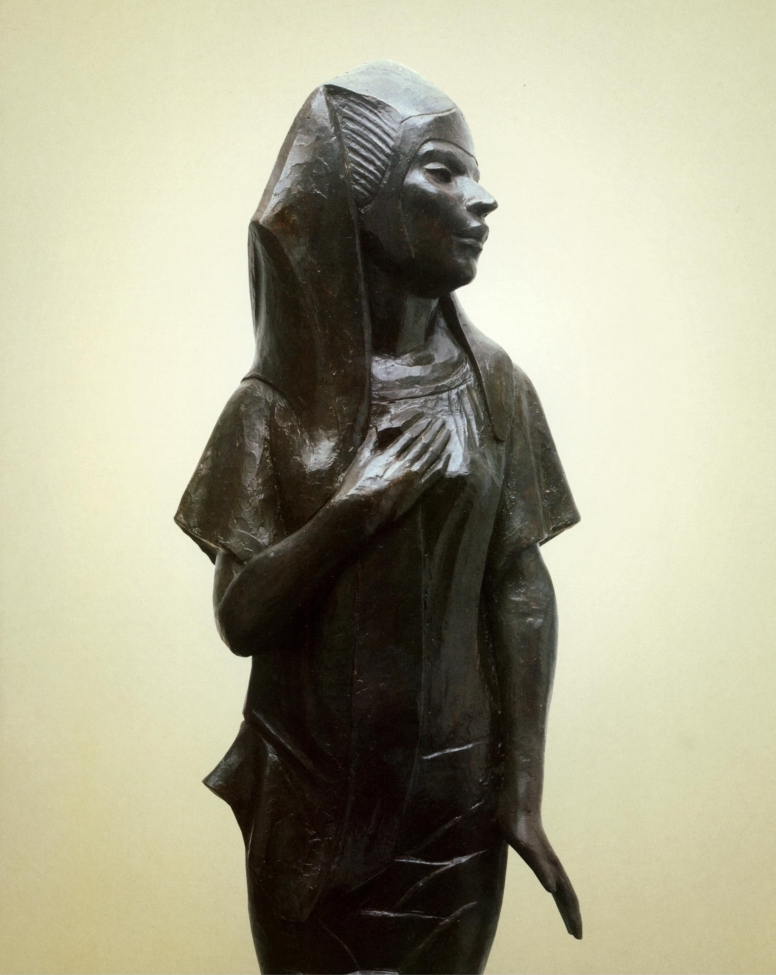
Meta Vaux Warrick Fuller, Ethiopia, 1921, National Museum of African American History and Culture, Washington DC.

Today we make it into the 20th Century – so far I’ve deliberately avoided it, to be honest, for reasons of copyright, but that is the only reason… I’m assuming nothing will happen on this occasion, though. However, despite what I suggested a couple of days ago, I have decided not to confront the angst I thought I might try and deal with – the French press once labelled today’s artist ‘the delicate sculptor of horrors’ – because I wanted to end this mini-survey (to which I will return) with something more positive.

There are various versions of this piece, entitled either Ethiopia or Ethiopia Awakens – or other variations of these terms. You will also find it given a number of different dates, the result of an error in a book from 1940, which dated it to 1914, an error that has often been repeated. A publication from 1943 even said it was created in 1889, which is remarkably unlikely, as Meta Vaux Warrick would have been 12 years old! I am sticking to the date 1921: the work was commissioned for the America’s Making Exposition which took place that year in New York.

Meta Vaux Warrick was the daughter of prominent members of the African-American community in Philadelphia – they were friends with Henry Ossawa Tanner (Picture Of The Day 81), who was to be a great support when she got to Paris in 1899. Her father was a barber and caterer, her mother a wig-maker and beautician for wealthy white women. These included the woman after whom their daughter was named, Meta (pronounced the same as ‘metre’), the daughter of Senator Richard Vaux. By the time Warrick arrived in Paris she was a graduate of the Philadelphia Museum and School of Industrial Arts. Once in Europe, she continued her studies at the Académie Colarossi, well known as one of the first places to accept female students, and at the École des Beaux-Arts. She visited Rodin in his studio at Meudon, and he is supposed to have told her, ‘My child, you are a sculptor; you have the sense of form in your fingers’. To be honest, this is such a ‘typical’ thing for him to have said, I’m not entirely sure that it’s true, although he is known to have been very supportive. Some of her work at the time was very much in his style, as was the work of Camille Claudel, Rodin’s student – and lover: he had that sort of charisma that would knock people off their feet, it seems. Warrick was lucky enough to be exhibited by Siegfried Bing, whose gallery, the ‘House of New Art’, or Maison de L’Art Nouveau, which opened in 1895, gave the movement its name. This really put her name firmly on the Parisian map, and her work was also accepted for exhibition in the Salon of 1903, the year in which she returned to Philadelphia. Her last name – Fuller – comes from her marriage, in 1909, to one of the first black psychiatrists in the United States, Solomon Carter Fuller.

Things did not always go smoothly for her, though. Even on arrival in Paris she was denied access to the American Women’s Club, even though she had already booked a room, because she was black: it was Henry Ossawa Tanner who helped her find lodgings. Back in the States a fire in her studio in 1910 destroyed 16 years worth of work, a disaster which is just one of the reasons why her name is perhaps not as well known as it should be. As her work developed she introduced biblical themes. She was a regular church-goer, but stopped attending when she was faced with discrimination. Nevertheless – and despite its appearance – it was the bible that inspired today’s sculpture.

One of the first people she met in Paris, the author W.E.B. Du Bois, had always been one of her greatest advocates: it was he who came up with the idea for this particular work. The America’s Making Exposition was intended to celebrate the artistic and industrial creativity of the immigrant communities of the United States, and Du Bois was an executive committee member of the section entitled ‘Americans of Negro Lineage’ – Fuller’s sculpture was to feature prominently in the exhibition’s catalogue.

Although Du Bois had more or less described the sculpture he wanted, Fuller developed her own ideas, which are both subtly elegiac and profound. For both of them, however, it was the place that Ethiopia had in the African-American philosophy of the time, particularly in relationship to the church, which gave the sculpture its meaning. The inspiration came from the Book of Psalms, 68:31:

Princes shall come out of Egypt; Ethiopia shall soon stretch out her hands unto God.

This text was regularly cited within African-American churches as prophesying their eventual liberation. As Renée Ator explains in a superb article in American Art (Autumn 2003 – I was hoping to include a link, but sadly that’s not possible), ‘Ethiopia ultimately served two seemingly contradictory purposes. It filled a need for African Americans to formulate an authentic racial identity by looking to the grand achievements of Egyptian history while also supporting the romantic ideal of Christian Ethiopia as a symbol of black liberation’. Fuller herself explained in a letter to a friend,

Here was a group (Negro) who had once made history and now after a long sleep was awaking, gradually unwinding the bandage of its mummified past and looking out on life again, expectant but unafraid and with at least a graceful gesture. Why you may ask the Egyptian motif? The answer, the most brilliant period, perhaps of Egyptian history was the period of the Negro kings.

For African American theorists, the dominance of the Egyptian kingdoms was important, and served as a historical precedent for their own cultural aspirations. Supporters of slavery looked to Egypt as part of a continuum of culture that led through Greece and Rome to modern Europe and thence to the United States, and saw the Egyptian use of slaves as the inevitable domination of one race by another, and therefore, inevitably, a precursor to their own denial of the first sentence of the Declaration of Independence, ‘that all men are created equal’. For the African American community, if the Egyptians were seen as a noble race of Black Africans then the argument that had so incensed Edward Mitchell Bannister (POTD 84), that ‘the negro has an appreciation for art while being manifestly unable to produce it’, was manifestly untrue: like the Egyptians they had a culture of their own. We have already seen the importance of Egypt at the time in Edmonia Lewis’s The Death of Cleopatra (POTD 82), who, like Ethiopia, wears the nemes ­ – the headdress usually worn by Egyptian kings. 

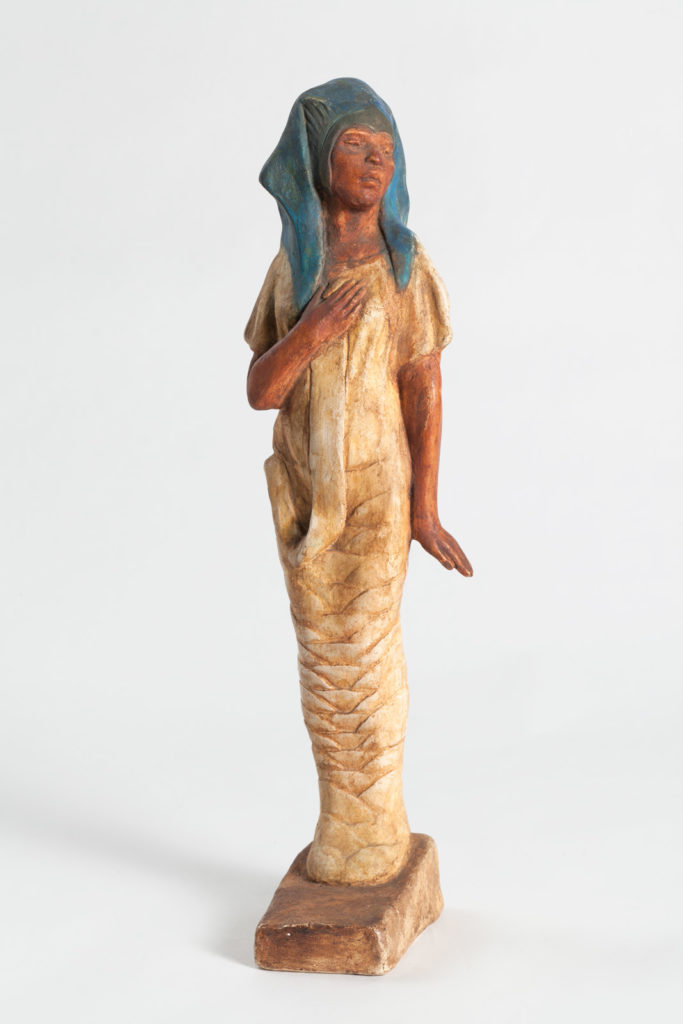
The version of Ethiopia I have shown you so far is made of plaster, painted to look like bronze (Fuller often couldn’t afford to have her sculptures cast), but in a maquette preparatory for the finished work, she uses colour to pick out some of the details, which can make the piece easier to read.

Meta Vaux Warrick Fuller, Maquette for Ethiopia, Danforth Art Museum, Framlingham, MA.

I think it is far easier to see that the bands of the mummified form are starting to unravel, and that the figure holds one end of the bandage against her heart. The legs are still firmly bound, rigid, incapable of movement, but the torso has become more flexible. Both hands can move – the ‘graceful gesture’ of her left hand, and the act of self-liberation embodied by her right. The head also twists at the neck, no longer fixed, staring straightforward, but now able to look around and find a new place in the world. The sense of awakening was important. The Emancipation Proclamation ending slavery may have happened in 1863, but there was still not true freedom, and certainly no equality. Fuller had been a firm supporter of the Equal Suffrage Movement, hoping to get the vote for women, until she found out that black women were not included. However, culturally, things were changing, and, as Fuller hoped, a race which had lived out centuries in mummified subservience was taking hold of its own destiny. Ethiopia effectively serves as a fanfare announcing the birth of the Harlem Renaissance, an explosion of art, music and literature centred in the eponymous New York neighbourhood during the 1920s. Meta Vaux Warrick Fuller was one of the most significant women in this movement, and one of its most important sculptors – I should really talk about it another time. 

Day 85 – The Flight into Egypt

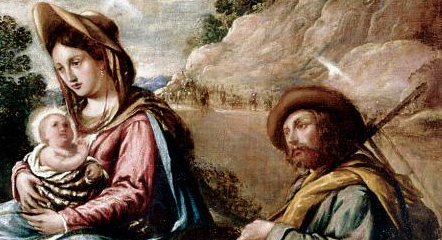
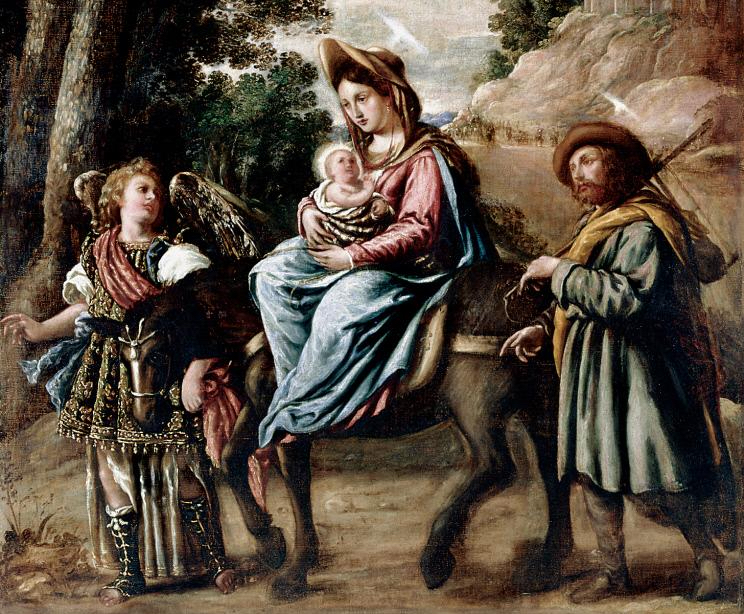
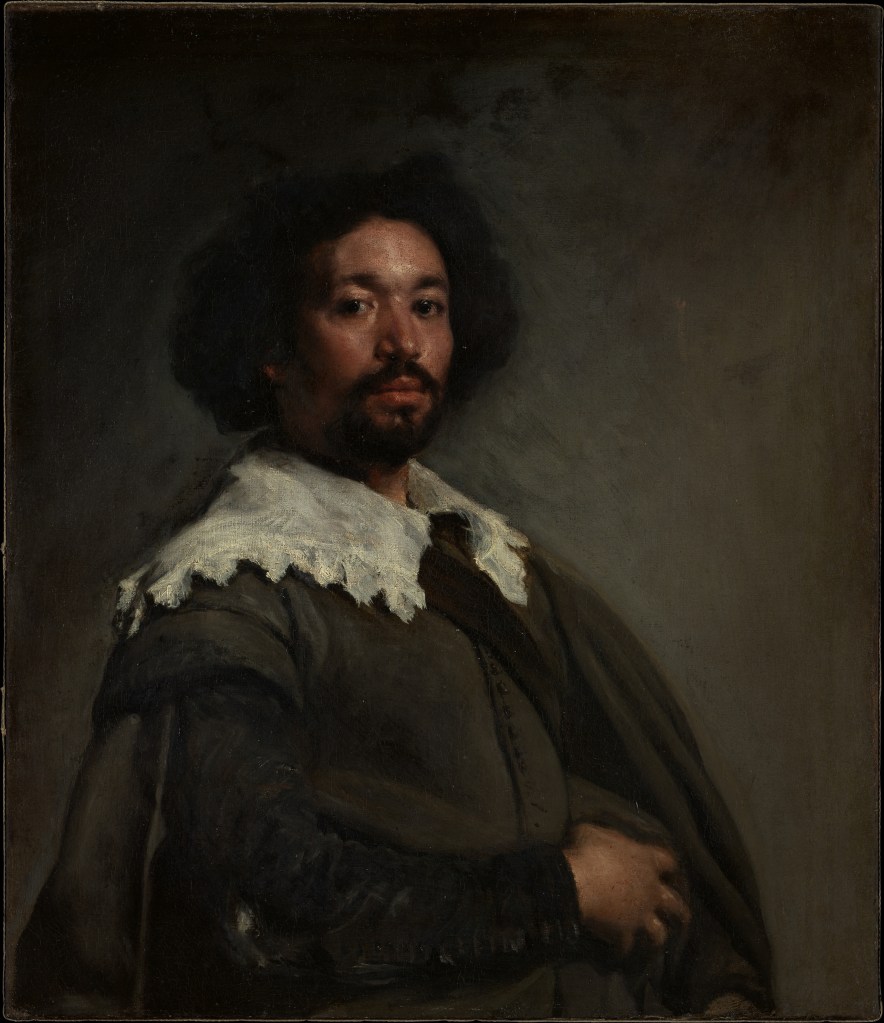
Juan de Pareja, The Flight into Egypt, 1658, The Ringling, Sarasota, FL.

Ah, look, you say – back in our comfort zone. A Spanish artist, a familiar subject. Yesterday I said Europe, I said 20thCentury, I said America – well, two out of three ain’t bad. It’s a European painting alright, in an American collection, but it was painted in the middle of the 17th Century. And just in case you thought I’d shifted away from what I said would be this week’s theme – think again! Juan de Pareja was born a slave, and was owned by Diego Velázquez.

The Flight into Egypt is a common subject in Western European painting, drawing its imagery both from the Bible and from popular retellings of the story. According to Matthew 2:13-14, after the Wise Men had departed, 

 ‘…behold, the angel of the Lord appeareth to Joseph in a dream, saying, Arise, and take the young child and his mother, and flee into Egypt, and be thou there until I bring thee word: for Herod will seek the young child to destroy him. When he arose, he took the young child and his mother by night, and departed into Egypt’

Joseph has several dreams in the gospels, which explains why he is regularly shown nodding off in medieval and renaissance paintings. It’s not just that he was considered to be old (Picture Of The Day 31), although I have already got to the age where I regularly nod off… And in this case, if you actually look at the painting, he isn’t old at all.

With reddish hair and beard, and an unlined face, I could easily imagine him to be in his 30s. This is a feature of Spanish 17th Century painting – and it is partly the result of the visions of St Theresa of Avila (POTD 63). According to Catholic belief, after their marriage Mary and Joseph continued to live a life of chastity – and therefore, both remained virgins. The medieval mindset couldn’t understand how Joseph could live with the most perfect woman ever, and not sleep with her (I’m not convinced that the outlook of some men has changed…). The only explanation they could come up with was that Joseph was, to put it bluntly, past it – and with the account in the Golden Legend that he too considered himself to be old, it’s hardly surprising that that is how he was depicted. In a number of medieval mystery plays he was even treated as a cuckold. Although he was married to a woman having someone else’s baby, that would, of course, have implied that Mary was having an affair with God – so it’s surprising that the church let the actors get away with it. St Bernardino of Siena, the 15th Century Franciscan preacher who first advocated the bonfires of the vanities, was appalled that Joseph should be considered a figure of fun – but it was really St Theresa who called a halt to it all… at least in Spain, where far from being an old codger, he starts to appear as a younger, and more virile man, a suitable step father, capable of working, and of caring for both Mother and Child. 

In between the calm and clearly delineated faces of Mary and Joseph is a distant crowd of soldiers: they have come to look for Jesus and kill him. In the end, as they could not be sure which of the children he was, the ‘slew all the children that were in Bethlehem, and in all the coasts thereof, from two years old and under’ (Matthew 2:16). Mary and Joseph have a curious glow over their heads, Pareja’s version of a halo, a holy emanation, whereas Jesus simply glows – it is not unlike the light you would find around the head of Tintoretto’s holy figures. Indeed, the Venetian influence in this painting is strong, probably the result of the number of Titians in the Spanish Royal Collection. 

Having said that, Joseph reminds of the Christ in Altobello Melone’s Road to Emmaus in the National Gallery – do look it up, but I suspect this is purely chance: both wear similar clothes. With his sturdy leggings, coat and hat, Joseph is dressed far more like a contemporary (17th C.) traveller than a 1st Century carpenter. Mary wears her timeless combination of red and blue, plus a rather jaunty 17th Century hat. And the angel – well, the angel is dressed how the Spanish liked to dress their angels, a pseudo-classical skirt and peep-toe boots, blue and red scarves, plenty of gold and a resplendent pair of wings. The angel is not part of the biblical narrative, but became a common presence in depictions of this story, derived from the messenger who appears to Joseph in his dream, promising to return. He becomes a guardian angel pointing the way, and leading them in safety to Egypt. Joseph effectively becomes the rear-guard – having led the donkey bearing Mary to Bethlehem, he is happy now to be the faithful follower. 

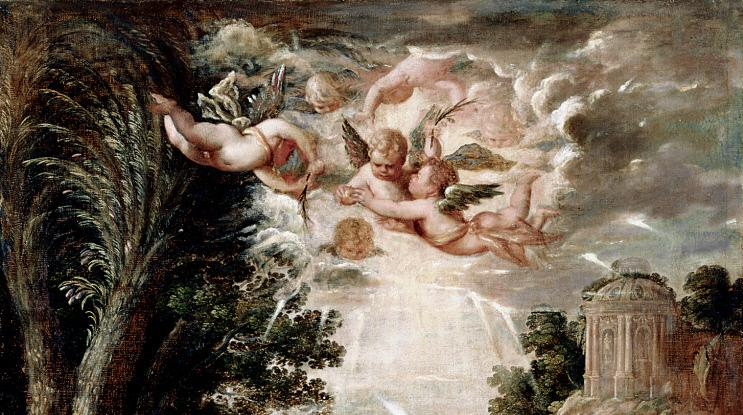
The classical temple on the hillside reminds us that these things came to pass during the reign of Caesar Augustus. And, like the Guardian Angel, the cherubs flying above the Holy Family watch over their progress. However, if I’m not mistaken (and sadly the reproductions I can find are very poor) two of them appear to be holding an apple. This is not something nutritious for the baby, but a reminder that Jesus has come to take original sin upon himself. The branches held by a couple of the cherubs could presage much the same: as palms of martyrdom they are, like the apple, a reminder that this tiny child has come to die. 

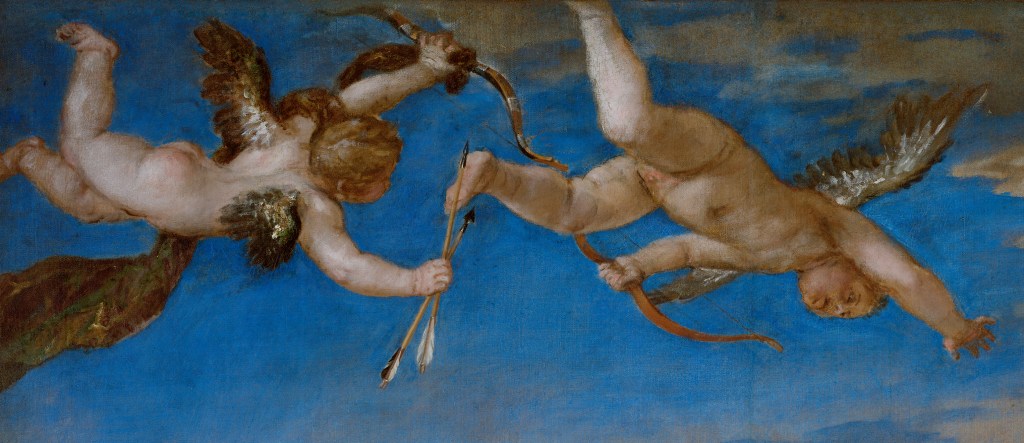
And yet, they do look like the amoretti Titian painted in the sky of The Rape of Europa – the subject of the very first POTD. But then again, as this was painted for Philip II, grandfather of the King alive in Pareja’s lifetime, that is not impossible. It is, however, surprising, that Pareja should be so strongly influenced by Venetian art given that he had been Velázquez’ assistant for nearly 30 years by the time he painted this. He became a free man in 1654, but even after this he continued to work for Velázquez until the master died – at which point he assisted Juan Bautista del Mazo, Velázquez’ son-in-law. I am entirely indebted to my sister, Jane Wickenden, for bringing him to my attention. I was aware of his name, and of the portrait that Velázquez painted of him, but not that he was, himself, an artist. I will tell you more about him another time, when I tell you about this truly glorious portrait.

Diego Velázquez, Juan de Pareja, 1650, The Met, New York.

I will look at more of his work in the future – although only ten of his paintings are known – and I will of course be talking about Diego Velázquez for Art History Abroad at 6pm (UK time) on Wednesday 24 June (yep, if you looked it up, I got the date wrong last time I mentioned it – sorry!).

Day 84 – Boston Street Scene

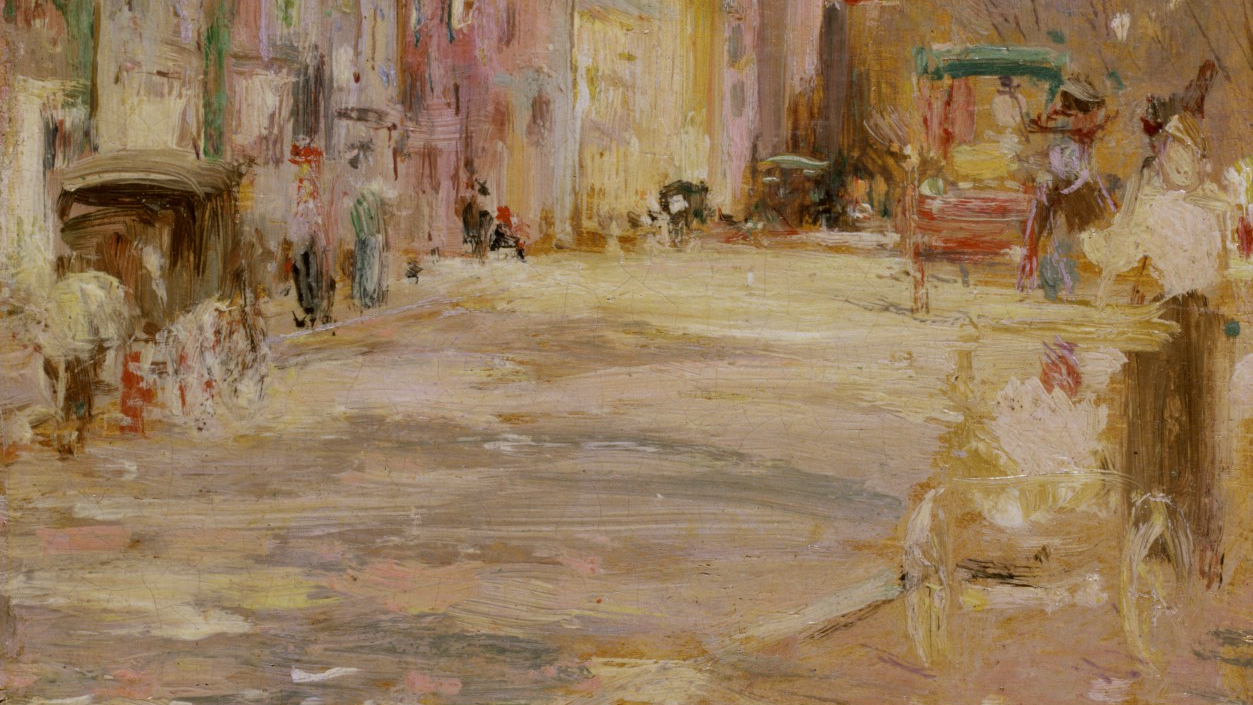
Edward Mitchell Bannister, Boston Street Scene (Boston Common), 1898-99, The Walters Art Museum, Baltimore, Maryland.

Another landscape today, very different in style to yesterday’s, but, in some very subtle way, connected by a common mindset. Edward Mitchell Bannister’s work contains even less reference to social status or racial issues than paintings by Robert S. Duncanson, but, like Duncanson, he creates a world in which liberty and calm seem to dominate, creating a sense of being at ease in a world where nature is essential benevolent.

Having said that, today’s Picture is not typical of his work, as it is a cityscape. Also, unlike most of his more ‘solidly’ painted works, inspired by stretches of barely populated countryside, it is in an avowedly Impressionist style. Like most national schools of Impressionism outside of France, the Americans were late to the party. Whereas the series of eight exhibitions held by the French stretched between 1874 and 1886, it wasn’t until then – 1886, and the end of ‘official’ Impressionism – that William Merritt Chase’s views of New York parks kick-started the American movement. Another of the great American Impressionists, Childe Hassam, had made his name in Boston between 1882-86 painting in a Realist style, before heading to France. It was there that he took on board the lessons of Impressionism, and took them home with him in 1889. By the time that Bannister was painting in 1899 American Impressionism was a fait accompli, but nevertheless, for him this was a new development in a long and successful career. He had been living in Providence, Rhode Island for nearly 30 years, and was visiting Boston when he painted this work. However, what might have been a new direction for his art stopped short: Bannister died two years later, and this was one of his last works.

As it happens, he was not American by birth. He was born in St Andrews, New Brunswick – in Canada – in 1828: he was just seven years younger than Robert Duncanson. His father was a native of Barbados, his mother’s heritage remains unknown. Orphaned at the age of 16, he was fostered by a white family, and destined for a life at sea, like most of the male population of St Andrews. However, he settled in Boston in 1848, and worked as a barber, supplementing his income by hand-colouring photographs – which was also Sorolla’s route into painting, as it happens. Although he had started painting and attending classes in the 1850s and 60s he became determined to become a successful artist through anger, having read an article in the New York Herald which stated, with the assurance typical of the ill-informed, that ‘the negro has an appreciation for art while being manifestly unable to produce it’. Less than ten years later he was awarded the bronze medal for painting (the first prize) at the Philadelphia Centennial – the very same exhibition at which Edmonia Lewis exhibited The Death of Cleopatra (POTD 82). I would show you the painting itself, but sadly Under the Oaks has not been seen since the beginning of the last century. Fantastic, you think, he won the bronze medal. But when the judges found out he was black they decided they had come to the wrong decision. Fortunately, Bannister’s white ‘competitors’ wouldn’t accept this, and the judges were forced to uphold their original choice. A substantial and successful career followed – in 1880 he was one of the seven founders of the Providence Art Club, which is still active today, for example. He was a prolific painter, and, despite his name being forgotten after his death, as those of so many artists of colour were, the Smithsonian American Art Museum, home to both The Death of Cleopatra (POTD 82) and Landscape with Rainbow (POTD 83) owns 122 of his works. 

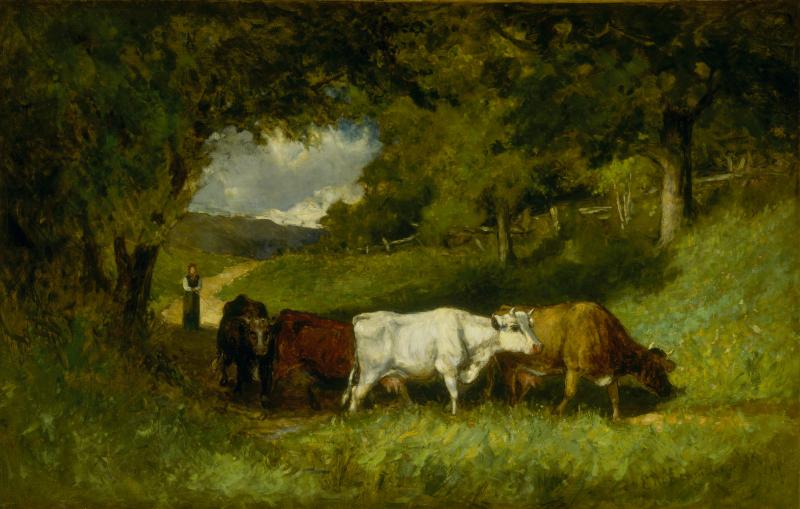
Edward Mitchell Bannister, Driving Home the Cows, 1881, Smithsonian American Art Museum, Washington D.C.

The majority of Bannister’s output – including the 1881 painting Driving Home the Cows – is associated with Tonalism, a predominantly American movement inspired by one of the predecessors of Impressionism – the Barbizon School: think Corot, Millet and Daubigny. His direct source was probably one of the Boston-based Tonalists, William Morris Hunt, as, unlike other successful African-American artists in the 19th and early 20th Centuries, he never travelled to Europe.

I wanted to include this painting, though, because it is unlike anything else of his I have seen. The looser brushwork and lighter, pastel colours had gradually developed through the later 1880s and 1890s, but not quite to this extent. It is, as all good Impressionist paintings are (and there are one or two bad ones!), beautifully composed. The skill of such art is not just painting what you see when you see it, but choosing the right thing to look at in the first place, and the right way of looking at it. The authenticity of plein air painting in front of the motif (i.e. painting outside while looking at the subject – let’s cut to the chase!) has often been questioned. Were they really outside, for one thing? Many of the works were, of course, ‘improved’ back in the studio (but there’s nothing wrong with that). And were they really painting exactly what they saw? Well, no, of course not. They were artists! The main aim was to capture the ‘feel’ of being there. Well, one of the main aims, anyway. And in this case, the painting is dated ‘1898-99’, so even if he had been outside, he wouldn’t have been there all that time. Maybe he, just like Degas – and for that matter, Henry Ossawa Tanner – had recourse to photographs (The Banjo Lesson, POTD 81, was based on pictures that Tanner had taken). 
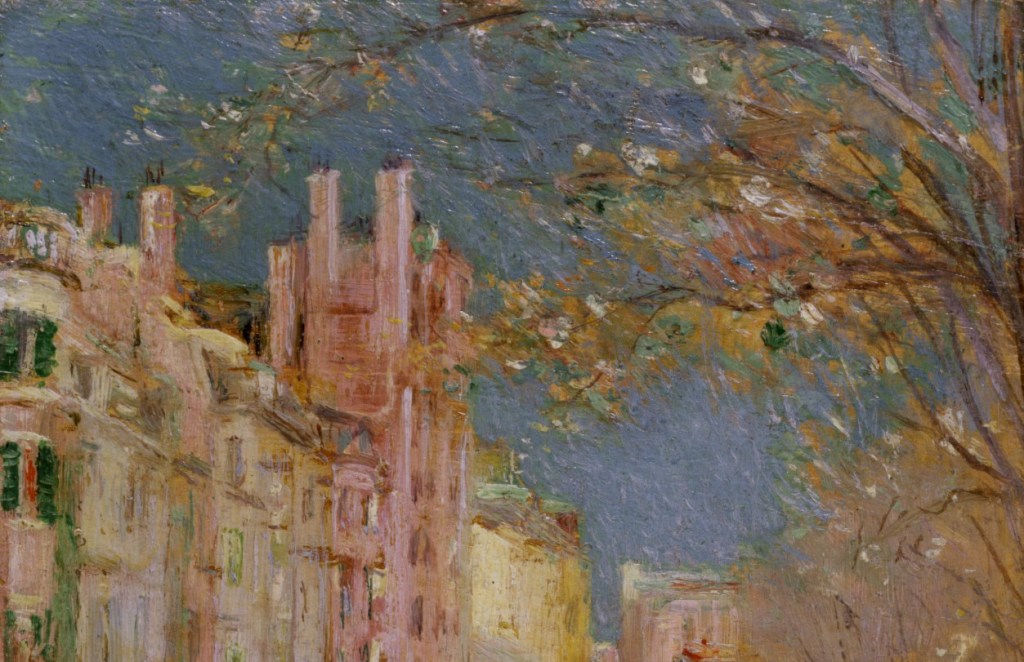
All that aside, we are probably heading along Tremont Street in Boston, with the Common to our right, and buildings – none of which survive, as far as I can tell – on our left. The street cuts in on a diagonal from the bottom left, with the line of the kerb starting in the corner, a favourite compositional device to lead the viewer’s eye into the painting. Here, it takes us to a stroller (yes, this is America) pushed by one of two ladies.

Bannister is using colour to unite the two, rather than painting what he saw, I suspect. The woman on the left, further back, has a brown top, the same colour as the skirt of the woman on the right. The latter’s top is pink – and uses the same colour as the dashes which describe the baby in the pushchair. There is a wonderful freedom in the handling of paint, wet-on-wet, almost scratchy in places, and a real ability to conjure up a sense of time and place. There is so little traffic – unlike late 19th Century Paris – with one horse and carriage coming towards us on the far left, and another heading away in the middle distance on the right – with a few more in the background.

The clear sky is built up from flecks of different blues, laid on top of brush strokes going in all directions. Surrounding the leaves, and what looks to me like blossom, it reminds me of some of van Gogh’s cherry trees. However, as the Dutch artist wasn’t exhibited in America until 1913, and, as I have said, Bannister did not travel to Europe, this is probably coincidental. There is such a delicate touch – the tall pink building is almost sketched in with the thinnest of horizontal and vertical lines building up its form – and across the painting, every window, windowsill and roof, however free, is still surprisingly secure. It is beautifully painted, I think, and I will certainly seek out more. Meanwhile, before tomorrow, we will have to leave the apparent calm of Boston at the end of the 19th Century, and head off to a more angst-laden 20th Century Europe. Although we may find that I’ve had to return immediately to America. 

Day 83 – Landscape with Rainbow

Robert S. Duncanson, Landscape with Rainbow, 1859, Smithsonian American Art Museum, Washington, D.C.

One of the problems with learning is that you keep finding out how much you don’t know. And this week I’m finding out the full extent of my ignorance. I should probably come clean: American art has never been one of my main areas of study, although I know enough about it to know that it didn’t start with the Abstract Expressionists in the 1940s. As the ‘Story of Modern Art’ used to be told, New York became the centre of the Art World after the Second World War – almost as if nothing had happened there before. I do understand the compulsion to pin down one ‘Story of Art’, but nothing is ever as simple as you think. Having said that, when, exactly, did ‘American Art’ get going? Benjamin West, the 2nd President of the Royal Academy, was born in Pennsylvania in 1738: was he an ‘American Artist’? Given that the War of Independence was fought between 1775-83 you could argue that he was not. But at what point did art from the North American continent stop being Colonial and become its own thing? I am, of course, talking about art evolving from the Western European tradition. I know there are whole areas of Native American Art that should be brought into discussion, but as, in this case, my ignorance is complete, I wouldn’t dare to discuss it. 

Some would argue that the first truly American artistic movement was the Hudson River School, a group of landscape artists influenced by Romanticism, and thoroughly in awe of the geography of the North American Continent – particularly, as the name suggests, the area surrounding the Hudson River in the State of New York. However, until the exhibition American Sublime at Tate Britain in 2002 I was completely unaware of it – and have subsequently seen very little: relatively few 19thCentury American paintings are held in British collections, and I don’t think I’ve been to the States since 2004…

One of the key paintings of the Hudson River School is Frederic Edwin Church’s Niagara – capturing the full scope and scale of the waterfall. It was enormously successful when first exhibited in 1857, and, at the time, it was suggested that no one would paint a landscape as grandiose again. However, that is precisely what Robert S. Duncanson attempted to do in his Landscape with Rainbow just two years later.

But who was Duncanson, and why have I never heard of him before? As my knowledge of Church’s work is limited, maybe I shouldn’t be surprised, but judging by the title of a Smithsonian Magazine article published in 2011, I am not alone: America’s Forgotten Landscape Painter. I will give you a link at the end of the blog. What becomes clear is that however successful Duncanson had been, his name disappeared from the singular ‘Story’ of art shortly after his death in 1872. In his day he had been big – very big. And not just in the States – in Canada he was seen as one of earliest ‘cultivators of the fine arts’, and on a visit to London he was declared a master of landscape painting. 

Robert S. Duncanson, Land of the Lotus Eaters, 1861, The Royal Collections, Stockholm.

On one occasion he even visited Alfred, Lord Tennyson at his home on the Isle of Wight, taking with him what is now seen as his masterwork, Land of the Lotus Eaters – inspired by the Poet Laureate’s similarly-titled poem. Given that it measures 225 x 134 cm – not quite as wide, but bigger overall than Church’s magisterial Niagara – that must have taken some doing. He was a determined man. The effort certainly paid off, as Tennyson reassured him that, “Your landscape is a land in which one loves to wander and linger.”

Art Historians argue about the extent that issues of race were important in the work of the man who is arguably the first successful African-American artist. In a letter to his son, Duncanson himself said,  “I have no color on the brain; all I have on the brain is paint.” However, in Land of the Lotus Eaters the ease and comfort enjoyed by the lucky few – inevitably white – is only possible because they have black servants. In other paintings there are similar references: painting the world around him, they would have been impossible to avoid. But Duncanson’s main concern was to be an artist, which, under the circumstances, was statement enough.

Race is not, it would seem, the ‘subject’ of Landscape with Rainbow: there are only two people, and both are white. Given their clothes – his trousers are rolled up, her skirt is lifted, revealing a petticoat, I would assume they are children, perhaps put in charge of the herd of cows which wander along the road. He carries a stick, and gestures towards the rainbow.

Duncanson leaves no doubt that this is the main focus of the landscape. It burns through the sky, almost more like a multi-coloured meteor. Each of the seven colours appear, even though they fade in and out as is so often the case when seen for real, with sporadic rain, and uncertain light. In addition to its brilliance, we are directed towards it by other elements of the composition. Not only does the boy point to it, but the track on which the children stand, along which the lowing herd winds slowly, is leading towards it. There are also flashes of sunlight, one illuminating the foreground directly under the children, another catching some rocks and plants below the right-hand trio of cows, which together form a virtual path of light towards the rainbow’s mythic golden end. 

Is it a coincidence, therefore, that more or less at the end of the rainbow there is a house? I really wouldn’t think so. An artist chooses what to paint and where to paint it – he must have had a reason to include the house. Sometimes choices are governed by style, or ethos, the decision to replicate what can actually be seen, and sometimes, by the will to summon up a world that is pure imagination. Unlike Church’s Niagara, inspiring awe by encompassing the grandeur and sheer scale of geological fact, Duncanson wanted to create a mood, by sharing an idea: there’s no place like home.

The fact is, if this is a real place, the both light and weather have gone awry. For one thing, you only get a rainbow when there is both sun and rain, and I can’t see that there is enough cloud. That could be something to do with the photographic reproduction, I suppose, but I doubt it. And where, precisely, is the sun? When talking about Constable’s Salisbury Cathedral (POTD 47) I explained precisely why you could never see a rainbow as Constable had depicted it. And I suspect the same is true here.  It’s such a masterful painting, that I can’t actually tell where the light is supposed to be coming from. The mood is crepuscular – the purple distant hills, the sense of plodding homeward, the gradual darkening of the sky, and above all, the brilliant yellow light on the distant horizon, suggesting it is sunset. But if the sun is in the distance, there is no way we could see a rainbow here, nor could there be a rainbow here. And we couldn’t we see a rainbow in the same place as the children do, they are too far away. But this is art, and the meteorological incongruities do not matter. This is a magical, enchanted place – every cloud is lit from a different direction, to make each look real, rather than actually being real. What Duncanson has painted is an ineffable sense of calm.  The cows head home, the children follow them, all will be well. And that is, of course, the standard symbolism for the rainbow – all will be well – as defined by God’s covenant with Noah (POTD 37).

Robert S. Duncanson, View of Cincinnati, Ohio from Covington, Kentucky, about 1851, Cincinnati Art Museum, Ohio.

Robert S. Duncanson was an African-American artist painting this landscape in 1859, two years before the outbreak of the Civil War. The Southern Confederate States, who continued to support Slavery, would fight the Northern Unionists. An earlier painting, dating from around 1851, is entitled View of Cincinnati, Ohio from Covington, Kentucky. Of all of Duncanson’s landscapes, this is – potentially – the most overtly political. The Ohio River, which separates Cincinnati and Covington, was one of the boundaries between North and South.  Duncanson – born free in 1821 in Fayette, New York – spent much of his life in Cincinnati, also in the ‘free’ North. It can be seen in the background of the painting, populous and thriving. In the foreground, in Covington, black slaves are labouring on the plantations under the watchful eye of the white owners. When Landscape with Rainbow was painted some eight years later, the war was still two years away, but tensions were rising. Nevertheless, the painting gives the sense that there might yet be the possibility of peace. It hints that there might just be somewhere idyllic, calm – Arcadian, even – where people could live in peace and harmony. Somewhere over the rainbow, perhaps?

If you would like to know more about this wonderful artist, I really recommend the article I mentioned above, America’s Forgotten Landscape Painter.

And on a completely different note, Art History Abroad has just announced my next online lecture, at 6pm on Wednesday 24 June: Reflecting on the Power of Art – Diego Velázquez.

Day 82 – The Death of Cleopatra

Edmonia Lewis, The Death of Cleopatra, 1876, Smithsonian American Art Museum, Washington, D.C.

Today I’m finding it hard to say who or what had the most unusual history – the artist or their art, the subject or the sculpture – and given the fame of Cleopatra, Queen of Egypt that’s really saying something.  But Edmonia Lewis was a remarkable woman, and, if anything, her history is further shrouded by the mists of time, and by whims of the imagination, than that of her famous subject. So let’s start with the sculpture. Cleopatra is seated on her throne, her left arm hanging down, her right hand resting on her thigh, her head tilted to one side, for all the world as if she has just nodded off. But as we know from the title, carved on the base of the sculpture, this is the sleep of death. Rarely has it been portrayed so calmly.

Intricately carved, you may yet be struggling to focus on some of the details: the sculpture is badly worn, the result of an unconventional history. Cleopatra wears an approximation to the headgear of Egyptian pharaohs, a combination of the nemes – the striped head cloth, with its two lappets hanging down behind the ears (familiar to us today from the mask of Tutankhamun) – with a form of pinnacle, perhaps derived from the hedjet – the white crown of Upper Egypt. The stylised leaf decoration on the back of the throne creates a foil to the crisply-carved folds of the dress, making the figure stand out from its background. The half-length sleeves are caught up twice into bunches, and the dress is gathered at a high waist, so that there is a counterpoint between the freely-hanging, more deeply carved drapery and broader areas where the cloth clings to the underlying anatomy. One breast is defined by fabric and folds, the other revealed. Her right hand, apparently relaxed, still holds the asp that killed her.

The queen wears two necklaces, both beaded, and the lower also has a pendant, possibly representing a bucranium– the skull of an ox – although, given the lack of detail, this is not certain. The full skirt flares out behind her hips, and hangs over the arm of the throne, which is carved along the sides with mock hieroglyphs.

The two heads on the arms of the throne, also wearing the nemes, represent the twin sons of Cleopatra and Mark Anthony. Whether the ring she wears on the fourth finger of her left hand represents her relationship with him, or is merely decorative, is not clear. She wears wonderfully inventive sandals, the large loops revealing her delicately carved toes, the smallest of which is slightly lifted. The skirt of the dress hangs down from her knees, wrapping round her left shin, with the hem to revealing her feet. From there, it trails down to the right, falling over the edge of the sculpture. A rose has dropped onto the foot of the throne, and lies there, resting on the dress, the fallen bloom symbolic of the subject’s death. 

On one side, as we have seen, the arm of the throne is covered by drapery. The other is decorated with a leaping griffin holding a leaf in its front paw, and surrounded by other, stylised leaves. From this angle, the tail of the asp can be seen lying across Cleopatra’s right leg.

The Death of Cleopatra was first exhibited at the Centennial Exhibition in Philadephia in 1876, but it had been shipped from Rome. Edmonia Lewis had settled there a decade before, having travelled from Boston via London and Paris. However, it is only the middle of her life that can be documented with any certainty. She was probably born in 1844 in the State of New York, to an Afro-Haitian father and a mother of mixed heritage, African American and Chippewa: as an adult Lewis would claim an affinity with Hiawatha. Both parents had died by the time she was nine, when she was brought up by her maternal aunts. As she said of her own childhood,

Until I was twelve years old I led this wandering life, fishing and swimming … and making moccasins. I was then sent to school for three years… but was declared to be wild – they could do nothing with me.

Apart from this it is hard to pin down her childhood. Like so many artists she became the master of her own history, and like Andy Warhol or Tracey Emin, was arguably her own greatest creation, drawing on different parts of her heritage according to the public she was addressing. She was good at marketing, it would seem, even if not financially secure. Her half-brother had made enough money in the Gold Rush, though, to send her to Oberlin College, which accepted both female and black students. Nevertheless, as part of a tiny minority she was subject to continual racism, and forced to leave after unfounded accusations that she had poisoned two fellow students and stolen from the College itself. She moved to Boston (again, supported financially by her brother), where the sculptor Edward Beckett acted as a mentor and helped her to set up her own studio. Her work was supported by a number of prominent abolitionists and advocates of Native American rights, of whom she modelled portrait medallions in clay and plaster, later carved in marble: one example is illustrated here. Her bust of Colonel Robert Shaw, a white officer who had led a company of African-American infantrymen during the Civil War, was enormously successful. She sold numerous copies, these sales paying for her trip to Europe.

Edmonia Lewis, Wendell Phillips, 1871, NPG, Washington D.C.

In Rome, she was befriended by American sculptor Harriet Hosman, who, like Lewis, was one of very few women to carve marble. On the whole, sculptors would pay stonemasons to carve their works, having first modelled them in clay or plaster. Figures as eminent as Canova would do this (Picture Of The Day 68) but Lewis could rarely afford to pay anyone, so did most of the carving herself. Nevertheless, the connection with Canova was real: when in Rome, she did as he did – and rented his former studio.

The Death of Cleopatra is said to have taken her four years, but by the time it was completed she couldn’t afford to ship it to the States. She travelled back alone, and sold smaller works to pay for it to be delivered. It was the hit sculpture of the Centennial Exhibition, although not universally popular. Traditionally Cleopatra had been seen as very much alive – decorous, alluring, and tantalising with that oh-so-dangerous asp. But definitely not dead. Curiously, there is a precedent – Artemisia Gentileschi painted Cleopatra post-bite, her lips already blue, but I doubt that Lewis would have known that. No slight on her – nobody really knew who Artemisia Gentileschi was in the 19th Century: they were only just rediscovering Caravaggio. 

In this sculpture there is an undoubted sense that Cleopatra, as a strong African woman, had a mastery over her own fate, and Edmonia Lewis, who is also known to have claimed her own biography, was in a position to show her doing so. The material was also ideal: it allowed Lewis to depict a strong African woman, while also giving her license to portray her white – not as white, but carved in white marble – which might have made the image more acceptable to some of the audience, as would the more-or-less fully clad figure. Most artists had portrayed the voluptuous Queen in a more advanced state of undress – including Artemisia, who showed her lying on her bed completely naked more than once, dead and alive. In this case, it really was the fact that she was already dead that some critics didn’t like. One, an artist himself, William J. Clark Jr., thought that “the effects of death are represented with such skill as to be absolutely repellent—and it is a question whether a statue of the ghastly characteristics of this one does not overstep the bounds of legitimate art.” Ironically, this was a form of praise: what Lewis was attempting to do, she had done too well.

Despite its popularity, the sculpture did not sell. Nor did it sell when subsequently exhibited at the Chicago Industrial Interstate Expo, but Lewis could not afford to ship it back to Rome. Somehow it ended up as a feature in a Chicago saloon, until it was bought from there by a shady character named ‘Blind John’ Condon, a racehorse owner and gambler, who used it as the gravestone for a favourite horse – also called Cleopatra – by side of a Chicago race track. The race track became a golf course, then a Navy munitions site, and finally a postal depot. The sculpture was covered with graffiti, until well-meaning boy scouts painted it white. Although rescued in the 1980s, it wasn’t until the 1990s that it ended up at the Smithsonian, where it was cleaned up as much as was possible. However, after decades in the open air, there is no hope of restoring its original finish.

Henry Rocher, Edmonia Lewis, c. 1870, NPG, Washington, D.C.

And Edmonia Lewis? She was successful, for a while, and could employ as many as six assistants. But then she disappeared from view for the last two decades of her life. It was only recently that it was discovered that she died in London in 1907 – she had been living in Hammersmith, and was buried in St Mary’s Catholic Cemetery, Kensal Green. She had disappeared from view, and sadly so had many of her sculptures – but there are just enough, in the Smithsonian, and the Met, to keep her name alive.

Day 81 – The Banjo Lesson

Henry Ossawa Tanner, The Banjo Lesson, 1893, Hampton University Museum, Hampton, VA.

I’m always glad to learn about new artists, and this week, for reasons which I hope are clear, I’ve decided to seek some out. Henry Ossawa Tanner promises to be the most exciting recent discovery. His style sits somewhere between Realism and Impressionism, the result of his training in the United States and his experiences in Paris, and it develops into something entirely original and personal.

Realism is nowhere near as famous as Impressionism, probably because the subject matter tends to be a little more intense and it never resorts to superficial effect. Although the term does have stylistic implications – it is undoubtedly naturalistic – ‘Realism’ refers more to the reality of the subject matter than to the appearance of the image. It was a term coined initially by Gustave Courbet in 1855 (as I mentioned in Picture Of The Day 10), and it relates to real-life events, and often subjects which are relevant to everyone, as opposed to the ‘History Paintings’ favoured by the Academies. These, are not necessarily ‘History’ but ‘Story’ paintings, narratives taken from the Bible or the lives of the saints, from classical history or myth. As it happens, Henry Ossawa Tanner was known for narrative paintings drawn from the bible – his father was a minister of the African Methodist Episcopal church – but also for his engagement with ‘Realism’, and especially in terms of the African American experience. It is true that, in previous centuries, art had dealt with what could be described as middle- or working-class subject matter in the genre of painting known, rather annoyingly, as Genre Painting. However, in focussing on normal people doing normal things for an inevitably elite audience, the artists often seemed to be looking down their noses and laughing.

Not so with Realism – the lives of normal everyday people were dignified and given value. It was one of Tanner’s great skills: to look where no one else had, and to find value. In today’s picture we see an old man teaching a boy to play the banjo. Given the age difference we assume that they are grandfather and grandson, although there is nothing specifically to confirm this, apart from the fact that both seem so much at ease that they could easily be at home – a very humble home at that. There are pots and pans on the bare floorboards, and a jug, a plate, and some bread on the table in the background. There is a coat hook, a shelf and two chairs – the old man sits on one, a coat is thrown across the other. The room is not without decoration, though: two pictures are hung on the walls, too indistinct to identify. 

There are two light sources, neither of which is visible. A fire on the right casts a warm glow on the floor, with some of the pots throwing the nearest floorboards into shadow. Foreground darkness is a traditional compositional tool, though: we tend to look from the dark towards the light, and so our eyes are led into the painting. The firelight also illuminated the back wall, with the table and jug casting shadows. This light is brighter than we might expect, but that is because illumination – or enlightenment – is one of Tanner’s themes. Light also comes from the left, as daylight enters a window or door, catching the faces of the two protagonists, giving them form, and character, and revealing their expressions.

This careful planning means that the couple are surrounded by light. It illuminates the floor around them and the wall behind, so they stand out, dark, but clear and distinct, even if the Realist attention to naturalistic detail is softened by an impressionistic blurring of form. The boy stands on the floor, legs close together and slightly bent, leaning against the old man’s leg, slightly unstable, slightly unsure. The grandfather is entirely stable, feet planted, secure. What we are witnessing is knowledge being passed from one generation to another. 

The degree of focus, of concentration, is captivating. The banjo is clearly too large for the child to encompass its entire length or to bear its full weight. The old man holds the end of the neck, and keeps it raised at the right angle – but this is the full extent of his intervention. His other hand sits foursquare on his thigh. Both look intently at the boy’s plucking fingers, their joint focus, and the echoing positions of their left hands, expressing their shared experience. The fingers of the boy’s hand stretch to form a chord, while his right wrist is bent, the fingers arched to pluck. The light catches the back of his right hand in the same way that it catches his grandfather’s resting fist. It also falls on his forehead, eyelids, nose and lips. We can see that he knows he is learning: he is illuminated, enlightened. The light glancing across his grandfather’s face suggests something else: the exhaustion of a difficult life, perhaps, but with the consolation that the boy is starting to learn.

Henry Ossawa Tanner was not the first artist to depict black men playing the banjo, but you could argue that he was the first to give them real dignity. Historically it was as musicians – entertainers – that people of colour had been permitted a role (to what extent that has changed is debatable) but often in paintings this was reduced to stereotypes of mock minstrelsy.  An exception might be the painting by Thomas Eakins, who was, tellingly, Tanner’s teacher. 

Tanner was born in Pittsburgh in 1859 to Benjamin – the minister – and Susan, who had been born into slavery in Virginia, but escaped to the north, and became a school teacher. Henry’s second name – Ossawa – was invented by his father, and refers to the town of Osawatomie, Kansas, where, in 1856, there had been a violent clash between abolitionists and pro-slavery partisans. Henry drew and painted from a young age, his artistic activity re-doubling while he was recovering from illness resulting from a difficult apprenticeship. Although his father had initially opposed his wish to become an artist, in 1880 he enrolled as the only black student of the Pennsylvania Academy of Fine Arts. Thomas Eakins’ teaching was an inspiration, and Eakins reciprocated, appreciating Tanner’s talent – not only was he a favourite student, but one of very few honoured by the master with a portrait, painted some two decades later (above right).

In 1891 Tanner visited Paris – and ended up settling there for the rest of his life. There were a few return visits to the States, during one of which he painted The Banjo Lesson. Back in France, though, he regularly had works accepted at the annual Salon, and his success there was just one of the reasons he chose to remain. That he was able to be successful was another. As he put it himself, ‘In America, I’m Henry Tanner, Negro artist, but in France, I’m “Monsieur Tanner, l’artiste américaine”’.

There’s so much more to say about this painting – about its debt to the European tradition, and to contemporary French art – but to be honest it has already been said so well by others that I am simply going to refer you elsewhere – a clear, thorough and easy-going essay, beautifully illustrated by Farisa Khalid on the Khan Academy website, and an even more thorough and entirely academic article, exploring the full significance of Tanner’s achievement, by Judith Wilson, from Contributions in Black Studies. I shall return to Tanner’s work in the coming weeks, though.

Day 80 – Gabriel’s Mission

Giotto, Gabriel’s MissionThe Annunciation and The Visitation, c. 1305, Scrovegni Chapel, Padua.

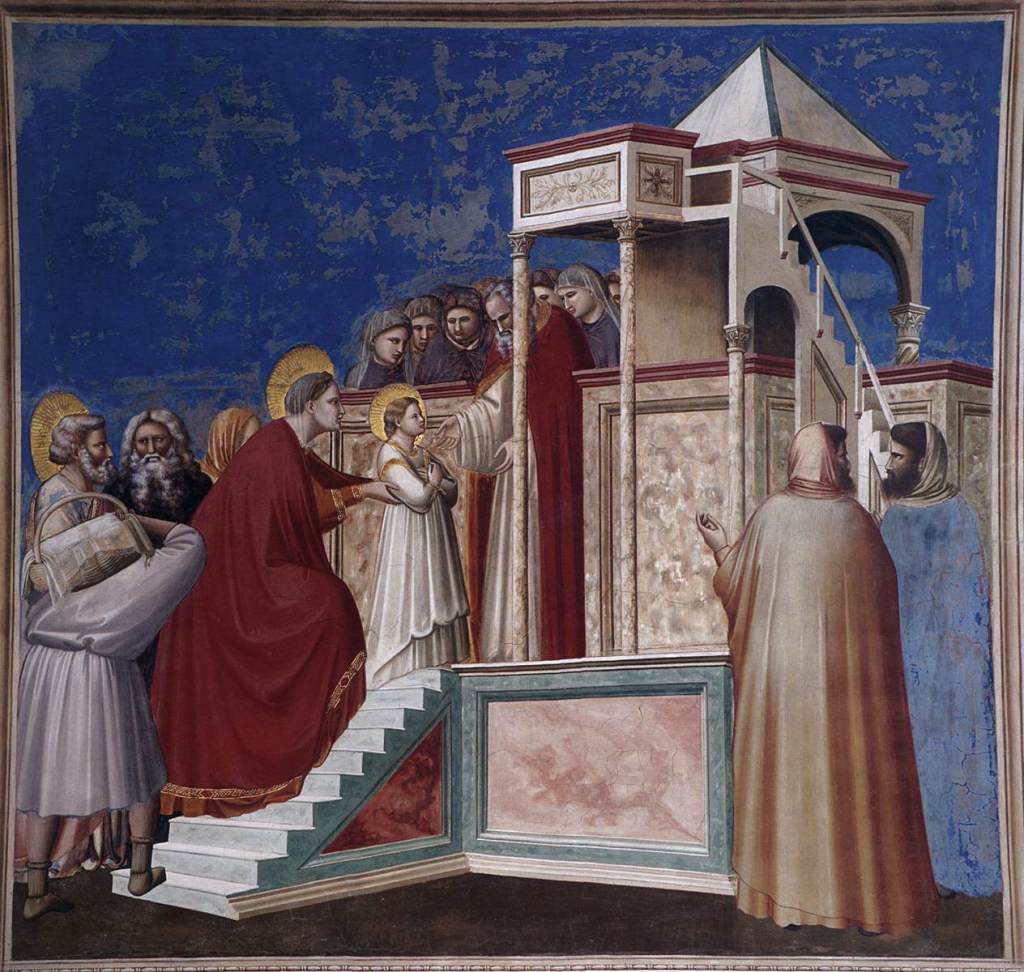
Ah – Scrovegni Saturday! How many more will there be, I wonder? So far we’ve looked at the West Wall, with the Last Judgement (behind us, in the photo below), and the Virtues and Vices along the bottom of the South and North walls respectively, the Story of Joachim and Anna atop the South wall (on the right of the following view) and the Birth and Betrothal of the Virgin at the top of the North wall (on the left here).
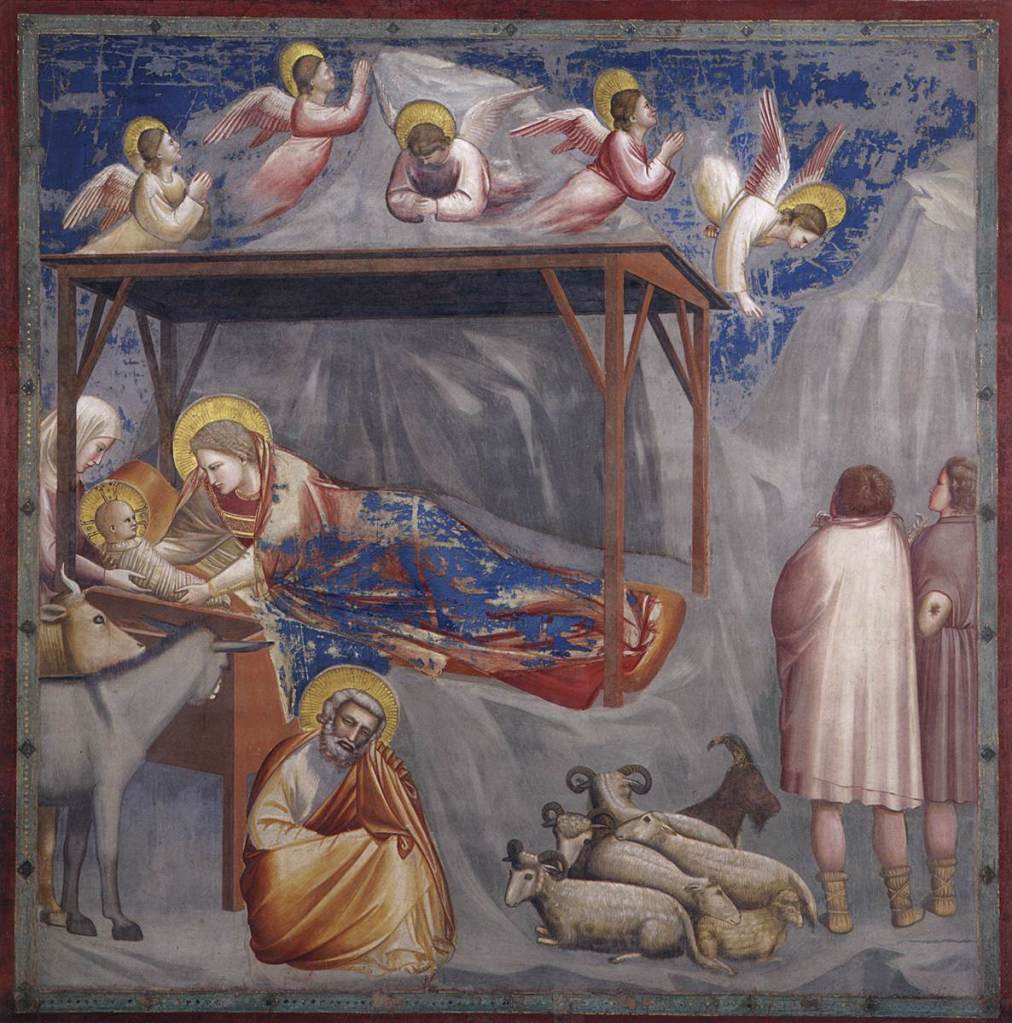
So now – the chancel arch, at the East end. That is, ecclesiastical East, as the chapel is actually angled towards the North-East. But whatever the direction, we are looking at the triumphal arch which leads towards the altar. We will start at the very top, in the section that is mainly blue, like the sky.

And the reason why it looks like the sky is because that is where we are – beyond the sky, in fact – in Heaven. In the centre, God the Father sits enthroned, and yes, there are three steps Heaven, or at least, to the throne. Sadly much of the painted surface is damaged, but that doesn’t get away from the fact that God – and the throne – look substantially different. And that is because they are. Whereas everything we have looked at before and will look at after in this chapel is painted in fresco – i.e. onto wet plaster – the throne was painted with egg tempera on wood. This throne is actually a door. By 1278 it had become a tradition in this part of Padua to re-enact the Annunciation on the feast day itself, 25 March, even before the Scrovegni Chapel had been built. In all probability the drama was performed again when the chapel was consecrated, and dedicated to the Annunciation, on 25 March 1305. This door may well have been opened to allow a dove, representing the Holy Spirit, to fly out and settle on the Virgin Mary. However, as doves themselves are reasonably unpredictable, it would have been a model dove, on a piece of string, lowered down to the choirboy performing the role of the Virgin Mary. This is how the National Gallery of Art in Washington describes the performances of the ‘Golden Mass’ which took place in Bruges in the 15th Century, performances which seem to be echoed in Jan van Eyck’s painting of the Annunciation which we saw on Tuesday (POTD 76):

Two young choirboys—with “sweet high voices”—don costumes in the sacristy. Gabriel carries a sceptre. After the singing of matins, they take places near the main altar. Gabriel stands and Mary kneels as the deacon begins the Gospel reading from Luke:  “At this time, God sent the angel Gabriel to a city of Galilee called Nazareth, where a virgin dwelt, betrothed to a man of David’s lineage; his name was Joseph and the virgin’s name was Mary. Into her presence the angel came and said….”

At this point the choirboys pick up the narrative. Gabriel genuflects three times, then sings: ave gratia plena: dominus tecum: benedicta tu in mulieribus…. [Hail, full of Grace, most favoured among women, the Lord is with you….] He calms Mary’s initial bewilderment and explains that she will conceive and bear a son. Mary asks, “how is this possible as I have no knowledge of men?” As a dove is lowered from the choir, the angel explains: “the Holy Spirit will come upon thee, and the power of the Most High will overshadow thee. Thus this holy offspring of thine shall be known as the Son of God….”

Before giving her response, Mary stands. She turns to face the altar and raises her hands; her gesture during the reenactment, as in Van Eyck’s painting, parallels the expancis minibus made by the priest during the mass. She submits: Ecce ancilla domini, fiat mihi secundum verbum tuum [Behold the handmaiden of the Lord, let it be to me according to your word]. The actors remain in place as the mass continues, and the dove is raised again during the singing of the Agnus Dei.

A long quotation, I know, but I think it’s worth it. Let’s get back to the painted decoration – the black line going through the picture here is one of the braces, holding the walls together, just in case you were worried. God the Father sits enthroned surrounded by angels, who are gathered playing music and looking around at one another. Two angels flank the throne, one on either side – and the one on the left takes a step towards the deity: God gestures down to him. This is the Archangel Gabriel, being given a mission from God – to seek out Mary, the most perfect woman ever born – Immaculate, even (POTD 71 & 72) – and to tell her that she will be the Mother of Jesus. He flies down to the left, where we see him in a tabernacle which could so easily be part of a temporary stage for a religious drama, announcing the good news to Mary who is in an equivalent tabernacle on the other side of the chancel arch. 

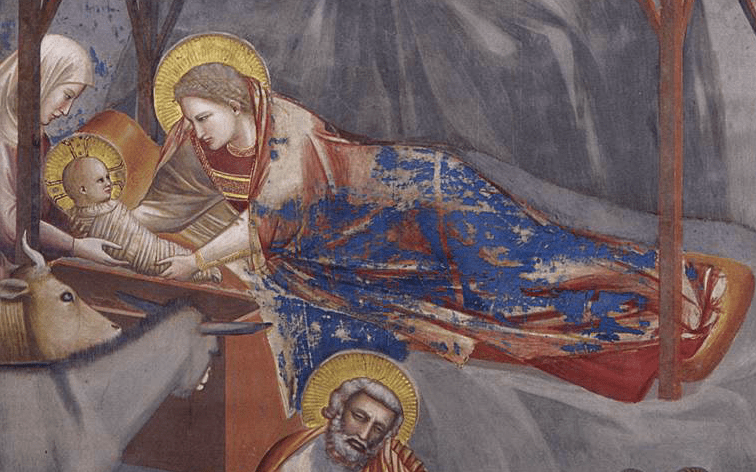
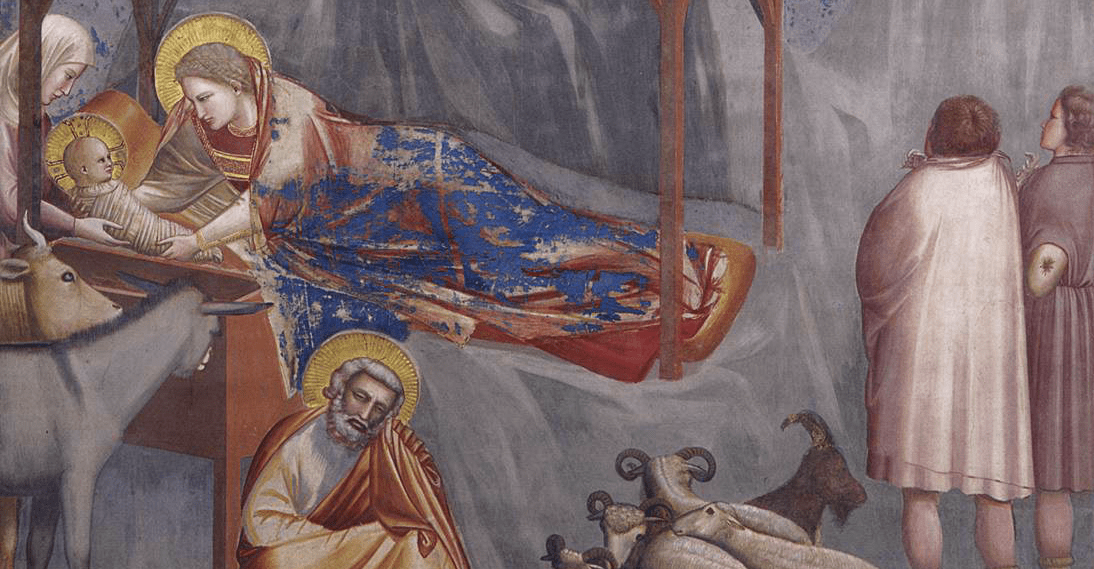
To enhance the development of the narrative, Giotto paints these ‘tabernacles’ to match the house towards which Mary had processed after her betrothal to Joseph. When looking up to the top left of the left-hand image you can see that the end of the story of Mary is just above the announcing Angel on the adjacent wall – we have taken a step down, as we will again on the other side when Jesus is born – the story is spiralling down towards us as it becomes more significant.

For Giotto the Annunciation is a non-nonsense affair. Gabriel holds a scroll, intended to represent the angelic salutation, Ave gratia plena, but no staff or lily. Mary kneels, hands crossed in front of her chest, in practical acceptance. She has been at her desk, and holds a tiny volume of the scriptures. Beams of light seem to come down from God the Father, and, on the other side, they also emanate from Gabriel – there may well have been gold detailing, which has been lost, in both cases. In true theatrical fashion curtains have been drawn back to reveal the protagonists, and they are tied around porphyry columns to keep them out of the way. 

Churches often have the Annunciation depicted on either side of the Chancel Arch, but wherever the subject is represented it is always worthwhile thinking about the implications of the location. Gabriel says ‘Hail, full of Grace’ – and if you imagine the words being written out (as they are, by Jan van Eyck and others), then the space between Gabriel and the Virgin is itself ‘full of Grace’. In the Scrovegni Chapel the greeting acts to sanctify the chancel arch. Gabriel is announcing the birth of Christ across the archway which leads to the altar. This is where Mass is performed and bread is transformed into the body of Christ: Gabriel is announcing the birth of Christ exactly where he will indeed be ‘born’ through the miracle of transubstantiation. And, as I mentioned last Saturday (POTD 73), Mary was sometimes referred to as Porta Coeli – the Gate of Heaven – as she will give birth to the means of our salvation. In this setting the chancel arch represents that triumphal entry – Mary is both ‘the Gate’ and painted on ‘the Gate’.

It is immediately after the Annunciation that the Gospel of Luke tells us that Mary went to visit her cousin Elisabeth, who was with child. Giotto implies that Mary headed out straight away, wearing the same clothes – the differences in colour between the two images are probably the result of the photographs being taken at different times on different cameras under different lighting conditions and at different stages in the restoration history of the frescoes. This scene on the right is frequently represented as it is very important – The Visitation. At the beginning of her visit Mary greets her cousin, and the child moves within Elisabeth’s womb. This is how Luke reports it in 1:41-44:

And it came to pass, that, when Elisabeth heard the salutation of Mary, the babe leaped in her womb; and Elisabeth was filled with the Holy Ghost: And she spake out with a loud voice, and said, Blessed art thou among women, and blessed is the fruit of thy womb. And whence is this to me, that the mother of my Lord should come to me? For, lo, as soon as the voice of thy salutation sounded in mine ears, the babe leaped in my womb for joy.

Even before he has been born, John the Baptist has recognised his cousin Jesus as the Messiah – and Mary acknowledges the fact with the words ‘My soul doth magnify the Lord’ – which become the words of the Magnificat, sung during Anglican Evensong.  But how does the painting fit onto the chapel walls?

It is directly below the image of the Annunciate Virgin – as if Mary has just gone downstairs. Notice how notice that Mary’s movement, like Gabriel’s in the Annunciation is, as ever, from left to right. And then, see how Giotto reverses the colours across the arch. Whereas Mary is on the left in red greeting Anna in yellow, on the other side of the arch a figure on the left is in yellow, with another on the right in red. This is the sort of symmetry that Giotto delights in across the chapel. As to what that scene represents – well, we’ll have to wait a couple of weeks to find out!

Before we go, let’s just stop to think about the flow of the narrative. Last week we traced the birth of Mary, her arrival at the temple and her betrothal at the top of the wall on the left here. We then take a step down to the Annunciation, where we are joined by Gabriel, who has been sent by God from the very top of the chancel arch. Mary then leaves the Annunciation, heading down – in the same clothes – to the Visitation below. And then the story continues at the same level on the right wall – the first image we will see next week is the one between the windows to the right of the Visitation. But before then, I will leave you with a detail that shows the love between two cousins, and Giotto’s skill at characterisation: the Immaculate Virgin, with her cousin Elizabeth, ‘well stricken in years’.

Day 79 – Pygmalion

François Boucher, Pygmalion and Galatea, 1767, The Hermitage, St Petersburg.

The day before yesterday I was talking about a self portrait by Sofonisba Anguissola seeming to come alive (Picture Of The Day 77), and referred to the myth of Pygmalion – so what better than to explore that idea a little further today. The origins of the story have been lost, and the nature of even Ovid’s version has been confused by George Bernard Shaw, whose eponymous play has almost nothing to do with the original – apart from being concerned with one man’s creation of his ideal, in which he falls in love. However, Shaw believed that the creation could not fall in love with its own creator, and in the play Pygmalion Henry Higgins does not get the girl. However, in My Fair Lady, musical theatre – and presumably the producer’s big bucks – persuaded him he was wrong. And indeed, for Ovid the tale of Pygmalion is an anomaly – it is one of the very few Metamorphoses which has a happy ending.

I’ve chosen this painting by François Boucher because, to be honest, there aren’t a great number to choose from, and some of the available examples have inappropriate implications. But also, it is undoubtedly the best example, and takes the idea of art coming to life just that one step further. It’s in The Hermitage in Moscow, but I’ve never seen it – there’s just too much to look at. And to think there would have been more! In the 1930s when the Soviet powers were more than usually strapped for cash, after the museum had closed its doors of an evening, the curators would sometimes be required to stay behind to rehang the paintings, in order to cover the gaps on the walls created by the sale of some of the best works, usually to the United States. For years no one in Russia found out the truth. Jan van Eyck’s Annunciation (POTD 76) was one of them. I’ve only just found that out from Irina Polevaya, a fantastic guide in St Petersburg: if you’re ever going, let me know and I’ll send you her details! 

One of the great joys of doing POTD, to be honest, is finding myself looking at paintings I’ve never seen and can’t find any information about – so we’re left with the looking, which is what this is all about. I know this was painted in 1767, so is a late work – Boucher was 64 and died three years later – but apart from that, I don’t know who it was painted for or where it was supposed to hang… which would be useful as it might explain some of the painting’s peculiarities. Is it a straightforward illustration of Ovid’s tale? Well, let’s have a look.

We see Pygmalion, the sculptor, in his studio, leaning on a table looking up at Galatea, his creation (Ovid doesn’t name her, by the way – the name came later). The scene is framed by sculptures at far left and right. Running along the bottom, in between us and Pygmalion, is a long work bench, with a portfolio, papers and a portrait bust at one end, and a mallet and material in the middle. There is also a monumental column running up the left hand side of the painting.  There are various cherubs and nymphs in attendance, and a chariot in the top left-hand corner, in front of which two doves are billing and cooing.

The story of Pygmalion is one of the tales sung by Orpheus after he has lost his beloved Eurydice – at which point he renounces the love of women, and sings of the loves of the gods for boys… Again, Pygmalion is unusual here, apart from the fact that he too has renounced the love of women. According to Ovid (or Orpheus, as he’s the one who is telling this story) Pygmalion came from Venus’s island of Cyprus, where the women, the Propoetides, had denied the goddess her status and became the first to prostitute themselves. Venus punished them by turning them into stone (I can see an ironic reversal on the horizon), and Pygmalion turned away from women because of their immorality, preferring to live as a bachelor, and carry on carving. Here’s an extract from a contemporary translation, which you can find on the Poetry in Translation website – you need to look for Book 10:

But, with wonderful skill, he carved a figure, brilliantly, out of snow-white ivory, no mortal woman, and fell in love with his own creation. The features are those of a real girl, who, you might think, lived, and wished to move, if modesty did not forbid it. 

Yes, he carved himself a sculpture, and fell in love with it. It is more beautifully told, if less accurately translated, in an 18th Century version, which, as the title page asserts, was ‘Translated by Sir Samuel Garth, John Dryden, et al’ – and you can find a transcript of that too, on the Internet Classics Archive – again, it’s Book 10, and this quotation overlaps with the last:

Pleas'd with his idol, he commends, admires, 
Adores; and last, the thing ador'd, desires. 
A very virgin in her face was seen, 
And had she mov'd, a living maid had been: 
One wou'd have thought she cou'd have stirr'd, but strove 
With modesty, and was asham'd to move. 
Art hid with art, so well perform'd the cheat, 
It caught the carver with his own deceit: 
He knows 'tis madness, yet he must adore, 
And still the more he knows it, loves the more: 
The flesh, or what so seems, he touches oft, 
Which feels so smooth, that he believes it soft. 

The phrase which really catches my eye here, which is not quite, I suspect, in the original, but captures so well what interests me about this story and its relevance to the power of art, is, ‘so well perform’d the cheat/It caught the carver with his own deceit’. Basically, he made such a perfect sculpture that he believed it was real – and he goes on to treat it as though it is, even though he knows it isn’t – like an audience member in the theatre, he has suspended his own belief. Soon after, at the Festival of Venus, he beseeches the goddess to give him – well, he would have asked to make the sculpture truly his, but asks instead for a woman who is just like the sculpture. When he gets back home, he goes to kiss his girl, his statue, as he often has before, imagining that he feels her soft and warm – and he feels her soft and warm. This time, she really is – and as she awakes, she sees him – and they live happily ever after! Venus even attends the wedding, and they have a son, named Paphos, after whom the city is named. 

It’s fascinating to see this transformation in Boucher’s painting. Pygmalion, leaning on his work bench, looks up at Galatea in awe, his hands stretched out as if he wants to touch, and yet he is not touching. This is the story re-imagined, not quite as Ovid tells it. To the left of his left hand we see a marble tree trunk, that very common accessory used to support the weight of marble sculptures, as marble legs can not bear a marble torso on their own. Carved from the same block is a marble cherub, who grasps Galatea’s drapery – but flying above him is a living double, painted in flesh tones with blonde hair, and another living cherub flies in behind. The feet, the shins and even the knees of Galatea look like stone – but how about the thighs, and stomach? Is that colour? Or is that imagination? The drapery on the left of the detail above is surely not stone… However, if we look at a different detail, we get a different idea of what is going on. 

The chariot in the top left belongs to Venus, and hers the doves that pull it (POTD 32). Clouds flow into the room to tell us this is a vision, covering some of the grandiose architecture, which, like the monumental column on the far left of the painting are part of the sculptor’s craft – although the work of stonemasons rather than artists, perhaps. Two cherubs ride the crest of the wave of cloud, one playing, one bearing a flaming torch aloft, next to another dove. Why the torch? Well, I’m sure I’ve said this before, but in the words of the poet, ‘Come on baby, light my fire’ – a song about many things, none of which is central heating. This torch will light the flames of passion – in Pygmalion already lit.  And of course, the ‘nymph’ attending to Galatea is none other than Venus herself, almost cradling the sculpture’s arm, and making it flesh, as if she is sculpting a real person out of marble. Galatea’s stretching left hand points, a cherub points back at the miracle of marble turned flesh, and a rococo reference to Michelangelo’s Creation of Adam is born: Adam was made out of clay, and Galatea from marble. She lives, she looks at Venus, she is surprised – and her clothing is definitely in colour. From this detail we have no doubt: this is a woman.

I am, however, intrigued by this workbench stretching the full width of the bottom of the painting. Pygmalion is the other side of it, almost as if he is trapped there, cut off from us. The paraphernalia of the sculptors studio is placed upon it – propped up props to remind us where we are – and yet it could almost be like the frame of a painting. It is as if, rather than the sculpture coming to life, the sculptor has become art – he has left our world and entered fully into the world of his own imagination. 

And if we step away again, there is an unnerving feeling that nothing he sees is real – the subtle variation in tone between Galatea as a sculpture and as a living woman is echoed in the feminine pallor of Venus, in the thinly painted, only-just-sketched cherubs and the pale pellucid sky. Is it really a sculpture being brought to life, or is it a painting of a sculpture being brought to life that he is looking at? He is real – undoubtedly solid, richly coloured, worldly, rugged, his weight leaning on that bench – but everything else is evanescent. Clearly we are looking at a painting, if only because it is a part of Boucher’s painting – and Boucher seems to say that, if we believe a sculpture could come to life, how much easier is it to believe a painting, how much more real is it?

Shakespeare used the story of Pygmalion, without ever saying what it was. In The Winter’s Tale the wronged Hermione is said to have died, but a sculpture of her is revered. It is a polychrome sculpture, painted by ‘…that rare Italian master, Julio Romano’ – the only artist Shakespeare ever mentions by name (POTD 44). Paulina takes Leontes to see the sculpture of his late wife, once he has truly repented of his wrongs, and he is overawed. She wants take him away, saying,

No longer shall you gaze on't, lest your fancy
May think anon it moves.

…and then, as if were not enough that the sculpture might move,

I'll draw the curtain:
My lord's almost so far transported that
He'll think anon it lives.

Eventually she confesses that, through dark arts, she can make it move, and when he says she should, Paulina’s request is simple

It is required
You do awake your faith. 

Shakespeare understood better than any other author, I think, the power of art – and The Winter’s Tale is the play in which he plays constantly with what is seen. Looking at paintings – and sculptures – is simple. Just trust your eyes. Believe what you see. It is required you do awake your faith.

Day 78 – St Petroc

C. E. Kempe & Co. Ltd., St Petroc, 1914, St Olaf’s Church, Poughill.

It’s all too easy to forget precisely how many Saints there are – probably because I doubt that anybody even knows how many saints there are. The Vatican must have an exhaustive list, but several have come and gone, some of them because even the church has deemed them to be entirely fictitious. Not so St Petroc, and as today is St Petroc’s day, I wanted to think about him. If you’ve never heard of St Petroc – shame on you! He is one of the Patron Saints of Cornwall.

I’ve also chosen today’s image because there is, of course, more than one type of picture. I’ve focussed on paintings, I know, but I have occasional shown you pictures of sculptures, or even, on rare occasions, buildings. But never stained glass. It is something that has flourished in various eras across most of Europe, but it has been especially important in Britain – even though, given the Reformation (or reformations, as they happened at different times in the different nations of the Kingdom) much of our heritage of stained glass has been lost.  I imagine that for iconoclasts, ‘idolatrous images’ in glass were quite fun to deal with. There was the most extraordinary revival in ecclesiastical decoration in the 19th Century, though, as a result of a revival in the church, and then a change in taste. The Anglo-Catholic Revival developed from the Oxford Movement, and as William Morris was an undergraduate in Oxford, it would inevitably influence the development of the Arts and Crafts movement, at the tail end of which today’s window was made. 

This is just one panel from a larger window which illustrates a number of Cornish Saints. The various legends about St Petroc are rather confused, and, given their age, it is hard to know how much of the myth is true – after all, he was supposed to have died in 564 AD.  Or 594, depending on which source you read. According to the earliest life written about him, he was the younger son of a Welsh Chieftain, and he studied in Ireland. Either before or after a pilgrimage to Rome he found his way to Kernow (Cornwall to you and me – unless you are from Kernow of course) and founded a monastery at the mouth of the River Camel on the North Cornish Coast, which came to be known as Petroc’s-Stowe – or, as we now know it, Padstow. He also founded an Abbey in Bodmin, and became its first prior – hence the crozier in his hand, a stylised shepherd’s crook, with which he would symbolically look after his flock, yanking them back in when they strayed from the straight and narrow.  After his death his remains were initially revered in Padstow, but they were ‘translated’ (i.e. moved) to Bodmin some time around the year 1000. However, in 1177 a disillusioned priest called Martin stole them, and took them to the Abbey of St Meen in Brittany (Petroc may well have preached all over Brittany: there are many churches named after ‘Saint Perreux’). Thanks to the intervention of King Henry II the precious relics were returned, and were kept in a rather fine Sicilian/Islamic ivory casket until the Reformation, at which point, with the dissolution of the monasteries, they were thrown out. Fortunately the casket survived, and can still be seen in St Petroc’s, Bodmin.

A second Life of St Petroc, written in the 12th Century, was re-discovered in Germany in a library in Gotha in 1937. It describes the saint as ‘handsome in appearance, courteous in speech, prudent, simpleminded, modest, humble, a cheerful giver, burning with ceaseless charity, always ready for all the works of religion because while still a youth he had attained by watchful care the wisdom of riper years’ – however, that can have had no influence on this window, which dates from 1914, some 33 years before the rediscovery of the Gotha Life.

Photo: Jules & Jenny on Flickr

At the top we see two angels holding scrolls, and then, in the upper tier, Sts Ia, Olaf and Keyna. St Petroc stands at the left on the bottom tier, alongside Sts Wyllow and Sampson – I’m sorry, but apart from our man, you’ll have to look them up for yourselves! The inscription underneath the last has a dedication to the memory of William and Margaret Field, and their son Francis Trevoes, and bears the date ‘mcmxiv’ – 1914. If you can pin it down, you will probably find the window attributed to Charles Eamer Kempe – but as he died in 1907 that’s not very likely, even though the designs for stained glass windows could be kept and reused.  As it happens the term ‘stained glass’ is a misnomer: the only colour you can stain glass is yellow – so only the yellow details in today’s picture are actually stained. The rest is coloured glass, made by the adding various mineral salts to the molten glass. The details – all the black lines and decorations – are painted on with a form of enamel, and fired to make them bond with the glass.

Kempe himself was from East Sussex (his father Nathaniel developed Kemptown in Brighton) and had a typical upper class education – Rugby, and Pembroke College, Oxford. It was as an undergraduate that he was inspired to become an architect, having seen the decorations of the Oxford Union carried out by, among others, William Morris and Edward Burne-Jones. He had wanted to go into the church, but had a rather bad stammer, and decided he could minister better by designing that by preaching. He studied with leading ecclesiastical architect George Frederick Bodley, himself a student of Giles Gilbert Scott, and became Bodley’s assistant during the building of All Saints, Cambridge. The East Window there was designed by Burne-Jones and executed by Morris & Co. Kempe himself designed three of the church’s windows. However, he wasn’t with Bodley for long, as he set up his own studio in London in 1866, which went on to be one of the leading ecclesiastical designers of its time. His windows were especially sought after, renowned for the peacock wings of his angels (this isn’t a great example), and the richly jewelled apparel of the royalty and priesthood – look at the pearls on the depictions of Sts Olaf and Sampson, for example. After his death the studio continued under the name of C.E. Kempe & Co. Ltd, and a distant cousin, Walter Earnest Tower, took over as chairman. Stained glass designers don’t often put their names on their work, but use symbols as a form of ‘maker’s mark’. Kempe’s was a sheaf of golden corn, called a ‘garb’, which came from his own coat of arms (I said he was upper class…). When Tower took over, a black tower was superimposed on the maker’s mark – and you can see it on the panel with St Petroc, in the decorative border to the left of St Ia’s feet – at the very top left-hand corner of the detail on the left.

There are not that many images of St Petroc, and, as a result, his iconography varies. The Kempe studio chose to show him holding a bowl, with a tame wolf by his side. These attributes are best explained by the various myths which survive about the saint. Here they are, retold by Anna Chorlton – you can find the full story on the website Mazed – Traditional Tales from East Cornwall:

It was always raining in North Cornwall near the monastery. One day Petroc predicted the rain would stop the next day, but the next day the rain still fell in rivers. Petroc was mortified, his power of prophecy had failed, maybe he wasn’t such a good holy man anymore. He decided to go on a pilgrimage to become more holy, so he travelled to the Holy Land and then on to India. One day he was standing by the sea, it was so hot and he was dreaming of Cornish rain, when he saw a silver bowl in the water. Petroc climbed into the bowl and floated to an island. There he lived for seven years, every day eating one silver fish he caught in a pond. The fish returned every day to be eaten again.

One day the shining silvery bowl floated up on the sea again, and Petroc climbed in and sailed back to shore.

A wolf was waiting for him. It had guarded Petroc’s staff and sheepskin for 7 years while the saint was on the island. The wolf stayed as Petroc’s loyal companion till the end of his days.

Day 77 – Sofonisba Anguissola

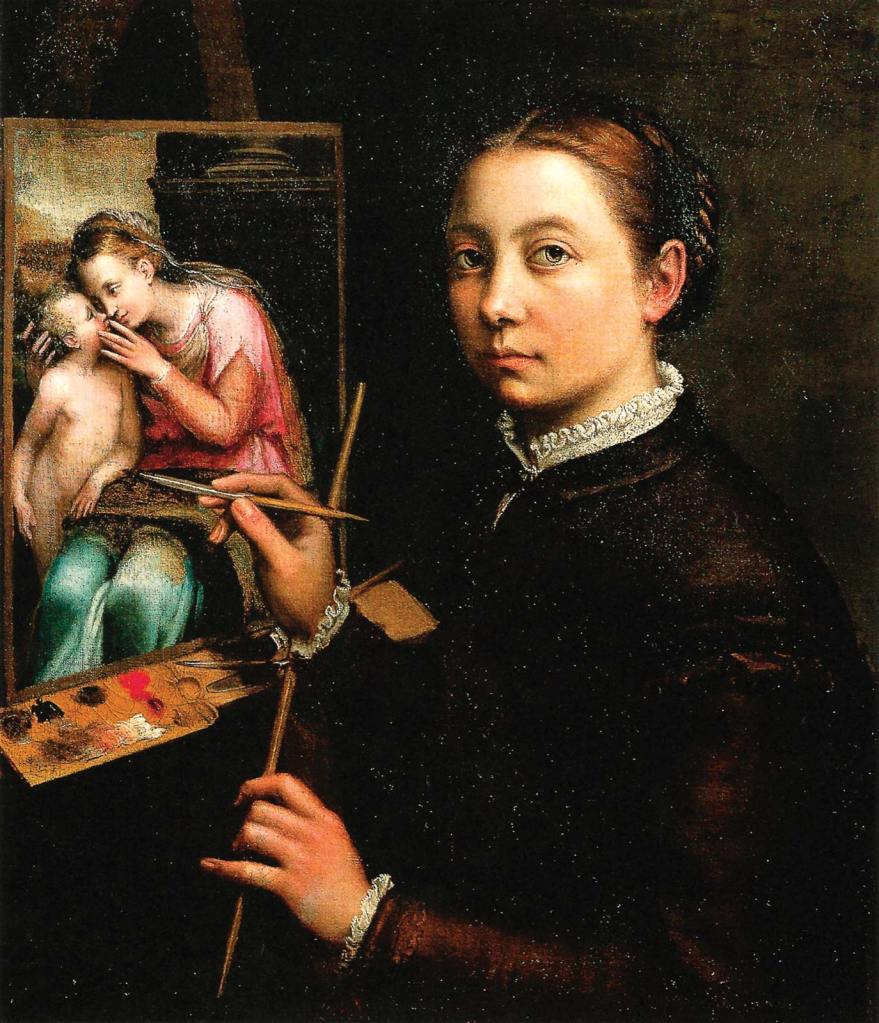
Sofonisba Anguissola, Bernardino Campi painting Sofonisba Anguissola, late 1550s, Pinacoteca Nazionale, Siena.

Who could not love this artist given her name? Quite apart from her talent, of course. I will come back to her very soon to explore her life and her work in more depth. But for now, I want to look at a painting which shows that, contrary to the assertions of many men over history (mainly artists who were protecting their pitch) women really did have the intellectual and conceptual ability to understand art and what art can do. 

It is a double portrait, as the ‘title’ suggests – but of course, this is only what some people choose to call it now. You can also find it listed as ‘Self Portrait with Bernardino Campi’ – but that really misses the point. What is remarkable is that, as far as I am aware, no one has ever thought this painting was by him – after all, he is the one painting. The self portrait by Judith Leyster (Picture Of The Day 34) was for years attributed to Frans Hals, because it is in a similar style to his, even though she herself is sitting there in front of an easel, holding a palette and around 18 paint brushes. Like the Leyster, we have a painting within a painting – in this case, a man painting a portrait of a woman – what could be unusual about that? It would make sense to assume that he was the artist. He looks towards his subject, painting the delicate details of her elegant dress. The padded end of his mahl stick (POTD 28) is propped on the very edge of the canvas so that he can rest his right wrist on it, thus keeping his hand steady to paint the details of the embroidery. His profile cuts across the left edge of his canvas and the easel can be seen projecting above it. The lower edge of his canvas can be seen, towards the bottom of the painting itself, and to the right we can also see the canvas stretched around the stretcher. As for the portrait he is painting, it is beautifully executed, and surely, almost complete. The subject wears a rich red, high-collared and sleeved bodice, embroidered with gold thread. Underneath this she has a white chemise, with its lace-trimmed collar standing up inside the collar of the bodice, delicately laced at the neckline. There is just a hint of a large drop-pearl earring, and her left hand droops at the wrist, holding a pair of deep red gloves, a sign of both class and sophistication. This is clearly a wealthy and successful woman. A beautiful executed portrait, in a perfectly standard painting, but it all seems perfectly normal. Until you remember that Sofonisba painted it.

Think about it this way: what are they looking at? He looks round towards us, but why? To catch our eye perhaps? To see if we approve of his efforts? Or is he looking at a mirror to catch his own reflection to paint his face? He would have had to do that to capture his own appearance, after all – but at the moment, he is painting Sofonisba’s dress – so he must be looking at her. And of course he’s looking at her, because it is she who is actually painting this, and, while his face was being painted, she must have been looking at him. And what about her? Who or what is she looking at? Well, if he’s painting the portrait, she must be looking at him, but, as she painted both subjects, she must be looking at herself, in a mirror: she had to, or she wouldn’t know what to paint.

If that hasn’t done you head in, here are a few more questions. Who is in charge here, and why? Whose face is clearer? Which character is more dominant? To my eyes – and it’s always worthwhile remembering that everyone sees things differently – Sofonisba stands out far more clearly than Bernardino. Her face is brighter, clearer, sharper. Her costume is richer – and brighter – whereas his black doublet fades into the background, and so does his hair and beard. He tones in. His face appears softer, the lights and shades more finely, and more subtly, blended. It is more painterly, I would suggest – and this makes her look more alert, more alive. He looks at us – and ultimately, whatever they were looking at during the course of the development of this work, the intention was to make it look as if they are looking at us, to make them seem more immediate and present – he looks at us with interest and understanding, but out of the shadows. By contrast, she is almost sphinx-like in her immoveable security. And she is higher up – which has always implied a higher status. When painting her face (if he were actually painting her), he would have to look up to her. And so he should – she is his creation. Not just in this imaginary portrait by him, which is actually by her, but in the person of Sofonisba herself. Because Bernardino Campi taught her to paint from the age of 14. She is everything he made her, and in this painting, probably painted when she was in her late 20s, she acknowledges that. But she also puts him in the shadow.  And if that’s not sophisticated enough, there is another suggestion: that she has painted each of the subjects in their respective styles. So she paints him how he would paint himself, whereas she paints herself, as she did quite often, using her own technique.

Conceptually I think this work is unparalleled before the 16th Century, and also, I suspect, for some time after. The self portrait by Catharina van Hemessen (POTD 28) is the first we have of an artist depicting themselves painting, and that was in 1548. I think it was Sofonisba who painted the second, in 1556. Today’s Picture would have followed a couple of years later. An artist painting someone else painting them. I might be missing the obvious, but I’m not sure I even know of any other examples – please tell me if you do! 

I would be more than happy to leave it here, but I should mention the painting’s curious history, partly because, if you were to look it up online or even – yes, it is possible – in a book, it might well look rather different. Look at the following three versions, and before you read any further, try and spot the differences.

I don’t know if you’ve ever visited the Pinacoteca Nazionale in Siena – it is the main art gallery, although people rarely go. There is so much else to see in the city, including genres of painting you can’t find anywhere else. There are frescoes extolling the virtues of Good Government, frescoes explaining the foundation of a hospital and all of its duties, and frescoes exploring the life of a fairly inconsequential Pope, and they are still on the walls for which they were painted, so why bother going to a museum? Siena is a city which really deserves more than the day trip it usually gets. But, until recently, the Pinacoteca has not been a great place to go – dingy, dirty even, with absolutely everything they could squeeze in hung on the walls in an endless sequence of shabby rooms. To be honest, I don’t know what it’s like now, because last March when I was there they were in the middle of refurbishing – probably the first time in seventy years or so it’s seen as much as a lick of paint. So by now it could be glorious. But I used to actively avoid taking my students there as it was one of those buildings that saps the spirit (I have a list). Had I spent more time there, I would have learnt how to cherry pick the best – but when I first went, this painting would never have made the cut. It was extremely dull. A black painting with two faces, two hands and a mahl stick. You could just about see the edge of the canvas and the easel, but it really was nothing remarkable. Until they cleaned and restored it in 1996, when they found out that Sofonisba was not originally wearing such a dark dress – but a wonderful red and gold one. But they also found out that she had two left hands. For five years, that is how they exhibited the painting – with one hand reaching up behind Bernardino’s, and the other lowered, holding her gloves. It was only six years after the first (recent) restoration that the conservators returned to the portrait and painted over the second hand – and so, since 2002, it has been exhibited as we have discussed it, the assumption being that Sofonisba must have intended it to be seen like that.

When you look at the details it only begs more questions. What would she have been doing? And why did she change her mind? And who changed her clothes? All of the answers to these questions must by hypothetical, but to me it looks as if she was reaching up to take the paintbrush. In Ovid’s Metamorphoses Pygmalion was a sculptor who fell in love with one of his own creations, and, having invoked Venus, goddess of love, the sculpture was brought to life – the power of art is that it can take on a life of its own. Here however, it is not love but talent that brings Sofonisba to life, taking over from her Master, like a relay runner taking the baton. A common topos – a regularly used phrase used almost conventionally – for a portrait was that ‘it only lacks a voice’. Well here, she may lack a voice, but she has come to life. Of course it’s possible that something else was going on, nothing to do with painting. Was she taking his hand? And if she was, would that have been appropriate? And what if she had meant to show herself taking his brush, but it looked as if she were going to take his hand? Maybe that’s why she changed it – or maybe she changed the position of the hand simply because it didn’t work, it looked too strange. Or maybe, she changed it because she looks more sophisticated holding the gloves. Whatever it was, it seems likely that she painted over the original hand, but over the years the change had become visible. Some paints fade, some change colour and some go transparent, revealing what are called pentimenti – changes of mind, as the artist ‘repents’ and repaints. So the second hand might have started to reappear. In the 19th century people didn’t like the ‘bright’ colours of earlier paintings, so to cover up the pentimento and make the whole thing look more balanced, more like an ‘old master’ painting, it could have been repainted, with a far darker dress for this respectable lady. Under most circumstances there would be no qualms about removing a 19th Century layer of paint from a 16th Century painting, but, having removed an earlier ‘overpaint’ which clearly wasn’t original, what are the ethics of covering up something that was? Was the first hand (or is that the second hand?) original though? Had it ever seen the light of day? Well, these are the choices that conservators and curators have to make. But rest assured, that hand hasn’t gone – it has just been disguised, covered up – and the conservators could get it back by taking off the new overpaint in a couple of days. Possibly quicker, but you never rush a painting, in case you damage it. I for one am happy to see it as it is now. And when I next have a chance to go to Siena, I will – and I hope to find it in a resplendent, newly decorated and refurbished art gallery!