Day 45 – Virtues, again…

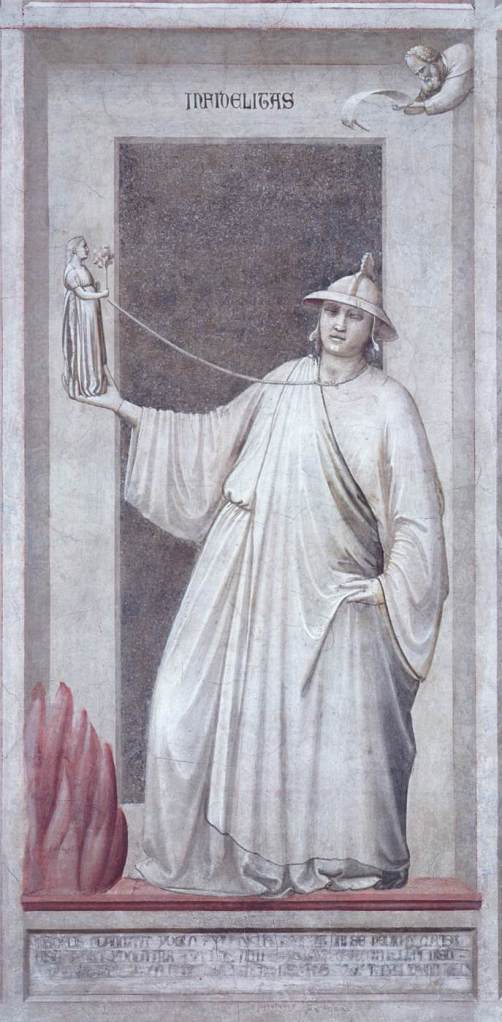
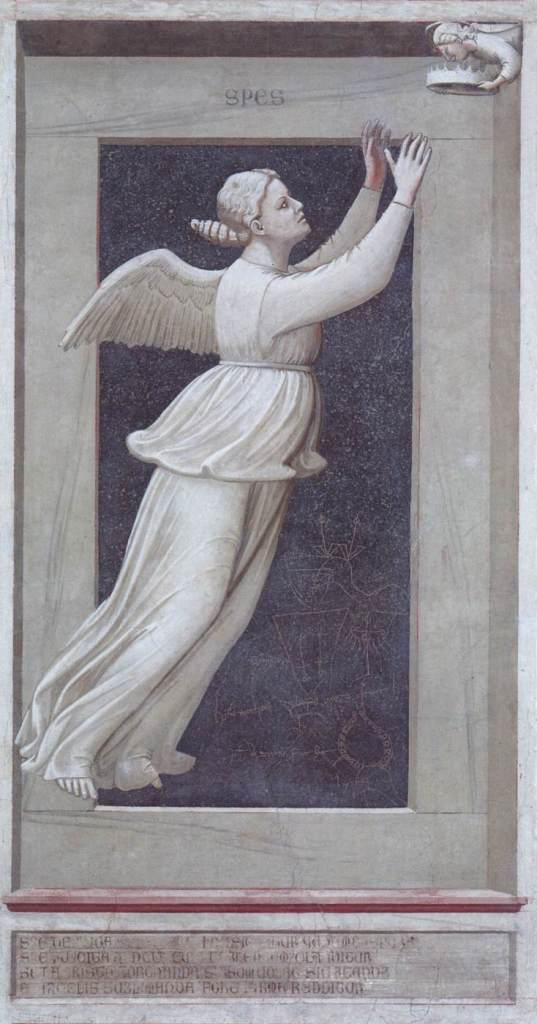
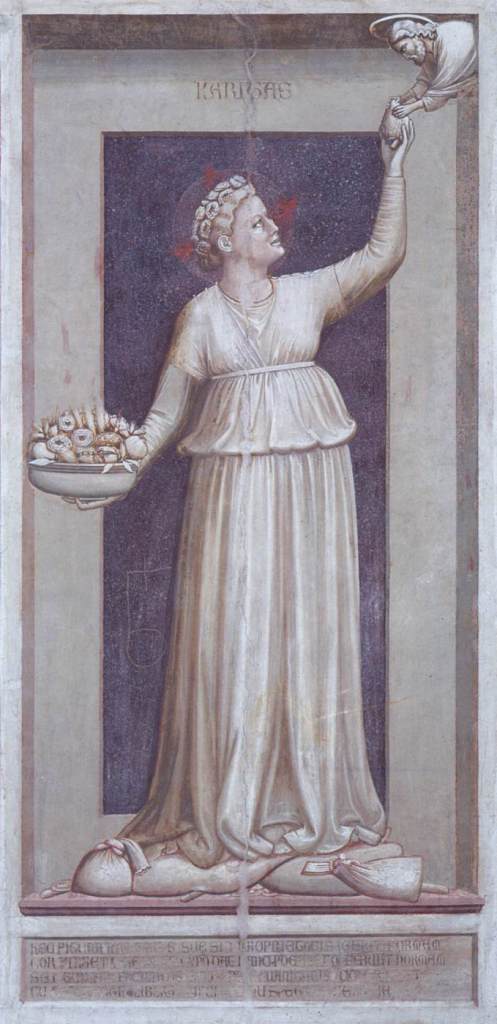
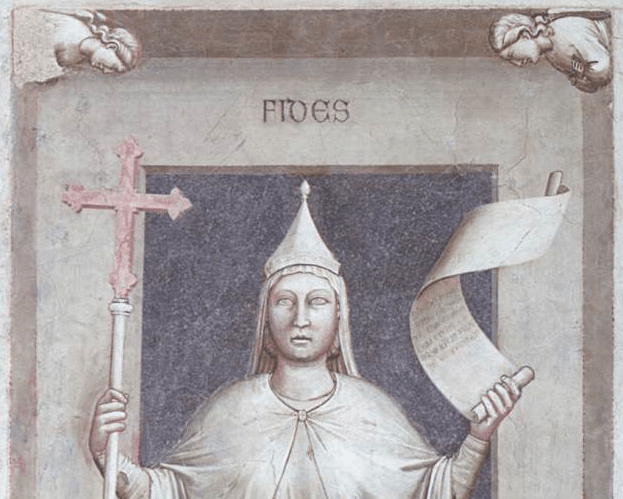
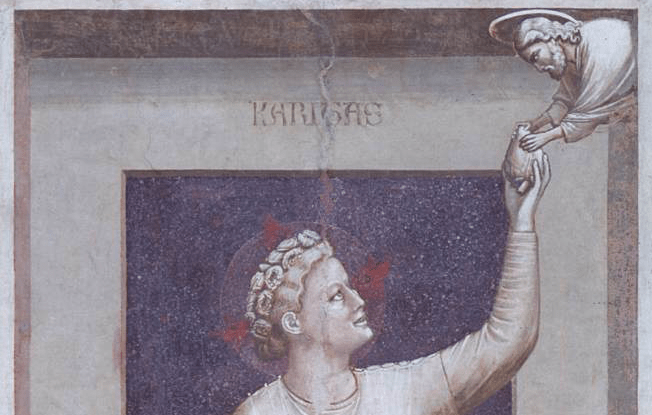
Giotto, Faith, Charity and Hope, c. 1305, Scrovegni Chapel

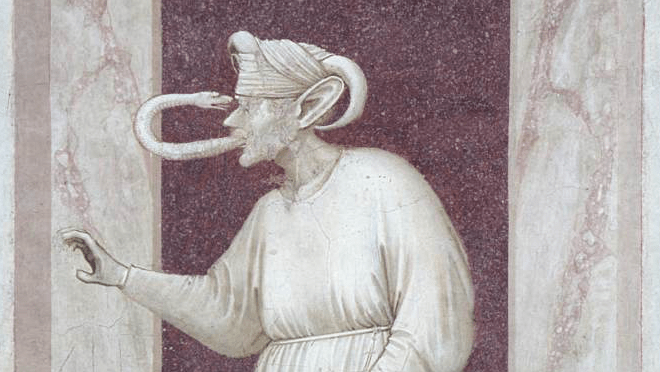
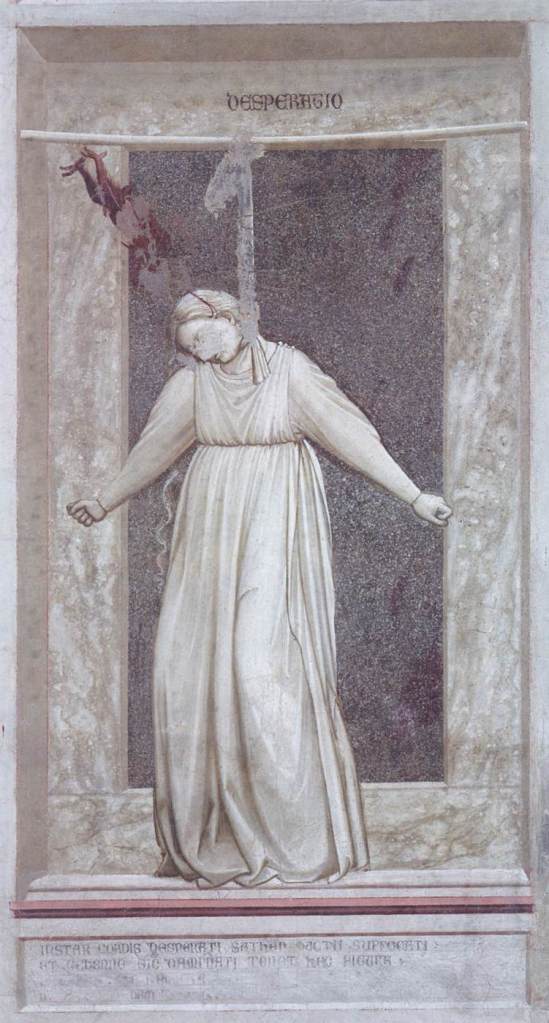
I must break off from the Story of Psyche, as it is Scrovegni Saturday, and I want to return to the consideration of the various Virtues that we began when we were looking at Verrocchio’s wonderful bozzetto in the V&A on Wednesday (Picture Of The Day 42). Again, I would like to look at the three Theological Virtues, FaithCharity, and Hope, to see how Giotto has represented them.

I’ve put them in this order, because that is the way they are laid out in the Chapel – although not this close together. All three are painted in grisaille, which translates as ‘greyness’, but refers to paintings which are monochrome – and specifically, black and white. The technique is used for different reasons: here the intention is to make the figures look like sculptures, carved out of some sort of stone – maybe even marble. Each is set into a rectangular niche lined with a grey, veined stone, with a slab of a darker stone – probably meant to be serpentine, a deep olive green – set into the back of the niche. The base of each niche is made of a slab of red marble, probable intended to be Rosso di Verona, a red stone from the hometown of Romeo and Juliet, which was often used for architectural decoration. You will see that there are inscriptions underneath the red ‘sill’, but please forgive me, I don’t have the time to look up what these say – that will have to wait. 

Giotto has imagined the fall of light into each niche as slightly different – that is how careful he was. In Faith, for example, the top of the niche is in shadow, and a shadow is cast onto the back ‘wall’, falling just above where the name is carved: Fides, Latin for faith (hence Fido for dogs). On either side, the inner vertical faces of the niche are just slightly lighter on the right, and lighter still on the left. The ridge just under the inscription (which has been more or less lost here) is far brighter on top – the light is definitely falling from above, as it would be, given the windows in the chapel are higher up. The fall of light in Charity is pretty much the same, but in Hope the left inner face is far darker than the right: this is, presumably, related to the precise position of the windows on the wall above these frescoes. Because her feet are not touching the ‘ground’ you can see more clearly that the light is falling directly onto the pink shelf, and onto the top edge of the grey slab behind it. This use of light and shade helps to define these spaces as potentially real, and the marble slabs as solid – and the skill with which Giotto does it puts him decades ahead of his colleagues.

Certain elements of these fictive sculptures are painted as if they are carved from stone that is a different colour from the white marble used for the majority of the figure. Faith, for example, carries a processional cross which is carved from a flat slab of Rosso di Verona (there’s no doubt about that here, the darker veins are unmistakable). She may be the most statuesque of the figures, stately and secure, but Giotto is gently nudging us to think again. He appears to be suggesting that painting must surely be better than sculpture – for who could carve the thin shaft of that processional cross on the scale of this painting? Or, for that matter, could anyone ever have carved the paper-thin, unfurled scroll she holds in her left hand? It seems unlikely, but he has been able to paint the ‘sculpture’ with consummate ease: one-nil to painting. Notice how the hands and face have a slight flesh tone to them. Is he perhaps suggesting that the sculpture is so well painted that it could almost come to life, like Paulina in The Winter’s Tale?As it happens, Shakespeare tells us that that particular ‘effigy’ was painted by ‘that rare Italian master, Giulio Romano’ – whose work we saw yesterday – and who is the only artist Shakespeare mentions by name. Above Faith,two angels look down from the corners of the niche, in devotion to the cross, and what we must therefore interpret as a religious text – both are items of Faith.

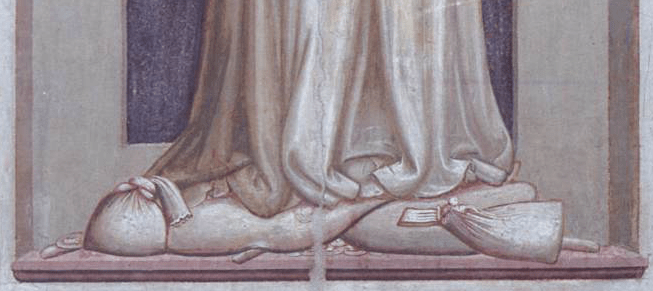
At her feet lie a broken sculpture, and two rectangular slabs. The sculpture represents a pagan idol, the sort of classical sculpture which had already been an inspiration for Nicola Pisano (POTD 8) and would be even more important for the artists of the Renaissance a century later. Although, yet again, is Giotto saying that we don’t need sculptures, given that he can paint them better than other artists could carve them? The two slabs are probably meant to be the tablets of the Law brought down from Mount Sinai by Moses – the Ten Commandments. The implication is that, with Christianity, the old orders have passed away. Paganism has gone for good, and the Law of Moses has been superseded by the Grace of Christ. That is what Faith means.

Charity tramples moneybags underfoot – worldly wealth is not important to her. In this context the rejection of moneybags should, of course, be seen in reference to Reginaldo degli Scrovegni, father of the patron of the Chapel, Enrico, who Dante had seen in the Seventh Circle of Hell among the usurers, with a money bag tied around his neck. 

In her right hand she holds a basket of fruit, flowers and grain – the overabundant, inexhaustible plenty that is the gift of true love – and she holds something up to God. I’m not entirely sure what this is – it could be something like an artichoke, and she could be offering this bounty to God, or receiving it from him. On the other hand, as a sign of love, she could be giving him her heart. It is a fairly common symbol in images of Charity, and certainly what Marcel Proust thought it was:

By a fine stroke of the painter’s invention she is tumbling all the treasures of the earth at her feet, but exactly as if she were treading grapes in a wine-press to extract their juice, or, still more, as if she had climbed on a heap of sacks to raise herself higher; and she is holding out her flaming heart to God, or shall we say ‘handing’ it to Him, exactly as a cook might hand up a corkscrew through the skylight of her underground kitchen to some one who had called down to ask her for it from the ground-level above.’

Proust was one of the most visual of authors, and referred to more than 100 artists in A la recherche du temps perdu. Indeed, there is an entire book written about the paintings he mentions. You can read more of the above passage – and get details of the book – in the Public Domain Review.

The quotation comes from a passage in which one of the kitchen maids is compared to ‘Giotto’s Charity’ as Proust calls it. He has a point – she is not entirely unlike a kitchen maid. One of Giotto’s greatest innovations was to make the ordinary divine – he gives holy characters and allegorical figures such as these a sense of reality which was unprecedented. You could argue that all his models were from Tuscan peasant stock, the farmers and labourers he grew up with, were it not for the fact that he wouldn’t have used models in this way. But he creates a solid reality for everyone, giving them both physical, and spiritual, weight. 

Hope is perhaps the exception. A solid figure she may be, but her longing for God – and for the Heavenly Crown, which is held out for her by an angel at the top of the niche – has lifted her off the ground. With this image Giotto appears to have given up on the idea that these Virtues are sculptures. Or maybe he is just seeing how far he can push the conceit – will we still believe this is really a sculpture? Or are we just meant to enjoy the game? Could a sculptor make his work fly? No! But a painter can! Notice, again, that her hands are slightly pinker… particularly the one which is further into the shadow of the ‘niche’. Without any symbol or attribute for her to carry, it is the gesture of these hands which most defines her essential quality, and it is for this reason that they are emphasized, almost like being underlined, in red.

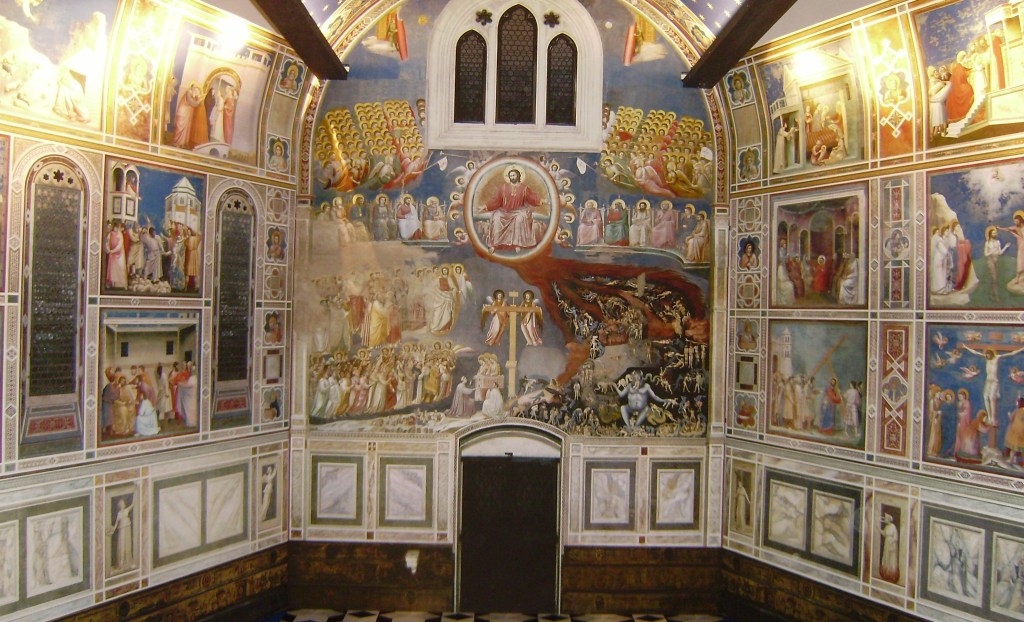
Replica of the Scrovegni Chapel

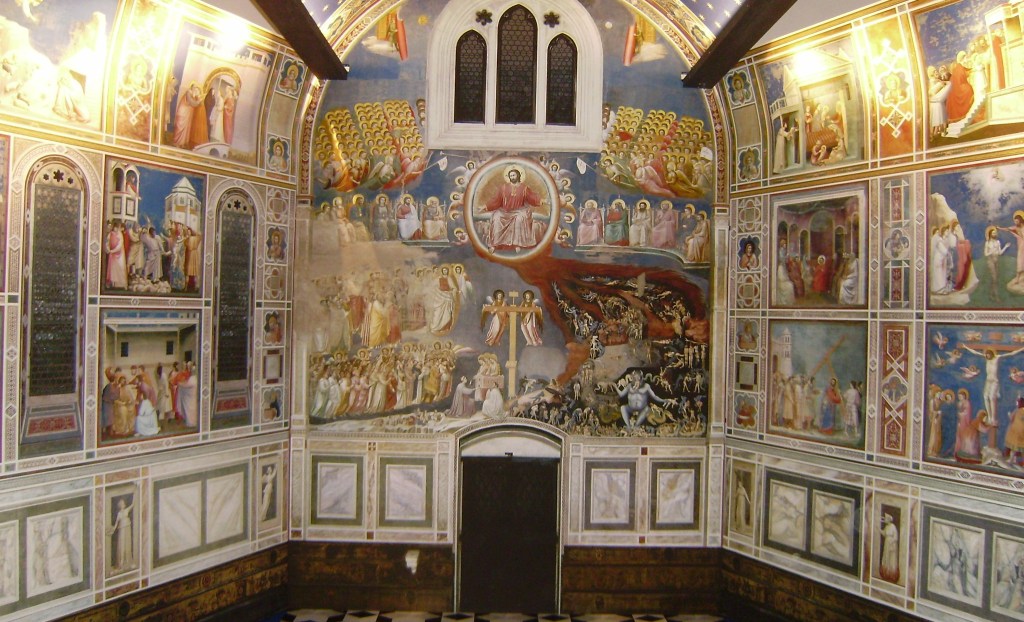
This photograph allows us to see where the Virtues are in the Chapel, but beware! This is not the Scrovegni Chapel! The clue is the over-harsh lighting, and clunky light fitting, at the top. It is actually a photograph of a replica, on the scale of 1:4, which was part of an exhibition at the Eretz Israel Museum in Tel Aviv in late 2009. The opening up of the Chapel is useful, as we can see the layout of the walls more easily, and so understand the location of the Virtues. They are part of a fictive marble wainscoting, which reaches up to the full height of the door at the West End, underneath the Last Judgement that we saw last week (POTD 38). On either side of the door there are two marbled panels, surrounded by a green frame, which in its turn is framed by more decorative panelling. Along the side walls are the ‘sculptures’ in their niches, each one of which is separated by two more of the decorative panels. Even at this scale, I hope you can see that the nearest one to the Last Judgement on the left is Hope, her yearning gesture and upward movement taking her towards the figure of Christ on the end wall.  She could very easily join the progression of the Blessed just above her who are being guided by the angels into the divine presence. Charity, too, holds her heart – or artichoke – towards the Redeemer. They are on the right hand of Christ, on the side of the Blessed – which can only mean that opposite them, on the side of the Damned, are their equivalent vices. For now, though, they will have to wait.

Day 44 – Psyche II

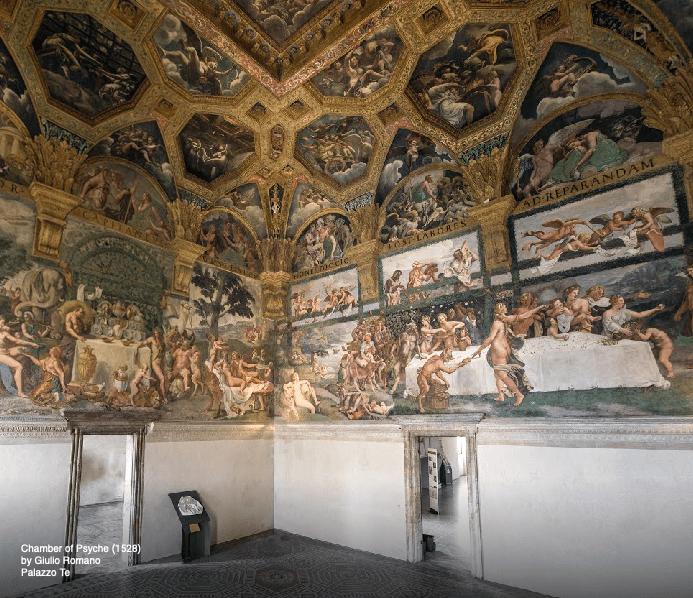
Giulio Romano, The Story of Psyche, 1526-8, Palazzo Te, Mantua.

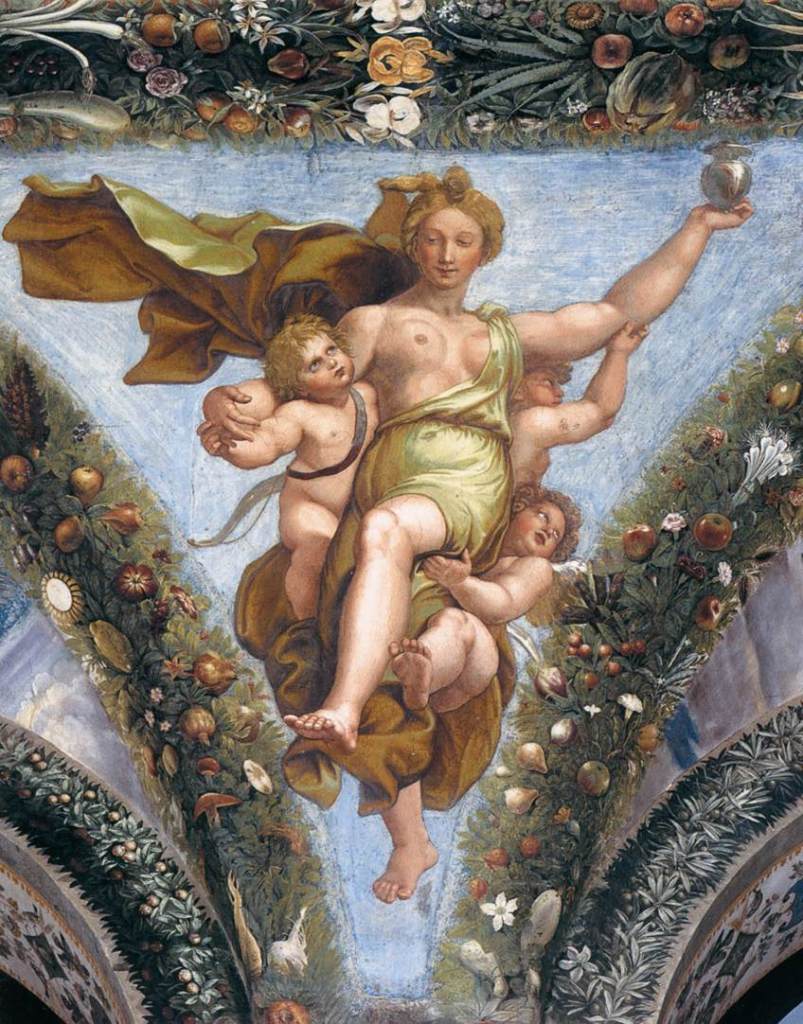
The Story So Far… Psyche is more beautiful than Venus, Venus is jealous of Psyche, Cupid was supposed to ruin Psyche’s life but has fallen in love with her, and has had her taken to his castle. Psyche is more than happy but falls out with her sisters when they suggest that her lover might be a monster. But what if they are right? She has never seen him, after all, and she doesn’t know his name. Too quick? Well, before we go any further let’s recap more slowly with one of the great Psyche Cycles – painted by Giulio Romano in the Palazzo Te in Mantua between 1526 and 1528. The name of the palace has nothing to do with tea, by the way – that would be Tè, with an accent. It is named after the area in which it was built, on the edge of the countryside just outside the city walls. It was a lime (or linden) grove, which, in Mantua, in the early 16th Century, would have been called a tejeto.

The Palace was designed inside and out by Giulio Romano for Frederico II, Marquis – later Duke – of Mantua as a suburban villa, i.e. just outside the town. It was a pleasure palace, to get away from the cares of the court, and also, so it seems, a place to get away from the wife and spend more time with the mistress. The architecture is playful and so are the frescoes, ranging from theme-park crazy to downright rude. The frescoes in the Room of Psyche are among the rudest anywhere, but I’m not going to show you those bits – just some of the ceiling, which is rather intricate. Looking up, it is hard work to see these pictures, and even harder to follow the story. Unfortunately that also means that the photographs are not so terribly good. Apologies. Above, you get some idea of the room, and below, some sense of the complexity of the ceiling. 

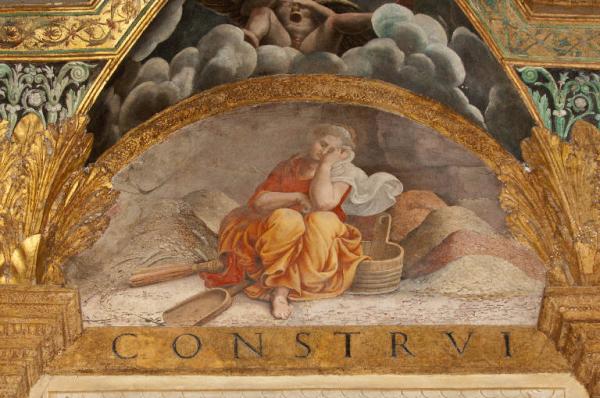
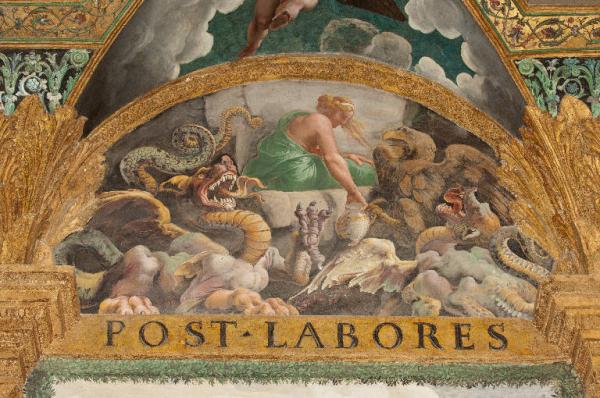
The start – and end – of the story is told in the canvasses which are set into the rich gold coffering of the ceiling, the final image being in the very central square. The stories are set into the octagons, the other sections showing winds and weather deities doing their thing, or putti fighting and playing.  Other episodes are painted in the lunettes (semi-circular paintings) at the tops of the walls – you can see them in the photo of the room above.  We’ll get to them… one day. For now, we’ll start with the two octagonal scenes you can see at the bottom of the picture.

As I was saying, Psyche was so beautiful that people started worshipping her instead of Venus. Despite this, no husband could be found for her, and her parents were so concerned that they consulted the oracle to see what should be done. The news came that she would be married to a monster, and it would be better for her if she were left exposed on a mountain peak. Fortunately it didn’t end too badly, though, as Cupid fell in love with her, and had the wind Zephyr carry her away to his castle. In these two images we see Psyche’s parents taking her to the Oracle on the left: the poor girl is kneeling in desperation at the bottom right, with Dad’s arm around her shoulder. All of these scenes are quite dark – in palette as well as mood – which serves to make them more mysterious and magical, contrasting with the rich gold of the coffering. In the right octagon, Zephyr is carrying Psyche away over the sea. Indeed, that would appear to be Neptune, God of the Sea, who has appeared, trident in hand, as they go past. At the top, a minor goddess pours down rain from the sky. The two scenes in the octagonal coffers miss out part of the story, though – how did she get from oracle to sky? It seems we need a flashback.

In this section of the ceiling, which is actually to the left of the previous two scenes (i.e. going round 90° clockwise) Venus is pointing out Psyche to Cupid, instructing him to make her fall in love with a monster (which would, of course, fulfil the oracle). You might recognise the image – it is remarkably similar to the version painted by Raphael’s workshop in the Farnesina in Rome which I showed you yesterday (POTD 43). That’s hardly surprising, because Giulio Romano was a member of that workshop. Raphael was busy elsewhere, painting the Pope’s apartments in the Vatican, and dying before the Psyche Cycle could be completed – most of the painting had been left to his assistants – including Giulio – anyway. The workshop completed what we see of the frescoes today after the master’s death. When Giulio was tempted away from Rome by Federico II, he would have taken memories of the Roman frescoes with him – and maybe even a couple of drawings. These two scenes are combined – Venus is pointing to Psyce, who we can see in the right octagon, where she is exposed on the mountaintop. By putting these two scenes together, Giulio creates a real dramatic tension. She is effectively about to be sacrificed: what will happen next? As we know, Cupid falls in love with her and gets Zephyr to save her in the nick of time.

When she arrives at Cupid’s palace, she is treated not like the mere mortal she is, but as a princess – a goddess, even. This section is just round the corner, anticlockwise from the image of her being carried away by Zephyr. It’s a remarkable feat of da sotto in su painting. This means, roughly speaking, ‘from underneath looking up’. We are asked to imagine that Cupid’s castle is effectively upstairs from the Palazzo Te, and we can see it through a hole in the ceiling. We see Psyche seated at the top of a few steps at a table, which looms above us, a circular tablecloth hanging down around its dark underside. A canopy is held up by flying putti, and dark, shadowy waiters appear, bringing platters loaded with fruit and flowers. This is the point we got up to yesterday, really – or rather, just before. After she has been royally – or even, divinely – entertained, Cupid and Psyche meet, by night, and he says that she can stay, on condition that she never tries to find out who he is.  She agrees, as long as her sisters can come over, just the once, so she can reassure them that she is alright. I suspect she also wants to gloat. Which is exactly what was going on in yesterday’s picture (POTD 43). As we saw, this meeting ends in an argument when Psyche’s sisters – who, let’s face it, have heard the predictions of the oracle – suggest that the mystery lover might be the very monster that had been augured. But what was she to do? She had sent them away, but what if they were right?

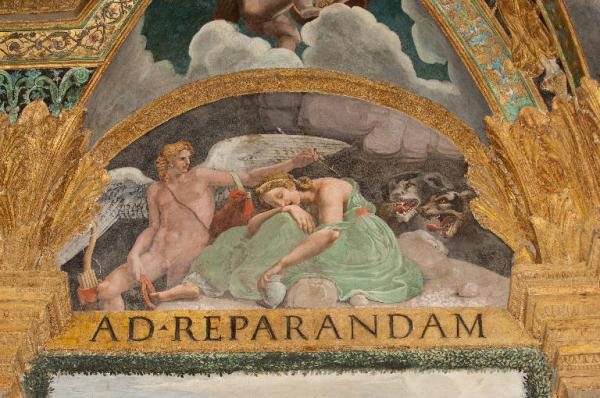
Inevitably, she decides to check up on him. It is one of the essential features of storytelling that, if someone is told not to do something, that is the one thing they will inevitably do. Just think of Adam and Eve. She has been told never to try and find out who Cupid is, or what he looks like. So what does she do? She takes an oil lamp and creeps to his room. Now, it’s a long time since I last read The Golden Ass, but as I remember it, the Palace turns against her. She pushes on the door – it creeks – she creeps softly across the floorboards – and they creek too. Indeed, however quietly she tries to step, the floorboards creek even more. It is as if the Palace is jealous of their love. She finally gets to the bed, and despite stirring in his sleep because of the noise, he hasn’t woken up. But, as she leans over, and finally catches a glimpse of his wings and realises who he is, the lamp – also jealous – sputters, and two drops of hot oil fall onto his arm. He wakes up, furious, knowing that she now knows who he is, and she knows that he knows that she knows. At this point… oh, I’m really sorry, I need to get going. I’ll continue… another day!
Day 43 – Psyche

Jean-Honoré Fragonard, Psyche showing her Sisters her Gifts from Cupid, 1753, National Gallery, London.

I thought I’d have some presents today… for various reasons. Did you know it is the 75th anniversary of the death of Adolf Hitler? Or that it is the 137th anniversary of the death of Edouard Manet? Neither of these are the reason, obviously. But it is the 100th Birthday of Captain Tom Moore – congratulations, sir, and well done for everything you have achieved. So today – Psyche showing her Sisters her Gifts from Cupid. 

Jean-Honoré Fragonard, 1732 – 1806 Psyche showing her Sisters her Gifts from Cupid 1753 Oil on canvas, 168.3 x 192.4 cm Bought, 1978 NG6445 https://www.nationalgallery.org.uk/paintings/NG6445

The story of Psyche is a wonderful one, and sufficiently long to be shared over a couple of days… if I can track down good enough images, of course.  It is peppered across Greek and Roman myth, but the version that is best known isn’t myth at all, but part of a late Roman novella, The Golden Ass, written by Apuleius in the second half of the second century AD. It tells of a man, Lucius, who, as the result of a freak magic-related accident, is turned into a donkey (if you think you’ve heard this before, yes, this is probably the origin of the Bottom sub-plot in A Midsummer Night’s Dream). He wanders the world trying to regain human form, and on his journeys hears various stories, which are recounted as part of the novella. The longest and most thoroughly told tale is the story of Cupid and Psyche, which became a particular favourite in the Renaissance. It is illustrated in full by Giulio Romano in the Palazzo Te in Mantua, and Raphael started a cycle in the Farnesina in Rome, although sadly it was never completed. I will come back to both, though, as well as throwing in other interpretations as the mood takes me!

Luca Giordano, Psyche Honoured by the People c.1695-7, Royal Collection Trust.

Psyche was a mere mortal, but as a girl, was said to be more beautiful than Venus herself, the Goddess of Beauty. She was so beautiful, in fact, that people started worshipping her instead of Venus. Gods never like a threat to their status, and Venus was no exception. 

Workshop of Raphael, Venus and Cupid, 1518, Farnesina Palace, Rome.

She sent her son Cupid to make Psyche very unhappy, by making her fall in love with a monster (another feature of the story which is echoed in the Dream, perhaps?), but when he saw her he understood what all the fuss was about. Leaning closer to get a better look, he accidentally pricked himself with one of his own arrows, and fell madly in love with her. Knowing that his mother would have been furious, he knew he had to get her out of the way, so he got his good friend Zephyr, the wind (who we have already seen in Picture Of The Day 8, 37 & 41) to pick her up and carry her off to his castle. Once there, she was brought food by invisible servants, played music by invisible musicians, and showered with gifts from who knows where. He came to her at night, in the dark… and the earth moved. Clearly she was happy to be there, and he told her that she could stay, on condition that she never tried to find out his name or see what he looked like.  This suited Psyche, although she was a bit concerned that her sisters might be worried about where she’d got to, so she persuaded Cupid, much against his better judgement, to get Zephyr to bring them to the castle so they could see that she was alright.

On arrival she shows them all the gifts she has been given – some of these are scattered on the ground: a basket of roses, tipped up for inspection by the sister in red, and in front of that an elaborate golden bowl, with turquoise fabric lying in and around it. There is a pipe and a tambourine – evidence of the magical music, perhaps – and leaning against the frame of Fragonard’s painting is another frame, an oval one, with a blue ribbon tied onto the loops at the back so that it can be hung. We will never know what this is – a mirror, perhaps? Or a painting? Also lying on the ground is a quiver full of arrows – this should be a clue. Psyche is not the sort to go out hunting (unlike Diana and her virgin nymphs), so these must belong to Cupid. If only she had noticed them, and stopped to think what they were doing there!

She seems to have been given a vast amount of fabric. One sister, blonde, who is facing us, holds up a length that is a very pale lemon yellow and white, with a sky blue border, while the redhead with her back to us in shadow clasps what appears to be cloth of gold. The fabric pours across the floor and over the step on which this woman is kneeling. As this woman is in the left foreground, and in shadow against a lighter background, she should really be a repoussoir, encouraging us to look further into the image, but she looks off to her left, and directs our attention away from Psyche, the focus of the story. I can only imagine that Fragonard is implying that these bolts of brocade are spread far across the floor, way beyond the edge of the painting.

Jean-Honoré Fragonard, 1732 – 1806 Psyche showing her Sisters her Gifts from Cupid 1753 Oil on canvas, 168.3 x 192.4 cm Bought, 1978 NG6445 https://www.nationalgallery.org.uk/paintings/NG6445

Fine fabrics would appear to be the stuff of the sisters’ dreams, they are so well attired themselves. The primrose yellow of the standing blonde woman is one of my favourite colours in any painting – don’t ask me why – but Fragonard makes it ring out by surrounding it with different yellows and turquoises. Despite this, there is no doubt that Psyche is the most important person here. Her brilliant white drapery – it could hardly be called it a robe, as it barely covers her, despite its length and breadth – shines out between the shimmering yellow and the deep red. She is the only person seated, her feet resting on a splendid cylindrical cushion, in turquoise velvet, with gold tassels. Her hair is being coiffed by one of her more attentive sisters, who looks over her shoulder to see a swarm of amoretti  – ‘little loves’ – bringing yet more jewelry and roses. It is almost as if they are embodiments of the rich perfumes emanating from the large, gold censer on the far right. 

Her chair is elaborately carved and gilded, and next to the cherub’s head at the end of the arm is a cushion in delicate pink, with feathery gold embroidery appliqued freely and plentifully as if it were the cherub’s wings. All this appears to be taking place in a fantasy setting – well it is rather fantastic! A stage set, perhaps, or the courtyard of a grand palace, with a terrace that has been strewn with rich materials for a tête-à-tête – en plein air – as it were. Fragonard has himself changed his mind about how it is represented, as there is a ghost-like vase hovering above right of the two standing sisters. This is what is known as a pentimento – or change of mind – which has, through the aging of the paint, become visible again.

What do Psyche’s sisters feel about all the attention she has been getting? Well, flying through the sky is a woman with snakes in her left hand and a flaming torch in her right, looking down at the two standing sisters. This is Eris, the Goddess of Discord – the Goddess of Arguments. I’ve always assumed that she has the snakes to freak people out, and the torch to heat up the arguments. Of course, the sisters were jealous! They wanted to know who he was, this wonderful lover, and what did he look like? Psyche couldn’t answer. As he only came at night, she had never seen him. When they pointed out to her that he could be a monster, she lost the calm that she is so clearly enjoying in this painting, and got into an argument (Eris always gets her way in the end). She then told Zephyr to take them away again. But what should she do next? We’ll find out tomorrow!

Day 42 – Some Virtues

Andrea del Verrocchio, Model for the Funeral Monument for Cardinal Niccolò Forteguerri, c. 1476, Victoria and Albert Museum, London.

Not exactly a request today, but I was asked to talk about some Virtues a while back, and this terracotta relief sprang to mind. I have since realised which Virtues had been requested, and why, and I will get back to them soon – but for now, a charming sketch which goes to show what a brilliant artist Andrea del Verrocchio was.   

Niccolò Forteguerri was born in Pistoia, not so terribly far from Florence, and rose through the church to become a Cardinal in 1460. It probably helped that his Uncle was Pius II, Pope from 1458-64. Niccolò was, therefore, his nephew, or, in Italian, nipote, from which, of course, we get the word ‘nepotism’ – jobs for the boys. He died in 1473, and was buried in Rome, in his titular church, Santa Cecilia in Trastevere, but his hometown decided that they wanted to remember him, and held a competition to design a memorial. We know little about the process, apart from the fact that in 1476 Verrocchio was commissioned to execute the monument following the design of a bozzetto – or sketch – which he had presented to the steering committee.  It is generally assumed that this is the very bozzetto that Verrocchio submitted.

(c) Victoria and Albert Museum

Made out of terracotta – which translates literally as ‘cooked earth’ – the relief is both wonderfully realised and beautifully sketchy. It is evocative, rather than precise, but allows you to see the disposition of all of the figures, as well as giving a wonderful sense of character and mood. It is full of vibrant movement and flowing draperies, light and airy, as if the characters were out in the open on a windy day, flying or coming in to land, above a platform on which a man is kneeling. 

We are very familiar with the idea of a sketch as a drawing, but anything that is done quickly, or remains apparently unfinished, can be considered a sketch. It could be an oil painting (remind me to show you one of my favourites!) or, as here, a sculpture. They are sometimes also called modelli – or models – as this is what they are – a small version of something which, when finished, will be far larger. Given the vicissitudes through which all art has past, the survival of a clay model from the 15th century is quite remarkable. Admittedly, it has not come down to us unharmed – there are a few repairs visible at the bottom of the relief  (the man’s praying hands are made from red clay, for example) – but it is still in a wonderful condition.

At the top of the image, Christ appears in a mandorla. The word means ‘almond’, and is used to refer to the almond-shaped ‘glory’ held up by the angels. The stress should be on the first syllable, by the way – MANdorla – as so often with three syllable words in Italian (Medici, Cupola… but not modello, where the stress is on the second syllable). In religious dramas, whenever anyone descended from heaven, or was assumed, they did so in a mandorla which was physically winched up or down, to or from the roof of the church…  Jesus looks down, blessing those below with his right hand, while supporting an open book on his knee with his left: this is the image of Christ Pantocrator, or ruler over all (we’re all too familiar with ‘pan’ as a prefix these days), and is a slightly medieval feature of the monument. However, Verrocchio subverts this ‘medieval’ feel with a touch of proto-baroque humour. Although in other images Christ manages his own Ascension unaided, here four angels hold him aloft – although they do not seem entirely secure. The one at the bottom left may have lost his grip, and has had to adjust his hold, or maybe the one above him wasn’t pulling his own weight, I’m not sure, but they are not entirely in control of the mandorla. It has tipped sideways, as you can see from the winged cherub’s head at the top, which is not directly above its companion at the bottom, but some way to the left. This slight shift, with its sense of movement and asymmetry, can be seen in almost all of Verrocchio’s output, a sense of drama which, as I have suggested, prefigures the Baroque in an unprecedented way. 

Moving to the bottom of the bozzetto it is the Cardinal himself who we see. He is kneeling on a sarcophagus, praying, and looking up to Jesus, either witnessing a vision of Christ, or the real thing – it’s up to you to decide. A woman steps towards him, although she is not fully on the sarcophagus. Under her feet is what could be a small rock, but is meant to be a cloud – this was the standard, accepted ‘sign’ for clouds in sculpture at the time. In her left hand, and close to Forteguerri – almost as if she is handing it to him – is a cross. In her right is a chalice, held above her shoulder. These are both items of Faith, and that is indeed who she is: a personification of Faith. Her movement towards him is swift, her right leg stepping across and in front of her left, her drapery flying out behind – again we have a wonderful sense of movement and of asymmetry. The dress of the figure on the right also billows out behind her. More obviously standing on clouds – she is further from the sarcophagus, after all – it is almost as if she is swooning, the rapid movement inward combined with a lowering of the body as she leans forward. Her arms are crossed over her chest, and she looks upwards, her gaze parallel to the Cardinal’s own. Her prayer, like all requests, wants fulfilment – that is what she hopes for. Indeed, she represents the virtue of Hope. Notice how Faith’s chalice, the direction of her gaze, and her cross, form a diagonal leading our attention to Forteguerri, while the angle of his head makes us look towards Jesus: Verrocchio expertly directs our eyes around the surface of the relief. Hope’s trailing left leg, and her gaze, create a diagonal which is continued by the leg of a third Virtue who appears above them.

Given that we already have Faith and Hope, this can only be Charity. Together they are the three Virtues named by St Paul in the thirteenth chapter of his first Epistle to the Corinthians. This is verse 13:

And now abideth faith, hope, charity, these three; 
but the greatest of these is charity.

As they are in the Bible, they are often known as the Theological Virtues. Now more often translated as ‘Love’, Charity, or Caritas, is the boundless love of – or for – God, and is expressed in a number of ways. Love is like a burning fire, which is why she carries a flaming torch in her right hand. The love for one’s children is unqualified, and a baby sits on her left. Charity is often surrounded by three – or more – babies, clambering all over her, and you’d have to be really loving to put up with that. Here she has just one, held safe in the crook of her left arm, the torch held as far away as possible. Unusually, she is winged. Verrocchio seems to be equating her with the angels. She flies above the other two virtues, perhaps in line with Paul’s assertion that she is the greatest.

Niccolò Forteguerri kneels on his sarcophagus awaiting the life to come. Faith offers him the consolation of the Cross, Hope echoes his own yearning for Salvation, and there truly is Love between him and Jesus. These three Virtues gather round him – flock to him, even – and reassure us that his soul will be with Jesus in Heaven. What better way to remember a man of whom the city of Pistoia could be justly proud. And even if we thought he wasn’t that great, maybe this monument could persuade us we were wrong – that is the often the function of memorials, if we’re honest.

Sadly the commission did not proceed smoothly. There was disagreement among the commissioning body in Pistoia, and at one point they tried to replace Verrocchio with Piero del Pollaiuolo. But Verrocchio went straight to the Boss – who at this point was Lorenzo ‘the Magnificent’ de’ Medici – who sorted things out. Nevertheless, the monument hadn’t been completed by the time the sculptor headed to Venice in 1483 to complete a more prestigious commission.  The sculptures were completed by his assistants in Florence, and were finally taken to Pistoia five years later. Some were deemed to be substandard, and were re-worked, meaning that the monument wasn’t erected until 1514, more than 40 years after Forteguerri had died. By this time, the Pistoiesi were probably asking ‘Niccolò who’? And that’s not the end. In the 1750s the monument was moved, the figures altered and re-installed, bunched up and straitjacketed by an unimaginative Rococo frame. The kneeling effigy was replaced with a bust, and although it survives in the local museum, Verrocchio’s original intention is lost. There is ongoing scholarly debate about which bits of the sculpture Verrocchio had anything to do with, and to what extent the life, the energy, the vitality of the bozzetto ever made it into marble. What is certainly clear is that, in the monument as installed, Jesus is secure, and the angels are fully in control. I can’t imagine that the church would have allowed any doubt of that. But how wonderful that we still have this magical bozzetto free to see in the V&A.

Day 41 – Night and Sleep

Evelyn de Morgan, Night and Sleep, 1878, The De Morgan Foundation, Compton, Surrey.

There is something I find indefinably exquisite about this painting, something remarkable about its combination of colours and forms, like the flavours and textures of a well cooked dish, a delight, and one that should not be savoured too quickly. To see what I mean, just have a look at this detail.

Even without knowing anything about the painting, this is a wonderful combination of line, form and colour. A hand hangs down, index finger slightly taut, almost like the hand of God in Michelangelo’s Creation of Adam. The arm is held, ever so lightly, by a paler hand, forefinger extended towards the darker wrist, the middle finger curved back further and the others more, so they are out of sight. The sleeve of this second arm is a cloth of two colours, an almost electric pink and butterscotch, which wrap around each other. A tiny hint of pink can be seen on the downward flick of the butterscotch corner, and, at another point further right, as the one folds back, you see it is lined with the other. These pointed ‘flicks’ of the fabric echo the fingers of the hanging hand, and in between them the folds and hems of the bi-coloured cloth create the overlapping rhythms of a musical duet. There is a poppy in the languid fingers of the lower hand, and three more appear against the pale blue background, picking up the pink of the fabric. Above this pyramid of arm, hands and sleeve, a deeper russet brown appears like a curtain, with a web of threads – of string? – adding to the flowing, echoing rhythms.

The artist, Evelyn de Morgan, was one of the most successful women artists of her day, but her work is only gradually coming back into the public imagination. It’s the same old story. Her career was hard won, she had to fight for it at every stage, but even given her success, she was more or less forgotten after her death. Why is this? Her husband perhaps? Not in this case. She married the ceramicist, and later, novelist, William de Morgan in 1887, and theirs truly was a ‘marriage of true minds’. They shared the same ideas and ideals, and exhibited together both before and after they married. He couldn’t have been more supportive. And neither could she. Someone once said that he had no business sense, and she had little more, but nevertheless it was her success as an artist that kept them going. She was the breadwinner, and she supported his career as a ceramicist from her earnings from the sale of her paintings. She took his name, admittedly, having been born Evelyn Pickering. But she did at least have a name as Evelyn de Morgan – until the first biography of her was written in 1922. It was entitled ‘William de Morgan and His Wife’. Before you get worked up at the all-too-infuriating-but-let’s-face-it-we-expected-that chauvinism of it all, this book was written by a woman, Wilhemina Stirling. Or to put it another way, Wilhemina Stirling née Pickering. Evelyn’s name was written out of history by her own sister. I’m sure she didn’t mean to, but Wilhemina was, it seems, a real product of her time – or, at least, a credit to her mother’s upbringing. Mrs Pickering firmly believed that women who received payment for their work were, ‘not only unfeminine but petit-bourgeois’, and at one point was heard to exclaim, ‘I want a daughter, not an artist’. And this, despite the fact that art was in the family. Evelyn’s great aunts had studied under Gainsborough. Mind you, they got married and gave up painting, which was an accomplishment for a young lady, but not a career. Evelyn’s Uncle – her unforgiving mother’s brother – was John Roddam Spencer-Stanhope, who could be described as a second generation Pre-Raphaelite. In many respects he was her saviour. 

She was given drawing lessons at 15 – as one of her ladylike accomplishments, of course – but by 17 was determined to paint. It was then that she started classes at the South Kensington National Art Training School – which is now the Royal College of Art – only to move to the Slade the following year. In 1875, the year before she graduated from the Slade, she visited Italy for the first time, something she would continue to do for the rest of her life. In Florence she stayed at first with her Uncle, Spencer-Stanhope, who also introduced her to other members of the Pre-Raphaelite circle, including Dante Gabriel Rossetti. Her work has suffered from comparison with these two men, being seen by some as a weak imitation of both. But however much they might have inspired her, her work was very much her own, and something altogether different.

Night and Sleep is a relatively early work, painted in 1878, at the age of 23. Night, wearing the rose-red of sunset and carrying a dark veil with which to cover the brightness of the day, leads a drowsy Sleep by the arm. The veil frames the figures and echoes their forms – billowing above her right elbow and flexed in the same way, the hand trailing behind, or flowing out between Sleep’s right knee and his left, an echo of each. He holds a bunch of poppies close to his chest in his left arm, scattering them carelessly with his somnolent right.

With several visits to Italy already under her belt, the experience had clearly been valuable for Pickering (she wouldn’t marry for another 9 years, so this would seem to be a better name to use). Botticelli was someone who enchanted many of the Pre-Raphaelites, and he fascinated her. She regularly quoted from him, taking forms, and re-purposing them, as here, or borrowing characters and giving them new life, as she did with the Primavera. In this case the inspiration is Botticelli’s Birth of Venus (Picture Of The Day 8).

Of the two winds, one is undoubtedly Zephyr, the other, perhaps, Austrus, if we assume that Botticelli was taking Alberti at face value (see POTD 8 & 37). They are more upright than Night and Sleep, but this is because they are more ‘active’. The members of both pairs are closely dependent on one another, entwined in each other’s arms, their draperies overlapping, and seen against a sky strewn with flowers. In Botticelli’s case, they are roses, the flowers of love, and one of the attributes of Venus. For Pickering, they are poppies. Any fan of The Wizard of Oz will be able to tell you why: ‘Poppies… poppies… poppies will put them to sleep!’ Of course Evelyn Pickering would never have seen the film – or read the book for that matter – but she could easily have read the Aeneid. A bit obscure, you might think, but among her many ‘accomplishments’ were Latin and Greek, both language and literature. She also studied French, German and Italian, as it happens. In book 4 of the Aeneid, Virgil discusses the Garden of the Hesperides, with its tree that grows golden apples. Somewhere around line 486 he says that the Guardian of this Garden, 

 … protects the fruit
of that enchanting tree, and scatters there
her slumb’rous poppies mixed with honey-dew.

No need of Virgil to understand this symbolism though. For the Victorians the poppy was the main source of opium, and therefore laudanum, used for pain relief and to enable sleep – most notably in Mary Shelley’s Frankenstein. However, once more her travels to Italy might have given her inspiration. She visited Rome on her own, which would have been remarkable for a woman in the 19th Century. Even in London her parents hadn’t allowed her to travel to the Slade un-chaperoned. I don’t know if there are records of what she saw in Italy’s new capital, but given her interest in art she must have visited the Museo Borghese, home to Alessandro Algardi’s delightful Allegory of Sleep (c. 1635).

A drowsy equivalent of Cupid, this small boy has butterfly wings, clutches poppy seed-heads in his left hand, and wears them as a garland in his hair. He is sprawled asleep on a black cloth, the high polish of the black marble making it stand out from the rougher ground, textured with the marks of a small chisel. His arms, the right wrapped round his head, the left by his side, are not unlike Night’s, whereas his legs are closer to Sleep’s. And like them his form stands out against a dark cloth. I have no idea if Evelyn Pickering saw this endearing, sensuous, sculpture, but it would make a great deal of sense if she had.

Throughout I have assumed that ‘Night’ is female, and ‘Sleep’ is male, so I was surprised to read on the De Morgan Foundation website that, ‘Night floats through the evening sky, his red robes reminiscent of the sunset, and his billowing cloak darkening the sky behind him’. Meanwhile Wikipedia (OK, hardly decisive, I know) suggests, ‘dark-haired Night guides her son Sleep’, probably quoting from Evelyn Pickering de Morgan and the Allegorical Body by Elise Lawton-Smith (2002). Another blog, to whom I am indebted for the quotation from the Aeneid, talks of, ‘… a young woman (probably) wearing long red robes…’ and goes on to say that, ‘Her left arm is intertwined with the right arm of what is probably a young man’.

I can’t even see it as ambiguous. Night is definitely female – her long robe may wrap tightly round her legs revealing their form, but it does keep her covered to the ankle, and down to the wrists. It is typical of the dresses worn by women in Pre-Raphaelite and Aesthetic paintings, and not unlike a Greek peplos. By contrast, Sleep’s legs and arms are revealed: he is wearing something more like the chiton, or tunic, worn by Greek men. The relative pallor of her skin compared to his more olive tones, seen especially where her hand holds his arm, also suggests the standard contrast of female and male. Apart from anything else, Pickering’s knowledge of Italian would have suggested as much: La Notte – Night – is feminine, whereas Il Sonno – Sleep is masculine. Night could, perhaps, be considered a bit masculine in appearance – but not unlike many of Rossetti’s female figures. Indeed, she is not at all unlike his favourite model, Jane Burden, one of the great Pre-Raphaelite beauties, who married William Morris, only to have an affair with Rossetti, and who would later become one of Evelyn Pickering de Morgan’s greatest friends. 

Is Night the mother of Sleep? Maybe, although she does look rather young… They clearly belong together, though, given the counterpoint of their bodies, their parallel trailing legs, and the simple ease with which they get along, Sleep drawn on by the lightest touch of Night’s hand. Their harmony is expressed through their hues. Sleep’s cap is even brighter than his poppies, Night’s scarf the same green as their stems. The pinks, reds, russets and darker browns take us through the spectrum of crepuscular colour while their horizontal forms and half-closed eyes encourage us to sleep.

The last time I was in Newcastle, not so far from where I am socially distanced, I was excited to see that the Laing Art Gallery was hosting an exhibition of the work of William and Evelyn de Morgan, only to be disappointed to find out that they don’t open on a Sunday. How bizarre! Never mind, I thought, I’ll be back before it closes in June… Who knows, at this stage, if will re-open? Such a pity – they were both rather special artists, and they worked very well together.  Look out for her!

Day 40 – The Baglione Chapel

Pinturicchio, The Baglione Chapel, 1501, Santa Maria Maggiore, Spello.

Another request today, and this time, for an entire chapel! It’s in the charming Umbrian hill town of Spello, and well worth the visit – something to look forward to when we can get out again, and travel. One of the things I love about Umbria is the fact that there isn’t a huge amount of art. This may sound counterintuitive, but this does mean that you can look at things properly, give them the right amount of attention, and still have plenty of time to wander through the picturesque streets and enjoy a relaxed and delicious lunch. By the time I’ve got into the Uffizi in Florence – and even before I’ve seen any of the paintings – I am already in need a holiday. It’s all a lot more relaxed if you go to some of these less visited towns.

We know very little about the artist, or about this particular commission, to be honest. We’re not even sure when he was born – although the traditional date, based on dodgy information, is 1454. Nor do we know with whom he trained. The only things we do know about his early life is that he was born in Perugia, the son of Betto di Biagio, and was christened Bernardino. His first important work was in Rome, and after painting the apartments of the notorious Borgia Pope Alexander VI, he was summoned to Spello in 1500.

The chapel he was commissioned to paint is an addition to the church of Santa Maria Maggiore. For years it served as the Sacrament Chapel: the consecrated host, which Roman Catholics believe is the actual body of Christ, was reserved in a tabernacle so that you could pray there in the physical presence of God. But the function of the chapel changed in 1874, as it did again 100 years later when a restoration removed any traces of Ecclesiastical furniture. Now it is hard to see how the chapel would have functioned. Of course, this does mean that you can see the frescoes better, as well as the delicate, 16th-Century ceramic pavement from Deruta.

The chapel is almost square, and entered from about two thirds of the way along the nave of the church, which is decorated in a rather overblown baroque style. Don’t get me wrong – I love the Baroque – but it’s not always good. Entering through a round-topped arch, you are confronted with three more almost identical arches opening up into three alternative universes – although it is worth remembering that the entrance arch is the only one that is solid. All of the ‘architecture’ that you can see in these photographs was painted by Pinturicchio and his studio. The ceiling is decorated with four Sibyls – the female equivalents of prophets – but as they are by a different artist, and in a rather poor condition – I shall let them go for the time being.

Directly in front of you is the Nativity. It is framed in the same way as the frescoes on the walls to left and right: two square pillars support an arch decorated with inlaid marbles, and a low wall prevents us from climbing in to the verdant landscape. But remember, there are no pillars, no arch and no wall – all of this is painting – fictive, or imaginary, architecture. Central, and just below our eye-level, the Christ Child lies on the ground – a true sign of his humility. His mother Mary kneels to our right, with Joseph standing still further off, the Ox and Ass looking on from behind. The stable has been scrappily thrown together from the ruins of a Roman building, including two square pillars not unlike the two framing the fresco. This is a common symbol that the rise of Christianity will coincide with the fall of Rome. A choir of angels stands secure on a cloud, slightly closer to us than the stable roof, and the shepherds approach from the left. Meanwhile the Magi wait their turn in the middle ground.

If we now turn our attention to the wall on the left as we enter, we see the Annunciation (compare it with Piero’s version, POTD 7). It is framed in the same way as the Nativity, but rather than a green meadow, we seem to have a stage that stretches away at the same level as the top of the low wall. The fictive entrance acts as the proscenium arch in a theatre, with entrances left and right.  The continuity of the space is evoked by the door on the back of the left wall, which is cut off by the pillar supporting the proscenium arch, and by the equivalent wall continuing off to the right. Mary would have been on stage as the curtains opened, standing at her lectern reading of the prophecies of the Messiah’s birth. The angel has entered Stage Right – the audience’s left – and… I think I’ve just had a revelation! Almost all Italian Annunciations have the Angel Gabriel on the left, and the Virgin Mary on the right. About 5% show them the other way round, and no one has ever been able to explain to me why that should be. The assumption has always been that, as we read from left to right, that is the way that the story should progress. However, in Northern European art, the image is more often the other way round. I can’t give you the figures, but maybe as many as 25%. So – why does Gabriel enter from the left? I’ve just realised that it must go back to the societal ‘leftism’ I mentioned on Saturday (POTD 38). Christ raises the blessed with his right hand, and condemns the damned with his left. As a result of this, in medieval mystery plays the angels would always appear Stage Right, and the devils, Stage Left – a tradition which continues with the goodies and baddies in a traditional pantomime. So of course it makes sense for Gabriel to enter from Stage Right, and therefore appear on our left. And I’ve been worrying about that for 30 years! Maybe the Germans didn’t have so much religious drama. Meanwhile, God the Father flies in from above, a true Deus ex Machina, and the Holy Spirit descends. He is currently just above the Virgin’s right arm, heading towards her ear. I’ll explain why another day. On the wall to our right a portrait is hanging. 

This is a self portrait. It shows a painting of the artist as part of the decoration of the Virgin’s house, his name written on the plaque underneath in Latin, ‘Bernardinus Pictoricius Perusinus’ – Bernardino Pinturicchio from Perugia. He came from Perugia, but couldn’t use ‘Perugino’ as his nickname, because that was already taken. Indeed, Perugino had already painted a self portrait like this, with a very similar inscription. It’s in Perugia, his hometown, in the frescoes he painted for the Money Changers Guild between 1497 & 1500. This was just before Pinturicchio did the same thing – the date of the completion of the Baglione Chapel is at the top of the pilaster on the left of this detail: MCCCCCI, or 1501. The name he signs himself with, Pictoricius – Pinturricchio – tells us something else about him. He was very short. It means ‘little painter’.

The perspective of the Annunciation suggests that we have not fully entered the chapel – we are not in the middle of the square – as the arches do not recede symmetrically. There also appear to be a slight shift in the perspective as you get beyond the marble floor, and into the enclosed garden – maybe this is all meant to be a painted backdrop? The situation is different on the opposite wall, which shows Christ Among the Doctors.

It is now twelve years since the Nativity (according to Luke 2:42), and Jesus is centre stage, standing on a marble pavement discussing theology with an array of adults. They have given him space, and many have discarded their books on the floor, because their knowledge and experience is no match for this boy. Worse than not being able to keep up with your child’s home schooling, Mary and Joseph had headed home after their yearly visit to Jerusalem, only to realise that they had left Jesus behind. I hope you have never lost your children but it must be terrifying.

Finally they have found him, and appear, with haloes, and gesturing towards him, at the front on the right. They are wearing their traditionally coloured clothes – yellow for Joseph and blue for Mary. He stands on the central axis of the painting, with the orthogonals – the parallel lines going away from you into the painting – converging on either side of him. However, he is not at the vanishing point. That is located in the dark entrance to the temple – the perspective is encouraging us to go to church. Pinturicchio has created the renaissance architect’s dream – a symmetrical, centrally planned church. Octagonal in ground plan, it has a porch on four sides (I’m taking the one at the back for granted). It is orderly and symmetrical, and therefore approaches perfection: symmetry is, simply, divine. The dome is also octagonal, and not entirely unlike the dome of Florence Cathedral – although, unlike most of his contemporaries, including those from Umbria, it seems likely that Pinturicchio never visited the Tuscan city. 

The temple sits in the middle of a field, not entirely unlike San Biagio, just outside the walls of Montepulciano – although the fresco can’t have been inspired by that example, as the church we see today, with its cruciform ground plan, would not be started until 1518. The idea actually comes from the Sistine Chapel, and Perugino’s fresco of Christ Giving the Keys to St Peter, in which the action of the painting takes place in the foreground, with a vast, perspectival pavement leading back to an octagonal temple with porticoes on four sides. One of Pinturicchio’s first jobs might well have been assisting Perugino in the creation of this fresco in 1481-82. Twenty years later, he still remembered the experience – and the composition – and adapted it for his own use.

A large number of the learned have gathered around Jesus, but more of them crowd in on the left of the painting. This leaves more space for us to see Joseph and Mary clearly on the right.

At the front on the far left – behind the two children who are clearly part of the Temple’s early learning programme – is a man entirely dressed in black. Compared to all the other faces here, his is far more specific: a long chin, sagging jowls, swept back, greying hair and a protruding nose above a pinched mouth. Compare it with the idealisation of the face on the right in this detail – the large, oval eyes, the simplified forms of the nose, mouth and chin. Clutching a book, on the right we have scholarship’s young dream. The man in black is the reality. He is the patron of the chapel, after whom it is named: Troilo Baglione. He was Prior of Santa Maria Maggiore from 1499-1501, after which he left Spello having been appointed Bishop of Perugia. He died five years later. Sadly we don’t know how he knew Pinturicchio, nor what he wanted from this decoration, but it is wonderfully coherent. Despite their poor condition, the Sibyls on the ceiling are there to prophesy the coming of the Messiah, whose immanence is then announced on the left-hand wall. But this is only an introduction – the perspective tells us that we have not yet fully entered the chapel, we are not yet at the centre of the story. Christ’s presence is made manifest as we move around in a clockwise direction. Starting with the left wall, we move to the one opposite the entrance, where Christ, as a baby, is lying on the ground, entirely central to the story and in the painting. Shifting once again to the wall on the right, he is still central, but now standing on his own two feet, already breaking free of parental constraints at an unnervingly young age. With the perspective centred, we too have arrived, fully, into the chapel, into an understanding of Christ, and we are witnesses to his understanding of the world. As the Sacrament Chapel, this would have made perfect sense – Christ is announced, is born, and is present in the Temple, both as a painted image and in the consecrated host. As a work of art it is a perfect three-act play – with prologue. And, if we have visited in the morning, it should set us up nicely for a wonderful Umbrian lunch.

Day 39 – La Tempesta

Giorgione, La Tempesta, c. 1504, Accademia, Venice.

I’ve been asked to talk about Giorgione’s evocative and mysterious painting La Tempesta, which I’m very happy to do, even if it is something I have often avoided, for reasons which should become obvious. The best translation of the title would be ‘The Storm’, but, if translated at all, it is usually called ‘The Tempest’, because that sounds more poetic – and it is a profoundly poetic painting. More poetic still, the title is more often left as La Tempesta, giving non-Italians a greater sense of the exotic and unreachable. We have no idea what Giorgione himself would have called it. As I have said before, like many titles, this is a nickname, but at least in this case it is one which makes sense, inspired as it by the lightening that is arguably the main focus of the painting. However, I sometimes wonder if it should be renamed ‘the swamp’, given that most scholars who talk about it end up stuck, waist deep in the shifting sands of interpretation. It would be easy to say that nobody really knows what is going on here, but the problem is worse than that: everyone thinks that they know what is going on, but has a different idea to everyone else. So, for now, let’s just look at it.

Accademia – La tempesta – Giorgione

It is relatively small (82 x 73 cm), painted with oil on canvas, and is predominantly a landscape – rich, deep green trees, bushes and shrubs and brighter grass surround a deep blue river, which reflects the colours of the lowering sky. A path emerges from the bottom right corner of the painting, curves around a small rocky outcrop, and turns back into the painting behind the outcrop at the bottom left corner, heading towards a small section of wall topped by two broken columns. It seems to lead to a light green pasture beside the river, which is crossed by very basic bridge. Posts support girders, which in their turn have planks lain across them. The bridge leads to one of the defensive gateways of a walled town, unidentified and unidentifiable, which has more defensive towers further away along the grassy bank of the river. There is a church with its campanile – or bell tower – in the distance. The setting is not Venice, but somewhere in the Veneto, the mainland domain of the maritime republic. The foreground seems unnaturally light given the colour of the sky, suggesting a sultry warmth. Maybe the clouds have cleared behind us, and a low sun is cast the golden light of dusk on the ground. We have reached that tense moment when the hairs on the back of your head start to bristle with the build-up of electricity just prior to the storm, and even after the first lightning has struck, but before it has begun to rain.

Accademia – La tempesta – Giorgione

Within this landscape there are also three people. A man stands on the left, his left hand behind his back, his right resting on a staff, which in turn rests on his shoulder. He looks towards the right of the painting, but probably not directly at the woman who is sitting, naked, on a white cloth on the grassy bank next to the path. She has another white cloth around her shoulders, and is breast-feeding a child who is sitting on the ground beside her. Who are they? Well, the earliest reference to this painting comes from 1530, when it was owned by the Vendramin family. At that point, twenty years after Giorgione had died, it was described as ‘el paesetto in tela cun la tempesta, cum la cingana et soldato … de man de Zorzi de Castefranco’. Admittedly my 16th Century Venetian dialect isn’t strong, but this translates as ‘the little landscape on canvas with the storm, with the gypsy and soldier… from the hand of George from Castelfranco’. Giorgione – meaning ‘Big George’ – probably because he was a great artist – was indeed from Castelfranco, a charming walled town in the Veneto not entirely unlike the one depicted here. It’s well worth a visit! But we don’t have to take rest of the description that seriously, as the man is definitely not dressed as a solider. His clothes could be described as the fashionable daywear of the moneyed class in Venice in the 16thCentury. And if we don’t have to take the identification of the man seriously, neither should we for the woman. As far as I am aware, none of the terms used in the phrase ‘breast-feeding naked in a storm’ has ever been used to describe a gypsy, however unconventional it may seem. But after that, we are lost – who are they and what are they doing there? You can at least see why the term ‘soldier’ might be appropriate, as he is standing with a staff that could be used as a weapon. He could be defending her, or on the lookout. But he might equally well be surprised to see her – the distance between them seems relevant. Another early account described him as a shepherd. This seems equally unlikely, in those clothes. And still there is nothing to explain why the woman is there. It is this that has intrigued everyone who has looked at the painting.

We are, undoubtedly, in the Veneto – but why would this couple – if they are a couple – be among ruins, with two broken column? As a symbol this would often refer to the classical past, but what do they signify here? Are they in some way related to the two characters, each in some way broken, or out of place?  Giorgione certainly brings them into visual relationship with the man and woman, by painting the columns in the same white as the fabrics. The man is pictorially echoed by the ruined structure as a whole. The brick-red colour of his hose and slashed britches echoes the bricks, while the marble sill which supports the two columns is equivalent to the white bar formed by the lower half of the man’s shirt, including the sleeve of his right arm. This horizontal white area is also topped by the white vertical which is left visible by the cloak thrown over his shoulders: both shirt and columns form an inverted ‘T’. The columns are also echoed by the guard towers in the background, especially by the more brightly lit walls on the left of each building. Giorgione uses this to structure the painting, the light areas forming a diagonal coming down from the lightening, through the towers and the columns to the shirt. The white of the woman’s drapery completes this pyramid of light on the right-hand side.

Accademia – La tempesta – Giorgione

I have said that we are in the Veneto, but where is the proof? The landscape is typical of the Venetian mainland – predominantly flat and marshy, with a river (it could be a canal…) and a bridge. The buildings look Venetian, too, with the big, conical chimneys of the houses which can be seen above the left end of the bridge. The relatively small dome on the church is also similar to many seen in Venice and the Veneto, as is the freestanding campanile.

Accademia – La tempesta – Giorgione

Even more specifically, some historians have identified the markings above the gateway at the end of the bridge as one of the emblems of Padua, whereas the Venetian Lion of St Mark can be seen on the edge of the tower at the left of the trees – visible at the bottom left of the detail above. With the lightening striking between these two symbols, some have suggested that the painting represents political discord between Padua and Venice at the beginning of the 16th Century – which is possible – although as Padua had been ruled by the Venetians since 1405, most towns in the area would have had St Mark’s lion prominent somewhere or other. It might also be worthwhile remembering that, unlike Venice, Padua had been a Roman town (the ruins of the Roman Amphitheatre, or Arena, can still be seen, and give an alternative name for the building commissioned by Enrico Scrovegni: the Arena Chapel). But this doesn’t help us in interpreting the painting. Nor does it tell us if there is any reason why a stork should be standing on the steep roof directly to the right of the lightening. Maybe it is just a naturalistic observation. Or maybe it is symbolic of the birth – even if this particular child was not born that recently.

So who are they? We may never know. One suggestion is that they are Adam and Eve, with Cain, their firstborn son, having been thrown out of Eden. But no other image of the biblical pair has shown them like this, and, if it is them, who built the town, and when? Another theory suggests that the painting shows the finding of Moses, but if you look at Poussin’s version (Picture Of The Day 21) you will realise that there should at least be a Princess present, if not several maids to accompany her. It doesn’t look at all like Egypt, either, but that is a minor concern. Yet more scholars have wondered if it is it even a narrative at all – it could be an allegory (e.g. of the discord between Venice and Padua). And at one point it was even interpreted as a self portrait of the artist with his own family, but if I were you I wouldn’t give that one a second thought. About a decade ago it was related to a poem written in 1482 in praise of the Vendramin family, which discusses their descent from the classical hero Aeneas (they weren’t the only family to flatter themselves with such exalted claims). More specifically, they claimed their origins with his second son, Silvius, who got his name from the Latin word ‘Silva’, meaning forest or wood, as that was where he was born. In this interpretation the woman would be Silvius’s mother, who has escaped the jealousy of her elder son, and the man would be Silvius himself, now grown up. It is not unusual to have the same person in a painting twice. This interpretation would certainly be worth looking into, as the painting was first known in the Vendramin Collection – and they might even have commissioned it.

Or maybe – for possibly the first time in art – it is just a picture drawn from the artist’s rich and inventive imagination. Going back to the Greeks, Simonides of Keos, who died in 468 BC, suggested that ‘Poetry is a speaking picture, painting a silent poetry’. The Roman Horace rephrased this a couple of centuries later in the phrase ‘Ut pictura poesis’ – ‘as is painting, so is poetry’. This idea is most fully stated in his Ars Poetica, where, to quote him at length, he suggests,

‘Poetry resembles painting. Some works will captivate you when you stand very close to them and others if you are at a greater distance. This one prefers a darker vantage point, that one wants to be seen in the light since it feels no terror before the penetrating judgment of the critic. This pleases only once, that will give pleasure even if we go back to it ten times over’.

So maybe – just maybe – this is what Giorgione was doing, painting a silent poem, evocative, enchanting but ultimately unknowable. Even if we go back to it ten times over.

Day 38 – Enrico Scrovegni

Giotto, The Last Judgement, c. 1305, Scrovegni Chapel, Padua

Welcome back to Scrovegni Saturday! I dipped into three scenes from the top last week, but today I want to look at an entire wall – the Ecclesiastical West End. I am not referring to those theatres in London where musicals like Jesus Christ Superstar, Godspell and Joseph etc are performed, but the end of the chapel opposite the altar. Traditionally, churches should be orientated, i.e. the altar should be at the East, with the rising sun behind them, a symbol of the resurrection of the Son. This is an aural pun which only works in English, but one which Shakespeare, whose works were meant to be heard (as in ‘audience’ – not ‘spectator’), knew well enough. More of that another day. Meanwhile, back in Padua, the Scrovegni Chapel was designed to be adjacent to the eponymous Palace, and so it had to have the same orientation as the palace. As a result the altar is not at the East, but it’s easier to use the traditional cardinal points to describe which wall you are talking about – the Ecclesiastical West End will always be the one opposite the High Altar, and in the Scrovegni Chapel it is completely taken up with an image of the Last Judgement.

I’m starting with a detail, as it helps to understand what is going on. We can see the patron, Enrico Scrovegni, giving the chapel to three angels, with the help of an obliging priest who has it comfortably balanced on his shoulder. The angels are, of course, accepting the gift on behalf of God, who is quite busy Judging elsewhere in the fresco. Why would any self-respecting person wanting to invest in such a magnificent gift? Well, because they wanted the Judgement to go in their favour, of course. Particularly when their father happened to be a notorious usurer. Enrico’s dad, Reginaldo degli Scrovegni, was so notorious that Dante (who might have been present at the consecration of the chapel in 1305) saw him in the seventh circle of hell. That is where the usurers sit, bags of money tied in purses around their necks, so that, however much and whichever way they look down, they can’t quite see their cash. On passing one of the damned Dante sees ‘an azure, pregnant sow inscribed as emblem on his white purse’: he is describing the Scrovegni coat of arms. Enrico paid for the Chapel, and its entire decoration by Giotto, to help get his father out of hell – and to keep himself out altogether. One of my favourite details in the entire chapel occurs just to the right of the depiction of the building, which still looks exactly like this today. You can see the foot of a cross which is held aloft by two angels. Quite apart from the wonderfully observed grain of the wood, a naturalism in detail that we would usually associate with later artists, I love the tiny soul clinging on behind. And why not? Just to the right, devils are hauling the damned to hell with no dignity whatsoever – one has his shirt pulled over his head revealing what may well have been the main cause of his sins. Just below a couple more trudge along the arch which forms the entrance to the chapel: they appear to be walking through our world. The priest’s robes also fall over the frame of the picture, Giotto already aware that his fiction will be all the more powerful if it breaks into our space. Compared with the whole these are tiny details, but the hidden soul clinging behind the cross could so easily express the fears of Enrico Scrovegni himself, clinging on, using everything at his disposal to stay out of the pit.

Christ sits in majesty in the centre of the painted image, directly under the window, so that most of the light in the chapel appears to come from the Redeemer himself – he is, quite literally, the Light of the World. The Heavenly Host are ranked in neat and orderly rows to the left and right of the window, with the twelve Apostles seated on either side of Jesus.

His arms are extended, with his right hand (on our left), palm upwards, raising the blessed to Heaven. On our right, his left hand is turned down, condemning the lost souls to Hell. From this, and a statistical constant (throughout history and pre-history roughly 10% of humans have been left-handed), stems society’s ‘leftism’. The Latin for ‘right’ is dexter  – from which we get the word ‘dextrous’, meaning that you are good with your hands. If you can use both hands equally well you are ‘ambidextrous’, meaning that you can use both of your hands as well as your right. If I were to try this I would be completely useless at almost everything, as I am left-handed. The Latin for ‘left’, on the other hand, is sinister – which nowadays, according to the Collins English Dictionary, means, ‘threatening or suggesting evil or harm’. If you ever see Jesus blessing with his left hand, get out of the way, it’s the Antichrist. And never trust a word I say. The Blessed are raised on Christ’s right, the damned on his left. But what about the Apostles, who are seated on either side? Well, clearly, if you are on a level with Jesus, it s all pretty good – but there is a hierarchy. The more important place is on Jesus’ right hand, and here, as so often, Peter, in his yellow and blue, with short grey hair and beard, is Jesus’ right hand man. His left hand man is St Paul – important, but not quite as important as Peter. It then alternates, going outwards, right, left, right left…

At the bottom of the image, on the left, we see the resurrection of the body, with tiny people climbing out of the ground, and above them the Blessed, being led to Heaven by Angels in two tiers. Lower down, and slightly smaller, are the everyday devout, perfectly well behaved and orderly in their neat rows. Above them, with haloes, slightly more space, and just a little bit larger are the Saints. Sadly the fresco is seriously damaged here. Meanwhile, on the right we see rivers of fire flowing down from the foot of the throne, and the disorderly damned subjected to a multitude of tortures, which vary according to the sins they had committed during their lifetime.

Inevitably, the Devil has the best tunes, and when visiting the chapel it is all too easy to get caught up enjoying Giotto’s inventiveness, as bodies are strung up by any extremity, sawn, spiked, or speared, swallowed by dragons, or stuck on the spines along their back, ingested by Beelzebub, only to reappear, undigested at the other end. You can see them trudging down across the entrance arch, some still pointlessly holding onto their worldly possessions or sartorial finery. Tellingly, given Dante’s account of Reginaldo’s fate, there are a number of money bags ostentatiously displayed down there, wielded by the damned in denial who still think that the money – or the status – that they had while alive still means something. But beware – because of the delicate condition of the frescoes you only get 15 minutes to see them all, having spent 15 minutes in a kind of limbo while you are atmospherically adjusted. Do book in advance, as often all the slots are filled, and, if you can, do what we do when I take groups and book two slots back to back. This will allow you to spend just a little bit more time, and will also give you the chance to gloat over those who are unceremoniously evicted, clinging to their tickets like the soul behind the cross we saw earlier. Inevitably though, and far too soon, it will be time to leave. By this stage my ticket is always dog-eared, and curling at the corners, so firmly have I been clasping it while trying to see everything as thoroughly as possible and as quickly as possible. There is still just time to stop and look at the very top of the fresco, and what really is my favourite detail. It is the end of the world, which, like my ticket, is dog-eared and curling up: the angels are rolling back the corners, preparing to scrunch it all up and throw it into the bin, only to reveal, behind it, the golden glory of the New Jerusalem, and the promise of a well-behaved eternity in paradise standing in orderly rows.

Day 37 – Noah

Paolo Uccello, Stories from the Life of Noah, c. 1447-8, Chiostro Verde, Santa Maria Novella, Florence.

I mentioned, a few days back (Picture Of The Day 32) – I think it was Sunday – that I would come back to the great polymath of the Renaissance, Leon Battista Alberti. And just a couple of days before that, last Friday, I was sitting down to write and Radio 3 launched into their sing-a-long, Somewhere over the Rainbow. It’s not what I tune into Radio 3 for, to be honest, but the great bonus is that you don’t hear the rest of the Nation (or at least, the Radio 3 contingent) singing.  Nevertheless, this painting naturally sprang to mind – as it had previously, passing the numerous rainbows displayed in windows, which I have seen throughout the town on my daily walk and weekly shop. It’s a symbol which is being used without most people realising why, I suspect. 

The rainbow is used as a symbol of hope, this meaning coming from the story of Noah, which you can find at the very beginning of the Bible, in Genesis Chapters 6-8. The rainbow is almost the end of the story – it has rained for 40 days and 40 nights, the floodwaters have lasted 150 days, but the land is now dry. Noah has grown food, and given a sacrifice to God in thanks for being saved from the flood. God has appeared in the sky to accept the sacrifice, and, as a sign of his covenant with Noah, he places a rainbow in the sky to reassure him that it will never happen again – whenever the rainbow appears, it is a sign of hope that things can only get better. He was not referring to New Labour. In typical fashion for Uccello, God’s appearance is quite alarming: he has flown in upside down. This is not the cardboard cut-out of God sitting upright on the clouds, familiar to fans of Monty Python, but Uccello’s attempt to create something new and real, using the innovative techniques of perspective. Even now it seems rather surprising, a little shocking, even. Noah stands directly beneath God, his hands raised. Haloes mark both of them out as holy. Noah is surrounded by his wife (who remains nameless, so is universally known as ‘Mrs Noah’), his three sons Japheth, Shem and Ham, and their wives (also unnamed). You can’t see them all in the detail here, nor are any of them very clear. Sadly this fresco is not in a terribly good condition. 

As you can see, a lot of the plaster has been lost. It was just one of a cycle of frescoes painted in the main cloister of Santa Maria Novella, the largest Dominican Friary in Florence – the Chapter House, discussed in POTD 24, leads off of it. The cloister is open to the elements, and although each of the four sides is covered, they are still subject to fluctuations of temperature and humidity throughout the year. Worse than this, and with a certain irony, the frescoes suffered from Florence’s own deluge, the catastrophic flood of 1966. Painted onto fresh plaster, the frescoes didn’t respond very well to the rising waters. As the walls were also waterlogged, the frescoes were removed (if you know what you’re doing it’s not too hard to detach fresco, apparently), only to be returned later. This one has recently been restored, and exhibited in the relatively new Santa Maria Novella Museum. Most of the images I am showing you are post-restoration: there is nothing that can been done about the centuries of damage which have resulted from exposure to the elements. It is one of two stories on the lower part of the wall. On the right of this detail you can see part of the Drunkenness of Noah. This is probably Ham telling his brothers – well, I’ll tell you that story another day. What you can see, though, is the vine which Noah has grown, which Uccello has painted in rather breath-taking perspective – he really had mastered the basic principles even if his application of them was sometimes a little… eccentric, I suppose. Vasari, writing in the mid-16th Century, certainly thought he was bonkers. I think that’s the correct translation from the original Italian. You can also see a hint of the wonderful woven wall of Noah’s garden shed.

But how, you might be asking, does Alberti come into this? He wrote his commentary on painting – rather conveniently called ‘On Painting’ – in 1435, in Latin. One of his intentions was to raise the status of his subject among his learned (or at least, rich) patrons, as they were far more likely to be able to read Latin than artists were. However, realising that, to have a direct influence on painting itself, it would be useful if the artists could read the book, he translated it into Italian the following year. It was the first text to describe how to ‘do’ perspective, the technique having been devised by Brunelleschi some 20 years before, and then put into practice by Masaccio and Donatello among others. Nevertheless, the perspective of the pergola is almost certainly indebted to Alberti. But the influence becomes more obvious if you look at the image at the top of the wall.

This is a photograph of the fresco in situ in the Chiostro Verde, or ‘Green Cloister’, which gets its name from a whole series of all-but monochrome frescoes painted in a pigment called terra verde or ‘green earth’. Uccello himself was only responsible for two bays of the decoration, this, and an earlier one (in terms of both the biblical narrative and his career) covering the Creation. The various gaps and joins you can see, and especially the metal clip on the left, tell you that this photograph was taken after the frescoes had been detached to prevent them from being damaged by the humidity of the wall – and to allow the wall itself to dry – but before the recent restoration.

The upper scene is the deluge itself, in two parts: the early days on the left, where people outside the Ark are struggling to avoid the rising waters, and after the waters have subsided on the right. The image is framed by two views of the Ark. On the left, Uccello creates a breath-taking sweep along the full length of the structure. God’s instructions to Noah were that, ‘The length of the ark shall be three hundred cubits, the breadth of it fifty cubits, and the height of it thirty cubits’ (Genesis 6:15). On the left we have the full three hundred-cubit length, while on the right is the shorter fifty-cubit end. Within this outer structure God had specified three stories, a window and a door.

You can see Noah leaning out of the window on the right, the dove returning with a sprig of olive just to the left of his extended hand. So where is the raven he sent out a week before? Well, it’s in the bottom right of the scene, at the foot of the Ark, pecking at the body of a dead child. I shan’t show you a detail of that. And who is the man standing proud and erect about two-thirds of the way from left to right? Well, nobody knows. Uccello didn’t let on. The best suggestion is that he is Alberti’s chorus figure, ‘who admonishes and points out to us what is happening there; or beckons with his hand to see; or menaces with an angry face and with flashing eyes, so that no one should come near’, who I mentioned in POTD 32 – although he is not looking at us. His hand – which could be read as a warning gesture – is pointed towards our right. This is the direction that anyone entering the cloister from outside the Friary would approach this fresco, so we could interpret him as warning anyone else who might be approaching, ‘so that no one should come near’. For us, in front of the scene, it is too late. However, this in itself would not necessarily be evidence that Uccello had read Alberti’s book. Let’s have a look at the upper scene in more detail, from a post-restoration image.

Here are a few quotations from On Painting. I am using the first ‘modern’ translation into English, by John R. Spencer, published by Yale, although I have substituted the word istoria (about which whole books could be written) with ‘image’:

‘That which first gives pleasure in the image come from copiousness and variety of things… I say that image is most copious in which in their places are mixed old, young, maidens, women, youths, young boys, fowls, small dogs, birds, horses, sheep, buildings, landscapes and all similar things’.

I would say that most of these are in here. And then again:

‘In every image variety is always pleasant. A painting in which there are bodies in many dissimilar poses is always especially pleasing. There some stand erect… some are seated, others on one knee, others lying. If it is allowed here, there ought to be some nude and others part nude and part clothed in the painting; but always make use of shame and modesty. The parts of the body ugly to see and in the same way others which give little pleasure should be covered with draperies, with a few fronds or the hand’.

Again, that is also the case. It’s also worthwhile looking back to Botticelli’s Birth of Venus (POTD 8), where she is covering herself (or pretending to) with her hands. And finally,

‘I am delighted to see some movement in hair, locks of hair, branches, fronds and robes’.

I would say that all of these things can be seen moving in this painting – some, rather alarmingly so. At this point, though, Alberti has a problem, and one that I have mentioned before – again, with the Birth of Venus:

‘However, where we should like to find movement in the draperies, cloth is by nature heavy and falls to the earth. For this reason it would be well to place in the picture the face of the wind Zephyrus or Austrus who blows from the clouds making the draperies move in the wind’.

Botticelli, as I said back in POTD 8, did do this – but then the narrative allowed him to, as Venus was said to have been wafted ashore by the winds. There is nothing in the biblical story of the Deluge which suggests that Uccello could fit similar personifications into his depiction. But look again at this detail.

Directly above Noah’s hand, just above and to the right of the dove, there is a small boy running through the sky, his left leg extended in front of him, the other bent right back, the foot almost touching the side of the Ark – and he is blowing. Not only that, but in the very corner, just tucked in where the edge of the image meets the side of the ark, there is a second face, cheeks puffed, a small jet of air coming out of the mouth. The details are really faint now, and seem to be fainter every time I look. If anything, they are slightly clearer in the pre-restoration photograph above.

I think this is conclusive proof that Uccello had read On Painting. Why else would you include these details? Unless you were slightly bonkers, of course. 

Day 36 – St George

Bernt Notke, St George and the Dragon, c. 1483-89, Storkyrkan, Stockholm

My text for today is taken from Henry V, Act iii, line 1125:  ‘Cry “God for Harry, England and St George!”’

Happy Birthday Shakespeare! Happy St George’s Day! Ramadan Mubarak!

And while we’re about it, we should also remember the deaths of Shakespeare and Cervantes, both of whom were once said to have died on this day, 23 April, in 1616. Even given the fact that Cervantes is now generally said to have died on the 22nd, even if they had both died on 23 April 1616 they wouldn’t have died on the same day. I’ve gone into this before (Picture Of The Day 23) – Spain had been on the Gregorian Calendar for about 3 decades, and England wasn’t to adopt it until 1752, so even if they both died on 23 April they would have died 11 days apart… More interesting this year is the coincidence of St George’s Day and the start of Ramadan, especially given that one of the main reasons to invoke St George throughout history was what in contemporary terms would be called islamophobia, which could make things tricky, but I won’t let it. 

Still, as we are celebrating St George’s day today, I wanted to do it with a remarkable sculpture in Sweden by a ‘German’ artist. I say ‘German’, because Germany at the time was not a single nation state and in any case the Notke family came from Talinn (Estonia). However, he did most of his work in Lübeck, which is now in Germany. Nationality is a tricky thing, and boundaries even worse. After all, there is nothing ‘English’ about St George, apart from the fact that, like many of the English his origins lie elsewhere. Some of my ancestors came over with William the Conqueror, apparently, and St George came from Cappadocia. He was effectively Turkish, and counts among England’s most successful immigrants, coming over here and taking the jobs of our perfectly good English patron Saints, Edward the Confessor and Edmund. This happened at some time in the 1340s, during the reign of Edward III, but no one is entirely sure when. You may think that someone who is most famous for having killed a dragon was entirely fictitious anyway, but as there were churches dedicated to St George as early as the 4th Century – i.e. as soon as Christianity was legalised within the Roman Empire – there must have been someone on whom the legend was based. As for the dragon – well, I shall let you make your own minds up about that.

I was looking forward to seeing this particular sculpture at least twice this year, as I was supposed to be taking a group to Stockholm in June. We’ll be going next year instead, but to make up for it this year I’m going to talk about it now. It is the most remarkable thing, larger than life-sized, and, with its base, about 6m tall. The main sculptural group measures about 3.75m on its own, allowing plenty of space for St George, on horseback, and the Princess, on her separate battlements, to be suitably socially distanced. They are separate elements of an ensemble, some of which has sadly been lost. We’re not entirely sure how it used to fit together, nor exactly where it stood. We do know, however, that it was consecrated in 1489, and was commissioned by Sten Sture, who acted as regent after the death of King Charles VII of Sweden in 1470. Charles had married his mistress on his deathbed, and despite the fact that their son was then legitimised, he was not accepted by the Swedish Government – hence Sture’s regency. It is generally assumed that the sculpture was commissioned to celebrate Sture’s victory at the Battle of Brunkeberg in 1471, at which he defeated a Danish force: like Germany, the Scandinavian countries hadn’t yet settled themselves into the form we know today, and Sweden was trying to break free of Danish domination. It is said that Sture had taken an oath of allegiance to St George before the battle, and that his troops went to war singing hymns to this most international of saints. In this theory, the meaning of the sculpture becomes clear – the Princess, as Stockholm, is saved from the dragon (Denmark) by St George (Sture). However, another theory says that the sculpture was planned as part of a fundraising effort to launch a crusade against ‘the Turk’. Ironic, given George’s origins. But this would be the more common interpretation of the story. The Princess, dressed in a wedding dress, represents the Church, the Bride of Christ, who is saved from the dragon of Islam by St George – Jesus himself. Whatever the interpretation, though, it is, in some way, the triumph of good over evil, however you choose to allocate those qualities.

According to the documents Bernt Notke, to whom the sculpture is attributed, was a remarkably important artist – although very little of his work survives today. This sculpture is generally seen as his masterpiece, but it has had a rather chequered history, partly as a result of the restructuring of the church for which it was made. The Storkyrkan, or ‘Great Church’, is medieval in origin, but the altar, choir and crossing were rebuilt for the first time in 1550, at which point the Saint George was moved. It seems likely that it would have been behind the high altar – the plinth on which the drama takes place would have allowed it to be seen above what was a rather low altarpiece. This might explain why St George is not focussed on his foe, but looks out with a sense of distant, almost visionary, abstraction – and effectively, in our direction.

From directly in front there is a wonderful combination of heads – the dragon, spiky, twisted to our left, the horse, heroic, turns to our right, while St George, rapt, and above it all in more ways than one, faces forwards. His complexion is smooth, clear and innocent, expressive of his virtue, as he triumphs over the complex forms of the suffering beast. It is pointedly tormented, this dragon, and its angular spiky form would be a remarkable feat were it carved solely out of wood. It is predominantly wood as it happens – oak – but look again at its horns, its wings and some of its spines. Notke has thrown everything he can at this sculpture, including one of the most remarkable materials I’ve seen in any work of art: elk antlers. But then, in other parts of the work he also uses iron, leather, rope and hair, coins and jewels, all of which are integrated into the complex forms and then beautifully painted and gilded.

The splendour of George’s elaborate golden armour is contrasted by the bilious colours and contorted forms of the dragon, not to mention the human remains of its unfinished meals which are scattered around, together with a brood of baby dragons squirming unpleasantly in the rocky crevices. George has broken his lance in the dragon’s chest. The tip remains embedded, while the hilt lies alongside. The dragon defends itself by grabbing the horse’s belly, piercing it so that it bleeds. It is this gesture that allows Notke a remarkable feat of engineering – the horse is rearing up on its hind legs. Most of the weight of horse and rider is actually borne by a metal armament embedded in the dragon’s leg.

The Princess kneels separately, and was presumably meant to be separate from the start. The idea is derived from painting by Jan van Eyck, which sadly has not come down to us. But it was so well known in the 15th and 16thCenturies that in the 1580s or 90s Giovanni Stradano imagined the Flemish master working on it in his studio. Even here you can see the horse rearing, its weight helping George to thrust the spear into the dragon’s mouth The Princess kneels in prayer, devout and demure, on her own in the middle ground. Further back you can see the city of Silene, which the dragon had been terrorising. The story is told, as so many are, in the Golden Legend (see POTD 31), which relocates it to Libya. I quite like the idea of St George being a Libyan immigrant, but that’s another story, which I will tell you in full another day. Wherever it took place, the Princess left the city to be sacrificed to the dragon, so it doesn’t really make sense in Notke’s sculpture that she is kneeling in a castle (the inconsistencies of scale are irrelevant). Her current location is probably part of a later restructuring of the original elements. It seems more likely that the King, her father, would have been poking his head up above the battlements.

It might even have been Notke’s posthumous portrait sculpture of Charles VII, currently in Gripsholm Castle, which served this function.  So there would have been at least three elements to this particular work. The first was, naturally, St George and the Dragon. The second, some way off, would have been the Princess, with a sacrificial lamb (its always good to have a side dish – the people of Silene only started sending the dragon people to eat when they were running out of sheep). This leaves the King in his castle, which would presumably have been a little further away. How these were disposed is not clear, but it challenges the assumption of the contemporary art world that it invented the concept of the ‘installation’. Art which takes some of its meaning from the movement of the viewer within the space that the work itself occupies has been with us for as long as art itself. Indeed, it is an essential function of devotional art, whether painting, sculpture or architecture. This work was also, effectively, a performance piece: the figure of St George used to be removed every year on 10 October, the anniversary of the Battle of Brunkeberg, and carried in procession to the site of the victory.

As a ‘work of art’, it also had a number of different functions. A sculpture of St George and the Dragon, undoubtedly, but also a celebration of victory at the Battle of Brunkeberg – or an encouragement to give money to fight the forces of Islam, depending on which interpretation you want to take. It was also a reliquary. You can’t see it in these photographs, but St George has a medallion around his neck which was opened in 1866 by none other than August Strindberg (yes! the playwright, that master of misery! He was working as a librarian at the Royal Library at the time). Inside were some bones and a piece of parchment explaining that these were relics of St George himself. This makes its location behind the High Altar all the more likely, as this was the standard place for a church to display its most important relics. Most medieval shrines, including those of St Thomas Becket in Canterbury and St Edward the Confessor in Westminster, were behind the high altar. St Edward’s is there to this day, the only shrine to a Catholic Saint to remain intact in an Anglican Church. As a devotional image, memorial and reliquary St George and the Dragon is already fulfilling more functions than most sculptures, but there was one more. After the death of Sten Sture in 1503 he was interred somewhere within the base of the monument, which can only have served to strengthen his identification with St George – although he was subsequently reinterred elsewhere – twice.

When the church was restructured, the sculpture was moved. The base of the sculpture was decorated with a series of reliefs of the various martyrdoms of St George (he was killed three times, and came back to life twice…), and these were removed and turned into an altarpiece. At some point, the King was removed, and the Princess’s dress was cut down so that she (and the sheep) would fit onto the castle. In 1866 the main figures were taken to the Historical Museum, at which point Strindberg discovered the relics. It was returned to the church, although not to its original location, in the early 20th Century, and at this point the ‘altarpiece’ with the reliefs of the life and deaths of St George was re-purposed, or rather, returned to its original purpose, as the decoration of the base, to become a focus of National pride and tourist interest. It is truly unique, the work of a ‘German’ artist of Estonian heritage working in Sweden, depicting a man who came from Turkey but is best known through a story set in Libya, the patron saint of England, Portugal, Catalonia, Ferrara, Genoa, Beirut, Malta, Ethiopia, Georgia, the Palestinian territories, Serbia and Lithuania. So, as I said at the start, Happy Birthday, Shakespeare, Happy St George’s Day, and Ramadan Mubarak! At the moment the threat does not come from other people, it comes from a virus. The world is a complicated place, and all we have to do for the time being is to stay at home, although now I’ve got to go out shopping. Once more unto the breach, dear friends, once more!