Day 17 – Judith Beheading Holofernes

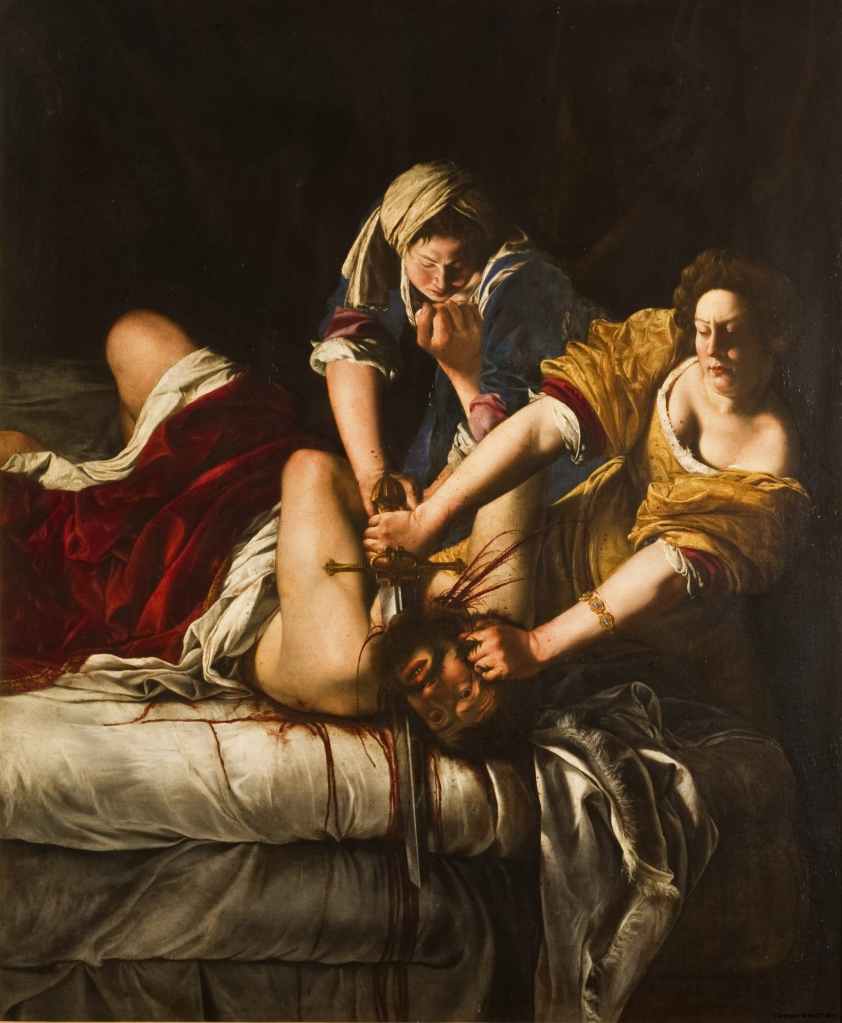
Day 17 – Artemisia Gentileschi, Judith Beheading Holofernes, c. 1620, The Uffizi, Florence.

Originally posted on 4 April 2020

Today should have seen the opening of ‘Artemisia’ at the National Gallery – and there is still some hope that we may yet see it. But in the meanwhile, let’s enjoy this painting. By now, after a little light cannibalism thanks to Giulia Lama (#POTD 16) I’m sure you will be inured to violence, and to the fact that women were perfectly capable of depicting it. You will also probably know more about today’s artist than yesterday’s, and know more about her life than about that of many other artists. If you do, you will probably know why she wanted to paint this image – although in reality, it is unlikely that she chose the subject matter. It was probably a commission, and probably from the Medici family, who by the 17th Century were the Grand Dukes of Tuscany. It was their personal collection that formed the nucleus of ‘The Uffizi’, where the painting is today. The gallery found its home in what had been the administrative offices of the Grand Duchy – hence the name.

This was the second version of the subject she had painted. I always used to prefer the earlier version, painted around 1611-12, and currently in the Capodimonte in Naples, but that might have been because it was easier to see. It was presented in the centre of a wall, directly opposite the entrance to the room, at the end of a short enfilade – or succession of rooms. The hang of the Capodimonte is very clear – the most important paintings (if that means anything) are always at the end of a ‘vista’. You can identify their Caravaggio from 200m (nowadays that would be a supermarket queue of 100 people…) The Uffizi, on the other hand, displayed their ‘Judith and Holofernes’ at the left-hand end of a wall, in a corner which, as a result of the structure of the building, was at an acute angle – so you couldn’t even stand in front of it very easily. Now, following their re-hang, it can be seen far more easily and clearly, and reveals its full, gory glory.

The story of Judith comes from the eponymous book, which is either in the Bible, if you are Roman Catholic, or among the Apocrypha, if you are Protestant or Jewish. It tells the tale of a virtuous woman of the city of Bethulia, which is besieged by an army led by Holofernes. One night Judith creeps out of the city and approaches the enemy camp pretending to have defected. To cut a long story short, one night she dresses up in her finery and heads to Holofernes’ tent – at his invitation – and, as the story says, ‘Holofernes was so enchanted with her that he drank far more wine than he had drunk on any other day in his life’. So, at the appropriate moment, she took down his sword and chopped of his head.

It was a popular subject. Which is surprising, as most art was commissioned by men. But through her act Judith saved her people – and so she was seen as a precursor of the Virgin Mary, who, through her own personal sacrifices, saves her people. She is a model of Virtue triumphing over Vice. She was particularly important in Florence, for reasons I shall explain when I talk about Donatello’s ‘Judith’ – which, I’m afraid to say, is my favourite. Artemisia’s is definitely the best painting. I love Botticelli’s: he tells the story in two tiny paintings each the size of a large post-card. The first shows Holofernes’ troops finding the headless body in his tent. In the second we see Judith sashaying through the countryside followed by her maid Abra, who is holding the head on her own like a bag of laundry. They might just as well have been out shopping, returning home victorious having found the last bag of flour. It is beautiful, richly coloured, and elegantly drawn – but misses the fact that a man has just been beheaded.

It says something that Artemisia is even better than Caravaggio at depicting this scene – particularly as Caravaggio is one of my favourite artists. He must have been having an off day – or an off three months, the least time it would have taken, surely. It’s the one painting by Caravaggio that I really don’t like, simply because – well, I’m disappointed by him. He is so good at thinking about the most dramatic moment in a story, the most human aspect, and how that would work in real life, even if the situation itself is anything but real. But here… it just doesn’t work. His Judith might be very good at flower arranging, and could conceivably cope with cutting Holofernes’ hair (no help, as he isn’t Samson), but in terms of engineering alone this would never work. That sword simply would not go through that neck at that angle, while she lifts a limp lock of hair. And she really doesn’t want to get any blood on that pristine white blouse, does she? He is so young, so muscular, and so vigorous she doesn’t stand a chance. I suspect Caravaggio might have been distracted by the youthful vigour.

Artemisia, on the other hand, shows she knows exactly how to do it: wait until he is flat out on the bed (no, I didn’t mention the bed, but it’s clearly what Holofernes had in mind) and get your maid to hold him down. At this point it helps to have a younger maid. Notice how Abra is directly above Holofernes, and putting her full weight into it. His face is also central, as is Judith’s right hand holding the sword, which is cutting through the neck along the central axis of the painting. The full force of both women is going into this. Judith is really going for it – pulling with her right hand, and pushing the head in the opposite direction with her left. I bet Artemisia practiced this, a tearing, ripping action, assisted by the slice of the sword. And the blood – this is blood. Not those scarlet ribbons fluttering away from Caravaggio’s Holofernes.  It spurts out, dark against his brightly lit arm, runs across the clean white sheets, and trickles down the folds from one mattress to another. It’s the same colour as the royal red velvet bedspread, and the rolled-up under-sleeves of Judith’s dress. They are all in this together, besmirched with the same blood.

A couple of days ago (#POTD 15) I talked about the advantage Mary Cassatt had over some of the male Impressionists – she knew how women behaved when men weren’t around. And I’ve always thought that Artemisia has a similar advantage here. She understands female anatomy in a way that men couldn’t. She knew about breasts. So many male artists didn’t – Michelangelo being the most famous example. Now, I have very little experience, but I’m imagining that, if you’re wearing a bodice, pulling with you right arm and pushing with your left, this is exactly what will happen to your bust – please tell me if I’m wrong (particularly any actors (f) out there, or anyone else who has worn a bodiced gown). It just looks so… real.

One problem with looking at Artemisia’s paiintings is that we know too much about her. In general we tend to talk about the biography of female artists even more than that of the men: how did they get to be artists in the first place? What did they do? What happened to them? Well, Artemisia got there because her father Orazio was an artist, and initially she would have trained with him. He was a great friend of Caravaggio’s, and one of the first people to be influenced by his revolutionary style. He even leant Caravaggio a pair of wings, probably to use for the more-than-slightly unnerving painting ‘Love Victorious’. Artemisia then went to work as an assistant for one of Orazio;s other colleagues, Agostino Tassi, who raped her. Unusually, she took him to court, and even more unusually she won. But as it was his word against hers, she had to prove that what she was saying was true. So they tortured her, and she didn’t step down.

You can understand why she would have it in for men, but that is not why she painted this painting. She would have been commissioned. In any case, the situation is not entirely parallel, as Judith knew what she was doing. Not only that, but Artemisia got no help from her chaperone, who had an agreement with Tassi, and left the two of them alone together. But that’s not to say she didn’t understand Judith, or associate herself with the Jewish heroine. And she certainly defended herself with a knife. There are several, minor differences between the earlier version of the subject and this one. The composition has been slightly rethought, and Judith is dressed differently. Her hair is also more finely coiffured, and she wears a bracelet on her left arm.

This all fits in with a re-reading of the text, where it says that Judith dressed herself in all her finery and bedecked herself with jewels. It’s just that the bracelet is in such a prominent position, halfway along her brilliantly illuminated forearm. It matches her bodice in terms of colour, and lines up with a darker fold in the fabric, so it stands out more. Look at the detail – each section bears an image of a standing woman. It’s hard to see what this is, as the detail is so small, but it is probably the Greek goddess Artemis – the Romans called her Diana – the chaste, virgin goddess of the hunt. The goddess who, when Actaeon chanced to see her naked, turned him into a stag so he was hunted to death by his own hounds. The goddess after whom Artemisia was named. And yes, you’re right, those are not coral beads next to the bracelet, that is a stream of Holofernes’ blood. She knows what she wants, and she knows how to do it.

Day 16 – Saturn devouring his Child

Day 16 – Giulia Lama, Saturn devouring his Child, c. 1720-23, Private Collection (Sold at Christie’s, 2011).

Originally posted on 3 April 2020

Why do we talk about women artists so rarely? Apparently it wasn’t always the case. According to Grizelda Pollock, one of the first and most consistent feminist art historians, they were regularly included in dictionaries of art and artists until the beginning of the 20th Century, at which point they were all but written out.  This year, with Artemisia at the National Gallery, and Angelica at the Royal Academy, let’s hope they are being written back in, and not just as token representatives, but as vital and inventive artists.

The fact is, there always were fewer women who could make a career in the arts – they were not given the training. It helped if Dad was an artist, as in the case of Angelica Kauffman (#POTD 14), especially if his studio was very busy – or he didn’t have any sons to help him. But they wouldn’t get apprenticeships with another artist, as that would mean living with a man who was not a member of your family at the age of 11 or 12. When academies started to be founded in the second half of the 16th Century, women weren’t admitted, because women didn’t get an education anyway. The few women who did succeed usually had unusual fathers – i.e. fathers who were artists, or who believed that their daughters should be educated. Or the girls were amateurs, practicing the usual accomplishments any young lady should have – music, and some ability with a little delicate decoration – until they turned out to be outstandingly good at it and so broke through to the ‘mainstream’.

In any case, it was thought that they lacked the necessary intellect to understand something like perspective and didn’t have the necessary education to know about classical mythology, so they would never be able to paint great narratives. Women weren’t supposed to paint portraits of men, in case the men assaulted them, and landscapes weren’t a great idea because, out in the countryside, they might be attacked by brigands. So they were left with Still Life, because, on the whole, a still life won’t bite back. The most distasteful thought was that they might attend a life class. Drawing and painting the male nude became the foundation of artistic training, because without a thorough understanding of male anatomy an artist would never be able to paint a battle scene, or a martyrdom – those uplifting stories which were the apogee of art. It would be so inappropriate for a woman to draw a naked man. Ladies were supposed to avert their gaze, and not stare at anything.

So, that’s what we’re left with – pretty flowers, ladies having tea (#POTD 15), or the artist herself indecisive between painting and music (#POTD 14). I have yet to cover the pretty flowers. It’s all pretty girly really, lets face it. Just like today’s painting… 

Sadly we don’t know a huge amount about this image, and the attribution to Giulia Lama isn’t universally accepted. But I think few people doubt it now, particularly as her painting is getting better known. We also know relatively little about Giulia Lama herself. She was born in the Parish of Santa Maria Formosa in Venice, the daughter of an artist (it helps). One of her great works is in the church there, a Madonna and Child with Saints on an impressively grand scale. Her style is remarkably close to that of one the greatest, but underrated, artists of 18th Century Venice, Giambattista Piazzetta, whose works are the smoky colour of bitter toffee apples, if such a thing exists. His fame was eclipsed by that of Tiepolo, whose candyfloss colours are ideally suited to those of a sweet tooth – I love them both. 

Why was Lama’s style so similar to Piazzetta’s? At this point a discussion arises: was Lama a student of Piazzetta’s, or a colleague? Opinion is tending towards the latter: they may well have trained side by side in the school run by artist Antonio Molinari – which would make her the first woman to attend any sort of art school.

Today’s painting could almost be a manifesto overthrowing all the reasons why women couldn’t become artists. It’s a classical story, shows a male nude, and has fantastic foreshortening (basically perspective applied to a single object). And it is anything but ladylike – or, for that matter, for a classical narrative, anything but uplifting. It’s a man eating his own child! It is, of course, a story that proves that we don’t learn from history. Saturn made it to the position of Top God after his mother, Gaia (the Earth), got so upset that his father (Ouranos, the air) kept imprisoning their children that she gave him (Saturn – or Chronos, as he was known back then) a very sharp knife, and encouraged him to castrate his own father, which he did. The severed genitalia fell into the sea, which was therefore made fertile, and the result was Aphrodite – her name means ‘born from the foam’. Of course, the Romans called her Venus, which explains Botticelli’s famous painting (#POTD 8) – and stops it looking quite so charming.

Knowing how easily a god could be overthrown, Saturn didn’t want to take risks, and so eat each of his own offspring as they were born. Eventually his consort, Ops (Rhea, to the Greeks), lost patience with this, and handed him a stone, pretending it was the latest baby, smuggling the newborn to Crete, where it grew up to be Jupiter. As an adult, Jupiter returned, forced to Saturn to regurgitate his siblings, at which point they overthrew Dad. And you thought Eastenders was bad.

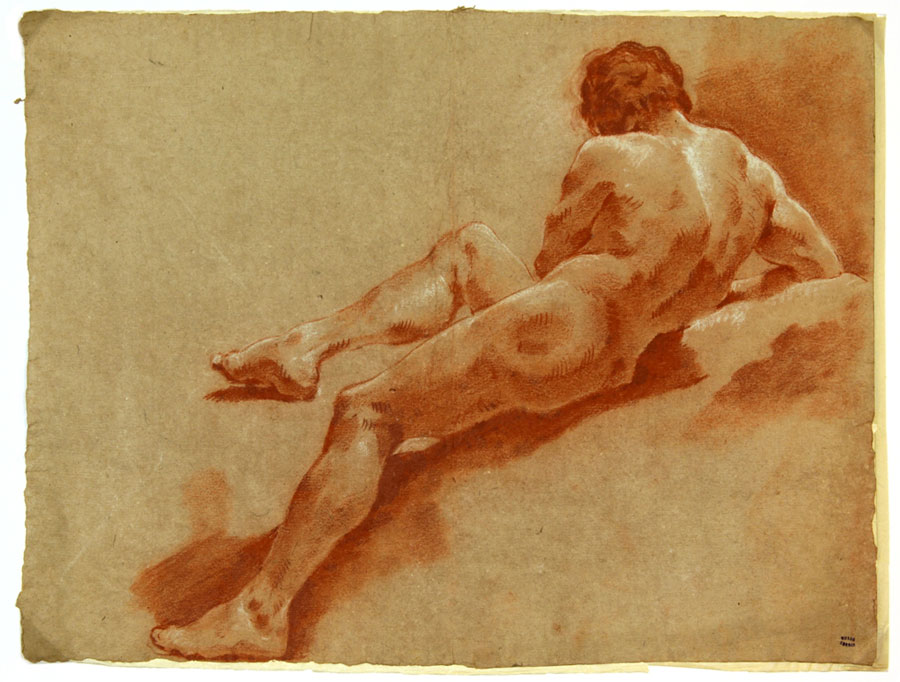
Precisely why Lama chose to paint this subject – or who commissioned her to do so, and why – we may never know. A contemporary account says that many churches wanted her to paint them an altarpiece, so highly was she respected, and as well as the one I’ve mentioned in Santa Maria Formosa there is another in San Vidal, just over the Academia Bridge. But that doesn’t explain this painting. Maybe she painted it simply because she could. She certainly seems to have been the first female artist to have studied the male nude – and she did so often: I’ve included two of her drawings, and they are superb. She uses black and white chalk in one and red and white in the other, the light and shade giving the body a sculptural feel, with short, stabbing strokes of the chalk, over broader areas of shading. They show a remarkable ability to articulate the limbs and arrange the body in complex ways, but with the slight exaggeration that creates movement and drama, the essence of all great Baroque art.

The same qualities can be seen in the painting, the limbs of Saturn creating diagonals across the surface, and into the depth of the painting. The legs continue the shallow diagonal of his grasping left forearm, while the body of the child, softer, lighter and therefore more succulent than that of his swarthy father, is parallel to the muscular upper arm. It marks the diagonal from bottom bottom to top left, whilst also creating depth for the composition. All this is set in bright sunlight, so they stand out clearly from the dark rock in the background, and allow for the deep dark shadows that define Saturn’s muscularity. It’s not pretty, and it really isn’t ladylike. In many ways, it isn’t even very nice. But it is brilliant – an astonishing bit of painting and a fantastic work of art.

Day 15 – The Tea

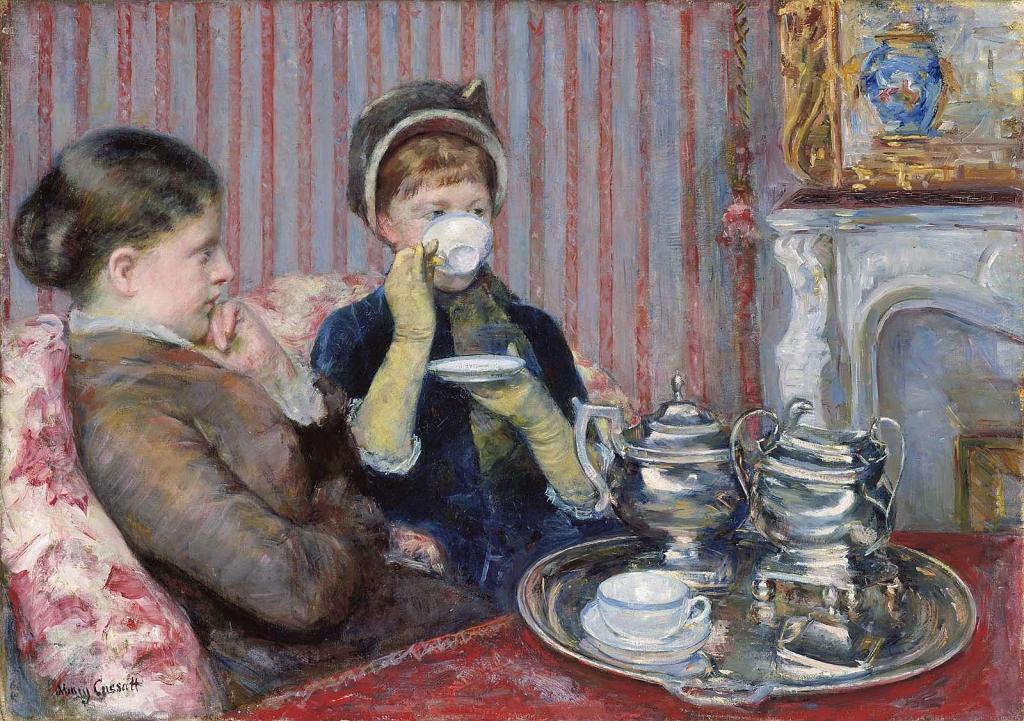
Day 15 – Mary Cassatt, The Tea, about 1880, Museum of Fine Arts, Boston.

Originally posted on 2 April 2020

A change of mood: let’s calm things down a little, and have a nice cup of tea, brought to us by Mary Cassatt, and the good people of Boston (www.mfa.org). There are some paintings which just make me want to stop, and look, and say, ‘Isn’t that lovely!’ And this is one of them. It’s so carefully composed, and harmoniously coloured.  The two women, the tea service, and the vase in front of the mirror – or is it a painting? – are evenly spaced across the surface. The rich red of the tablecloth, with its thin, decorative border matches the floral patterning of the upholstered sofa shared by the two women, as well as the stripes of the wallpaper. The blue, presumably Japanese vase, with its gilt fittings, together with the frame of the painting (or is it a mirror?) echoes the colours of right-hand woman’s outfit, while also, together with the carved marble fireplace, describing the richly appointed lifestyle that was Cassatt’s milieu. The antique silver tea service is another indicator of this. There is such a focus on these still life details, with the carefully but freely painted teapot, sugar bowl and cup, the reflections on their surfaces and their reflections in the tray, that we might assume that this tea service is the real the subject of the painting. It is more prominent than the women, a third character in this domestic drama. 

Mary Cassatt came from a wealthy Pittsburgh family, and left the States just after the Civil War, like so many other Americans – she could almost have been in a Henry James novel.  She wasn’t the only woman to exhibit with the Impressionists, but she was the only American. She joined them in 1877 at the invitation of Edgar Degas, so often maligned for his misogyny. I suspect he got grumpier as he got older (I know the feeling), and so a lot of the misogyny was general misanthropy.

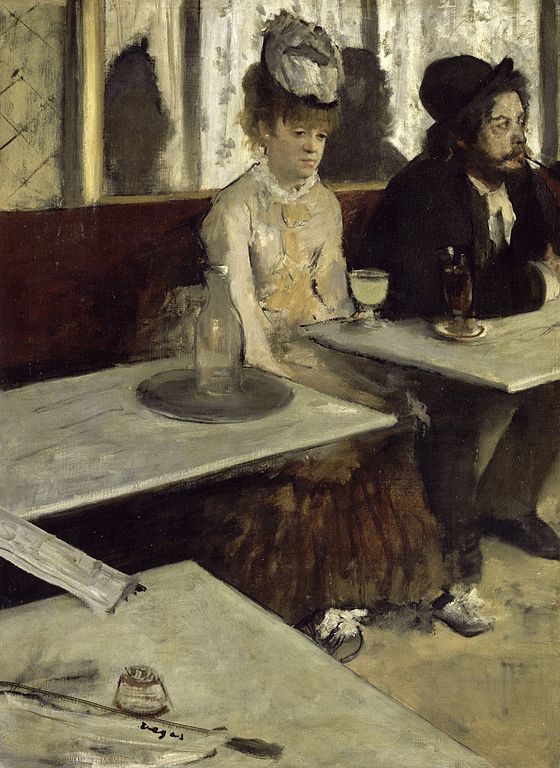
You can see what he liked about her work from this image. The composition is not so very far from some of his own: two people in a room, drinking, a tray on the table, the table taking up most of the foreground space, the same tones and colours as the walls – a description that would fit both ‘The Tea’ by Cassatt and ‘Absinthe’ by Degas, painted three or four years earlier. The connection is purely coincidental – or rather, it is part of what makes them both Impressionists: they have common interests and concerns.

The Impressionists didn’t set out to be the most famous and successful artistic movement of the 19th Century – they just wanted their work to be seen. At the time there was only one main art exhibition per year – the annual ‘Salon’ – held by the Académie des Beaux-Arts, and therefore officially sanctioned. If you wanted to get known, to be accepted and to sell work in France, you had to be seen there. But the paintings of a group of young artists who hung around in the circle of Edouard Manet in the Batignolles district of Paris were rejected. In true 1950s American movie fashion, they decided to ‘put on a show right here’ – ‘here’ in this case being the studio of the photographer Nadar at 35, Boulevard des Cappucines. This was in 1874. But what should they be called? Well, they marketed themselves as ‘The Anonymous Society of Painters, Sculptors, Engravers, etc.’ It was never going to catch on. 

Although there were bad reviews, they were not really as bad as everyone always says. One critic did try and suggest a name for the group, saying that, as the word ‘Impression’ had been used by one of the artists – Claude Monet exhibited a landscape called ‘Impression: Sunrise’ – you could do worse than calling them ‘Impressionists’, as they really did capture the impression you had on first seeing things. The exhibition was definitely not a financial success, and they didn’t follow it up the following year. However, in 1876 they put together a second exhibition, under the same name and, in 1877, a third. This was the first that Cassatt contributed to – she was delighted to be involved. On receiving Degas’ invitation she said, ‘I accepted with joy… I hated conventional art’. This was the moment, she thought, at which she ‘began to live’. It was also the point at which the ‘Anonymous Society of Painters, Sculptors, Engravers, etc.’ decided to cut to the chase and call themselves Impressionists.

They weren’t really a group, as such, and they didn’t really have a single style, although some of the more prominent artists did share similar interests. A lot of them painted outside, to capture the freshness of the moment – although Degas never did: he based a lot of his work on photography. Some of them were interested in bourgeois society, and the life of the city. Cassatt certainly fits in here. However, someone like Pissarro preferred peasant life and chose to live in small towns some way outside the capital – like Norwood, where he stayed during his years in London. But with all of them there is a sense that they stand on the outside looking in – voyeurs, perhaps. Or anthropologists. They loved people watching, and Cassatt’s great advantage was that she was a woman. Not only did she know how women behaved, but she had access to spaces and rituals that men could not have eperienced. Had ‘The Tea’ been painted by Renoir it would have been very different. The women would have been more buxom, for a start. And probably more girly – looking at the artist and smiling. Even giggling. Or languishing with bedroom eyes. Not Cassatt, though – she’s too good for that. She knows what it’s really like.

The similarities with ‘L’Absinthe’ relate to her attempt to make the image look real – almost like a snapshot. The table gets in our way, and distances us from the women, although, in an apparently contradictory way, it also bridges the gap between us and them, leading our eye into the painting. Cassatt has portrayed the scene just as she saw it, without bothering to tidy it up, to move the table out of the way, or to make sure we can see both of the women clearly. In fact, she goes out of the way not to show us the women, choosing, very carefully, the moment at which one of them is drinking her tea, so that the cup is almost completely covering her face. This is the point at which you realise that the Impressionists’ claim to be painting what they saw, when they saw it, just as they saw it could not possibly be true. This isn’t ‘fly on the wall’ observation, it is careful calculation. How long would you spend with a cup tipped up like that? And how long would it take to paint? More than a few minutes, certainly.

The women are dressed rather differently, one in plain brown, her right hand leaning on her cheek, the other resting her saucer on her left hand, which is clad in a delicate primrose-yellow glove. The other gloved fingers lightly hold the cup to her mouth, little finger aloof, as she looks away from her companion. As well as gloves, she wears a hat – she is a guest in the other woman’s house and has recently arrived from the outside world. Her rich, deep blue coat, like the accessories, points to her wealth. The woman in brown is presumably as wealthy – look at her room – but, as she is at home, she does not feel the need to make the point (all those Working From Home bear this in mind).Cassatt was the master (or mistress?) of gesture and character, of setting and mood. Why did she want to paint the guest in the act of drinking? Why cover so much of her face? And why is she looking away? The cup is tipped quite high – she must have nearly finished. And not a moment too soon – the hostess has nothing more to say to her, it seems. And, possibly, she is thinking to herself, ‘I hope that’s the last sip’. The patient, long-suffering expression seems to say as much. And why is there so much focus on the tea service? Maybe we are also present in this room, a third, unseen person, and like the woman in blue we have looked away, we’re focussing on the silverware, as there really is nothing more to say, nothing more to do.  Talking of which, I really wouldn’t want to keep you any longer. But do feel free to linger, and enjoy the colours, the careful composition, the contrast between reclined relaxed hostess and upright, edgy guest, and that wonderful, tense, long, dramatic pause…

Day 14 – Self-portrait of the Artist hesitating between the Arts of Music and Painting

Day 14 – Angelica Kauffman, Self-portrait of the Artist hesitating between the Arts of Music and Painting, 1794, Nostell Priory, West Yorkshire.

Originally posted on 1 April 2020

Two weeks of #pictureoftheday already! Thank you so much for all your ‘likes’, comments, queries, requests, and ‘shares’ – yes! Especially for the ‘shares’, keep on doing that, I’d be so happy if even more people could get to read these ramblings. And if there’s anything you’d like me to cover, please ask!

That’s what I’m doing today – a request – for art by a woman. It shouldn’t be a request, I know. I should have done it already, and will do more in the future! And yes, I know I could have jumped straight in with Artemisia, but by now everyone knows about her (that won’t stop me in future, though), and it is really sad that the opening of the National Gallery’s exhibition has been delayed: let’s just hope it doesn’t get cancelled altogether. Another exhibition I’m really looking forward to is Angelica Kauffman at the Royal Academy. As it’s due to open on 27 June, I suppose there is still some hope it could open on time.

Kauffman was a wonderful artist, as I hope today’s painting shows, and a very clever woman – which I hope you will understand by the time I’ve finished. She was born in Chur, in Switzerland, which a Swiss friend of mine once spent a very long time trying to persuade me not to visit. It wasn’t that bad, to be honest, but I probably wouldn’t rush back, although I want to go at some point as their museum was being refurbished, and I missed the Kauffmans. Kauffmen? Not that there should be that many there – the family moved away when she was one, and then again ten years later, by which time they were in Italy. She was trained by her father, and assisted him from the age of 12, and she moved to London in 1764, by which time she was 23. She rapidly became a hugely successful portraitist, and in 1768 was one of only two women to be founder members of the Royal Academy. But she was not just a painter of pretty faces – she spoke German, Italian, French and English, and the subject matter of today’s painting shows she was well educated in other ways too.

It shows her, as the title tells us, ‘hesitating between the Arts of Music and Painting’. She is central, in white, with her body facing towards us. Not only is she making sure we do not miss her by taking up as much of the painting as she can, with her shoulders full width across the surface, her gestures take up just a little bit more space, but the white makes her figure ring out from the darker background and the rich colours of the allegorical characters. It also gives her a higher moral status – white makes her look virtuous – while unifying the composition by matching the white of Music’s undershirt and the off-white of the score on her lap and the headdress of Painting. In the same way Music and Painting are balanced on either side of Ms Kauffman as they are wearing red. 

Music is relaxed, and seated, looking towards the artist with a winning gaze, which is returned. She pulls the artist’s right hand – the hand Kauffman paints with – towards her. Meanwhile, Painting looks concerned, almost anxious. She points towards a temple atop a steep hill in the top right-hand corner of the painting. If you look back to Music, you will realise that the diagonal of the hill, and the pointing arm, actually starts in the score, undulating across Music’s knees and echoed by Kauffman’s right arm. 

The artist’s left hand points towards the palette, which has four dabs of paint on it – there’s not a lot there, as if work has only just begun. We see mustard yellow, ochre, red, and – a dark burgundy? The mustard yellow and red seem to be the colours of Painting’s clothes – the darker versions for the shadows maybe – with the hint that Painting herself has only just begun: there is more work still to do. Painting is not finished. What is missing from the palette, then, is the blue of her dress. Is it fanciful to imagine that she wears this blue robe in the same way that Mary does in so much Christian art – because it was the most expensive pigment and became associated with the most important person in the painting? What is certainly true is that Painting is wearing red, yellow and blue – the three primary colours – everything that painting is made of. But is she the most important? Or, of the two arts, is she more important than Music? We know the choice Kauffman would make, as we know her as an artist. She knows it too, and so, I think, does Music. Why else would she clasp that right hand so tightly, while Kauffman gestures to the palette with a look of compassionate regret on her face? Music is being rejected.

A lovely idea, and it’s cleverer than that. It is a direct reference to classical mythology, and particularly to a subject called ‘Hercules at the Crossroads’: the second picture shows Annibale Carracci’s painting of the subject from 1596.

Xenophon of Athens, writing some time in the 4th C BC, tells us that, as a young man, Hercules was faced with a choice between Virtue and Vice – should he take the hard, upward road, a life of toil and responsibility which would eventually lead to glory, or should he opt for an easy life of pleasure and enjoyment (i.e. going to the theatre and listening to music in a see-through skirt, by the look of it). Shakespeare was clearly aware of this parable, and, changing the context, gives the following words to Ophelia, after her brother Laertes has told her to be virtuous:

Do not, as some ungracious pastors do,
Show me the steep and thorny way to heaven,
Whiles, like a puffed and reckless libertine,
Himself the primrose path of dalliance treads…

The parable was well known in 18th Century England. Kauffman’s great friend was Joshua Reynolds, first president of the Royal Academy (was her admission a rare case of Jobs for the Girls?), and he had adapted it in 1760-61 for his portrait showing ‘David Garrick between Tragedy and Comedy’.

Reynolds, Joshua; David Garrick between Tragedy and Comedy; Samuel Johnson Birthplace Museum; http://www.artuk.org/artworks/david-garrick-between-tragedy-and-comedy-19617

For Garrick, the implication is that Tragedy is hard, but leads to glory, whereas comedy is easy (well, look at her), and fun. This was painted a few years before Kauffman arrived in London, but she may well have seen it – after all, the first of her portraits to be exhibited in London was of Garrick (picture 4). She’s playing with an idea created by Reynolds here, with the sitter peering over the back of a chair – many years before Christine Keeler.

Having said that, her self-portrait is not drawn directly from Reynolds. Look at Painting’s hand pointing up to the Temple of Art, and compare it with Virtue’s left hand in the Carracci – it’s far more like that. ‘Hercules at the Crossroads’ comes from the Farnese Collection in Rome, but it was moved to Parma in 1662, so even though Kauffman moved to Rome in 1782, 12 years before painting her self-portrait, she probably hadn’t seen the Carracci first hand. Given that Virtue and Painting are on opposite sides of their respective images, I wonder if she had taken the idea from a print, where the gesture would have been reversed? This does not imply that she lacked invention – quoting from the work of others was a way of signalling that you knew about their art, acknowledged it, and, if you did it well, ‘owned’ it. You were part of that world. As Picasso is supposed to have said, ‘Good artists copy. Great artists steal’.Wherever she got that gesture, she is saying one thing, and saying it rather clearly at that. As far as she is concerned music comes easily to her, and, much as she likes it, it’s a case of ‘I’m sorry, it’s not you, it’s me…’ So Music is deserted in favour of Painting. Painting is hard, but painting is rewarding, and painting will win her a place in the Temple of Art. A little bit of false modesty perhaps, but being an artist was never easy, and even harder – especially hard – if you were a woman. She’s got to fight for everything she can get. Women were denied an artistic training because it was thought they didn’t have the necessary intellect, let alone the necessary education. It really helped having a father who was an artist, but even with that training she still goes all out to say, ‘Not only can I do this, but I do know the Classics, and I do know about European art’. She deserves her place – let’s hope we get to see that exhibition!

Day 13 – Chiostro Grande, Certosa di San Martino

Day 13 – Cosimo Fanzago, Chiostro Grande, c. 1623, Certosa di San Martino, Naples.

Originally posted on 31 March 2020

Well that’s a surprise! It’s not a painting. I think I did say, almost two weeks ago, that I would be talking about a painting every day, but quickly realised there’s more to life than flat things – and I love painting, sculpture and architecture equally, so today’s #pictureoftheday is a picture of a sculpture in Naples. To be honest, I really want to talk about the space it’s in, the ‘Chiostro Grande’, or large cloister of the Certosa di San Martino – or Charterhouse of St Martin – in Naples but I suspect this image will better at grabbing you attention! 

It’s not entirely clear who designed he cloister, to be honest, although it is traditionally attributed to architect and sculptor Cosimo Fanzago. Born near Bergamo in the North of Italy, he made his name in Naples. He was certainly working in the Chiostro Grande around 1623, but might have added the decoration to a slightly earlier structure. At the very least he was responsible for the architectural frameworks of the doors in the corners of the cloister, and the sculptures which inhabit them: they are all fantastic, but this is probably the best.

It represents the Blessed Niccolò Albergati, a Carthusian monk who became a Bishop in 1417, and then a Cardinal in 1426. Five years later, working as a diplomat in Antwerp, he met Jan van Eyck who painted his portrait –which looks nothing like this sculpture. I’d trust van Eyck, though, as Fanzago is clearly creating a dramatic showcase with which to display his ability to make marble move. Albergati wasn’t beatified (the first step towards being recognised as a Saint) until 1744, but his inclusion in the Chiostro Grande in the 1620s shows that he’d been revered by the Carthusians for a long time. 

The sculpture shows Fanzago at his very best, but to appreciate it fully you’d have to go and visit, as you need to move around it and see it from more than one point of view. You would see it frontally like this while walking along one of the arcades in the cloister (imagine it in the far distance in the second picture). Framed by the cool, grey marble, the brilliant white figure stands out, both in terms of colour and sculptural form. It’s like he’s standing behind an oval window, his bible resting on the windowsill, with his habit flowing out into our space. His left wrist rests on the book allowing his hand to fall forward towards us, and he props his right elbow on the other side of the book, his wrist bent back so that his long, curving fingers rest on his face. The sculpture are deeply cut – especially behind the book, creating a dark shadow – and every joint is beautifully articulated, with each finger extended differently, and a large space opening up between his chest and right arm – which you can only really appreciate from the left-hand side.  In this photograph he appears to be turning away from us, but imagine approaching along the arm of the cloister which joins from the left. Not only would you see the looping form of the arm and hand, but you would also see him looking down towards you, assessing you, fully aware of your actions, perhaps: curious, if not judgemental. This is a sculpture which is perfectly suited to its location.

Wherever you go in the world, the best way to understand it is to find a place where you can see as much of it as possible in one go – go to the top of a tower, if you can. Or go up a hill, which is where the Certosa is, overlooking the bay of Naples, as that’s where the Carthusian monks decided to establish their monastery. From the terrace outside you can get a very good sense of the extent of the city, of its limits in Greek and Roman times, and of its expansion in the 19th and 20th Centuries (although the latter is rather distressing). It’s the perfect place to go.

I’ve been wanting to write about the Carthusians for a while – ever since #POTD 6 as it happens, as the artist of that mesmerising Still Life, Juan Sánchez Cotán, entered the order in his forties, in the middle of a career as a successful artist. The Carthusian Order is intriguing, and the monks would be doing very well right now. Founded by St Bruno of Cologne in 1084, the order is a combination of two different types of monastic lifestyle: eremitic and coenobitic. The former is the life of a hermit, withdrawn from the world, and solitary. The second implies belonging to a community. The Carthusians manage to do both by being hermits within a community.

There were – and are – two types of Carthusian: cloistered monks, who live a life of prayer and contemplation, who are destined to become Fathers, and the lay brothers. The choirmonks all live in the cloister, and each one has their own split-level cell, built to a uniform design. On the lower level is a room in which to store wood for a stove, and a workshop for manual labour. The rest of this level is given over to a walled garden, used by the monks for prayer and contemplation, and to grow food for themselves and the rest of the community. On the upper level there is a small area for prayer, which adjoins a larger space, a combined bedroom, dining room and study. Each monk eats lunch and supper alone, the food being delivered via a turntable next to the door of the cell by one of the lay brothers, who are responsible for the practical running of the monastery, but who also lead a life of silent prayer and contemplation. You can see these ‘turns’, as they are called, on the far side of the cloister in the second picture, and all around the cloister in the third. Of the seven daily services, the cloistered monks say four on their own, leaving their cells three times a day for communal worship. I’ve read that they go for a walk in the countryside once a week, and only then can they speak. However, another source said this outing would take place once a year, and yet another, never. On Sundays and special feast days there are communal meals, but these are eaten in silence.

Basically they are all self isolating and socially distancing while at the same time receiving home deliveries and remaining part of a wider community – we could all be doing it now. The first time I visited San Martino I wanted to move right in. Having passed through the church, which is richly decorated in brightly coloured marbles – quite overwhelming – I stepped out into the Chiostro Grande, with its pure white architecture, and it took my breath away. The weather was pretty much like it is in these photographs, too – clear blue skies, and pleasantly warm. Not only that, but I quickly realised that almost all of the cells have sea views – check out the third illustration. It was an especially good place to be in times of plague: the monks went out very rarely, so they were unlikely to catch anything. In any case, they lived high above the city, well outside the city walls, so disease would not reach them. Monks also had an age-old tradition of washing their hands before meals, so they were even less likely to get ill. As a result it became abundantly clear to the people of Naples that God was watching over the Carthusians, especially when, in 1656, the plague killed around half of the 300,000 inhabitants of the city, and the monks didn’t even get sick. What a brilliant place to live. Mind you, the only way out was up – to Heaven – leaving their earthly remains in the Cemetery that is visible in the second image. You can see it on the right, surrounded by a balustrade, which Fanzago topped with rather cheery skulls. I suppose it’s not how we’d choose to live today. Apart from the fact that in 1907 a twenty-year-old architectural student from Switzerland visited the Certosa di Galuzzo, just outside Florence, and made a number of drawings – the fourth picture comes from one of his sketchbooks.

The idea of living separately as part of a community made sense to him. Everyone has some open space of their own and room to work, sleep and eat, while being part of a community, with all the infrastructure necessary for good living easily to hand in the same building. Initially the young Charles-Édouard Jeanneret arranged these units horizontally. But then, he piled them up into the sky, so people would living like crows – an idea related to the name by which we know him today: Le Corbusier – ‘the crow-like one’. Sadly a lot of bad architecture was influenced by his ideas, but I can’t help thinking that the ideas themselves were necessarily wrong: it was when the need for individual open space started to get cut out as ‘inefficient’ that it became less desirable. Perhaps I’ll move into San Martino after all.

Day 12 – The Effects of Intemperance

Day 12 – Jan Steen, The Effects of Intemperance, about 1663-5, National Gallery, London.

Originally posted on 30 March 2020

I thought about this painting the other day, as I was taking my daily exercise. I saw someone walking directly towards me right down the middle of the pavement who clearly wasn’t going to shift out of the way, so I stepped out into the middle of the road and cut along the dotted line as if I were saving a voucher for my own well-being. And I thought, whatever happened to ringing bells and shouting ‘unclean, unclean’, even if we are all healthy? After all, we can’t know that we are.

So naturally I thought about this painting, ‘The Effects of Intemperance’, by Jan Steen. You’re probably already worrying about social distancing, but they are a family unit, just a somewhat dysfunctional one. Mum has fallen asleep, pipe in hand, while her eldest daughter is giving the parrot a drink of wine. Two of the kids are feeding the cat a rather impressive pie, another throws roses at a pig, while the last, on the far left, has got his hand in his mother’s purse. It’s appalling behaviour, why are they doing this? Any of you who are home schooling probably understand the situation far better than I do, but notice the flagon resting on the ground by the eldest girl’s hand – it has toppled over and the lid is open, but nothing is coming out. Mum’s drunk the lot – with the exception of the glass being held by her daughter. The temptation to hit the bottle at the present time must be enormous. Mum’s clearly had a bit too much and has fallen asleep. So the kids are running riot. 

So far it all makes sense, but who would dream of giving wine to a parrot? Well, what do parrots do? They talk, for one thing – or rather, they copy what other people do. They parrot. Now look at the parrot, and look at the mother – the posture, the curve of the back, the position of the head, and the angle of the head to the body, not to mention the colours – greys, reds, and whites. They are the same. In image as well as in behaviour, the bird is parroting the mother – she has been drinking, and so the parrot has too. Before long, they will both fall off their perches. The mother is setting a bad example. To quote a Dutch proverb commonly illustrated by Steen, ‘As the old sing, so the young pipe’.

The daughter will be the next to fall off her perch. We know this, because she is holding a pretzel. Nothing wrong with a harmless, salty snack, you might think, unless we look at a genre of literature that was popular in the Netherlands in the 16th and 17th Centuries, the Emblem Book. Each emblem has a title and a picture, together with some text explaining the connection between the two. One of these emblems features a pretzel, being held on either side by the little fingers of two different hands. It seems that the Dutch used to play a game with pretzels, very similar to the game I used to play after Sunday lunch roughly once a month, when we’d had roast chicken: pulling the wish bone. Each person grabs hold of one end of the Y-shaped bone and pulls until it breaks, and the person who gets the larger part of the bone wins. The same rules apply for the pretzel. But who, in the emblem, is playing this game? The text explains that, from the moment they are born, children are a prize fought over by God and the Devil: who would get the larger part? If this young lady doesn’t mend her ways – and follows the example of her mother – she will go to the Devil. 

What about the children feeding the cat? It’s clearly a waste of good food, and their lives could be similarly wasted. The image of the boy throwing roses to a pig comes from another emblem, which is ultimately derived from the teachings of Jesus, in the gospel of Matthew: ‘Give not that which is holy unto the dogs, neither cast ye your pearls before swine, lest they trample them under their feet, and turn again and rend you’. If I had any pearls, I’d certainly hold on to them. As for roses and pigs, ‘they don’t go well together’, to quote the title of emblem, so again, life, and its beautiful possibilities, are being wasted. And finally, the boy stealing? Well, that’s just criminal, and it’s where Steen’s light-hearted touch gets a little bit heavy.

Whose fault is all this dreadful behaviour? Well, of course, it’s the mother’s fault. She hasn’t been doing her duty. But, you might ask, what about the father? I remember asking that question to a group of children once (taking care not to assume that everyone lives with two parents), only to receive the answer from one of the seven-year-old lads, in loud and ringing tones worthy of Barbara Windsor in Eastenders, ‘Ee’s messin er abaaaaaht!’ And how right he was.

You can see Dad at the far right of painting, in the background, a young woman on his lap, and he’s got a whole pie to himself. Why is he behaving like that? Again, it’s the mother’s fault, of course. If she had been a good wife, he wouldn’t have run off with someone else. Of course he’s in the right – he is on the side of the church, which is shown directly above him. Now you might be thinking, ‘But surely, she’s hit the bottle because he’s run off with a younger model’. But that’s because you’re not living in the Dutch Republic in the 17th Century. Or 1950s England, for that matter, when, I’m led to believe, mothers were still saying to their daughters, ‘If you don’t give him what he wants he’ll only go and look for it somewhere else’.

What’s going to happen to the mother next? Or to put that question another way, what can you see hanging over her? I love it when paintings can be so directly translated into words. Well, in this case, she has a basket hanging over her head. In it you can see some sticks and a crutch, as well as a rattle dangling down the left-hand side. Dutch society said that, if a wife proved to be a disappointment, she could be sent back home without her dowry. She could end up homeless. She would be beaten for her wrong-doing (the sticks), and might get ill (the crutch). And if she got really ill, she would have to warn people by shaking the rattle: ‘Unclean! Unclean!’

All this is dreadful. It is unbelievably harsh. And yet the painting is – well – fun. It is, after all, one of the very few paintings in the National Gallery where someone is actually smiling. So what is the artist saying? Steen is, of course, a product of his time, and the Dutch Republic had the first real art market. As a result, it also had the first real art collectors. Rather than most paintings being commissioned, or ‘made to measure’, a lot of the work was ‘off the peg’ – so if you wanted a particular genre of painting you would go to a particular artist. If you wanted a fun, satirical painting, you would go to Jan Steen, for example. A consequence of this was that artists’ incomes were not guaranteed, and many of them had a second job. Jan Vermeer was an art dealer, for example. Jan Steen ran a pub. Yes! He sold the very alcohol which could so easily prove to be the mother’s ruin. He would have seen drunkenness and its results every day.

I once asked a group of children – possibly the same ones – what the ‘moral’ of this painting is. ‘Don’t drink or smoke’ came back the answer. I could foresee enormous problems for some of them if this got back home – and in any case, that’s not the message. Even if it were, Jan Steen softens his lesson with humour. He would never put anything quite so bluntly – nor was he so entirely proscriptive. ‘Just look at this’, he says, ‘and now, make up your own minds’. We now call the painting ‘The Effects of Intemperance’ – or basically, ‘Don’t Drink and Smoke Too Much’. In other words, as the ads say, ‘Please Drink Responsibly’. And while you’re at it, wash your hands and stay at home. 

Day 11 – Cupid complaining to Venus

Day 11 – Lucas Cranach the Elder, Cupid complaining to Venus, 1526-7, National Gallery, London.

Originally posted on 29 March 2020

I’ve had a request to talk about Cranach, partly to make up for the fact that the exhibition at Compton Verney, which opened on 14 March, can no longer be seen. I’m delighted to do so, although at this point, I must put my cards on the table. He is not my favourite artist. Not every artist can be (though most of them are…). Every artist’s career develops in a different way, but there are certain set patterns. Some just get better and better (Rembrandt), some get better and level off – at a consistently high level (Caravaggio) or an average one (no names – or maybe Sickert, who often painted in a colour I would describe as mediochre), some go up and down (Hockney) while some get better, get good, level out, then tail off. I’m afraid I’d put both Canaletto and Cranach in this last category, as in both the endless repetitions, whether of motifs or formulae – or entire images – make their late work seem automatic and ultimately uninteresting.

That said, Canaletto is one of my favourite artists (his not-so-good was better than many artists’ best), and Cranach is not only an important artist, both as portraitist, and PR guru for Martin Luther, but also created paintings that both delight and charm, which contain passages of extreme beauty. Today’s painting is one of these – his ‘Cupid complaining to Venus’.

Unlike Botticelli’s ‘Birth’ (#POTD 8) there is no mock modesty here – Cranach’s Venus is brazen. It’s not often you wander around in the woods with no clothes, but accessorising your birthday suit with a chunky gold chain and a red plush hat trimmed with fur can only look louche. Particularly given the shape of the hat, its colour and the fact that it is trimmed with fur – I’ll leave it to your own imaginations to decide what it was that Cranach was really thinking about. Also, she is clearly standing astride a branch, rubbing her foot along it, her left arm holding another branch above her head so we see her apparently smoothly shaved armpit. When I was at drama school I was told that, in medieval dance, ladies never lifted their arms above their shoulders, it’s just not ladylike. I would suggest that the same should apply here, and that Venus is being deliberately provocative. But you’d probably realised. Not only that, but she’s looking at you. Yes, you! And it’s an apple tree. It brings to mind other paintings of naked women under apple trees – I’m just showing you the second illustration as an example that I have chosen at random. Apart from the fact that it’s anything but random, of course, as it’s also by Cranach and it was painted at about the same time. There is even some suggestion that the two might have been painted to be seen together. Its long-term home is the Courtauld, just down the road from the National Gallery.

This is ‘Adam and Eve’, of course, and we’ve got to the point in the story where Eve is handing Adam an apple, and he’s clearly not sure what to do with it. It’s not obvious whether Eve has taken a bite yet (in some paintings it is – you can see the bite marks), but he certainly has not. It is purely by chance that they are standing behind low-lying branches, thus fortuitously preserving their modesty. Mind you, if I were Adam I’d definitely be wary of those antlers. 

In this painting, Eve is looking at Adam, holding out an apple, her left hand clasping a branch, provocatively showing him her armpit and tempting him to take what she has on offer. And that’s exactly what Venus is doing in today’s painting: looking at you, tempting you to take what she has on offer. But in a thoroughly Christian society, which Cranach’s was (a Protestant one, as it happens) the pagan subject matter is justified by its moral – Christian – tone. That is an apple tree, this is temptation, and you would be wrong to fall for it. It’s a tease. 

And Cupid? What’s going on there? Well, look at the third image: he is holding a curiously shaped and patterned object, there are insects on his chest, arm and forehead, and he reaches up to his head, looking to his mother in some distress. The ‘object’ is a honeycomb, and the insects are bees – he has been stung. And what do you do, as a small child (albeit a minor deity with wings) when you’ve been stung by a bee? You go and tell mummy. And what does mummy do? Ignores him completely. Not only that, but her right hand is held down towards him, as if to say ‘Sshh! Darling! Not now! I’m flirting with the viewer’. 

Cranach included an inscription at the top right of the painting, so we do know what is going on, even if it is written in Latin. Artists weren’t as ‘uneducated’ as we sometimes think. It’s a reference to ‘Idyll 19’ by the Ancient Greek poet Theocritus, writing in the first half of the 3rd Century BC. The verse is also called ‘The Honeycomb Stealer’, which I prefer, as ‘Idyll-19’ sounds like a highly infectious strain of poetry. What has happened is that Cupid has reached into the hive to take the honeycomb, and the bees have flown out and stung him. The moral here is not ‘do not steal honey’. After all, look at the shape of the hole in which the bees built their hive, while at the same time remembering (a) this is an apple tree, seen as the tree of temptation, (b) the act of reaching in, and (c) the shape of Venus’s hat. I’ll leave the rest to you.

So, how does Venus respond, when he’s finally got her attention? In the words of Theocritus,

‘”What?” cries she, “art not a match for a bee, and thou so little and yet able to make wounds so great?”’

(This is clearly an old translation, which I gleaned from this site: https://www.theoi.com/Text/TheocritusIdylls4.html)

Basically, he has stolen the honey, and the bees have stung him. In the same way, he shoots his arrows to make people fall in love. Sometimes, love is sweet like honey – but sometimes it really hurts.

The atmosphere of love is woven through the painting. In the background, on the left, a pair of deer, stag and doe, is successfully self-isolating in the depths of the wood. But elsewhere, we see the sting. In the far distance, on the lake, towards the right-hand side of the painting, in one of those moments of sublime beauty that Cranach can conjure up, we see a cottage reflected in the limpid waters of the lake, the leaves and branches of the distant trees sketched out with poetic delicacy. Just above the reflection of the cottage, there is a pair of swans, and they look like they are about to start fighting. Ay me… The course of true love never did run smooth. I trust things are going better for you, wherever you are socially distanced.

Day 10 – Barge Haulers on the Volga

Day 10 – Ilya Repin, Barge Haulers on the Volga, 1870-73, The State Russian Museum, St Petersburg.

Originally posted on 28 March 2020

Russia had the most wonderful artists in the 19th Century, and it surprises me a little that, although we are so familiar with the name ‘Tolstoy’, most of us have never even heard of the likes of Shishkin, Kramskoy or Repin. It’s similar to the case in Finland, where we know Sibelius, but Gallen-Kallela is unfamiliar. In both cases the reasons are the same, I suspect: paper is easy to move, and words and dots easy to reproduce, so novels and symphonies can easily be exported across the world. Paintings can also move easily, I know (although, like us, they are stuck where they are for the time being), but in both cases, the Russians and Finns took care to hold onto what they knew was good.

I was reminded of today’s painting, ‘Barge Haulers on the Volga’ by Ilya Repin, while I was writing yesterday, because the first time I saw it, in the company of the lovely Irina Polevaya, I realised it has some connection with Turner’s ‘Fighting Temeraire’ (#POTD 9). It’s not just that both show ships being towed: both paintings also use this as a metaphor for progress. Admittedly Turner’s is about making progress, while Repin’s shows a society failing to move forward, even if it does show the human will triumphing against great odds. It is about the failure to progress, although, like the ‘Temeraire’, it is not without optimism. But we’re getting ahead of ourselves.

Repin entered the Imperial Academy of Fine Arts in 1863 just as some of the students were finding the academic training restrictive, and the proscribed subject matters they were assigned irrelevant. They broke away to form their own Society, much as Gustav Klimt and his Viennese contemporaries would do some three decades later. From 1870 they started organising exhibitions that would take art to the people in the provinces, and for this reason, they became known as ‘Peredvizhniki’ – ‘The Wanderers’. As well as Ilya Repin, the group included two Ivans, Kramskoi and Shishkin. The second image I’m showing you is a detail of the former’s superb portrait of the latter, partly because it allows me to mention two for the price of one, and partly because, well: beards. The Wanderers painted the best beards, and of the best beards Kramskoi was king.

‘Barge Haulers on the Volga’ is often seen as the signature painting of The Wanderers. Aside from the great selection of beards, it deals with issues grounded in society, which affect the people themselves. In this sense it belongs to an artistic movement called Realism, effectively founded by the French artist Courbet in 1855. Although the painting is naturalistic in appearance, ‘naturalism’ is not what is meant by ‘Realism’. Courbet’s aim was, in his own words, ‘to translate the customs, the ideas, the appearance of my epoch according to my own estimation.’ So his subject matter was not drawn from Christianity, nor did it include ancient myths and legends, these last being irrelevant to most people. Instead, the subjects were important everyone in different ways. In Courbet’s case this included his monumental painting, ‘A Burial at Ornans’, where the interment of the artist’s own Uncle is used to provide an image of universal relevance.

Repin was inspired to paint the Barge Haulers following his experiences travelling the country, and all of the people depicted are based on characters he met and got to know. The man at the front, for example, who seems to lead the way, was based on a defrocked priest called Kanin, whose long-suffering dignity was a particular inspiration. Repin was surprised to learn that the burlaks, as the barge haulers were known, were drawn from across a wide range of society, and, although the groups would have been larger than the one depicted, he chose eleven men to represent a broad swathe of Russian society, a condemnation of the inhumane exploitation of labour. And even here not everyone is included – groups of burlaks could be made up entirely of women. This was a situation that continued into the 20th Century.

The men are bowed, but not quite broken, exhausted, but still – if only just – able to continue. The one exception comes exactly half way along the group – five men in front, and five men behind, a young, blonde man stands out, his lighter clothes and upturned face catching the sun, as does his hair, and the arm across his chest, the hand pressed to his heart showing determination, the look on his face defiant. He looks towards the left of the painting, and directs our attention toward a boat travelling full sail in the opposite direction, travelling down stream. These men are going against the flow and into the wind – everything seems to be against them, and yet, they continue. 

The men are tied together like a chain gang, and attached to the ship by a rope which leads our eye to the top of the mast. This is flying the Russian flag, easily recognisable by its bars of red, blue and white. And yet, if you know the Russian flag, you will know that white should be at the top – not the bottom. This flag is flying upside down, an internationally recognised symbol that the ship is in distress. But what we are witnessing was, for Russia at the time, day-to-day life. Has Repin ‘got it wrong’? Oh no. This is no normal barge, no normal ship: flying the Nation’s flag, it represents the ship of state, which is about to run aground. What is remarkable is that, from the completion of the painting when it was reworked in 1873, it would be another 44 years until the Russian Revolution. Had Repin seen it coming? Well, it was a long time coming, let’s face it, given that the Decembrist Revolt had taken place 48 years before, in 1825. And what is even more remarkable was that, not only was it highly praised from the start – even though it was the work of an unknown 26-year-old (Repin later considered it his first professional work) – but that it was bought not by a member of the art world cognoscenti, but by Grand Duke Vladimir, son of Tsar Alexander II, at the heart of the establishment. Admittedly Dad was trying to reform Russia, having emancipated the serfs, abolished the death penalty, reorganised the legal system and ended some of the privileges of the nobility. He might have gone even further were it not for the numerous assassination attempts, the seventh of which (at least) finally succeeding in 1881.

Repin also tells us that not only is the state doomed, but the exploitation of these men is, in any case, completely unnecessary. The downward diagonal of the far-right rigging leads our eye to a steamboat in the distance. Steam power could be doing the work of these men, and yet this system continued unabated for decades.

I don’t know that Repin ever travelled to England, but in 1873, the year the painting was definitely finished, he did visit France and Italy with his family. It was first exhibited in 1870, though. Why is this important? We know about his early travels, but that doesn’t include the UK – so he can’t have seen ‘The Fighting Temeraire’. However, he might have seen a print of it. But it’s more likely that the similarities are a coincidence. After all, ships with sails furled being towed, ships in full sail and steamboats could be seen on every river in the developed world by this stage, and for any talented artist the ironic contrast of towing and sailing, of old and new, sail and steam and the metaphor of going against the tide would be obvious choices. Admittedly, both artists use the towing of an obsolete vessel as their central theme, although the difference is that Turner’s is a worthy veteran of war, while Repin’s represents the corrupt ship of state doomed to run aground. 

The painting is well known in Russia, and is often parodied, being used for satirical cartoons. Who is pulling the ship of state today, and who would we put on board the barge, exploiting the barge haulers for an easy ride? I’ll leave that for you to decide, but I have a few thoughts. One of the many notable people who appreciated this painting was Fyodor Dostoevsky, whose initial fears about the painting, when he read about it in the press, were that it would be too obviously political, agitprop rather than art, and that Repin would be milking the pathos. His fears proved to be unfounded. ‘Not a single one of them shouts from the painting to the viewer, ‘Look how unfortunate I am and how indebted you are to the people!’ he said. And then went on to add that he saw, ‘barge haulers, real barge haulers, and nothing more… you can’t help but think you are indebted, truly indebted, to the people.’ Today we have health workers and carers pulling against the tide, walking into the wind. You can’t help but think you are indebted, truly indebted, to them.

Day 9 – The Fighting Temeraire

Day 9 – Joseph Mallord William Turner, The Fighting Temeraire, 1839, National Gallery, London.

Originally posted on 27 March 2020

Isn’t this a wonderful painting? Evocative, atmospheric, rich in colour, packed with meaning – all in all, it is beautifully painted. Indeed, a few years back it was voted ‘the Nation’s favourite painting’, and has even found its way onto the £20 note. An even greater sign of its prestige: it was featured in a James Bond film – a rather clever choice, in context, as it happens. It’s also the perfect painting in times of transition, so I’m very happy to think about it today, at the request of my sister, Jane.

‘The Fighting Temeraire’ was, unlike many of Turner’s later works, well received when first exhibited. Despite many offers, he never sold it, holding onto it until his death, when it was left to the Nation as part of the Turner Bequest in 1856. It’s been ours ever since. It is, in purely painterly terms, one of his most beautiful and successful paintings, I think. The rich colours of the setting sun reflected in the calm water create a warming glow, which add to the cool greys of the Temeraire  – the sailing ship on the left hand side of the painting – to create a pervasive atmosphere of melancholy. The paint is thickly applied on the right, building up a notable ‘impasto’ (a thick application of paint), creating the effect that the clouds surrounding the surprisingly-thinly painted disk of the sun are made of solid colour, or dying sunlight. But there is little detail here – all is suggested. Turner is showing, but not telling. There is far more detail on the left, where the ship and the tugboat are drawn with something close to precision, the latter being bold, and ‘present’, the former, with its cobweb of masts and rigging, almost fading away, veiled by the mists, as if it were a ghost ship.

In Stoppard’s play, ‘Rosencrantz and Guildenstern are Dead’, we know where the play is going. He uses a quotation from Hamlet to tell us that these more-than-alive pair will inevitably pass away. The same is true here: ‘The Fighting Temeraire tugged to its final berth to be broken up, 1838’. Artists didn’t really give their paintings titles much before the 19th Century. The names we know are merely descriptions of what we see, or nicknames from the 19th or 20th century which stuck, even though, very often, they make no sense. ‘The Laughing Cavalier’ is not laughing, nor is he a cavalier, for example. Turner seems to make up for the previous lack of titles with names of notable length – this is not his longest by any means. And it is interesting because it marks changes in the English language. The ship, the second of the line at the Battle of Trafalgar in 1805 (the first was, of course, Nelson’s ‘Victory’), was called the ‘Temeraire’. By calling it ‘The Fighting Temeraire’ Turner acknowledged its vital role in the British Victory – it captured two enemy ships! However, on its return to England there was a devastating storm, the Temeraire was severely damaged, and it never fought again. It was moored towards the mouth of the River Thames, at Sheerness (probably the second best thing connected with Sheerness that I know), where it served as a guard ship (it kept its cannon, and could have fired at any invading vessel) and a supply ship (it stored food and resources for other ships in the fleet). But by 1838 the Navy was no longer building sailing ships, and the Temeraire was, in any case, obsolete. It was sold for scrap and towed into London, one tug boat pulling from the front, another tug boat assisting with steerage from behind. On arrival, it was broken up. Notice the terminology: it was towed by a tugboat. By saying ‘tugged to its final birth’ he is following a trend in the change of the use of the word ‘tug’ to mean ‘towed by a tugboat’. Some have even said he instituted this change.

Sorry, I got distracted. Back to the painting. The title is important because we know what is going to happen – the ship is coming to an end, in the same way that the day is coming to an end. The sunset may look real, but this isn’t realism, it is symbolism. But it isn’t just this ship which is coming to an end, it is an entire era: this is the end of the Age of Sail. The Industrial Revolution is in full swing, and we are well into the Age of Steam. Look at that tugboat, determined, powerful, triumphing over the sailing ship’s impotence in the face of a calm sea, black and ominous, belching its smoke and steam over the damaged dowager’s fragile forms. Now look at the Temeraire, majestic, skeletal, doomed. Things were so much better in the good old days! 

But wait. The sun isn’t the only thing in the sky. At the top left, you can see the moon. Even as a sliver its silvery light traces echoes through the clouds and over the surface of the water, it is unmistakable but often goes unnoticed. In English we use the word ‘crescent’, which comes from the Latin ‘crescere’ – ‘to grow’, even though crescent moons aren’t always growing. Of course, we do have the words ‘waxing’ and ‘waning’, but nowadays we don’t really use them very much. The Italians, on the other hand, have the terms ‘crescente’ and ‘calante’, ‘growing’ and ‘falling’ (or, in this context, diminishing). As they have the two words, they know how to apply them – and they would know that this crescent moon is waxing, not waning. This is the beginning of the lunar cycle, and if the sun is being used symbolically, so, surely, is the moon. It may be the end of the Age of Sail, but it is also the beginning of the Age of Steam – and Turner loved steam power: just think of his painting, ‘Rain, Steam and Speed’, a celebration of the possibilities of the Industrial Revolution. He wasn’t at all worried about smoke and steam, as it happens, and loved bringing them into play to enhance the evocative nature of his paintings.

Some things end, yes, but others things begin. This is a painting about development, about transition, melancholy perhaps, but not without optimism, which is why it is a perfect painting for today.

I could stop here, but I have to go back to my outburst from yesterday (#POTD 8). Because, basically, Turner GOT IT WRONG.

Think about it. Look at a map. Look at the painting. Going from Sheerness to London you are going West. The sun sets in the West. It’s in the wrong place. So either the ship is lost, the sun is lost, or this is sunrise not sunset. But we know it is sunset – even without any movement, Turner gives us the sense of ‘setting’. And that’s not all. The ship is being towed, because its sails are furled, and, in any case, there is no wind. Look at the mirror-like surface to the water. And yet there is a ship in full sail in the background to the right of the tug – where did that wind come from? And where is the second tugboat? Has he tucked away behind the larger vessel? 

There are also a couple of technical shipbuilding details. First, the masts. It was very hard to erect the masts of a ship like this, and the only people who really had the equipment to do it were the Navy. Before the ship was sold, the masts were taken out. How do we know? Well, look at the second illustration, an etching by John and William Beatson from September 1838, which shows the Temeraire laid up at Beatson’s Yard in Rotherhithe. No masts. The second point relates to the construction of steam boats: the engine needs to be in the middle to keep the boat balanced, so the funnel must be in the middle with the mast at the front. Turner has swapped them round. This was such a terrible mistake that, when the painting was engraved in 1845, the artist responsible, James Tibbetts Willmore, swapped them round so make the image more accurate.

Camera: DCS660C Serial #: K660C-01366 Width: 3040 Height: 2008 Date: 17/2/03 Time: 10:07:43 DCS6XX Image FW Ver: 3.2.3 TIFF Image Look: Product Sharpening Requested:Yes (Preferences) Counter: [10901] Shutter: 1/125 Aperture: f– ISO Speed: 200 Max Aperture: f– Min Aperture: f– Focal Length: ?? Exposure Mode: Manual (M) Meter Mode: Center Weighted Drive Mode: Continuous Low (CL) Focus Mode: Manual (AF-M) Focus Point: Center Flash Mode: Normal Sync Compensation: +0.0 Flash Compensation: +0.0 Self Timer Time: 10s White balance: Auto Time: 10:07:43.528

This illustration really shows why Turner made the change – after all, he did know his boats and ships, and would have known it was wrong. Adding the sails back onto the Temeraire gives it that sense of majesty, and of dignity – it helps us to feel more sympathy with this loyal vessel. And by switching the mast and the funnel, he creates a smoother line, rather than the clunky, jumping series of verticals in the print, and enhances the diagonal which goes from the ship in full sail in the background, and the crescent moon at the lop left. Maybe this diagonal is a symbolic timeline, in which the background represents the past, with the Temeraire as it was, leading through the present – the tugboat – to the future – the inevitable growth of the moon.Ah yes, the moon. The best time to tow a ship up a river would be when the tide is highest, and that occurs when there is a full moon. And yes, art historians have checked the shipping charts (we don’t all sit around all day going ‘Isn’t this a wonderful painting?’), and lo-and-behold on 8 and 9 September, 1838, when the Temeraire was towed upstream, there was indeed a full moon. And yes, Turner got it wrong. But this isn’t a piece of documentary evidence, it is a work of art. It is, like Botticelli’s ‘Birth of Venus’ yesterday, more beautiful than true. And yes! This is a wonderful painting! 

Day 8 – The Birth of Venus

Day 8 – Alessandro Botticelli, The Birth of Venus, c. 1485, The Uffizi, Florence.

Originally posted on 26 March 2020

The request I’m following up today is ‘wonky people in early paintings’, and although 1485 is not terribly early from my point of view, a discussion ensued about Botticelli – and as I mentioned Venus yesterday, and talked about the idea of ‘tradition’, this seemed the perfect choice, because there simply was no precedent. When asked to paint ‘The Birth of Venus’ Botticelli had absolutely nothing to go on, as no one had painted it before. In the terms of yesterday’s #POTD, no words, no melody, and especially, no ‘backing track’. How did he decide what to do?

The first choice, I suppose, would be to read the original sources, although all artists, in a situation like this, would also have received a huge amount of advice. Whoever commissioned the painting would know what they wanted, in the same way that, if you commissioned an architect to design you a house, you would tell them how many bedrooms and bathrooms there should be, and possibly even how you would like them to be arranged. Very often, the patron would also be getting advice. In this case, the patron was a member of the Medici family: the painting is first mentioned in the middle of the 16th Century, when it was in one of the Medici villas just outside Florence. This leads to the assumption that the idea for the subject matter was suggested by Agnolo Poliziano, a leading thinker of the day, and the man appointed by Lorenzo de’ Medici to be tutor to his children. Poliziano certainly wrote poetry that includes a description of the birth of Venus, including how she was ‘wafted to shore by playful zephyrs’, her hand ‘covering… her sweet mound of flesh’ while ‘the Hours’ are  ‘treading the beach in white garments, the breeze curling their loosened and flowing hair.’ You can read more about that connection here:

http://employees.oneonta.edu/farberas/arth/Arth213/botticelli_poliziano_birth_venus.htm

Botticelli’s painting is not an illustration of Poliziano’s description though – there are too many differences. Even from the extracts above you will realise that there is only one of the ‘Hours’ present (the Hours, or Horae, were goddesses of the seasons, and so of periods of time).  Poliziano also mentions Venus ‘pressing her hair with her right hand’ which Botticelli doesn’t show. Titian does, as it happens, although his Venus isn’t worried about ‘covering… her sweet mound’. What this suggests is that Poliziano, who may well have advised the Medici on what paintings they should have to decorate their villa, and may well have gone on to advise Botticelli how to paint it, provided only one of the sources for this particular image. 

Another source – for both Poliziano and Botticelli as it happens – was almost certainly a classical sculpture known as the ‘Venus Pudica’ – the bashful, or modest, Venus. The one I’m showing you is called the ‘Medici Venus’, because it was in their collection, although it is not know when it was discovered. Either this, or an equivalent sculpture, must have been around quite early, because Giovanni Pisano used it somewhere between 1302 and 1310 for his figure of Prudence on the pulpit he carved in Pisa cathedral. You can see her in the photograph here alongside ‘Fortitude’, who is shown in full ‘trophy hunter’ mode.

In neither the classical original nor Botticelli’s painting is Venus either bashful or modest. She may be pretending to cover herself up, but fails completely. What she is actually doing is pointing and saying ‘Look at this, boys!’ Or girls, for that matter. Let’s not be too heteronormative about it. Whatever she is doing, though, the ‘Venus Pudica’ was undoubtedly another one of Botticelli’s sources, even if the sculpture doesn’t have the strands of hair blowing in the breeze that we can see in the painting. 

For these, we must turn to one of the most important renaissance texts on painting, called, conveniently, ‘On Painting’. It was written in Latin in 1435 by Leon Battista Alberti for Gianfrancesco Gonzaga, Marquis of Mantua. Alberti describes not only how to go about being a painter (although he doesn’t discuss practical technique), but also why you should be a painter, and how you can make yourself look better. It must have occurred almost immediately that artists themselves would appreciate this advice, and the following year (1436) Alberti translated the book into Italian as ‘Della Pittura.’ Many artists read it, and in some cases they transcribed what they had read in the book – often Alberti’s observations on what he had seen and liked – directly onto their paintings.

Take, for example, his thoughts on movement: “I am delighted to see some movement in hair… where part of it turns in spirals as if wishing to knot itself, waves in the air like flames, twines around itself like a serpent’. Surely that is exactly what Venus’s hair is doing in Botticelli’s painting? Fortunately, one of the few books I have brought with me in my Social Distancing is ‘On Painting’ – the translation by John R. Spencer published by Yale, which it seems I bought in January 1985. Always have a copy with you. 

Alberti does find a problem in showing this movement, though, which he explains while talking about fabrics: ‘However, where we should wish to find movement in the draperies, cloth is by nature heavy and falls to the earth’. The solution? It is one of his most bizarre ideas, and goes against the logic, the rationality and the clarity of the rest of the book. No artist in their right mind would dream of doing it: ‘For this reason it would be well to place in the picture the face of the wind Zephyrus or Austrus who blows from the clouds making the draperies flow in the wind’. And again, that is exactly what Botticelli does. Here it is not madness, but an essential part of the original story, although at least one other artist, Paolo Uccello, included both Zephyrus and Austrus in one of his paintings. Admittedly, Vasari did think he was a bit bonkers.

So, there we have it – at least four sources: the original myth, Poliziano’s interpretation of it, the ‘Venus pudica’ and Alberti’s ‘On Painting’. But although that might explain what he’s painted, it does not explain how it’s arranged. There was no precedent. What model could he possibly use? Someone naked in the water, someone on shore leaning over, a couple of people flying around? Surely no one had ever painted anything like this before? Again (see #POTD 4) the credit goes to Ernst Gombrich, who pointed out that the model was actually the ‘Baptism of Christ’, with Jesus wearing nothing but a loin cloth in the river Jordan, John the Baptist on the shore leaning over to baptise him, and two angels, with wings, who attend on the other side. I’ve chosen the one illustrated here because is in a room in the Uffizi not so very far from the Botticelli, even if the angels don’t have wings. It was painted by Verrocchio and Leonardo, among others. 

At this point the Renaissance has truly arrived: no longer is Christian art and architecture drawing on the classical past for inspiration, but a classical subject is drawing on Christian influence. In other words, a Christian subject is wearing classical clothes, rather than the other way around.

The more astute among you will have noticed that I’ve got this far without even mentioning ‘wonky people’, but we’ve been looking at them all the time. Botticelli is a wonderful artist, his figures are elegant, his paintings inspired. But he was rubbish at anatomy. If he was trying to paint an anatomically correct painting, then he ‘got it wrong’. At this point I would like it to be known in no uncertain terms that that is my least favourite phrase spoken about art: ‘He got that wrong’. What does it mean? In order to know if someone ‘got that wrong’ you have to know what they were trying to achieve. In this instance, anatomical accuracy would have been inimical to Botticelli’s purpose. But, you say, look at Venus’s right ankle – she has dislocated her foot! However, it does create a wonderful, extended, elegant, line, continuing the almost balletic pose of the right leg. Feet and ankles are rarely elegant (although, as so often, I do have a nomination for ‘Best Foot’), and were her foot at the usual angle to the shin, it would jut out abruptly, poking towards us and disrupting the stylised distancing of this deity which Botticelli creates to keep us slightly in awe of her. We don’t need to stop at her ankle. She has no shoulders, and, like almost every figure by Botticelli, one eye is higher than the other. Picasso could do it, so why shouldn’t Botticelli? It is these peculiarities, these awkwardnesses, these quirks, which make the painting so strange and elegiac – it is poetry, not prose, and like poetry the syntax is stretched, the meaning is moved. It is more beautiful than true, perhaps. Or, to put it another way, ‘Beauty is truth, truth beauty’, in the words of the poet. That’s all you need to know.