Day 3 – Cookmaid with Still Life of Vegetables and Fruit

Day 3 – Sir Nathaniel Bacon, Cookmaid with Still Life of Vegetables and Fruit, probably 1620s, Tate Britain, London.

Originally posted on 21 March 2020

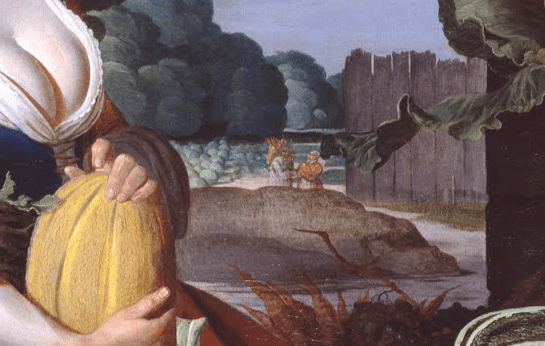
So what, I hear you ask, is the best cabbage in art (see #POTD 1)? Well, one of you asked, so thank you Sarah! I have two nominations, but I’m going to cut to the chase and give the award to Sir Nathaniel Bacon, for his ‘Cookmaid with Still Life of Vegetables and Fruit’ @Tate #Britain, probably painted in the first half of the 1620s. I admire these plants for their sheer size, and for the loving attention to detail with which Bacon has painted them, for their subtle variations of colour and tone, with a soft sheen on the inner, lighter, suppler leaves, and the clarity of the ribs giving architectural support to the darker, firmer – if a little frayed – outer ones. They may well have been grown by Sir Nathaniel himself: he came from a family of gardening aristocrats, the most famous of whom was his uncle, statesman and philosopher Sir Francis Bacon, whose essay ‘Of Gardens’, written in 1625, was one of the first on the subject.

There are three of these behemoth brassicas, each of which seems to have a life and character of its own. The one on the left seems to be eyeing up the Cookmaid, almost licking its leaves, puckering up like Audrey II in ‘The Little Shop of Horrors’, preparing to devour her. Indeed, one of its leaves, framed by a fence in the background, reaches past the end of the wall like the extended hand of Michelangelo’s God the Father on the Sistine Ceiling, about to give life to the Cookmaid’s melon. And yes, she is inordinately proud of her melons. Despite his name, Bacon has painted an entirely vegetarian image, but even so there is a lot of flesh on display. This is a painting of burgeoning fecundity, richness and plenty, with rampant root vegetables, tumescent squash, and bulging pumpkins.

In the background we can just pick out the kitchen garden, growing an entire army of enormous cabbages. There is also a couple in conversation – it could even be towards them that the stray leaf is pointing. Bacon painted them after the background, and they have worn a little thin, so it’s hard to see what is going on. I really can’t work out what the woman is holding, but the man has a basket on his back containing the most enormous carrots. I suspect he has approached her because he wants to give her one.

Looked at in this way you could divide the whole painting into male and female. There is nothing scientific about this division, it should be said, but that’s how the objects appear, how they are grouped in the painting. On the left, the richly-coloured and feminine flowers and fruits, with the Cookmaid as ‘Best in Show’, face up to the man-spreading, muscular vegetables on the right, with each side displayed to perfection against the background of a wall. The space between them opens up to the garden, and keeps the two sides frustratingly apart, a leaf nestling cherries and plums on a basket of beans being the only point of communication.

It is a display vegetable abundance, yes, but also of artistic skill. Bacon is showing off his ability to depict different colours, shapes and textures – just look at those beans, bursting with vitality and goodness, not to mention the bloom of the plums, and the intricacy of the basket itself. He was a remarkable, but unusual, artist, a self-taught aristocrat, as we learn from the inscription on his funeral monument in Suffolk:

Look Traveller, this is the monument of Nathaniel Bacon, A Knight of the Bath, whom, when experience and observation had made him most knowledgeable in the history of plants, astonishingly Nature alone taught him through his experiments with the brush to conquer Nature by Art. You have seen enough. Farewell.”

And the moral is…? I hate to think. But you’ll be hard pressed to find a display like this in your local supermarket now. Perhaps we should all get gardening in case it goes on longer than we think.

p.s. If you haven’t ‘seen enough’, you should read this fascinating blog post from The Gardens’ Trust about Sir Nathaniel, his family, his plants and his paintings:

Day 2 – Pan and Syrinx

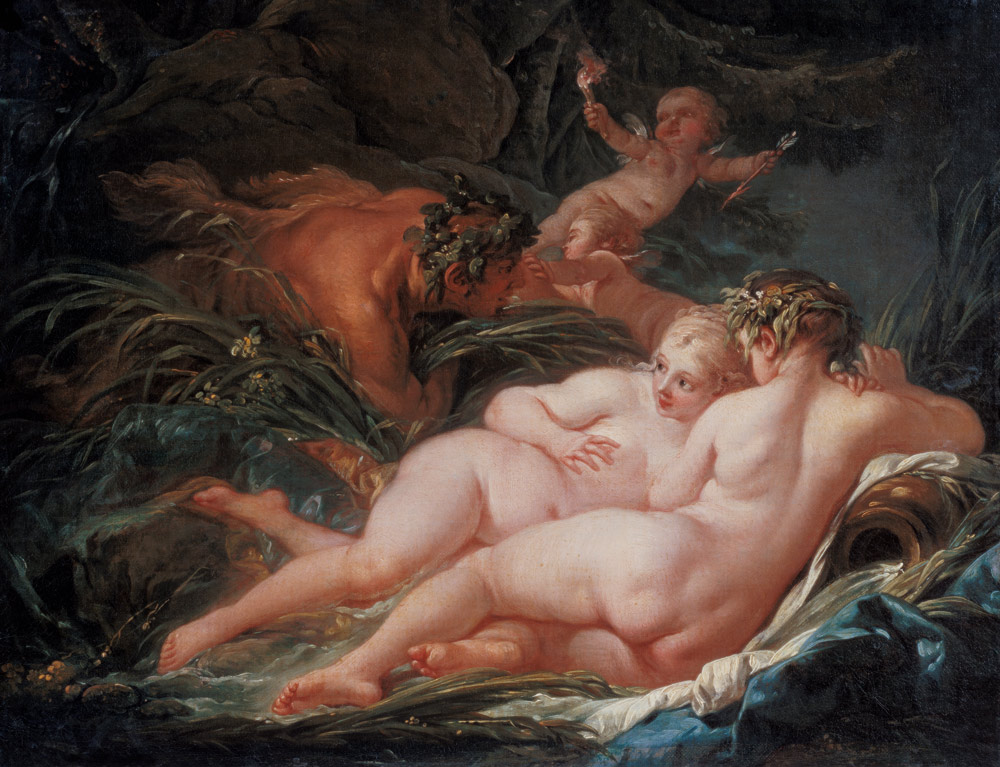
Day 2 – Boucher, Pan and Syrinx, 1759, National Gallery, London.

Originally posted on 20 March 2020

Day 2, and my thoughts turned to pandemics – don’t ask me why. The term comes from the Greek words ‘pan’ and ‘demos’, meaning ‘all’ and ‘people’. This, in turn, made me think of Pan, the Greek god of nature, fields, hills and groves, of shepherds and the flocks, of growth, and fertility and therefore not unconnected to sex and sexuality. He’s half man and half goat, and let’s face it, who doesn’t occasionally want someone who’s a bit of an animal? The origin of his name, is, as so often, lost in the mists of time, but oddly it’s not entirely unconnected with the English word ‘pasture’. However, almost certainly it has nothing to do with the notion of ‘all’ – although some folk etymologies, even in ancient times, suggested that it did.

Today’s picture, like yesterday’s (#POTD 1) was inspired by Ovid’s ‘Metamorphoses’. This time it is Pan who has fallen in love with a nymph. Syrinx, like Callisto (painted by Titian in one of the Poesie), was a follower of the chaste goddess Diana.  Terrified of Pan, she fled, and sought shelter with the river nymphs, who obligingly turned her into a clump of reeds. Pan’s frustrated sighs caused these reeds to vibrate, and the sound was surprisingly beautiful – so he cut them down and made the first set of panpipes.

Boucher’s painting is an image of typical Rococo naughtiness, with ample dimpled and flushing flesh willingly displayed. One cupid flies up to the right with an arrow and a flaming torch (in the words of the poet, ‘Come on baby, light my fire…’), while a second seems to grab Pan to pull him on – or hold him back. Pan is already clutching at the reeds, although Syrinx is anything but transformed – he seems frustrated, because he can’t get what he wants. Maybe that’s because Syrinx simply isn’t available, seeing how she seeks solace in the arms of a river Nymph. The latter is identified by the waterweeds in her hair, and by the jug of eternally flowing water on which she leans – the source of her own personal stream.  The story really doesn’t call for two naked women, and there’s no real reason why they should be so closely clinging, apart from Syrinx’s need for protection. 

This is the point at which I’d like to know more, but as yet I have not found an expert on ‘Lesbianism in the Art of François Boucher’. This reads like the title of an academic paper, and, if all else fails, I am going to have to write it myself. However, I do know that 1759, the date the image was painted, falls at an interesting time in the history of lesbianism. The year before, the Marquis de Croismire had involved himself in the affair of Marguerite Delamarre, an unwilling nun. The Marquis tried to use his position in society to liberate her from the convent. Shortly after this, Denis Diderot came up with a ruse to try and trick the Marquis to act once more, and started writing letters from a fictional nun, Suzanne, who, like the real-life Marguerite, was desperate to get out of the convent in which she had effectively been imprisoned. These letters developed ian epistolary novel La Religieuse, initially and private and personal affair which was eventually published posthumously in 1792.  It covers many subjects, not least of which was corruption among religious institutions – and notably, the perverse sexual practices (i.e. lesbianism) that the other nuns were forcing upon the unwilling Suzanne, who needed someone – perhaps the Marquis de Croismire? – to rescue her. The assumption, of course, was that the nuns had only turned to each other as they had no men to hand – oh, the arrogance of straight men!

Meanwhile in Vienna in 1760, the year after Boucher’s painting, the eldest son of Empress Maria Theresa, the soon to be Emperor Joseph II, was married to the beautiful, young Isabella of Parma, who promptly fell in love with Joseph’s sister Maria Christina. A passionate correspondence ensued, but the young girls were separated and, after her death, Maria Christina’s letters were destroyed, so only half of the correspondence survives. That half is delightful, touching, and, ultimately, moving.

Is there any connection between Diderot’s novel, the affair of Isabella and Maria Christina and Boucher’s painting? Was there something in the water around 1760? Apart, that is, from Syrinx… I’d love to know!  Perhaps more importantly, how relevant are paintings like this today? It might be worthwhile pointing out that the name ‘Syrinx’ is the origin of our word ‘syringe’: do remember that when they manage to develop a vaccine. And Pan? As god of the wide-open spaces, he spent much of his time relaxing with the sheep, wandering through the fields calmly playing his pipes. But if he awoke suddenly from his midday nap he would shout out, causing the sheep to run away with a sudden fear that he had inspired. The Greeks called it ‘panikos’. His name is the origin of our word ‘panic’. Remember him when you can’t find any toilet paper.

Day 1 – The Rape of Europa

after 2019 cleaning

Day 1 – Titian, The Rape of Europa, 1562, Isabella Stewart Gardner Museum, Boston.

Originally posted on 19 March, 2020

In these extraordinary times, I’m going to attempt to write about a painting every day – but where to start? Having made a pilgrimage on foot to the National Gallery on Tuesday to catch the wonderful Titian exhibition just after it opened and immediately before it closed again, I am choosing the Rape of Europa from the Isabella Stewart Gardner Museum in Boston.

The painting is one of six Poesie which Titian made for the man who would become King Phillip II of Spain. They must rank among Titian’s greatest achievements. Not only do they show his phenomenal technique, his astonishing ability to manipulate paint and to form worlds out of colour, but they also demonstrate his brilliance as a storyteller. Drawing on classical mythology, and mainly the Metamorphoses of Ovid, he enters into a common Renaissance debate about the arts: which is better, poetry or painting? Although drawing much of his imagery from Ovid’s text, these are not illustrations.  He adapts the stories, reworks them, finding the perfect way to spin his yarn on canvas. He retells the tales with brushstrokes rather than words. 

Why this one, of the six? Well, although I have been to the Isabella Stewart Gardner Museum at least three times, I can’t in all honesty say I stopped to look at this painting – there are so many other wonders there, and at the time I was either in my early stages of studying art history, and knew nothing, or was obsessed with the Ferrarese paintings in the collection. I’ve come to know it better through talking about the Poesie – particularly when the National Gallery acquired, with the National Galleries of Scotland, the two Diana paintings – and while teaching courses on the art of the 16th Century. I also love the fact that Velazquez knew it in the Royal Collection in Spain, and quoted it in the background of one of his own works. However, before Tuesday, I couldn’t swear that I had seen the original before, so in that respect, it is new to me.

In this work we see how, in his endless and unquenchable lust, in order to get his hands on the beautiful nymph Europa, Jupiter has transformed himself into a bull. He persuaded Mercury to drive a herd of cows down to the beach, and frolicked among them, flirting with Europa, who happened to be there with her companions. She was gradually entranced by his winning ways, and, as she clambered upon his back, he sidled from shore to sea, going from the shallows through the waves, without her realising what deep water he was getting her into. Her companions – and the unwitting herd – can be seen in the distance, helpless on the shoreline.

It’s a problematic story – it is after all a story of rape. Is she entirely unwilling? In this instance it isn’t all that clear, although in other encounters Ovid is explicit about the dread and terror Jupiter’s victims experience. Like Jupiter, Titian seduces us. His means: rich colours and lushly applied brushstrokes, underplaying the horror with a touch of the absurd. I’d never noticed before how cupid rides his fish in much the same bizarre and awkward way that Europa rides the bull, one arm clinging on, waving (not drowning), a leg flying free.

after 2019 cleaning
after 2019 cleaning

The other fish was a revelation, a new favourite, and I’d like to nominate it as the Best Fish in Art, a category of which I was previously unaware (although I do have two suggestions for the Best Cabbage). Its scales are evoked with flicks of white and blue paint, making it glimmer at the bottom of the painting, as if is merging with the sea, appearing and disappearing, painted with similar brushstrokes and tones to the sea itself, part of the watery world over which Europa is now conveyed.

Eventually she will get her feet back on dry land – on the continent of Europe, which took her name. And eventually we will be able to see these paintings again, brought together for the first time, to be seen as Titian himself never did, all in one room. I am a least glad that these paintings, long separated, must be enjoying some quiet time together, but I am looking forward to seeing them all again when we have got to the other side.