
Anthony van Dyck, Cupid and Psyche, 1639-40, Royal Collection Trust.
This is another re-post, but somehow, and I really don’t know how, I managed to delete the original quite a long time ago. I was probably on a train with dodgy WiFi, and maybe even using my phone, all of which would generally result in technological incompetence on my part. But, as it is the only one of the original 100 Pictures Of The Day that hasn’t survived online, it really is time to get it back up there. It also fills in a gap in my telling of the story of Cupid and Psyche, which will be the subject of the second half of Tuesday’s talk, Myth, Allegory, or Simple Story? which concludes the series Classical Mythology in European Art. Details can be found via those links, or in the diary. Then, after ten days or so in Scotland, I will return to Monday evenings for An Elemental August, looking at four women from the late-19th to the 21st Centuries, all of whom had different vistas (the subtitle of the series), as they all spent much of their lives in countries other than the ones in which they were born. The first two – Lucie Rie (7 August at 6pm) and Gwen John (14 August) are already on sale, and the final two (Evelyn de Morgan and Paula Rego) will appear next week. Again, see the diary for more information.
As I finished Picture of the Day 53 back in May 2020, Psyche had performed the last of her tasks for Venus, in an attempt to appease the angry goddess, and win her help in getting Cupid back… Venus, more intent on killing Psyche than helping her, had asked her to go to the Underworld to collect a vial of Persephone’s ‘Beauty’. It’s as if Persephone, like so many celebrities today, had released her own fragrance – and if she had, it would have been called Everlasting Sleep. Psyche had been told that on no account should she open the vial – but what does anybody do under those circumstances? Of course, she opened it, breathed in, and fell asleep, potentially forever… at this point I’ll jump to what I wrote on the next day – this was originally posted on 11 May 2020:
Well, I couldn’t just leave her lying there, eternally asleep… To be honest, according to Apuleius, Psyche thought she was collecting Persephone’s ‘Beauty’ to take to Venus, and that is what she wanted to see – but it turned out to be ‘Everlasting Sleep’ after all. And Cupid, who had been at home all the time, recovering from the wound of the burning oil, finally crept out, only to find her, as if dead, on the road.
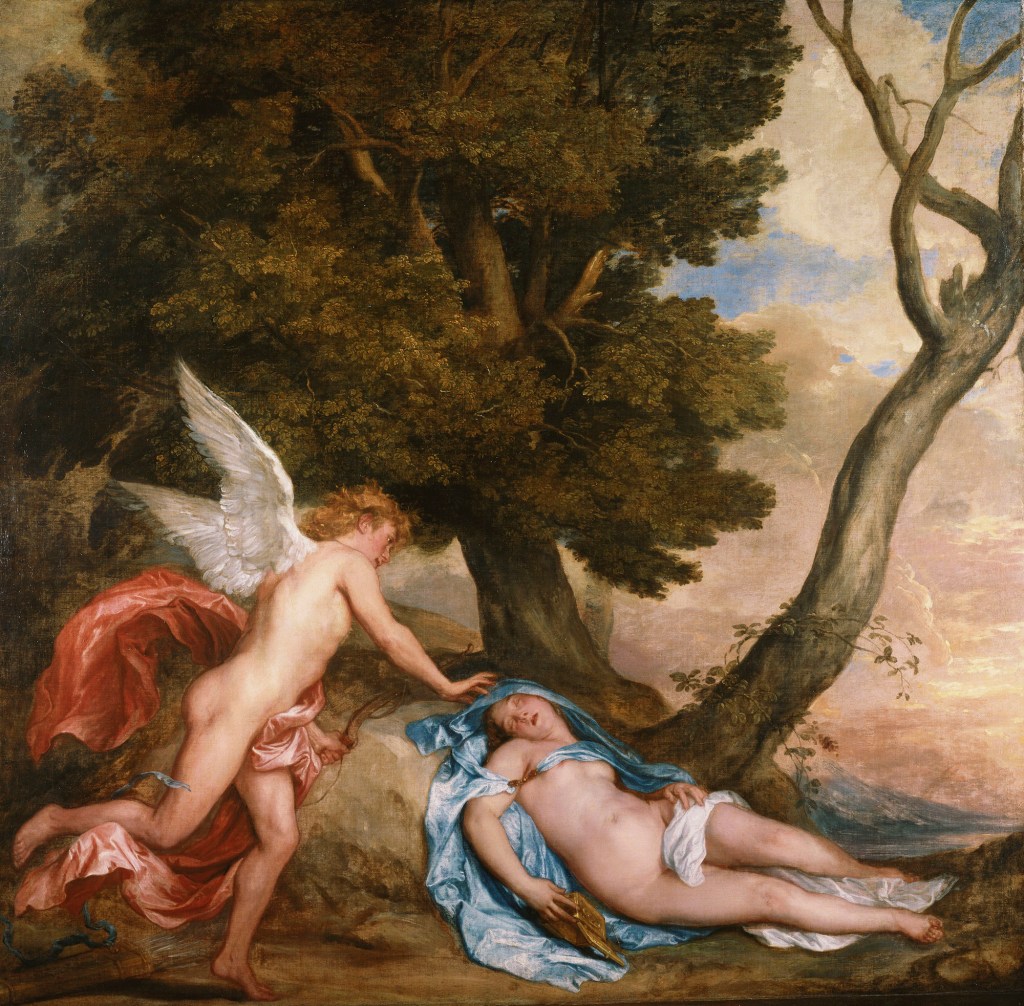
And that is precisely how Anthony van Dyck painted her – she could only look more dead if she were paler, I suspect. This painting is not what we, in the UK, expect from Van Dyck – he was, after all, one of the great portraitists. What our ancestors wanted from him was his ability to make them look grander, nobler and more beautiful than perhaps they really were. I say our ancestors – not mine – I’m not that posh. And so this is the only mythological painting that survives from his time as a court artist for King Charles I. It may have been part of a series of paintings illustrating the story of Cupid and Psyche, to which Rubens and Jordaens would also have contributed. The series was commissioned for the Queen’s House in Greenwich, but was never completed. It might have been painted for something else, though, but whatever the purpose, it is a fantastic painting, and should be better known. It is also potentially one of the most outrageous paintings you’ll see, but we’ll come to that later. At first glance, it is a straightforward telling of the story, even if, like Claude (POTD 46), it is almost more of a landscape painting. It’s a curious format – almost square, but marginally taller than it is wide. This shape might be related to its intended location, but as we don’t know what that was, we’re left in the dark. Nevertheless, more than half of the painted surface is taken up with trees and sky. Again, like Claude, these trees are helping to tell the story. One is entirely alive, just like Cupid, towards whom it leans, while the other is profoundly dead, positioned as if emerging from Psyche’s body. Whereas she is all stillness and weight, he is fleeting and light, flying in to find her, his foot barely touching the ground. It is a wonderful painting of contrasts.

Psyche lies on the road, with a gold casket (rather than the white vase we saw yesterday) resting under her right hand, open and empty. This used to contain ‘Sleep’. Her left hand rests on her thigh, holding down the white cloth essential to stop this sensuous image descending to the obscene. Her sky-blue robe (or cloak? – it’s not entirely clear what this is) acts as a blanket beneath her. It is clasped in an entirely blatant failure to cover her breasts, and is painted with van Dyck’s very best silk technique, shiny and slick and airy. ‘Psyche’ means ‘soul’ in Greek, by the way – I don’t think I’ve mentioned that before – so airiness is apt.

Cupid, on the other hand, is entirely concerned with love – or lust – represented by the colour red, just like Charity (see 120 – The Colour of Virtue). Hence the colour of the cloth he is ‘wearing’, every bit as alive as he – while hers is equally dead. In his left hand Cupid holds his bow, although he has abandoned his quiver, full of arrows, on the floor. His nudity is surprising – it is not what we expect from van Dyck (after all, the portraits of the great and the good show the sitters in all their finery– you should see the ones he painted in Genoa!) but it exhibits a remarkable ability on van Dyck’s part to paint the human body. And this particular subject does allow him – given that he has taken some license – to show off both male and female nudes. Having said that, Cupid’s ‘modesty’ is miraculous – the red drapery flies out behind him, curving down, away from the wings, with a splendidly sculptural flourish, then wraps around his body to cover his left thigh, only to appear behind his legs, the final flourish backwards echoing his extended right leg. And yet, there is no hint how it’s held up.
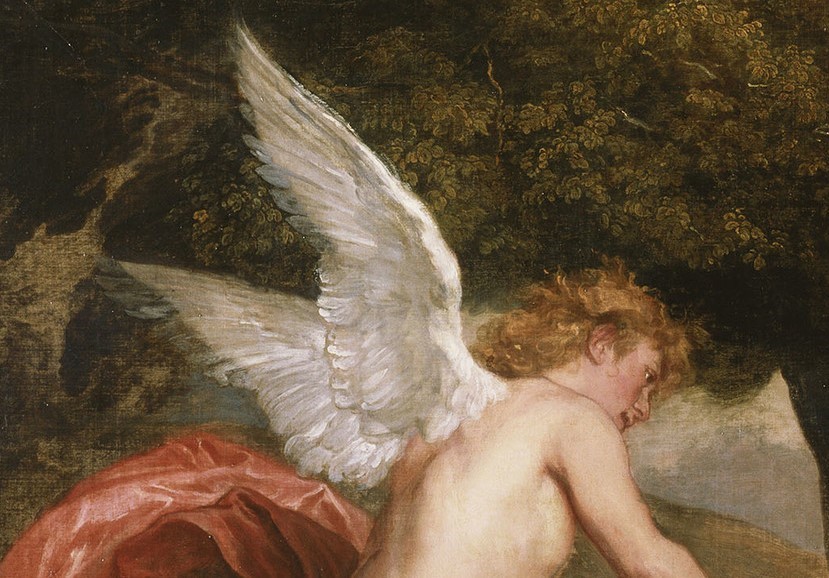
He tilts slightly away from us, so that his right shoulder obscures his chin – but we see his mouth, just open in awe, and his look of love and concern. The curls of his blond hair flick back in the breeze caused by his descent. His wings, emerging delicately from his back, have the whitest of feathers, which fade away with a magical translucency. There are those who say that this painting was never finished. They may well be right, but the delicacy of Van Dyck’s touch is superb here.

And yet, let’s think about this again. Cupid’s right hand reaches out towards Psyche with a gesture, which, if this were a Renaissance painting, would look like a greeting. The Renaissance is relevant here, given his debt to Titian – just look at her legs and that white drapery. But in a Renaissance context, how would you interpret this image? It could so easily be something different. A man with wings has flown in to greet a beautiful woman in blue and white. If it weren’t for the nudity, and were she not asleep, this could be an Annunciation. And of course Charles I – one of the greatest collectors of art, with a Roman Catholic wife – must have known that. To paint Cupid and Psyche as if they were Gabriel and Mary would make a sensuous story blasphemously titillating. And my suspicion is that that would suit Charles I down to the ground. It’s entirely outrageous!
Earlier, I said that the tree behind Psyche is ‘profoundly dead’. However, there is something growing from its base. New life. Maybe all is not lost. Looking back to Giulio Romano’s image with which I finished yesterday, you might be able to see that Cupid is holding one of his arrows in his left hand, and he looks as if he is about to tap Psyche on the back with it. ‘Eternal Sleep’ is not something that a deity would have to worry about – it is a supernatural quality after all. On seeing his love lying there, as if dead, he forgave her, gathered up the ‘Sleep’, put it back in the box and shut the lid. Don’t ask me how. Then he tapped her on the back with his arrow and woke her up – which of course meant that her love for him was renewed. But will they live happily ever after? Not if mum – Venus – gets her way…
If you want to find out what happens next, I have three suggestions. You could read the original in Apuleius‘ own words (albeit in translation). You could click on the ‘Psyche’ archive link at the bottom of this post to try and locate the next part of the story – Psyche VI (well, that’s a link to it – otherwise I’m afraid the WordPress archives aren’t the easiest to navigate). Or – and this is my preferred option – you could join me on Tuesday, 18 July at 5.30pm, when we will assess whether the story of Cupid and Psyche is Myth, Allegory, or Simple Story? There will be other stories (or myths, or allegories…) in part 1 as well, of course!
 dr richard stemp
Dear Richard,
I would have loved to attend your course on Classical Mythology but the times did not work for me. I wonder if you could repeat it for one of the other organisations that you do work for who are able to record the lectures?
Regards, Marion Kirk
>
LikeLike
So sorry you weren’t free, Marion – I will certainly let people know if I do repeat it!
LikeLike
Thank you so much Dr Stemp. I love your blogs and am so looking forward to your talk on Tuesday.
Best wishes,
Eithne White.
LikeLike
Thank you, Eithne, I’m so glad you like them!
LikeLike