
After four weeks talking about the Royal Academy’s superb exhibition celebrating the ‘chance’ encounters of Michelangelo, Leonardo and Raphael in Florence, it will be a pleasure to keep the momentum going this Monday, 9 December by including just a few of their works in my introduction the King’s Gallery exhibition Drawing the Italian Renaissance. There are so many glorious images to choose from that I’m now going through the difficult process of cutting my presentation down to a manageable size… and you probably know what that means. I will come back to the Renaissance in January, delving into A brief history of The Madonna and Child on 6 January (as it’s Epiphany I’m bound to include the odd Magus…), and then I will discuss the National Gallery’s exhibition dedicated to Parmigianino’s The Vision of St Jerome which opens today, and has already received brilliant reviews. However, before then, I will be thinking about colour, and landscape, and Romanticism, with the exhibitions dedicated to Constable (16 December) and Monet (23 December). All of this is in the diary, together with details of the trips I will be taking for Artemisia next year, along The Piero Trail, and to Hamburg, Liverpool, and Florence (…and if you’d like to come, please mention my name when booking, thank you).
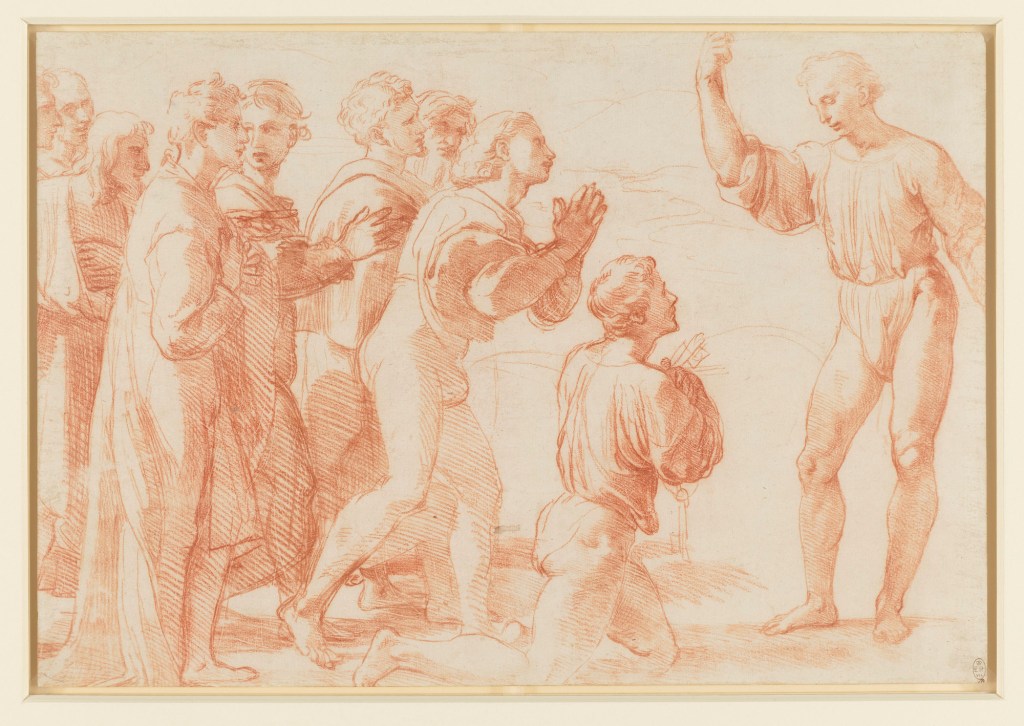
One of the things I appreciate more and more is precisely how good Raphael’s drawings are, and how important they were to his process of creating art and disseminating ideas, which is why, even after posting about him for the past two weeks, I want to do so again today. This also happens to be a particularly rare type of drawing – although the reason why is not immediately apparent. We see a man on the far right pointing upwards, with a group of nine others approaching him in different attitudes, some gesturing, one starting to bow, hands in prayer, and one on his knees. We are left in no doubt as to his importance, even though there is nothing notable about his appearance – apart from the fact that he is not wearing any trousers, I suppose. This is clearly a preparatory drawing for a religious scene, but then we knew that from the title: Christ’s Charge to St Peter – but how did the people who gave the drawing that title know what was going on? After all, Jesus did not dress like this, nor was he associated with a group of nine men… However, people only kneel before people they respect or fear (or both), and there is no sense of any threat, even if one or two faces show a touch of concern. On the whole the image radiates calm, and compassion, and even communicates a sense of sanctity – but maybe that is the result of having read the title.

The protagonist wears a baggy shirt, with the sleeve of the right arm rolled to the elbow. The shirt is gathered at the waist with a belt, and its tails might be tied between his legs, or the man is wearing a pair of baggy underpants which are cut very high at the sides. Raphael seems to be particularly interested in the articulation of the model’s left hip, and the structure of the leg below it. Attention is also paid to the face, looking downwards with a sense of humility, although other details are only hinted at – the short, thinning hair, for example, and the right hand, which is apparently pointing. The left sleeve may not be rolled up – but we can’t be sure as most of the forearm and hand are not seen. This is either because the drawing has been damaged, and/or cut down, or because the paper Raphael was using was not large enough for the whole composition. Just looking at a photograph it is hard to tell, although the edges are very crisp for an old piece of paper, which suggests that it might have been trimmed. The four men visible on our left of the detail above are positioned in a falling diagonal. The man closest to the protagonist is kneeling, and the one behind him is bending over. His shadowed hands, raised in prayer, fall half-way between the two heads. The two men next to him have their heads tilted in different directions, towards us and away, and this is enough to start the curving diagonal which creates a clear space between the group and the protagonist. But then there is another negative space between the praying man and the man kneeling – the latter is singled out from the group: presumably he is the secondary subject of the narrative, St Peter.
I find the delicacy with which each individual face is drawn, and the subtlety of the emotions depicted, truly beautiful. And trust me, it is even more remarkable – and subtle – if you see the drawing in the flesh: there is a softness to the lines which is really very evocative. Notice how the light comes from the left, so that Jesus’s face (or at least, the face of the model who is in the position of Jesus) is the only one that is fully lit. Even there, the side of the cheek and neck are softly shadowed. The praying man’s hands are quite dark, apart from a couple of fingers which catch the light coming over his shoulder. The side of his face is also lit, as is the side of his neck and his back, and this brightness pushes him towards us, as does the light on his large, puffed, 16th century sleeve. He looks younger, and more innocent than the others here: maybe this is St John, the youngest of the apostles.

The kneeling man’s face is more deeply shadowed by close, insistent, parallel strokes which darken around his neck. His hands, clasped to his chest, are also in deep shadow. The light shines on the crown of his head, with short strokes of the chalk defining curling tufts of hair. He looks up with awe – and maybe even some slight concern.

Behind him, the three men we have discussed are divided from the remaining five, a connection between the two groups being made by the right arm of the man to the left of the gap, which crosses in front of the shoulder of the man who whose head is tilted slightly towards us. The man reaching forward looks back over his right shoulder, and this helps to unite the group of five with the rest of the composition. It is as if he is checking to see how they are reacting to the interaction between the protagonist and the kneeling man. The next person – the one closest to us, perhaps – clasps his hands to his chest, a sign of awe, or of devotion, while the character behind him leans forward, also placing his left hand, more crudely drawn that the others, on his chest. We only see the faces of the remaining two, but again each is individually characterised, with one turning in towards us, and the other in strict profile.
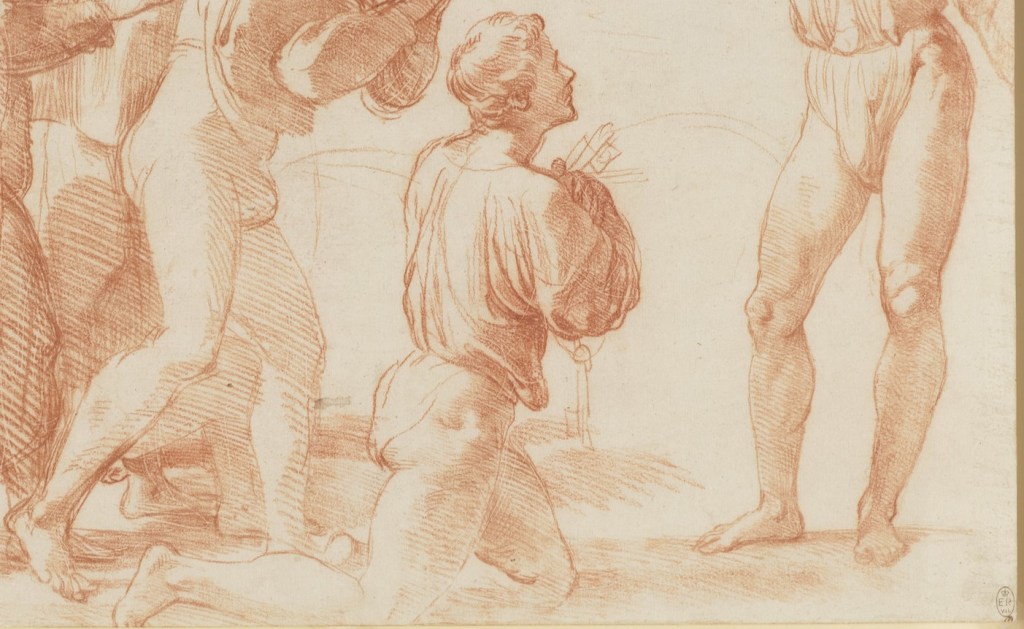
It is clear from the three figures on the right, if not the others in the group, that Raphael was using models. They could easily have been studio assistants. These three, who were wearing contemporary, 16th century clothing, have removed their breeches and hose so that Raphael could get understand the structure and articulation of the legs. He carefully demarcates the light and shade defining the forms of the muscles, bones and tendons. If the legs, whether standing or kneeling, are correctly positioned, then the rest of the body presumably follows suit. And if you know where the legs are, and so how the figure is positioned, it is easier to dress the figures, and to understand how and where the drapery will fall. The legs of the younger, praying man (on the left of the detail above) are more freely sketched in, but nevertheless we can see precisely how they work – and Raphael still pays considerable attention to this man’s right ankle, in the bottom left corner of the detail. Like the protagonist (the model standing in for Jesus), the kneeling figure wears a baggy shirt gathered at the waist, and some form of underclothing. Again Raphael looks at the structure of the hip joint, and also the curve of the buttock and thigh. He pays far less attention to what this man is clasping to his chest, but the forms projecting above his hands and hanging beneath his elbow can easily be read as a pair of keys – the keys that loose and bind. This is, of course, St Peter, and the reference is to St Matthew’s Gospel, Chapter 16, verse 9. These are Christ’s words to St Peter:
And I will give unto thee the keys of the kingdom of heaven: and whatsoever thou shalt bind on earth shall be bound in heaven: and whatsoever thou shalt loose on earth shall be loosed in heaven.

The legs of most of the remaining figures can be seen in the bottom left corner of the drawing – and here they appear to be clothed – although the forms of the legs can be seen through the fabric. Raphael fixed the position of the legs, and then drew drapery on top of them – precisely the method I suggested above. It would be very difficult to identify the form and style of this clothing, though, given the sketchy nature of its depiction. It is also difficult to know how many of these figures are based on models, or how many come from the artist’s imagination – his memory and experience. Would he really have grouped ten people together in the studio to draw them? Or did he build up the composition by posing one or two models in several different poses? There are a number of similar facial types and hairstyles, but these are things he could easily adjust. Having said that, Raphael is said to have had one of the largest workshops of his day, and it was reported he used to walk around Rome with a considerable group of his assistants and apprentices – so maybe it would have been possible to get a group of this size together. What I find most striking in this particular detail, though, is the insistent shading – shading which runs on diagonals at various angles from top left to bottom right, which, as I was saying only recently, is the sign of a left-handed artist – like Leonardo da Vinci. But Raphael was right-handed. It might be possible to work out what is going on if we think about what it is that we are actually looking at.
The drawing was made in preparation for one of the tapestries that Raphael had been commissioned to design for the Sistine Chapel: Christ’s Charge to St Peter. The keys that Peter holds refer to Matthew 16:19, but they are just there to identify the Saint. The incident depicted in the tapestry occurred later, after the resurrection, as you might be able to tell from the fact that Jesus is dressed in white, with ‘supernatural’ gold decorations. Rather than point up, as in the drawing, in the tapestry he points down to Peter with his right hand, and with his left he indicates a small flock of sheep. This is an illustration of John 21:15:
Jesus saith to Simon Peter, Simon, son of Jonas, lovest thou me more than these? He saith unto him, Yea, Lord; thou knowest that I love thee. He saith unto him, Feed my lambs.
This instruction is repeated again in each of the following two verses, and refers, of course, to Peter watching over his fellow Christians: to this day a priest’s congregation is referred to as his flock.


By comparing the drawing with the completed tapestry we can see a number of things. First, the nine men in the drawing are just missing two of the apostles. There were only 11 at the time, as this was after Judas’s suicide, and before St Mathias had been appointed. One was inserted behind and to our right of the young praying figure (who is, indeed, St John the Evangelist). This is presumably St Peter’s brother, St Andrew, usually depicted with a long white beard, who John’s gospel says was the first apostle to be called. The 11th was added at the far back of the group, to our left of the figure in profile. The other thing which you may not have noticed is that the compositions are fundamentally the same. However, they shouldn’t be: they should be the mirror image of each other. A tapestry is designed in much the same way as a painting, with preliminary drawings leading up to a full-scale cartoon. After this the process differs. The would be sent off to the tapestry weavers, who would cut it into sections, and work on the tapestry from behind. In the process, the orientation of the design is reversed. We can check this by comparing the drawing with the relevant cartoon – and that is possible, of course, because some of them have survived. They belong, like today’s drawing, to the Royal Collection, but are on long-term loan to the Victoria and Albert Museum.

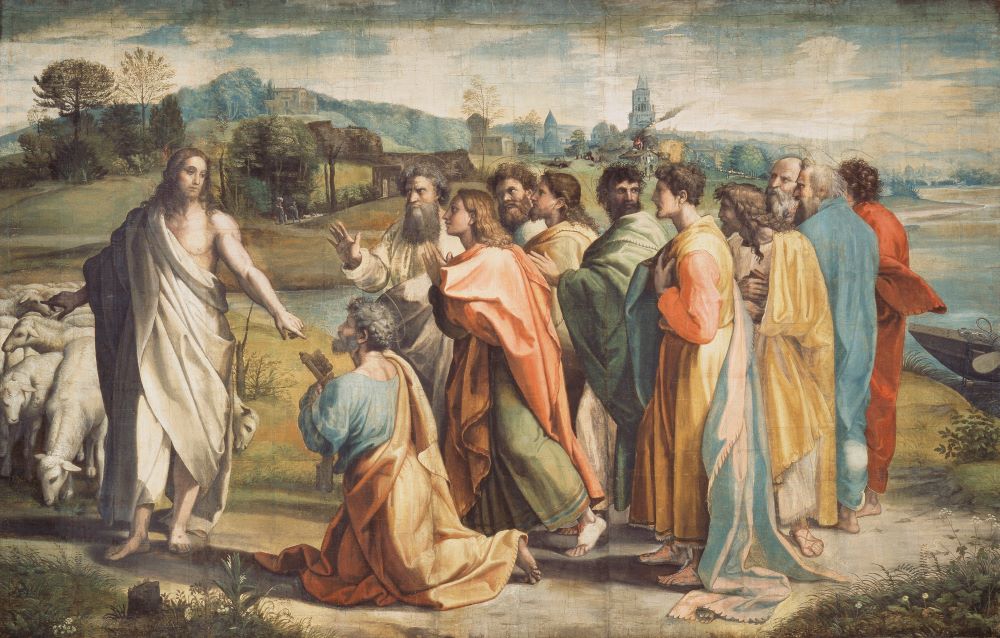
And look – the drawing is the reverse of the cartoon. That’s because this is not actually a drawing: it is an offset. Having made a delicate red chalk drawing, a dampened piece of paper would have been placed over it and the two pieces of paper pressed together and rubbed. An offset is effectively a print of a drawing, and like other printing techniques results in the design being reversed. Three fragments of the original survive: there are two below, now joined together, which are in the National Gallery of Art in Washington. The third is the figure of ‘Christ’, which is in the Louvre. The second image below is a detail of the Royal Collection’s offset version, so you can see that they are, effectively, identical.

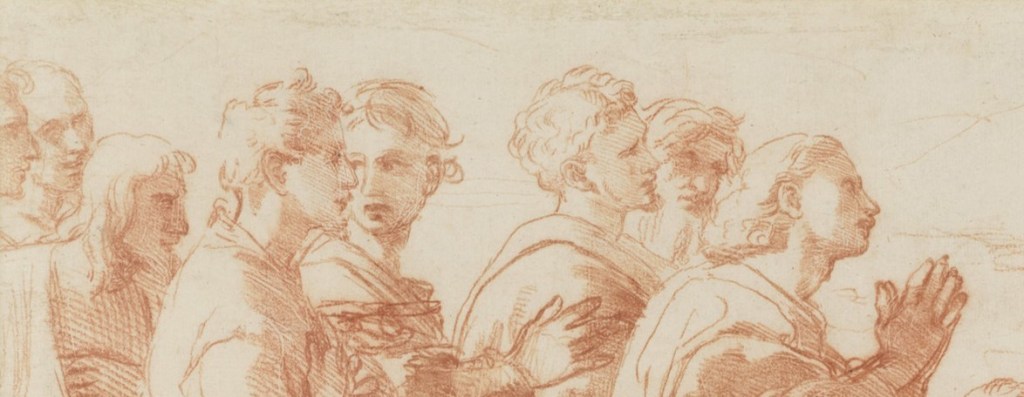
Why would Raphael have done this? Well, he was an incredibly accomplished and thorough artist. He wanted to know – before he went too far – that the composition he was designing would look alright once it was reversed in the tapestry – so he made the offset just to be sure. The reversal of the image explains why the right-handed Raphael was apparently drawing as if he were left-handed… it’s a result of the process. And maybe, as an offset, that is also why the ‘drawing’ has a softer appearance than many of the other marvellous examples in the King’s Gallery exhibition… if indeed it has. Why not join me on Monday to find out?
 dr richard stemp