
Claude Monet, The Thames below Westminster, about 1871. The National Gallery, London.
Keep looking – that’s the most important thing. If you keep looking you keep learning. I certainly do: it’s one of the things I most enjoy about writing this blog. But then, check that what you’ve learnt from what you see is correct – if you can. Maybe this all comes from my background as a scientist: make an observation, draw an inference, test the hypothesis. I’ve just done that with today’s painting and… I’ve thrown out a long-held (and oft-suggested) idea. We’ll get to that. Monet looked. He looked and looked again, and painted each different idea as he saw it – and then painted again later, as he remembered what he’d seen. It is this practice which is the foundation of The Courtauld’s sold-out exhibition, Monet and London: Views of the Thames which I will talk about this Monday, 23 December at 6pm. I thought a splash of colour in mid-winter would get us through the cold and the dark – although it is still oddly mild in the UK, and apparently will remain so until Christmas. At least Monet made the best of it, and enjoyed the bad weather. For that matter, he also enjoyed the pollution: every cloud has a silver lining, I suppose. In some cases, for Monet, that lining was rarely silver, though. Sometimes it was golden, purple, green or (in one instance) even yellow and pink… but more of that on Monday.
There will then be a break for the Twelve Days of Christmas. I’ll be back on the Feast of the Epiphany (6 January) for The Virgin and Child (a brief history). As a short introduction I will start with early Christian examples and some paintings from Byzantium and the Orthodox Church, before exploring the development of the idea in the Western European tradition, using examples from the National Gallery’s collection as a starting point. I will go as far as the High Renaissance, culminating with a painting by Parmigianino. This, in its turn, will be the subject of the following week’s talk. Parmigianino: The Vision of Saint Jerome (13 January) will introduce and expand on the National Gallery’s small exhibition about this recently restored treasure, one of the highlights of Mannerism. In case it’s not clear what this term means, the following week (20 January) I want to ask the question ‘What is Mannerism?’, and, as Parmigianino’s painting was commissioned by a woman, we will then think about Women as Patrons in the Renaissance on 27 January. I’ll put the last two onto the diary as soon as I can. Meanwhile, there’s a lovely, select exhibition of terracotta sculptures dating across three millennia at Colnaghi until mid-January, and I’d love to talk about it. I might just sneak in an extra mid-week talk at some point, and I’ll let you know if I can find a time – but don’t miss it if you have a spare hour in London: they are very close to the Royal Academy.

This view is, for most of us I suspect, quite familiar. Even if we are not inhabitants of, or frequent visitors to London, the Houses of Parliament – seen on the right of the image – are so regularly featured in films, documentaries and the news that we recognise them instantly. Their fairy-tale appearance, speaking of an age-old presence, evokes a nostalgic view of times gone by, a mood that is enhanced by Monet’s choice of palette, which has the almost-monochrome appearance of a black and white photograph. The steamboats chugging along the Thames and the manual labourers on the Embankment, which is itself free from today’s heavy traffic, add to this sense that the painting belongs to ‘the good old days’. But this interpretation of the painting shows how flawed our contemporary vision can be if we don’t look from a historical perspective. Not only is it flawed, but it couldn’t be further from Monet’s intentions. For him, this was a painting of modernity.
The artist came to London in late 1870, although it is not clear exactly when he arrived. Most commentators would suggest September, but he might not have got here until November. The Franco-Prussian war had broken out on 15 July (Monet was on his honeymoon in Trouville at the time), and it looks like he fled France, with Madame Monet, to avoid the draft. Since my school days the dates ‘1870-71’ have been fixed in my mind: the Franco-Prussian war, one of the things that led up to the First World War. Since my early days as an art historian I’ve known that Monet was in London during those precise years. As a result, I’ve always assumed that he was in London for nearly two years. However, one of the things I’ve learnt writing this post is that by 2 June 1871 he was in Holland, so at the very most he was only in London for nine months, although there is every possibility that it was little more than six. In that time he painted (among other things) five views of the city – two of the Pool of London, two of parks, and this. He also met his colleague Daubigny. They are supposed to have bumped into each other when both were out painting on the banks of the Thames. Daubigny then introduced Monet to the dealer Paul Durand-Ruel, who exhibited Monet’s work in the short-lived London gallery, before purchasing many of his paintings back in Paris in the early days of Impressionism. Even before the name had been adopted for this disparate group of avant-garde artists, one of their main aims was to paint modern life. Three years before the ‘first Impressionist exhibition’ of 1874 (150 years ago…) that was precisely what Monet was doing in London.

The tree at the far right of this detail marks the edge of the painting. The structures in the distance behind it belong to Westminster Abbey, adjacent to the Houses of Parliament – just over the road, in fact. From this point of view the front right corner of the Palace of Westminster (as it is also known) is marked by what is probably also its the most famous element. Known almost universally as Big Ben, after the main bell which tolls the hours, this was originally called St Stephen’s Tower, but was officially renamed Elizabeth Tower in 2012 to mark the late queen’s Diamond Jubilee. To the left of that, at a ‘medium’ height in the painting, is the Victoria Tower, which is actually the tallest part of the palace. It is at the far end of the building from the Elizabeth Tower and includes The Sovereign’s Entrance at its base. To the left again is an octagonal tower with a spire which rises above the Central Lobby at the centre of the building. Unimaginatively, it is named the Central Tower. The mass of buildings to the left are the House of Commons and the House of Lords – closer to us, and further away respectively.
These buildings have stood for our entire lifetimes, and also those of our grandparents. They are all we have ever known, but they are not really that old. There was a disastrous fire on 16 September 1834 which all but destroyed the muddle of medieval buildings which had originally been the royal court, before they evolved into the seat of Parliament. When it came to rebuilding, there was a debate as to whether the new palace should be neo-classical – looking back to England’s Roman past – or the relatively new neo-gothic style. The latter was chosen as representing England’s medieval history – the point at which it became itself. I say England, knowing full well that the United Kingdom contains other nations – but like so many decisions of national importance this was considered purely in terms of the South East. The first stone was laid in 1840, and the Victoria Tower was completed twenty years later. However, construction did not finally end for another ten years – meaning that the building was only completed in 1870, the year that Monet arrived in London. He was painting a brand new building.
He was certainly painting what he saw, but he was also painting what he wanted to see – making the towers, spires and pinnacles taller and thinner than they are in real life. The effect is to make it look even more like a fairy-tale gothic castle – not unlike the Disney Castle, which was first sketched in 1953, based on the castle included in Cinderella (1950). That was based on Neuschwanstein, built for the Bavarian king Ludwig II, with the foundation stone laid on 5 September 1869 – far too late for Monet to have known anything about it. Admittedly there is also an influence from the third Hohenzollern Castle (1846-67) – but I still think that’s too late, or too distant… I’ve always thought that Monet was inspired as much as anything by something like the town hall at Calais. This idea was based on what must have been a brief, but strong impression I had when passing through the town after disembarking from the cross-channel ferry some years before the opening of the tunnel (1994). However, I looked it up this morning and found out that the current town hall was built between 1912 and 1925… so that’s that theory out of the window. However, it is safe to say that Monet was looking at the Houses of Parliament – and using artistic licence.

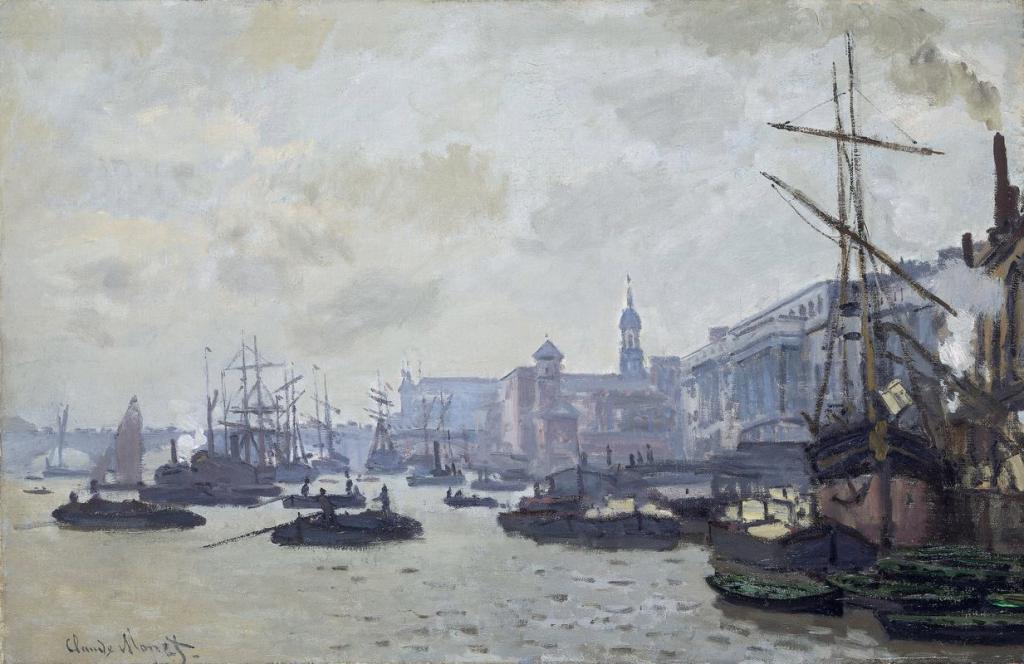
On the grey water of the River Thames a number of steamboats go about their business, their dark colours subdued in the distance by the intervening mists. Of the two closer to us, the one on the right has red paint at the water line – a nod back to Constable’s practice of adding flashes of red to make his landscapes look greener, even if there is no green here. Behind them, Westminster Bridge spans the Thames between Parliament and the low, broad mass of St Thomas’s Hospital, visible behind the bridge at the left edge of the painting. Again, all of these would appear to be features of London whose origins are lost in the mists of time – but that is only because they are gradually being lost in the mist. As well as the palace, the fire of 1834 also seriously damaged Westminster Bridge, which consequently also had to be rebuilt. The current bridge, the one seen in the painting, was designed by Thomas Page, and opened on 24 May 1862. That was only 8 years before Monet painted it – still relatively recent. St Thomas’s Hospital did not open until 21 June 1871, by which time Monet had been in Holland for about three weeks. Surely the steamboats were old? As far as we are concerned today, they are, of their very essence, ‘old fashioned’. Well, yes, the idea was older: the first steam-powered ship was launched in 1783, so they had been around for nearly 90 years. But they still hadn’t completely taken over. There are no sail boats visible in this painting, even though there would have been some on the Thames at the time: have a look at Monet’s contemporary Boats in the Pool of London (1871), from Amgueddfa Cymru – Museum Wales, if you want to be sure. His choice not to include any in The Thames below Westminster suggests that he was focussing on what’s new – although admittedly there might not have been any sailing vessels on this stretch of the river at the time he was painting.

Monet’s viewpoint for The Thames is above the level of the river, and some way in from the river bank – so we must assume that, while painting, he was standing on a jetty not unlike the one depicted in the foreground. There are men working on this jetty, and below them a number of planks, or logs, are floating on the surface of the water, each grey-brown ripple of which is marked out with a separate brushstroke. Under the trees at the far right another plank slopes down from the jetty to the embankment, looking as if it would get in the way of the pedestrians who are walking towards, or away from, Parliament. The embankment is a vital part of the composition. The wall meets the water snugly in the bottom right corner of the painting, and together with the horizontal elements making up the architectonic structure of the embankment wall, the line where it meets the water leads our eyes along a diagonal into the painting, pulling our attention towards the Palace of Westminster. It takes us past the dark skeleton of the jetty – which gets in the way, but which, in the process of doing so, helps to measure the depth of the painting. Of course, this is not any old embankment. It is The Embankment, designed by Joseph Bazalgette to contain London’s much-needed sewers, with architectural elements designed by Charles Henry Driver. Construction started in 1862, and it was officially opened by the Prince of Wales (later King Edward VII) and one of his younger sisters, Princess Louise, on 13 July 1870. Like the Palace of Westminster, Monet is painting a very recent feature of the London landscape. Indeed, it is often said that the workmen on the jetty are removing some of the scaffolding after the Embankment’s completion… although it would have been left in place for six months or more after the opening if that is true.
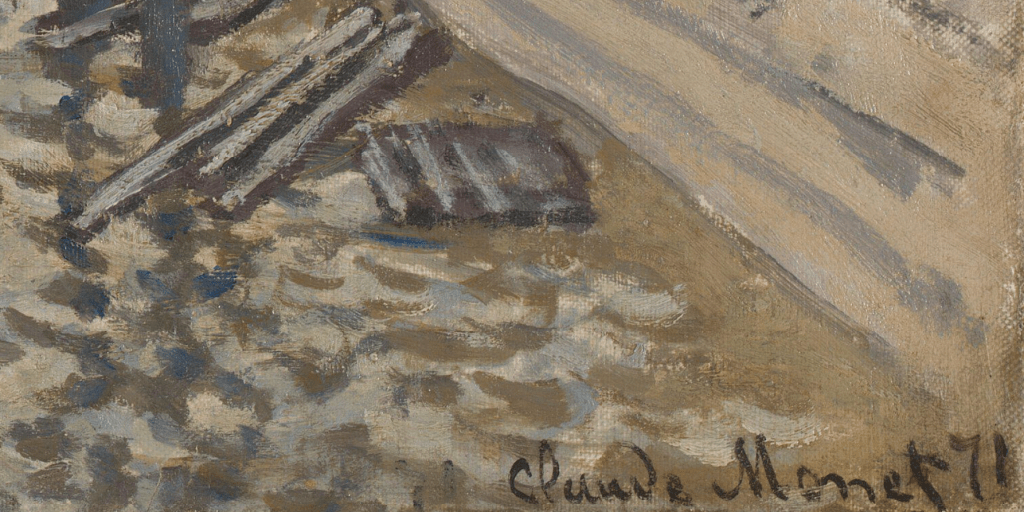
One of the problems, though, is that we don’t know exactly when this was painted. Yes, you can see the signature in the bottom right corner of the painting, and it definitely says ‘Claude Monet 71’. And so we could assume it was painted some time between January and May, given that it would have taken him a couple of days to get to Holland for 2 June. However, it’s never that simple. The National Gallery currently dates the painting ‘about 1871’. Monet had an annoying habit – for the literally-minded like me, at least – of adding dates later. He might have started it in 1871, but he could have got to work immediately after his arrival in 1870. However, he might have taken it with him to Holland and finished it later, although it was certainly finished by, or during, 1872, when he sold it to Durand-Ruel. Indeed, most of the paintings we will see on Monday are dated two, three or even four years after Monet visited London to paint them. But as far as this painting is concerned that is really unimportant, compared to the fact that the Palace of Westminster and the Embankment were both completed in the year that Monet arrived in London, and St Thomas’s Hospital did not open until after he had left: this is a modern painting for modern times. The freedom of handling of the water in this detail, with its dabs and dashes of paint, and the surprising variety and richness of the colours – including some unexpected splashes of royal blue – tell us as much. And remember, this was three years before the ‘first Impressionist exhibition’.
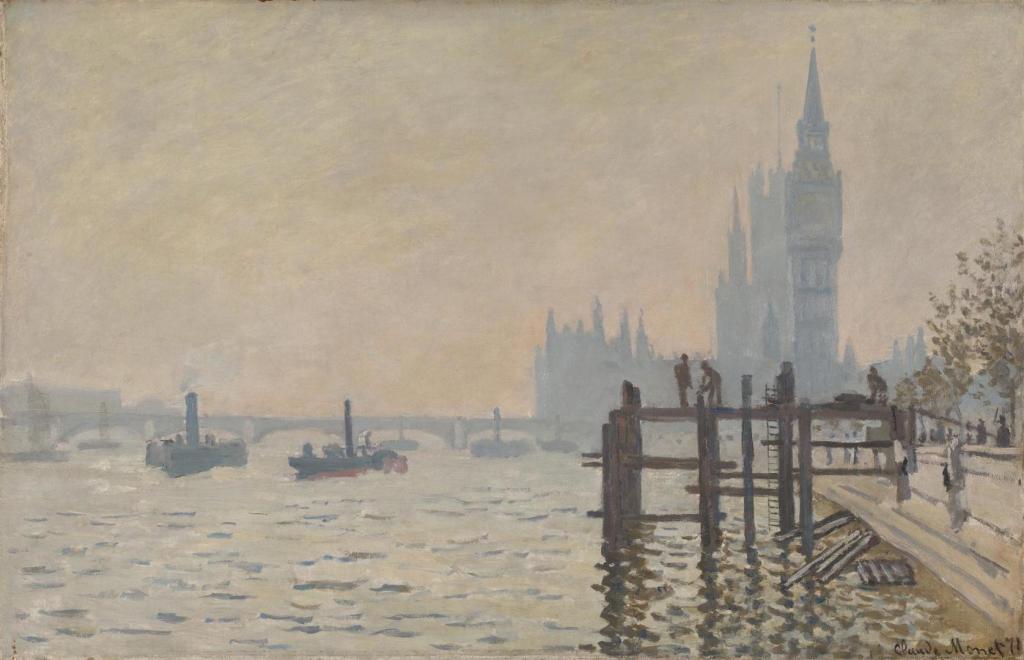
As a whole, The Thames below Westminster is far more rigorously constructed than the apparent spontaneity we tend to attribute to Impressionism might suggest. Built up from a combination of horizontals and verticals, the only diagonal is the line of the Embankment, which thrusts into the painting and leads us to the point where the base of Big Ben meets the extrapolation of Westminster Bridge. Bristling along with the tower are the spires and the pinnacles of the palace, the funnels of the boats and the verticals of the jetty. The combination of these last posts with the jetty’s horizontals – the platform the workers are standing on and the binding elements below – makes this structure resemble nothing so much as the skeletons of Mondrian’s abstract compositions from the 1920s and 30s, while the long, low stretch of the bridge seems to keep the painting calm and grounded. The cool, almost featureless grey of the sky suggests to many that Monet had managed to see the earliest Nocturnes by Whistler – although there is no concrete evidence that they met either in Paris or in London before they became good friends in the 1880s. The subtle pink glow around the Palace of Westminster – which is far easier to see in the original – speaks of the presence of the sun behind the mist, fog and clouds. We are looking more or less due South, as it happens, which would suggest that this is more or less midday, and with the sun low in the sky it must have been early in the year. But, as with Monet’s painting, we can’t be too precise. That would take the edge off things. Nevertheless people do try to be too precise – I’ll give you an example on Monday. Some of the paintings have even been given a precise date and time according to where the sun is in the sky (if the sun can be seen)… which fails to take into account that these paintings are not documentary evidence, they are works of art. Maybe Monet put the sun where it looked best. In this painting there is no sun – but there are those tall, aspiring towers, and a warm glow surrounding the Palace of Westminster that suggests this really is a powerhouse… The painting is entirely real, and true, and historically accurate. But it is also a wonderful example of the power of the imagination.


Happy Christmas Richard!I ‘attended’ your Stories of Art series for the National Gallery during lockdown. I live
LikeLike
Thank you, Annie – a Happy Christmas to you too! I only got part of your message though…
LikeLike
Thought you might like to read Richard’s most recent blog on Monet ……
LikeLike
Hi Gillian – I think you may have sent this back to me, rather than on to your friend…
LikeLike
Thank you! Trying to share it with Peter as I knew he would enjoy it too. Pre-Christmas burnout!
LikeLike
I was intending to share it with Peter. It was such an enjoyable article – thank you! I think I must be suffering from Pre-Christmas burnout!
LikeLike
A pleasure, thank you – but I’m a bit worried how you’ll be Post-Christmas!
LikeLike
Have been tryng to buy a ticket for your Monet talk but something seems to be up with tixoom – in that I have filled in all my details as usual but nothing happens when I clock Confirm and Pay.
Deborah Bragg
LikeLike
Dear Richard
I went to the Monet exhibition yesterday and enjoyed it very much, however i was confused by the accompanying notes until I realised that Monet had painted these pictures on his visits to London in the early 1900s not in 1870 when he was an unknown young poor man. When he came back in 1900 and 1901 he could afford to stay at the Savoy. So your comments about the works were not helpful at all. I usually trust you totally however I might need to read other sources as well, especially for those exhibitions I can’t get to
regards
Eleanor Flynn
LikeLike
Dear Eleanor, I’m glad you enjoyed the exhibition, but really, I didn’t say in my post that these paintings were painted at the same time: I gave the date and the circumstances of the painting I was writing about. The dates of the later paintings are also given clearly in the exhibition, so I’m afraid I think it should have been clear to you that the circumstances were very different. I’m sorry my comments were not helpful to you, but that is simply because I wasn’t actually writing about that exhibition. And yes, I agree with you – always read other sources, and especially those which are relevant.
LikeLike