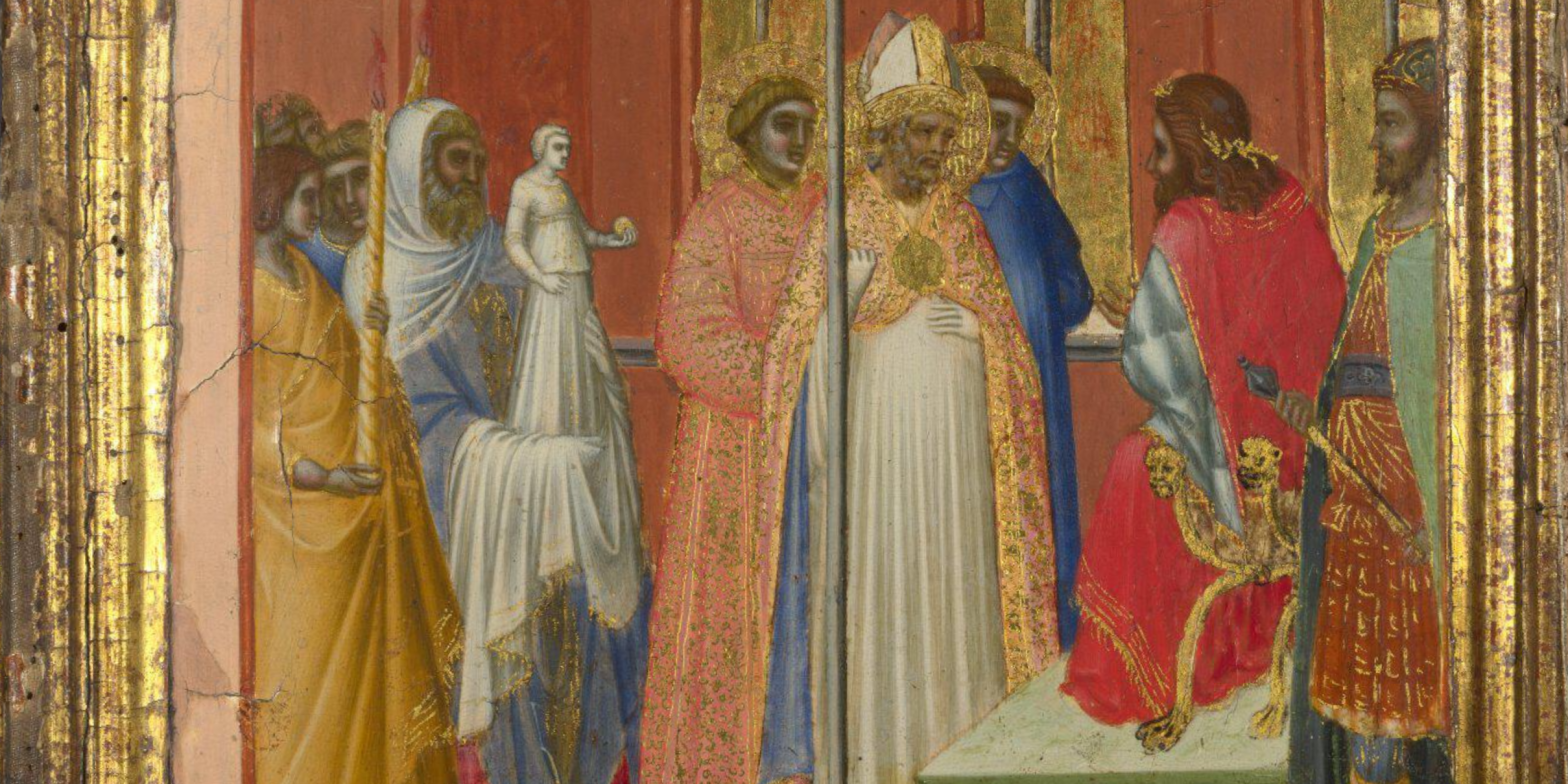
Pietro Lorenzetti, Saint Sabinus before the Roman Governor of Tuscany, 1335-42. The National Gallery, London.
It’s not long until Siena: The Rise of Painting opens at the National Gallery. I’ve already talked about Duccio, and now, after a week’s break (please do check the dates of the talks you are booking for!) I will continue my series celebrating the four main artists who form the focus of the exhibition. This Monday, 24 February at 6pm it will be the turn of Pietro Lorenzetti, and the third talk, looking at the wonderful Simone Martini, will be one week later (3 March). The week after I’m heading off to follow The Piero della Francesca Trail once more, so Ambrogio Lorenzetti will follow after another week’s break on 17 March, by which time the exhibition will be open. To round the whole thing off, on 24 March I will introduce the exhibition itself, with a ‘virtual’ guided tour which could either prepare you for a potential visit, remind you of what you have already seen, or make up for the fact that you can’t get to London…. Siena: The Rise of Painting explores the development and influence of painting in Siena in the first half of the 14th Century, and also includes works in a wide range of other media by contemporaries of the four artists and by future generations. When seen all together we will be able to decide if the curators are right when they assert that some of the major developments in Western European painting originate in this time and place. Spoiler alert: today’s post will suggest that, in one way at least, they definitely are… more will follow!
I have a confession to make. I have worked at The National Gallery in one way or another for around three decades, but I have not previously looked at today’s painting in detail. I suspect that it has not been on display a great deal, or, if it has, it has been ‘outshone’ by the Duccios (which have almost always been accessible), or something as unique as the Wilton Diptych… Let’s face it, we are incredibly lucky to have such a rich collection of medieval art in the heart of London. One of the things I love about writing this blog is discovering something new, or getting to know something that has lurked in the corner of my eye – like this painting, for example – and finding out that it is truly remarkable. I suspect that one of the things that has kept it slightly out of reach is the obscurity of the subject matter, but, as ever, close looking makes everything clearer.
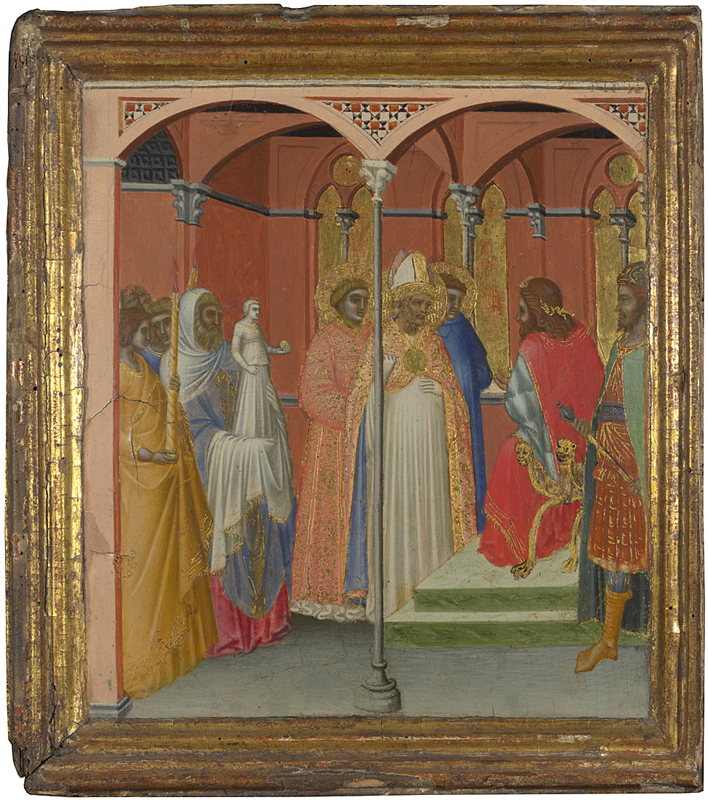
We are looking at a relatively small-scale painting (33.7 x 33.2 cm), which suggests that it was either made for private devotion, or was part of a larger ensemble. The painting is surrounded by a gold frame, which appears to be the same width at the left, top and bottom, but a bit narrower on the right. As the frame is clearly old, slightly battered and with traces of woodworm, it could well be original (…it is), and as the right section of the frame is narrower, it might have been cut down from something to the right (…it was). The perspective of the imagery also implies that we are seeing it from the right, and is another feature which suggests that this was just part of something else. But wait a moment: Brunelleschi discovered, devised or invented single vanishing point perspective around 1415, and Pietro Lorenzetti almost certainly died as a result of the Black Death some seven decades earlier in 1348… so is this really perspective? Well, yes, it is a form of perspective, an approximation to the way in which we experience space, and a way of representing three dimensions on a two-dimensional surface: the Sienese really were that innovative. The ‘space’ in this case is defined as a large room with a double-arched opening on our side, and three windows at the back. Through them we can see the flat gold background typical of paintings of the time. A number of people are standing in the room, gathered around a seated ruler – but who (or at least ‘what’) they are will become clearer if we get closer.

The three men on the left of this detail have haloes, so must be saints. The haloes are shown as flat circular disks of gold leaf, each punched with a ring of circles and stippled with small indentations to catch the flickering light of the candles that would have illuminated the painting. The man at the front wears a mitre, a two-pointed Bishop’s hat: this is St Sabinus, one of the four patron saints of Siena, who features in Duccio’s Maestà kneeling to our left of the central throne. He is believed to have baptised the first Christians in Siena way back at the beginning of the 4th Century. As well as his mitre he wears a cope – the semi-circular cape in a pink cloth of gold – which is fastened at the chest with a large, circular, gold morse. Both of these items confirm his status as a bishop, and, given that, back in the day, it was only bishops who baptised, this adds coherence to the story, even if Sabinus is supposed to have been beheaded in the year 304 at the tender age of 19. It should be pointed out, though, that ecclesiastical hierarchy and fashions were not the same in the year 304 as they would be a millennium later, but then Pietro Lorenzetti wanted to make this story comprehensible to his contemporaries. Behind Sabinus stand two deacons, named as Marcellus and Exuperantius. Deacons are minor church officials, ranking just below priests. The thick rings of hair around the bald crown suggest they have been tonsured (the hair on the top of the head has been shaved off), a sign that they have taken religious orders. Their robes are relatively simple in form, and have square-cut collars, which can be seen more clearly on the right – because the simple blue robe doesn’t have the rich patterning of the other (presumably worn by a more senior deacon – or one who was simply richer, or less humble). These are the robes worn by deacons. St Sabinus is slightly obscured by the slim column at the front of the room (Lorenzetti is trying to make this space look as ‘real’ as possible: it is almost as if we are chance observers of the narrative, physically present in the room). This colonette also hides his gesture: he is pointing back over his right shoulder with his right thumb, an unusual and seemingly very modern thing to do, but a gesture which the artist used often (as we will see on Monday). Sabinus is communicating something to the seated man, who leans forward, also gesturing with one hand. He is clearly interested in whatever Sabinus has to say, or trying to convince him of something. The seated man wears a red, fur-lined cloak (signs of royalty and of wealth respectively), and has a garland of golden leaves in his hair. Together with his seat, a gold, lion-headed faldstool, usually used to denote a ruler, we need have no doubt that this is the ‘Roman Governor of Tuscany’ mentioned in the title. He has his own bodyguard, standing to the far right of the image and partly obscured by the frame. The guard also wears red, which connects him to the ‘royal’ court, and also has a helmet and a mace – a heavy club with a spiked metal head – which he is clearly prepared to use. But what is Sabinus gesturing towards?

Another group of people enter from the left. One, with greying hair and beard, has his head covered with a shawl. He is carrying a white sculpture – presumably carved in marble – which depicts a woman carrying a golden, spherical object. He is not touching it though – his hands are covered by a white cloth, so that he does not sully what is clearly a revered object. This older man – some kind of priest, presumably – is flanked by two younger men each of whom carries a candle. Again, this shows us the regard in which the sculpture is held: we are witnessing a religious procession, of sorts. A fourth man follows, but we can only see the top of his head. Given that we are in Roman times we can assume that the sculpture represents a classical goddess. Lorenzetti has made the men treat it in the way that Christian priests might revere the consecrated host, but Christian priests did not dress like this, nor did they revere sculptures: that would be idolatry. This is Venus, goddess of love and beauty, holding the golden apple which Paris awarded her, thus recognising her as the most beautiful of the goddesses.
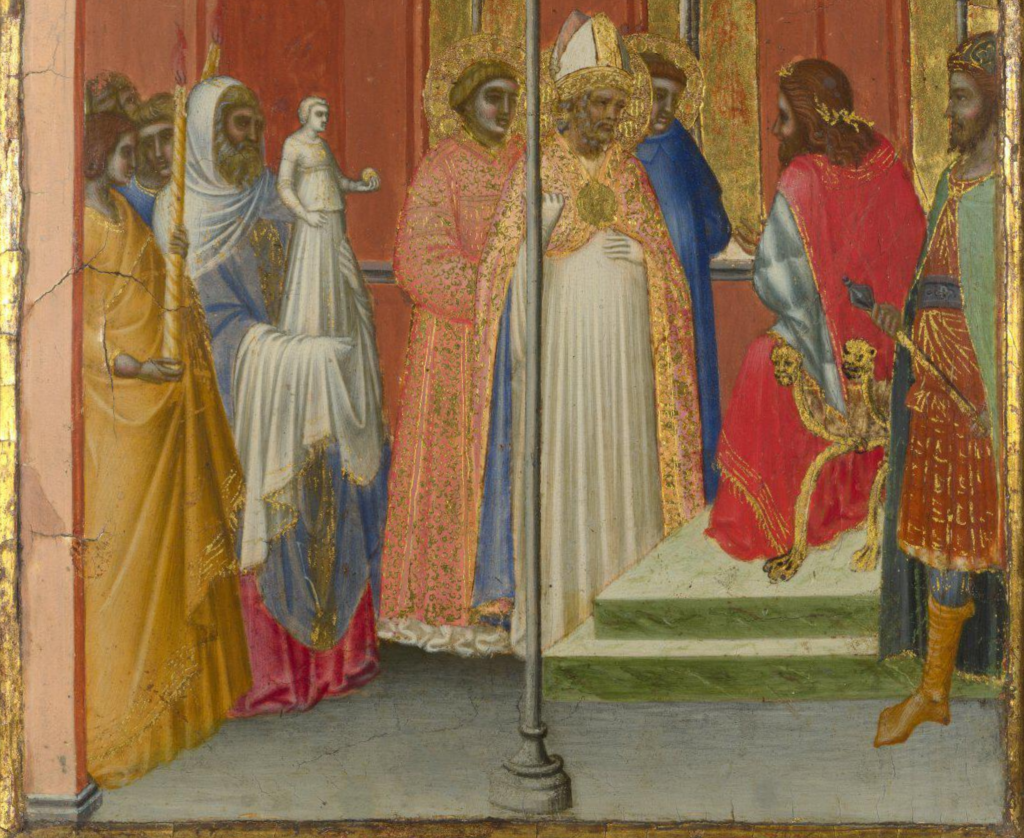
If we take a step back, the story might be a little clearer. Sabinus, looking suspiciously older than his supposed 19 years, has been arrested as a Christian, along with Marcellus and Exuperantius: the Edict of Milan, allowing freedom of worship, would not be issued until 313, 9 years after the traditional date for Sabinus’s martyrdom. According to legend, the Governor’s name was Venustianus. He gave Sabinus a choice: either prepare to die yourself, or sacrifice one of your people to the pagan gods. Accompanied by the two deacons Sabinus held off, and asked to have one of the ‘gods’ brought before them. Lorenzetti shows us the point at which the god – a sculpture of Venus – is brought into the audience chamber in procession. In the original story it was supposed to be Jupiter: Lorenzetti may simply be punning on the Governor’s name. This is as far in the story as the painting goes: we do not see what happened next. Sabinus and the deacons prayed, and then smashed the idol to pieces. Venustianus responded by torturing the deacons to death. Sabinus was allowed to live, though, and later was able to cure the governor of blindness. This inevitably led to the governor’s conversion, and, almost equally inevitably, to the martyrdom of both Sabinus and Venustianus. So, like all good stories, they both lived happily ever after – albeit in heaven.

What I find remarkable about this painting is the complexity of the space which Pietro has created to tell the story. We are excluded by the arcade made up of a pink pier on the left and a slender column in the middle which support two very shallow arches (there is just a sliver of a second capital supporting the arch at the far right). The spandrels (curved, almost-triangular shapes above the arches) have shallow recesses, with shadowed edges, and are inset with mosaics created from triangles and squares of black, white and brick-red stone. The procession enters through a door on the left, the entrance passageway topped by a coffered barrel vault, the like of which can still be seen in the Basilica of Maxentius in Rome, or, in Pietro’s day, in the bronze roof of the Pantheon’s portico (it would be several centuries before Bernini had that melted down, at Urban VIII’s suggestion, to make the Baldacchino in St Peter’s). On the other side of the entrance is another arcade, beyond which is an empty side aisle. We could be in a side aisle, too – with windows behind us – leaving Sabinus and the other men in a central ‘nave’. The bishop and the deacon in blue are directly between two identical slim columns, with the one at the back just to the left of an equivalent colonette in the middle of the middle window. You will realise that I am talking in terms of church architecture, and this clearly isn’t a church, but if it were, then the Governor would in the position of the high altar, up a few steps. But this is exactly the structure of a classical basilica (such as the Basilica of Maxentius I have already mentioned – check the ground plan on that link), which takes its name from the Greek basileus, meaning ‘king’ or ‘monarch’. A basilica was a building in which you would have an audience with the ruler, and it was the form adopted by early Christians for the house of the King – the King of Heaven, in this case. However, the early Christians took away the monarch’s throne (in this case, the golden faldstool) and replaced it with an altar. I get a strong sense that Pietro Lorenzetti really knew what he was doing.

He brings the edge of the relevant space – the ‘nave’ – right to the bottom of the painting, with the base of the pier on the left and the column in the middle all but touching the frame. Apart from this the foreground is empty – as if we could step through the arcade and join the gathered assembly. The governor’s dais takes up the right-hand side of the space, the corner of the lower step just touching the colonnette. However, this is not the only way in which the painting is asymmetrical. There is no pier on the right, and the bodyguard is trimmed in half, cut off by the frame. My initial thought was, ‘this is just a fragment: the painting must have been cut down’.

However, I checked the exhibition catalogue, and in the list of exhibited works at the back it tells us that Pietro Lorenzetti’s Saint Sabinus before the Roman Governor of Tuscany is ‘Tempera on poplar, 37.7 x 33.2 cm (with engaged frame)’. I’ve told you the measurements before, but not they include the frame: this really is a compact pictorial field. And I didn’t say that the frame is engaged, meaning that it was attached before painting began. This tells us that the painting surface has not been cut down, even if the frame has (as we said, it appears to have been trimmed on the right). This really sparked my interest. It was a deliberate choice to paint the narrative asymmetrically. This helped Pietro to create a far more naturalistic space, with bold framing at the top and to the left. I find the slab of pink wall at the left of the image truly surprising, a large area of flat, featureless painting at the very front of the pictorial space. In itself, it is devoid of interest, but it serves its function perfectly, helping to create the space behind it, and to reveal the movement of the procession arriving from the pronaos, or vestibule. Throughout this small image the architecture is an active agent in the narrative. Enclosing Sabinus and the right-hand deacon between the two colonettes helps to give a sense of their captivity. The bodyguard is upright, his stance defined by the frame, and parallel – and equivalent – to the pink wall on the left. From this we get an idea of his strength, but his posture also makes the governor’s forward lean, his interest in Sabinus, all the more marked. And being cut off by the frame we again get the sense that the guard is located within a real space outside which we are physically present.
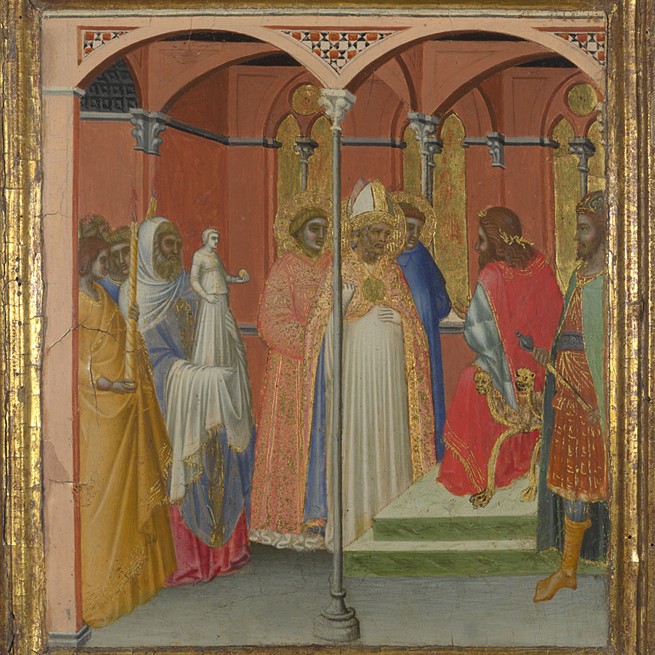

In 1317, just six years after Duccio’s Maestà was completed, the Sienese started to build a new baptistery down the hill from the Cathedral, and the choir of the Cathedral was extended above it. In the early 15th century a new baptismal font was commissioned, decorated by some of the leading sculptors of the day. Donatello modelled a relief of the Feast of Herod, completed in 1427, which I have discussed in two separate posts (see 154 – A Feast for the eyes and 156 – Second Helpings at the Feast) – you can see it on the right here. This is often credited with a photographic, ‘snap-shot’ naturalism, because one of the figures – on the far right – is trimmed by the edge of the relief. But Pietro Lorenzetti had got there almost two centuries before with his own dramatic scene which also occupies a complex space built up from several other interlocking spaces. The empty surface of the floor, leading us in, also performs a similar function in both images. Given that Pietro’s small painting was upstairs from the Baptistery – in the Cathedral – maybe this is where Donatello got his ideas from – adding in single vanishing point perspective, which he would have learnt from his friend Brunelleschi. As for the ‘ensemble’ that today’s painting originally belonged to… well, you’ll have to wait until the talk on Monday to find out – but it is one of the greatest paintings in the exhibition!
 dr richard stemp