
Édouard Manet, Corner of a Café-Concert, probably 1878-80. The National Gallery, London.
This week, after the splendour of Siena in the 14th century, it is time to turn our attention to another flourishing city – Paris, in the second half of the 19th century – but we will look at it via Switzerland. Over several decades in the 20th century the Swiss businessman Oskar Reinhart acquired a remarkable collection of paintings and works on paper. These included an admirable selection of the Impressionists and Post Impressionists, some of which I will be talking about this Monday, 7 April at 6pm, as they have been lent – for the first time as a group – to The Courtauld, where they form the nucleus of their enormously successful exhibition, Goya to Impressionism. I want to lead into this by writing about a painting by Manet from the National Gallery, at the other end of the Strand in London. It is not in the exhibition, but it was, for a while, part of a painting that is. Two weeks later, on 21 April, I will look at the National Portrait Gallery’s exhibition of Edvard Munch Portraits – some of his finest work, frankly. And finally, for April, I want to go to one of London’s great, but under-visited, free museums, the Guildhall Art Gallery, to introduce their exhibition Evelyn de Morgan: The Modern Painter in Victorian London. I am planning to devote May to German art – but more news about that as the series develops: keep an eye on the diary!

The Café-Concert of the title would have been just one of at least 150 such establishments in Paris at the time this was painted. They varied in size and in the scale of their entertainment – from a piano in the corner to a full-sized orchestra – but the basic idea was the same: they provided musical entertainment and refreshment. However, up until 1867 they were strictly regulated: the performers were not allowed to wear costumes, being restricted to everyday ‘streetwear’, and no more than 40 songs could be performed in one evening. Even then, the entire programme had to be passed by the police to prevent any seditious material being heard. There was to be no dancing, no dialogue and no sets – the aim being to protect musical theatre. Theatre as a whole had long been under ‘royal’ control, but by 1867 Napoleon III’s popularity was waning, fifteen years into the ‘Second Empire’. The relaxation of the law in 1867 not only led to the flourishing of the Café-Concerts, but also helped just a little to keep the Emperor going – until France’s defeat in the Franco-Prussian War just four years later. The Café-Concerts, on the other hand, went from strength to strength, and, as a feature of contemporary society, they became a popular subject for avant-garde artists such as Manet, hailed as ‘the painter of modern life’. In the painting, we see members of the public seated at a table being served drinks. A waitress places one glass of beer on the table while holding two more in her left hand. She looks off to our right, perhaps checking for other customers in need of service, or reminding herself who ordered the drinks she is still holding. In the background we can see a singer, or dancer (or both) on stage, with an orchestra seated in front.
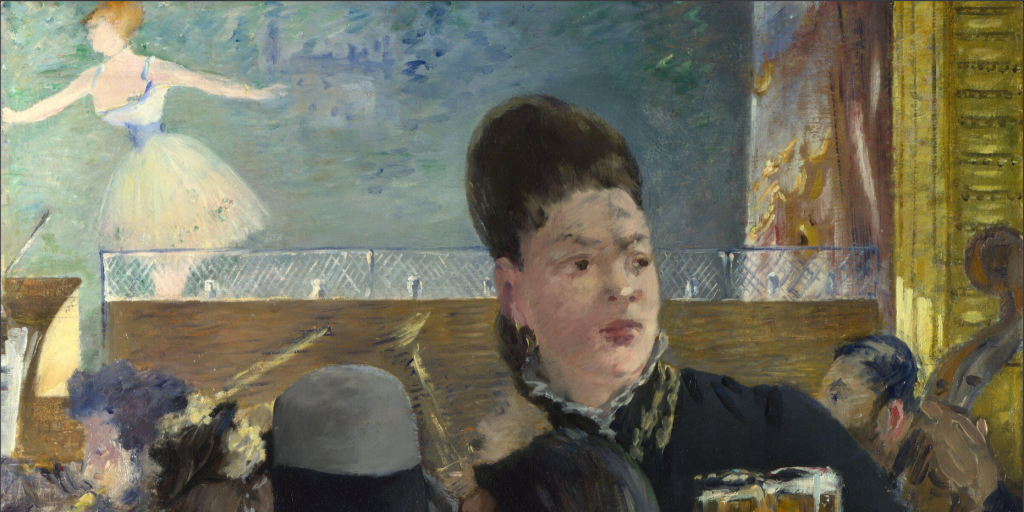
One of the reasons for the popularity of the Café-Concerts was probably because they were – like the ballet – some of the few places where you could see a woman’s legs in public. Indeed, the performer appears to be dressed for the ballet, wearing something like a tutu. She has a remarkable slim waist (and is presumably corseted), and sports a décolletage which is low-cut, even given the word’s definition, and held up by the slimmest of shoulder straps. Leaning forward with her arms flung out she could either be taking or bow, or maybe singing. The setting is non-specific, with just a hint of a pale château with a blue roof seen between trees, in the midst of a Renoir-like array of light turquoise and blue brushstrokes. The gilded curtain can be seen to the far right just inside the proscenium arch, which frames the stage. The orchestra is separated from the performer by a screen topped by a row of glowing footlights and what looks like a low fence.

The orchestra itself is painted remarkably freely. A trombonist sits on the left, his instrument stretching behind his head on a diagonal from bottom left to top right, and, neatly framing the grey hat, a tuba player sits behind him. Both instruments are only just sketched in with creamy yellow and blue dashes, a style of painting that would be more at home in a late Impressionist or a spontaneously Divisionist painting. But then the freedom with which Manet could deploy paint, yet still hold onto the essence of his subject, is demonstrated clearly by the dashes of colour with which the beer is painted, a slight head of foam visible through the glass, the waitress’s black dress seen through the beer, but broken up by the colour of the light which both illuminates the beer and reflects off the glasses. There’s a real sense of how much these drinks would weigh – and therefore of the waitress’s skill in delivering one drink whilst focussing elsewhere. Nearby, the man in the foreground holds a clay pipe, from which curls a puff of smoke. The stem of the pipe rests on his thumb and his forefinger is curled over it, clamping it onto the knuckles of the remaining three bent fingers.

The central ‘drama’ of the image is not whatever is happening on the stage, but the split focus of the two protagonists: the waitress looking to our right, the smoking man to our left. Both appear to be focussed on things beyond the frame: there are aspects of this Café-Concert that we will never know. This fragmentary depiction is one of the truly modern features of the painting: the artist is not showing us everything, but allowing us a glimpse of just one of the things which interests him, a moment of alienated interaction which suggests that these two people have no interest in each other. While we may not know everything that is going on, this impersonal interaction is one of the hallmarks of life in modern society: Manet is showing us not only what people look like, but also how they behave. He is also giving us a small cross-section of Parisian society. The smoker, in the customary workers’ blue – the Bleu de Travail – is wearing a black cap and smoking his pipe. Next to him another man wears a slightly smarter hat, like a taller version of a bowler hat, but in grey and with a broad back ribbon – I think it’s a tall crown bowler (or, for the Americans, a high crown derby). Beyond him, a woman turns away, her hair pulled back behind her ear and piled on top of her head, where it is dressed with yellow ribbons which merge, visually, with the brass of the trombone. Is she with the man in the grey hat? There is no evidence that she is, but could she be her on her own? It would seem unlikely, in the 1870s – unless she is there alone professionally… draw your own conclusions.

The Bleu de Travail is the dominant element in the foreground, baggy so as not to restrict movement at work, hardwearing and cheap. But it’s not evenly blue – a hard line cuts down the worker’s back directly below the two beers, lighter on the right and darker on the left. This is a sure sign that Manet extended the painting, adding a new section of canvas on the right. When originally completed it would presumably have looked more coherent, but as the new section was not prepared in the same way – the surface blue doesn’t have the same layers of paint underneath it – it has faded to reveal the addition. While we’re looking at this detail I’d like you to try and find something else. The beer is not necessarily for this worker – he has a dark brown drink in a tall glass in front of him. To the left of the top of this glass, just above the level of the liquid, is a tiny pink detail, at the bottom of a green drink that looks suspiciously like absinthe. This pink detail casts a shadow on the table beneath it – remember it, because I’ll come back to it later.
According to the art critic Théodore Duret, Manet was particularly impressed by the waitresses in the Brasserie de Reichshoffen, ‘who, while placing with one hand a glass on a table in front of a customer, were able to hold several more in the other, without spilling a drop.’ Manet asked one of these waitresses to pose for him, but she was reluctant, and said she would only agree if her ‘protector’ could be there too – and he would have to be paid as well. He is the worker in the foreground: the ‘alienation’ is a fiction, as they knew each other well. This may have allowed Manet to develop a particularly taut composition. The waitress’s left arm hangs down from her shoulder to her elbow and then up to her hand holding the beers, while the worker’s left arm goes down to the elbow, resting on the table, and up to his hand holding the pipe. The two hands, together with the beers, frame the worker’s head. The waitress’s right arm, clad in black, fills the gap between the worker’s brilliantly illuminated left forearm, and her white cuff meets his blue. Her hand remains hidden behind his arm, even though we can see the beer she has placed on the table. The far left and right of the composition are framed by the heads of the trombonist and a double bass player respectively, and also, on the right, by the proscenium arch. Its visibility on the right, but not the left, implies that the stage spreads far beyond the frame of the painting on the opposite side. Whatever the apparent spontaneity of the image (and remember, Manet never exhibited with the Impressionists – he wasn’t necessarily painting what he saw when he saw it) this is a rather brilliantly planned composition. However, it isn’t called Corner of the Brasserie Reichshoffen – we are in a Café-Concert, not a Brasserie. But then, Manet had changed his mind.

This is actually a screen shot taken from Monday’s talk. On the left is Manet’s Au Café (1878) from the Oskar Reinhart Collection – one of the paintings in the Courtauld’s exhibition. On the right is Corner of a Café-Concert. The painting of the Brasserie Reichshoffen was originally intended to be a reasonably sized composition, but Manet was unhappy with its progress, and cut it in two. Most accounts say he ‘cut it in half’ – but they are nowhere near equal ‘halves’. If you remove the addition from National Gallery’s painting, it is about half the width of its Swiss companion: he effectively cut a third from the original composition. Both were then re-worked into independent paintings, with the setting of the left section remaining securely in the Brasserie, while the other was transformed by the addition of a stage, a performer and an orchestra into a Café-Concert. All of these elements are far more freely painted, showing that the younger generation of Impressionists had a notable impact on their older mentor. I haven’t read a full account of the precise relationship between the two paintings (stuck in my study on the Wirral I don’t have access to the right libraries), but this is the best match I can come up with, the shadows of the drinks on the right matching those on the table on the left. Not only that, but the tiny pink detail at the bottom of the ‘absinthe’ is revealed to be the fingertips of the girl on the left. The Reinhart painting shows a more obviously respectable couple – a man in a top hat with a cane (of a ‘higher class’ than the men opposite him, clearly), with a woman modestly dressed in a beige-coloured coat and hat – who is probably his wife. The girl at the far end could even be their daughter, but she wouldn’t be drinking absinthe. Maybe that belongs to the unaccompanied woman at the end of the table who is turning away from us. [A few days after I wrote this I finally got round to reading Rachel Sloan’s entry about the Reinhart painting in The Courtauld’s catalogue – the re-working of the original painting was more complex than I had realised, and initially the canvas was cut between the man in the top hat and the ‘girl’ at the end of the table – who might originally have been a young man: look at the stiff white collar… That’ll teach me to research things properly!]
The additions to the Corner of the Café-Concert turn it into the very type of establishment mentioned in the title – a place of popular entertainment, which would in its turn evolve into the British Music Hall. By extending the canvas Manet also makes the waitress central, so that she becomes the real subject of the painting, rather than leaving her cornered. It does leave me wondering, though: if he hadn’t done this, how would he have painted her particular skill – delivering one drink while securely holding several more? Surely there would only have been just enough room for one glass of beer, if that. Maybe it was this that led to his dissatisfaction.
 dr richard stemp
Good morning/afternoon. In this piece you refer to Manet as the painter of modern life. I thought the artist referred to by Baudelaire in his 1863 essay “Painter of Modern Life” was Constantine Guys?
Great weekly article. I’ve looked at that painting many times, but never noticed the additions, etc. Mark Haimann
Sent from the all new AOL app for iOS
LikeLike
Well spotted! That’s why I said ‘hailed as ‘the painter of modern life’ rather than ‘hailed by Baudelaire as the painter of modern life’…
LikeLike