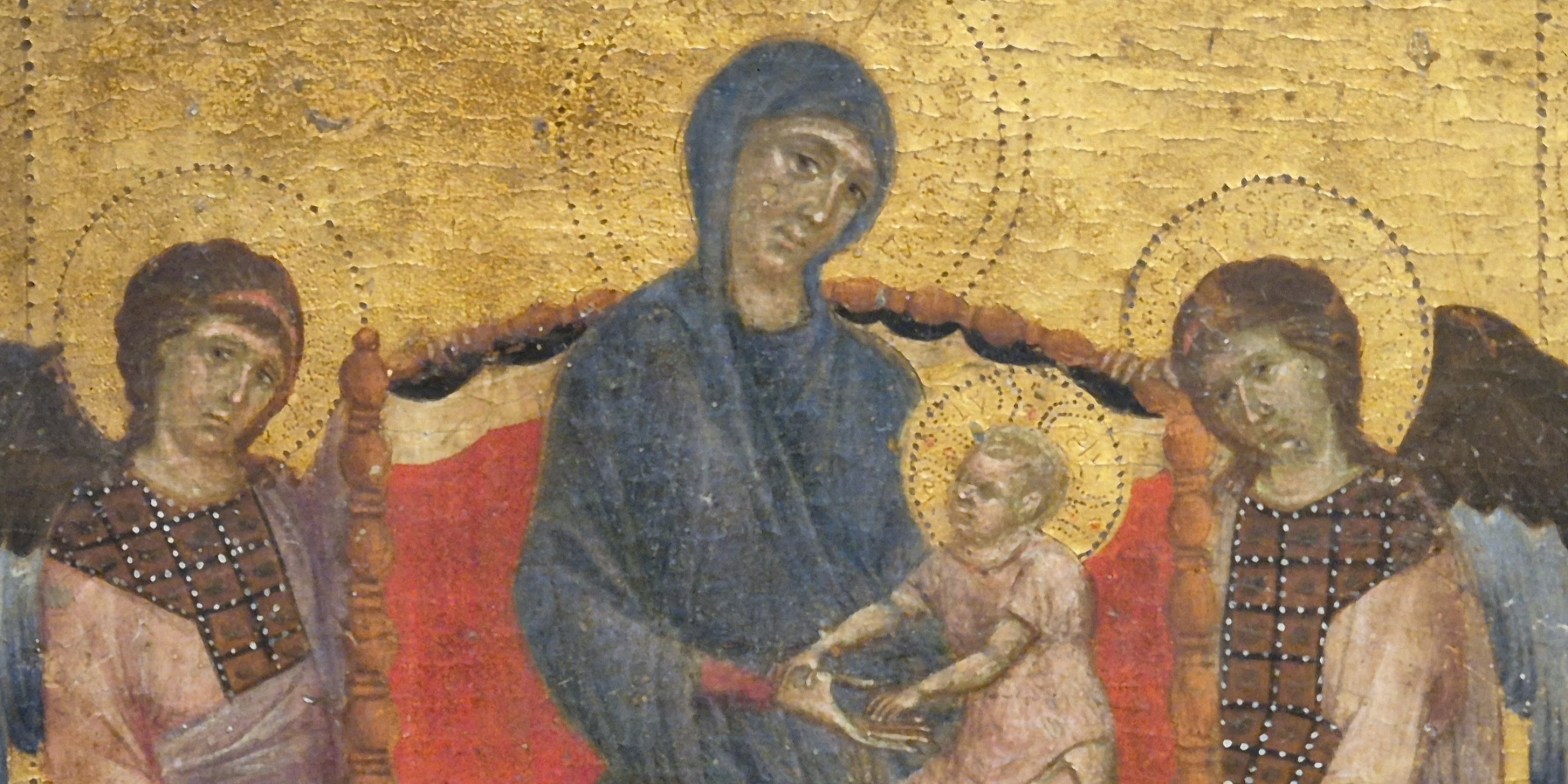
Cimabue, The Virgin and Child with Two Angels, about 1280-85. The National Gallery, London.
I confess that I have always been slightly dubious about the status of ‘Cimabue’ in the History of Art. After all, only one of his works is documented, and that is a mosaic: how can you establish an artist’s oeuvre on that basis? As a result I am especially glad to be Revisiting Cimabue this Monday, 23 June at 6pm, having seen the superb exhibition at the Louvre with a very similar title. The exhibition started – as my talk will – with an exploration of the very mythology which surrounds this supposedly foundational artist, the mythology of which I have always been wary. It then looked at his work in the context of his predecessors and contemporaries, before examining his impact on and significance for both contemporaries and successors – an exemplary display which I’m sorry I couldn’t get to earlier.
The week after I will start my exploration of the new hang of the National Gallery’s collection – or at least, of the Sainsbury Wing – with Three Sainsbury Stories, on Mondays 30 June, 7 and 14 July. Click on either of those links if you want to book for all three talks at a slightly reduced rate. Alternatively, you can book the talks individually on the following links – the titles being Opening up the North (30 June), At home in the Church (7 July) and In Church and at Home (14 July). A description of each can be found on the relevant link. At that point I was going to stop for the summer, but have realised I am free on the evening of 4 August – which gives me a chance to repeat this week’s National Gallery lunchtime lecture, Seeing the Light: the art of looking in and around Duccio’s ‘Maestà’, as I realise not all of you would have been able to get to London. It also gives me the chance to talk about some of the ideas in greater depth. It was great to see so many of you there – and especially the visitors from Edinburgh, Italy and even America! Thank you so much for coming. Meanwhile, I’m going to look back before Duccio’s career had started to explore the National Gallery’s small painting by Cimabue.

At first glance this might appear to be an entirely traditional image, if not rather ‘old fashioned’. As a genre, The Virgin and Child is rich and varied, and, even if it doesn’t represent a specific biblical narrative, it expresses so much about these two characters, their relationship, and their importance for the Church – the ‘Church’ in question being Catholic (the term ‘Roman Catholic’ didn’t come into being until about 300 years after Cimabue was painting). It could almost equally have come from the Eastern Orthodox Church – but not quite, and that is what makes this particular image so important. Mary sits on a blue cushion against a red cloth of honour, both of which are set on an elaborate throne. Her right leg is lowered, with her foot on the second of three steps, and Jesus sits on her raised left knee. They are flanked by two angels. Nothing unusual about this, you might think, but it is worthwhile comparing it with an earlier version of the same subject which is also in the National Gallery’s collection, from Margarito d’Arezzo’s The Virgin and Child Enthroned with narrative scenes from about 1263-64.


Margarito’s version is far closer to Byzantine art, or the art of the Orthodox Church. Neither Mary nor Jesus seem as ‘human’ as Cimabue paints them. Rather than a baby, Jesus is like a little emperor. Both figures sit upright, with their shoulders flat against the flat gold background. There is no sense that they are moving in the space which we inhabit, and as a result they are slightly abstracted from reality. But then, Orthodox icons are meant to show us a sanctity which is not seen in the down-to-earth world in which we live and breathe. Icons represent something which is more perfect – and as a result, something we can only imagine, unlike what we are actually familiar with. Nevertheless, there are similarities. For example, in both examples the Virgin wears a red robe with a blue cloak, and sits on a cushion. Notice also that in both images Mary’s right foot is on the central axis, directly under her head: it is with the feet that we will start.

Most obvious are the feet of the angels. On the left we see both feet, balletic, but not turned out enough for second position, almost as if the angel is on tip toe – the usual description for Byzantine imagery after it had evolved away from the naturalism of late Roman art. On the right we can only see one foot: the other must be behind the throne, or behind the steps leading up to it. This in itself helps to create a sense of space, and of three dimensions: the holy beings are in the same space as us, thus making the image appear more ‘real’. Both angels wear red stockings and delicate black shoes, or slippers. It could be that Mary is wearing the same, although we can only see the toes peeping out beneath the hem of her red skirt. Her right foot (on our left) is on the second step up, and her left is one step higher. The centrality of the lower foot, and its ‘proximity’ on the lower step, might encourage us to lean forward and kiss it, a sign of our humility.
A semi-transparent veil hangs over the seat of the throne and behind Mary’s legs. It falls over the upper step, and her left foot is resting on it. The steps themselves appear to be at an angle, as does the throne: this suggests that it is a three-dimensional structure, again implying the real presence of Mary and Jesus in our space. To me, the steps look as if they could be removed, with the throne only accessible when they are there: they would only be put in place for the right person, of course. To the far left and right of the detail above are the ends of the angels’ wings. Their purple cloaks hang down, and the points almost coincide with a row of fine dots tooled into the gold leaf background which, as we shall see, frame the entire image.
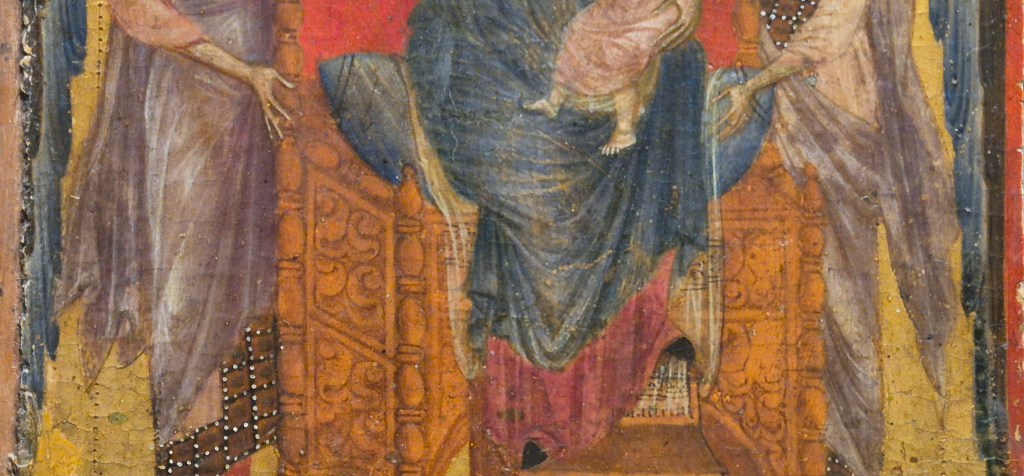
Moving up, we can see these tooled dots disappear behind the left angel’s robes only to reappear at waist level. This angel holds the back corner of the throne, while his companion on our right holds the cushion, which curves up on either side, giving us a sense of Mary’s weight – another subtle naturalistic observation, reminding us that Mary has a real physical presence. The semi-transparent veil falls over the cushion: it has been suggested that it is not unlike an altar cloth, spread over the altar to receive the consecrated host – which, in Catholic belief is the actual body of Christ – during the Mass. Indeed, the body of Christ is there, seated on Mary’s raised left knee. He is barefoot, with the left foot hanging down and the right raised. Given his angled position, the right foot falls roughly above Mary’s. This reminds me – at an admittedly distant remove – of Caravaggio’s Palafrenieri Madonna, in which Jesus’s foot rests on Mary’s, helping her to trample the serpent underfoot – as ‘prophesied’ in Genesis 3:15.

Mary and the angel to our left both seem to look straight into our eyes – and thus into our soul. The delicate tilt of their heads implies sympathy and a willingness to listen. Even as divine, or semi-divine beings, they are both sympathetic and approachable. The angel on our right looks over to the left, while Jesus’s gaze is turned further away – but in a naturalistic way. I don’t think there is a theological meaning to his apparent distraction. He is definitely a child, unlike Margarito’s little emperor, and his tiny hands hold onto his Mother’s. Her right hand gestures towards him, much as it would in an Orthodox Hodegetria – in which Mary shows us ‘the way’ – and, almost as if a demonstration of his humanity, Jesus has taken this opportunity to grab a finger and wrist, the comparison between the sizes of the hands giving us a sense of his fragility. Once again, heaven has been brought down to earth. Both angels lean in towards the throne, their innermost hands resting on its back (the fingertips of the left-hand angel are only just visible) – which in itself beautifully frames Mary’s shoulders. All four figures have haloes demarcated with more tiny tooled dots. Mary’s has a double ring, and Jesus’s shows a hint of the cross with which it is usually marked.

Stepping back we can see the continuation of the tooled dots which frame the image leading up from the angels’ wings and across the top of the flat gold field. And we can also see the golden space – the divine light of heaven – against which the heads of the three upper figures stand out. This space at the top of the painting contrasts with the bottom of the image, where the steps of the throne are almost touching the frame – or rather, what we might assume would have been the frame. It’s at this point that I should let you know that I was extremely frustrated by the digital file the National Gallery has posted on their website – the one I used at the top of this post. It doesn’t show you the whole picture – which would tell you more about the painting. I popped into the Sainsbury Wing after lunch today to take the following photo, and have used details from it for the details above.
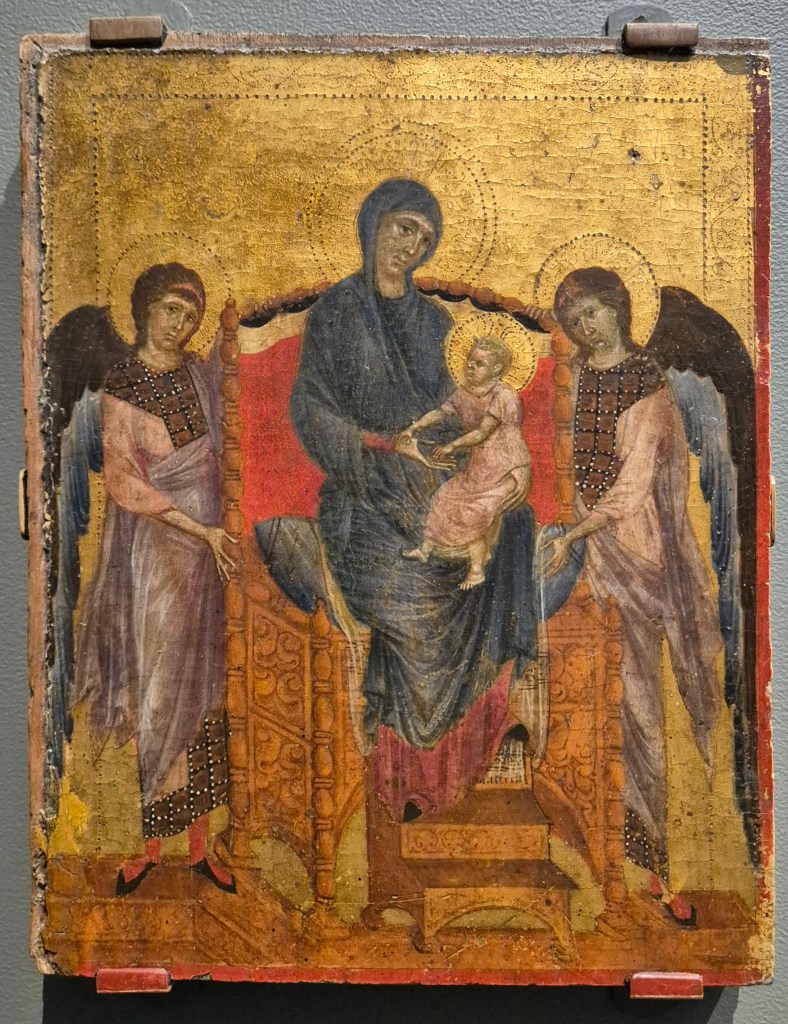
It’s pretty much the same, you might think, if a bit brighter (the NG’s file is oddly dark, but that’s not the problem). If compare the left and right edges you will see that they are different, as are the top and bottom – but you might have noticed that from the details already. Both the left and top edges are framed by a thin strip of wood, and the gilded, or painted surface of the pictorial field curves up slightly towards the edge – a lip, or bur, which denotes that the image was painted on a wooden panel with an engaged frame. This means that the frame had already been attached before either the painting or gilding took place. As part of the process of painting, the right-angled join between the frame and the flat panel would then have been filled in slightly with gesso and then paint, or gold leaf. This ‘infill’ has survived even after the removal of the original frame. The right and bottom edges, on the other hand, have a painted red border. There is no sense that there was an engaged frame on these two sides – which implies that this little image was originally part of a larger panel. It was probably not unlike this painting by Barnaba da Modena, painted in 1374, which also belongs to the National Gallery.
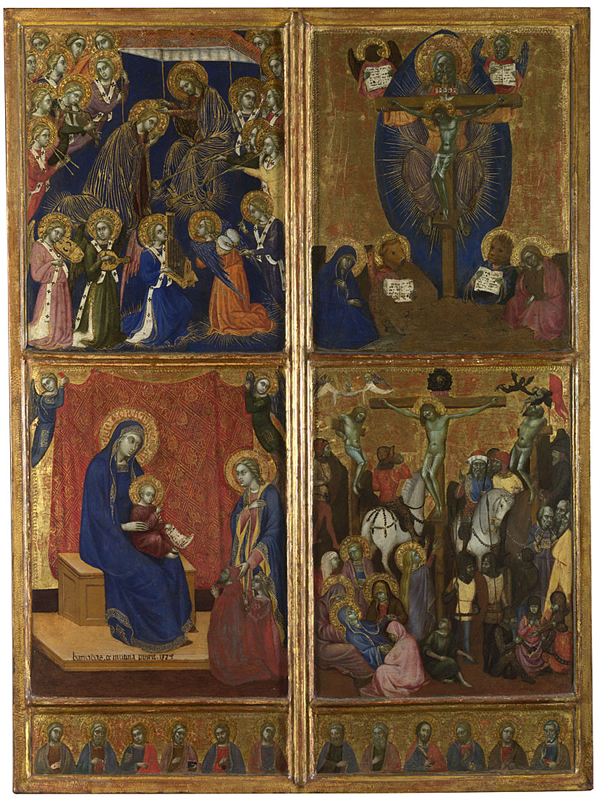
This still has its engaged frame. A similar, three-dimensional element also divides the separate images on the panel – whereas the Cimabue panel used the red borders to divide the different images. The photographic file for the Barnaba da Modena gives the painting a better idea of its structure as a solid object, and even has a thin white border, although you can’t see that against the white background. However, the file for the Cimabue (at the very top of the post) has been trimmed to make a nice tidy picture without any asymmetry or rough edges, implying that the Virgin and Child was painted as an image in and of itself, which it was not: it was part of something else. With the top and left edges being framed, it must have been at the top left corner of a panel – in the equivalent position to Barnaba’s Coronation of the Virgin at the top left of his panel. As it happens, two other sections of Cimabue’s panel have survived and one of them was recently acquisition by the Louvre. This was one of the reasons why they staged their exhibition this year: it was the first time it had been exhibited publicly. However, if you’d like to know more about the other two paintings, and how they fit together, you will have to join me on Monday!
 dr richard stemp
I
LikeLike