267 – From A – Z: All about Zorn
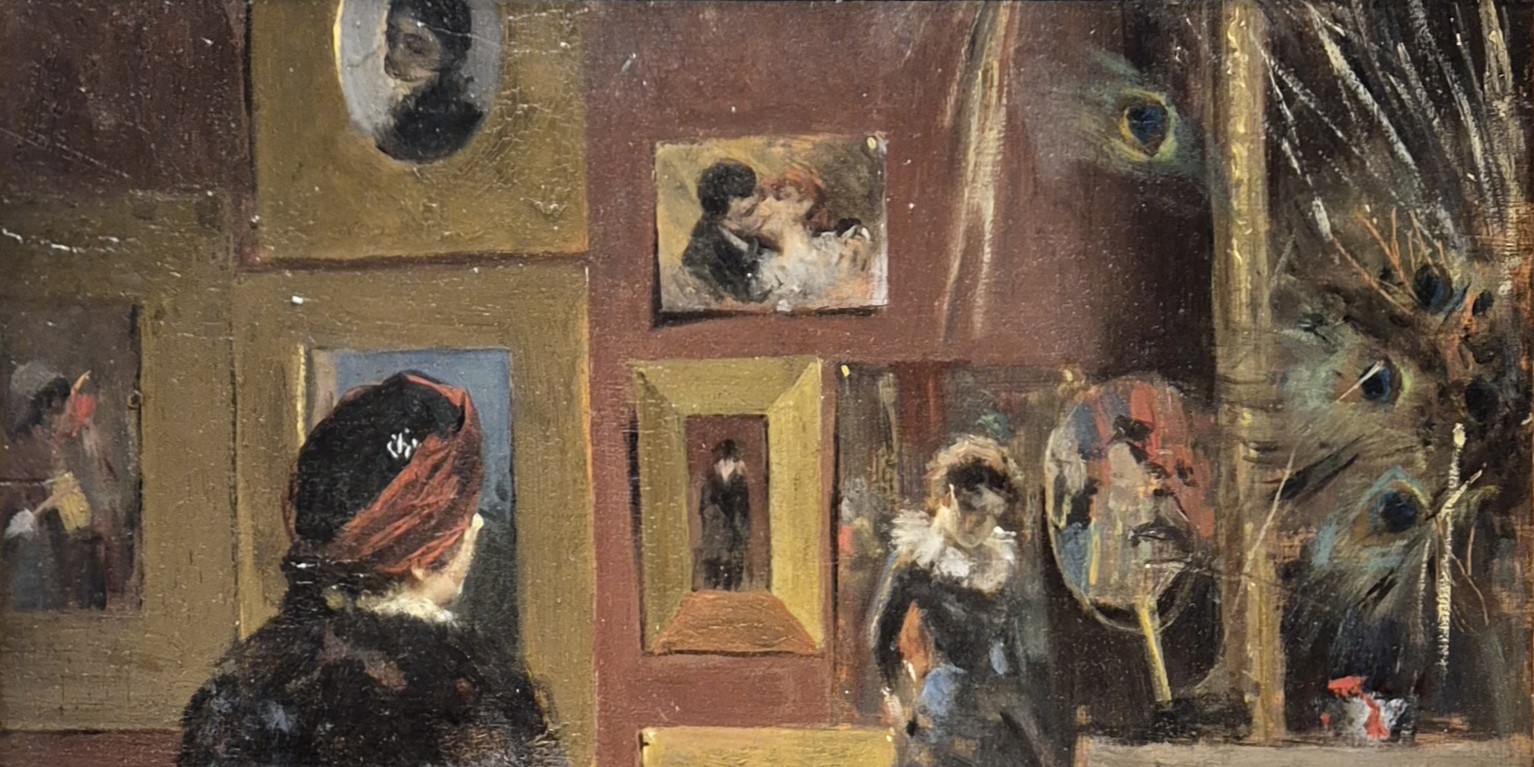
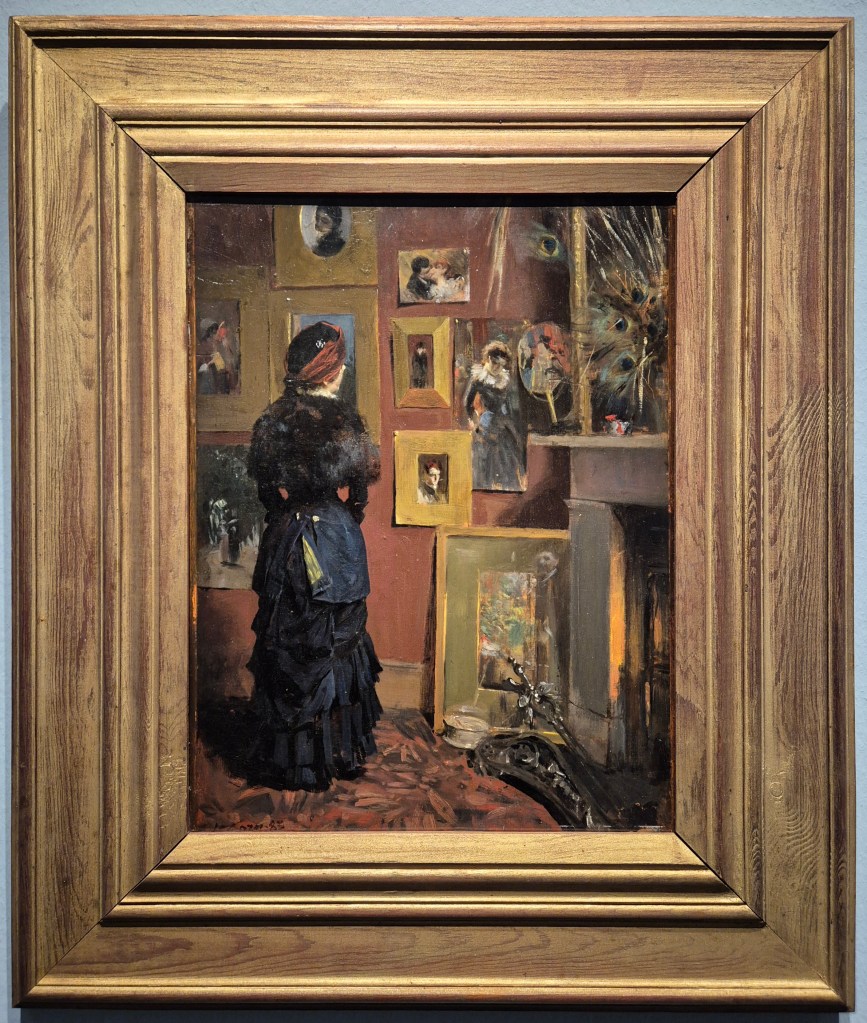
Anders Zorn, Zorn’s London Studio on Brook Street, 1883. Zornmuseet, Mora.
I would love to say that I planned this, but I really didn’t. Last week I was talking about Anna Ancher, who was born on 18 August 1859, and this week I’m moving on exactly 6 months, to Anders Zorn, born on 18 February 1860. Both Scandinavian, they were born far from the capital of their respective countries, Denmark and Sweden, but both trained in the capitals – Copenhagen and Stockholm – and both travelled widely… though few travelled as widely as Zorn. So today I’ve called the post ‘A – Z’, which you can read as Ancher to Zorn, or simply as the latter’s initials. This would make sense, given that I’m writing about a painting that, despite its female protagonist, is really all about Zorn. This Monday, 2 February at 6pm I will talk about the exhibition of his work that I saw in Hamburg a couple of weeks ago, which unfortunately has just closed. However, it is transferring to Madrid (19 February – 17 May) in what I believe will be substantially the same form, although with the addition of a subtitle: Anders Zorn – Travelling the World, Remembering the Land. If you like John Singer Sargent and/or Joaquín Sorolla I really recommend that you join me: Zorn’s work is every bit as colourful, exuberant, and painterly as theirs, and sits in the same area of ‘Realism influenced by Impressionism’ that they – and Anna Ancher – all inhabit. The following week, 9 February, I will look at The Barber in London, the paintings from the Barber Institute in Birmingham which, thanks to the refurbishment of their usual home, are currently on display at The Courtauld. The Barber really does have an astonishing array of masterpieces, including paintings I love by artists I don’t always like.
I’m then going to turn to two British artists who are often associated with portraiture, even though this was only really a minor interest. The first is Lucien Freud, who is being celebrated at the National Portrait Gallery with Drawing into Painting, the first exhibition to focus on his works on paper. I’ll introduce that exhibition on 23 February, and then on 2 March I will turn to William Nicholson. His work can currently be seen at the Pallant House Gallery in Chichester in the next of their superb series of exhibitions looking afresh at unjustly neglected British artists.
I’m entirely convinced that Anders Zorn was one of those artists who not only loved what he did, and never took a break, but who always knew exactly how to present himself. The result of this was that, from the very beginning of his career, people took him entirely seriously. Born in Mora, a little over 300km northwest of Stockholm, he studied at the Royal Swedish Academy of the Arts from 1875 – when he was only 15 – until 1880. He arrived intending to study sculpture, but before long switched to a focus on watercolour, at which he excelled – as we shall see on Monday.
At the Academy’s annual exhibition in 1880 he exhibited a watercolour called In Mourning to great acclaim, and he built on this success by producing several versions of the same subject in the following years. Along with the acclaim, the painting also brought numerous portrait commissions from local wealthy families. However, not satisfied with success at home, he decided to try the international market, and headed to London in 1882. This could so easily be the story of an ambitious young artist (he was still only 22) starving in a garret, but it really isn’t – far from it. He got in touch with the Swedish Embassy to be assured of some good contacts, and after a few months in Richmond, he took an apartment in Brook Street in the heart of Mayfair. He also ordered expensive suits, tasteful calling cards and quality furniture, setting himself up with all the appearance of a successful artist, even if he hadn’t yet had the time for a career. By doing this, though, he was able to present himself as exactly the right, classy, artistic outsider that the great and the good of London would seek out in order to be portrayed. He might have chosen Paris, which was considered the ‘centre of the art world’ at the end of the 19th Century, but he headed to London because it was in England that watercolour first became a Fine Art rather than just a desirable accomplishment for amateurs – thanks to Turner as much as anyone – and he wanted to hone his craft. It is Zorn’s position in London that is celebrated in today’s painting.
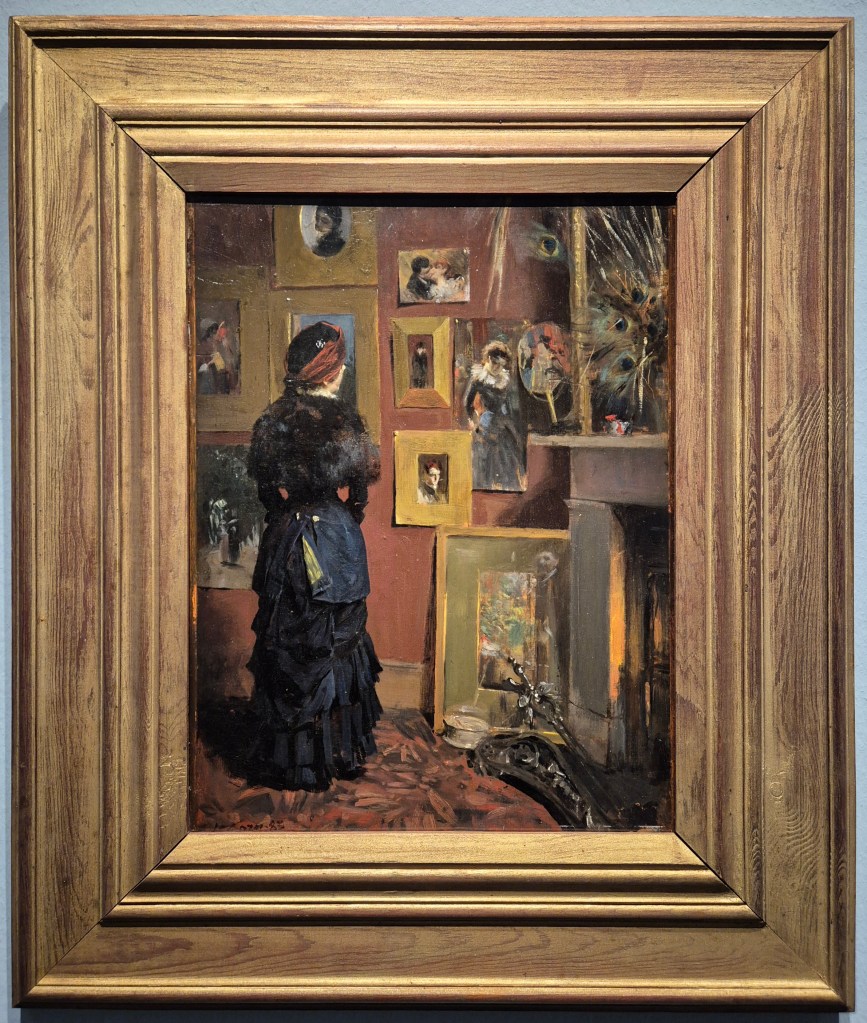
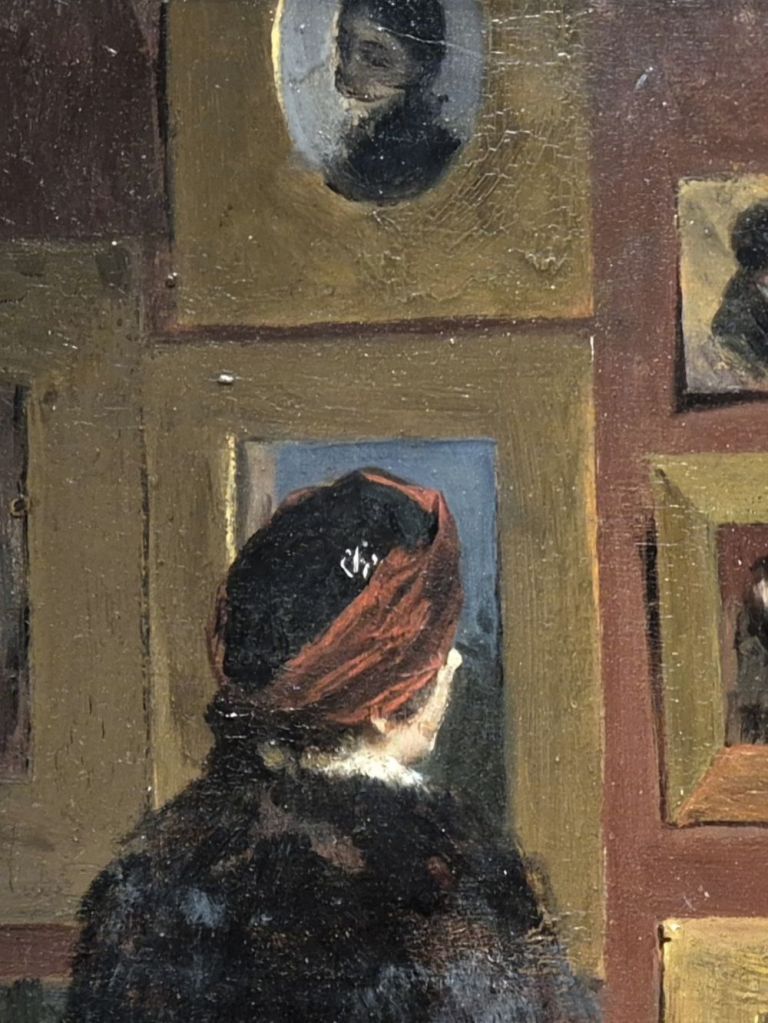
At first glance it might not appear to be about Zorn at all – even if we can assume, given the title (Zorn’s London Studio on Brook Street), that this woman has come to look at Zorn’s paintings. We could also assume that all the images in this room are by the Swedish artist – however, there is one exception. It is a well-appointed room – richly decorated with brick red walls and a fitted carpet patterned with brick red and black. We don’t see any of the ‘quality furniture’ I mentioned above, but there is a warm glow coming from the fire, so there is no economising on fuel. Given that the top of the frame of the highest exhibited painting is not visible, we can also tell that there is a high ceiling. This is a large room, warm and comfortably appointed: Zorn shows us that his lifestyle is very far from the romantic idea of a starving young artist. He also shows us how productive he is. Even in this corner of the room nine of his works can be seen, framed or unframed, on the wall or on the floor. A fashionably-dressed woman, clad in black, has arrived to look at the work, and is standing with her back to us, looking to her right so we just see her face, her gaze encouraging us too to look at the pictures on display – she is, effectively, a repoussoir.
These are all details from photos I took in Hamburg, and sometimes the lighting is not ideal. In places you can see light reflecting off the textured oil paint. Details like this are a reminder that, despite being a two dimensional art form, a painting is, in itself, a solid, three dimensional object. This fact is often disguised by official, ‘professional’ photographs. Although Zorn truly was a master of watercolour, the art-loving public would expect to see oil paintings from any self-respecting master. However, this is oil on wood – an oddly old-fashioned support for the 19th century – and this might reflect Zorn’s relative inexperience with the oil medium. Wood provides a harder, less flexible surface, and so it can be useful for painting small details: this isn’t a large work (38.9 x 29.6 cm).
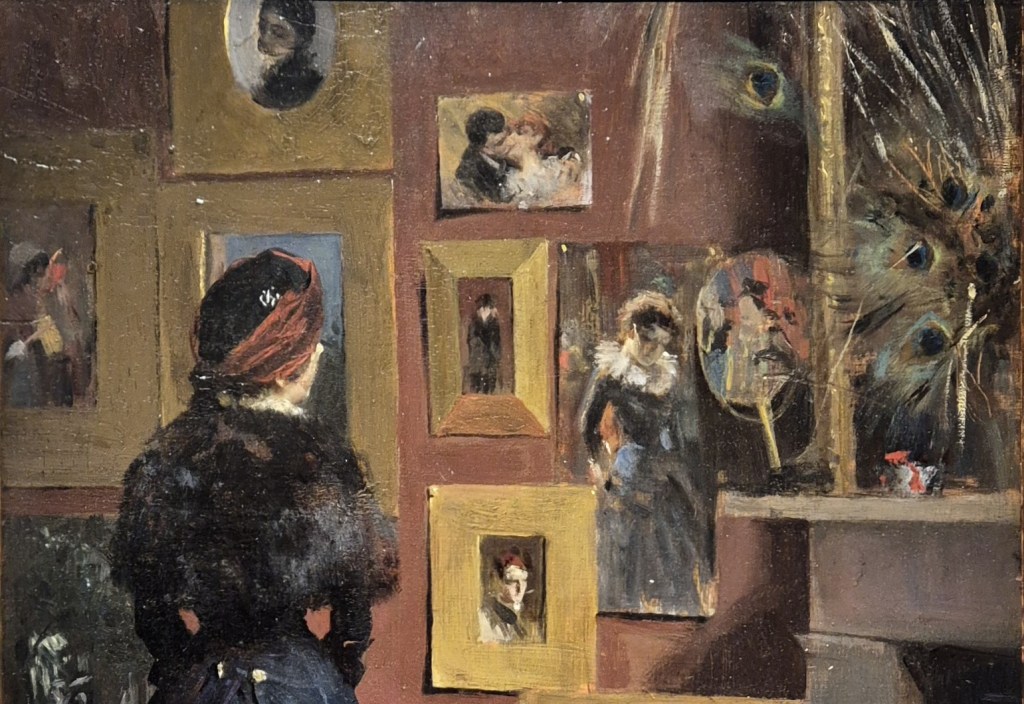
The woman wears a black hat with a very broad maroon ribbon wrapped around it – or a headdress that is mainly built up from this ribbon (…I’m not a milliner!). Her head is beautifully framed by a painting in a flat, broad, gilded frame, and painted sky can be seen around her hat. The ‘profil perdu’ – or lost profile – stands out brightly against what is probably dark vegetation in one of Zorn’s many early landscapes. The visiting woman is looking at a painting of another woman, who also wears a black dress, but with a large white collar, almost like a ruff. This painting is not framed, and two white dots in the top left and right corners tell us that it is a watercolour, on paper, which is pinned to the wall. Two other images have been placed over it. The bottom left corner is covered by another broad, flat, rectangular frame, containing an image of a young man (probably…) looking down. The top right of the watercolour has a Japanese fan (… or at least a Japanese-style fan) propped in front of it. This is the one image I mentioned that is not by Zorn. It shows him to be a member of the avant garde: artists such as Whistler, and others in the Aesthetic Movement, who were strongly influenced by Japanese art. The peacock feathers which are in front of what I assume is a mirror are another feature connecting Zorn to the latest trends in British art: the Aesthetes would swoon.
Sitting on the mantelpiece is a small white box with a red ribbon: little flashes of red like this are almost a signature motif for Zorn. If we tone this colour down to the maroon of the woman’s hat, we can see the same colour echoed across the painting. It is used on the fan, in the watercolour (between the woman’s wasp waist and her arm), and in the painting on the far left. It isn’t that different to the brick red colour of the wall, all of which adds to the sense of a warm, harmonious setting. At the top of the painting is an oval image in a flat, gold frame. It shows a veiled woman looking down to our left. Anyone who knew Zorn’s work – or his reputation – would have heard about this painting. You have too: I mentioned it above.
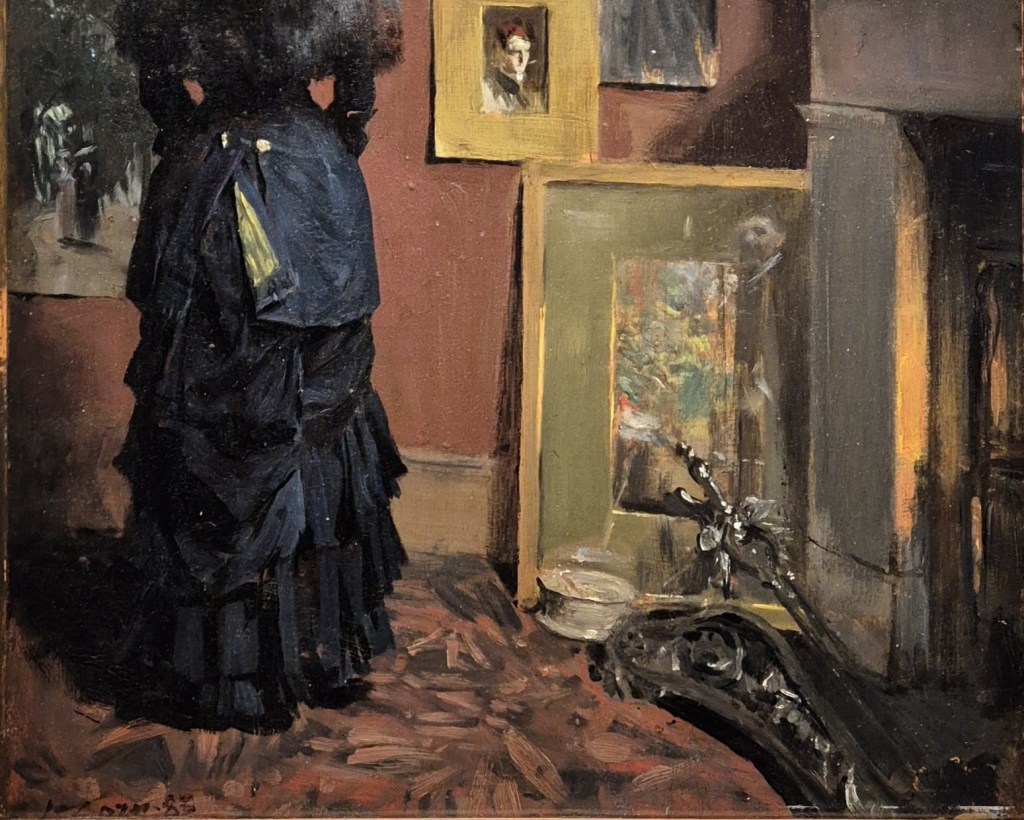
In the lower half, there is another watercolour pinned to the wall. As far as I can see it shows two women walking arm in arm, the one on our left wearing a long lavender-taupe skirt, and on our right a long black dress and a broad, pale-coloured hat. She may also have a furled umbrella over her arm… Light comes into the studio from a window behind us, to the right, and casts the visiting woman’s shadow onto the patterned carpet – the pattern built up over black with short, painterly strokes of the brick red paint. The woman’s outfit includes a cinched black jacket, which falls below the hips, vented at the back. There are two yellow buttons at the top of the vent, one side of which is turned back to reveal a yellow lining. The skirt is gathered beneath a form of tail, which hangs down below a bustle, and there are two more layers of the skirt further down (and yes, I know as little about describing dresses as I do about hats). The painting of the young man appears to look down towards the fire, and beneath it is a narrow, portrait-format painting which is probably also a watercolour. It has a broad, olive-coloured mount (usually used for works on paper) and a narrow frame, and, judging by the sheens of pale paint which cover the surface, it is also glazed. The greens and yellows in this painting – together with a splash of red – suggest that it is an image of a garden. There are some fire irons lying on the floor in front of this framed, glazed watercolour, and they lead our eye into the room from the bottom right corner of the painting. The glow of the fire, illuminating the interior of the fireplace and the edge of the mantel, is a deliberate contrast with the daylight shining into the room. The framed watercolour, resting on the floor, casts a shadow on the wall. I think Zorn is showing off his ability to paint different types of light, even in these small details.
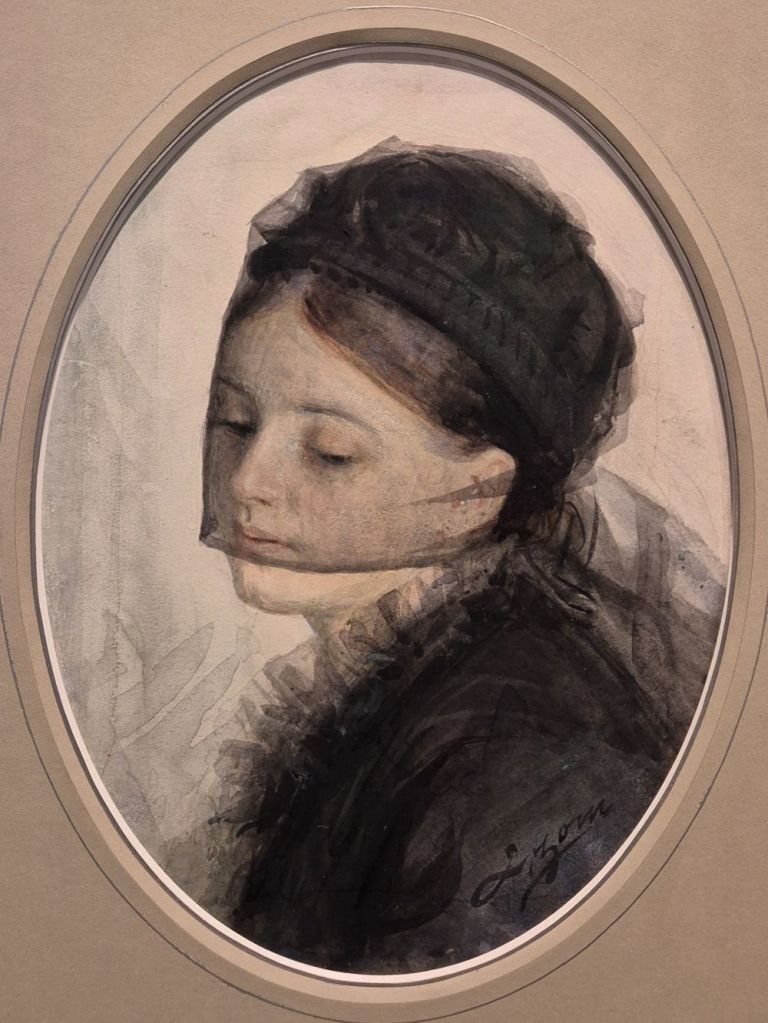
The painting at the top that I said people would have known about is none other than In Mourning, the watercolour that made Zorn’s name at the Royal Swedish Academy of the Arts in 1880. The one depicted in the studio is presumably one of the later versions which he is using as a form of calling card in London. The version on the right is the one I saw in Hamburg – the original – which now belongs to the Nationalmuseum in Stockholm. What won people over was the extreme delicacy of the depiction – both in terms of technique and emotional involvement. Particularly admired was the transparency of the veil: extraordinary skill for someone who was only just graduating. Zorn’s ability to articulate the subject’s neck is also commendable. Not only is her head tilted to her left, but also twisted round towards us slightly. As a result, as she looks down, she appears to be looking at the ground in between us and her – a modest, averted gaze meant to disguise the extremity of her loss, but which, artistically speaking, also encourages empathy in the viewer. The gossamer collar is another remarkably virtuosic detail, while the broad wash of colour, in bold strokes at the bottom left, is a clear reminder that this is a painting – a performance of skill. For his whole career Zorn’s paintings are always performative: he is always reminding you precisely how brilliant he is, although in an entirely charming way.
However, the idea that the woman In Mourning is looking at the floor in between us is determined by the context, when we are only looking at her. Where does she appear to be looking when hung high on the wall in Zorn’s studio?
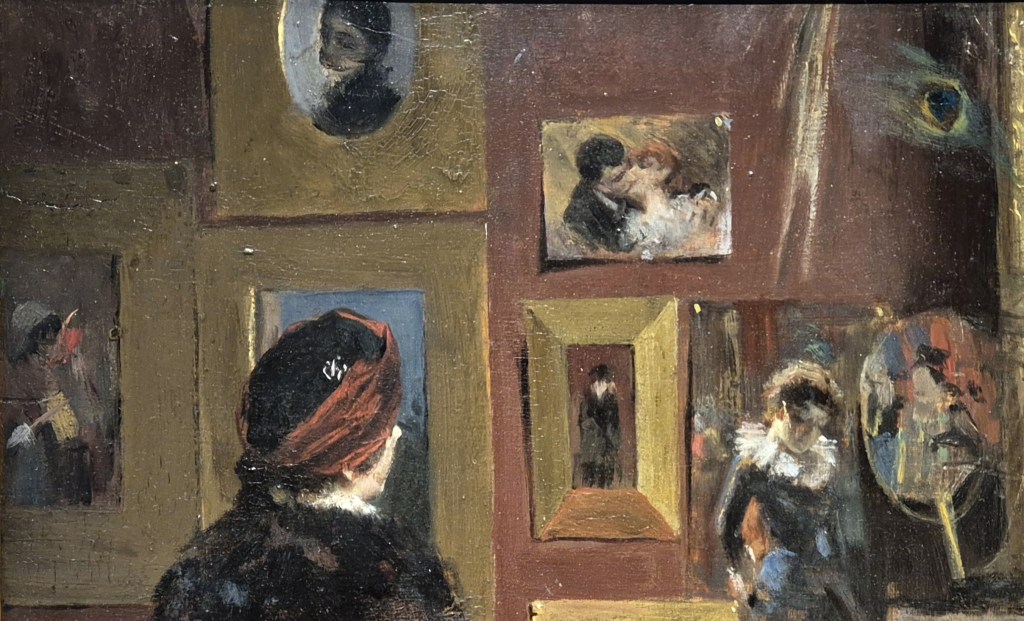
I am entirely convinced that he has set up a trail, a series of shared glances to lead our eye around the painting. In the small oil version we cannot see the position of the mourning woman’s eyes, but the position of her head suggests that she is looking towards the painting below her to the left. There are flashes of red and yellow in this latter painting, which make me think that it is one of the images painted during his first visit to Spain at the age of 21. It appears to show a woman looking to our right – so effectively towards the visitor in the studio. The visitor is also looking to our right, at the woman with the large white collar in the watercolour, who is looking down. It’s not just the visitor looking at her: the figure in the Japanese fan is facing to our left, and so also looking at the woman with the white collar. The latter’s neck is strongly tilted downwards, as are her eyes – as if she were looking towards her feet.
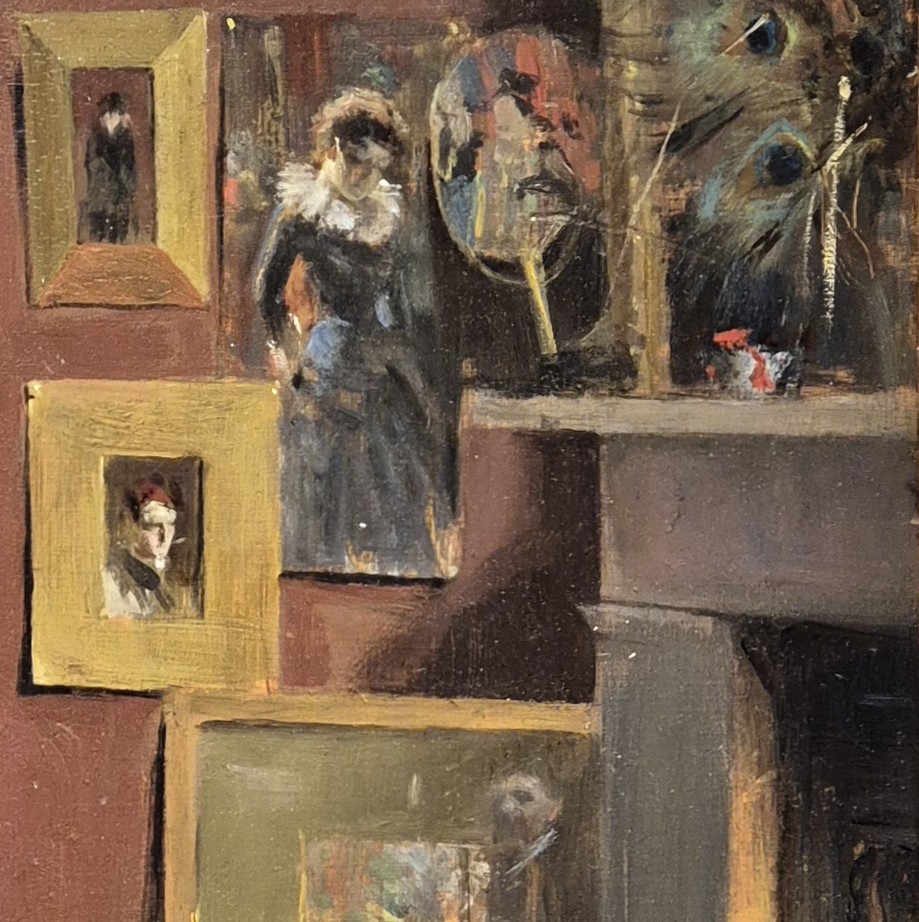
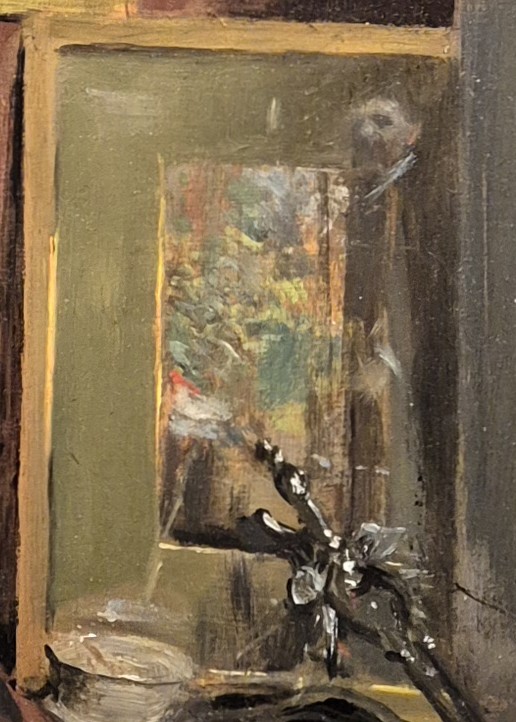
In the broader context she could even be looking at the painting below her – as could the young man in the small, framed image, who I previously suggested was looking towards the fire. If we follow their gazes we can see another face – but it isn’t a face in a painting: it appears in front of the olive mount, and so must be one of the reflections in the glass.
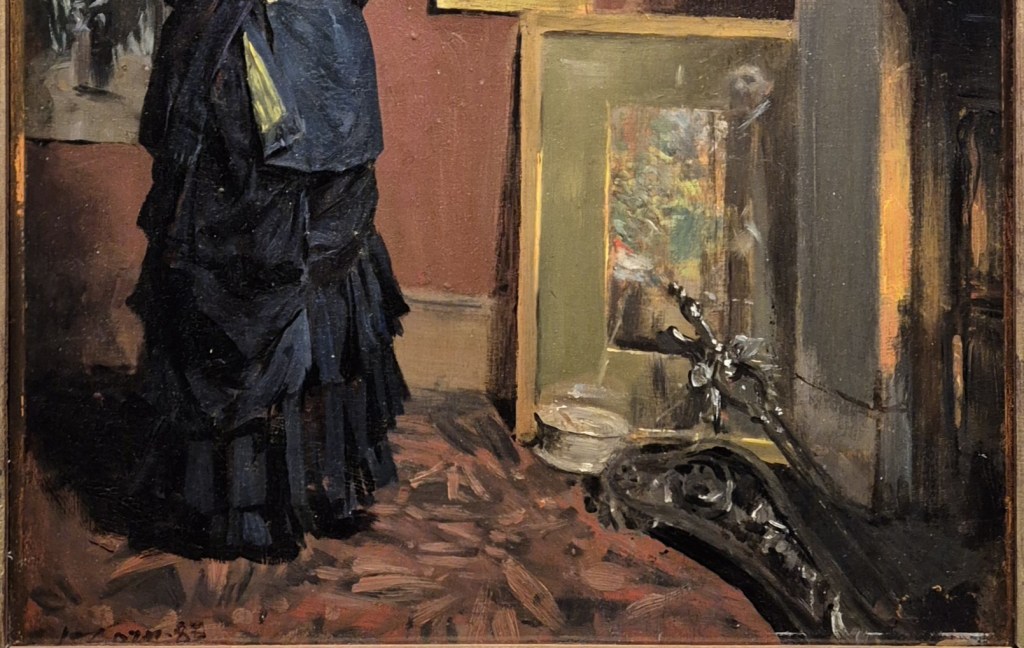
It is, in fact, a full-length reflection of a man in a dark suit with a white collar. His hair is dark, and his eyes are seen as pools of dark shadow. The edge of his nose catches the light, but his mouth also appears to be shadowed: it looks like he has a moustache – as Zorn did. Half-way down the right-hand edge of the garden scene we can see the reflection of a hand and a bright flash of white cuff. Who else could it be but Anders Zorn, watching over the visitor’s shoulder, offering information and advice, on hand to take a commission to make her look just like the woman with the large white collar? The fire irons lead our eyes into the painting, yes, but specifically they lead us to the glazed image bearing the reflection of the artist, a self portrait which is effectively looking out towards us. The fire irons lead us to his image, and they are balanced in the bottom left hand corner by his name, the signature on the patterned carpet. This really is all about Zorn – his studio, his works, his image, his name… his visitor.
His technique is superb, his understanding of the craft unparallelled, and his ability to promote himself, frankly, second to none. If In Mourning was the starting point of his career – the ‘A’, if you like, then ‘B’ is for Brook Street. On Monday we will see the rest of the journey, taking us all the way to the ‘Z’ for Zorn.
 dr richard stemp
I loved this – especially the reveal at the end! A classic!
LikeLiked by 1 person
Isn’t it great! Such a fabulous artist – why hasn’t there been an exhibition of his work in the UK? Or has there, and I haven’t done my research?!
LikeLike
Very good!
LikeLiked by 1 person
Will you be covering the Zorn palette and examples of it’s application?
LikeLike
No, I’m afraid not – as it happens this particular talk will be about the exhibition that was recently on in Hamburg. A broad brushstroke introduction…
LikeLiked by 1 person