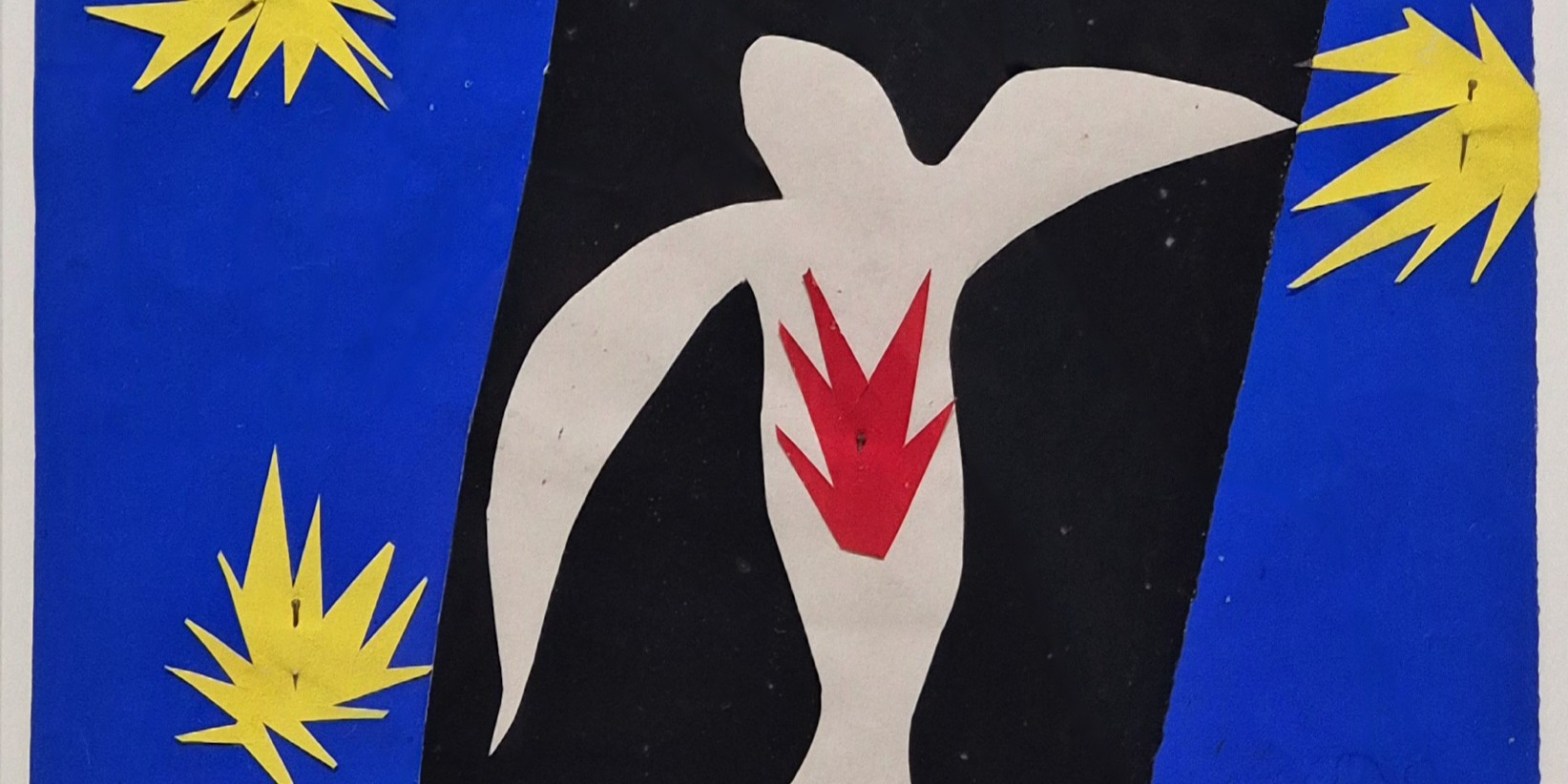
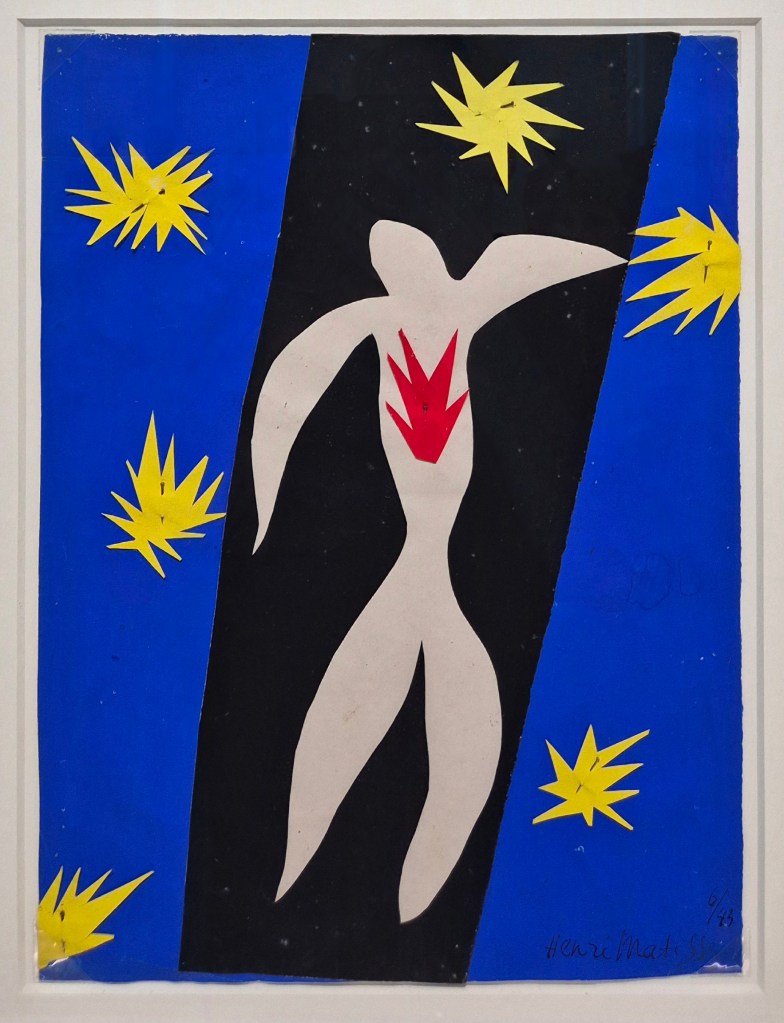
Henri Matisse, The Fall of Icarus, 1943. Private collection.
You know when someone says, ‘I’m having one of those weeks’? Well, that’s me. For a while I even thought I would have to postpone Monday’s talk, Matisse because on Tuesday night (well, Wednesday morning) at about 12:30am my laptop locked me out. However, I got it back from the laptop hospital today after some delay, I’m giving it all the tender love and care it deserves, and I will get it fit and ready for this Monday, 22 June at 6pm… I blame the British Museum, but that’s another story.
By the following week, 29 June, I will be more relaxed, and ready to unravel the tangle of threads that link May Morris, the Reading Bayeux, and the Post-Pre-Raphaelites. This will cover two exhibitions on the Wirral, where I live, and my recent work on the Bayeux tapestry (yes, I’m still blaming the British Museum) which have all fortuitously coincided: this talk will be the result. Expect fantastic paintings, skilful embroidery, and even wonderful wallpaper. I will then return to Bayeux via David Hockney’s work inspired by the tapestry, A Year in Normandie, on 6 July. I planned this before the news of his passing, and now, of course, it will be more of a retrospective than I had imagined. What a remarkable career! Details of these talks are on the diary, of course, and I will add more as I pin them down.
(In case you’re wondering why I blame the British Museum – well, my laptop seems to have burnt out after spending over 12 hours in the queue to book tickets to see the Bayeux Tapestry this coming September. At least I’ll be going. And I will probably have paid for the repairs by then… I’m going to dedicated at least two talks to it in October, if not three: that depends on how much ‘exhibition’ surrounds the tapestry itself. And no, it’s not a tapestry…)
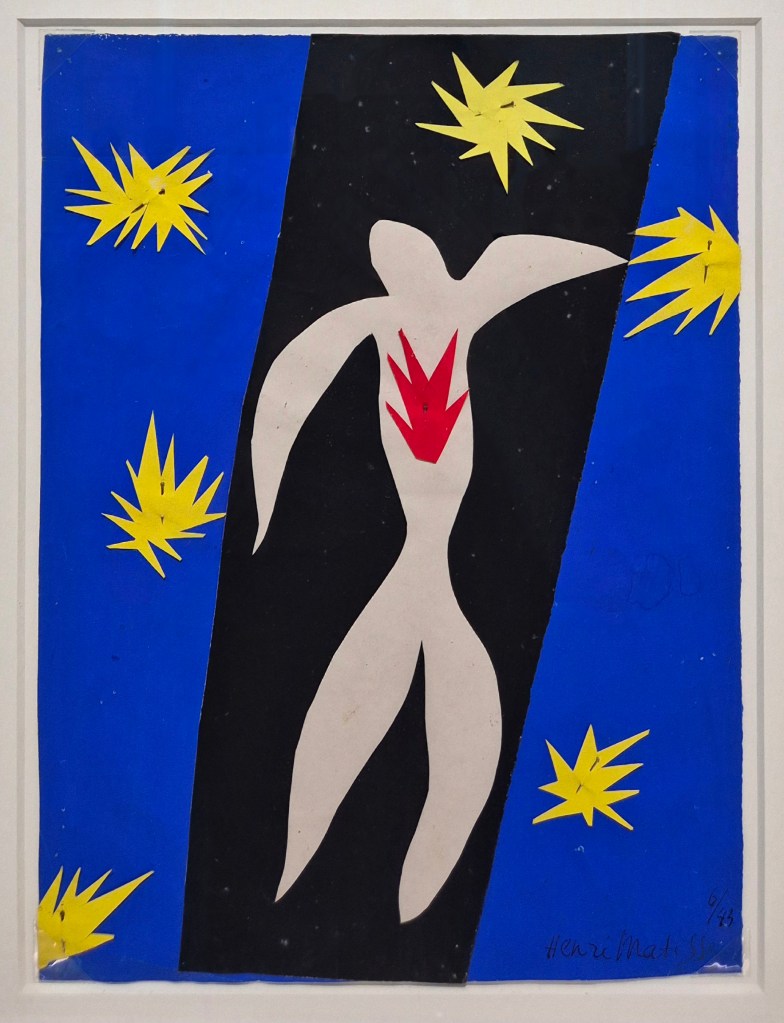
Two and a half weeks after his 71st Birthday, on 16 January 1941, Matisse had emergency surgery for cancer, which was followed by a post-operative pulmonary embolism – an operation that both saved his life and nearly killed him. Granted a ‘second life’, as he saw it, his outlook was unbelievably positive, and his work increasingly inventive. The example I want to think about today was one of the early examples of his paper cut-outs – in many ways an entirely new way of creating imagery – but we’ll discuss that further on Monday. Against an intense blue sky, dotted with sharp, angular stars, a white body appears suspended against a black diagonal. A burst of red appears in front of the figure’s chest. The work is named after the classical myth in which Daedalus and his son Icarus escape from prison by flying, using wings made of wax and feathers made by Daedalus himself. Failing to heed his father’s warnings, Icarus flies too close to the sun, the wax melts, the wings fail, and he plummets to his death. The black diagonal gradually tapers from top to bottom, the only thing that indicates the downward motion – apart, perhaps, from the upward splash of red. The blackness is almost the negative of a spotlight, or searchlight: rather than illuminating the most important figure, it casts him into a void, making his white form shine out against the darkness, darker even than the blue of the night sky.
Matisse called this work The Fall of Icarus, but, as ever, it isn’t that simple. To mention the most obvious things, there are no hints of either wings or feathers, and the myth makes no mention of Icarus being injured as he fell, although I can only assume that the red is blood spurting from his chest. Let’s look more closely, though, to get a better understanding of what this is.
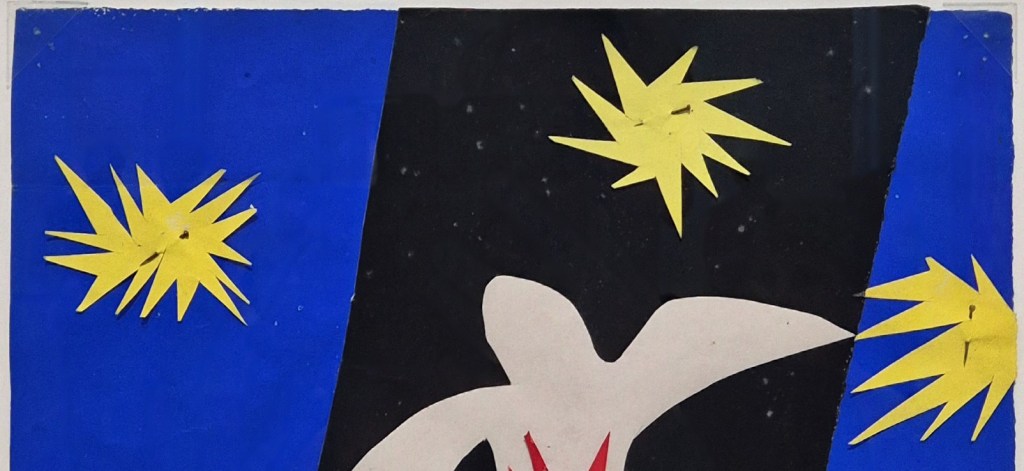
Ceçi n’est pas un collage – to misquote René Magritte. This is not a collage. ‘Collage’ comes from the French word coller, ‘to stick’, or colle, ‘glue’, and refers to an image made from elements that have been made, or sourced from elsewhere, which are brought together and stuck on the same surface. But not everything here is stuck down: the stars, and the splash of red, are held in place with pins. In English we call Matisse’s innovative late works ‘paper cut-outs’, whereas in French they are ‘gouaches découpées’ – cut-out gouaches. White paper was prepared with gouache – an opaque, water-based paint (sometimes called body colour, or more recently ‘opaque watercolour’) – and the shapes cut from that. From then on, the work could be very flexible. Matisse would move the shapes around, pinning them in place, then rearrange them until he was happy with the composition. He might pin them onto other pieces of gouache-prepared paper, as he has here – you can see the pins quite clearly, I hope – or he might pin them to the wall. The next day he might rearrange the motifs again, or remove some altogether. Later they might be used in a completely different composition. However, this transient and fluid way of working was not the most sturdy, and eventually, for the purpose of exhibiting the works, most of the ‘finished’ cut-outs were glued down – for purely practical reasons – and later also mounted on canvas, which made them easier to handle. Today’s image is one of very few that still has at least some of its pins. As a result it maintains some of its spontaneity, not to mention its three-dimensional form. Notice how the ends of the beams shining from the star on the left lift away from the paper, and cast shadows. There is a sense of flexibility, the possibility of change, and potentially, even, movement. If breezes were to blow across the image, the stars would twinkle in the sky. There are also marks in the intense colour of the background where pins have been inserted and then removed. These subtle punctures reveal traces of earlier compositions, the ghosts of potential artworks. What we see is an image that evolved across time, and what we are looking at is only one of its possibilities.
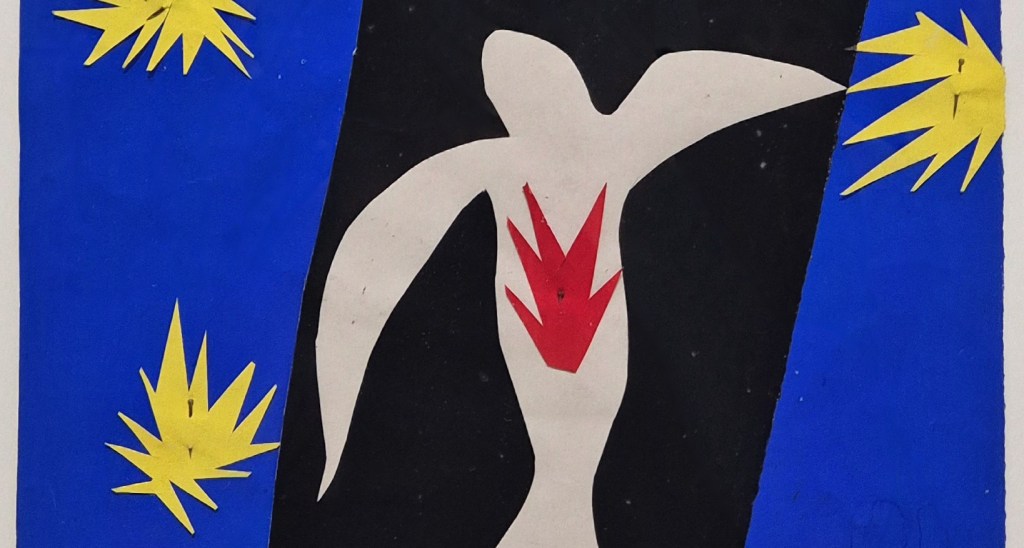
Much of Matisse’s concern was to simplify things as much as possible, and by simplifying them, to get to their essence. We read this as a human form simply because the arrangement of elements is so familiar: in this section we see a head and two arms. There is not much detail, though, partly because the shapes were cut with tools varying from large tailors’ shears, to smaller, more precise embroidery scissors. The lack of detail creates a sense of floundering, though: Icarus is not in control. The arms terminate not with hands and fingers, but with points, almost like flippers, which again gives a sense of helplessness. As I see it, Icarus is facing us – but only because I see the blood as spurting from a wound in his chest, as I mentioned above. However maybe, given how low the source is, it comes from the abdomen. This is not an abstract image – it clearly represents a human body – but it is, at least, abstracted, and with abstraction, the precise placement of every form becomes even more important. The curve of the right arm (on our left) never gets too close to the border between the black and the blue, and is comfortably surrounded by darkness. However, the tip of the left hand touches the edge of the black. Somehow this imbues it with a greater energy, even a sense of danger, which is only enhanced by its apparent contact with the twinkling star.
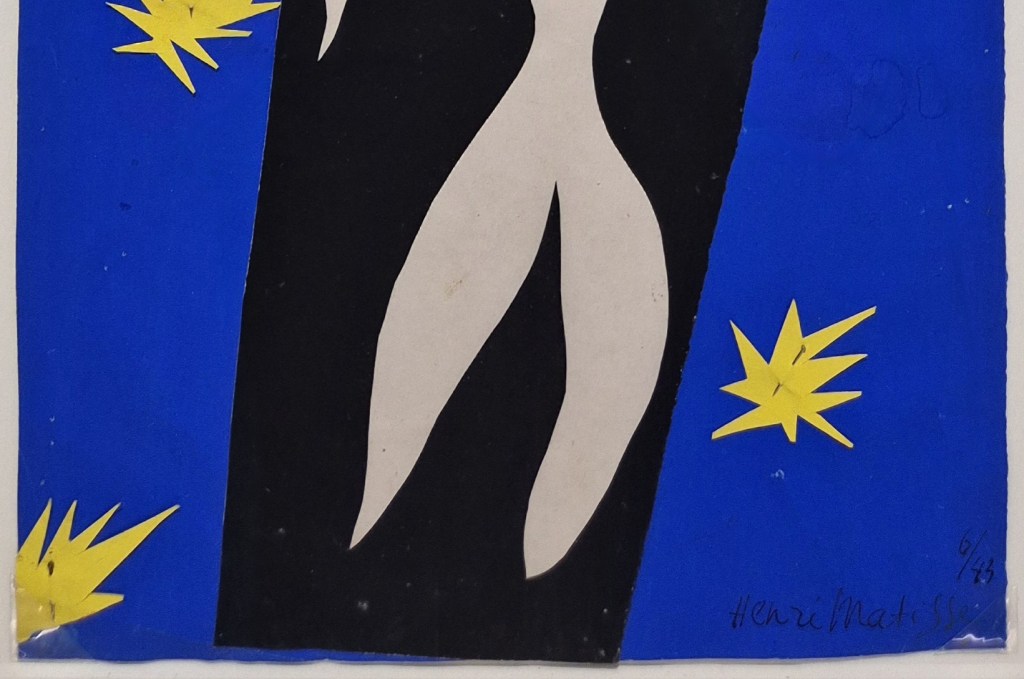
Matisse seems to enjoy how slim Icarus is, his torso curving to a narrow waist, then out again around the hips to very solid legs: his thighs are wider than his waist. At the bottom of the cut-out we get a wonderful sense of the physicality of the work. Rather than being stuck to the mount, or having a frame on top of it, cutting off the edges, the base, blue-coloured paper is held in place with transparent corner mounts, the sort that I have always thought of as photo corners. This allows the base to flex, and as a result it casts shadows on the white surface beneath. The black diagonal has been stuck onto the blue surface beneath – but it has not been trimmed to fit. It reveals a sliver of blue at its bottom left corner, whereas the bottom right projects over the edge. This emphasizes the physicality of the material, something which is all the more evident if we get just a little closer.
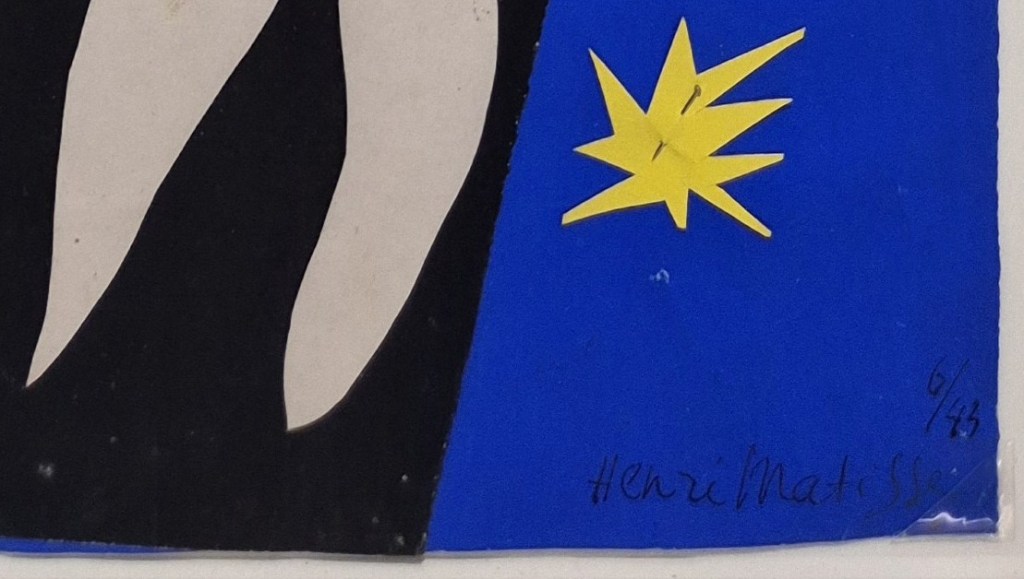
The projection of the corner of the black over the edge of the blue is clearer, I think, as are the shadows cast on the white background. There are small white dots in the corner of the black: these are the traces caused by the pins as Matisse shifted the black-painted section to find its most satisfactory position. The materiality of the pin in the star is also clearer, its head to the top right, the pinpoint at bottom left. The star wrinkles in the middle as a result of being pinned, and casts a thin line of shadow on itself. This physicality is one of the ways in which Matisse’s use of paper in the cut-outs is so different to traditional approaches. Most artists treat paper as a surface on which to draw or paint, whereas Matisse used each piece of painted paper as a three-dimensional object, material to be cut into and moulded. He even said that ‘cutting into colour reminds me of the sculptor’s direct carving’ – he is carving with paper. Rather than works on paper, like drawings or prints, the cut-outs are works of paper, incredibly thin sculptures.
We can also see his signature more clearly in the detail above: ‘Henri Matisse’, and just above the final ‘e’, ‘6/43’ – he made this work in June 1943. Starting from the very first issue, Matisse regularly provided illustrations for Verve, a journal published between 1937 and 1960 by the mononymic publisher Tériade. The Fall of Icarus was published as a lithograph in Verve, Volume IV, number 13 six years later. Here is a comparison between the original, which some would call a maquette, or ‘model’ (but that’s one of the things we will consider on Monday) and the published lithograph.
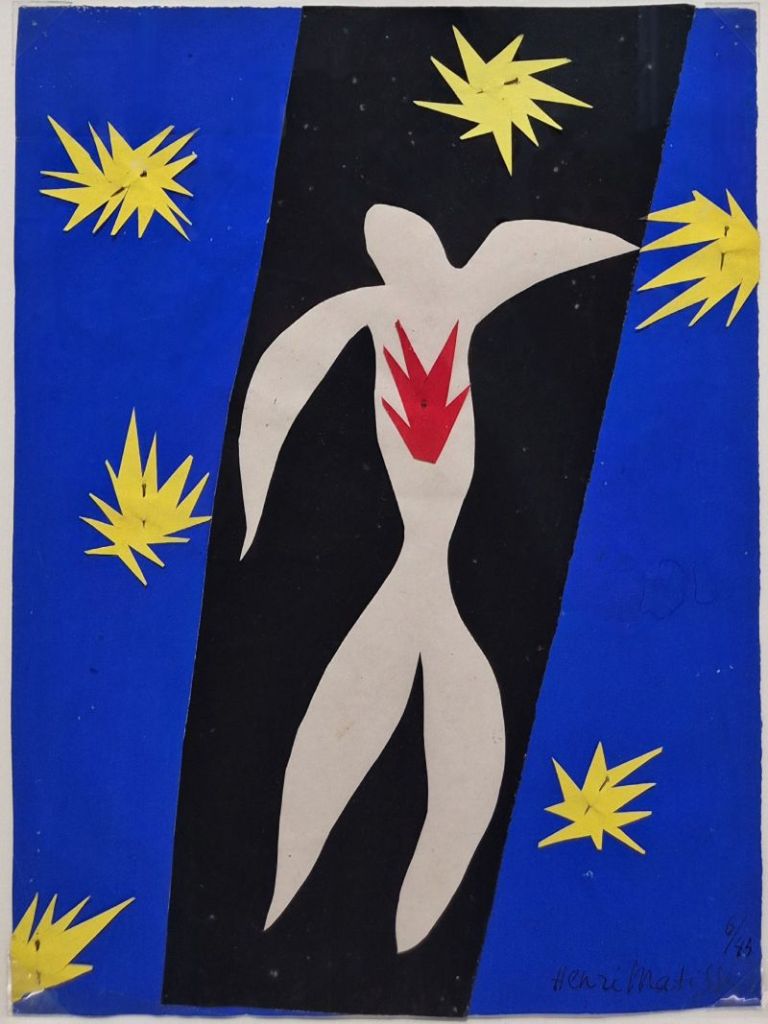
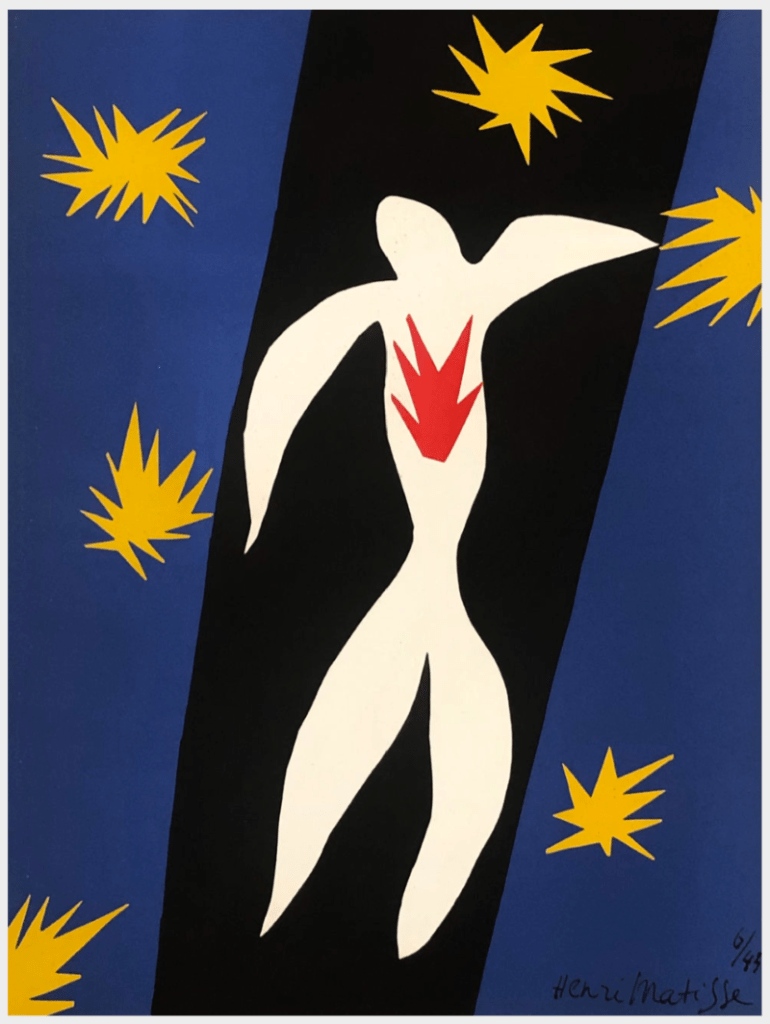
In the year that The Fall of Icarus was made and published Tériade managed to persuade Matisse to write a book about colour. It would take the name Jazz, and was eventually published in 1947, although most of the work was done in 1943. It was at this point that he really perfected the technique of the paper cut-outs. The colours were exactly the same in both the originals and the printed versions because the ink for the books used the same range of pigments as the gouache for the cut-outs (if they aren’t above, it is because the photos come from different sources). Nevertheless, Matisse was ambivalent about the printed versions, as they no longer had that three-dimensionality, or, for that matter, the possibility of change. They became fixed, slightly dead, like a butterfly pinned to a board… but I still think they look superb. As an Art History student at Cambridge I thought the pictures for Jazz were simply the best thing – and if you want to know more, one of my friends from those days, Louise Rogers, has written a fantastic book, Matisse: The Books – which of course, includes Jazz. Click on that link for more information.
But what about the title, The Fall of Icarus? Is this really an illustration of the myth? As ever – as we discovered last week (277 – How do you know that?) – context is everything. I’ve mentioned the dates of Matisse’s operation (1941), and of the execution of this cut-out (1943), and I’m sure you must have been wondering about both. What else was going on in the world, after all? It becomes slightly more obvious if we turn to another of Matisse’s associates, who, like Tériade, is usually known by only one name: the Surrealist poet Aragon. Writing about Matisse in 1971, he said that Icarus looked ‘like a corpse, and, from what Matisse said himself, it seems that the splashes of yellow—suns or stars if you want to be mythological—were exploding shells in 1943’. The Fall of Icarus was made in June 1943, nearly four years into the Second World War. Young men were regularly being shot out of the sky by shells, often wounded by machine guns… Is this the reason for the blood? Do the shells explain the sharpness and angularity of what we have read as stars? There is no reason to doubt it.
But – again, as ever – there probably is another layer. In January 1941 Matisse had been operated on for bowel cancer, and this was followed by a blood clot blocking his lungs. Is the image, perhaps, also a form of self portrait? The origin of the spurting blood – from the abdomen – might confirm this idea. Without wanting to belittle the possibility of its relationship to the war (and remember, I would always go for ‘and’ rather than ‘or’), a young airman falling tragically to his death does not have the same cause, or implications, as Icarus’ fate, the result of overweening self-confidence. Was Matisse worried that he himself was heading for a fall? Was he worried he might fail? One of the themes of Jazz is the circus, and one of the interpretations of Icarus – a version of which is included in the book – is that he is like a trapeze artist risking a fall, the stars being like spotlights in the big top… Matisse believed that, as an artist, you have to risk everything – like a trapeze artist defying gravity. And sometimes there isn’t a safety net. When they were first produced, the cut-outs were treated with scepticism, if not outright dismissal – but Matisse needn’t have worried. It was the audience that faltered, not him. Now they are seen as one of the triumphs in a remarkable career. Rather than falling, they are more like flying – which is exactly how he described the sensation of the scissors slicing through the painted paper.

