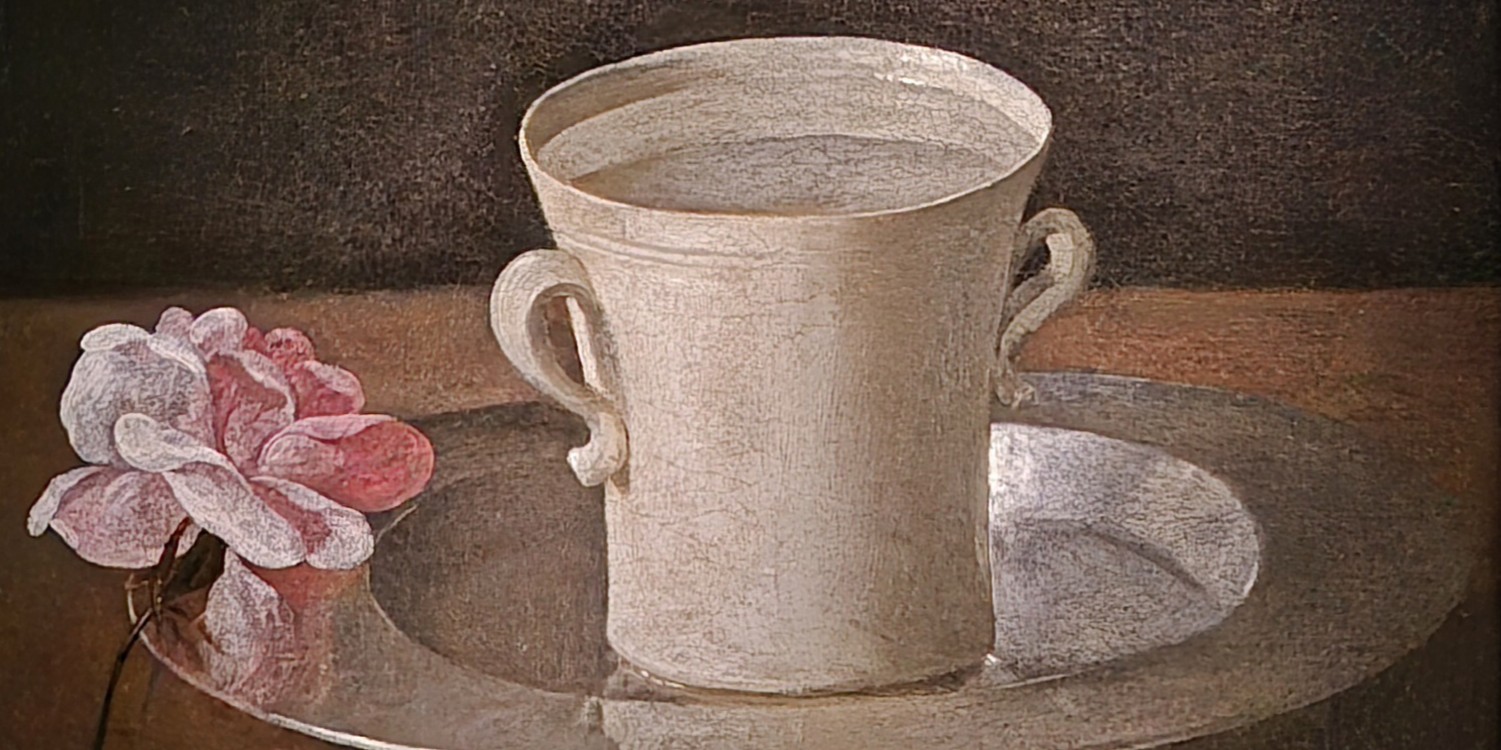
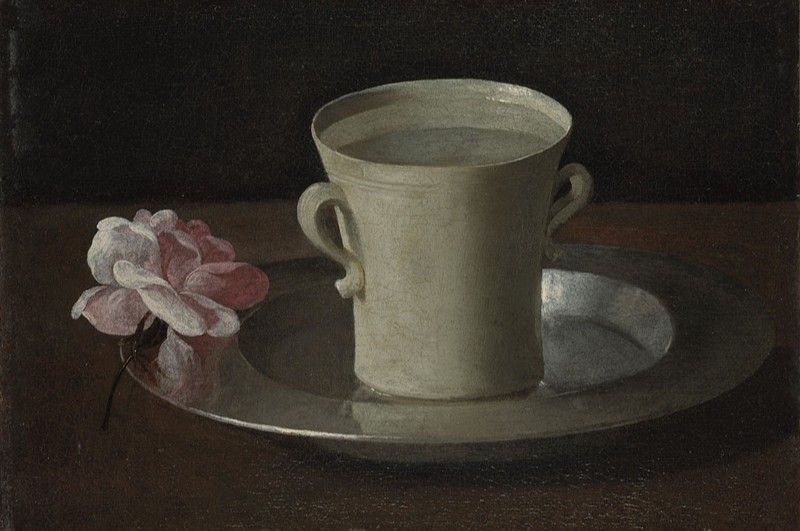
Francisco de Zurbarán, A Cup of Water and a Rose, about 1630. The National Gallery, London.
Zurbarán at the National Gallery has been open for some time, but I’m only just getting round to talking about it this Monday, 15 June at 6pm. There are various reasons for that, not least of which was preparing for what turned out to be a rather enjoyable visit to Strasbourg and Colmar with Artemisia – so enjoyable, in fact, that we are planning to repeat it next year in April (keep your eyes peeled for more information). Zurbarán is a fantastic show, with beautiful, striking, and occasionally surprising paintings – really one of those ‘not to be missed’ experiences. The following week (22 June) I will talk about the monumental exhibition Matisse: 1941-1954, currently at the Grand Palais in Paris. It charts the extraordinary productivity of the modern master’s final years. Far rather than going gently into that dark night – to misquote Dylan Thomas – Matisse created some of the most joyous, colourful and vibrant works of his long career, and, as well as other masterpieces, the exhibition includes many of the major cut-outs, from Jazz to The Snail, and even some examples of his stained glass.
The day after I talk about Zurbarán, Friends of the British Museum will be able to book tickets to see the Bayeux Tapestry, and tickets for others will go on sale on 1 July. On either side of the second of these dates my talks will also be looking forward to this momentous exhibition. On 29 June I will deliver a talk inspired by two exhibitions on the Wirral, at my two nearest museums. I’ve called it May Morris, the Reading Bayeux, and the Post-Pre-Raphaelites – but if you want to know how those things fit together you’ll have to click on the link! The week after (6 July), my second ‘Pre-Bayeux’ talk will be David Hockney: A Year in Normandie…, during which I will look back, in bullet-points, at his whole career from the perspective of the Bayeux-inspired frieze of the same name which is currently on show at Serpentine North in Hyde Park. Details are all in the diary, of course. And, in case you were wondering, I will be talking about the Tapestry itself, but probably not until October.
If you do book for any of these talks, Tixoom will send a confirmation, with a link, straight away. It should arrive within minutes, but if it hasn’t reached you by the next day – and if it’s not in your spam folder – then let me know: it would be easier to deal with it then than five minutes before the talk. Tixoom will then send you reminders 24 hours and 15 minutes before the talk, and both will include the link to join the talk. Of course, these might be delayed according to the efficiency of your own internet provider… but they will be on their way!
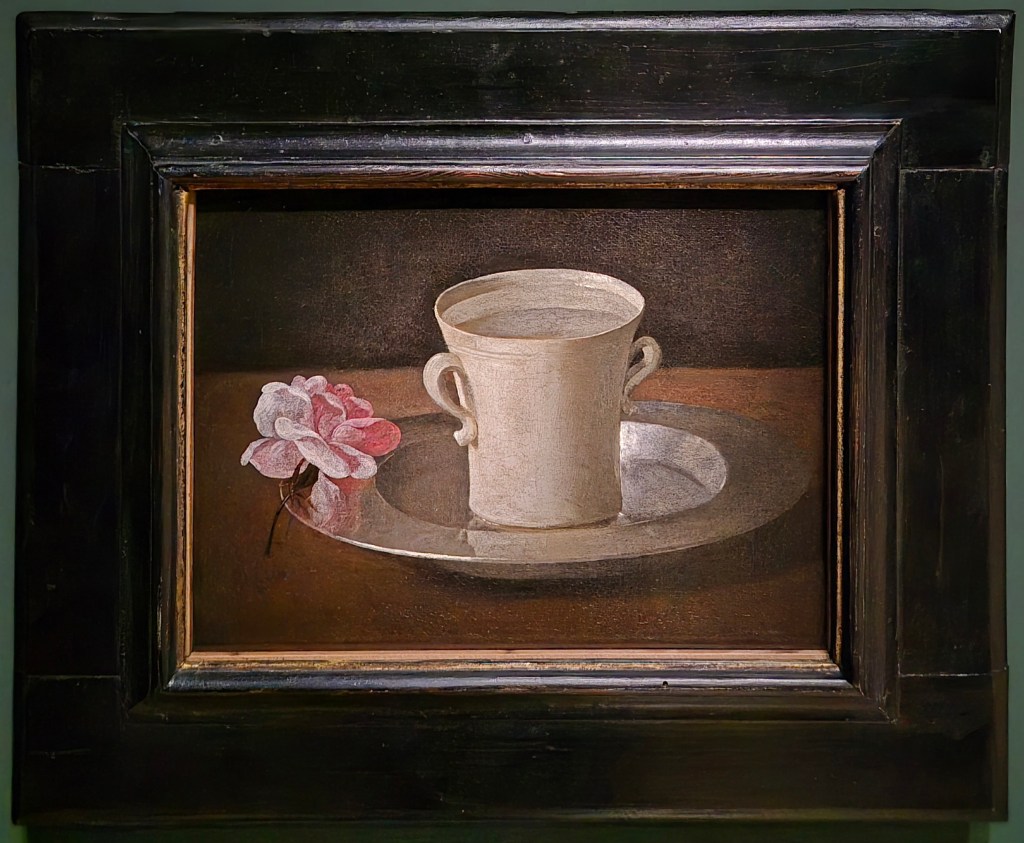
One of the questions I was asked most often over two decades of delivering guided tours to the general public at the National Gallery was ‘how do you know that?’ Admittedly there are times when I have to stop and ask myself the same question. There are ideas floating around in my head and I’m not always sure where they come from. Today’s painting is a good case in point, but one for which I can definitely answer the question. Although its title is entirely accurate – describing the painting as A Cup of Water and a Rose – it does not, as it might do, say that it is a Still Life – which it most certainly is. The title also doesn’t list every element of the composition: the silver plate, for example, or for that matter, the table, or shelf, on which the plate is resting. I suppose you could also mention the dark background. A ‘full’ title could be Still Life with a Cup of Water and a Rose on a silver plate on a shelf against a dark background. You can see why they only mention the two most important features. As I’ve said before, titles – for paintings prior to the 19th century at least – are most likely to be simple descriptions of what you can see – or at least, the most important elements of the composition, as is the case here. But maybe there is more to this painting than meets the eye.
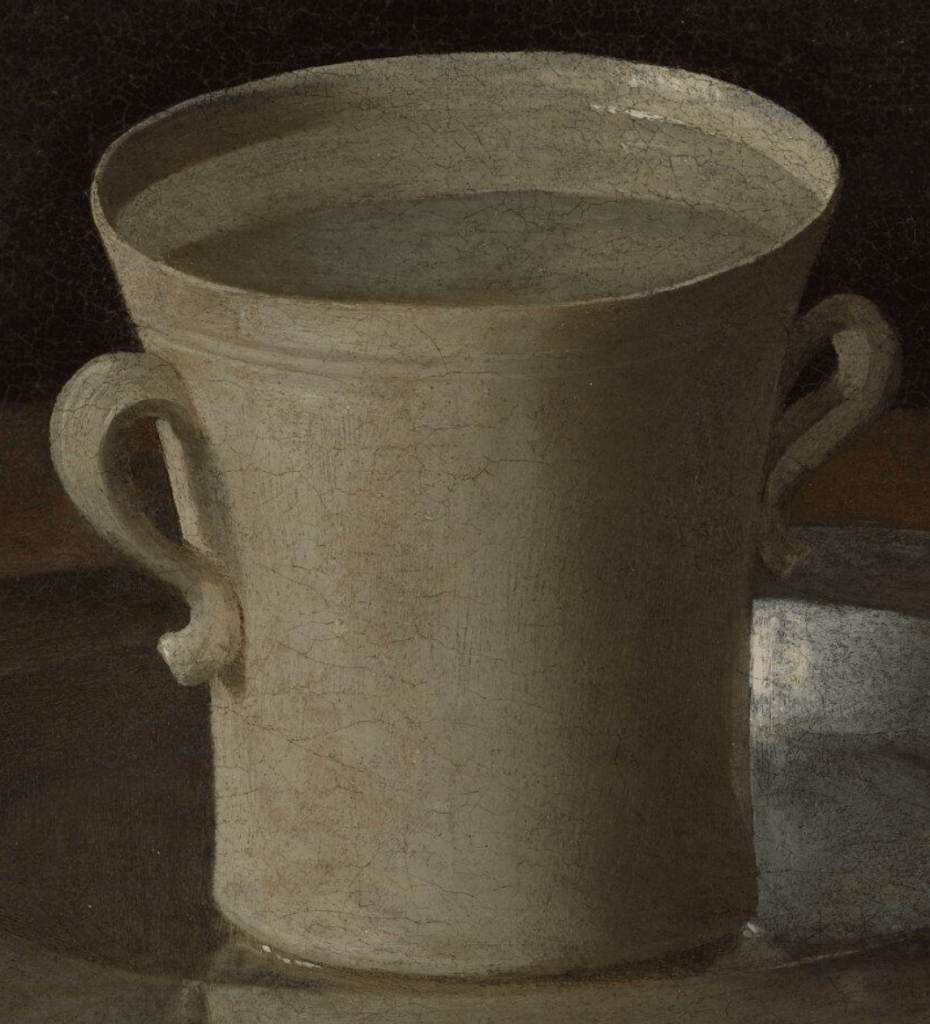
I’m using a couple of different digital files: this is a detail from the National Gallery’s website, the last photograph was my own. The cup of water is remarkably simple. Wonderfully thin, it flares from the circular base to its rim. Two slightly uneven handles are attached opposite one another, and two parallel grooves circle the top. Light comes from the left, so that the handle on the left casts a shadow between its two points of attachment. The transition from light to dark, which models the cup in three dimensions, falls vertically more or less half way across the cup.
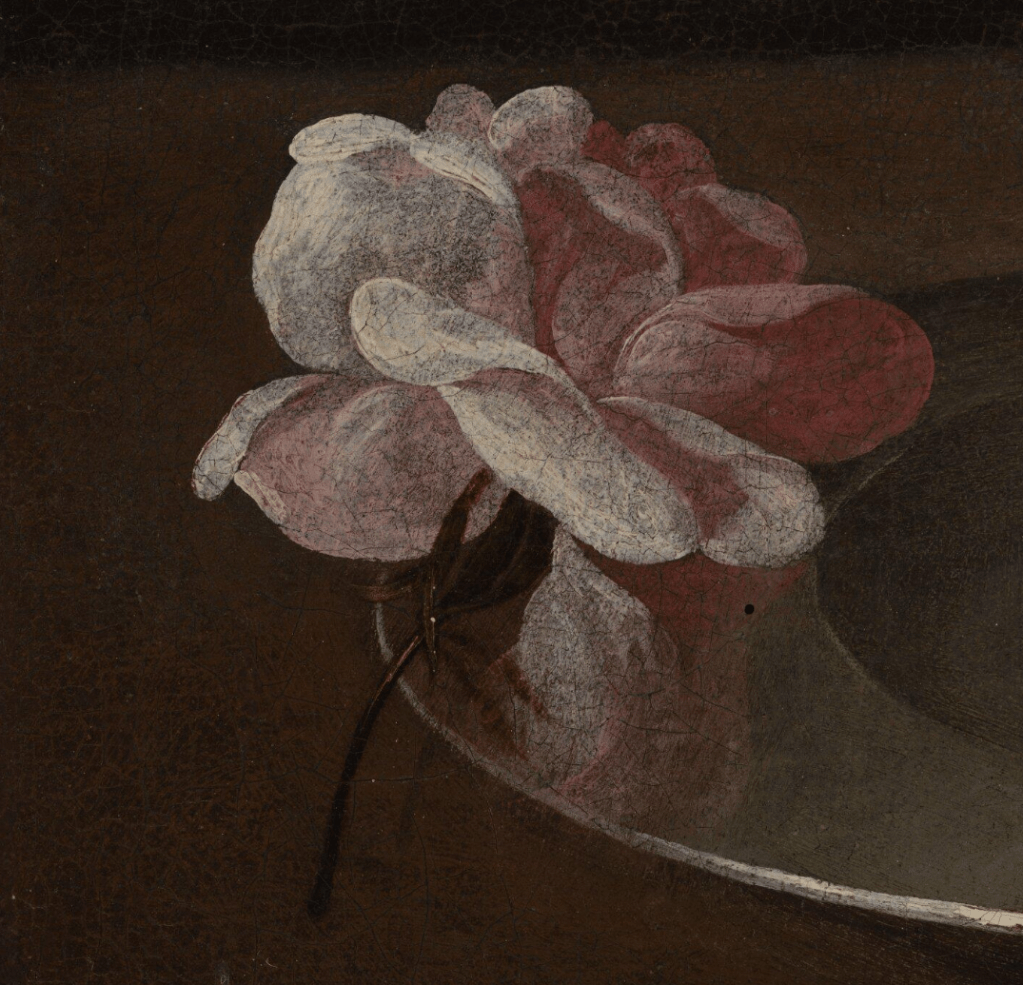
The rose’s outer petals, near the stem, are a pale pink, but deepen to a richer, deeper shade as they are more shadowed. We can see the reflection of the flower in the rim of the plate, and the sepals – the dark green, petal-like forms which originally formed the outside of the bud – appear at the bottom left of the blossom, curled out around the stem. Even at this resolution you should be able to see that the stem has no thorns – which tells us that this is a symbol of the Virgin Mary. ‘How do you know that?’, you may well ask. Well, I’m writing this post to answer that question.
For one thing, there are plenty of written sources that refer to Mary as rosa senza spina – ‘a rose without thorns’ – most notably St Ambrose, back in the 4th century. It refers to the fact that she was without sin. In Genesis 3:17-18 (yes, I know, I’ve quoted this before recently – see 275 – Then Mary gathered cherries), God rebukes Adam after the Fall, and tells him,
…cursed is the ground for thy sake; in sorrow shalt thou eat of it all the days of thy life; Thorns also and thistles shall it bring forth to thee; and thou shalt eat the herb of the field
Mary is like the rose, but without the thorns: beautiful, perfect, and with nothing bad. However, if this were the only painting in which this appeared, we might still be dubious that we had the right meaning. So often the conclusions we draw are based on context. If more than one artist paints the same thing, then there must be a reason – although admittedly sometimes it is a purely visual, aesthetic inspiration, using the form without its original function. As it happens, there are many thornless roses in western art. Wandering through the National Gallery a few weeks ago, I saw a painting that was unfamiliar to me, but only because it has only recently been loaned from a private collection. It is an Immaculate Conception by Alonso Cano, who studied with Francisco Pacheco in Seville alongside Diego Velázquez – so is more or less contemporary with Francisco de Zurbarán.
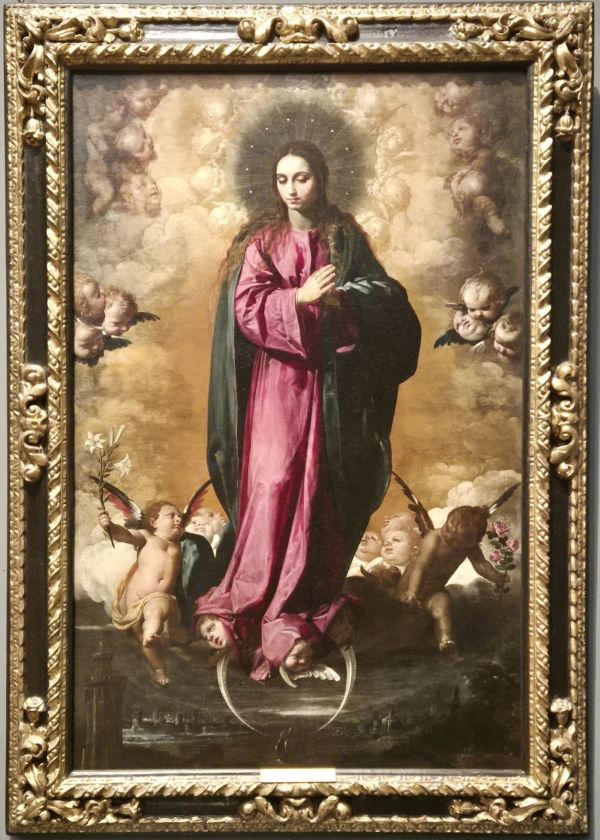
It was Cano’s master, Pacheco, who fully realised what became the standard iconography for the Immaculate Conception, frequently repeated in Spain in the 17th century. The image draws on the first verse of chapter 12 in the Book of Revelation:
And there appeared a great wonder in heaven; a woman clothed with the sun, and the moon under her feet, and upon her head a crown of twelve stars
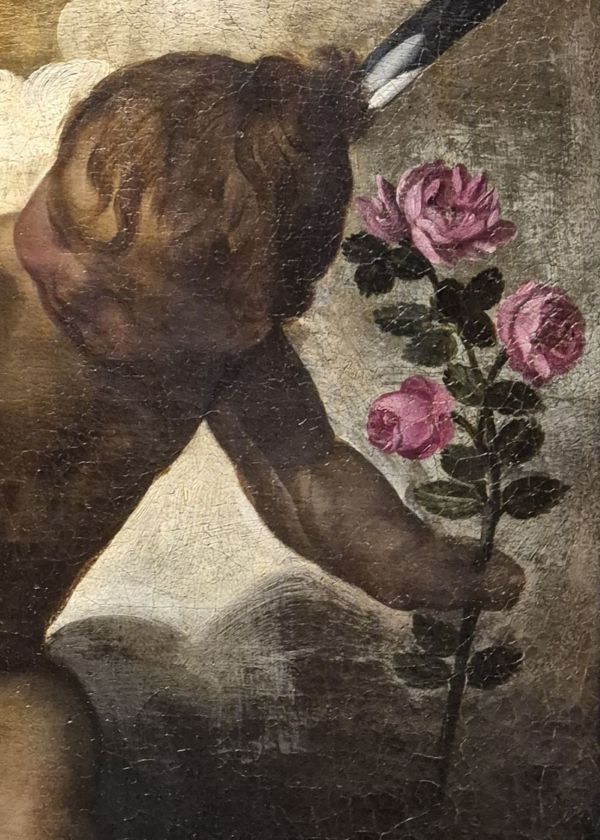
This verse had been interpreted as referring to Mary for centuries, and as early as the 15th century it had been used for some of the earliest images of the Virgin in her role as ‘the Immaculate’. However, it was Pacheco who formalised the swaying, full-length image, her hands held in prayer, that was so popular in Spain, and it was this model that Cano has followed. He has painted a crescent moon beneath the Virgin’s feet, and a golden glow to clothe her with the sun. The twelve stars (I can only see 10 here, but there is an 11th near her left shoulder, and the 12th must be behind her neck) appear at the edge of the dark circle of sky inside what could be interpreted as a halo of cherubic heads. Two other angels, with the bodies of children, appear on either side of her feet. The one to our left holds a white lily, which we all know refers to her purity and innocence, simply because it appears in so many paintings. The other angel holds a rose, the flowers the same colour as her dress (which connects it to her), and its stem without a thorn. The rosa senza spina occurs in enough paintings of the Virgin Mary that even without St Ambrose, we would know it referred to her. I’m not sure that we would also be able to work out that it refers specifically to her being in a state of grace (i.e. without sin) – although reference to Genesis 3:17-18 might be enough to get us that far too. So that’s how I know that the rose in Zurbarán’s Still Life refers to the Virgin Mary. And, as it does, maybe we should think about the other elements of the painting too. Let’s look back at the cup.
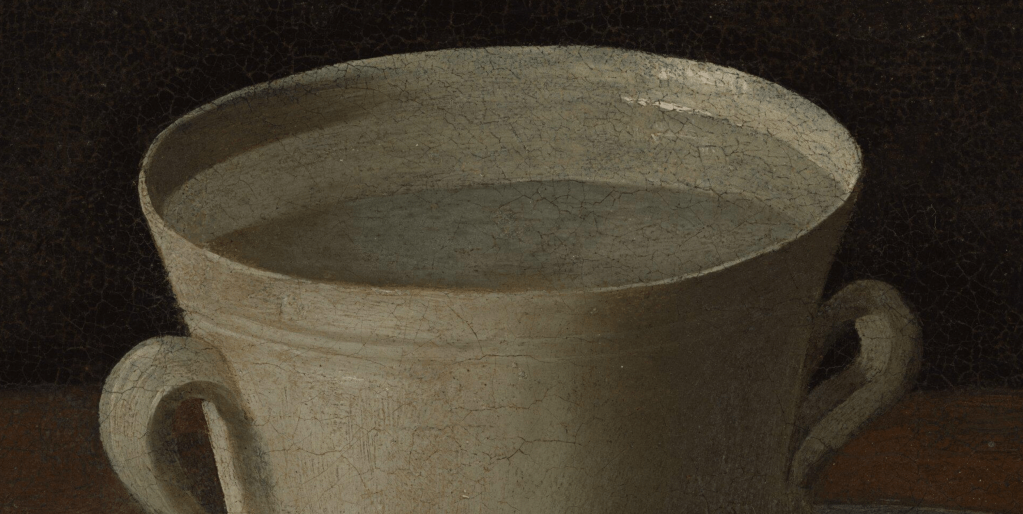
It is white: is that also a reference to Mary, and to her purity and innocence? Well, why not? After all, various bible texts are interpreted such that Jesus is referred to as ‘the water of life’. For example, in John 4:14, Jesus says ‘whosoever drinketh of the water that I shall give him shall never thirst; but the water that I shall give him shall be in him a well of water springing up into everlasting life’. So – this could represent the water of life contained within a pure white vessel, the Virgin Mary: during her pregnancy, she was, after all, a vessel ‘containing’ Jesus. In the Roman Catholic Litany of Loreto, Mary is invoked as Vas Honorabile, or ‘Vessel of Honour’. As it happens, the Litany also calls her Speculum Justitiae – ‘Mirror of Justice’, and elsewhere she is called speculum sine macula, ‘mirror without a stain’, a concept which derives from the Book of Wisdom 7:26, which was, inevitably, interpreted as a form of prophesy, foretelling Mary’s existence:
For she is the brightness of the everlasting light, the unspotted mirror of the power of God, and the image of his goodness.
Maybe the reflection in the water – the result of the water’s mirror-like surface, refers to this too. And if the water doesn’t, perhaps the plate does.
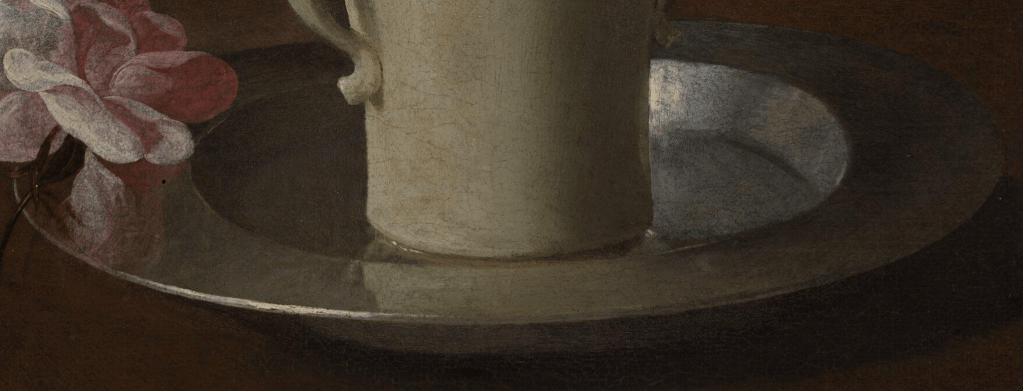
To be honest, I think you would be pushing it to claim that this plate is an ‘unspotted mirror’. The reflections are superbly painted, but they are more naturalistic than crystal clear. The sheen of the light on the back right rim contrasts strongly with darker side of the cup, adding to the sense of depth – and am I right in thinking that the glints of light under the cup to both left and right imply that there are drops of water there too? It is the most wondrous passage of painting. Even if it isn’t a ‘spotless mirror’, this plate does look remarkably like the sort of plate, or paten, used for the host (the wafers which are used as the bread during Mass). According to Catholic belief, during Mass the bread becomes the actual body of Christ, and as he is the water of life, and the water is on this plate, it might as well be a paten.
But I want to go back to the context of this painting. However, rather than thinking about it in relationship to other artists, I want to consider its context within Zurbarán’s own oeuvre. Here are two examples of him using the same detail.
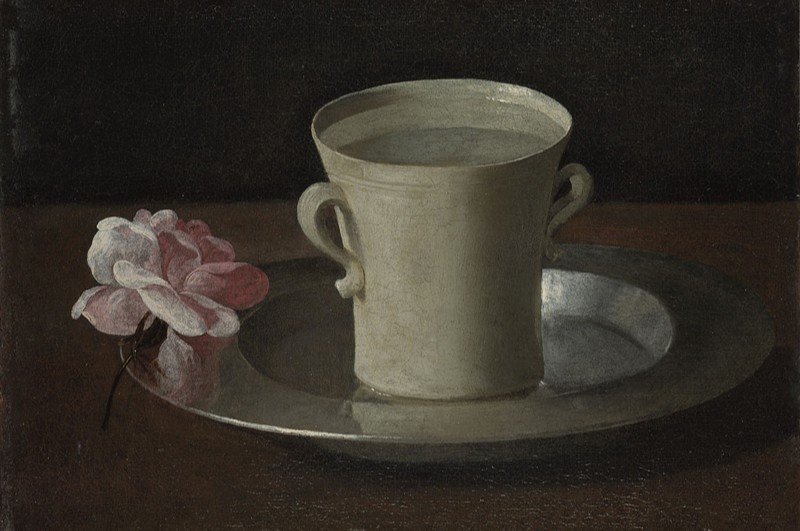
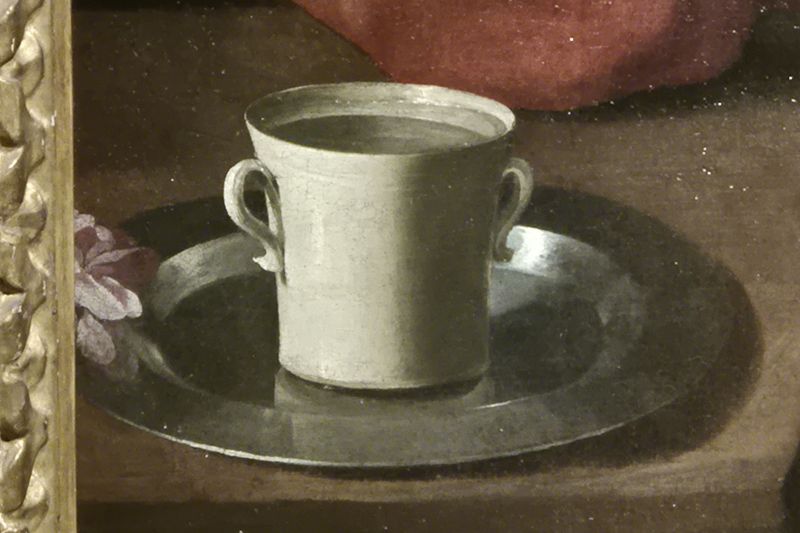
On the left is a slightly edited version of the National Gallery’s painting. On the right is a detail from another painting in the exhibition, The Family of the Virgin (about 1630), from the Abelló Collection. The details are not precisely the same, and curiously, on the right, the rose is cut off by the frame. It is possible that the painting has been cut down, although that is not mentioned in the catalogue of the exhibition. This is the rest of the painting, as seen recently in the National Gallery’s exhibition:
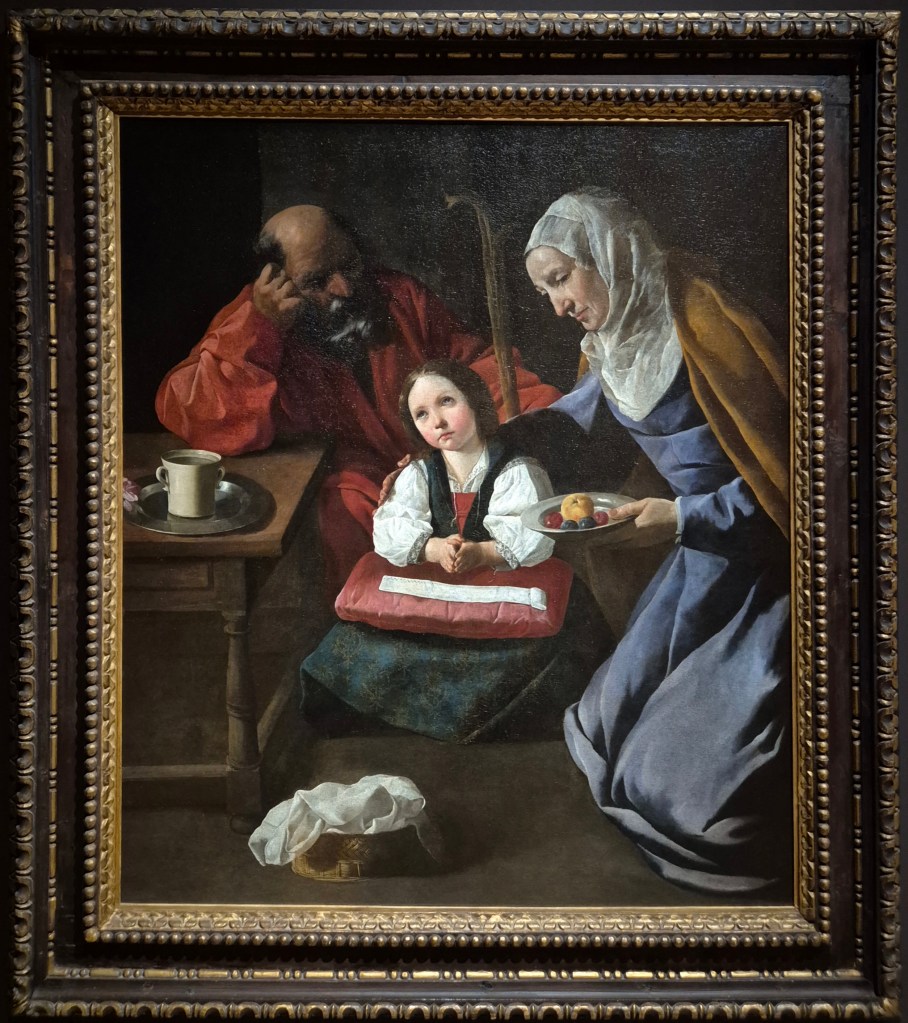
Mary sits in prayer between her parents Joachim and Anna. The plate, with the cup and rose, are sitting on a table at the left hand side. The presence of this motif in a painting which is about Mary confirms that Zurbarán associated it specifically with her. The same is true of another painting, which unfortunately is not in the exhibition.
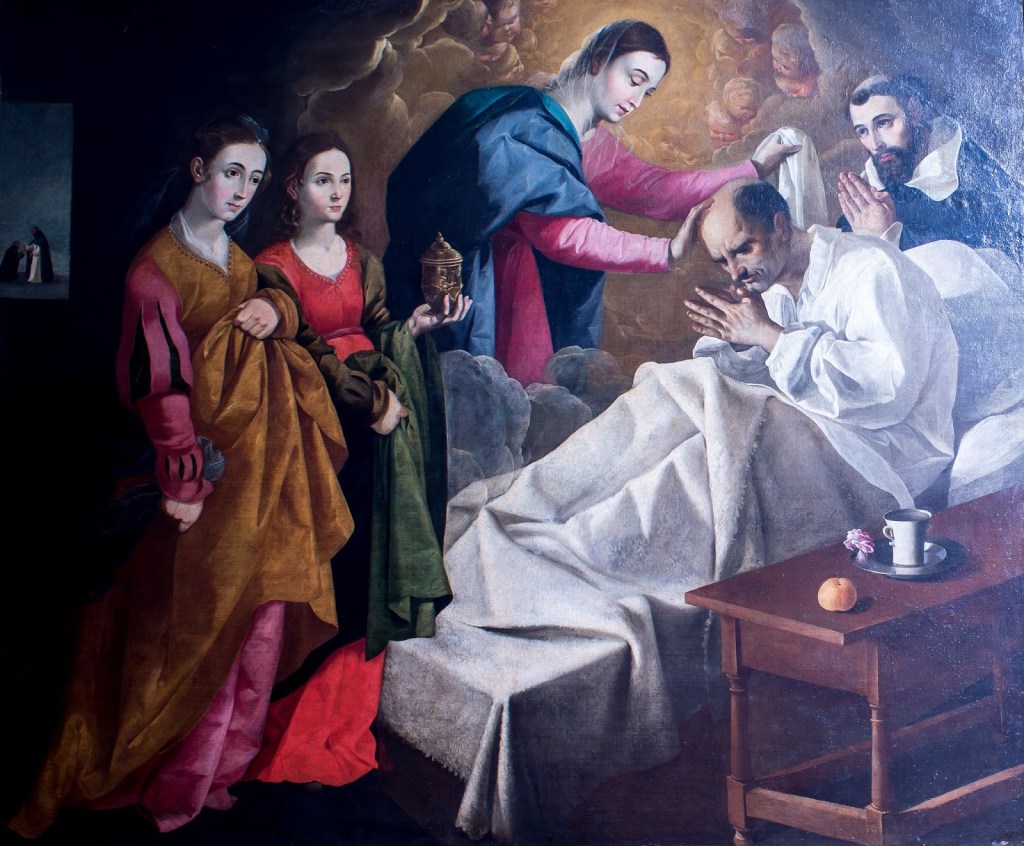
The Miraculous Healing of the Blessed Reginald of Orléans (1626), from the Church of Santa María Magdalena in Seville, appears to be Zurbarán’s first use of this motif. Although not next to the Virgin, the plate, cup and rose are on a table in the foreground next to the Blessed Reginald’s bed (it could even be the same table). On the other side of him is Mary, leaning over him, tending to her patient. Once again, its appearance is associated with the Virgin – and could be interpreted to imply that Mary’s presence surrounds the sick man, as she is on one side of him, while the symbol referring to her is on the other.
The National Gallery’s Still Life is a quiet meditation on the nature of the Virgin Mary, the Immaculate Conception. How do I know that? Because literary sources, going back as far as St Ambrose in the 4th century refer to her as ‘a rose without thorns’, a reference which is regularly illustrated in western European paintings. Her identification as the ‘Vessel of Honour’ and ‘Mirror of Justice’ are included in the Catholic liturgy. The concept of ‘the spotless mirror of the power of God’ comes from the Jewish scriptures – the Old Testament. As a composition it is clear, calm and beautiful, aesthetically pleasing and spiritually profound. Zurbarán included it in a least two of his paintings which concern the Virgin, either as a child, or as the Mother of God, which suggests that the motif as a whole was, for him at least, a metaphor for her qualities. However, it occurs in yet another painting which is in the exhibition but which, at first glance, appears to have no connection to the Catholic church.
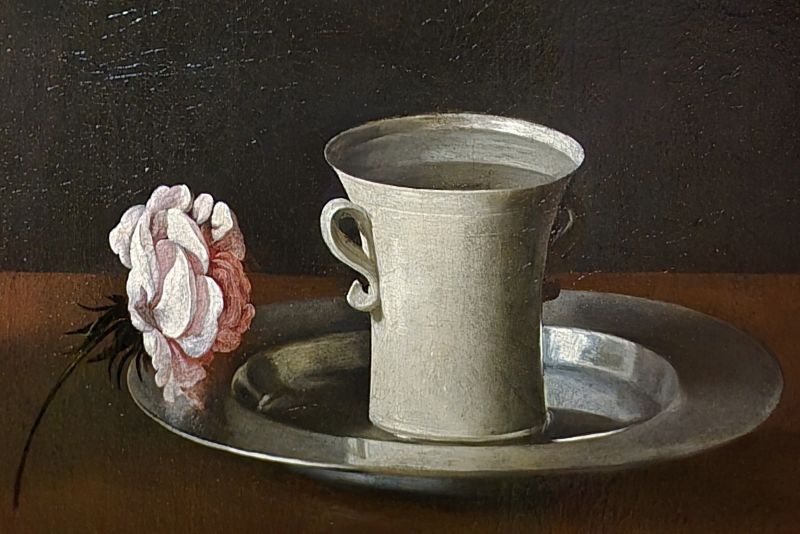
In the detail on the right the rose appears larger, and at a slightly different angle to the first version I showed you (on the left), while both the cup and its reflection in the plate are crisper. Nevertheless, the concept is the same: it is the same motif. However, even if the concept is the same, the context is not. This is the painting as a whole:
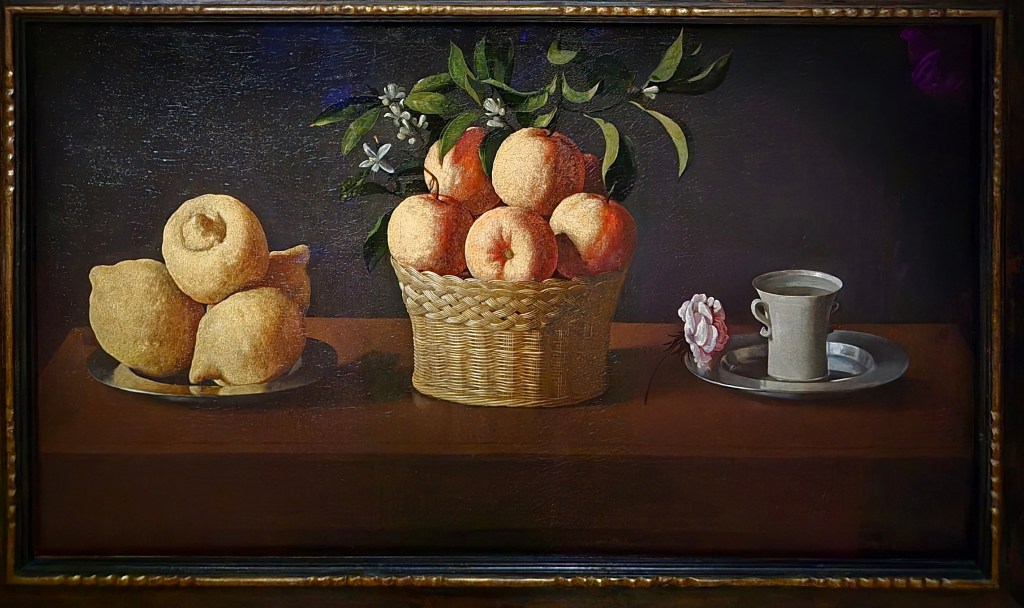
Still Life with Lemons, Oranges and a Rose (1633, The Norton Simon Foundation, Pasadena) is considered to be Zurbarán’s greatest Still Life. However, apart from the repetition of the Marian motif, it doesn’t appear to have any other connection to Christian symbolism. Is this a case of ‘form without function’, or are we missing something? Is there a text which refers to lemons or oranges? Can we put them into the context of 17th century Spanish painting? Does the basket appear anywhere else? Well, there certainly are plenty of baskets – and we will see them on Monday. There will also be some equally fabulous lemons… which might help us to understand what we are looking at here.


This was a particularly good post for me. Thank you so much, I have forwarded it to some of my art friends out here in Santa Fe as an example of why it is correct to consider 16th, 17th… ‘modern.’ I see this as a stepping stone on the road to deconstruction and the absence of figures on is often able to find in contemporary works.
I was excited by the phrase in the final paragraph, ‘Is there a tet which refers to…?’ Tet? Hmmm, however I now suspect that rather than a fun new vocabulary word it is simply missing an x – text.
Thanks again Richard you always help we look at what’s in front of me.
LikeLiked by 1 person
Ah yes – the fatal error of adding something on the final proof-read, and not going on to a very last check… Glad to see I can still keep people thinking!
LikeLiked by 1 person
Hi I
LikeLike
Sorry – not much of your message came through! Do try again, or send a message via the ‘contact’ page!
LikeLike