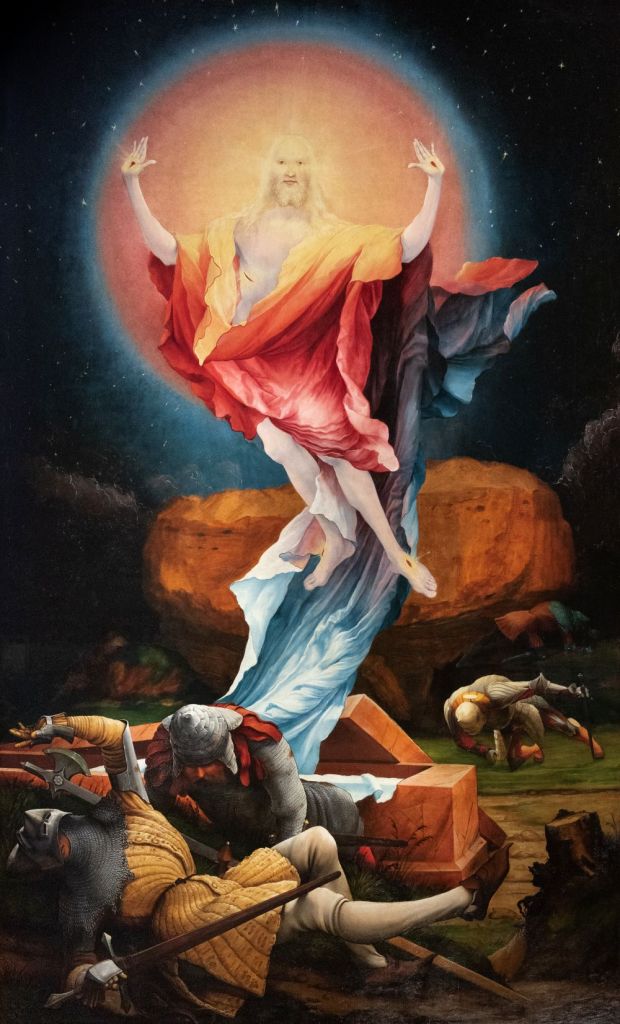
Matthias Grünewald, The Resurrection from The Isenheim Altarpiece, 1512-16. Musée Unterlinden, Colmar.
This Monday, 1 June, at 6pm, I will give a talk about Mathis Gothart Nithart, who is better known to us as Matthias Grünewald. This isn’t related to an exhibition – more’s the pity – but to my visit to Colmar with Artemisia in a week or so. The main reason to go is to see Grünewald’s masterwork, the Isenheim Altarpiece, one panel of which I am thinking about today. General consensus among the experts is that only ten of his paintings have survived the onslaught of history – although some, and most notably the Isenheim, are made up of several panels. There are also around 30 drawings, many of which are now in Berlin: on Monday we will take a close look at them, together with the surviving paintings.
The following Monday I will be on my way home from Strasbourg (and so, indirectly, Colmar), and the next talk will have to wait until Monday, 15 June. This will explore the National Gallery’s Zurbarán – a bold and beautiful introduction to the work of the Spanish master, perfectly curated and masterfully hung. That will be followed on 22 June by a visit to the monumental Matisse at the Grand Palais in Paris. After that I will make my first reference to the Bayeux Tapestry this year, in what could turn out to be just one of two ‘Pre-Bayeux’ talks (more about the ‘tapestry’ itself will follow in the autumn) – but it will also look at two different exhibitions in two different museums on the Wirral. Provisionally entitled May Morris, the Reading Bayeux, and the Post-Pre-Raphaelites, it will be more coherent than that title might suggest. I will post more information about it in the diary very soon, though.
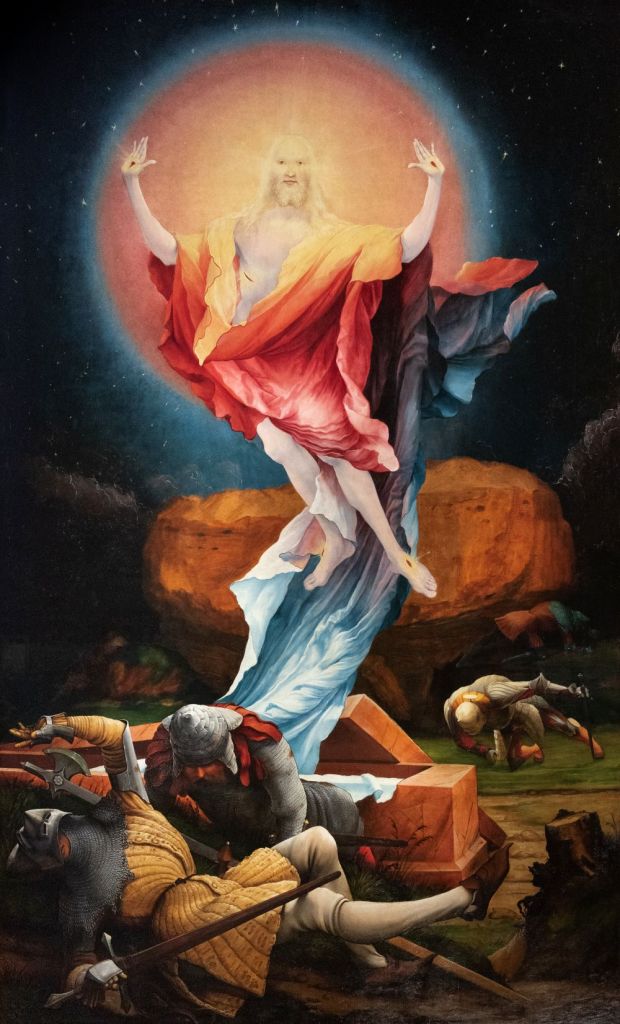
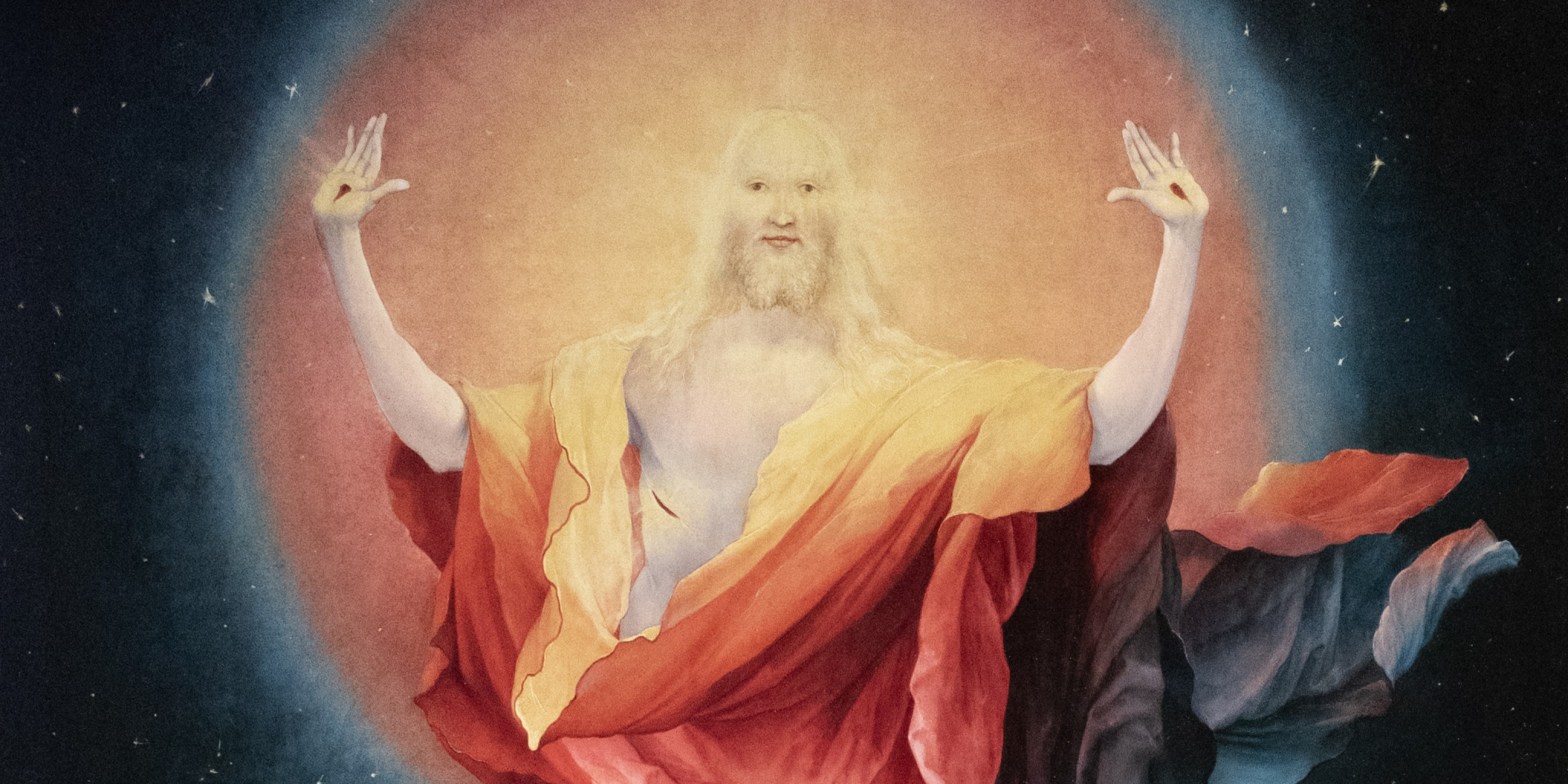
I’ve written about the Resurrection more than once – for example, recently I reposted Happy Easter and previously there was also Bringing the Resurrection back to Life – but I think this is the most remarkably painting of the subject that I know. Admittedly I am not as familiar with German art as I am with Italian, but I can’t think of anything else like it in terms of its power, energy, and wealth of colour, or in the way that it depicts the supernatural in a style that is itself appropriately supernatural. ‘The third day he rose from the dead’ it says in the Apostle’s Creed, but in this painting it is quite clearly night, with the black sky glistening with stars. Jesus has risen some distance above the tomb, glowing with a golden light which fades through orange to pink, and is finally ringed with blue. The shroud trails behind and beneath him, one end still resting on the edge of the tomb. Draped around his shoulders, it takes on most of the colours of the spectrum – red, orange, yellow, blue, indigo and violet: only green is missing. Soldiers lie in paroxysms both behind and in front of the tomb, and an enormous rock looms over the landscape.
The soldiers guarding the tomb are mentioned in the bible. Matthew 27: 59-66 talks about Joseph of Arimathea taking Jesus’ dead body, and laying it in his own tomb:
59 And when Joseph had taken the body, he wrapped it in a clean linen cloth,
60 And laid it in his own new tomb, which he had hewn out in the rock: and he rolled a great stone to the door of the sepulchre, and departed.
61 And there was Mary Magdalene, and the other Mary, sitting over against the sepulchre.
62 Now the next day, that followed the day of the preparation, the chief priests and Pharisees came together unto Pilate,
63 Saying, Sir, we remember that that deceiver said, while he was yet alive, After three days I will rise again.
64 Command therefore that the sepulchre be made sure until the third day, lest his disciples come by night, and steal him away, and say unto the people, He is risen from the dead: so the last error shall be worse than the first.
65 Pilate said unto them, Ye have a watch: go your way, make it as sure as ye can.
66 So they went, and made the sepulchre sure, sealing the stone, and setting a watch.
So, the watch has been set. Clearly Grünewald has not painted exactly what the text describes, as there is no ‘rock hewn tomb’ with a stone rolled across the door. The tomb is clearly a standard sarcophagus, a rectangular ‘box’ of stone, with another slab as a lid. This was entirely traditional in Western European art, though, and almost everyone depicted it like this. The way in which the lid has been pushed off implies that the Resurrection was in some way ‘explosive’ – as does the energy with which the risen body is projected into the air. The burial took place on Good Friday – the first day – and on the third day (actually less than two days later, as it was Sunday morning) the Resurrection is celebrated. Matthew is quite specific about it. The first verse of Chapter 28 says,
In the end of the sabbath, as it began to dawn toward the first day of the week, came Mary Magdalene and the other Mary to see the sepulchre.
So it is very early in the morning on Easter Sunday, Sunday being ‘the first day of the week’. It is only just beginning to dawn – hence the black night sky, looking darker against the brilliance of the resurrected Christ. The following 3 verses help to explain what is happening to the Soldiers:
2 And, behold, there was a great earthquake: for the angel of the Lord descended from heaven, and came and rolled back the stone from the door, and sat upon it.
3 His countenance was like lightning, and his raiment white as snow:
4 And for fear of him the keepers did shake, and became as dead men.
Again, the mention of an ‘earthquake’ implies an almost explosive Resurrection. There is no angel here, admittedly, but the remarkable colours of the image might have some origin in the description of the angel’s face as being ‘like lightning’. Nevertheless, we see the ‘keepers’ shaking, and becoming ‘as dead men’. It may be that the angel has yet to sit upon the tomb, even though he has already lifted the lid away.
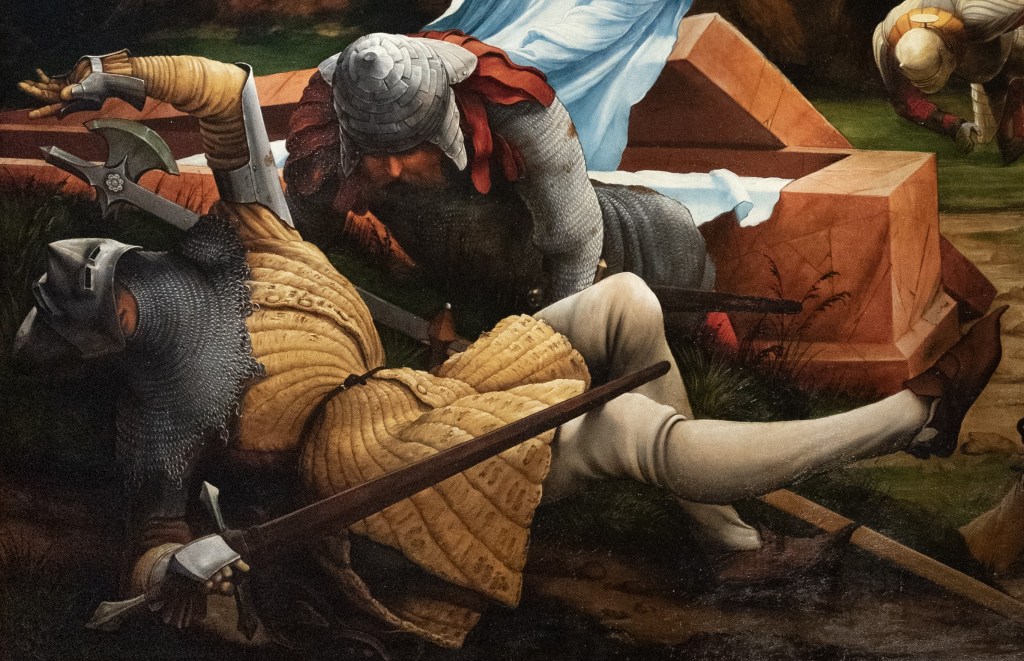
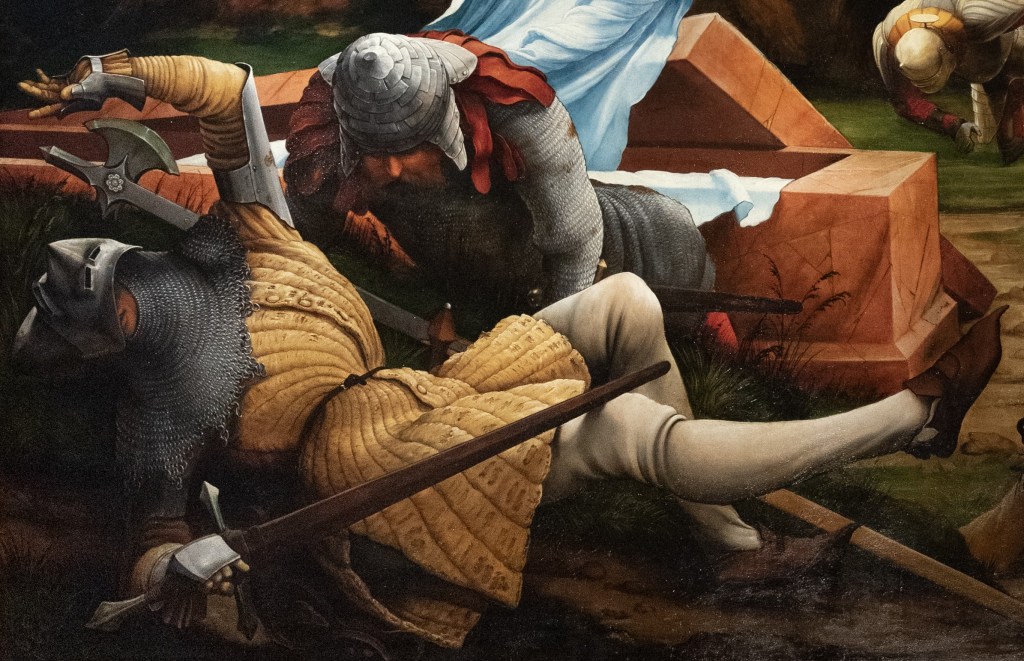
One of the soldiers appears to be thrown towards us, while another is contorted, his left arm held above his head the right still holding his sword, which rests on his right knee, straightened as his leg kicks away from the ground. Thrown sideways, his helmet has twisted around, the eye-slits in the visor now looking upwards, as the face itself looks away. The shroud, resting on the edge of the sepulchre, is almost white here, a bluish white admittedly. This is the ‘clean linen cloth’ mentioned above in Matthew 27:59, but its appearance, reaching up out of the tomb, could be a reference to the Gospel of John. In the following passage it is usually assumed that ‘the other disciple’ is John himself. Chapter 20, verses 4-8, describes Peter and the ‘other disciple’ heading to the tomb, after Mary Magdalene had told them about the Resurrection:
4 So they ran both together: and the other disciple did outrun Peter, and came first to the sepulchre.
5 And he stooping down, and looking in, saw the linen clothes lying; yet went he not in.
6 Then cometh Simon Peter following him, and went into the sepulchre, and seeth the linen clothes lie,
7 And the napkin, that was about his head, not lying with the linen clothes, but wrapped together in a place by itself.
Is Grünewald showing us the ‘linen clothes’ about to fall back into the tomb? I think that is entirely possible.
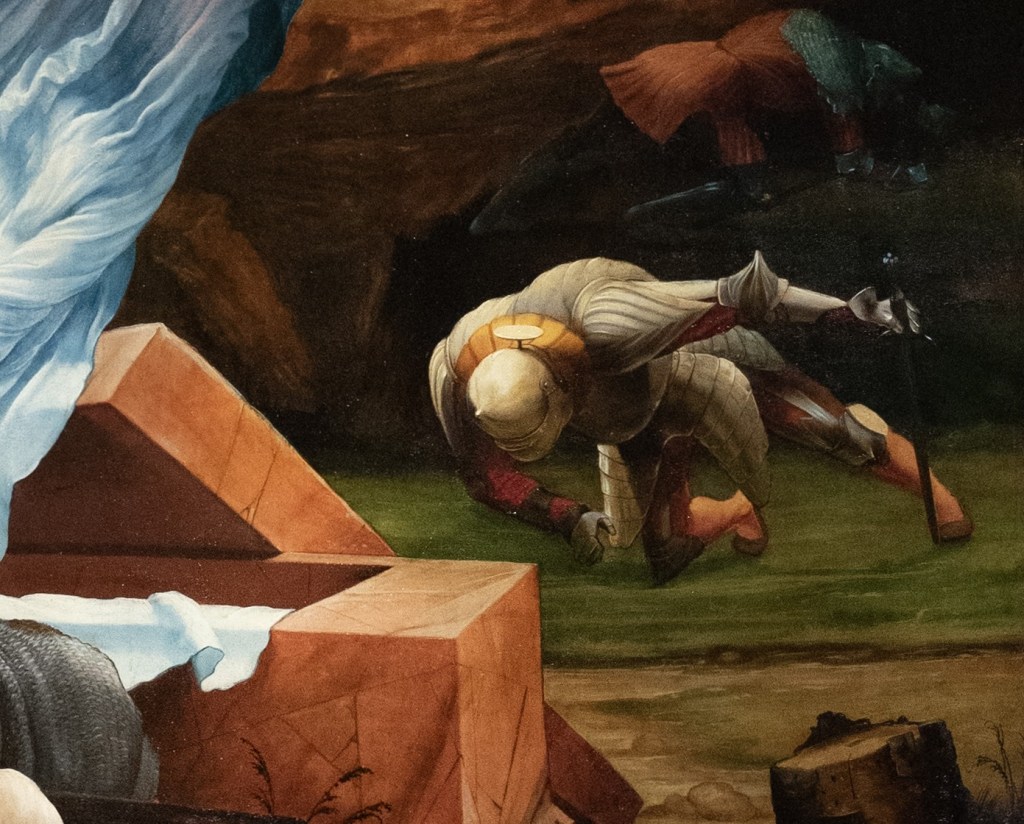
There are more soldiers further away. One, in full 16th century armour, falls towards us – which, to my mind, is entirely counter-intuitive. For some reason I would expect him to fall away from the tomb, but, if there was an earthquake, the tremors could make people fall in any direction… In any case, the ‘intuitive’, what you would expect to happen, could itself be seen as being counter-intuitive, given the supernatural nature of the event. The sarcophagus is thickly carved from red stone. If this were in Italy, I would say it was Rosso di Verona – a red, fossiliferous limestone from the eponymous Italian city. Whatever it is, it has either been put together from small, angular sections, or has cracked with the blast. Another soldier, in red, with a chain mail hood, further away and apparently higher up than his armoured companion, crawls from left to right. The nearer of the two appears to have been of especial interest to one of Grünewald’s contemporaries – quite possibly a member of his studio. A contemporary drawing, now dated ‘c. 1515’, is held in the Staatliche Kunsthalle in Karlsruhe, not so terribly far away from Isenheim (well, globally speaking – it’s about 180km).
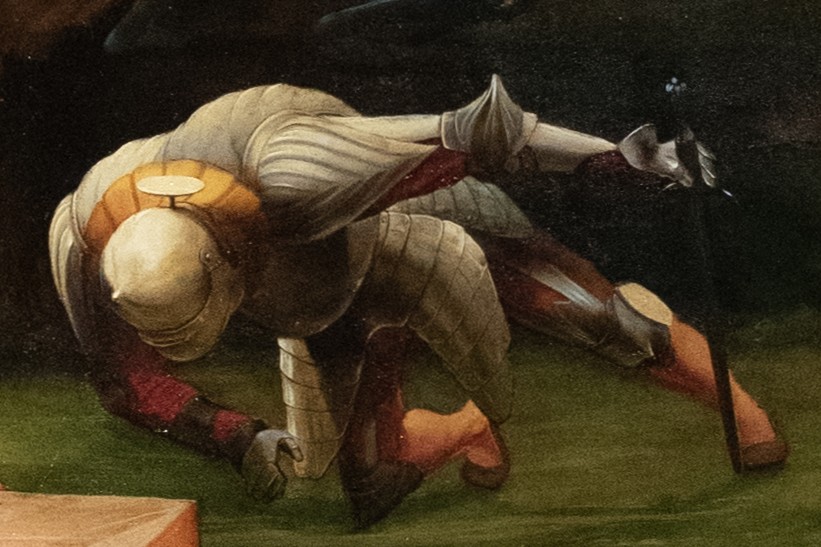
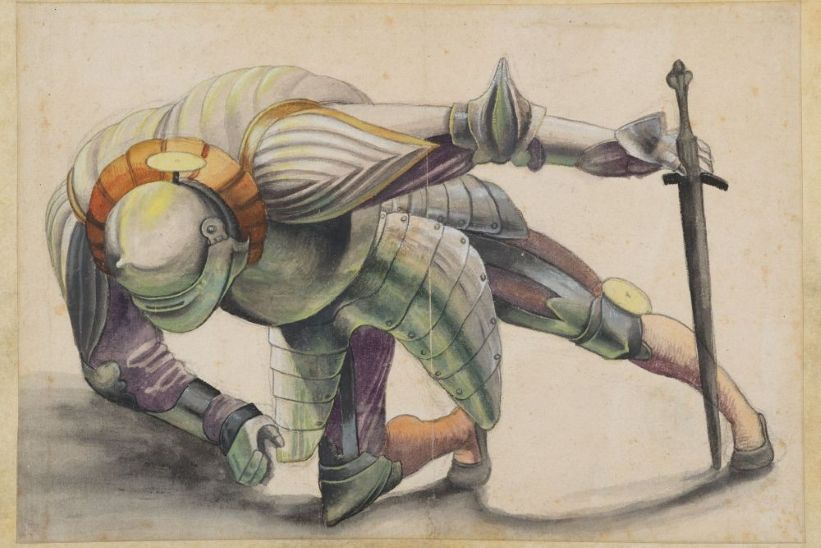
The artist is known, quite simply, as ‘the Grünewald copyist’, and he executed at least one other drawing of the Isenheim Altarpiece, also in Karlsruhe, which sheds interesting light on Grünewald’s working practice: we will see it on Monday.
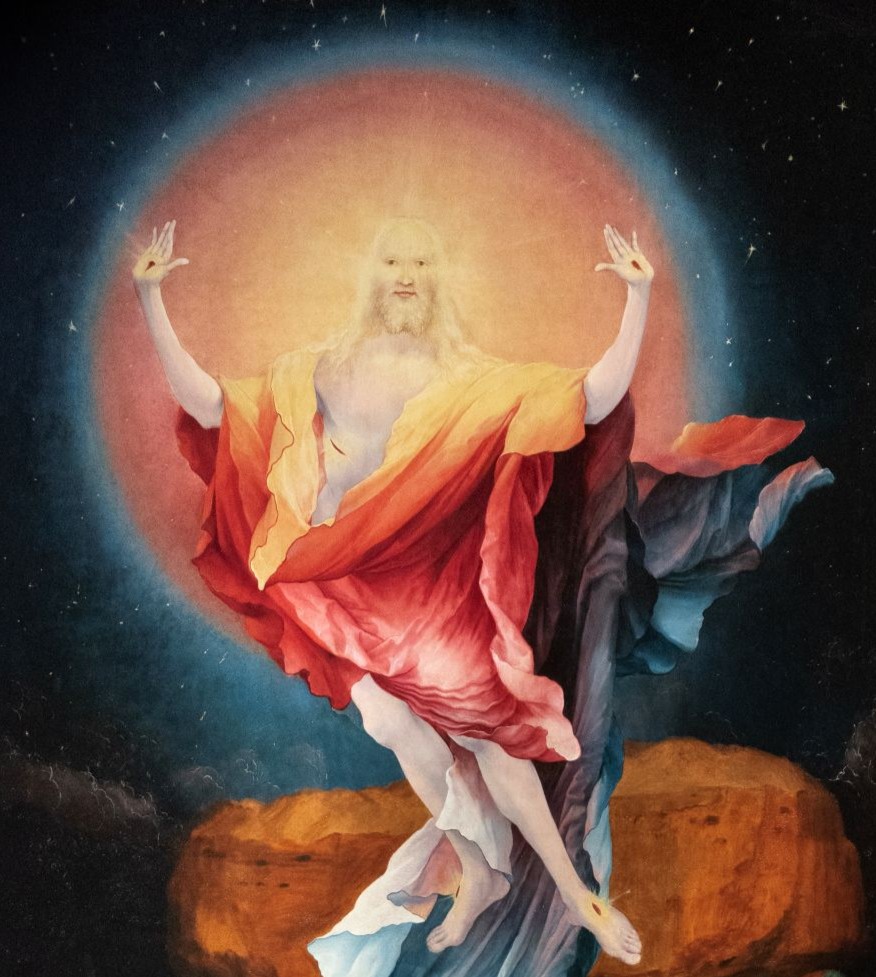
I find the appearance of Christ truly astonishing. With his hands spread wide and raised, displaying the wounds from the crucifixion, and the feet separated, the wounds again visible, it is almost as if he has been sprung free from the Cross as much as from the bonds of death. His legs trail behind him slightly as he leans forward, floating effortlessly, with one end of the shroud spread out to our right, while the length hanging from his shoulders falls in a V-shape in front of him, framing his torso and revealing the wound in his chest. The hallucinogenic colours with which it is illuminated may well be relevant for the painting’s intended audience – but again, more about that on Monday.
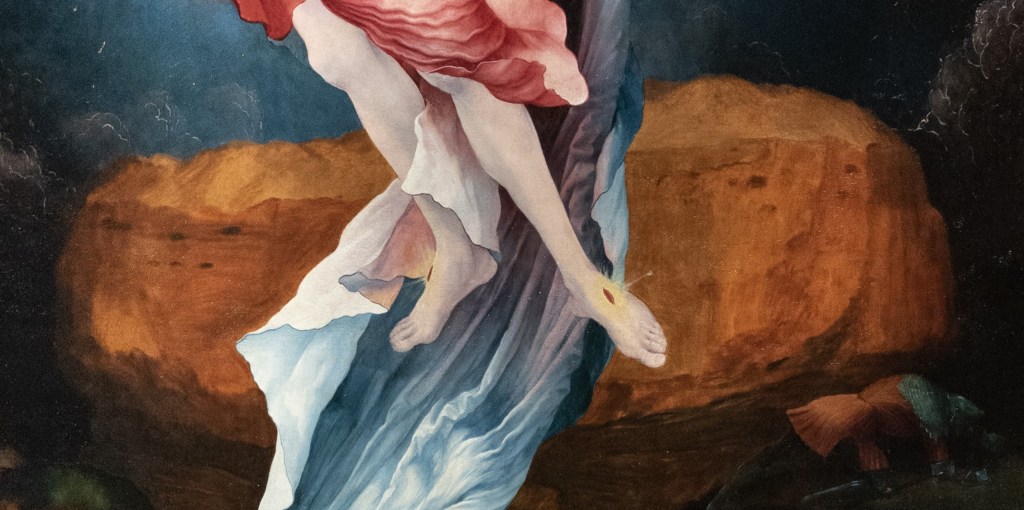
The feet, suspended in mid-air in front of a blue-violet section of the shroud, are framed by the enormous rock which almost appears, itself, to be levitating. The soldier in red crawls away beneath it. The implication is that the Garden of Gethsemane was a rocky one, and it was from one of these rocks that Joseph of Arimathea’s tomb had been carved. There could even be the implication that this is the massive stone which the angel has moved, but I am also reminded of Paul’s Epistle to the Ephesians, 2:19-20, where he points out that we should think beyond nationality:
19 Now therefore ye are no more strangers and foreigners, but fellow citizens with the saints, and of the household of God;
20 And are built upon the foundation of the apostles and prophets, Jesus Christ himself being the chief corner stone
Does the rock behind Christ’s feet represent the ‘corner stone’? I don’t know – but if I can see the connection now, so surely could the artist – or whoever was advising him. I’m also reminded of building houses on rock, in Jesus’ parable of the wise and foolish builders (Matthew 7:24-27). After all, rocks are very stable – although maybe not in an earthquake. Peter, too, means ‘rock’, as Jesus himself acknowledged, saying ‘and upon this rock will I build my church’ (Matthew 16:18). With the Resurrection we are very firmly at the foundations of the Church.
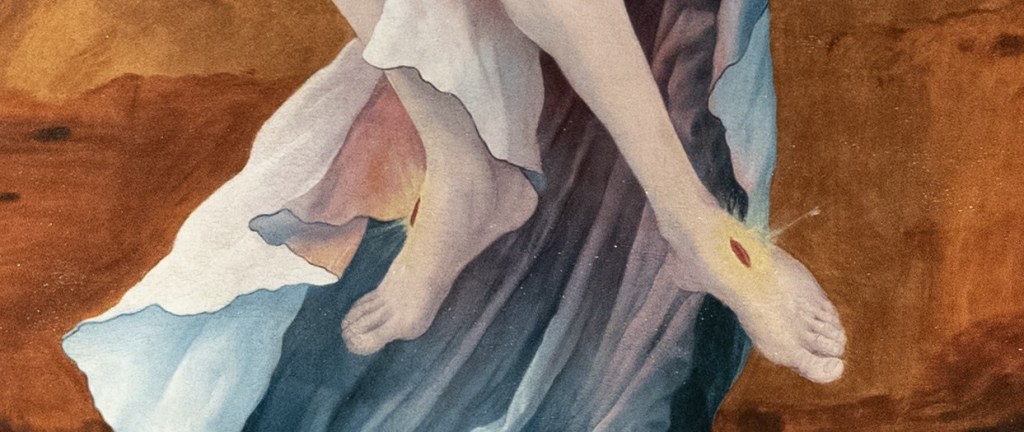
The feet themselves are extraordinary. The wounds from the nails are a deep red, but glow with holy light, radiating in all directions. They are not unlike mouths. For medieval mystics, the ‘Five Wounds’ were often the subject of intense devotion, and more than once they were referred to as mouths which witness God’s love for his creation.
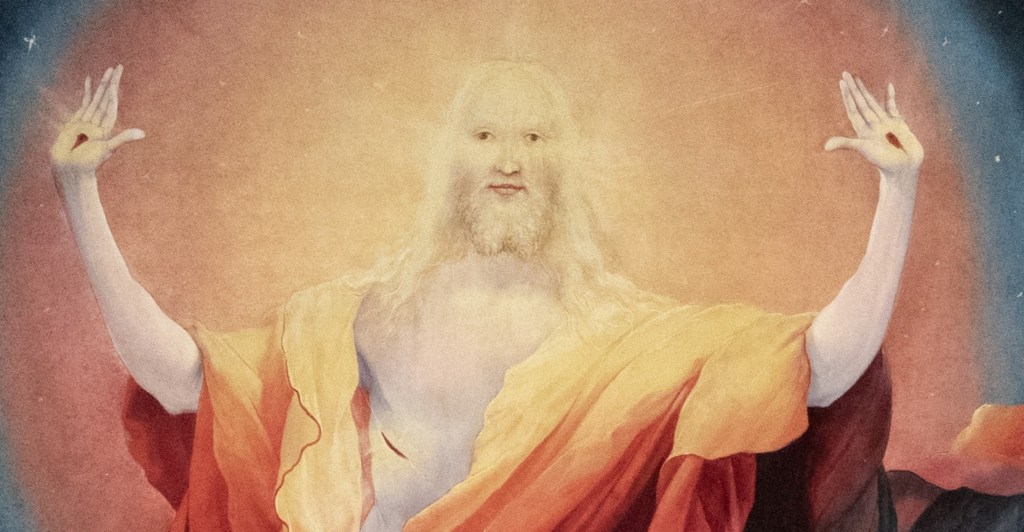
The wounds in Christ’s hands and side also glow, while the brilliance of his face almost dissolves it into the surrounding luminescence. In this painting Jesus really is the Light of the World. It was painted for the chapel of a hospital in Isenheim – and for the patients the image of the Resurrected Christ would surely have been inspirational. Apart from the five wounds, his body is perfect: without a stain, without a blemish and without a mark of the other tortures to which he was subjected. The contrast between his appearance here, and the abject torment of the Crucifixion, one of the most extreme ever painted, couldn’t be more marked: it’s not something I’ve ever heard mentioned, though. The patients themselves were undergoing a different abject torment – and for most of them there would only have been hope in the life to come. The compassion with which Grünewald treats his audience does not hold back from extremes – but, as this painting shows, he doesn’t hold back in the depiction of the power of redemption either. Overall, I am coming to believe that, at its simplest, the altarpiece as a whole expresses the problem, explains its solution, and tell us who to thank for that outcome – but I’ll explain what I mean more fully on Monday.