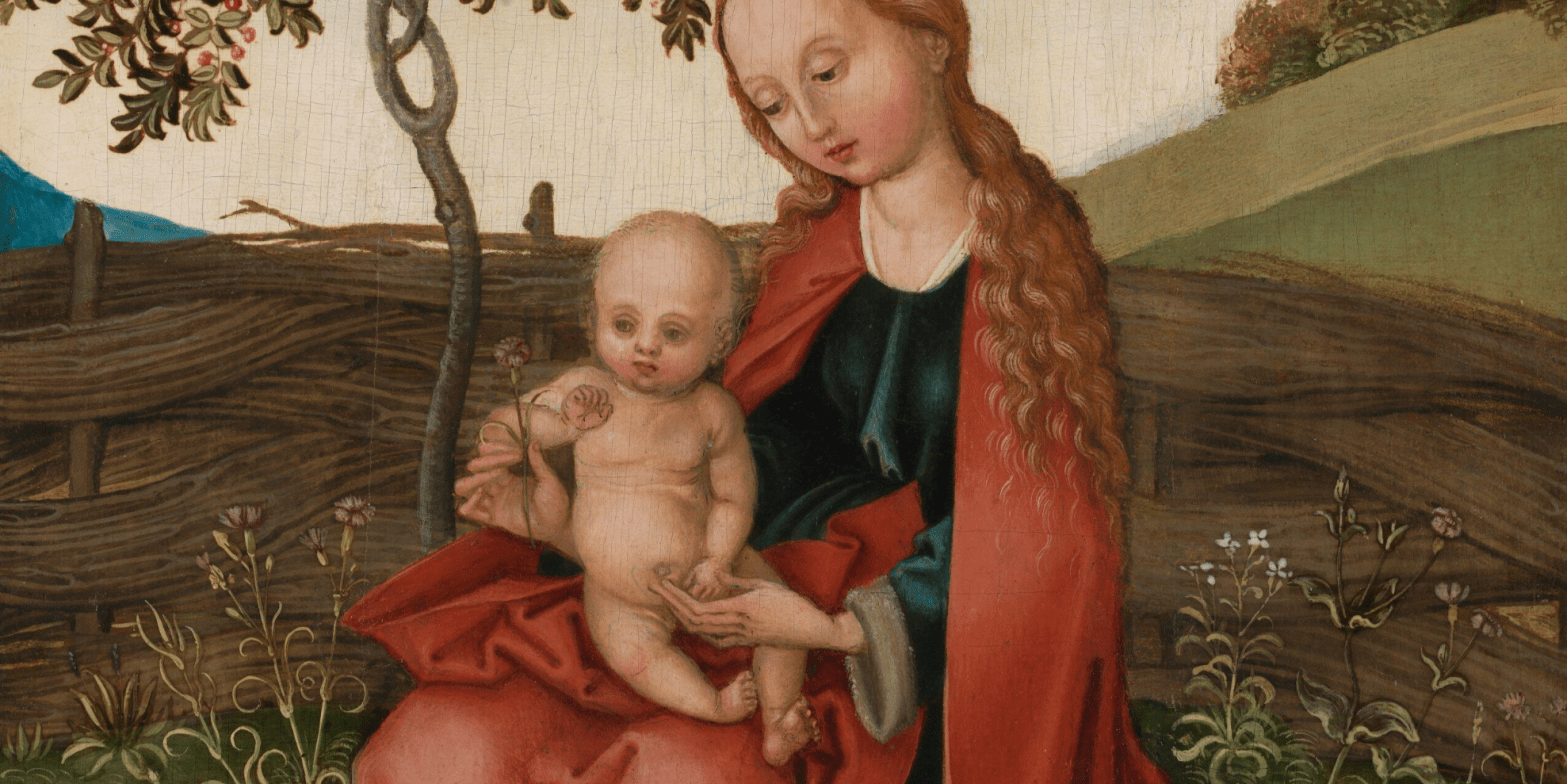
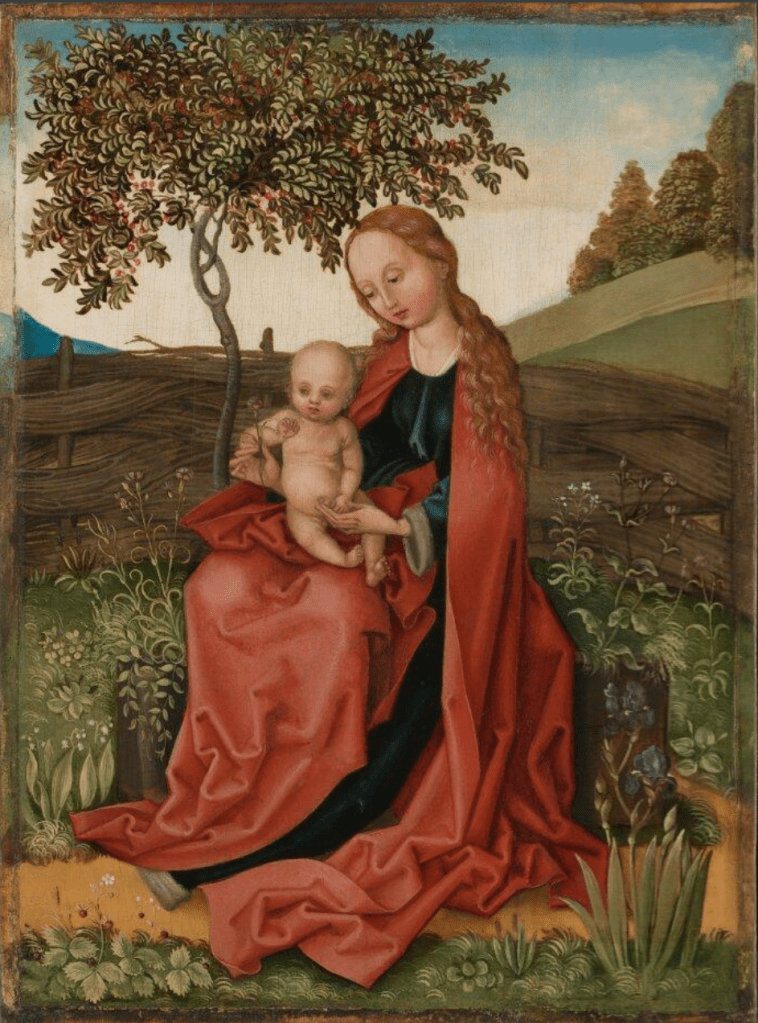
Workshop of Martin Schongauer, The Virgin and Child in a Garden, 1470s or early 1480s. The National Gallery, London.
Martin Schongauer, who I will be talking about this Monday, 18 May at 6pm, is most renowned for his engravings, of which many have survived. As one of a family of goldsmiths, working metal would have come naturally to him, and it was probably a result of this that engraving copper plates became his métier. However, he must also have trained as a painter, although only a few paintings by him survive. Most of them are currently in the Louvre, as part of the exhibition Martin Schongauer: The Beautiful Immortal, which is the subject of Monday’s talk. The exhibition itself turned out to be twice as large as I was expecting! The first half covers Schongauer himself – and I thought that was it. However, as I prepared to leave, I saw that Part 2 of the exhibition continued on the other side of the corridor, with more of his work illustrating the many ways in which he influenced his contemporaries, not to mention later generations of artists, well into the 17th century. I will focus on the first half of the exhibition, thus looking at the artist himself, and cherry-pick the best examples of his influence. And talking of cherries – well, we’ll get to them, but there is a cherry tree in the painting I will be writing about today. Sadly, the National Gallery doesn’t have an autograph work by this wonderful artist, so instead I would like to look at an entirely charming example from his workshop. As it happens, the NG does have a print by Schongauer, but it is embedded in somebody else’s painting: if you want to know how, then you’ll have to join me on Monday!
The following week, 25 May, I will be exploring Tate Britain’s exhibition James McNeill Whistler, which will only just have opened, and then on 1 June I will talk about Matthias Grünewald. Apologies if you clicked the link last week only to be taken to the Whistler page – my mistake – but I have double checked this time round, so all of the links should be the right ones. All of the information is on the diary anyway, and correct at the time of going to press, but of course last week was the only time I didn’t post a link!
Future talks will include an introduction to the National Gallery’s superb Zurbarán exhibition (it really is outstanding) on 15 June, and on 22 June I will talk about the monumental late Matisse show which I saw at the Grand Palais in my two busy days in Paris at the end of April – but more information on them soon… in the diary and future posts.
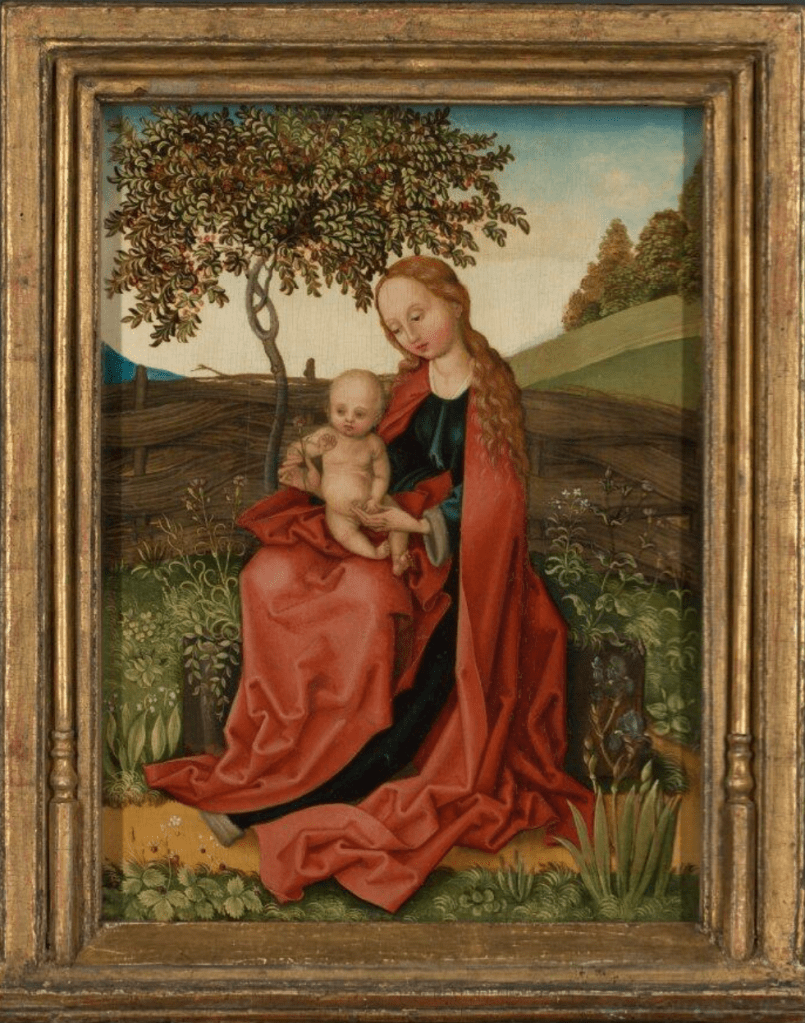
I got to know this painting some time back when planning a book on the evolution of art as seen through the depiction of plants – an idea which sadly never saw the light of day. Schongauer was very much at the forefront of naturalistic depiction in Germanic painting, and his observations of flora and fauna were second to none at the time – if you like the flowers in today’s painting, just wait for the birds we’ll seen on Monday! As the title suggests, this is The Virgin and Child in a Garden, but for those more familiar with Italian art, this might not immediately strike you as looking like the Virgin Mary: we are somewhat fixated on the idea that she wears blue. However, in Northern Europe, she is just as likely to wear a red cloak over a blue robe – the inverse of what is often seen in Italy. The blue may be an expensive pigment (though I confess I don’t know which are used in this painting), but it also symbolises her role as Queen of Heaven and Star of the Sea. The red, on the other hand, is a colour more traditionally related to royalty, and so emphasizes ‘Queen’, as opposed to the blue which implies ‘of Heaven’. The red is also related to the Incarnation, the Word made Flesh in her Son Jesus Christ – who sits sweetly, almost doll-like, on her lap. The sky is blue, the vegetation green, a path crosses in front of the holy couple and winds around their bench, and, barely visible, the landscape stretches off into the distance.
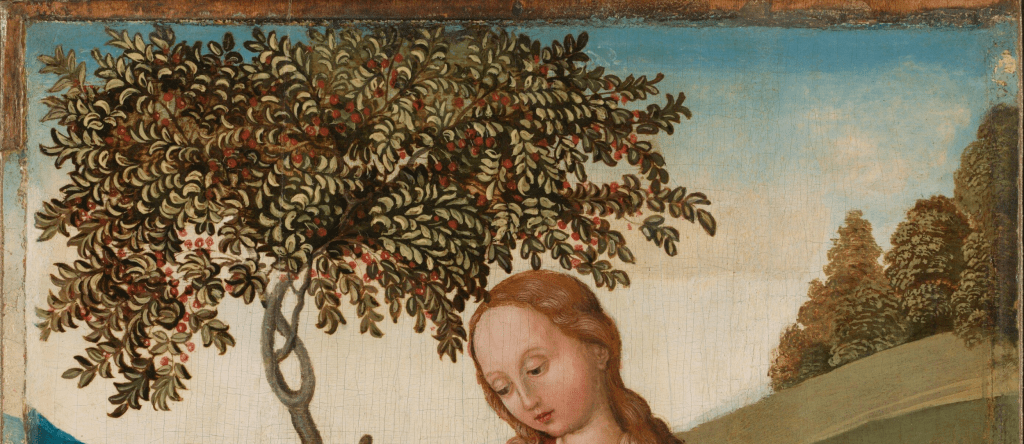
The frame in the first photograph is not original. The narrow wooden border at the top of this detail, with a lip, or bur, around the edge of the painted surface, tells us that it used to have an engaged frame, one that was attached to the wooden panel before it was painted. This wooden border has subsequently been disguised by being painted to look like the rest of the image. However, this hasn’t been done very well, or even consistently: if it had, we wouldn’t see the wood at the top. I’ll cut out this re-painted border in following details. Mary’s head bends to our left, while the cherry tree, with its branches growing from multiple stems, bends to our right – the Virgin and the natural world lean in toward each other, with the tree also functioning as a frame, and potentially, even, a shelter. Of course, if you know The Cherry Tree Carol, which is, admittedly English, but like the painting dates to the 15th Century, then you will realise that the tree might be leaning towards Mary because Jesus asked it to. When out walking, Joseph and Mary passed a cherry tree… here are a few verses:
Then Mary spoke to Joseph,
So meek and so mild,
“Joseph, gather me some cherries
For I am with child….”
Then Joseph flew in anger —
In anger flew he,
“Let the father of the baby
Gather cherries for thee!”
Then Jesus spoke a few words,
A few words spoke he,
“Let my mother have some cherries;
Bow low down, cherry tree!
“Bow down, O cherry tree!
Bow low down to the ground!”
Then Mary gathered cherries
While Joseph stood around….
You might notice that Jesus can communicate with the tree while still in the womb – but then as the second member of the Holy Trinity, and therefore God, he had created the tree in the first place. Schongauer was certainly aware of a very similar story, and illustrates it in his engraving of The Flight into Egypt, which we will see it on Monday: it is one of the prints that can be seen to have influenced Dürer – among others. In addition to being the subject of the eponymous carol, the cherry can also be a symbol of the joy of Heaven – thanks to its bright, joyous colour – but also, of Christ’s passion – given that the juice is red like blood. The joy and the suffering are not entirely unrelated in this case.
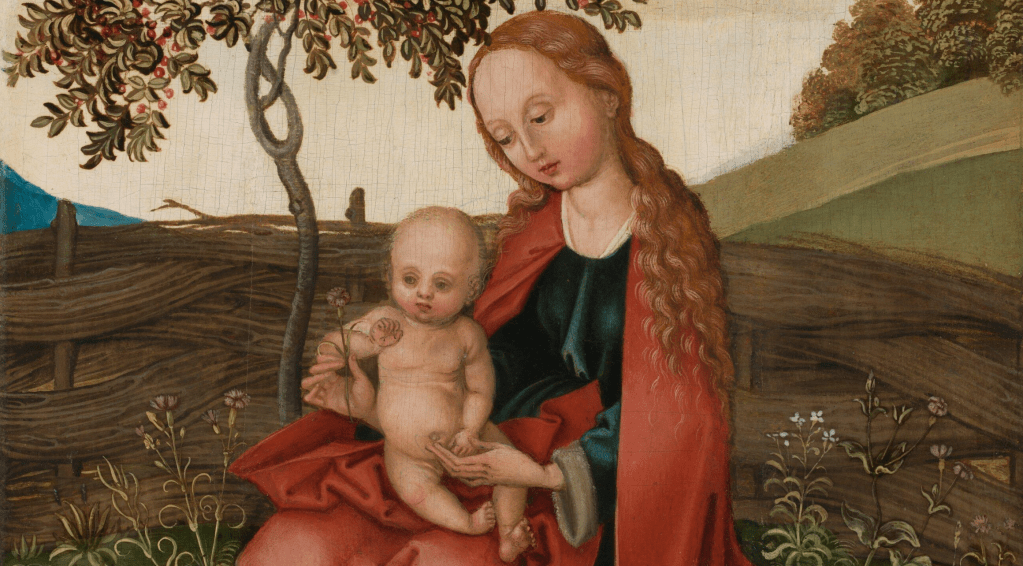
Notice how the natural world – and the man-made – help to focus our attention on what is important. The green hills on the right slope down towards Mary’s shoulder, leading us towards her, and the blue, distant hill on the left slopes down to the fence (already, in the 1470s, Schongauer and his workshop were aware of aerial perspective). The fence, on the right, curves up to Mary’s shoulder, and continues on the other side, with the crown of Jesus’ head projecting just above it. The fence thus serves to frame mother and child, and to push them towards us. It is also there to show us that this is an enclosed garden… which is, of course, another symbol (I must have mentioned it before). The relevant biblical text is the Song of Solomon 4:12:
A garden inclosed is my sister, my spouse; a spring shut up, a fountain sealed.
A garden is fertile, but this one is ‘inclosed‘, so no one can get in. The Hortus Conclusus, as it is known in Latin, was a common symbol of the virgin birth.
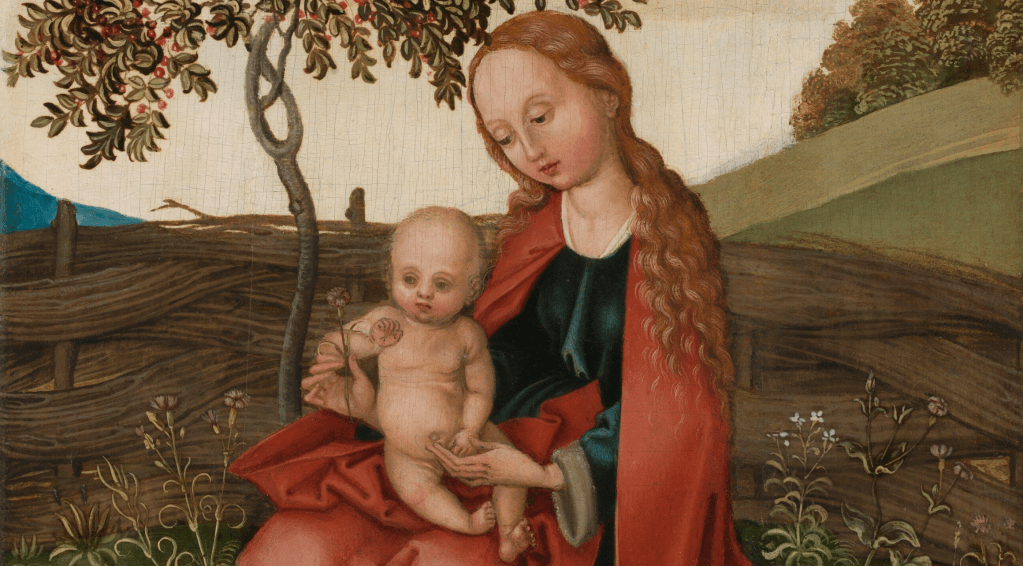
We can see some of the flowers growing in the garden. On the left is a plantain, just next to the fence, and closer to the holy couple, some pinks, or carnations. I would love to say that they were symbols of the incarnation, but linguistically I think this only works in English. However, in German they are called Nelke, which is the same as the word for clove – partly because they smell like cloves, apparently, and also because the top of the stem from which the flower blooms is nail-shaped. ‘Clove’ comes from the Latin clavus meaning ‘nail’ – cloves look like nails, after all – and Nelke is also related to the German word Nagel, meaning ‘nail’. This flower, pale and delicate as it is (just like the Baby Jesus) is, of course, a symbol of Christ’s suffering, relating to the nails used for the crucifixion. To the right is a white flower with four petals – which botanists would describe as ‘cruciform’: I’ll let you draw your own conclusions (but the white is also related to purity). It is probably the cuckoo flower, or lady’s smock (Cardamine pratensis – thanks, as ever, to the Ecologist for the identifications). Both names relate to the time of year when the flowers bloom: about the same time as cuckoos return, or for that matter, close to Lady Day – the English name for the Feast of the Annunciation. So, yes, the ‘lady’, in ‘lady’s smock’ is Our Lady – the Virgin Mary. To the right of these are some red campion (Silene dioica) – although I’m not convinced by any of the explanations I’ve read about their symbolism.
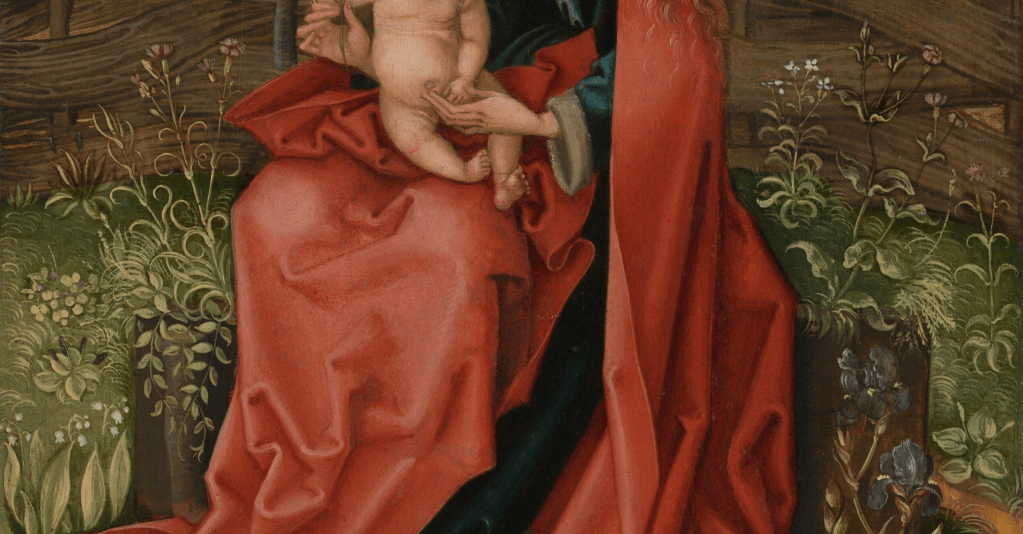
If we look further down the painting we see that Mary is seated on a raised garden bed, with the flowers growing on either side of her. This manages to combine the idea of the Madonna Enthroned, as she is seated, and upright, with the Madonna of Humility, as she is seated on the earth (or humus – which gives us the word humility, ‘down to earth’). Dürer – who was so interested in Schongauer’s work that he travelled some 400km overland from Nuremberg to Colmar to learn from the great master (only to arrive some time after his death) used this idea more than once – see, for example, 143 – A New Dürer. Poking their heads above the bottom of the detail are some lily-of-the-valley and an iris.
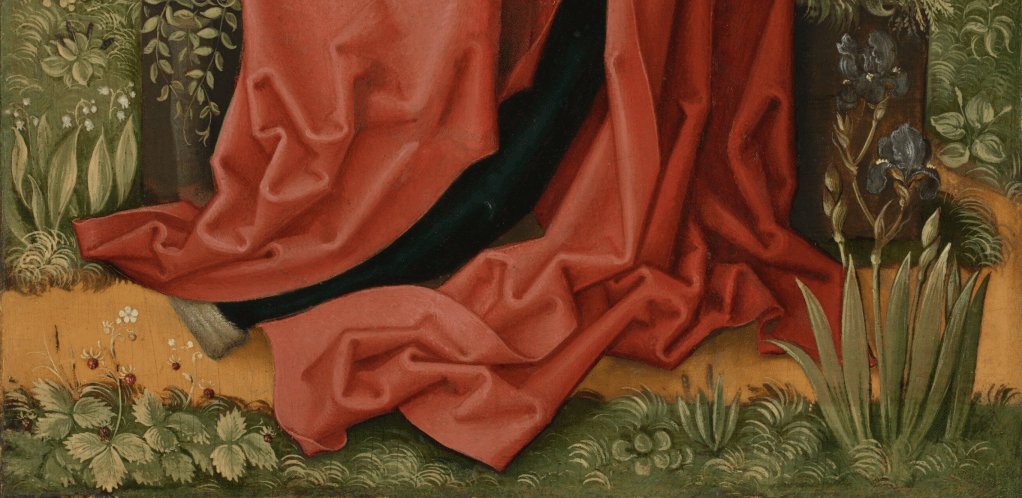
We can see them more clearly at the bottom of the painting. The lily-of-the-valley (Convalaria majalis), with its white, drooping, bell-like flowers would be seen as a symbol of Mary’s purity, modesty and humility, while the iris was very firmly associated with her suffering. When the Christ Child was presented at the Temple, the High Priest Simeon ended his song of praise with the warning to Mary, ‘Yea, a sword shall pierce through thy own soul also’ (Luke 2:35). Her suffering would be the result of seeing her own son crucified. The iris, in German, was called the Schwertlilie, or ‘sword lily’ – a name it also had in English, apparently – and so the connection should be clear. Its blue colour is often shown as close to the colour of Mary’s robes (it is not far off here), in the same way that her cloak, in this painting, is similar to the colour of the cherries.
In the bottom left corner there are some strawberries. Not only does each leaf have three sections – and anything that comes in threes is a symbol of the Holy Trinity – but it is also seen as a ‘prelapsarian’ fruit, which simply means that it has survived intact from before the Fall. When Adam and Eve do the one thing they were told not to, and ate the fruit of the tree of knowledge of good and evil, God tells them, in Genesis 3:17-18, that,
…cursed is the ground for thy sake; in sorrow shalt thou eat of it all the days of thy life; Thorns also and thistles shall it bring forth to thee; and thou shalt eat the herb of the field.
However, the strawberry doesn’t have thorns or thistles, or even a stone: it is one of the fruits of paradise.
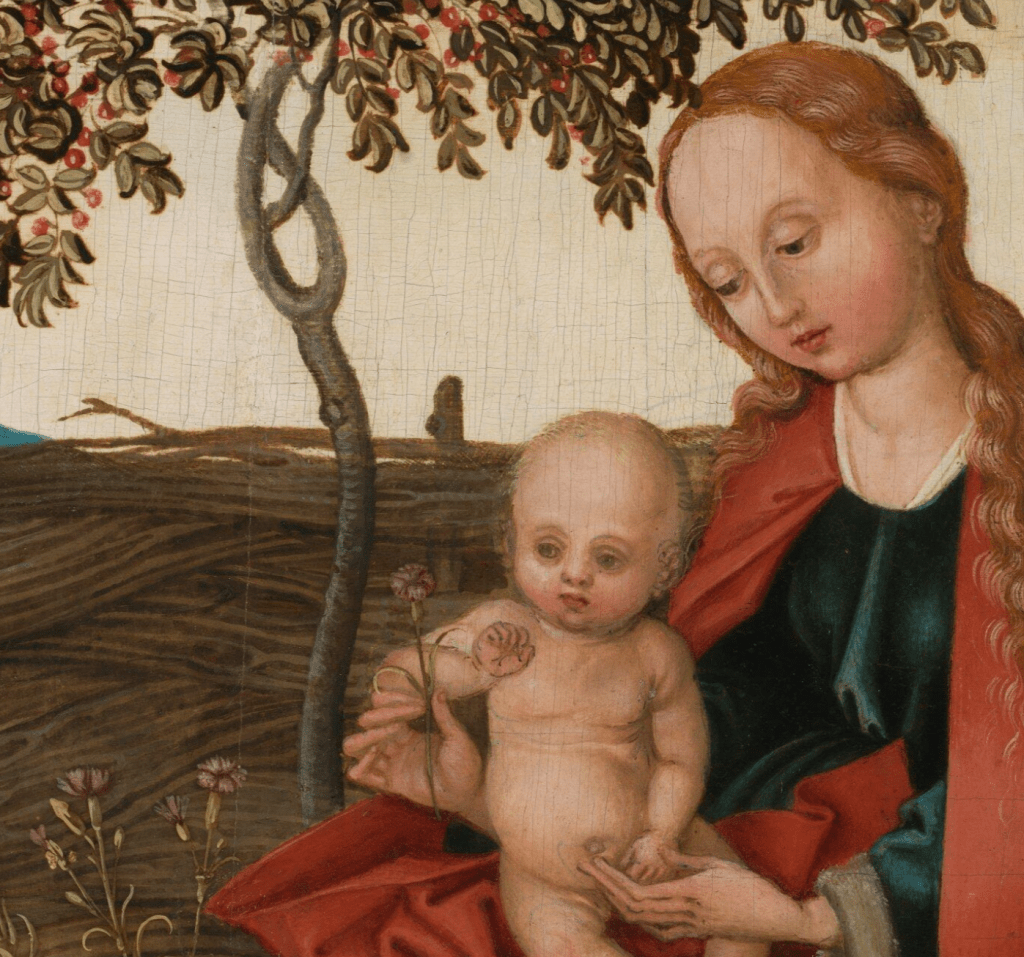
I find this detail particularly touching. Mary has plucked one of the pinks, and holds it between her thumb and her slim, elegant fingers, showing it to her infant son. Rather than reaching out for it, his hand is held back to his chest, his elbow strongly flexed. There is a sense in his wide-open eyes and slightly drawn back head that he knows what it means. This is a human baby, wary of novelty, and of the unknown, but it is also the Son of God, who knows that one day a nail will be driven through what is now a soft and tiny hand. Stylistically the painting is deemed not to be by the master himself – but the conception of it must surely be his. As we will see on Monday, Schongauer’s art and ideas were arguably more influential than those of any other artist – and not simply because his engravings were so widely distributed. His ability to catch nuance was superb, and the precision of his story telling profound.
 dr richard stemp
One thought on “275 – Then Mary gathered cherries”