Scene 57, The Bayeux Tapestry, 1070s. Musée de la Tapisserie de Bayeux, Bayeux.
The Battle of Hastings happened on today’s date, 14th October 1066, so I could say that it happened exactly 960 years ago. However, the calendar has changed: in the UK we moved from the Julian to the Gregorian Calendar in 1752, when 2 September was immediately followed by 14 September, and 11 days were lost to history. Still, it’s the same date – so guess what we’re looking at today? Last week I quoted Shakespeare, but I thought, for a change, I’d go for something more – outré? So I’m quoting Star Trek, and specifically the Klingon battle cry ‘Today is a good day to die!’ For those of you who prefer your quotations in the original language (and some of you are very rigorous), I had planned on making the title of this week’s post ‘Heghlu’meH QaQ jajvam’ – which I’m sure you would have recognised. As ‘a good day to die’ I will be marking the ‘anniversary’ of the Battle of Hastings by looking at the death of King Harold II of England. This confronts one of the great mysteries of the Bayeux Tapestry, others of which will make up a large part of my third talk about the eponymous embroidery, The Bayeux Tapestry in the British Museum and in Context on Monday 19 October at 6pm.
After that I will spend the rest of the year gradually working back to the present day. From the 11th century in Normandy and Kent we will move to 14th century Siena, with Duccio and the Virgin Mary on 26 October, and Pietro and Ambrogio Lorenzetti on 2 November. On 23 November I will get to the 15th century (in Bruges), looking at Jan van Eyck’s career as a whole (Van Eyck 1: The Works), before introducing the National Gallery exhibition Van Eyck: The Portraits the following week. Later we will get to Catharina van Hemessen (16th century), Renoir (19th) and then finally Painting the French Riviera (at the RA), which will bring us into the 20th. Information about the last three will be posted here, in the diary, and on my Tixoom page before too long. And – Stop Press! Next year’s Artemisia trips went live yesterday. I’ll be heading to Strasbourg, Cologne, Oxford and Umbria, and it would be lovely if you could join us!
If you book for one of the talks, you will receive, via email, a receipt from Stripe and a ticket from Tixoom, who will also send reminders both 24 hours and 15 minutes before the talk. These will also have links to join the talk. If the ‘ticket’ does not come within the first few hours, please contact me then, as 10 minutes before the talks I will switch off my emails and phone: by that time I will have other things to think about!
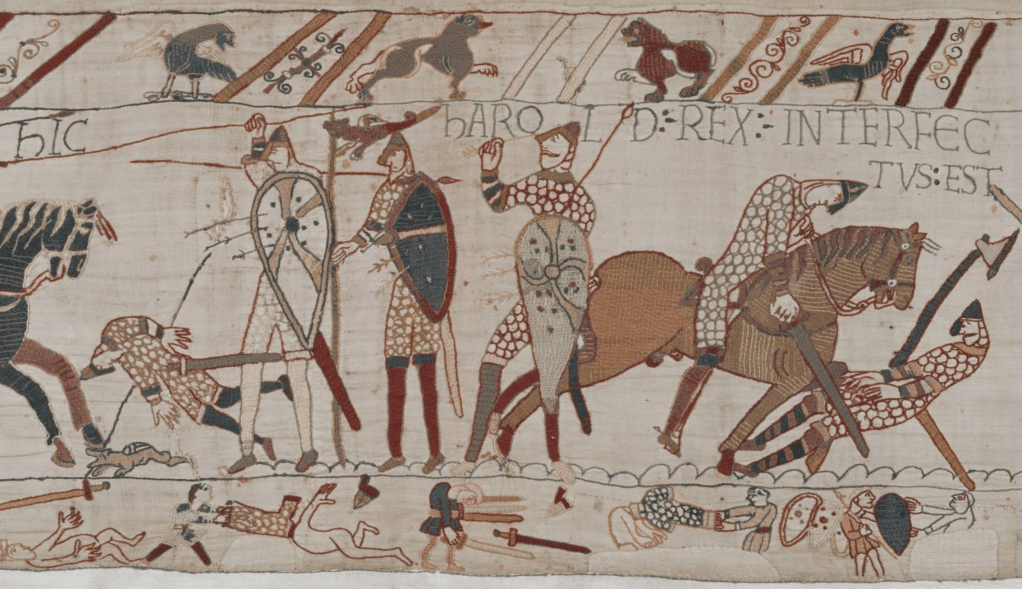
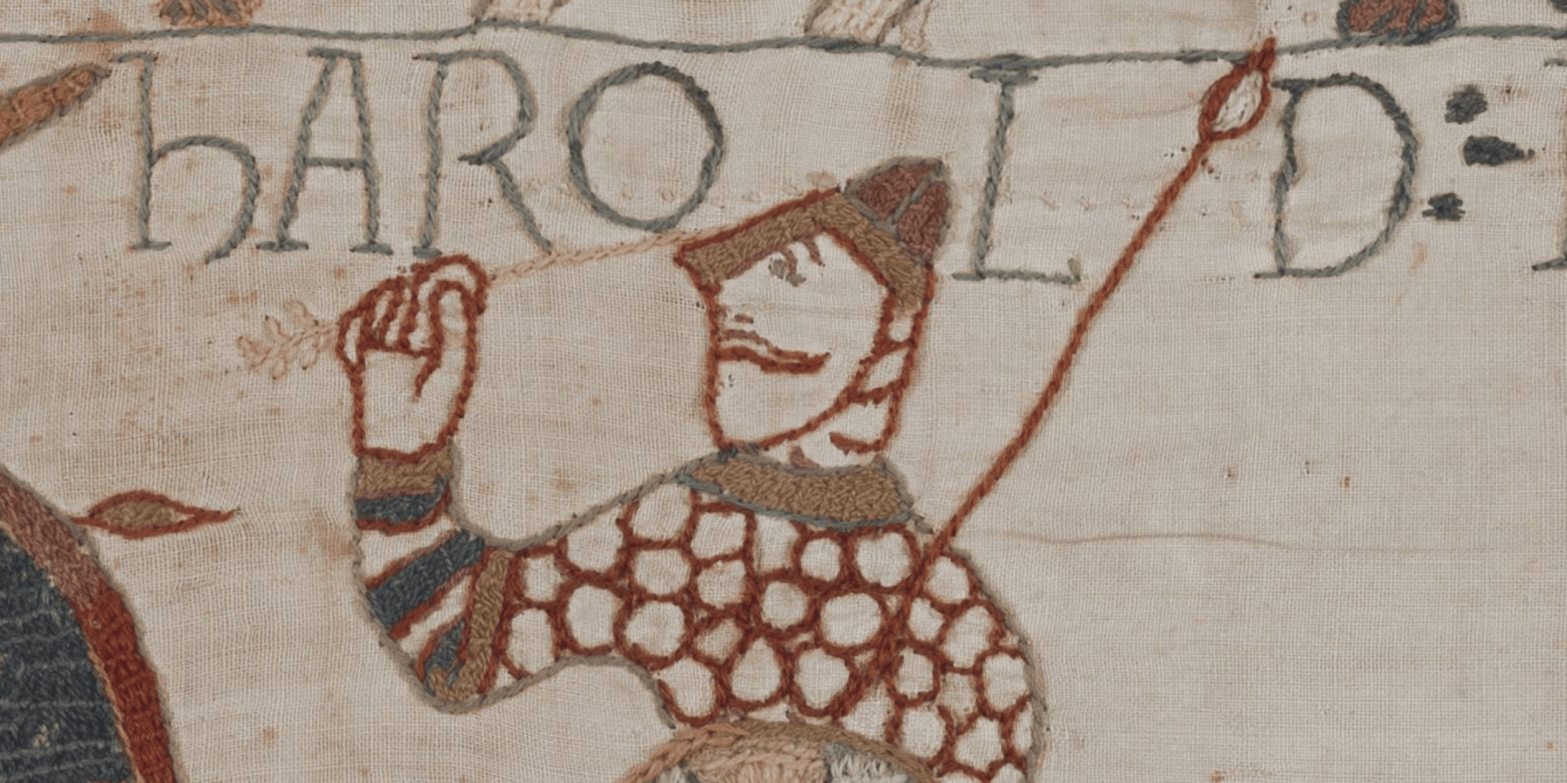
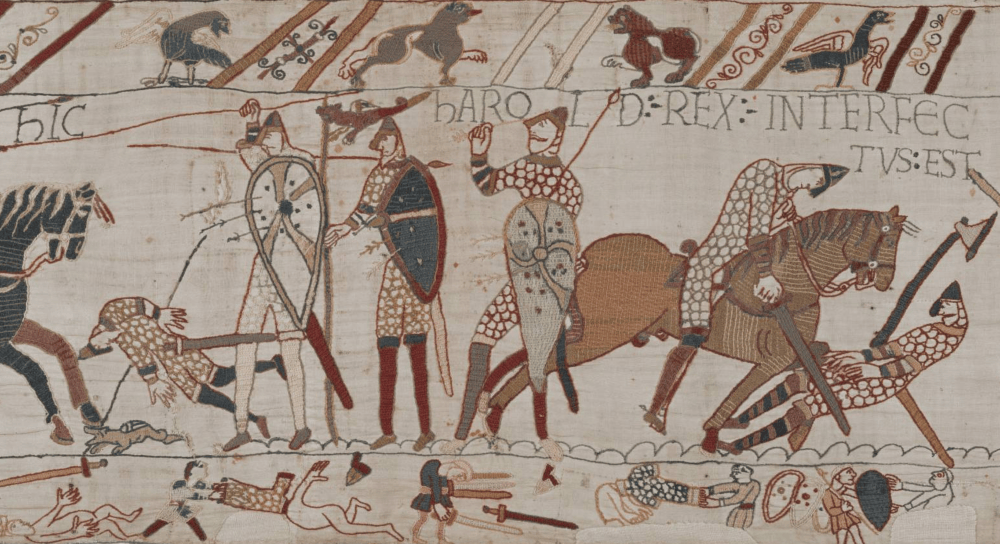
According to the titulus – the Latin inscription at the top of the central frieze – HERE KING HAROLD HAS BEEN KILLED. So, we have no doubt what is depicted. However, in a manner typical of the Tapestry and the non-committal nature of the tituli, it doesn’t tell us which one is Harold. Nevertheless, there are two things everyone knows about the Battle of Hastings. First, it happened in 1066. Famously, this was supposed to be the only date in history that everyone in England knew. Sadly many people, I might even suggest most people, do not even seem to know that any more. Second, if they know anything at all, it is that Harold was killed by an arrow shot into his eye. There appears to be clear evidence of this in the Tapestry. In the middle of the name ‘Harold’ – more precisely, between the ‘O’ and the ‘L’ – a helmeted man is grasping the shaft of an arrow, presumably to remove it: it is either stuck under his helmet or into his head. However, he isn’t dead yet – and the titulus does say ‘HAS BEEN KILLED’. The tenses in the tituli aren’t always quite in line with the action, so this may be irrelevant, but there are two other men depicted here who are more convincingly deceased – or at least, dying. One falls forwards on the left, just after the word HIC (‘here’), while another is about to land on his back directly under EST (‘is’). There is a man on the horse above him apparently hacking into his legs with a sword. How can we tell which of these, if any, is Harold?

While we are pondering this I’d like to pause and consider what is going on in the lower border. Basically, it is a scene of plunder: battlefield looting. Men who may or may not have fought in the battle have come onto the battlefield and are stealing from the dead. To both right and left they are pulling chain mail armour from the deceased and in the centre another has decided to collect swords – to sell them, presumably – and has so far gathered four. They seem to be weighing him down. A fifth lies nearby, and there are also helmets, with their distinctive nose guards, to either side. This vignette has little narrative purpose, but it does help to create the mood: when looking for the morality of the battlefield, there really is none. In the end, it is every man for himself, with no respect for the dead and dying. Another thing that is clear from this detail is the extent to which the Tapestry has been damaged – and repaired. To both left and right, under the chain mail, there are patches of lighter linen, repairs to the original fabric, which had either been worn or torn away. Let’s get back to the central frieze, which also shows signs of repair.
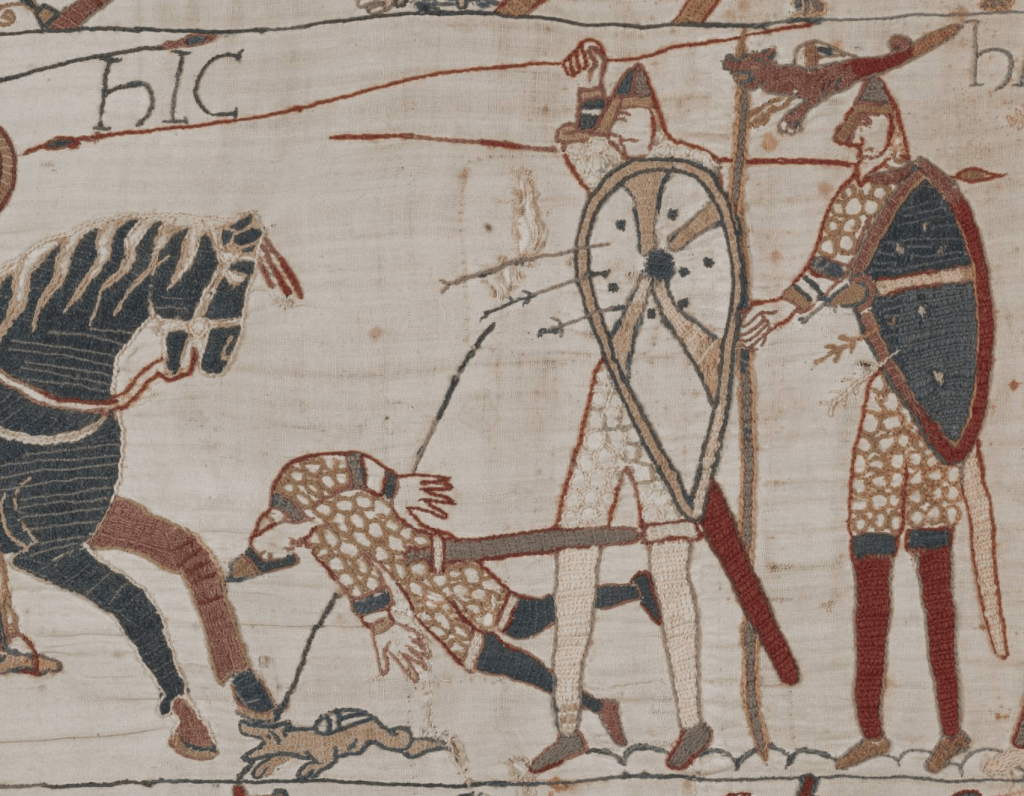
Harold could be the main falling on the left. After all, he is the closest victim to the word ‘HIC’, meaning ‘here’. If this is Harold then he really is here – just below the word. However, I don’t think anyone has ever seriously suggested this identification. On the ground beneath him is what looks like a small, two-legged dragon (or wyvern) with a curling tail. It looks as if the soldier is going to fall on top of it. However, there is also a long stick, maybe the shaft of a spear, which passes behind the falling body and down towards the dragon, possibly even piercing its mouth. It’s not unlike the dragon at the top of the pole held by the soldier on the right of this detail. It represents a dragon-shaped standard, the dragon being the emblem of the House of Wessex – and Harold was the Earl of Wessex. Either there were two standard bearers, with two standards, and one has died, or it is the same person, and this is a form of continuous narrative (a common story-telling technique whereby the same person appears in an image more than once to help tell the story). One pole is far thinner than the other, admittedly, and the soldier appears to have changed his leggings, but the Tapestry is rarely consistent in the way that people dress. There is a good reason for the ‘standing standard’ to be thicker than the falling one: it marks one of the seams in the Tapestry, which is embroidered on nine lengths of linen. This is the seam between the 8th and 9th sections. It is so carefully done that no one noticed the join before the conservation campaign of 1982-83: up until then everyone thought there were eight sections.
Given the presence of the dragon (or dragons), one thing is clear: someone from that House of Wessex must be nearby. After the death of his brothers Leofwine and Gyrđ (depicted in scene 52), Harold is the last of Earl Godwin’s sons alive. However, it is very unlikely that Harold himself would be holding the standard – which is probably why no one has suggested that the man falling forward is Harold. While we’re here, it’s worth pointing out that both of the men standing up have arrows stuck into their shields – there are a lot flying about.
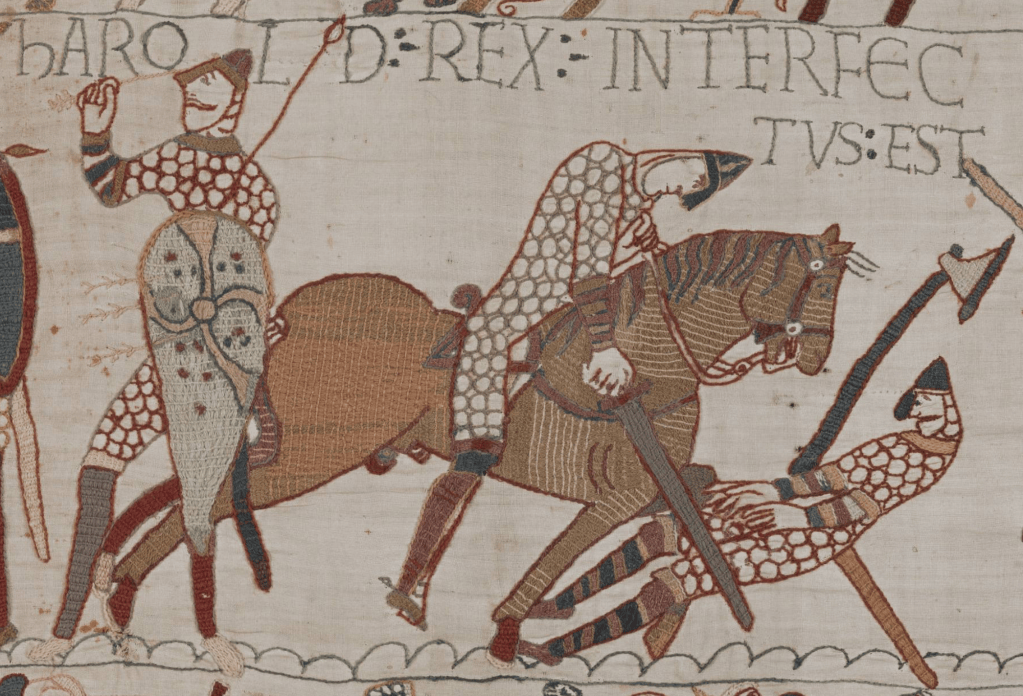
One of the arguments that Harold is the man with the arrow in his eye is that he is the man with the name ‘Harold’ directly above – or around – his head, but again, the Tapestry is not always consistent with this mode of identification. We have also just seen a man who is the nearest to the word ‘here’, and we’ve decided that Harold is not ‘there’. A third suggestion for the King’s identity relates to the nature of Latin grammar: the verb comes at the end of the sentence. You could translate ‘interfectus est’ as either ‘has been killed’ or ‘is killed’. The man falling backwards is directly below the word ‘EST’ – or ‘is’. So he is the man at the end of the sentence where the action is concluded. So maybe he is fulfilling the action of the titulus, and is Harold…
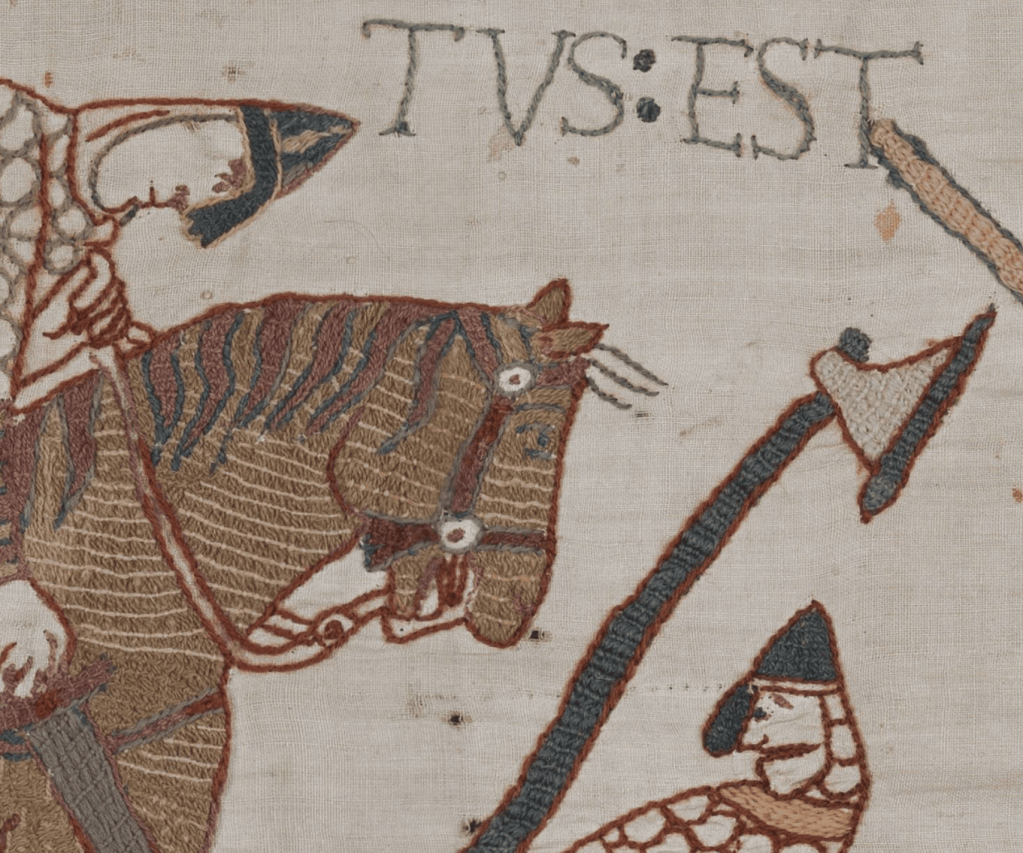
When the Normans appear, early in the Tapestry’s story, it is very clear who is Norman, and who is Anglo-Saxon. The Normans were clean-shaven, both facially and up the back of their necks and heads. The Anglo-Saxons had longer hair at the back and rather impressive moustaches. This distinction starts to blur about half-way through the tapestry, leading to the suggestion that there may have been more than one designer, or supervisor, or team of embroiderers… The other possibility is that, as the work progressed, they had to simplify the design to get it done more quickly. By the time we get to the battle, and the soldiers are all wearing similar armour and all-but identical helmets, there is even less distinction. However, the man falling backwards either has the most enormous mouth, or a sizeable moustache. This could be Harold.
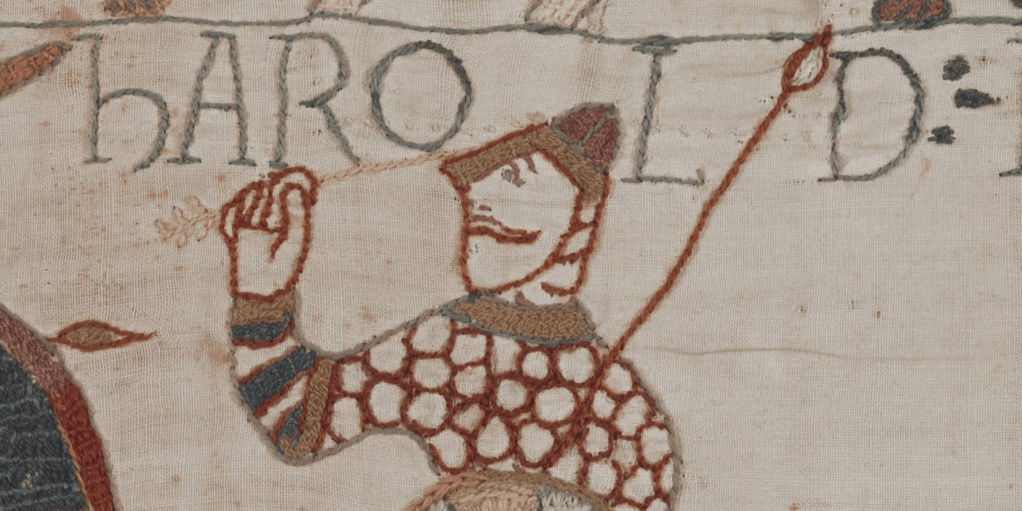
But, of course, the man with an arrow in his eye also has a rather superb, flowing moustache. There is no reason why this figure, so clearly labelled as ‘Harold’, can’t be Harold, surely? It might be useful to look at the literary sources. Among the earliest is ‘The Song of the Battle of Hastings’, which doesn’t mention an arrow. It says that Harold was hacked to death and then dismembered by a group of four Norman knights, one of whom was none other than William of Normandy. The arrow is not mentioned by William of Jumièges either. He wrote The Acts of the Norman Dukes only four years or so after the battle, and said that Harold died ‘covered with deadly wounds.’ The arrow isn’t actually mentioned until the 13th century, probably, some sixty years after the battle. The idea might be the result of confusing one Harold with another: King Harald Hardrada of Norway was killed by an arrow at the battle of Stamford Bridge several weeks earlier. Adding to the confusion, many people believe that, originally, there was no arrow in this part of the Tapestry anyway.
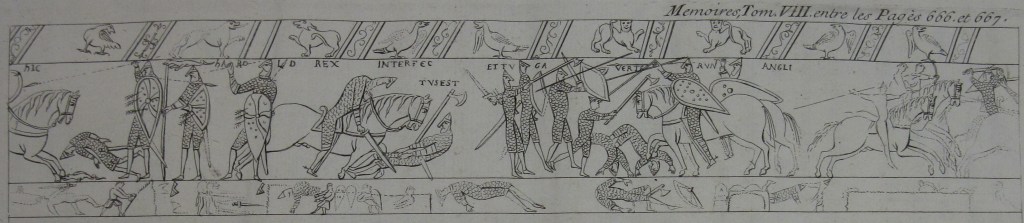
The earliest literary sources would support the idea that Harold is the man falling backwards, being hacked with a sword by the man on a horse. So where did the arrow come from? Maybe it would be an idea to go back to the visual evidence. Ideally, I would like to compare the earliest drawings of the Tapestry to what we see today, to see how much the 19th century ‘restoration’ might have changed it. But I don’t have access to that. Two weeks ago I showed you a print from Bernard de Montfaucon’s Les Monumens de la Monarchie Françoise, but I don’t have access to the relevant section of that either. However, in 1767 a Doctor Ducarel published a book called Anglo-Norman Antiquities considered, in a Tour through part of Normandy. He published a number of images of the Tapestry, with a caption that stated, “The following Plates were published by the learned father Bernard de Montfaucon, in his work entitled Les Monumens de la Monarchie Françoise…”. Admittedly, this is at two removes from the Tapestry (it is based on Montfaucon’s engravings which were based on the earlier drawings), but it is still instructive.
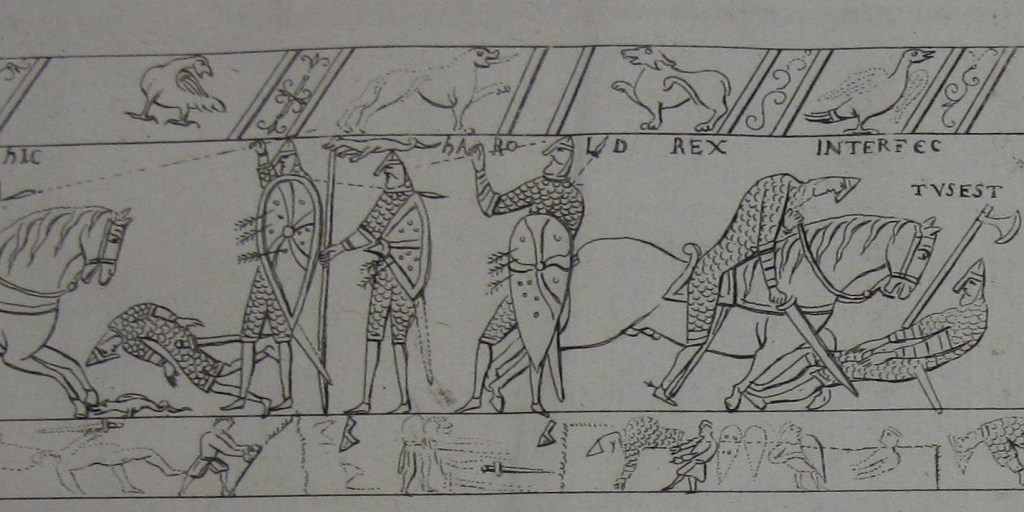
The central frieze, at first glance, seems almost entirely intact. All the figures are there, and in the same place, as are the two dragon standards, and the titulus, which is arranged in more or less the same way, but with slight variations in both position and proportion. The upper border is also very similar. However, in the engraving, the details in the lower border are entirely nebulous. Some dashes, which suggest stitching, imply there had already been repairs, but elsewhere there are elements that are either completely missing, or impossible to define. The naked body towards the left from which the chain mail is removed appears to be complete invention, for example. But how about the arrows? While they are clearly visible projecting from the shields, all that the character labelled ‘Harold’ is holding is a dotted line, and even that doesn’t seem to go as far as his helmet. Let’s look closer, comparing the 18th century print with a detail from a full-scale, hand-coloured drawing made by Charles Stothard between 1816 and 1818 for the Society of Antiquaries of London.
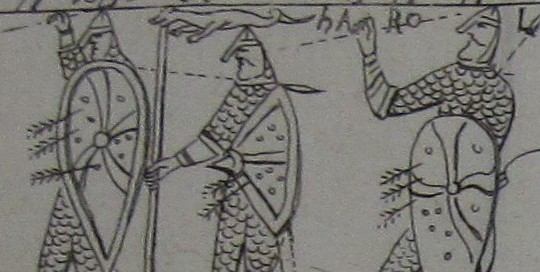
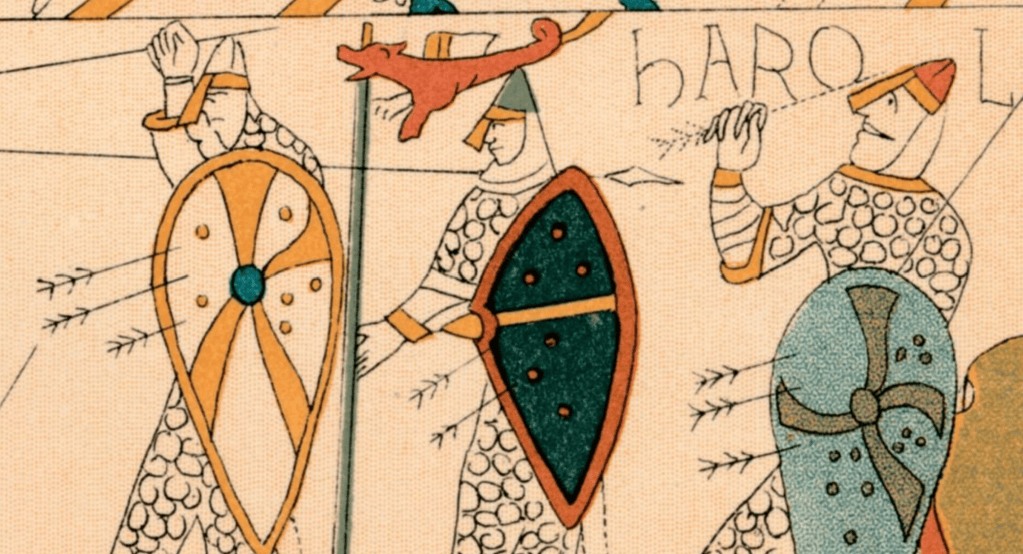
Whereas Montfaucon published a dotted line that extends from above the nosepiece to beyond the letter ‘H’ of ‘Harold’, Stothard has added dotted flights, turning the line into an arrow. However, the dotted arrow passes above the nosepiece of the helmet, it does not appear to go into the eye – or anywhere else in the face for that matter. Nevertheless, there is now an arrow there! It’s possible that Stothard ‘reconstructed’ what he saw as an arrow knowing what the later, 13th century sources, said. Let’s have a very close look at the tapestry again.
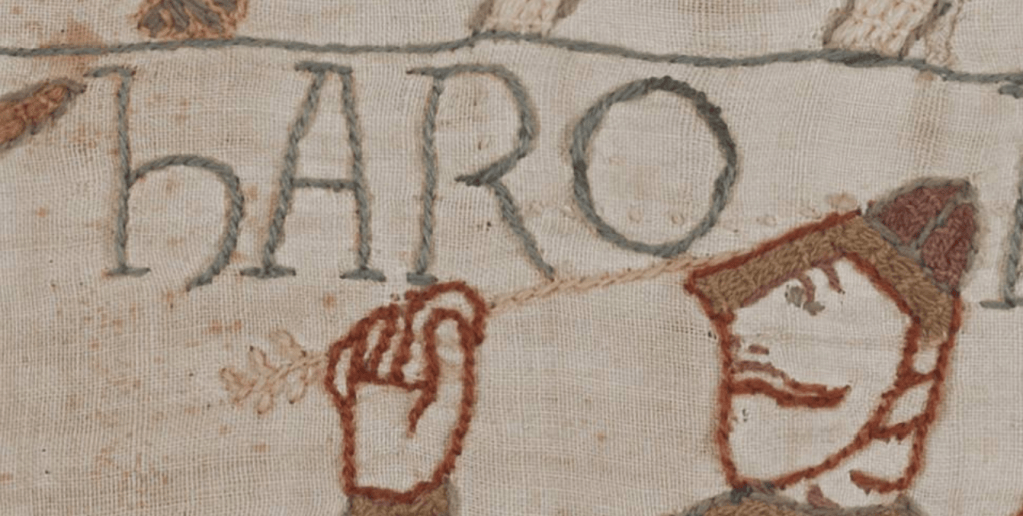
It’s an old and fragile thing, stretched, stained and repaired. There is clearly an arrow, with flights, almost exactly where Stothard drew them. However, the shaft of the arrow disappears behind the nosepiece rather than skimming above it. There are other stiches above the nosepiece, but they seem to track a repair that goes through the ‘O’ and as far as the ‘R’. It is possible that the 19th century restorers made whatever remained of the original embroidery into an arrow, either because they knew Stothard’s drawing, or because they too had read the later source material. But – and I do hope you can see this – look at the very bottom left corner of this detail: there are two tiny holes next to each other, mere pin pricks, which could, just possibly, be the remains of holes from other missing stitches. What did Montfaucon’s dotted line represent? Are there any clues elsewhere?
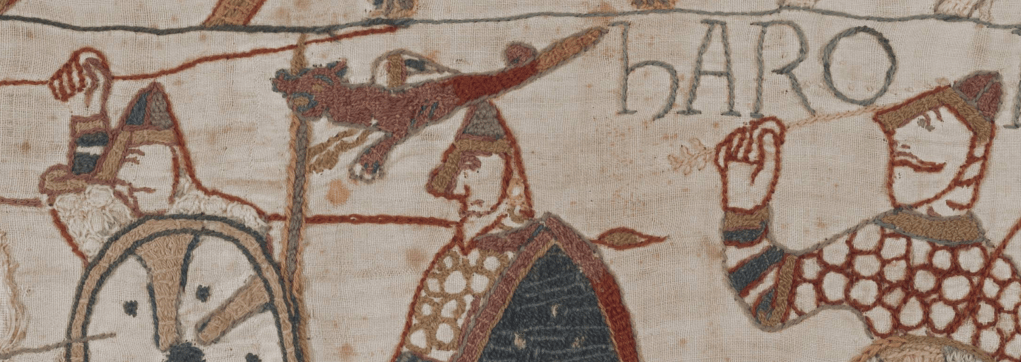
To the left of the dragon standard a man is holding a spear in the air, ready to throw it. Look at the shape of his hand, and compare it to the hand underneath the letter ‘R’. They are in very similar positions. It is more than possible – indeed, it is even likely – that this man (who may or may not be Harold) was originally carrying a spear as well. The pin-prick holes could have been the continuation of that spear.
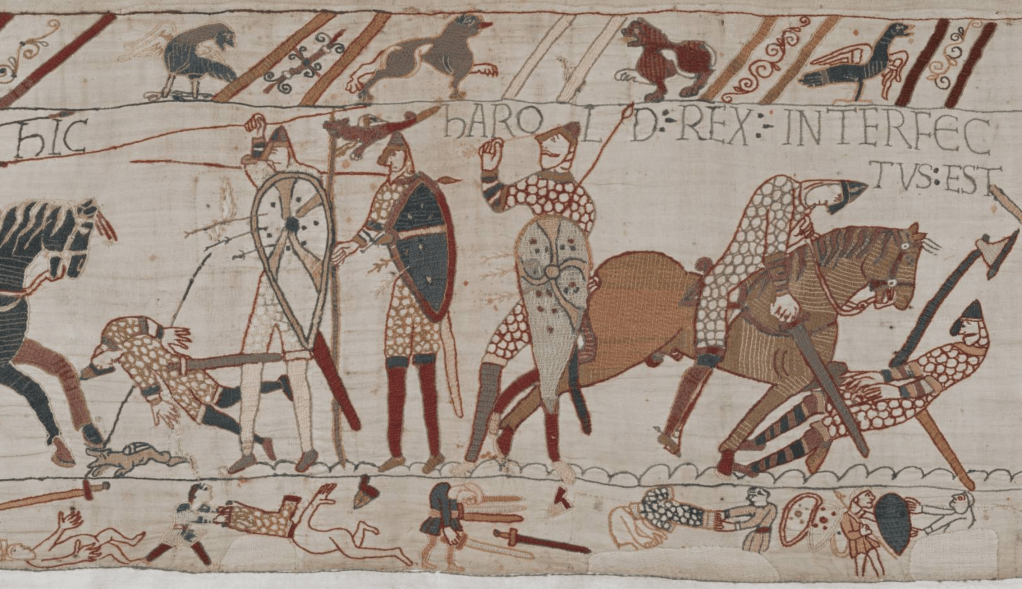
However, if we come back to the scene as a whole, there is a fourth possibility. As a reminder, the first three are (1) the man falling forward is Harold – but we have more or less discounted that; (2) the man who now has an arrow in his eye (and, for all we know, may have done before) is Harold; (3) the man falling on his back could be Harold. But let’s think again about the standard bearer before we consider the fourth possibility. Are there two dragon standards or only one, which is shown twice? As suggested above, it could be that there is only one, and we see the standard bearer twice as well, both standing, and falling forward – a form of continuous narrative. If there is only one standard bearer, seen twice, the fourth possibility is that we also see Harold twice: first, standing by his name, and then falling under the words ‘is killed’.
If, during a battle, a standard was taken, or fell, it would often mark a turning point in the army’s fortunes, as it was an essential tool for communication, and an important focus for morale. If the leader was taken – or fell – the result was even more decisive: the battle was effectively over. Whoever we identify as Harold – either one, or the other, or both – the standard and the head of the House have fallen. Harold was the last remaining son of the powerful Godwin of Wessex. Maybe we are seeing the last head of the dynasty falling at the same time as the standard, marking the actual and symbolic end of the House of Wessex. The Battles of Hastings was also the end of the Anglo-Saxon kingdom – but the beginning of England as we know it. If you are looking forward to the weekend, and your Sunday roast, you might be choosing between pork and beef – but certainly not pig or cow: we have the Normans to thank for that. But then, it could be lamb – which is a word from Old English (people rarely eat mutton – from the French, mouton – these days). I’ll stick to a nut roast though (‘nut’ is also from Old English, as it happens, although ‘roast’ is from Old French). The English are the result of the eventual blending (and it took a long time) of Norman and Anglo-Saxon culture… On Monday, as well as the leftovers from Sunday lunch, we’ll also have time to chew over some of the other problems associated with the Tapestry. One thing I haven’t mentioned – and won’t be discussing – is the myth that Harold didn’t die. Somehow he escaped. But you’ll have to look that one up yourselves…