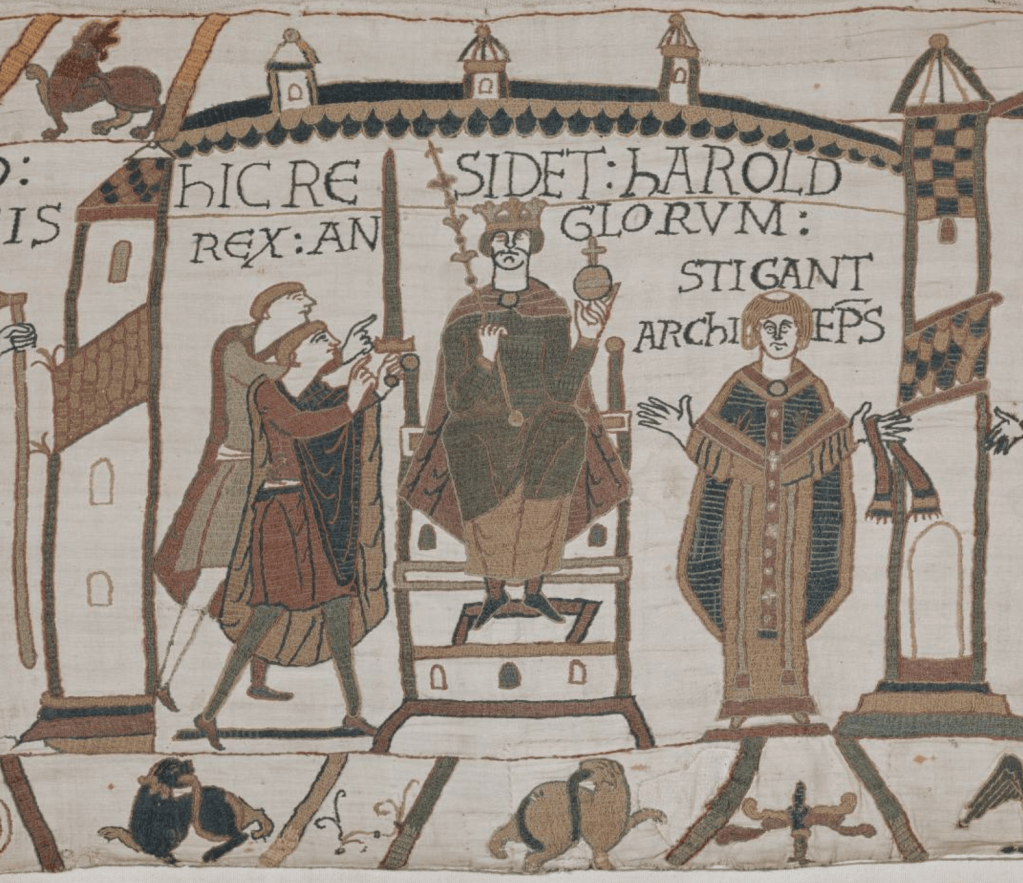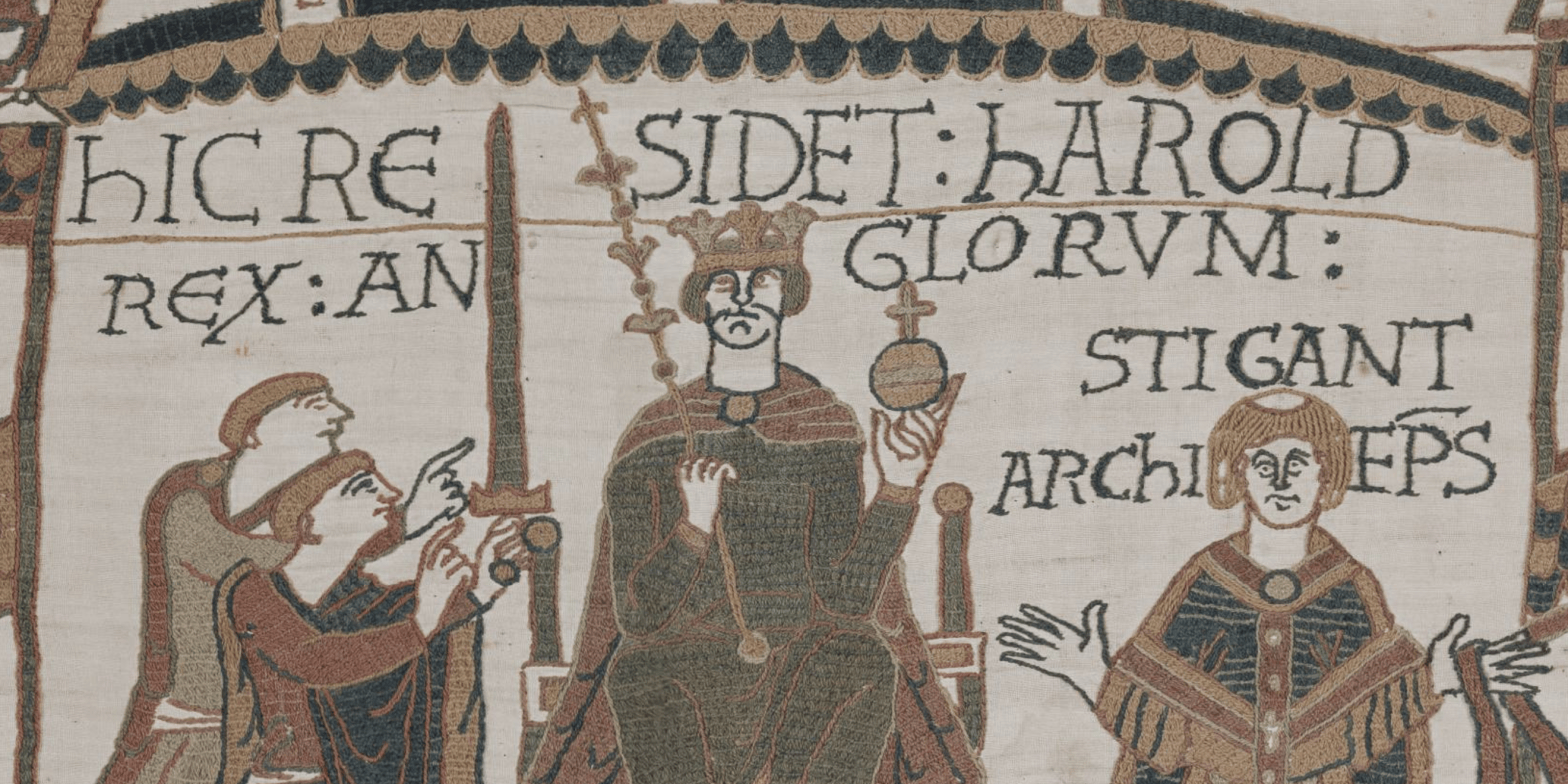
Scene 30, The Bayeux Tapestry, 1070s. Musée de la Tapisserie de Bayeux, Bayeux.
I’m quoting William Shakespeare – as so often before – and in this case it is Henry IV Part II, Act 3, Scene 1. I think it’s relevant, because I’ve come to see the Bayeux Tapestry as being Shakespearean in its scope, and Harold as not unlike one of Shakespeare’s tragic heroes – Macbeth, say, or even Hamlet – but I’ll come back to that another time. Some of us have already traced the first half of the Tapestry with Harold in Normandy last Monday, so this Monday, 12 October at 6pm it will be time for the second half, William in England. We ended the last talk with today’s image, and it is effectively where next week’s talk will begin. Harold’s coronation as King Harold II of England is undoubtedly pivotal, and triggers everything else that follows. More of that on Monday, though. The following week (12 October) we will consider The Bayeux Tapestry in the British Museum and in context, during which I will give you a brief rundown of the experience of seeing the Tapestry while it is in London, before focusing on the questions that arise from seeing it, such as, who are all those people? How are they related? Who made it? How did they know what to make? And who did they make it for? As I’ve said before, most of these questions do not have a definitive answer – but we can still think about the different possibilities.
I will then have a brief Sienese period, talking about Duccio and the Virgin Mary on 26 October and Pietro and Ambrogio Lorenzetti on 2 November. Future plans include a gradual move towards the modern day, starting with two talks about Jan van Eyck – an introduction to his career as a whole on 23 November, followed by a focus on the National Gallery’s exhibition of his portraits on 30 November. But I’ll post those online (and on sale) in a couple of weeks. Everything that can already be booked is in the diary and on my Tixoom page.
Please remember that, if you book for one of these talks, you should get your ticket straight away. If it doesn’t come within a couple of hours, please contact me then, as I can’t deal with anything once I’ve started talking. In any case, I switch off my phone and my emails ten minutes before the talk…
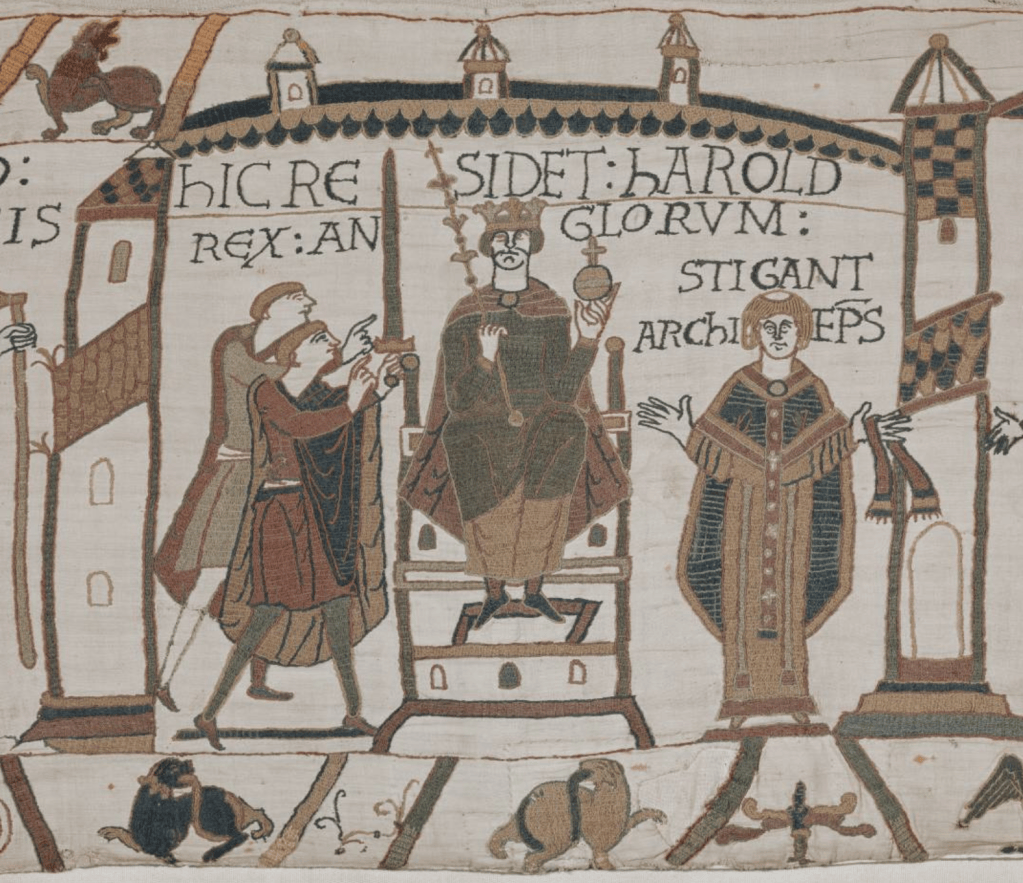
According to the titulus, or caption, of this image, ‘Here sits Harold King of the English’. In the ‘traditional’ numbering – which probably dates back to the beginning of the 19th century – this is scene 30 of the Bayeux Tapestry. Given that there are 58 (admittedly irregular) scenes, this makes it the beginning of the second half. It is clearly important, as the top of the palace within which Harold sits enthroned takes up the full height of the upper border. Two men stand on the left, and one on the right – with a secondary titulus telling us that this is Archbishop Stigand, who was the Archbishop of Canterbury when Harold was crowned (the line above the P in EPS tells us that this is an abbreviation: it stands for episcopus, meaning bishop). For once in the Tapestry a cleric is actually wearing clerical garb. He is also tonsured, as almost all of the clerics are: the top of his head is shaved as a sign of his humility before God.
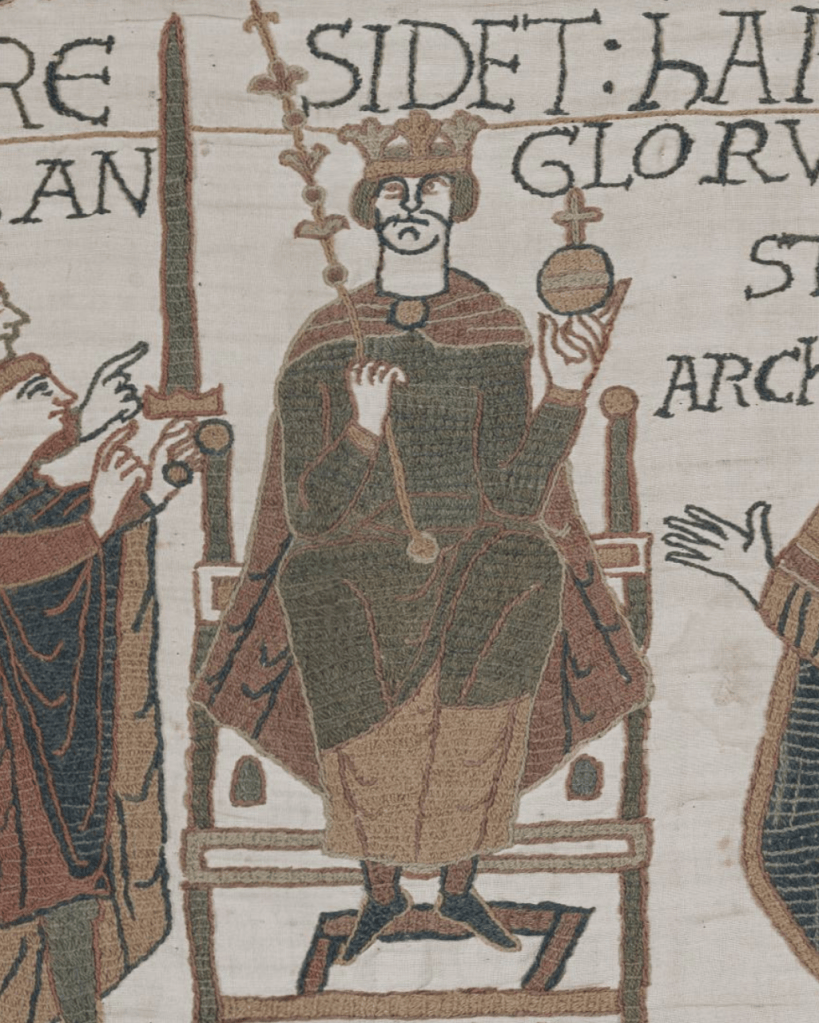
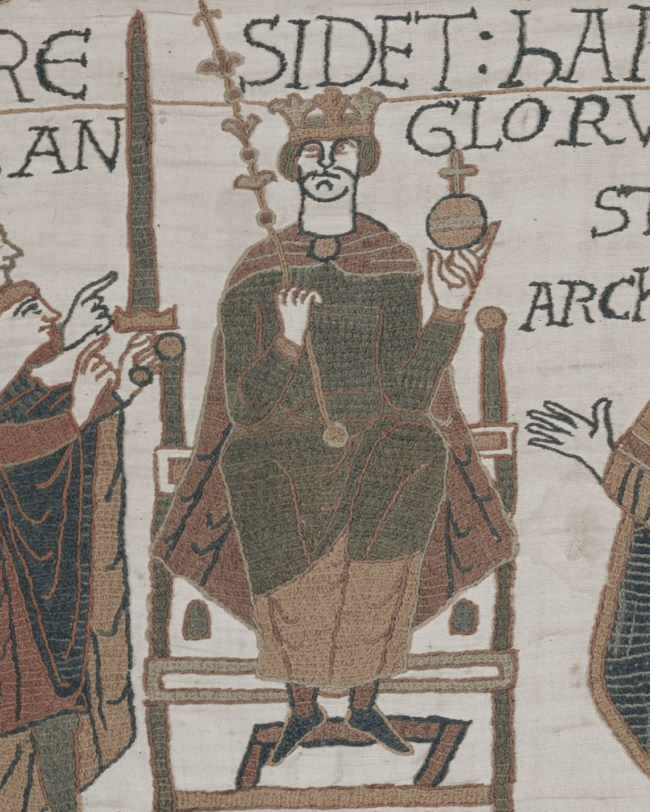
Harold looks entirely self-assured as King. His sits formally – upright, facing front, holding his sceptre in his right hand, with his orb poised delicately on his left. His crown fits perfectly, although maybe it is a little large, the rim sitting on his eyebrows, and the three tines (the same word as is used for the prongs of a fork) reaching up beyond the thin line which is either a lowering of the upper border, or an architectonic detail. Nevertheless, all seems to be well.
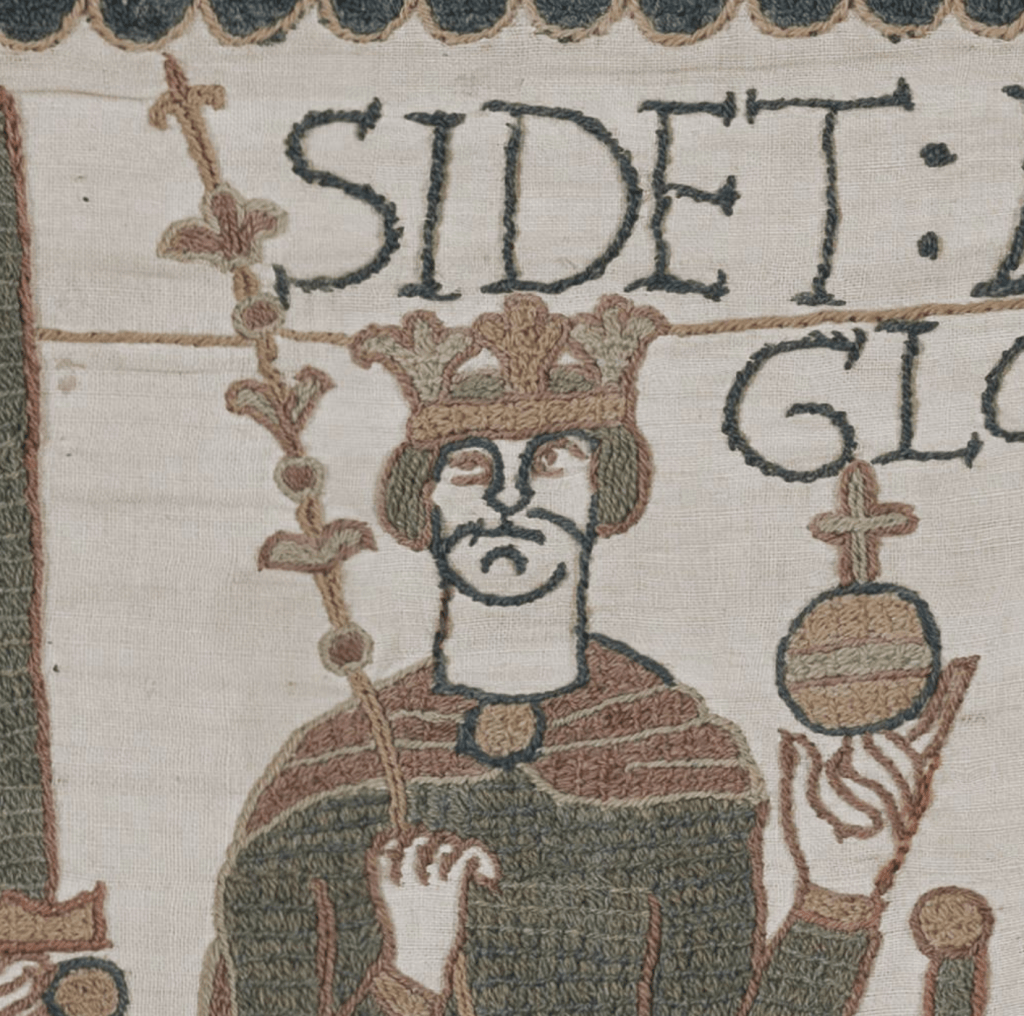
I’m showing you this detail simply because I can – but also to show you what could be seen as an insecure grasp on the orb. It is a model of the world – a sphere, with the equator marked on it, a pale green band delicately outlined in brown. It is a sphere: I have never believed that anyone in the past two and half millennia ever seriously believed the earth was flat (the Ancient Greeks certainly didn’t). The orb represents Harold’s Christian rule, a symbolism made clear by the cross which surmounts it. Were it more detailed, the upper hemisphere would be divided in two with a vertical line from the cross to the equator, thus dividing the orb into the three known continents, Europe, Africa and Asia – but this is a small detail and a refinement that might have been beyond the embroiderers’ capabilities. Nevertheless, the fingers are wonderfully evocative, stylised as they are. The forefinger is stretched straight, and the orb rests against it, while the middle, ring, and little fingers are curled, supporting the weight. He doesn’t even need the thumb, it seems, but it’s there to provide balance just in case the orb rolls from its upright position. The sceptre, on the other hand (both literally and practically), is held rather awkwardly. Harold’s manly, Anglo-Saxon moustache is clearly evident, slightly clashing with the line of his mouth, and we can also see the upper outline of a protruding chin.
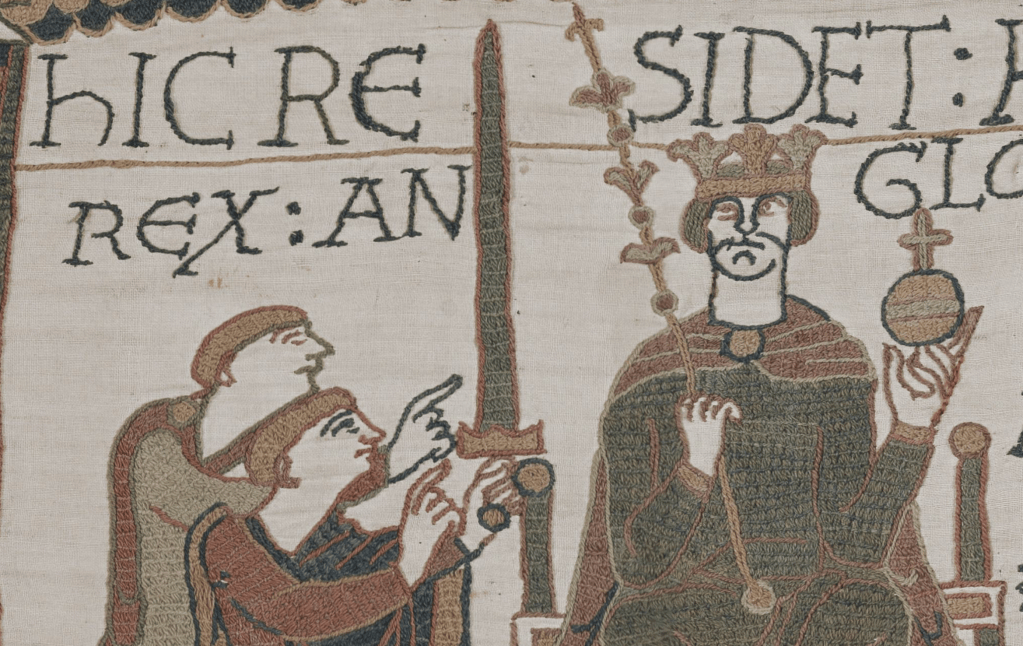
Two men stand in acclamation, both of them pointing to the King – we cannot doubt he is the monarch. The foreground figure holds a sword aloft in his left hand acknowledging Harold’s power – and putting himself in Harold’s service. He must himself be pretty strong to be able to hold such a weighty object at shoulder height for any length of time. Everything seems to be in place. Harold has been crowned king, and all is right with the world.
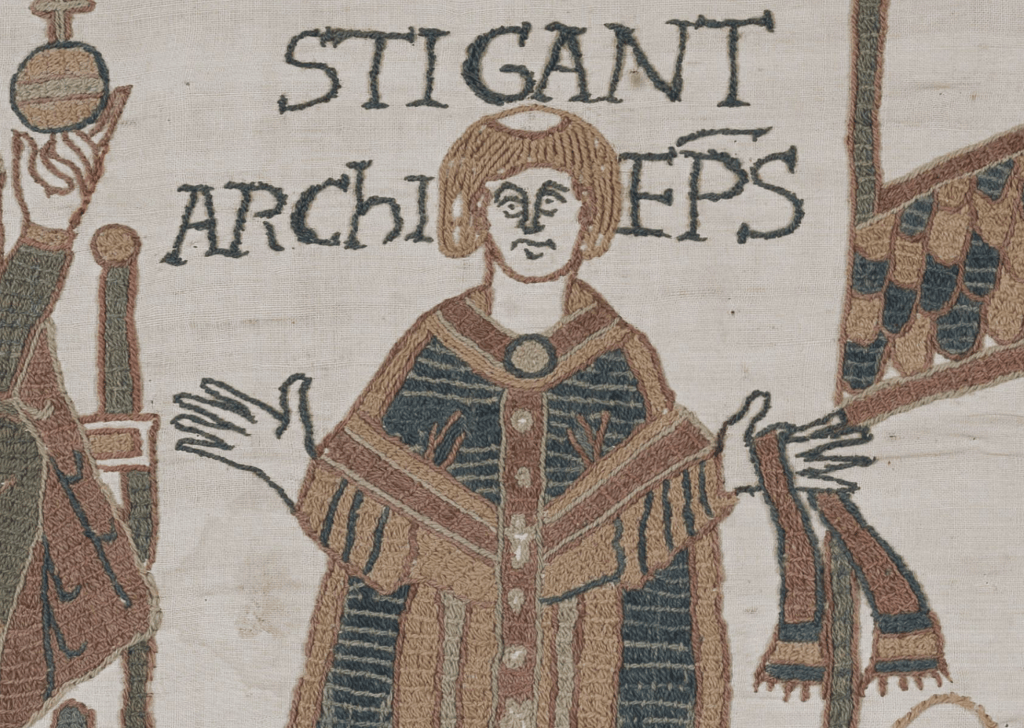
But what about Stigand? He stands facing front with his two hands raised, apparently adopting the posture of an orant – a character from early Christian art (2nd – 6th century) whose name means ‘praying’. This is indicated by the two raised hands and outstretched, bent arms. In his left hand he holds a strip of fabric with fringes at the end – some sort of scarf. Although it is shown as brown, I suspect it is meant to be white, but colour is never purely descriptive in the Tapestry: it is chosen to make objects clearly visible. I suspect the scarf is meant to be white as I think it is meant to be his pallium, which, if naturalistically depicted, would be a circular band of white lamb’s wool with strips hanging down the front and back: archbishops wear them round their necks. A newly appointed archbishop was supposed to travel to Rome to receive a pallium from the Pope, but Stigand didn’t go. He had been appointed Bishop of Winchester in 1047 and five years later also became Archbishop of Canterbury. At this point he should have given up Winchester, but didn’t: holding two offices was seen as a sin, and is known as ecclesiastical pluralism. This may be why he didn’t go to get his pallium – to avoid being punished. However, he did receive one later from Pope Benedict X – or rather, Antipope Benedict X. Benedict was seen as schismatic, and consequently Stigand’s status was also open to question. Not long after, Alexander II, pope from 1061 – 1073, wanted to root out all those who supported his rival, Antipope Honorius II (Benedict X’s successor). As Harold was said to support Honorius, Alexander in turn supported William’s invasion of England. It is said that he even sent a papal standard for William to carry into battle, a standard that may well be represented in the Tapestry. This becomes even more relevant when you learn that most contemporary historians agree that Stigand, despite being Archbishop of Canterbury when Harold was crowned, was not the Archbishop who crowned him. The coronation was almost certainly performed by Ealdred, the Archbishop of York. The inclusion of Stigand in scene 30 suggests two things, which are not necessarily contradictory: either this is not the coronation, or Stigand was included as a subtle slur on Harold’s claim to the throne. The scene could represent an ‘acclamation’, a formal expression of approval, during which the people accept a new sovereign. Indeed, as we will see on Monday, to the right of scene 30 there is a group of onlookers who seem to be in the very process of ‘acclaiming’. However, given that Stigand is present, but Ealdred is not, we might think that something is rotten in the state of Denmark. And yes, this is a reference to Hamlet, but then Harold was half Danish… Maybe we should take another look and check Harold’s body language.
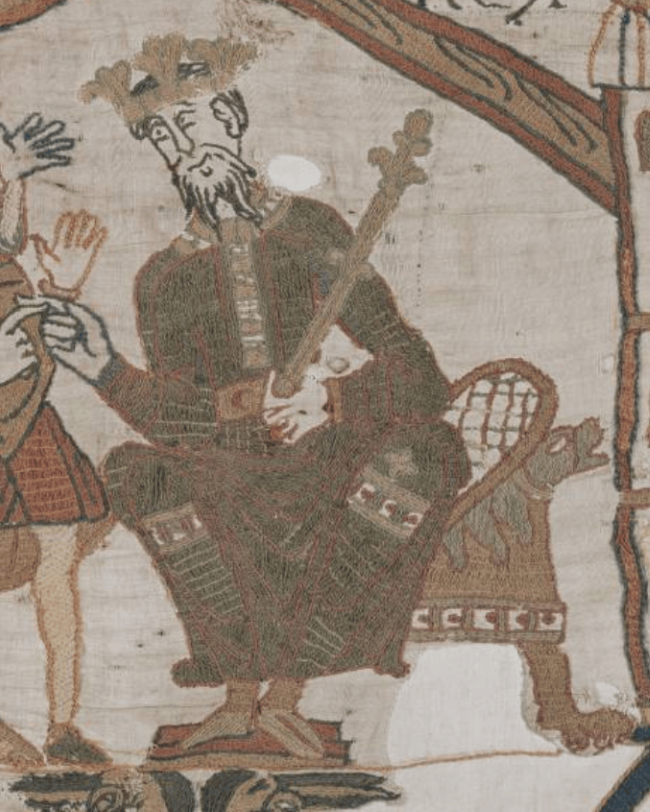
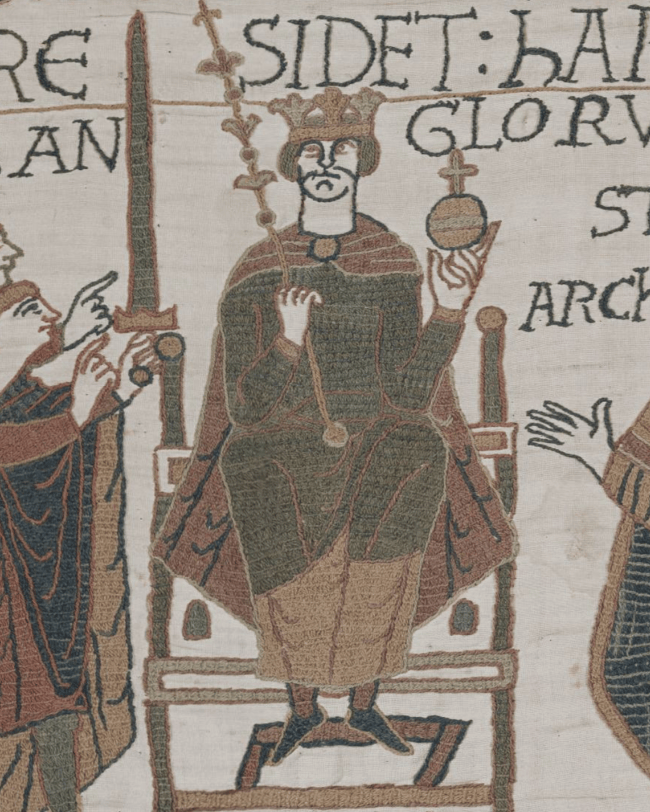
Last week, when I wrote about scene 1, I mentioned that Edward was adopting a posture typical of a king in medieval England. His feet are close together, but his knees are wide apart, thus taking up more space and showing how powerful he is. Although he leans towards the men with whom he is talking, he does not turn his shoulders towards them, thus remaining frontal and formal. He holds his sceptre at what would be about 45˚to the vertical, were he sitting upright. Compared to this, Harold may be sitting upright and frontally, but his feet are not so close together, nor are his knees so far apart. Not only that, but the sceptre, as well as being held awkwardly, is also held closer to his body: it’s more like 20˚ to the vertical. To me, his body language suggests that he is not entirely comfortable as King: he is holding things – his knees, his sceptre – too close to his body, as if he is feeling insecure. Let’s see how this compares to his main rival for the crown, William of Normandy. What was William up to in scene 23, while Harold was swearing his oath to support him?
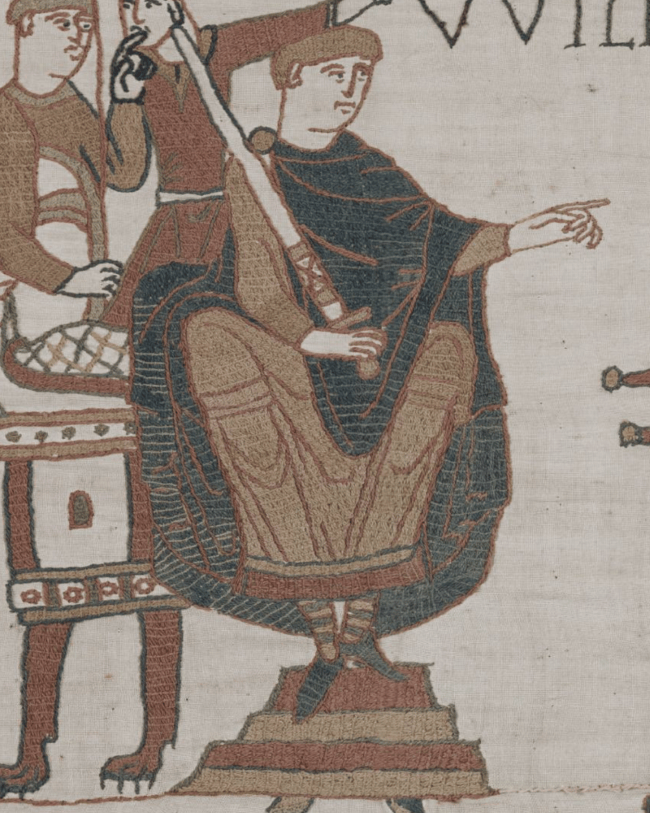
Again, the feet are close together and the knees further apart. He holds a sword, not a sceptre, as he is a duke, not a king, but it is still a sign of his status as a leader. It is held further out than Harold’s sceptre (although maybe at only 30˚). Compared to Harold, William seems far more secure in his role: maybe he would make a better king? I could be entirely wrong about this, I could be reading too much into it, but despite his acclamation, I think that Harold’s body language suggests that he knows things are not going to go well. We know it too, because we know how the story ends. I haven’t shown you the ‘acclaiming’ crowd today, but they will also realise – almost immediately – that something is going to go horribly wrong. When the penny drops, they do the most remarkable double take… but to see how they react, and why, you’ll either have to join me on Monday or have a good look at the Tapestry itself.