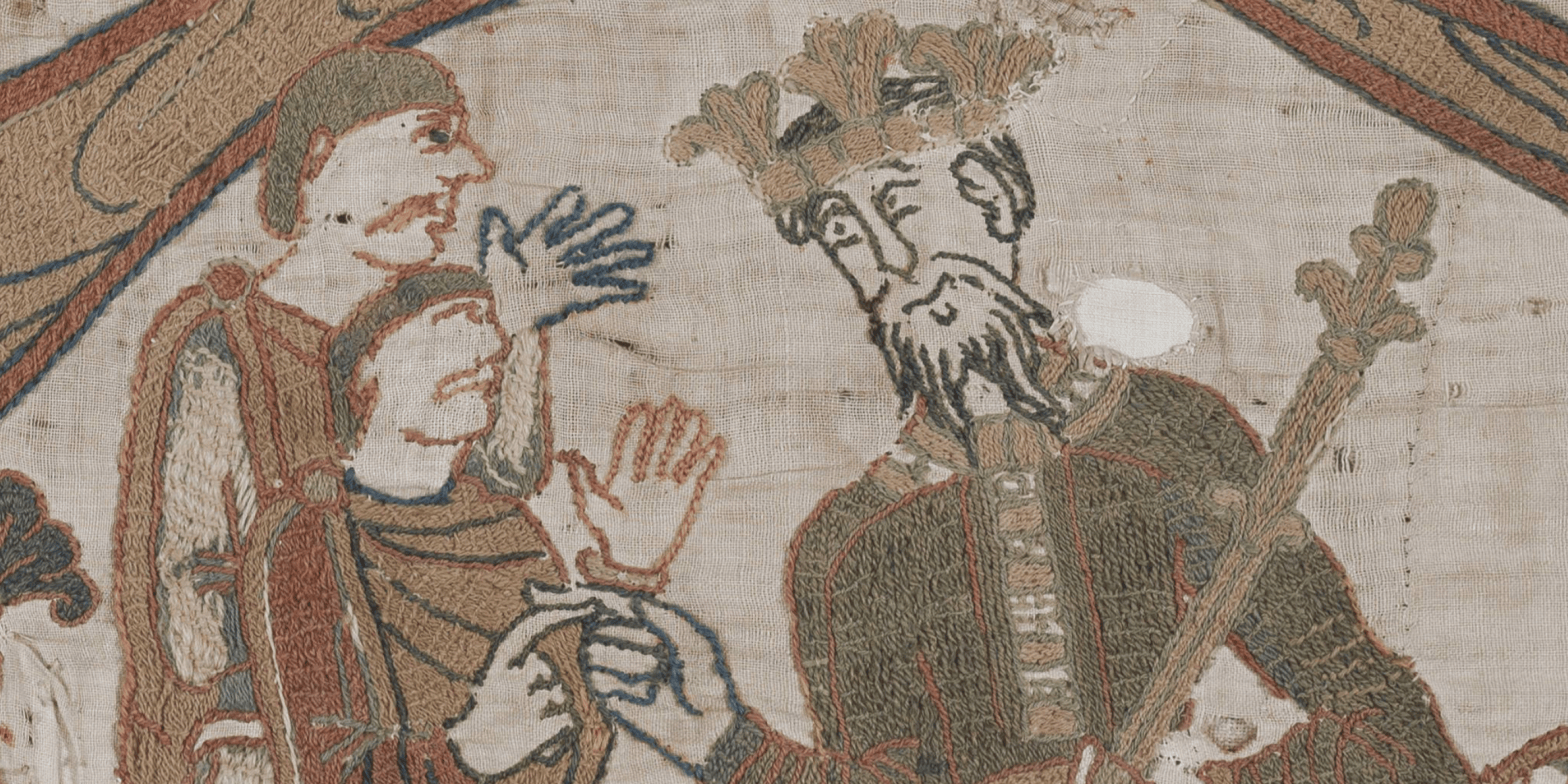
Scene 1, The Bayeux Tapestry, 1070s. Musée de la Tapisserie de Bayeux, Bayeux.
Well, it’s finally here, and by the time you read this, I will finally have seen it! Indeed, there’s so much to see that, as I’m sure you know, I am dedicating three talks to it. The Bayeux Tapestry, that is – is anyone thinking of anything else?! As ever, the talks will officially last 75 minutes (I know, I usually stretch to 80), and I am mentioning this because somebody recently said, ‘I can’t watch for two hours on my tablet…’ – but I haven’t done a two-hour talk for a couple of years now, and probably won’t again. I do, when making ‘guest’ appearances with other organisations, but on my own I’d rather stop for dinner! The first talk, Harold in England, will be this Monday, 5 October at 6pm and will cover the first half of the Tapestry: Harold Godwinson’s mission to Normandy and return to England, ending with his coronation as King Harold II. The following week (12 October), the second talk, William in England, will cover everything that ensued: William of Normandy’s plans for war against Harold, Harold’s death, and the consequent defeat of the ‘English’ at the Battle of Hastings. I say ‘English’, because in reality they were Anglo-Saxons. Having said that, Harold himself was only half Anglo-Saxon, given that his mother was Danish: things are always more complicated than you might think. It will take me two talks to look at the 67m-long embroidery (you know it’s not a tapestry) in detail… so in the final week, Monday 19 October, I will look at The Bayeux Tapestry in the British Museum and in Context, doing my best to deal with the unanswered questions from weeks 1 and 2, such as, ‘who made it?’, ‘who designed it?’, ‘what were the sources for the design?’ and ‘who was it made for?’ – not to mention ‘who was Ælfgiva?’ and ‘which one is Harold?’ I may not be able to answer all these questions, but we can certainly consider most (if not all) of the possibilities. In the weeks that follow I will try and get back up to date by looking at some more modern art… from 14th century Siena. Duccio and the Virgin Mary will be on 26 October, and Pietro and Ambrogio Lorenzetti on 2 November. It’s all in the diary, and on my Tixoom page, of course! Meanwhile, back to Bayeux.
It’s often said that ‘what you see is what you get’ – but unfortunately that’s not always the case with the Bayeux Tapestry… which is what today’s post is really about. Nevertheless, it’s worthwhile having a close look at all the details, and to do this, I have been using the website of the Musée de la Tapisserie de Bayeux, and especially their high resolution interactive page Explore the Bayeux Tapestry online. Alternatively, you could use the British Museum’s Bayeux Tapestry Online Experience which has many hotspots to click on for more information – although they do get in the way, perhaps, of uninterrupted close looking. But what do we see? And what are we getting?
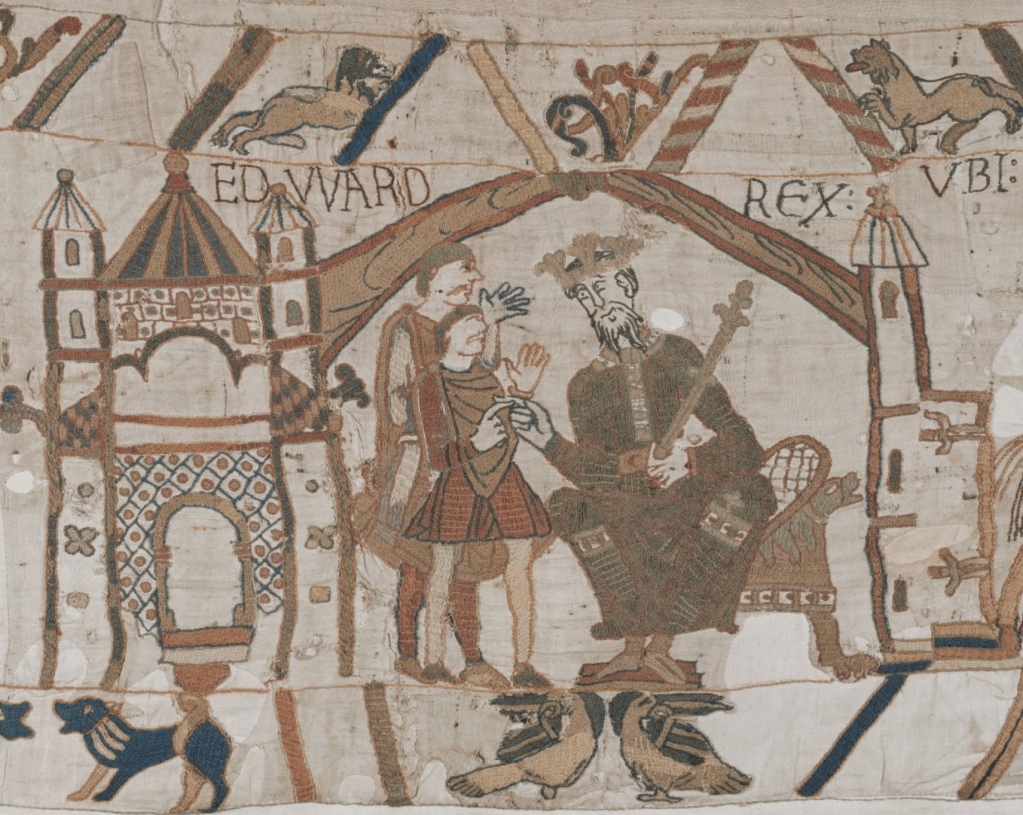
This is the first scene, at the very beginning of the Tapestry. And yes, I know it’s an embroidery, and not a tapestry, but then, the Battle of Hastings didn’t actually take place in Hastings. There’s even a scene in the Tapestry of the soldiers leaving Hastings to go to the battle site, which was subsequently named ‘Battle’. No one is ever going to change the name of the battle, though: the Battle of Battle just sounds ridiculous. However, it is worth pointing out that the French use the word tapisserie to mean any kind of textile wall hanging – which could include a tapestry – and they can even use it to mean wallpaper… In the same way I still talk of doing the hoovering even though I’ve never owned a Hoover. I’ll keep calling it the Tapestry, with a capital ‘T’, just to remind us! The first scene shows King Edward, who we now know better as King Edward the Confessor (which means he died confessing his faith – i.e. he was a good, saintly Christian… a fact which some historians dispute). There are various ways that we can tell he is a king. First, he is enthroned, i.e. seated in a big chair – it has animal-head arms and clawed feet, not to mention a large cushion. While he is seated, other people stand and talk to him – a sure sign of his status. However, this only tells us that he is some sort of leader, but the feet together, knees apart posture he adopts is a form of medieval manspreading which generally denotes a king. Although he talks to the people to our left, his shoulders are still more or less parallel to the picture plane, which visually implies a slight detachment from the real world, and so a higher status than the two men who are in profile – meaning that their bodies enter our space more (one shoulder is closer than the other). Edward is also, of course, wearing a crown, and carrying a sceptre – an elaborate form of commander’s baton – and these are two unequivocal symbols of his kingship. As if that wasn’t enough, it says ‘EDWARD REX’ at the top of the image – ‘King Edward’. This is one of the tituli of the tapestry, and each titulus – ‘title’, ‘label’ or ‘inscription’ – tells us who a character is, or what is going on. In one case, it also includes reported speech. The tituli are clear, and bold, and never elaborate. For example, although we are told this is King Edward, we don’t know who the other two are, or what they are talking about. It is left for us to work it out for ourselves – but, there is a clue. Like Latin, and English, and Western European languages generally, the tapestry reads from left to right, and all important action also takes place from left to right. Edward is looking to our left, and this implies that he is not necessarily going anywhere (this is not a hard and fast rule: people can arrive and depart), whereas the two men are going somewhere. Given that the next scene includes Harold Godwinson, it is usually assumed that he is one of the two men here. But that is only an assumption.
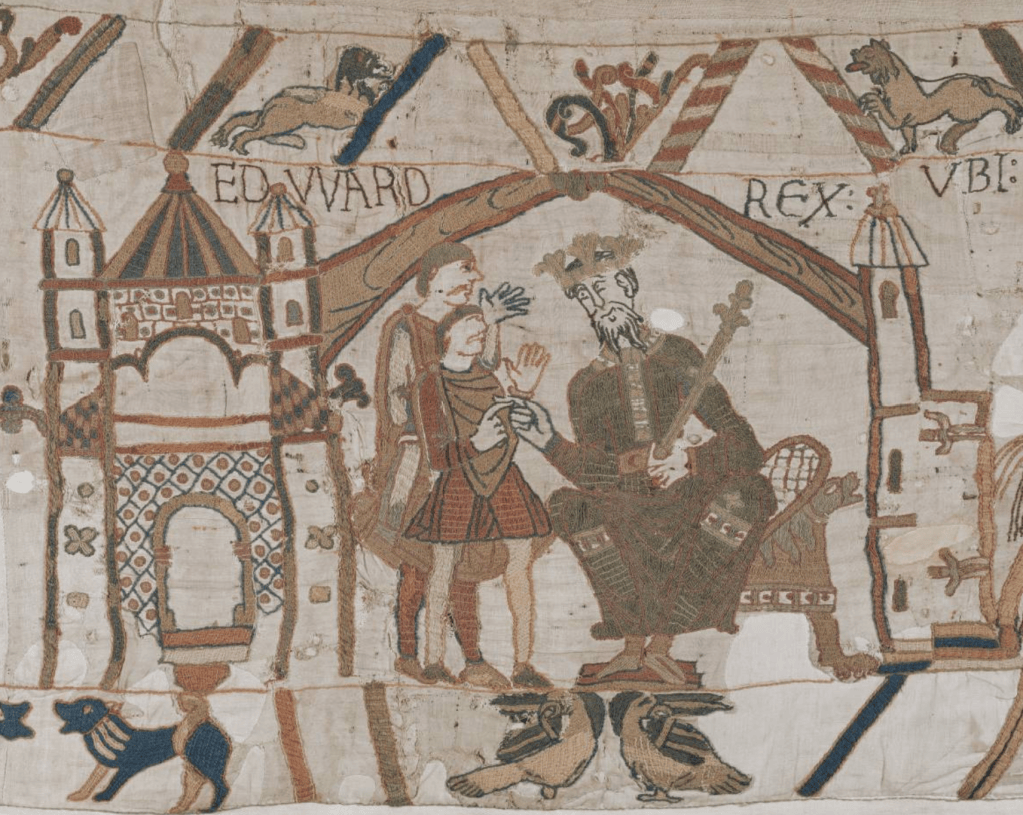
The three men are inside a large building. That they are inside is conveyed by the roof-like structure above their heads, although the curving black lines within it could be folds in fabric: a canopied, tent-like structure would be another way of enhancing Edward’s status. Nevertheless, this is attached to a tower on our left, which has two turrets, one on either side. Each of these has two windows, one above the other, implying a building with more than one storey. The central block of the tower has a large, round-arched window at the bottom, and three smaller windows – the same size as those on the turrets – at the top. The walls are patterned with horizontal and vertical lines and dots at the top (suggesting decorated building blocks) and diagonal lines (making diamonds) and dots at the bottom. Half way up the turrets there also appear to be tiled rooves to the left and right of the structure. This clearly represents a large and elaborate palace – but which one? The British Museum website suggests it is Westminster, which it may well be. The original Palace of Westminster was built during Edward’s reign, and probably in the 1040s and 50s. However, it is worthwhile remembering that in 1043 he was crowned King of England in Winchester Cathedral – so this could be the Anglo-Saxon Palace of Winchester, which probably dated to the late 9th century (it was rebuilt in the 1070s, after the events depicted in the Tapestry). On the right is a similar turret to the two on the left, with three windows arranged vertically – suggesting it has three stories. Projecting from this, to our right, is a rectangular structure with two forking horizontal bars. I think these are hinges, and that this is one of the doors of the palace (there is certainly a door like this depicted later in the Tapestry). The two men will leave the building, and, as we will see on Monday, they will mount their horses to ride to Bosham.
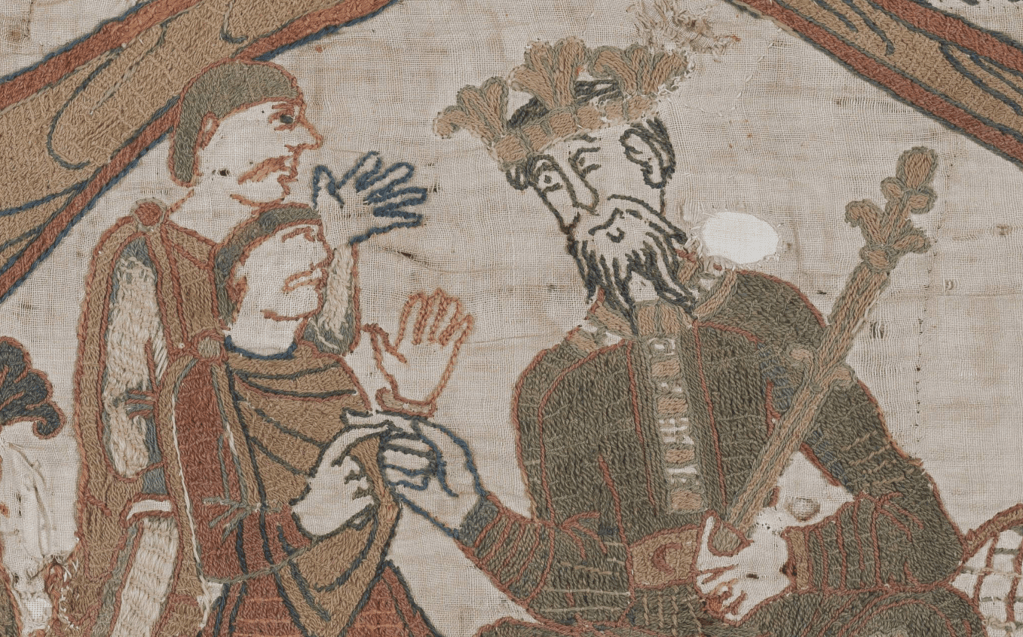
But what are they discussing? Edward leans towards the two men, holding his sceptre in his left hand and pointing at the nearer, shorter man with his right. He might even be touching this man’s chest. The shorter man is probably Harold. Even seated, Edward towers over him – the medieval convention being that size is equivalent to status. However, this doesn’t always apply. The man at the back appears to be taller than Harold, but I don’t think he is more important. In this case, he is larger simply so that we can see him. Both men hold up their left hands with the palms towards us and the fingers and thumbs spread wide. This gesture is interpreted in different ways, which are not necessarily contradictory. Most frequently it is said to be a sign of being impressed – of amazement or awe – a sort of ‘wow’ emoji expressed manually. But it is also suggested that it tells us that the person is speaking: this would make sense if the men are expressing how much they are in awe of the King and of what he is saying. Pointing functions in different ways. Sometimes a character is pointing towards their own name, or the name of one of the people present, and in others, they are moving the action forward, or indicating the most relevant feature of a particular event. If one person points to a second, it means that the second person is speaking – so in this case, it would imply that Edward and Harold are talking to each other. However, if the pointing hand touches another person, it implies a command or injunction – or even an oath. Again, this makes sense here, as Edward is telling Harold to do something… although again, at this point, it is not clear what Harold is being told to do – but we will consider the options on Monday. Harold is being sent on a mission – and that mission is the subject of my first talk. So far, good – although, we have only been looking at details. This is not necessarily how you see the Tapestry when it is in front of you.
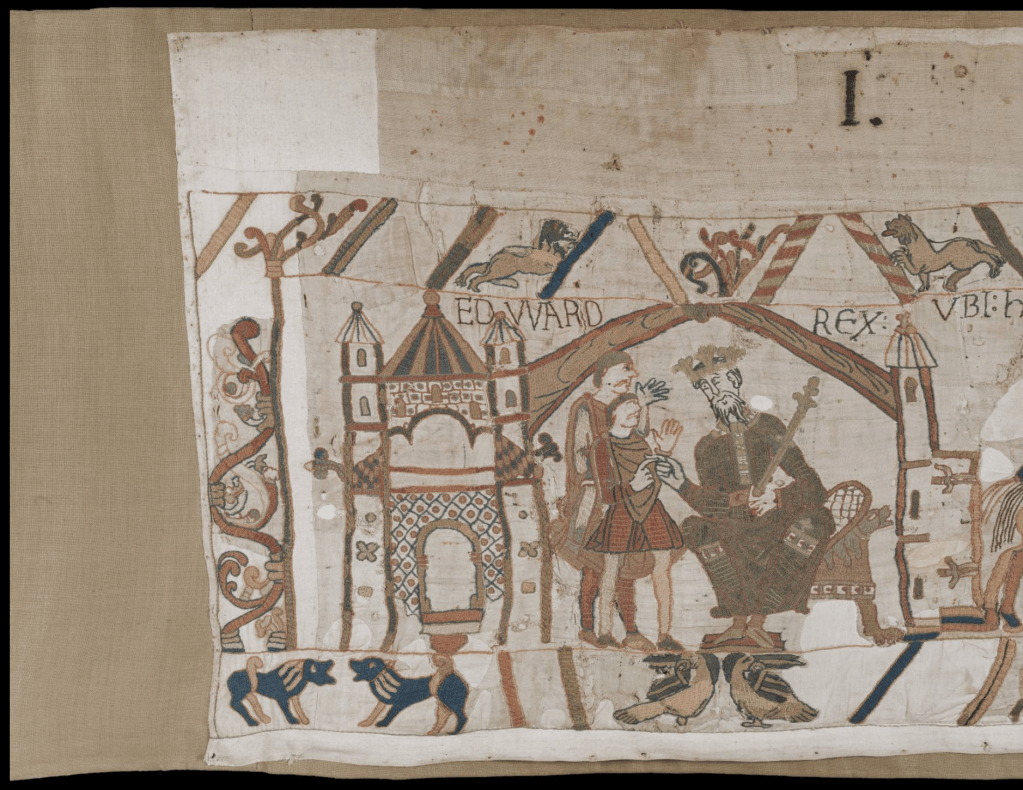
It has a very long history. After all, the Battle of ‘Hastings’ took place 960 years ago (to the month), and this textile is, at most, 940 years old (probably). It has suffered as much as anything that age would. If anything, it is astonishing that it has survived at all. The very first unequivocal reference to it is not until 1476, when it was stated that it was displayed in Bayeux Cathedral every year for a week during the Festival of Relics. This means it was taken out of its box, unrolled and hung in a church lit by lamps. The mere act of hanging would have damaged it, however it was done, and the lamps would also have produced soot… It was embroidered on relatively thin linen, which, with time, has worn, frayed and torn. It has been relined and mounted on several occasions. In the image above, the black background is the result of the appearance of the digital file I have cropped it from. The brown backing, with a broad edge on the left, and narrower at top and bottom, is a late 20th century mount. However, you won’t see that at the British Museum. It still appears to be there at the top of the textile, but at the bottom you will see a brand new, light-coloured fabric onto which the Tapestry has been laid. As well as the ‘recent’ mount, there is also a ‘historical’ one which extends some way beyond the original size of the Tapestry, of more-or-less the same colour as the original linen, so it is not at all intrusive. However, there is a light rectangle at its top left corner, passing down the left side, and there is also a thinner line running along the bottom. This lighter colour at the top left marks an area of repair, which also passes between the decorative border that ‘announces’ the beginning of the Tapestry, and the Palace just to the right: the embroidery might have been saved, but some of the original linen was lost. However, inevitably, it is more complicated than that.
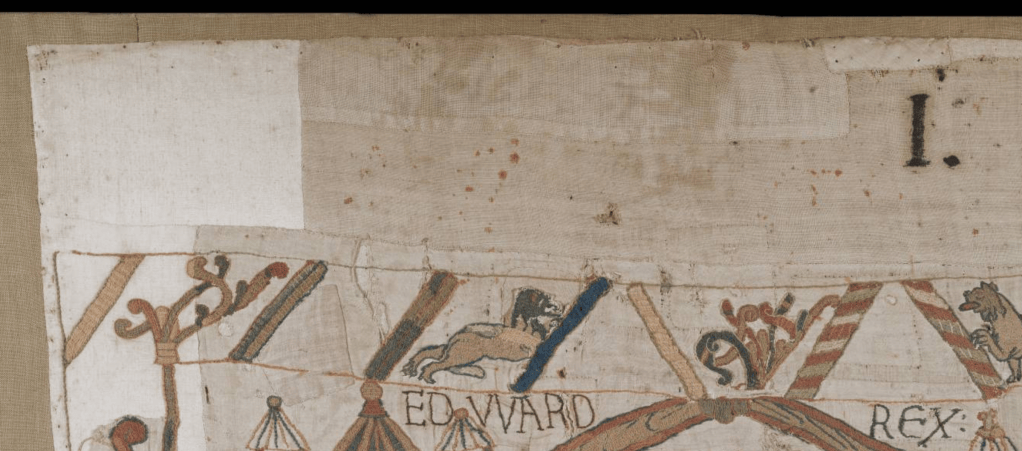
The letter ‘I’ marks the first ‘scene’ of the tapestry. There are 58 scenes, and their numbering probably goes back to the early 19th century – although numbers 57 and 58 were added during the Second World War by a branch of the Nazi SS when Bayeux was under German occupation. The backing strip on which they are written is even older – but it’s not clear how old. However, it is old enough to have been repaired many times, as you can probably see here, with different strips visible both above and to the left of the ‘I’. The scenes are ‘somewhat arbitrary’ according to the book which accompanies the exhibition (it doesn’t count as a catalogue, as it doesn’t say what is in the exhibition… apart from the Tapestry, of course), but are made up of different events or episodes which are often divided by highly stylised trees, or buildings. The linen of the Tapestry itself terminates just millimetres above the thin embroidered line marking the edge of the upper border: you should be able to see a seam sloping down to the right. The borders, at top and bottom, are filled with diagonal lines which are usually paired, and in opposing directions. They are populated by animals, birds, and mythical creatures, although when the narrative gets particularly exciting, the upper border we see in the detail above will get pushed out of the way by the expanding contents of the central frieze.
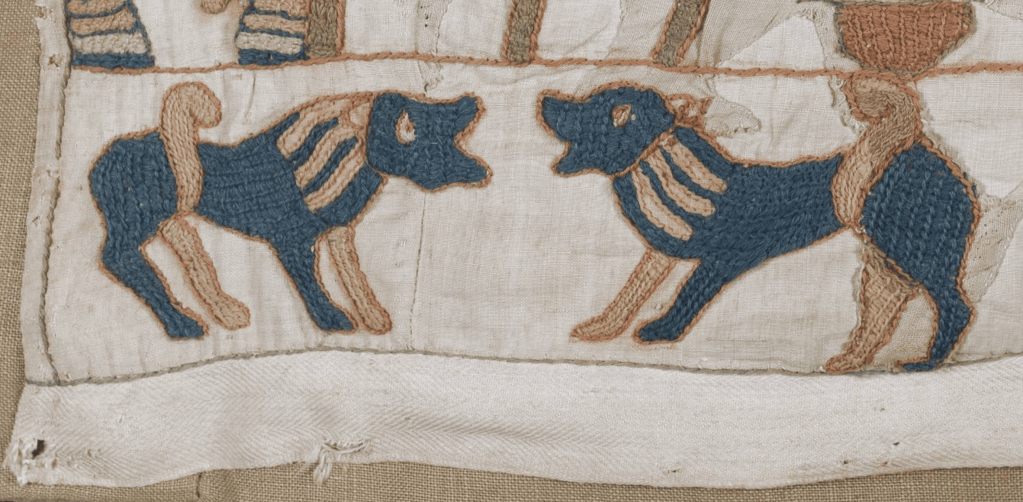
Looking down to the lower border, at the very beginning of the Tapestry, we can see that it starts with highly stylised, paired lions. Later on, there are also small narratives: references to fables, to farming, and eventually to fighting, death and plunder. Unlike the upper border, where the tapestry ends a few millimetres away from its thin outline, the lower edge ends abruptly with the fine embroidered line. There is a more recent backing strip, woven from thicker threads in a herringbone pattern, which runs along the full length of the tapestry. It is about three centimetres wide and was probably added in the early 19th century. There are clear signs of repair above and behind the lion on the right, and a hole in the early 19th century backing strip in the bottom left corner – the sort of hole that could have been made when pinning the end of the tapestry to some form of support. Similar holes run the full length of the textile. It is hardly surprising that one of the conditions of the loan to the British Museum was that the entire length of the fabric should be laid flat: it is extremely fragile.
As a summary of the above two paragraphs, here is a screenshot of one of the slides from Monday’s talk – just to remind you precisely what it is you are looking at.
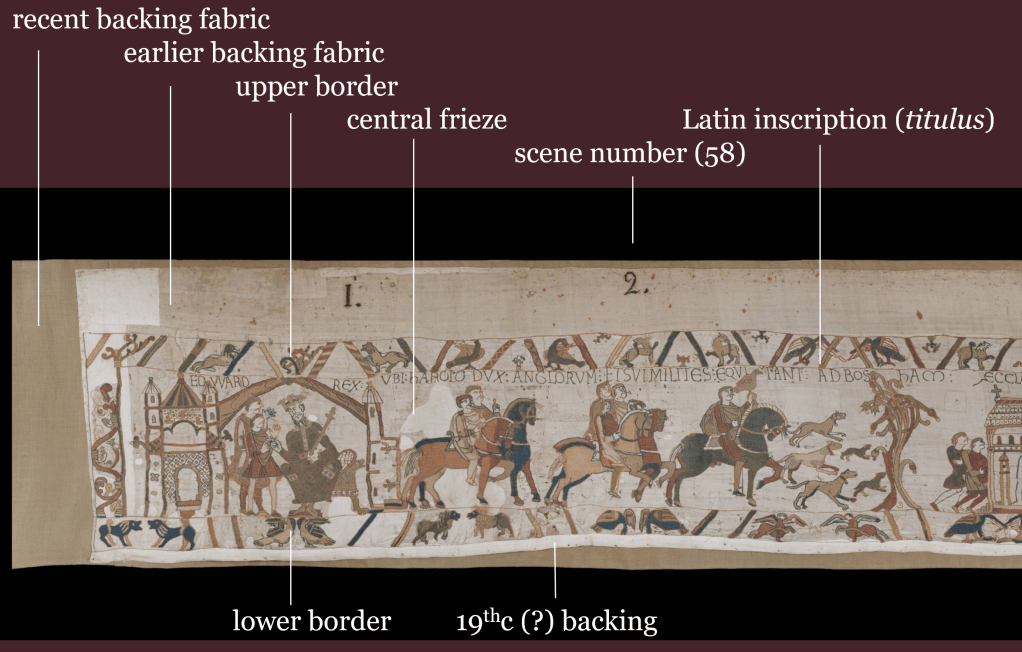
I hope that’s clear enough – although, as it happens, you won’t see much of the ‘recent backing fabric’. However, even when you think you know what is original and what is repair – think again. Compare and contrast the following two images. The first is the Tapestry itself, while the second comes from a book published in 1729, Bernard de Montfaucon’s Les Monumens de la Monarchie Françoise (‘The Monuments of the French Monarchy’ – and yes, Monumens was spelt without a ‘t’). This was the first time that the public – outside the Cathedral of Bayeux, at least – knew anything about ‘La Tapisserie de Bayeux’ – the Bayeux Textile Wall Hanging.
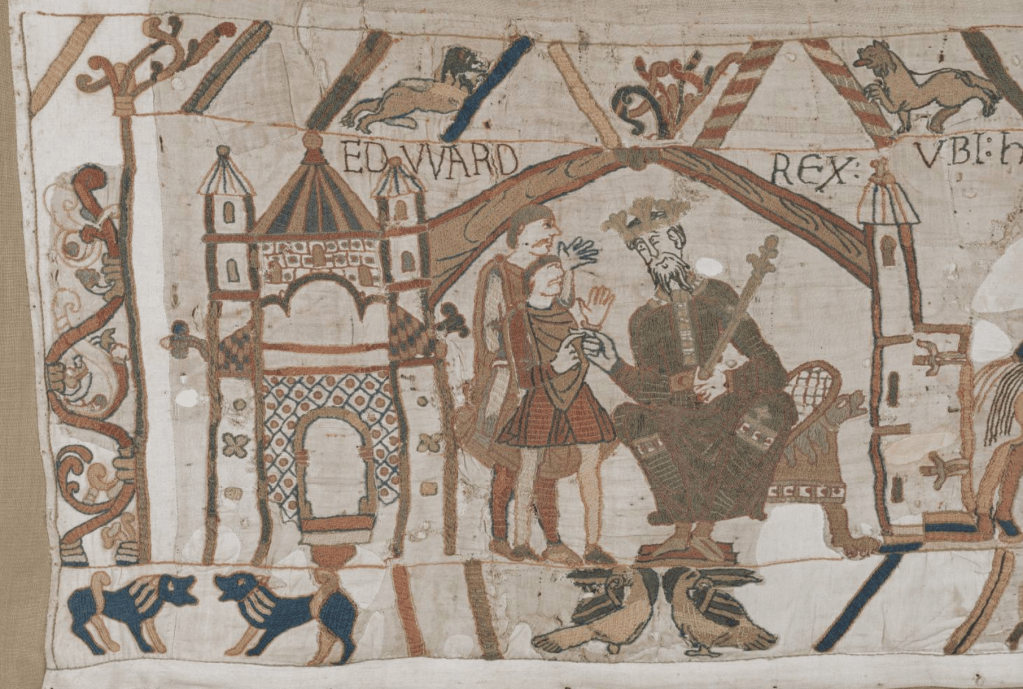
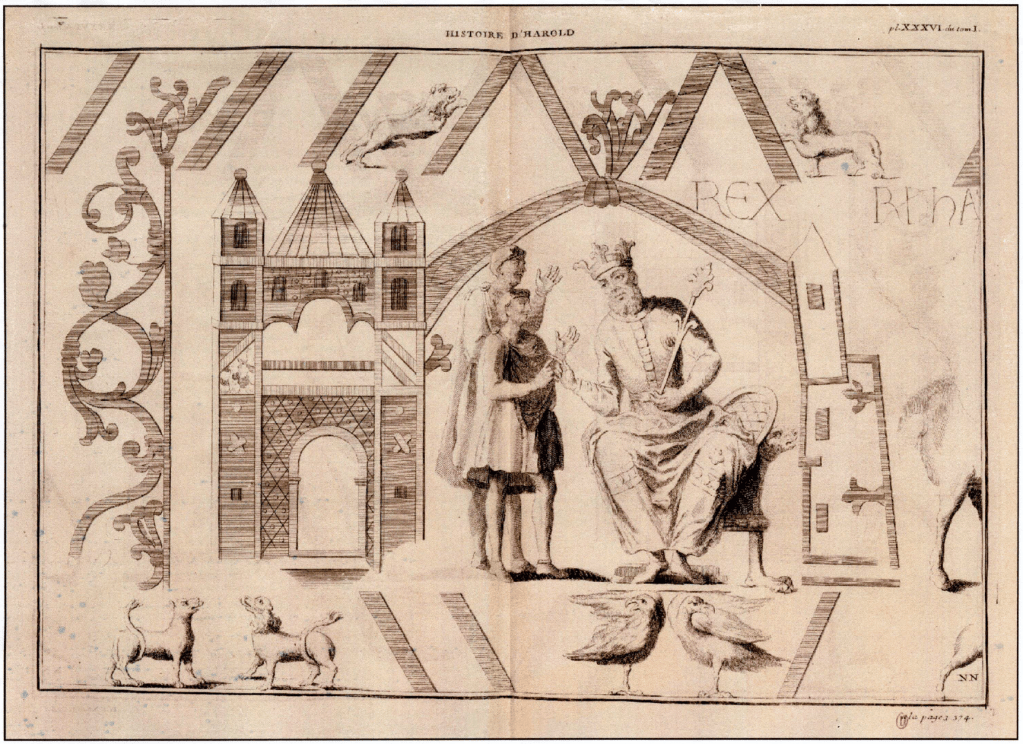
Many of the differences are clear. For one thing, in the engraving, the structure is entirely rectilinear. Admittedly I don’t know how irregular the shape was at the beginning of the 18th century (the engraving is based on a drawing which can only be dated ‘before 1724’ – although it is unlikely to be much before that), but it is unlikely that the straight lines were ever entirely rigid. The other major difference is that this is a post-renaissance drawing, using light and shade to model the people and creatures in three dimensions: they are far more naturalistic that the originals. Choices have been made to identify the paired animals and birds both top and bottom, although the building retains its essentially flat and geometric form. The flourish on the far left is more or less the same, but appears to be more elaborate in the embroidery. And then, there are things which are simply missing: diagonal lines in the top and bottom right of the photograph are simply not there in the engraving. Nor is the word ‘VBI’ – to be read as ‘UBI’, or ‘where’, in the top right corner – the beginning of the titilus ‘Where Harold, duke of the English, and his soldiers are riding to Bosham’, although some of it was still there – a bit of the ‘B’ and the ‘I’ – when the Tapisserie was ‘discovered’. Most importantly, we don’t know which king this is! Yes, it’s a king – the word ‘REX’ was clearly visible. But there was no ‘EDWARD’.
Nowadays we tend to use the word ‘conservation’ to convey the idea that we are trying to conserve historical artefacts in the best state possible. ‘Restoration’ does take place – restoring things to how they once were – but we don’t always know how things once were. In the past, ‘restoration’ often meant ‘making things look like they should have looked if the had been made properly’. This often resulted – especially in the 19th century – in changing the historical appearance of an artefact or building, or, in others words, inventing things that never existed: the famed ‘gargoyles’ of Notre Dame, for example (they’re not even gargoyles…). Fortunately, in this case, no one has any doubt that this is, indeed, King Edward, given that he appears in a similar form, though older, and not as healthy, later on. The ‘EDWARD’ was probably ‘restored’ at some point in the 19th century, although it could have been in the 18th. Whenever the name was added, it would have been there originally. Nevertheless, this should remind us, when looking at the Bayeux Tapestry, that what you see is not necessarily what the original patron got. Having said that, it is the two ends which are most badly damaged – indeed, the conclusion of the story is completely missing. We will consider if that is due to loss, or if, perhaps, because the Tapestry was never completed, in my second talk. But we have to get there first – so on Monday, we shall start our quest by heading from Winchester (or Westminster), via Bosham, to Normandy.


what a super introduction Richard and looking forward to your talk on Monday 5th October at 17:90t to start the proceedings of unravelling the mystery of the Bayeux ‘tapestry’.
LikeLiked by 1 person