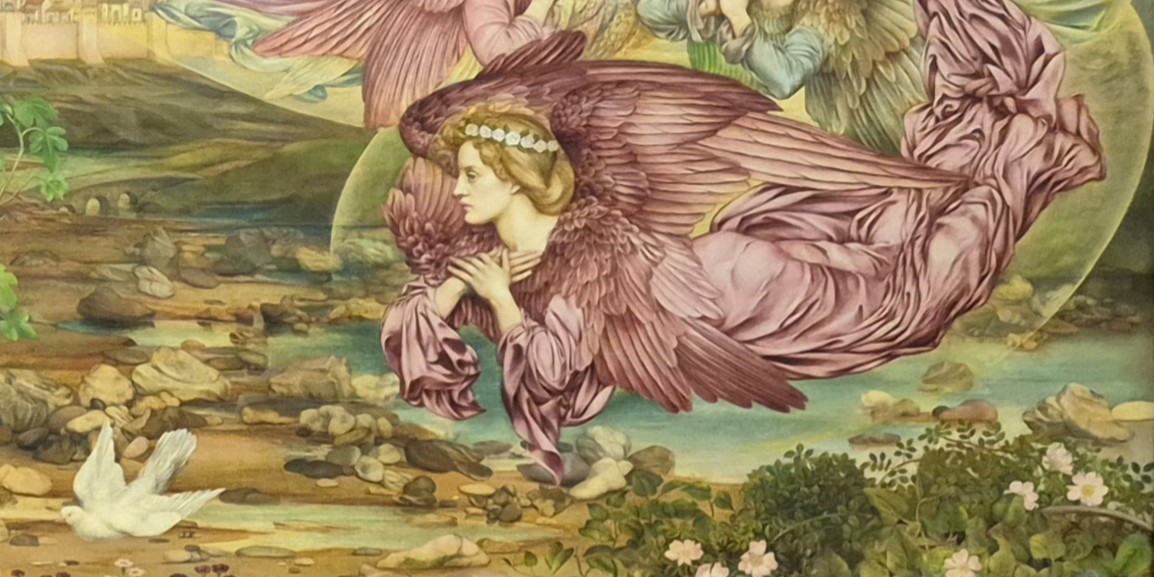
Evelyn de Morgan, Life and Thought emerging from the Tomb, 1893. The Walker Art Gallery, Liverpool.
I’ve written about Evelyn de Morgan before, and spoken about her fairly often as well as the result of at least two exhibitions, but also in connection to the ‘Pre-Raphaelite Sisters’ – the women associated in one way or another with the ‘Brothers’ – not to mention the inclusion of her work in other collections. I want to have a look at another of her paintings today, as we will certainly see it on Monday, 14 September at 6pm when we take another Stroll around the Walker. This will be stroll number VII – PRB: The Pre-Raphaelites and Beyond. As well as looking at works by the three most famous artists of the original seven, we will also consider several by members of the ‘Liverpool School’, artists from the North-West who were inspired by the luminosity and precision of the Brotherhood. And then, there are the friends and family brought into the movement who also build up the ‘beyond’ of the title…
Subsequent talks will include at least two relating to the Bayeux Tapestry, during which I’m hoping to include every relevant detail of Harold’s mission to France (5 October) and William’s invasion of England (12 October). From everything I’ve seen and heard so far, it will be as well to be properly prepared when we get to see the real thing! I am still thinking about a third talk, covering the full extent of the British Museum’s exhibition, but so far social media implies that the Tapestry is the only exhibit – but then, it does appear to be remarkably charismatic, and is certainly grabbing all of the attention. I will get hold of the catalogue in the next couple of days, and finally see the exhibition at the end of the month – but if that talk does happen, it will be on 19 October – so watch this space!
Already on sale are two talks dedicated to Sienese art – looking back to last year’s Siena exhibition at the National Gallery, and forward to my visit this year with Artemisia. The first, on 26 October, will look at the relationship between Duccio and the Virgin Mary, including panels from his Maestà that I have never talked about before (!). In part this is an excuse to explore Siena’s especial devotion to the mother of Jesus. The second (2 November) will be dedicated to Pietro and Ambrogio Lorenzetti, and will also consider images of the life of the Virgin from Siena Cathedral, as well as travelling further afield to discover works which, for one reason or another, are less frequently seen.
Details of these talks are also on my diary and Tixoom pages. Please remember, if you book for any of the events, Tixoom will send you a link to the talk straight away. If it doesn’t arrive within 24 hours, it would be useful to know then, as it will be far easier to sort out any problems early on. Reminders, with links, will also be sent 24 hours and 15 minutes before the talk itself.
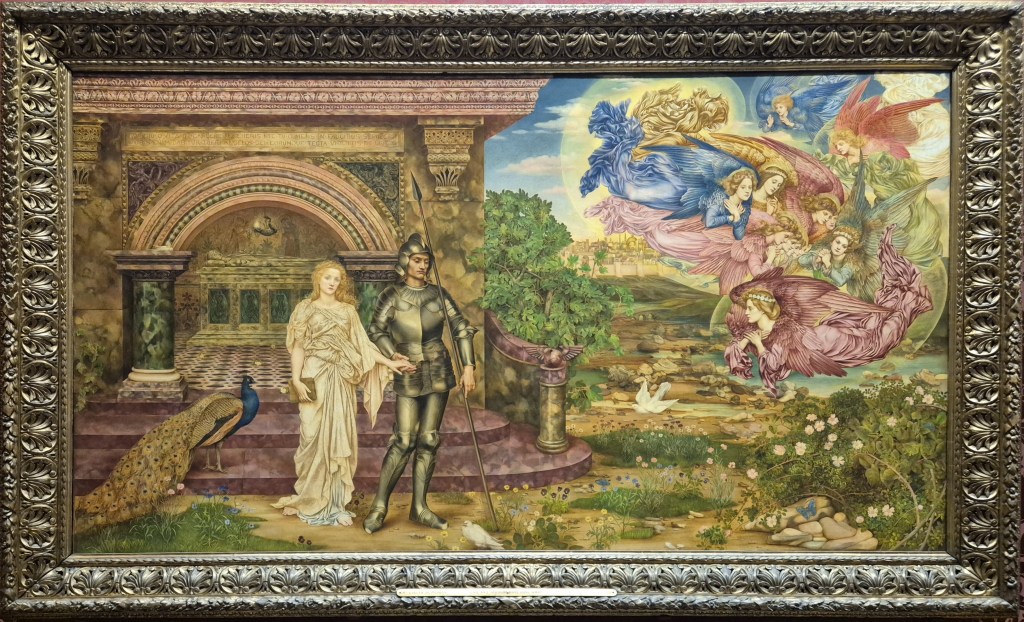
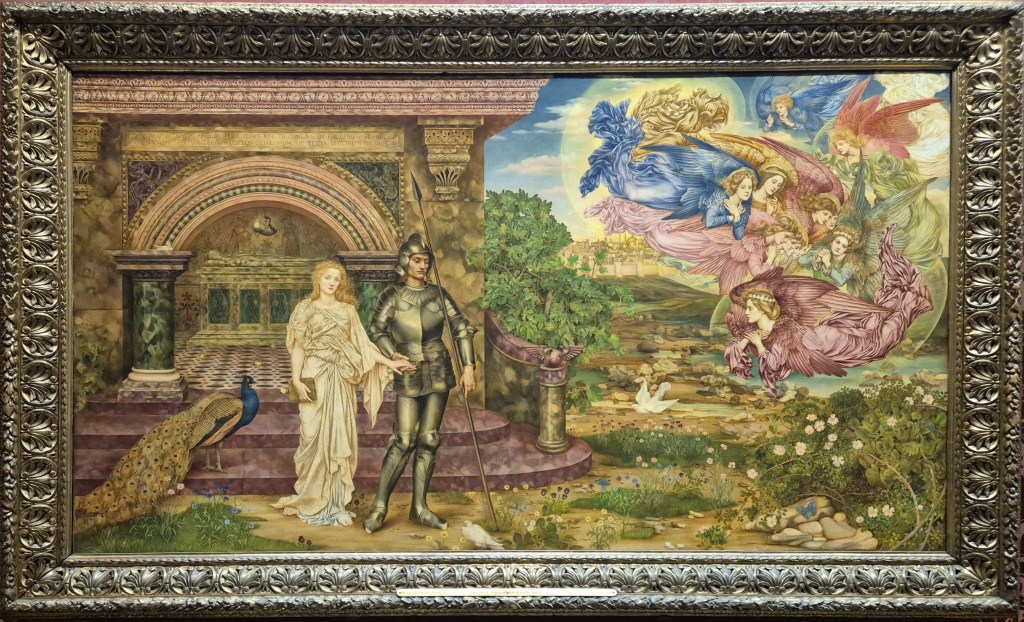
This is the painting as seen in the Walker Art Gallery – measuring 203.2 x 330.2 cm (including the frame) it is a fair-sized and impressive work, brightly and richly coloured. The left of the painting is dominated by a bold, neo-romanesque structure in coloured marbles, while the right gives ways to a landscape partially covered by a host of multi-coloured angels. A peacock stands on the lower step of the building, and next to it we see a woman in white whose hand is held by a knight in shining armour. Given the title of the painting, these must be Life and Thought emerging from the Tomb.
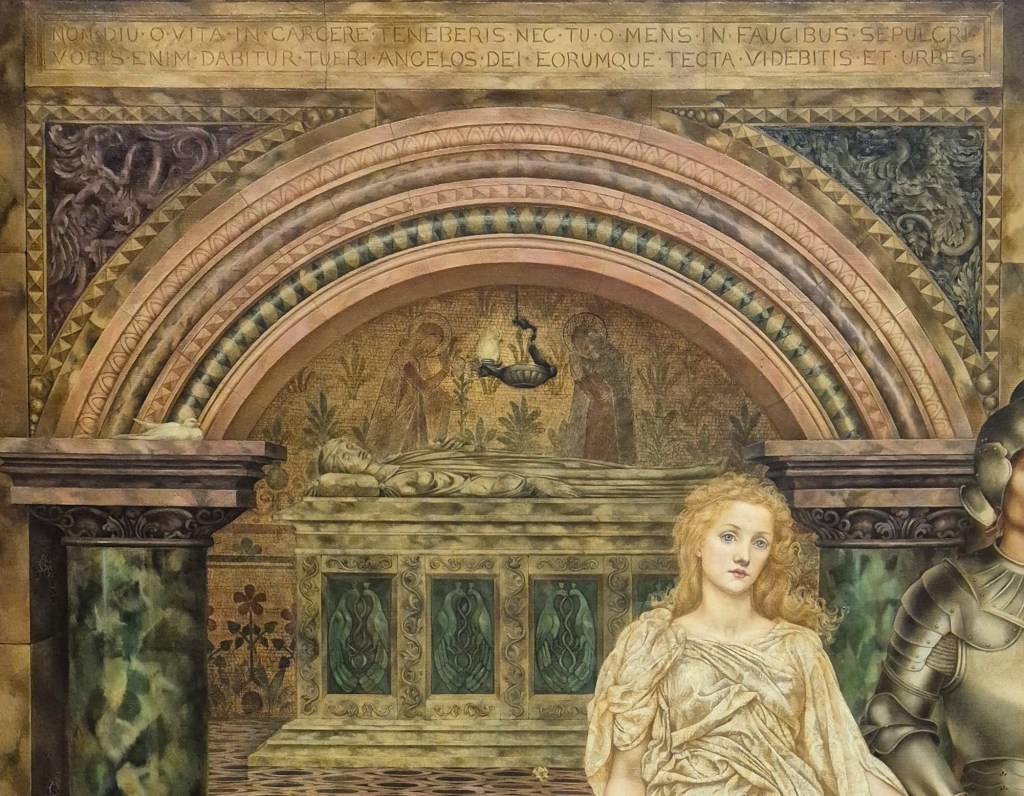
Looking behind them, we can see that the building is, indeed, a monumental tomb taking the status of a free-standing chapel. The round arch springing from the pink capitals atop massive green columns is a just a segment, not the full semi-circle of 11th and 12th century Romanesque buildings, but fully in line with some aspects of the style’s reinterpretation in the late 19th century – as are the elaborate mouldings of the arch and pastiche mythical carvings in the spandrels. Within the chapel an effigy, carved in stone, lies on a sarcophagus, as the body would have done on a bier during the funeral. The front of the sarcophagus is decorated with paired peacocks, symbols of the incorruptible flesh, and so life everlasting, and in between them the waving lines could be snakes, which are sometimes associated with eternity. A white dove, which has settled on the left-hand capital, would not necessarily have been associated with peace. I am sure that interpretation is more of a 20th century idea. It would certainly evoke the Holy Spirit, but also (as I read off my notes during my last talk), with ‘reassurance, and the gentle acceptance of mortality’. The idea of ‘reassurance’ comes from the dove’s role in the story of Noah. Having been released from the ark, it returned, bringing a sprig of olive, evidence that there was new life on earth after the deluge: a promise of life after death. A lantern illuminates the effigy of the deceased, and also, behind it, a mosaic illustrating the Annunciation. The Angel Gabriel kneels on the left, his right hand raised in greeting, while the Virgin Mary, in her traditional red robe and blue cloak, takes an equivalent position on the right. The clue to the meaning of this painting is given by the inscription which runs in two lines across the frieze at the top of this detail:
NON DIU O VITA IN CARCERE TENEBERIS NEC TU O MENS IN FAUCIBUS SEPULCRI
VOBIS ENIM DABITUR TUERI DEI EORUMQUE TECTA VIDEBITIS ET URBES
“Not for long, O Life, will you be held in prison, nor you, O Thought, in the jaws of the grave
for it will be given to you to behold the Gods, and you shall see their dwellings and cities.”
A more usual translation of ‘MENS’ would be ‘mind’ but given the title of the painting, ‘thought’ is more likely to have been de Morgan’s intention. If the inscription is a quotation, rather than something penned by de Morgan herself, the internet cannot locate it. However, I would be happy to go with the latter: Evelyn’s mother, Anna Pickering, née Spencer Stanhope, rather unusually (for the time) insisted that her daughter receive the same schooling as her sons, and that included Latin.
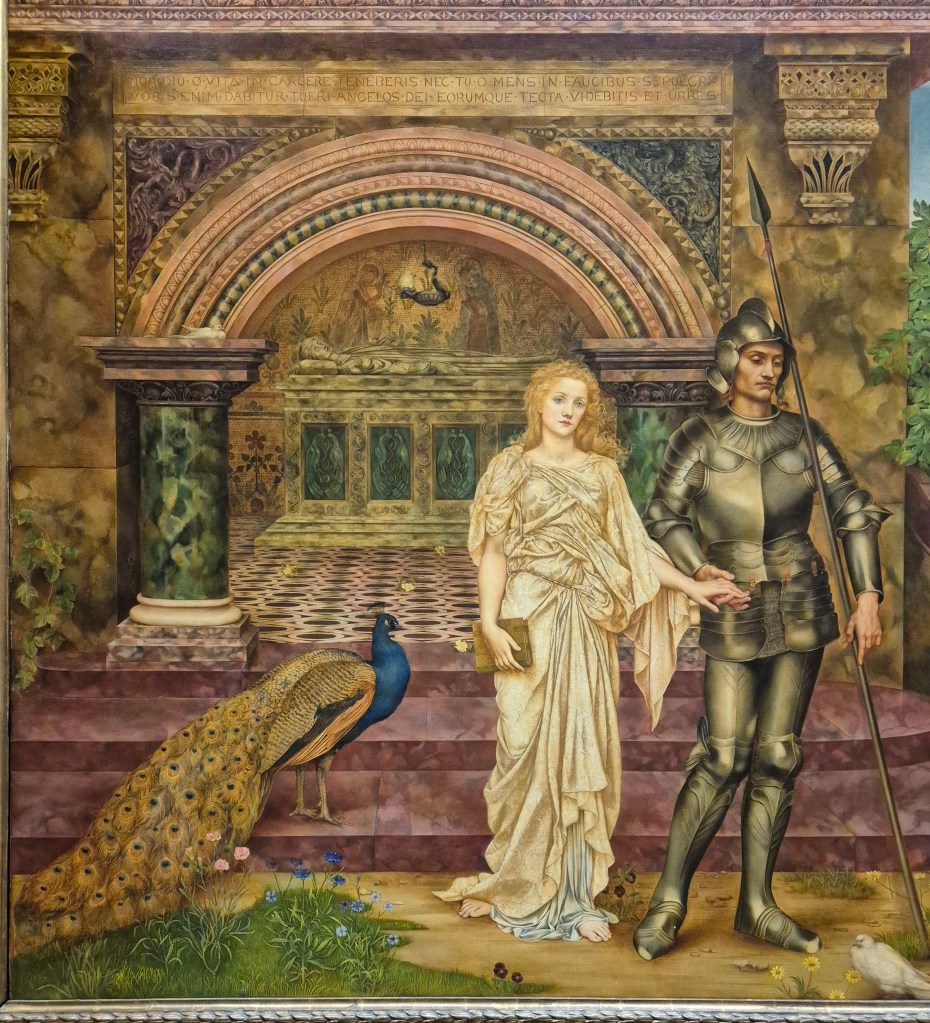
But which of the two figures is Life, and which Thought? As the woman has a book, I am going to suggest that she is Thought – while the figure apparently leading her away, armed against mortality, could be Life. They are both watched over by a rather magnificent peacock, the implication being, as stated above, is that these two figures are heading for life everlasting. However, despite patches of the greenest grass, in which grow beautifully coloured flowers, they walk on barren ground. But where are they going? A second dove sits at the bottom right of this detail, and presumably they will walk past it, towards the right of the painting. But before we look there, I wonder if you recognise them at all? Or, at least, do you recognise the style?
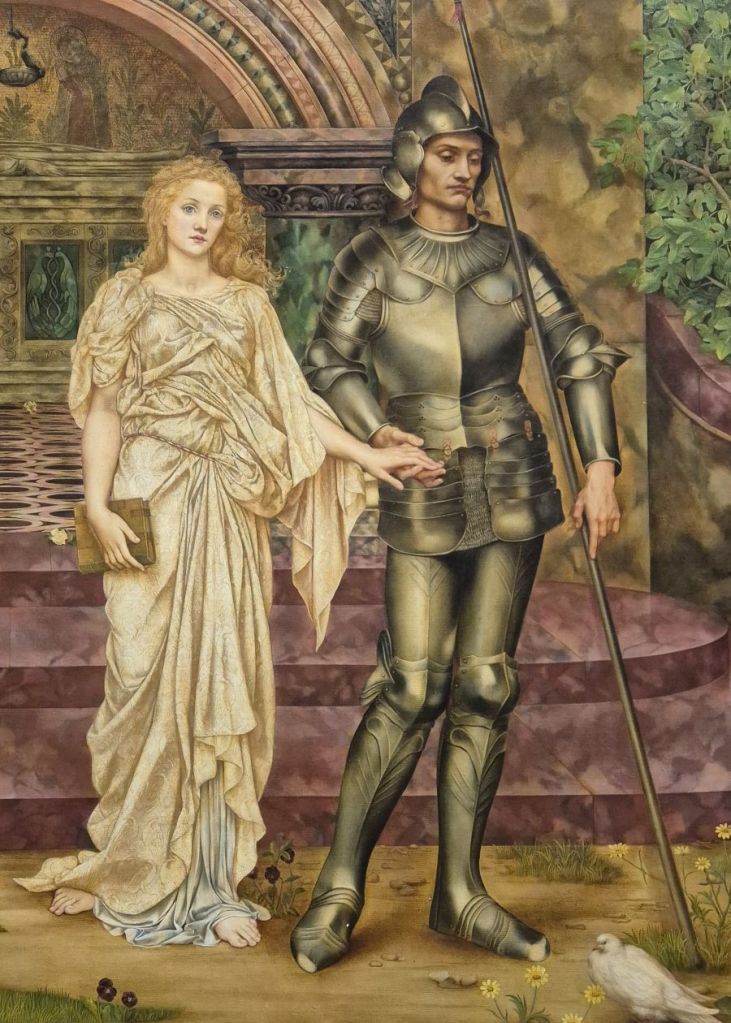
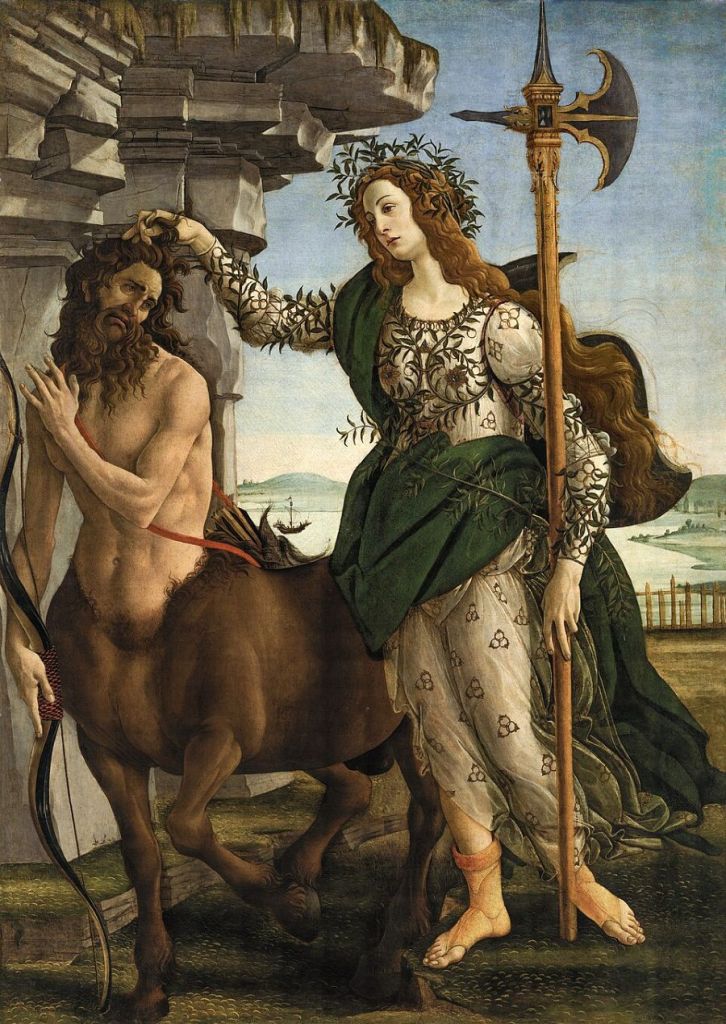
The implication of the two images is admittedly very different. On the left are Life and Thought, while on the right we see Pallas and the Centaur, painted by Sandro Botticelli around 1482, from the Uffizi in Florence. The Renaissance master was Evelyn de Morgan’s chief inspiration and she quoted from him often. Having said that, her knowledge and understanding of his work was such that I’m not sure she was ever really quoting from him: she just knew the paintings so well that they effectively became part of her own style. The precise identification of the woman in Botticelli’s painting is widely debated, but most people believe her to be Pallas – one of the many names of Athena, or Minerva, goddess of war and wisdom and inspiratrix of the arts. Whoever she is, it seems that she is a civilising influence on the part-man, part-beast Centaur, and the general interpretation of the painting is that the arts can calm the animal in us. I can’t disagree with that! The two figures seem to dance to the same tune, with Pallas leading the mythical creature by its hair. The stylised contrapposto used by Botticelli is exactly that adopted by de Morgan. This is most clearly seen in the figure of Life, and even though it is his left leg which bears the weight, while the right bends to step forwards – an equivalent dance, perhaps – his left arm is almost a direct transcription from Pallas’s. In both cases, one figure leads the other. Evelyn got to know Botticelli’s work first hand in 1875 – during her second year at the Slade School of Fine Art – when visiting her maternal uncle, John Roddam Spencer Stanhope, in Florence. He was another of her great influences, as we shall see on Monday. Later, when she was established, she and her husband wintered in Italy for two and a half decades, allowing her to deepen her understanding of the Florentine’s oeuvre.
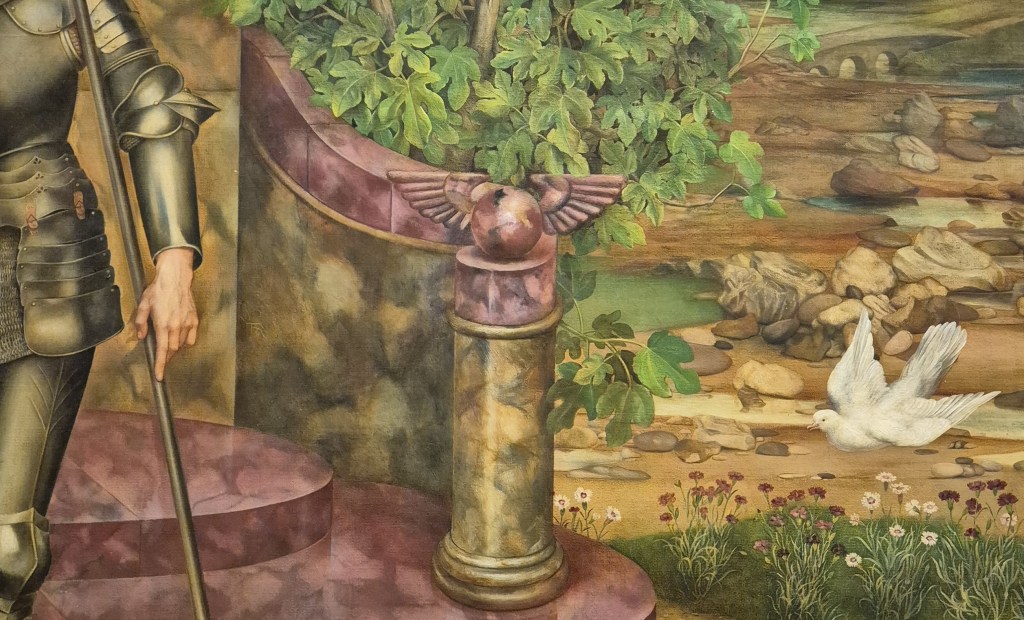
The transition from the world of mankind, as represented by the tomb, to the world of nature, as seen in the landscape, is marked by a short column at the foot of the stairs on which is mounted a winged globe. Evelyn de Morgan – together with her husband, the ceramicist, and later novelist, William de Morgan – combined their Christianity with the Spiritualist and Mysticist beliefs so common among artists and authors at the end of the 19th century. This is a symbol seen across many cultures, often associated with divinity and royalty, and can also be associated with one of the Old Testament prophets. Malachi 4:2 says, ‘But unto you that fear my name shall the Sun of righteousness arise with healing in his wings…’. The sphere could be the ‘Sun of righteousness’, and so the symbol is associated with healing, wholeness and ultimately the ascent of the soul. Above it, there is a fig tree, by some considered to be the source of the forbidden fruit, and so the origin of the Fall. Apart from anything else, there must have been a fig tree nearby, as Adam and Eve took its leaves to clothe their nakedness… Nevertheless, a third dove swoops in, offering reassurance.
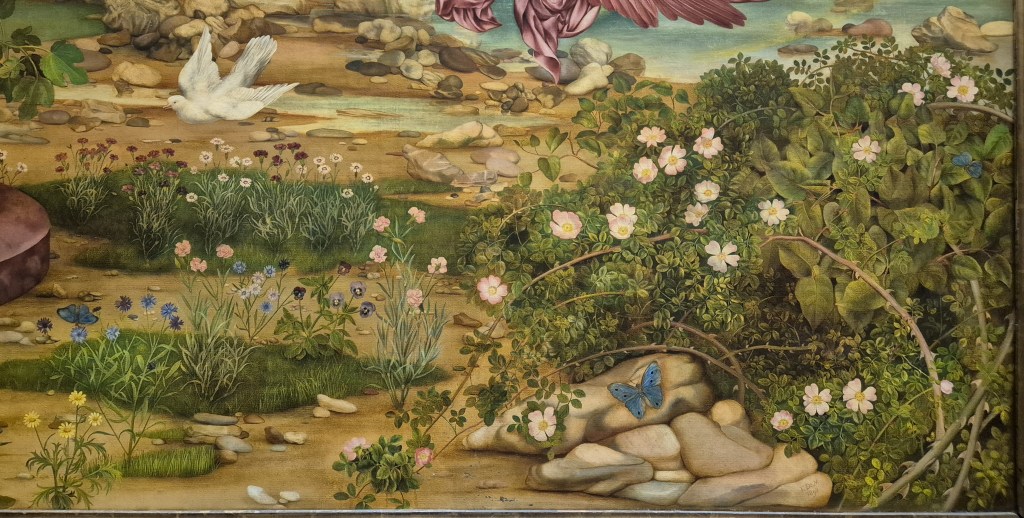
We see the same dove in this detail, the bottom right corner of the painting. Like the fig tree, there are more implications of Eden after the fall. The flowers may be rich and colourful, but there are brambles starting to creep among them, and brambles, with their thorns, were one of God’s punishments. Nevertheless, the flowers are mainly positive. The pinks, or carnations, are symbols of the passion, while the dog roses could remind us of Mary, a rose without thorns (although these are clearly prickly…). There are also cornflowers, whose brilliant blue can symbolise both heaven and its Queen. However, it should be born in mind that Evelyn de Morgan may have had her own personal ideas about these plants: unless I see a specific source, I am very wary of the rather optimistic interpretations of botanical symbolism to be found online. However, there are also three blue butterflies in this detail, and they can be securely identified as symbols of the human soul – a more beautiful aspect of life, and a form of resurrection after the creature’s grub-like beginnings and apparent, chrysalis-bound, death.
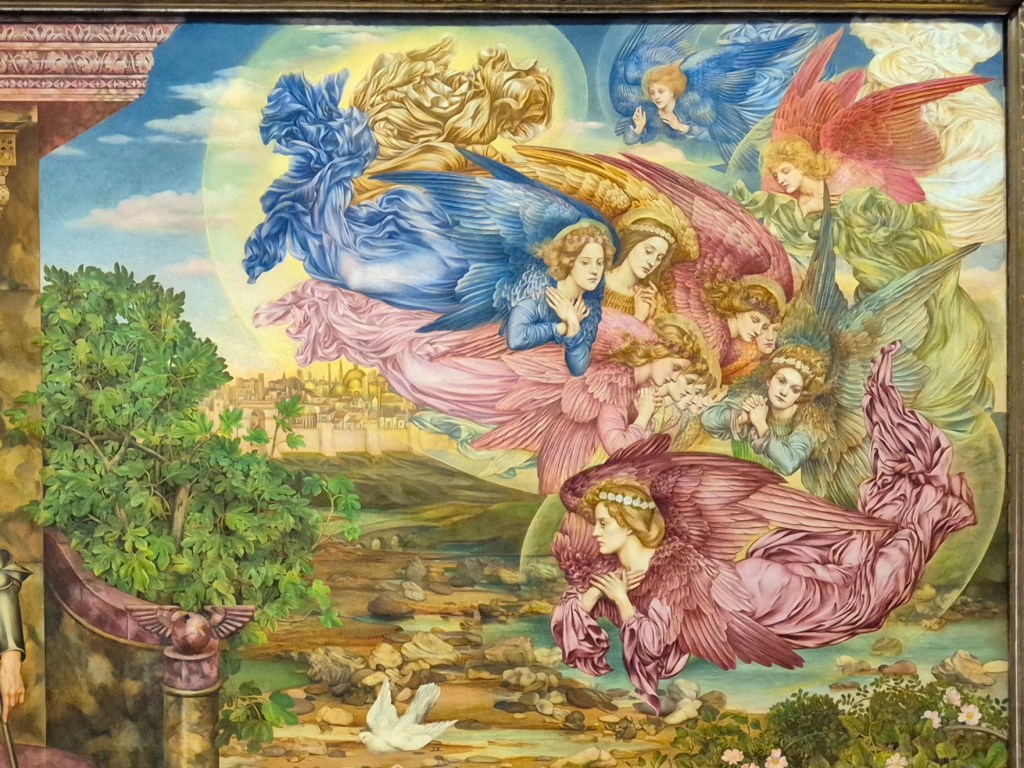
In the top right corner appear some of the heavenly host – at least 12 angels in reds, pinks, blues and a green. There may be more hidden away. They swoop down with their hands crossed in front of their chests, clutched together or held aloft, all gestures which can be associated with grief and compassion for the deceased: it is, after all, the dead person’s Life and Thought emerging from the Tomb. The angels elegantly fill the corner, and the outline they form echoes that of the cornice at the top of the tomb, the fig tree above the banister, and the shore of the lake on the right – which should remind us how carefully de Morgan has considered the composition. The swooping dove – which we are seeing for the third time – marks the beginnings of a rough and rugged path which passes through a flooded landscape, a continuation of the barren ground on which Life and Thought are standing. This path leads to a walled city, glowing with golden domes, on the horizon: surely the ultimate destination of Life and Thought.
Everything will become clearer if I tell you that Evelyn de Morgan was inspired by a poem, The Deserted House, by Alfred, Lord Tennyson, published in 1830. It’s short enough for me to quote it in its entirety:
Life and Thought have gone away
Side by side,
Leaving door and windows wide.
Careless tenants they!
All within is dark as night:
In the windows is no light;
And no murmur at the door,
So frequent on its hinge before.
Close the door; the shutters close;
Or through the windows we shall see
The nakedness and vacancy
Of the dark deserted house.
Come away: no more of mirth
Is here or merry-making sound.
The house was builded of the earth,
And shall fall again to ground.
Come away: for Life and Thought
Here no longer dwell;
But in a city glorious –
A great and distant city – have bought
A mansion incorruptible.
Would they could have stayed with us!
A dead body, Tennyson suggests, is like an empty house, which has been vacated by Life and Thought. He gives no idea of the appearance of these abstractions, so Evelyn de Morgan has imagined how they should be personified. She doesn’t illustrate every aspect the poem, though – but then, we don’t see the corpse itself, with its ‘doors and windows wide … builded of the earth’: it is enclosed within the sarcophagus. Life and Thought, the poem tells us, no longer dwell there. They ‘have bought/A mansion incorruptible’ located ‘in a city glorious’. The painting takes this idea further, suggesting that the angels, moved by the passing of the deceased, have come to lead Life and Thought through the barren ground, past rocks and waters, to the city on the horizon, which can easily be read as the New Jerusalem. Rather than a rigid, line by line reading, she creates an imaginative and evocative image, borrowing the essence of Tennyson’s verse while holding to her own vision. The style, with its brilliant, jewel-like colours and naturalistic detail is ultimately derived from that of the Pre-Raphaelites, but again, like her interpretation of the poem, at some remove – you could hardly call this the ‘truth to nature’ championed by Ruskin. In this respect, Evelyn de Morgan is one of many heirs of the Pre-Raphaelite tradition. We will see more on Monday.


Dear Richard Although you acknowledged our purchase of a ticket for this we were unable to listen to your talk last night as although Tixoom sent us a code about eight times, when we entered it, it it said it was no good.
I think the problem may be that for a short while this email address was out of order and we used gmail although that gmail account is now closed. For some reason tixoom may be trying to use the old account but the only email was have is this one.
John Parsloe
>
LikeLike
Dear John,
I am so sorry this has happened, and I have refunded the price of your ticket.
However, I’m afraid I have no idea why this happened: unfortunately I am an art historian and not a technician. All I can tell from the system is that your booking was made through the email address parsl******8@gmail.com (which I’ve edited, as this is a public platform), but as you say you received notification I don’t know what happened next.
Any acknowledgements of your ticket come from the Tixoom system, even if they have my name on, but I cannot think why you would not have been able to access the talk, particularly as no one else seems to have any of the problems you yourself encounter. Perhaps there is a problem with your computer? But you would have to consult someone who knows about computers to know what that might be, I’m afraid.
Apologies that I can not help more.
Richard
LikeLike
Dear Richard Thank you for your reply and for refunding the payment. It is as I suspected. They are using my old and disused email with gmail and not this one that I used to communicate with you and them. The problem is I do not know how to get them to use the right email in future.
But wishes
John
>
LikeLike
I’m not sure how they manage to put the wrong email in though. For obvious reasons, I never book for my own talks, but I have just had a look to check how it works. When I click on the link to book, the first page you come to has three boxes. At the top it asks for your credit card number, expiry date and cvc, the second box asks for your name, and the third for your email address. I’ve just tried do that, and it even then it asks you to confirm the email address, so I really can’t see how it is possible for it to put the wrong email address in… I confess to being completely baffled.
All the best for future attempts, though, and thank you for your continued determination!
LikeLike