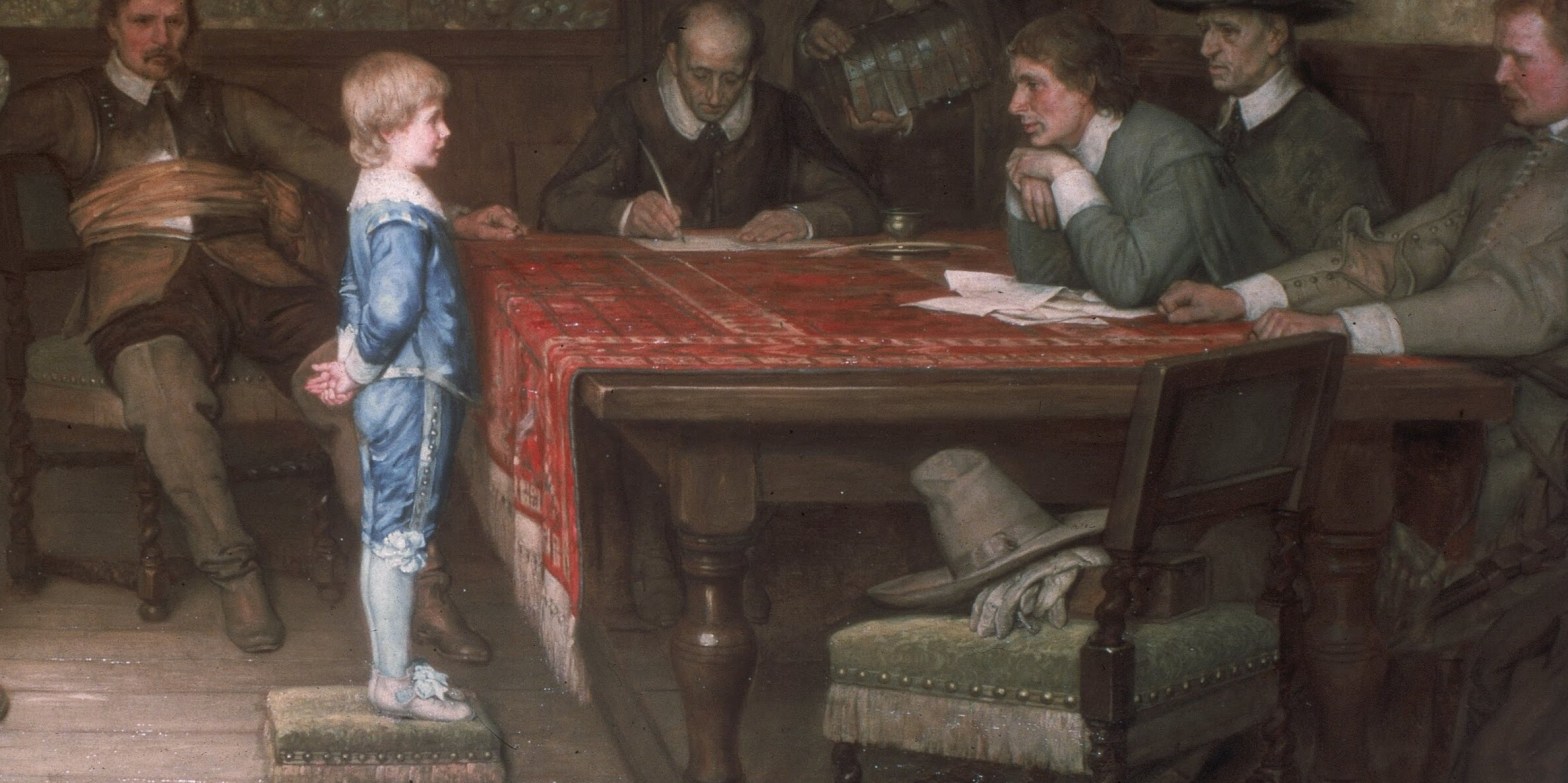
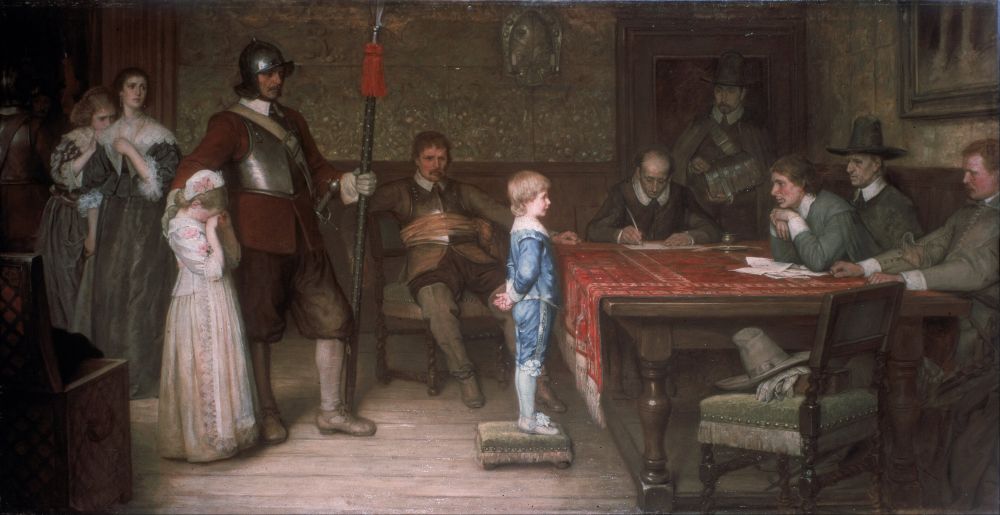
William Frederick Yeames, And When Did You Last See Your Father? 1878. The Walker Art Gallery, Liverpool.
This week, on Monday 7 September at 6pm, I will be continuing my occasional series of talks A Stroll around the Walker, getting to know my local museum of ‘Old Master’ paintings, the Walker Art Gallery in Liverpool. This week is no. VI, and I have reached ‘The Victorians’. I have chosen this title because the main room we will wander round is called Victorian Narrative Painting, even though the earliest painting there is dated 1806, 31 years before Victoria’s accession to the throne. The painting is The Death of Nelson by Benjamin West, the American-born 2nd President of the (British) Royal Academy of Arts. I will, of course, explain why it fits perfectly in that room – as well as looking at paintings by Turner and Constable (which aren’t narratives) and others in the adjacent Victorian High Art room which are. These will include works by George Watts and Frederic Leighton, not to mention other ‘Old Masters’, including at least three remarkable women, Sarah Biffin, Harriet Hosmer, and Edmonia Lewis. It promises to be a rich and rewarding selection!
The following week, 14 September, I am on to Stroll VII, PRB: Pre-Raphaelites and Beyond. As I’m sure you’ll know, PRB stands for Pre-Raphaelite Brotherhood, but I’m also using the ‘B’ for Beyond, by building up a ‘Pre-Raphaelite family tree’. Starting with Millais and other artists of the first ‘wave’ or ‘generation’, we will also look at ‘2nd generation’ artists, including Edward Burne-Jones and John Roddam Spencer Stanhope, ‘3rd generation’ – for example, Spencer Stanhope’s niece Evelyn de Morgan – and what could be described as either ‘4th generation’, or ‘revivalist’, including artists such as Eleanor Fortescue-Brickdale.
There will then be a couple of weeks’ break as I gear up for the Bayeux Tapestry, with two talks entitled Harold in Normandy and William in England, on 5 October and 12 October respectively. There may well be a third talk, introducing the British Museum’s exhibition and the context they give to the ‘tapestry’, which would be on 19 October, but I will decide on that nearer the time. I am, however, already looking forward to looking back to last year’s Siena exhibition with talks dedicated to Duccio and The Lorenzetti Brothers on 26 October and 2 November – but more about them soon. It will all be in the diary and on my Tixoom page as well.
Today, however, I want to look at a painting which has somehow always been in the back of my mind – and I’m not entirely sure how or why. However, having had the chance to get to know it in person, I do think it is a rather fantastic thing!
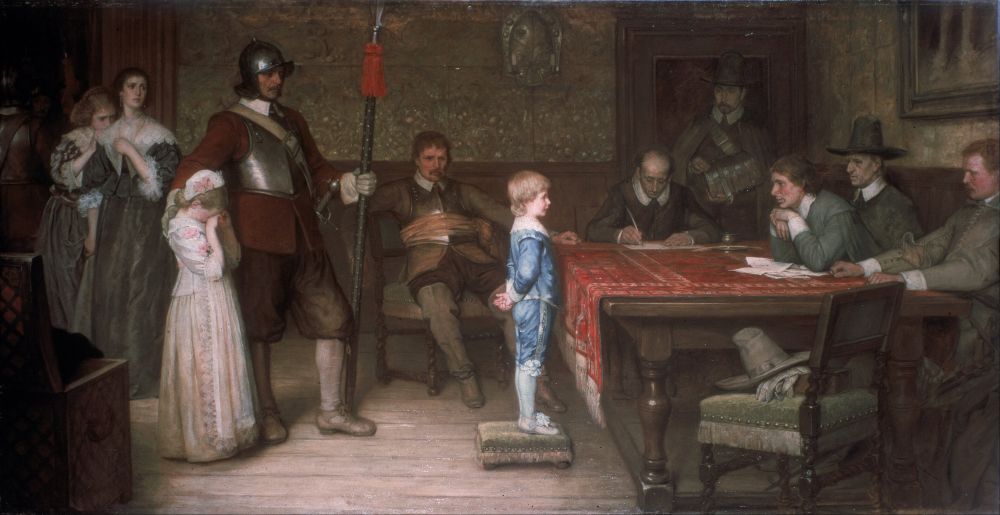
A boy in a sky blue ‘Van Dyck’ costume stands on a footstool just to the right of centre. He stands upright, his hands held behind his back, brilliantly illuminated and facing a man who is seated on the other side of a table which is covered in a red rug. The man leans forward to look intently at the boy, his chin resting on his hands, his elbows on the table. He is flanked by two others seated on the same wooden settle. At the far end of the table a fourth man enters through a doorway, while a fifth sits writing. To the left of the boy another man, wearing armour, is slumped on a chair. A soldier, also wearing armour, including a helmet, holds a spear in his left hand, and rests his right on the back of a girl dressed in pink. Behind these two are a woman and an older, taller girl next to a second doorway at the far left. In the foreground, left, is an open chest, and on the right a chair, both angled in as repoussoirs to focus our attention into the centre of the painting. Clearly our main focus of attention is the boy – and, before we go any further, some of you will no doubt have recognised his clothes, if not the boy himself.
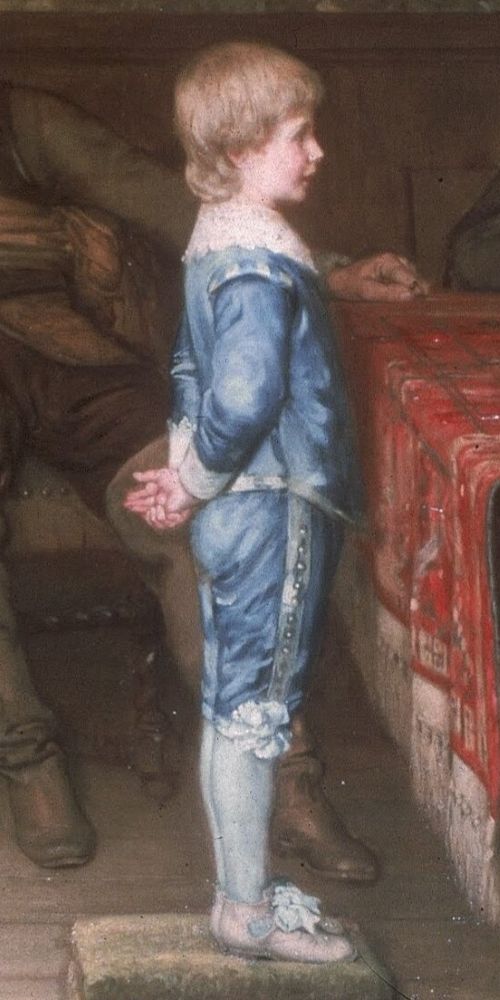
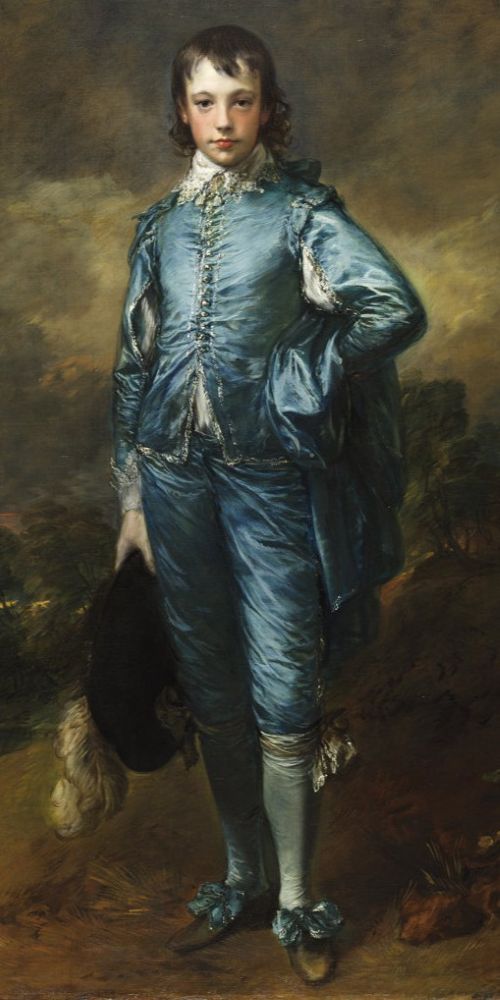
Yeames is deliberately quoting from Gainsborough, and The Blue Boy (exhibited 1770) specifically. The costume is not contemporary to Gainsborough himself – he was looking back, from the 18th century, to the legacy of Sir Anthony van Dyck, and the development of the Grand Manner portrait the century before. It was one of Gainsborough’s most famous paintings, and had been owned by the Duke of Westminster, until it was sold first to art dealer Joseph Duveen in 1921, and then on to Henry E. Huntington the following year. It is still in the collection of the Huntington Art Museum in California to this day, although they lent it to the National Gallery in 2022 to commemorate its departure from these isles a century before. The reason Yeames quoted from this specific painting in 1878 is not entirely clear – but the blue does stand out from the otherwise pervasive palette of browns. No doubt the familiarity – for some at least – with the work by Gainsborough may well have created a false sense of familiarity with this new painting, when it was first exhibited. This was in 1878, the year after the Walker Art Gallery opened: the painting was one of their early acquisitions. When I was young the painting still sat somewhere in the public imagination, but I really can’t think why I have always known about it. However, its fame was such that there was a popular music hall song about it in the 1890s (clearly before my time), and for Madame Tussauds to create a waxwork tableau, which was on show from 1933-1989. I have only been to Madame Tussauds once – back in the days of the fantastic but now sadly defunct Planetarium – and that was in about 1972. I suppose I could have seen the tableau then! And yes, film buffs, there is a 2007 film with the same title, but I’ve only just found out about that.
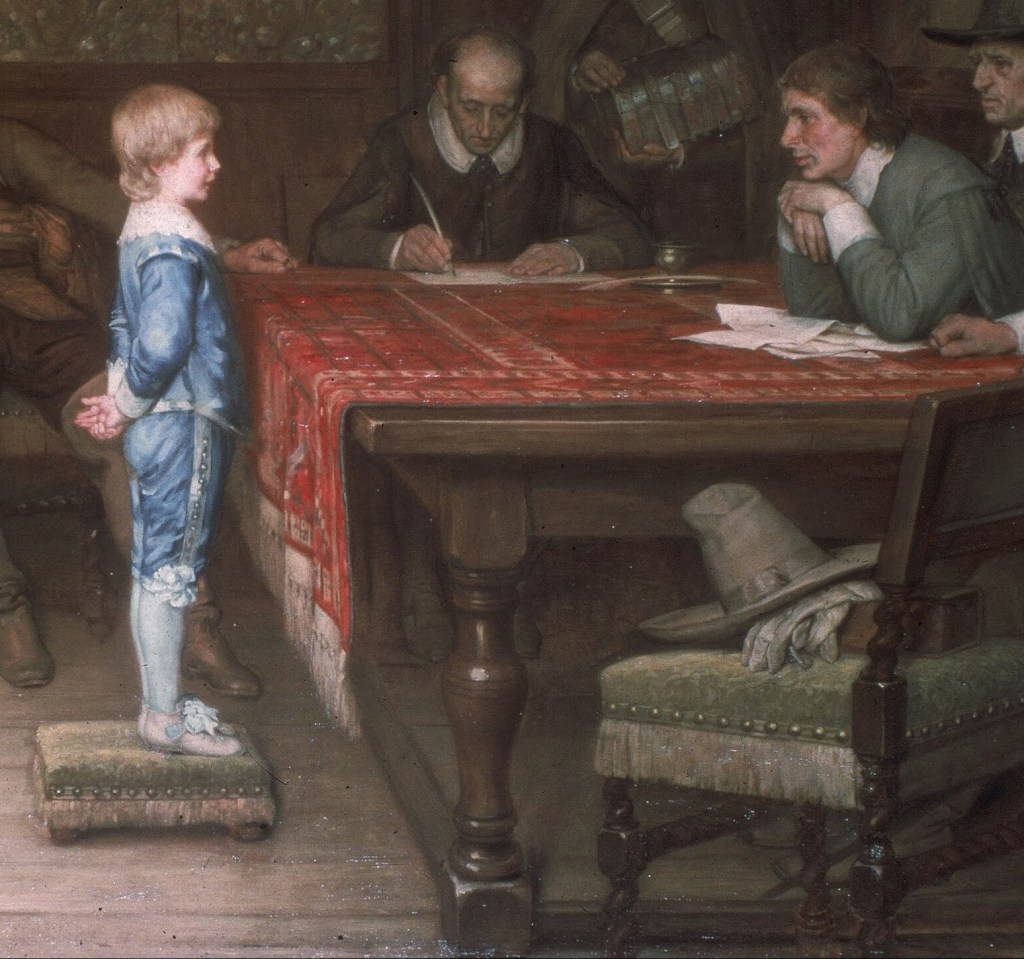
Relationships are all important in this painting, and the two most important are undoubtedly the relationship between the boy and the man opposite him, and between the boy and us. We are there, present in the room: notice how the edge of the canvas is at the same level as the feet of the table, and that the legs of the chair in the foreground are cut off: we are too close to see their full length. Notice too how upright the boy is, and the way in which he is standing at the edge of the stool closest to the table: he is not shying away. Together with the bright colouration of his clothing, and his blonde hair – both brighter than any equivalents in the rest of the painting – this persuades us that he is a good boy, keen, and entirely trustworthy. He doesn’t need to stand on the footstool to see over the table, but it gives him a higher status – not only for us, looking at the painting, but also for him, to give him the feeling that the men who are gathered around have his best interests at heart, and want to look after him. It also adds a touch of bathos. The man on the other side of the table lowers his head by resting his chin on his hands. They are not quite eye to eye – the boy’s eyes are at the level of the man’s mouth – but it helps to create some sense of equality, and makes the man less threatening. His expression is calm, open, and sympathetic. He is undoubtedly a good, trustworthy man himself. I have no doubt that it is he who has asked the question, ‘And when did you last see your father?’, and that the man at the end of the table, quill pen in his right hand, and an ink well to his left, will write down the answer.
The setting is plush. The sheen on the polished table leg tells us this furniture is solid, and in a good condition. The chair is upholstered with the same light green fabric as the foot stool, using the same studs, and with the same fringing: they are part of a set. The rug covering the table is clearly an expensive one. This is the household of a respectable, well-to-do family.
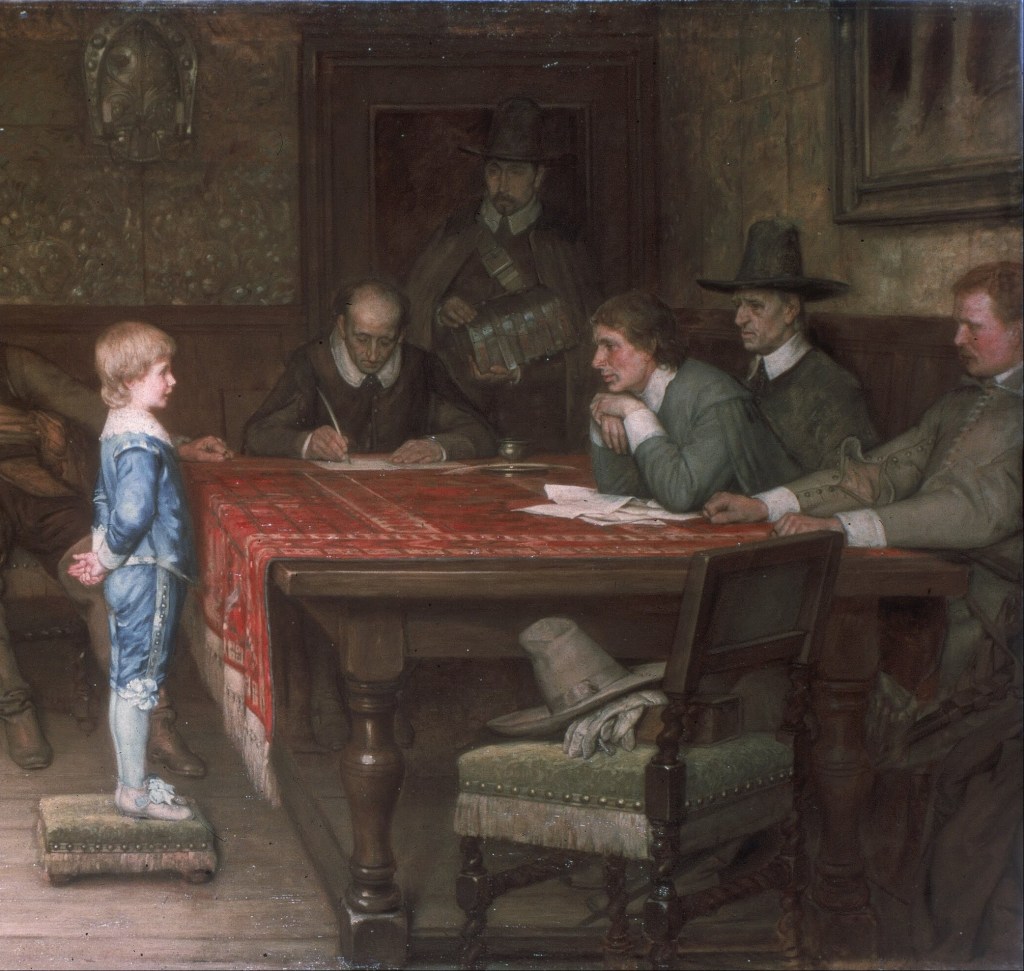
Where – and who – is the missing father? We don’t know, but there is a clue: he is both present, and absent. On the wall behind the seated man is a full-length portrait. However, we can only see the legs, clad in white hose, and the shoes, with elaborate bows. This tells us that the father in question is a royalist, and his son is wearing an equivalent outfit – given the bows on the shoes. Gathered around him are a group of Cromwell’s men. The events we are witnessing, the events we are present at, are part of the civil war. The man who is closest to us leans back, thus emphasizing the lean forward of the kindly interrogator. His hands are clenched: another contrast with the relaxed demeanour of his colleague. It could be his hat and gloves that are on the foreground chair, or they could belong to the man leaning forward… there is at least one hat ‘missing’. Further away sits a third man, wearing his hat, who sits upright. He may be leaning slightly forward, tense like the man on the right, presumably waiting for a correct, honest answer from the boy. Another hatted man enters the room with a small chest – the royalist family’s safe? – but stops in his tracks as he realises we have reached a key point in the process.
I really enjoy the geometry of this painting. The boy’s head is framed by the wooden panelling at the back of the room, a high wainscot, and the rug on the table: their horizontals are parallel. The rug falls vertically in front of the table, emphasising the boy’s verticality – a symbol of his upright nature. The wainscot is cut off by the vertical door frame going upwards. This creates there two distinct right angles, wooden and the woollen, which play against each other. The right of the door frame is also parallel to the left of the picture frame, the base of which is parallel to the top of the wainscot on the right wall. These two lines lead our eyes into the painting, forming two of the orthogonals of the perspective. These lead to a vanishing point just to the left of the boy’s head. He is not on the central axis of the painting – but his hands are. This helps to push him towards the table, and towards the man asking leading question of the title.
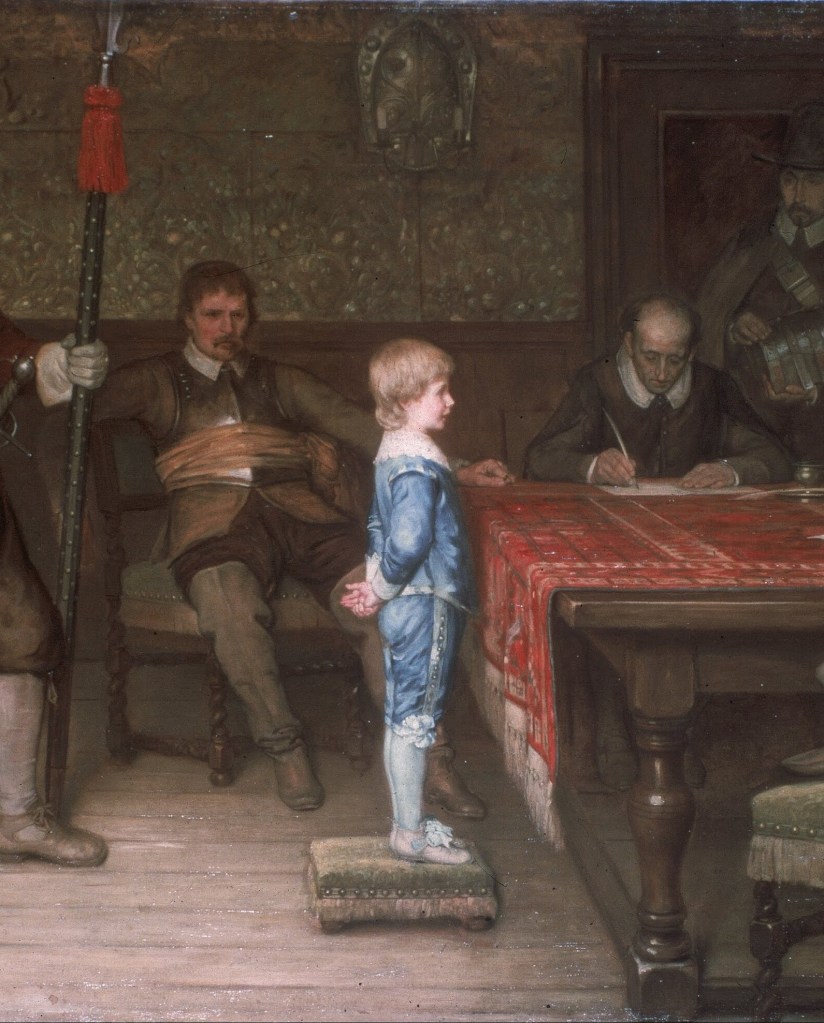
The boy stands at the front of the footstool (i.e. our right), which is lined up, parallel to the table. But he is also ‘framed’ by two chairs angled at a diagonal. One of these is the one in the foreground, with the hat and gloves – and a book – on it. At the back is a second angled chair, with a man who is slumped on it, looking intently at the boy. He wears a breastplate with a pink-orange cloth tied around it. His right arm hangs over the back of his chair (it’s quite hard to see as the spear gets in the way), and he rests his left hand on the table. His body and right leg are clearly visible to our left of the boy, but his left hand and foot appear to our right. Although at some remove, he ‘surrounds’ the boy visually, with the implication that the boy is trapped. The hand on the table also means that the boy cannot escape through the door at the back right – even if there weren’t another man blocking it – and the soldier behind him stops him leaving through the other door. Given the light on the floor, and on the boy, the outside wall of the building, with windows, must be behind us – so there’s no way out there, even if we weren’t in the way.
Above the boy’s head – directly above it – is a candle sconce, lined up with a join in the wall panels, which I take to be embossed and gilded leather – another sign that this a wealthy household. I’m intrigued by this sconce. Given the care and attention paid to every posture, every position, every detail, it must mean something. There are two candles, which are not lit. Why would they be? It is daytime. But maybe there is also something to do with truth and enlightenment going on. For some time the sconce has reminded me of the breastplates worn by the soldiers, and I wonder if Yeames was thinking of Saint Paul’s epistle to the Ephesians, and especially chapter 6 verse 14. The translation Yeames would have known is the King James Version (1611), which says, “Stand therefore, having your loins girt about with truth, and having on the breastplate of righteousness”, although the English Standard Version (1952) is perhaps easier to understand: “Stand therefore, having fastened on the belt of truth, and having put on the breastplate of righteousness”. Paul clearly intends these as metaphors – indeed, the boy is wearing neither. However, I can believe he possesses both.
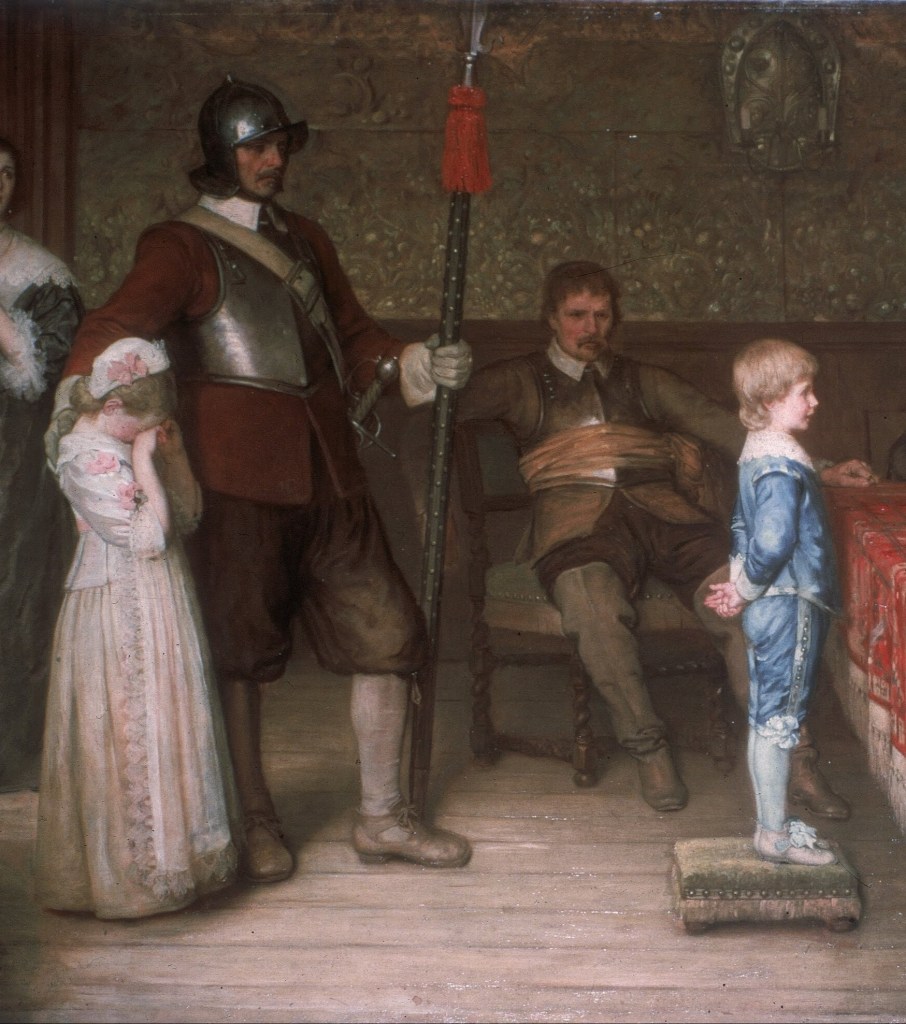
Behind the boy is a girl who is slightly taller: her head, bowed as it is, may be at the same level, but she is not standing on a footstool. She is presumably an older sister, waiting to be asked the same question. Unlike the upright, unwavering demeanour of the boy (like father, like son?), she is crying, and wiping the tears from her eyes. The man next to her places a firm hand on her back, but is in no way rough. These roundheads are clearly reasonable men. Yeames’ control of the composition is remarkable. The boy’s head is framed by the top of the wainscot and the slumping man’s arm, and that arm passes behind the boy on the same diagonal as his collar, while the boy’s hands – held politely, and without tension, behind his back – are neatly framed by the top of the man’s boot. The man slumps to the level of the wainscot, his head just projecting above it, almost as if his eyes are resting on it. Meanwhile, the girl’s back is aligned with the frame of the door on our left. In the centre of the painting is a space, a void, filled with light – and a distinct feeling that the absent father is watching over his son. The red fringing of the spear matches that of the rug, forming another, colouristic way of containing the boy.
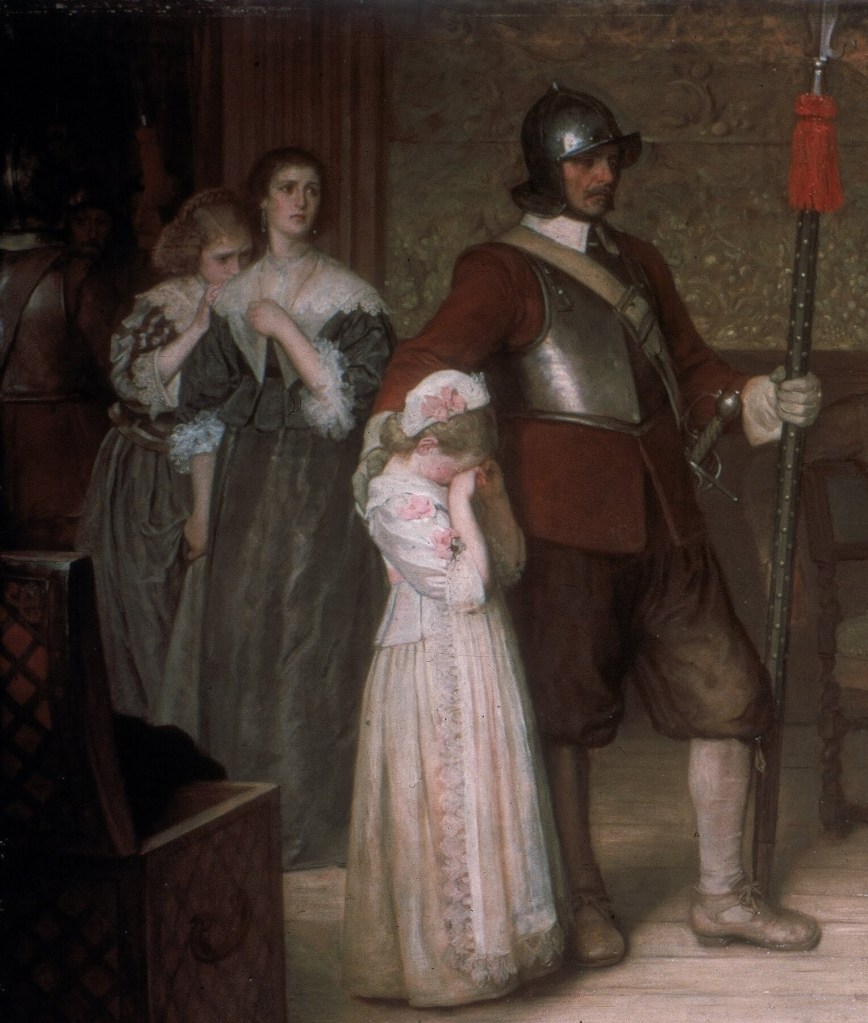
The chest is open – the Cromwellians have been looking for evidence. The mother stands tensely, her head and shoulders pushed forward by the downward vertical of the door frame. To our left of her is an elder daughter, dressed in maturer, dark colours – like her mother – almost hiding behind her mother for fear of what the boy might say. Mother is also worried, her right hand, tense, clutching her daughter’s skirt, while her left is held in front of her chest. She looks over, past the guard, the height of her eyeline suggesting – to me at least – that she is looking at the portrait of her husband rather than anyone present in the room. Through the door behind her we can see the back of another armoured soldier in conversation with yet one more, who is facing him. There is no way out.
This strikes me as the most typically British, typically Victorian painting – and yet Yeames was anything but typical. The son of a British Consul to Russia, he was born by the Sea of Azov just over the border from Mariupol. His father died when he was seven, at which point he was sent to school in Dresden, but moved to London six years later at the age of 13. This was in 1848, the year in which the Pre-Raphaelite Brotherhood was founded. Four years later he moved to Florence, then on to Rome, studying painting as he went, and learning by copying the Renaissance masters. Eventually he returned to London in 1869 – by which time he was 34 – and became part of a group of artists sometimes known as the St John’s Wood Clique. He became best known for a type of painting which relies on a close study of all of the elements of the painting, and the interactions of the characters within it – exactly what we are looking at today. It is what is known as a ‘problem picture’: very often these include puzzles which have no obvious solution, moral paradoxes. Today’s painting is one of the best examples of this genre.
After all – who are the goodies, and who are the baddies? I have referred to the character leaning across the table as both “a good, trustworthy man” and a “kindly interrogator”. None of the Cromwellians are being tough, or rough, or unreasonable. But if they find the father, one of the opposing army, surely they will have him imprisoned, if not executed. So are they good? I have also referred to the son as “a good boy, keen, and entirely trustworthy”, but if you are a republican you might think that the spoilt, entitled brat will grow up to support the antiquated regime in the same way that his father has. But that’s not really the problem here. The problem is the answer to the question, And when did you last see your father? He is a good boy, after all, and he has been brought up to tell the truth. His mother knows that, and his elder sister probably knows that too – which is why she is half hiding behind her mother and half peering round to see what the answer will be. So what happens next? Well, I really don’t know, because I don’t know what the answer will be. And that is Yeames’s genius: he doesn’t take sides. Apart from anything else, I don’t know if the boy even knows where his father is now – which could, of course, be the next question. Presumably, if he last saw him a week ago, he could be miles away by now, even out of the country. But if he saw him at breakfast, he is probably hiding somewhere in the house. It’s a delicious cliff hanger, but this isn’t a soap, it isn’t a series, and there isn’t another painting… so it’s up to you to decide. Will he be a good boy, and give the right answer – or will he be a good boy, and protect his father? And how do you weigh the two goods? I’ll leave it to you to think about.


I cannot remember a time when I didn’t know this painting although I only saw the actual work in early 2020. It must have been in a book suitable for children in the 1950s.
Anyway I thoroughly enjoyed your discussion of it.
I must try and revisit the gallery not least as I have a bone to pick with them about their labelling of The Family of Sir William Young where they give the black boy the name John Brook an error which may arise from Zoffany’s preliminary study of the four leftmost figures in the painting, which is now on loan to the National Portrait Gallery, and which carries a later inscription ‘”Brook, John and Harry Young/Zoffany and Stubbs pinx 1770’ and that the first two names have been mistakenly conflated and awarded to the slave. The figure on the horse is Brook Young, seated in front of him is John Young, the boy on the ground with the dog is Harry Young. Sir William Young’s second wife, Elizabeth, the mother of the children in the painting was the only child of the mathematician Brook Taylor so Brook was a family name. The family are named in Tobin B.F. Picturing Imperial Power (1999) p.40ff
I pointed this out to them some time ago and they did say they would change but have not, in the online labelling at least
LikeLiked by 1 person
Thanks, Adam, I’m intrigued to hear about the book!
Unfortunately I think the Walker’s website suffers from their lack of funding, but I could be wrong. It could probably do with a revamp, though…
LikeLike
Thank you Richard for a very enjoyable stroll around the Walker.
As you had already moved on to the Turner landscape, in my rush to ask you about the likely connection between Louis-Jacques Mandé Daguerre “The Ruins of Holyrood Chapel” and Caspar David Friedrich’s Abbey in the Oak Forrest, I didn’t have time to put a signature in my question.
Anne-Marie (Coleman)
LikeLike
Thank you, Anne-Marie – I’m so glad you enjoyed it!
And thank you for the question – I was thinking the same, but, as yet, don’t know how well Daguerre knew Friedrich’s work… but they are very similar. I saw your initials, but that was all…
LikeLike