
Hans Holbein the Younger, Christina of Denmark, Duchess of Milan, 1538. The National Gallery, London.
The subject of today’s portrait, Christina of Denmark, Duchess of Milan, appears in one of the paintings in the Holburne Museum’s gem of an exhibition, Painted Love: Renaissance Marriage Portraits, which, if you’re interested, I will tell you about on Monday 26 June at 6pm. Today’s painting isn’t included – but Christina is… more of that below, though. In the following weeks I will switch to Tuesdays, for three two-hour talks about Classical Myth in European Art, covering Gods and Goddesses (4 July, 5.30-7.30), Heroes and Humans (11 July), and Allegory, Myth or Simple Story? (18 July, tickets will go on sale after the first talk). Then – I’m going on holiday, so keep your eye on the diary (or the blogs) for news of what comes next… As ever, if there is anything you would particularly like me to talk about, please do let me know via the contact page. Meanwhile, let’s look at a painting which I have enjoyed for many years, partly for its sheer beauty, and partly because it is not as simple as it might initially appear.
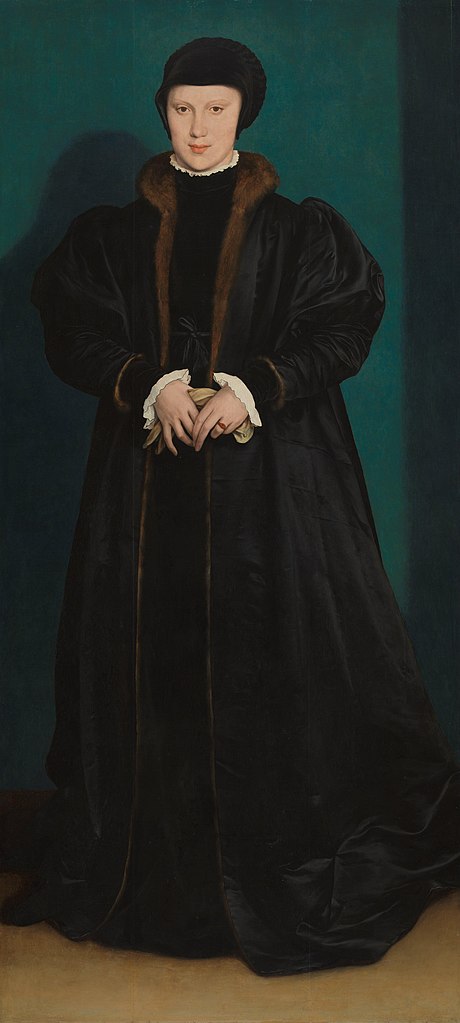
At first glance it is ‘just’ a painting of a woman. Commanding, elegant, and serene, she stands on a tawny-coloured floor in front of a dark turquoise wall, brilliantly illuminated by sunlight. The wall is cast into shadow down the right edge of the painting, so she must be standing at a large, open door, or floor-to-ceiling window. The subject herself casts a shadow to our left: the sun is in front of the painting, above it, and to our right, somewhere above and behind our right shoulders. She looks deep into our eyes, her hands held in front of her waist. Apart from her face and a tiny amount of her neck, they are only parts of her body we can see. Other than that, she is clad in black from head to foot.

Her hat, dress and coat are all black. Just visible, but prominent because of its pristine whiteness, is the scalloped hem of the collar of a chemise, peeping out above the high neckline of her dress. The other ‘non-black’ element is the brown fur lining of her coat, rich, and soft, and opulent. It speaks of great wealth, and great warmth. Given that the sun is shining so brightly, I have always imagined that it must be the winter, or maybe early spring: a sunny, but brisk day. Before now though, for some reason, I have never stopped to pin down the date, but it turns out that I was right: it is what we would now class as towards the end of winter. Holbein made the drawings for this painting on the afternoon of 12 March, 1538.
Have a look at her face. What is her expression? I confess I’m not entirely sure… She has a clear, light complexion, evenly almond-shaped brown eyes, the shadows at the corners of which seem to go up just like the corners of her mouth. There is some hint of a smile, perhaps, and yet also a feeling of great solemnity. I would be hard pressed to guess how old she is. She looks mature, and yet not old, serious, and yet somehow fresh. The portraitist’s tendency to flatter might have come into play, though.
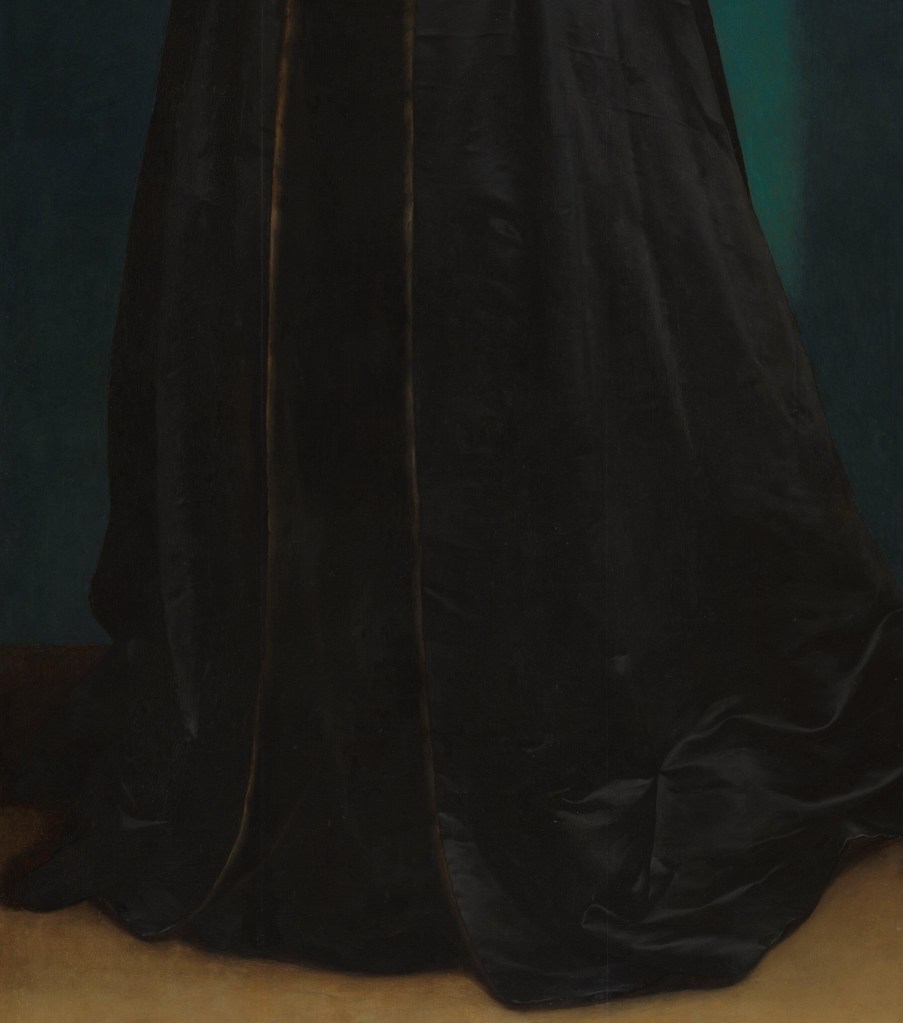
The solemnity is undoubtedly the result of being in mourning. It’s hard to see the dress itself in this detail: it is such a pure black that it is almost imperceptible. The dark space where it must be is framed by the fur lining of the coat, which can be seen all the way to the ground, even if it is far less evident than on the luxuriant collar. The coat itself is gloriously painted, with the black satin glinting and glowing in the sunlight, and spreading across the floor in waves. Towards the top of the detail there are some horizontal marks, running in parallel, which I take to be the remains of some folds. Another assumption of mine is that this coat was stored folded up, rather than hanging somewhere, but I could easily be wrong – the lines might be part of the structure of the satin itself (I’m not an expert in fabrics, let alone historical wardrobe practice…).
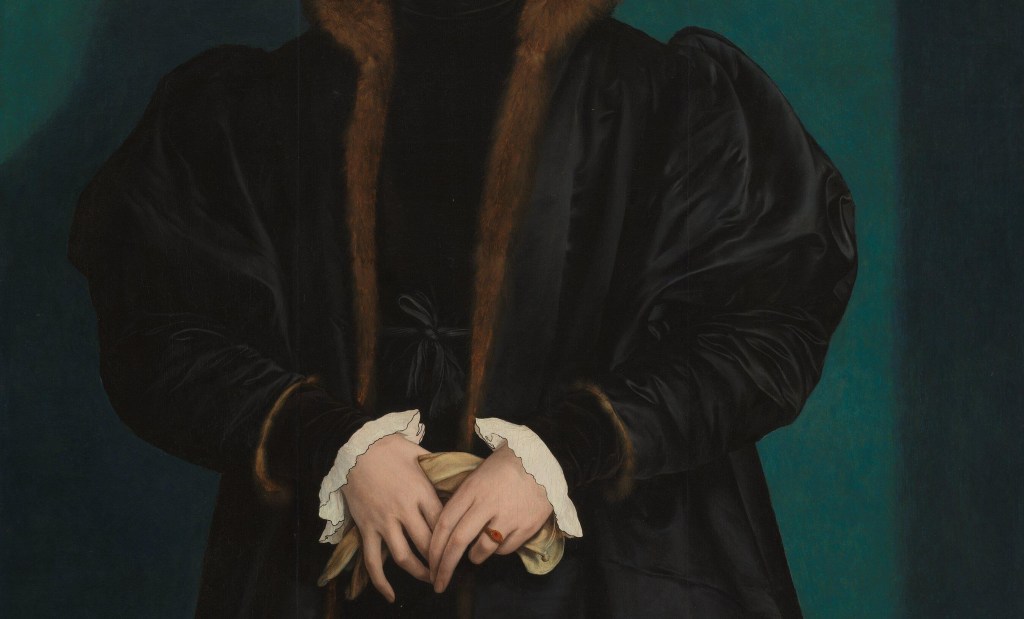
There is far more material than is actually needed for a coat. Apart from the excess fabric spreading across the floor, the sleeves are puffed to give a greater sense of grandeur and – I have to use this word again – opulence. The sleeves of the dress protrude beyond the fur trim of the shorter coat sleeves, and look softer, and even warmer than the satin: velvet, presumably. The dress has a high, black belt, and the cuffs of the chemise are clearly visible, fuller than the trim collar, framing, and giving prominence to, the hands. Christina is holding her gloves, which were a sign of elegance and sophistication. By removing them, not only do we see them – and recognise her elegance and sophistication – but we also get to see her hands, which were, apparently, famed for their beauty: delicate, pale, with long slim fingers, and without a mark. She was not a working woman. She was, however, married – there is a ring on the fourth finger of her left hand. Or rather, she had been married. It’s not a wedding ring, but a mourning ring – they were worn quite commonly between the 14th and 19th centuries: some are mentioned in Shakespeare’s will, for example.
This, as we know from the title of the painting, is Christina of Denmark, Duchess of Milan. And she was sixteen years old when this was painted. A widow at sixteen – but then (as Shakespeare has already come in to play), in Romeo and Juliet, talking of the heroine when told that she was not yet fourteen, Paris (her intended) says, ‘Younger than she are happy mothers made’. Christina was even younger. In September 1533, a couple of months before her twelfth birthday, Christina of Denmark was married by proxy to Francesco II Sforza, Duke of Milan. He was 28. She finally made it to Milan the following May, and in November 1535, by which time she was nearly 14, he died. Let’s have a look at that expression again.
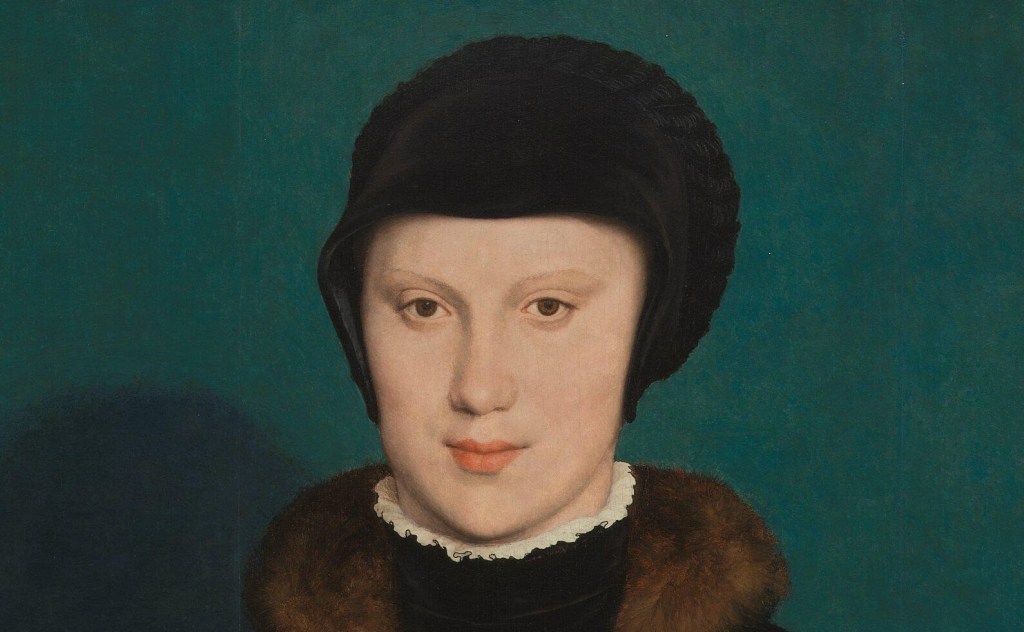
I have to be honest: she doesn’t look that upset. OK, so it’s 16 months later, but, while she is dutifully dressed in mourning, there is that barely suppressed smile. It’s almost like that situation when you want to laugh but mustn’t – there’s a real sense of control, gritted teeth. She was young, single, and fairly well off – enough to be happy, and, of course, entirely eligible. And – of course – there was someone in Europe looking for an eligible young woman at the time. He often was. He got through five in the end (the sixth, famously, surviving). Jane Seymour, the third wife of Henry VIII, had died in October 1537, and in March 1538 Hans Holbein was packed off to Brussels to paint Christina of Denmark, the widowed Duchess of Milan. He only got three hours with her – between one o’clock and four o’clock in the afternoon – before heading back to England. He would have made sketches, and, in all probability, a coloured chalk drawing with annotations, which sadly no longer survives. Many others like it do, though, and one is in the Holburne’s exhibition (I will show it to you on Monday). Holbein completed some sort of finished image, if not this full-length painting, fairly quickly, and Henry VIII was enormously pleased, ‘in better humour than he ever was, making musicians play on their instruments all day long’ (Shakespeare again: ‘If music be the food of love…’). He proposed marriage: which eligible young woman could refuse? However, Christina is supposed to have replied, ‘If I had two heads I would happily put one at the disposal of the King of England’. I so wish she had said that, but I’m afraid I can’t believe it. Let’s face it, Henry had only had one of his wives beheaded at this point (the first wedding had been annulled, and the third bride died) – so it was hardly a reputation. Still, she didn’t marry him. In 1541 she married Francis, Duke of Bar instead. He succeeded his father as Duke of Lorraine three years later (so Christina became the Duchess of Lorraine), and then died the following year. Christina basically went on to live happily ever after, reaching the ripe old age of 69, having been widowed twice with a total of less than six years married.
After a long-drawn-out diplomatic failure, Henry eventually gave up on Christina, and fell for another portrait, that of Anne of Cleves – who, in one of those bizarre twists of diplomatic fate, was betrothed to Francis, Duke of Bar. The King of England was a better catch though, so Anne married him, thus leaving Francis unexpectedly available… and free to marry Christina. In person, though, Anne didn’t live up to Holbein’s artistry, with Henry famously calling her ‘a Flanders Mare’ (or ‘Belgian horse’, in modern terms – although that’s another one of ‘those stories’, this one dating to the 17th Century). Luckily for her she was divorced fairly quickly, and, as a result, like Christina, she also lived happily ever after.
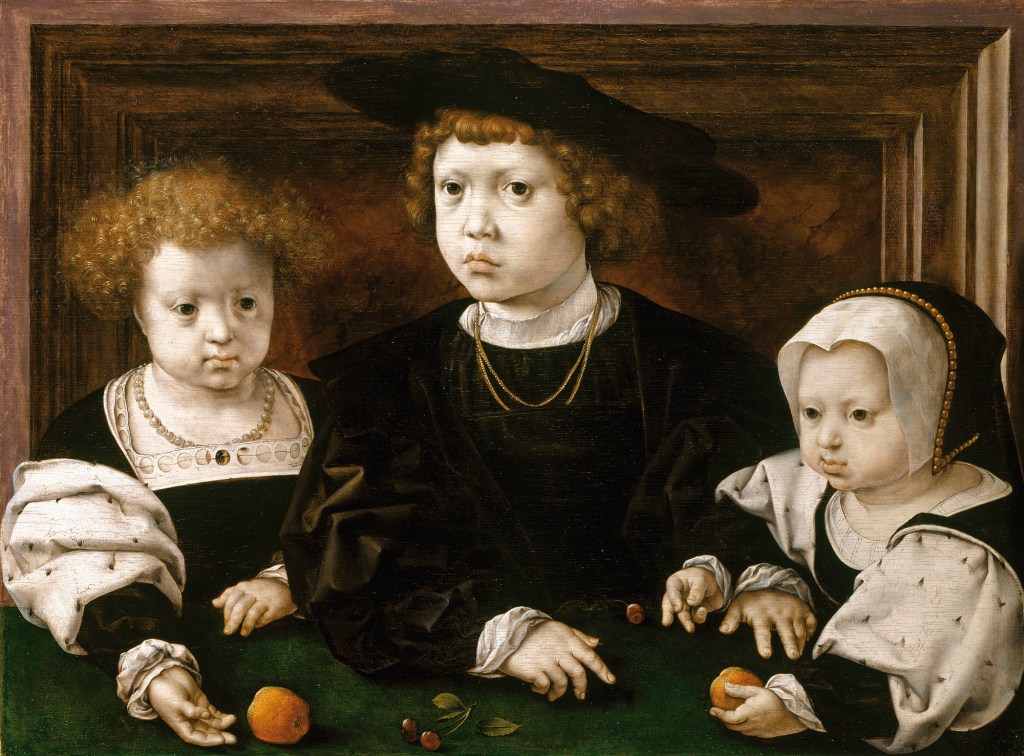
Painted Love – the Holburne’s exhibition – revolves around the portraits of eligible youths and maidens, of potential matches like Christina, of happy brides and grooms, and of the desired result: heirs, and even spares. And even if Holbein’s Christina of Denmark hasn’t made it to Bath, Christina herself has. One of the paintings, lent by His Majesty King Charles III, was painted by Jan Gossaert (artist of The Adoration of the Kings which I discussed detail by detail during Advent a few years back). Dating to 1526, it is entitled The Three Children of Christian III of Denmark, and the four-year-old Christina is on the right. You can never tell how someone will turn out.
 dr richard stemp
One thought on “199 – The One that Got Away”