
Lucie Rie, Bowl (brown and white inlaid line), 1974. Kettle’s Yard, Cambridge.
I first fell in love with the work of Lucie Rie when I was a student working as a volunteer at Kettle’s Yard, the inspirational home of Jim and Helen Ede, and now one of the University of Cambridge Museums – but more about that later. However, it was there that I saw the touring exhibition Lucie Rie: The Adventure of Pottery which I will be talking about this Monday, 7 August at 6pm. The exhibition has now moved on to the Holburne Museum in Bath, where you can catch it until 7 January, overlapping with either Painted Love or Gwen John, depending on when you go. This talk is the first in my ‘occasional’ series An Elemental August – different vistas, and will be followed on the three successive Mondays by Gwen John, Evelyn de Morgan, and Paula Rego. You can find more information via these links or in the diary. And if you fancy spending more time with great artists, there are still a couple of spaces available on the trip to Glasgow which I am leading for Artemisia, if you happen to be free 17-21 September and would like to join me (please mention my name!). But back to Lucie Rie, and inspiration…
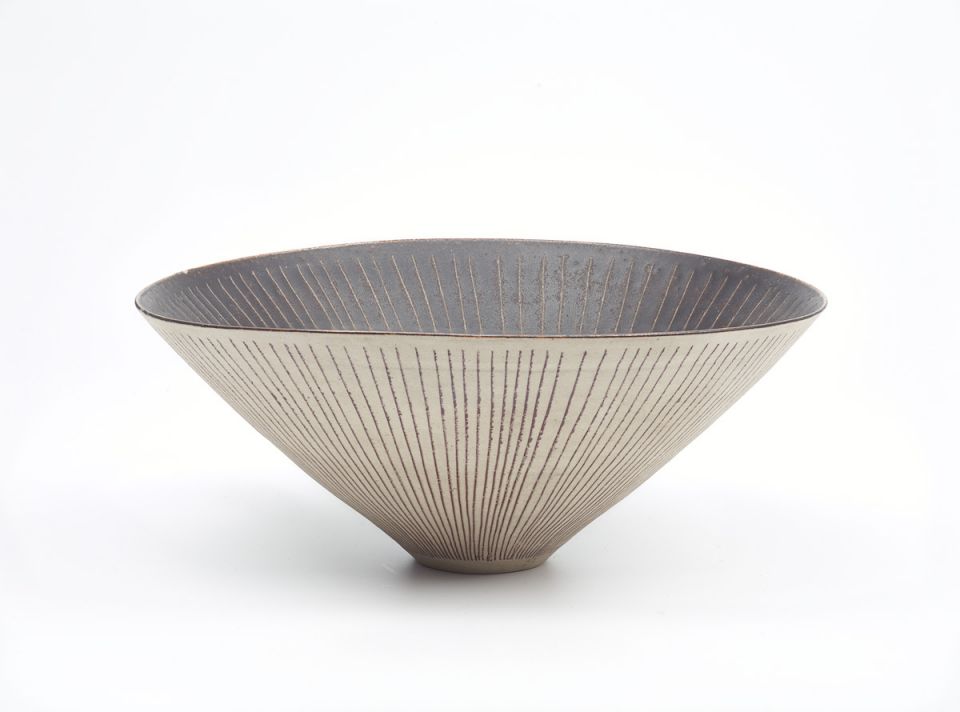
This is how you would see the subject of today’s post in a catalogue – almost like one of the ‘usual suspects’, a police record of a potential criminal. The best of such photographs – like those in the book published to accompany the exhibition – can show the true beauty of the object, and when the objects in question are the delicate, sensitive creations of Lucie Rie their exquisite sensibilities are plain for all to see. But they lack a context – so the remainder of the photographs I am using today are ones that I took myself when I re-visited Kettle’s Yard some forty years after I moved in over the road, during the second year of my undergraduate degree. I was studying Natural Sciences at the time, and although I had ‘gone up’ with the intention of becoming a theoretical physicist and working at CERN, by this point I had realised that I couldn’t do the maths, and instead was intent on becoming a geologist. I confess that I can’t remember if I visited the house while I was so close, but I may well have done. As a young scientist, I was fairly arty.
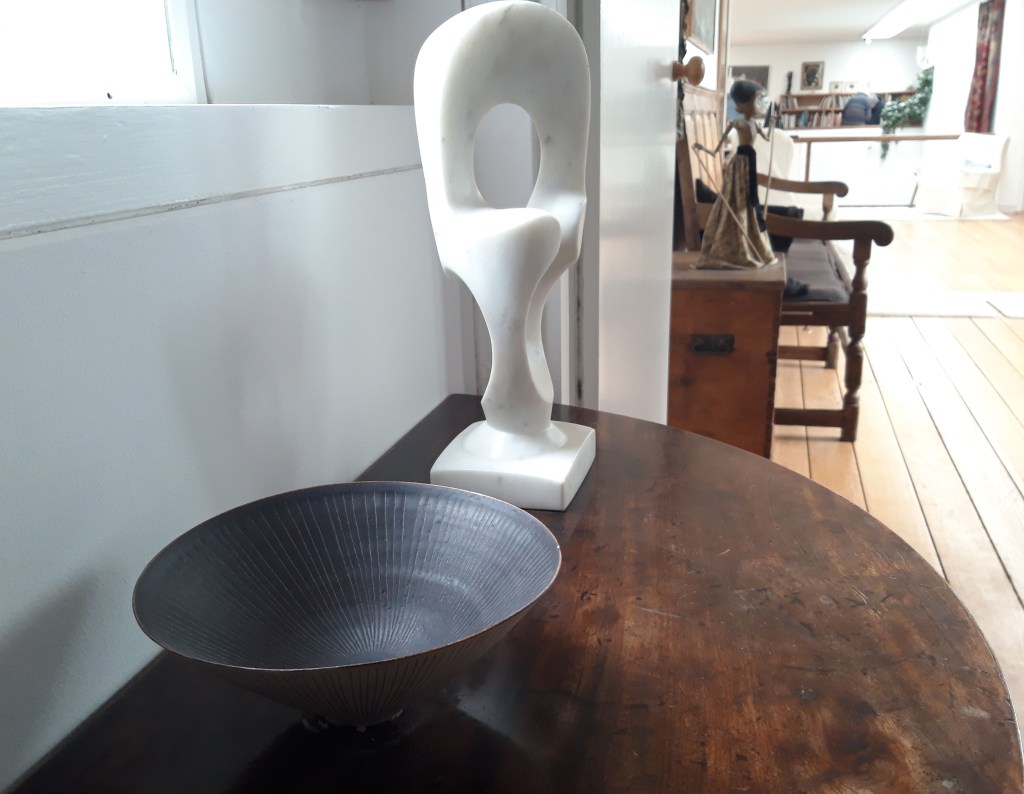
This is how you would first encounter the bowl in Kettle’s Yard. Jim Ede had been a curator at The Tate Gallery (as it was then known) and had put together a collection bought from – or given by – artists with whom he had become friends. He also also had a wide range of furniture, and a multitude of objets trouvés – pebbles and dried flowers feature significantly, for example. He and his wife Helen had sought somewhere to house the collection, and settled on four small cottages in Cambridge, which they knocked together to form a single home. A modernist extension was added later, initially for temporary exhibitions. Eventually the collection was gifted to the University, which continued Ede’s practice of holding a regular ‘open house’. Every afternoon, from two to four, you could ring on the bell and be let in. By my third year as an undergraduate I had realised that I wasn’t going to be a scientist, and embraced the History of Art, still unsure what I would be ‘when I grew up’. I’m still not sure, to be honest. For that matter, I’m not sure if I’ve ‘grown up’ either. For a couple of years in the 1980s – as an under- and postgraduate, I think – I was one of the people who would be ‘at home’ – opening the door and welcoming the visitors, or on hand around the house to answer any questions. Since then a couple more extensions have been added, to allow for exhibitions (the original extension had become part of the ‘house’) and to provide better facilities for visitors – including, I was surprised to find this year, a rather good café.
I’ve always thought that the house unfolds rather like a snail shell, starting with a small entrance vestibule, where the coats of the relatively few visitors would be hung, and bags left beneath the stairs (things have changed now – there are lockers at the ticket desk in the gallery along the passage before you get to the house). From the vestibule you pass through slightly larger (but still small) downstairs rooms, a larger upstairs room, and then cross a ‘bridge’ to the fourth cottage and the extension. You can see the space and light opening out to the right in the photograph above. There is an even larger room below, with a double-height space created by a rectangular, U-shaped balcony and the white wall hung with a Kilim visible at the very top right corner of the picture.

If you pass the bowl and look back this is what you will see – the steps leading down from the ‘bridge’ are at the bottom left. Ede must have regularly rearranged his collection, but by the time I was getting to know it, the bowl was already exhibited alongside a marble sculpture by Japanese artist Kenji Umeda called Spirality, carved, it seems (although oddly they’re not sure), in the first half of the 1970s. Umeda had studied at Cambridge in the 1960s, and used to help the Edes with the cleaning of Kettle’s Yard. He started his artistic life as a painter but switched to sculpture after a visit to the Carrara marble quarry. Ede had a particular sensitivity to form, colour and tone, and everything had its place – even if, as I suspect, that place changed from time to time. It is no coincidence that the interior of Rie’s bowl, using the deep, rich, red-brown manganese glaze of which she was so fond, harmonizes with the dark wood and semi-circular form of the table. Placed just under the window, Umeda’s sculpture catches the light and shows off the marble at its translucent best, a light, convex contrast to the darkness of the bowl’s concave interior.
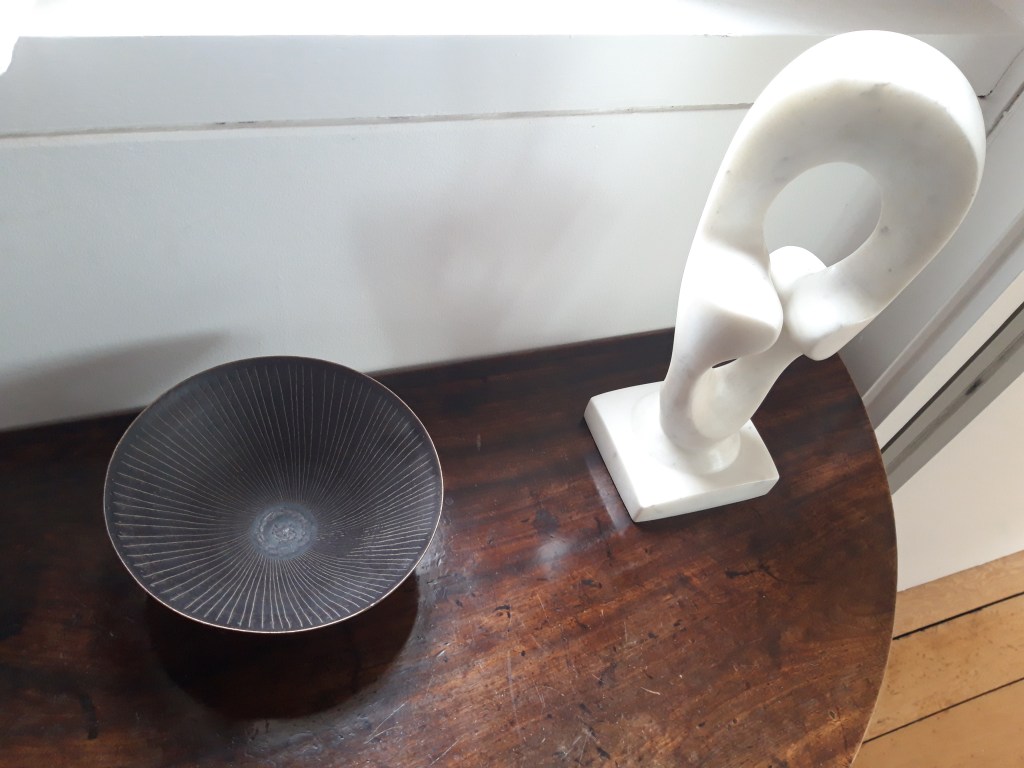
Going back and looking down into the bowl you can see that it appears to be etched with very fine lines. This is one of two related, but opposite, techniques which Rie used often. It is sometimes hard to distinguish between the two. This is sgraffito – an Italian word which is the etymology of ‘graffiti’, meaning ‘scratched’. Artistically it can refer to a number of different techniques in different media, but in this case it implies scratching through the glaze. The manganese glaze was applied evenly across the bowl’s interior, and then, with a fine stylus, Rie scratched through it to reveal the clay underneath before firing. Each line was scratched by hand, without the use of a ruler, and this explains the slight unevenness of the lines, quivering, and with irregular spacing, all of which brings the bowl to life: it is not a machine-made object but is subject to human frailty. For me it speaks of great focus, and yet fragility, created by a hand that is undoubtedly in control, but with nerves and blood vessels pulsing through it. The paintings of Agnes Martin hold a similar fascination for me. Although frequently grouped with the Minimalists, she was closer to the Abstract Expressionists, like a Rothko with finer sensibilities: I far prefer her work to his. Like this bowl, some of Martin’s paintings have long, hand-drawn pencil lines which don’t quite reach the edge of the canvas, creating a form of aura, even a sense of longing, or absence, which only adds to their appeal.

If you were now to crouch down to look at the side of the bowl (Jim Ede might have invited you to hold it, but, however tempting, please don’t – you might trust yourself, but I don’t trust the person coming down the steps beside you: they will probably be marvelling at the beauty of the space and light, and not looking where you’re standing…) – but if you were to crouch down, you would see the same effect, but in reverse: fine, dark, living lines against a light background. These are inlaid. After the bowl was thrown, Rie would have scratched thin lines into the exterior of the bowl, then applied a glaze over the whole surface. She would then have wiped off the excess glaze, leaving some of it in the grooves created by the scratching. Sgraffito and inlay look pretty much the same, and occasionally people fail to distinguish – not that it really matters. However, the piece is officially catalogued as ‘Bowl (brown and white inlaid line), 1974’, whereas a caption in the book The Adventure of Pottery describes it as ‘sgraffito bowl, 1974’. These descriptions are not entirely wrong, but they are not entirely accurate either. However, as I said, that doesn’t really matter: the bowl is still just as delicate – both physically and decoratively – and, to my eye, beautiful.
I love the way that the bowl and Spirality are reflected in the varnished tabletop, with the bowl’s reflection almost more like a shadow – the light form somehow looks dark. I also enjoy the echoes of the grain of the wood in the lines on the bowl – whether sgraffito or inlay. The contrast of light and dark is an essential feature of Ede’s arrangement here – a contrast which continues above the table.
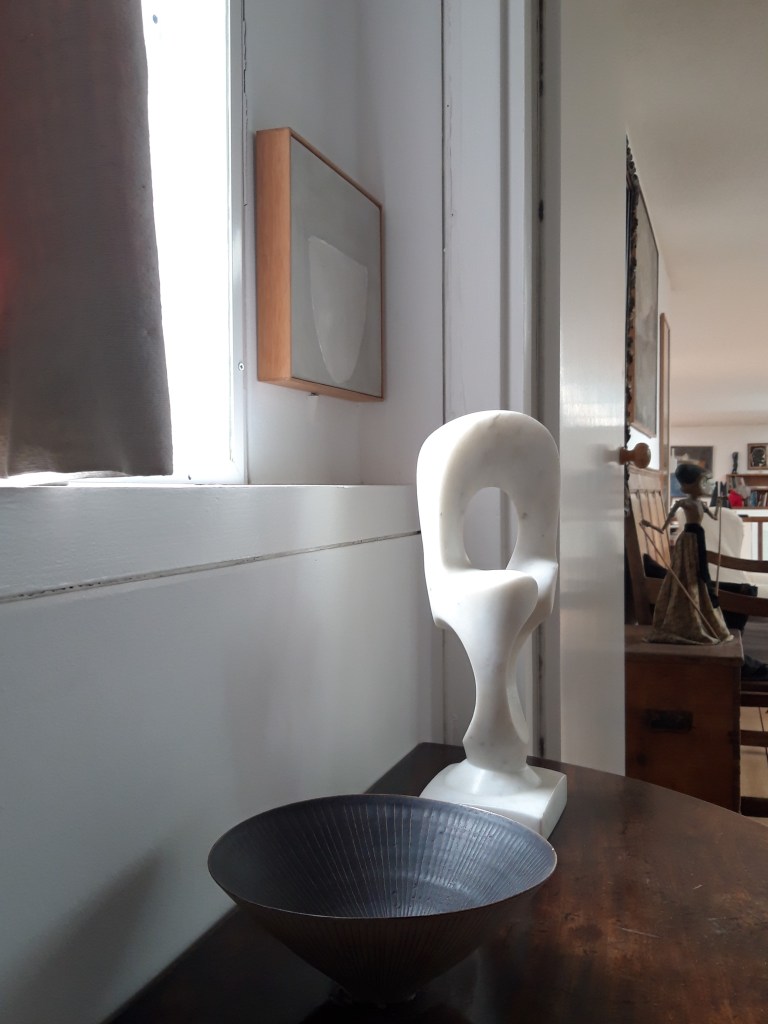
Hanging just above and to the right of the sculpture is a painting: William Scott’s Bowl (White on Grey), of 1962. The whiteness of the painted Bowl not only ties in with the exterior of Rie’s ceramic, but also inverts the curving top of Umeda’s marble. This attention to detail recurs across the whole museum, in every room – as I said, Ede had a remarkable eye. The house is a work of art in its own right, constructed from numerous objects, whether ‘art’ or ‘other’, all of which are given more or less equal status. These include four pieces by Lucie Rie, as it happens. Ede and Rie had a regular correspondence, and once, after she had visited the house, she wrote describing it as ‘a unique experience… I shall never forget’. When I visited earlier this year I realised what an inspiration it had been. At home I have transparent and translucent objects of different colours on windowsills, all very carefully arranged to catch the light: woe betide anyone who leaves something in the wrong place. I thought this was my own idea, but it must have been a subconscious memory of the light flowing through glassware and around sculpture not far from where Rie’s bowl is exhibited. I’m not pretending that my home is anything like Kettle’s yard – there’s not nearly so much space, for one thing, not nearly as much art, and far more clutter. However, most of what there is was made by friends, which adds to its value for me. Sadly I don’t own a Lucie Rie – let alone four – although I do have a dish I bought as a 21st birthday present to myself from Primavera, the ‘arty’ shop on King’s Parade in Cambridge, even if I can never remember the name of the potter… It came as a great surprise to learn that that Rie’s work had been sold in the same shop. Primavera was set up by Henry Rothschild (like Rie, a Jewish refugee), and it was he who organised the exhibitions of ceramics in Kettle’s Yard which led to Ede’s acquisition of his four pieces. It’s a tenuous link, perhaps. Nevertheless, one of the results of my afternoons in Kettle’s Yard was the fascination with this wonderful ceramicist, whose work – like that of textile artist Anni Albers – persuades me that the distinction between ‘art’ and ‘craft’ is sometimes an unnecessary distraction: a thing of beauty is a joy forever. I do hope I can share my enthusiasm and fascination with you on Monday.
 dr richard stemp
Lovely work.
The first terms that came to mind were Classic and Elegant, but also a Japanese element.
And then I read your blog. Pleasing to know my mind is on track – if only for today.
I was wondering with your undergraduate migrations – were you in the last intake of government grant students?
I just caught it.
LikeLike
I don’t think I was in the last intake – I’m sure there were a few more years after I graduated, but I’ve really lost track…
LikeLike
Thanks Richard. So often your posts remind me to be present and simply look at what is there.
LikeLike
Thank you, Ken – that’s just about the best thing you could have said!
LikeLike
I think I am right in thinking her home and workshop were at Albion Mews and that she didn’t have a separate studio. In this she is was very much like Alice Neal although I don’t think they had much in common despite being close in age. Loved the exhibition which was virtually empty when we visited unlike the Rossettis last week.
LikeLike
Absolutely – home and studio in the same building. It was quite common – e.g. the Leighton House in Holland Park, the Sorolla Museum in Madrid, and others…
LikeLike