
Dirk Bouts, The Virgin and Child, c. 1465. The National Gallery, London.
On Monday 18 March I will reach the third leg of my Stroll around the Walker, and will look at the beautiful and varied images of Mary and Jesus in the Liverpool collection in a talk entitled The Virgin and Child… and other relatives. Not only is this one of the themes of their new display, Renaissance Rediscovered, but other paintings in the Walker (which I have not yet discussed) remind us that this subject matter is endlessly diverse, while yet more can also add to our knowledge of the complex relationships within the extended holy family – as understood by the medieval church. Sadly I don’t have time to write about any of the Walker’s own paintings this week (I’m busy in London with In Person Tours), so I’ll leave that until Monday and re-post a blog, originally title Mary, multi-tasking, about a painting in the National Gallery. I fell in love with it when it was exhibited at the Dulwich Picture Gallery in the exhibition Reframed: The Woman in the Window. There won’t be a talk the following week, as I will finally be settling in to the new home (hoorah!), but I’ll be back on Monday 1 April to talk about the Royal Academy’s unheralded display looking at Frederic Leighton and Flaming June. The week after (8 April), I will be Revealing Ravenna, exploring the city’s history via its art and architecture – and most importantly, the stunning mosaics. The next group of In Person Tours will follow this. On Tuesday 9 April at 11am I will repeat NG03 The Northern Renaissance, and that afternoon, Tuesday 9 April at 2.30pm, I will continue with NG04 Florence: The Next Generation. On Thursday 11 April I will move on to a new session at 11am with NG05 Siena in the Fifteenth Century (Morning) and repeat it at 2:30pm for NG05 Siena in the Fifteenth Century (Afternoon). Details of the tours can be found via these links on Eventbrite, and in the diary. For now, though, let’s look at this wonderful painting by Dirk Bouts.

What better choice for an exhibition entitled The Woman in the Window? After all, The Virgin and Child appear to us through one window, and there is a second in the background – an idea which is elucidated, along with so much else, in the exhibition’s thoroughly researched and brilliantly written catalogue by curator Jennifer Sliwka. The Christ Child sits on a cushion on the window sill, supported by his mother’s left hand, his legs and back echoing the horizontal sill and vertical frame respectively. Mary proffers her breast for him to feed, and looks down tenderly, swathed in her traditional blue mantle. A red cloth of gold hangs over the wall on the right, and on the left the second window looks out on the surrounding countryside, and a not-too-distant city.
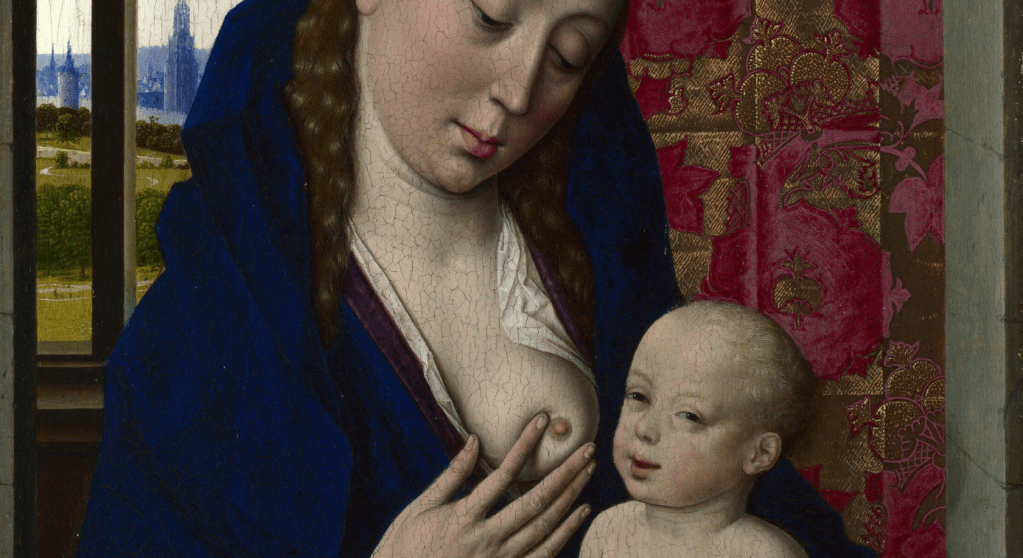
What role does Mary fulfil in this painting? Primarily, of course, she is the mother of Jesus – or, to give her the title bestowed unequivocally by the Council of Ephesus in 431, Theotokos, the Mother of God. This not only defines Mary’s status, but also confirms Jesus’s divinity. Her role as mother is demonstrated through her act of feeding, although, given that it was common for members of the moneyed classes to employ wet nurses to suckle their babies, Mary’s nurturing and care of her own child would have been doubly significant. Her ‘sacrifice’ in this regard also became equated with Jesus’s care for us. In the same way that Mary fed Christ from her breast, the wound in his side, from which blood and water flowed when pierced with a spear at the crucifixion (John 19:34), feeds us spiritually.
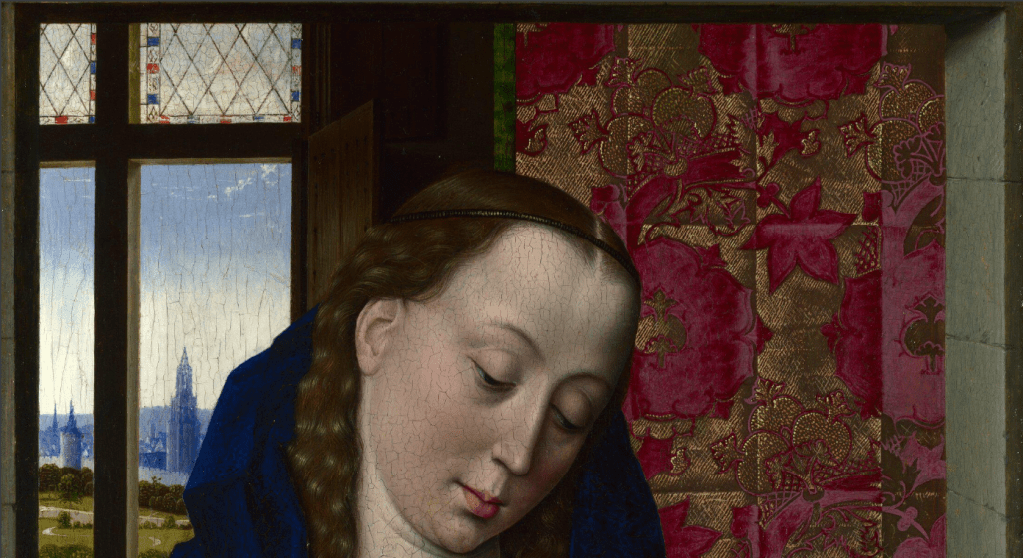
As well as Mother of God, Bouts also shows Mary as Queen of Heaven. The red cloth in the background is the same as that hung behind her when enthroned. It is a cloth of honour, used to enhance the status of medieval monarchs and serving to emphasize their physical position while holding court. It can also include a canopy, or baldachin, which effectively crowns the throne, as it does in the National Gallery’s Donne Triptych by Hans Memling. However, when ‘used’ as the cloth of honour, the fabric would be directly behind the monarch. Here it is hung to one side, suggesting that ‘Queen of Heaven’ is just one of several roles that Mary performs. The green trim with which the cloth is hemmed hangs on the central axis of the painting, implying that the cloth takes up half of the background – but notice that the framing is not symmetrical. In the foreground the light comes into the window from above and from the left: the inner face of the window frame on the right is well lit. The joints between the stones from which it is constructed are angled differently, telling us that Bouts had a good sense of spatial recession, even if this isn’t a geometrically consistent perspectival system. Nevertheless, these lines lead our eye into the painting, and into a space made holy by the presence of mother and child. The underside of the frame at the top, and the inner side on the left, are both in shadow. On the left there is less of the frame visible than on the right, suggesting that our view point is to the left of centre, as if we are directly in front of Mary, who is likewise positioned slightly to the left.

The window at the back is also important. The inside of the frame and its tracery are in shadow (which is not surprising, given that they are ‘inside’). I can’t help myself seeing the shape of the cross in those dark lines. The light would appear to come from the right here, but we can’t see the other side of the tracery to see if it is lighter or darker, so it is not necessarily inconsistent. As so often in paintings of this time (and so, one would assume, contemporary houses) there is glass in the upper sections of the window, but not in the lower (see, for example, the Arnolfini Portrait). The shutters are perfectly defined, and you can even tell that, in bad weather, the lower shutters would be closed first, and then the upper ones shut over them, if you wanted to keep out the light as well as the cold and rain. Rust streaks down from the iron nails in the lower panels. This detail is, I suspect, purely naturalistic, and helps up to believe in the setting. The glass too, is an example of naturalism, but it is also symbolic: light passes through glass without the glass breaking. In the same way, Jesus, both God and Man, passed through Mary, and she remained virgo intacta – intact, unbroken. Glass, and light passing through glass, is symbolic of Mary’s virginity. One of the many epithets applied to her was fenestra crystallina – ‘the crystal clear window’. Placing her blue mantle next to the (anachronistic) church tower, blue as a result of atmospheric perspective, and reaching up to the deeper blue of the zenith, helps to emphasize Mary’s role as Queen of Heaven. But it also, perhaps, suggests another role – Ecclesia, a personification of The Church.
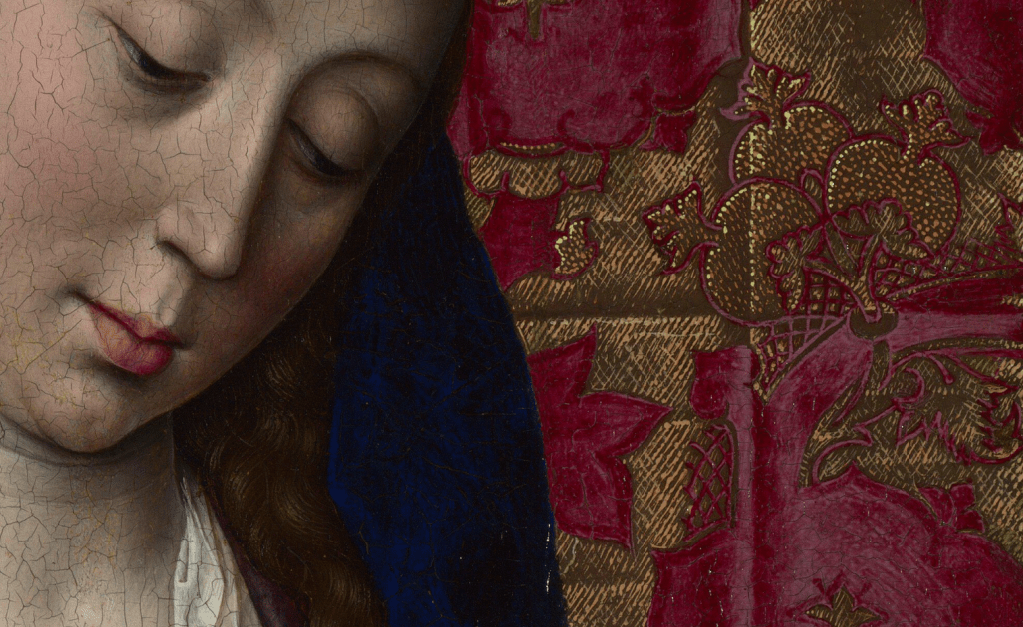
Bouts was not stupid. He painted the blue with the most expensive pigment, ultramarine, but he didn’t waste it. He painted it over a ground layer of azurite, a far cheaper form of blue. This was standard practice, to make the painting look good, but not to be too costly. And he didn’t use gold for the cloth of gold, although this was as much a display of painterly skill as anything else. I can see four different colours there: a ground layer of brown, and then, over the stylised leaves, cross-hatching of a creamy-butterscotch colour. The fruits are stylised pomegranates – I know, they really don’t look much like pomegranates, but comparison with other painted fabrics – not to mention real fabrics – shows different degrees of stylisation. They appear to have been woven in a different way to the leaves, and rather than cross hatching Bouts has applied texture with dots, both orangey-brown and a light cream. Seen this close up the vertical line of light cream dots looks unconvincing – but seen from a distance it becomes clear that here, as across the whole surface, the fabric is creased by careful, regular folds. Elsewhere, as below the line of dots, it is the contrast of light and dark which defines the folding.

Jesus is not sitting directly on the cushion, but on a white cloth, held next to his hip by Mary’s hand. This may well be his swaddling, but it is inevitably reminiscent of the shroud to come. That’s the third reference to his death, by the way. The first was Mary’s breast, with its echo of Jesus’s wound, the second was the cross formed by the transom of the rear window. And there is a fourth. Look at the delicate way in which Bouts has painted the creases of the baby’s hands and feet. In 33 years – more or less – they will be pierced with nails. Even as an infant he is showing us his hands much as he will as in some versions of the Man of Sorrows which show his wounds post-crucifixion. We are never allowed to forget why this fragile infant has come to earth. And yet, I find his expression in this painting delightful, if not entirely easy to define. Is he slightly sleepy? And content, maybe, having eaten? I can almost imagine a gurgle.
The light coming from the left casts a shadow of Jesus on the inside of the front right window frame – the edge of his head and his elbow – and indeed, the light on his body is beautifully painted. Look at the way his left hand stands out against the fully illuminated arm behind it, for example, or the light reflected from the window frame which edges his left arm and elbow, making them stand out from Mary’s dark cloak. There are also the subtly varied shadows on the different joints of the fingers of his right hand. Look, too, at the gentle pressure applied by Mary’s fingers on his stomach, and on her own breast, which even wrinkles slightly – such delicacy of depiction!

The composition of The Virgin and Child is not unlike a standard formulation for portraiture. Here is Bouts’ own Portrait of a Man from 1462 (the date is ‘carved’ into the wall at the top right) also in the National Gallery. His arms are firmly placed on a window sill, although in this case there is no surface visible: it would have been represented by the original frame of the painting, which no longer survives. We know that he is at a window, though, as the light casts a shadow of his head on the back wall – in the same way that Jesus’s shadow is cast onto the frame in today’s painting. There is also a window in the background, with a similar view, apart from having a distant town, rather than nearby city. However, this window has no tracery. It is more modest than that at the back of Mary’s house, although similar, perhaps, to the foreground window through which we see her. By painting The Virgin and Child with the same formulation as a portrait, Bouts makes them, too, look like they are sitting for a portrait, thus making them look more ‘real’. Not only are they appearing to us in the window, but they are very much a part of our world, the world we live in and see around us. But why did Bouts feel compelled to paint the window frame, when the picture frame could have fulfilled the same function – as it would have done in the Portrait of a Man?

This is not the original frame – although it is a style that was common for paintings of this period. However, we don’t know if the original frame was painted: many were (for example, the Portrait of a Man by Jan van Eyck in the National Gallery). And if it was, it makes sense that, rather than being cut off by the frame, the white cloth hanging below Jesus may have hung over the frame – as if it were a physical connection between us and the divine.
Mary is seen as the Mother of God, the Crystal Clear Window, Ecclesia, and the Queen of Heaven – the last role emphasized by the cloth of honour hanging in the background. Jesus sits on a green cloth of gold cushion, the underside of which is red – the same red as the cloth of honour. But then, the green of the cushion is the same colour as the green trim of the cloth, centrally located and seen only at the very top of the painting, where it leads our eye back down and connects to the cushion. If Mary is Queen of Heaven, Jesus, sitting on inversely coloured fabric, is its King, making Mary the Sponsa Christi or Bride of Christ. This is a title now commonly given to consecrated women whose life is dedicated to Jesus, but it also relates to the interpretation of that most intriguing of Jewish texts, the Song of Songs, or Song of Solomon, long seen by Christian theologians as an allegory of the love of the Church for Christ – or, for that matter, of the mystical marriage of Christ and the Virgin, as King and Queen of Heaven. In that light, Chapter 2, verse 9 is of particular interest:
My beloved is like a roe or a young hart: behold, he standeth behind our wall, he looketh forth at the windows, shewing himself through the lattice.
Admittedly the rich language of the King James Version is not at its clearest here, but the implication is that the bridegroom (Christ, in the Christian interpretation) is outside, and looking in at the bride (‘Mary’) through the window. This is one of the origins of an idea which culminates, poetically at least, with Petrarch (as quoted by Sliwka in the catalogue cited above). In the third verse of his ‘song’ Vergine bella, che di sol vestita (‘Beautiful Virgin, who is dressed by the sun’) is the phrase ‘o fenestra del ciel lucente altera’ – ‘o noble and bright window of heaven’. As well as fenestra crystallina – ‘the crystal clear window’ – Mary was also seen as fenestra coeli, ‘the window of heaven’. It is through her that we can heaven’s beauty and truth. The window frame through which The Virgin and Child appear to us is a symbol of that concept, and represents yet another of the many roles that the Virgin adopted for the medieval and renaissance church. That is presumably why Bouts wanted to paint the whole stone frame, rather than relying on the painting’s wooden surround.
The images of the Virgin and Child from the Walker Art Gallery which I will talk about on Monday are perhaps not as complex as this one, but each reveals a different facet of Mary’s character as it was built up by the Church over the centuries, and adds to our understanding of her importance for artists in medieval, renaissance and baroque art. There are some remarkably beautiful and unexpected paintings, worth looking at whatever the different messages they convey, so I do hope you can join me.
 dr richard stemp