
Laura Knight, Laura Knight with model, Ella Louise Naper (‘Self Portrait’), 1913. National Portrait Gallery, London.
This Monday 5 August at 6pm I will conclude my three part series on Tate’s superb Now You See Us, with a talk entitled From photography to something more modern. I will look at a few remaining paintings in the Victorian Spectacle room, before moving on to think about women and watercolour, photography, and then, as the title suggests (given that photography was developed back in the 1830s), ‘something more modern’, looking at paintings from the first two decades of the 20th century. I revisited the exhibition last week, and there really are some wonderful things to see in these last few rooms (as there were in the ones before, of course). The following Monday, (12 August) I will explore the Royal Academy’s exciting In the Eye of the Storm: Modernism in Ukraine 1900-1930s: it’s the most visually exciting exhibition I’ve seen this year, and really shouldn’t be missed. I’d then like to to revisit Laura Cumming’s beautiful written and highly readable book Thunderclap. Although she is mainly concerned with the enigmatic Carel Fabritius (about whom I have already spoken this year), she also discusses some other ‘greats’ from the Netherlands who mean a lot to her, including Hendrik Avercamp, Rembrandt, Gerard ter Borch and Adriaen Coorte. They will all be included in Thunderclap: the ‘other’ artists on Monday 19 August. And finally, for August, (on the 26th) I will introduce the National Gallery’s soon-to-open Hockney and Piero: A Longer Look, which brings together paintings by David Hockney and Piero della Francesca and looks at the nature of looking itself. More talks will follow: the details of everything that has been arranged so far can be found on the diary page of my website.
The undoubted ‘star’ of the last room of Now You See Us is Laura Knight. Or, if you prefer, Dame Laura Knight: in 1929 she was the first female artist to be granted this honour. Seven years later, she was also the first woman to be elected to full membership of the Royal Academy, and in 1965 she was the first woman to have a solo exhibition there. As I’m currently on holiday, passing through Aberdeen (did you know they have the most fantastic art gallery? I’m on my way there now), it seems a good opportunity, after last week, to revisit another post from January 2022. This one was originally entitled Me, Myself and I? and looks at one of Laura Knight’s truly great paintings.

It’s a remarkably original choice for any artist – a self portrait seen from behind: she is focussing on what she does, not what she looks like. Knight appears sensibly dressed, with a mid-length red jacket over a grey skirt, and what I would interpret as a striped foulard around her neck (although, as you probably realise, I am not an expert on women’s dress). As it happens, it’s not a jacket, per se, but a favourite cardigan, which she called ‘The Cornish Scarlet’. She bought it at a jumble sale in Penzance for half a crown (or 2/6, or 12.5p, depending on your age), and it can be seen in a number of her paintings. Nowadays it would be classed as ‘vintage’ and cost a whole lot more. She also wears a black hat with a colourful ribbon almost hidden by the upturned brim: all respectable women should wear a hat when in public. Her hair appears to have been plaited and pinned up. If she hadn’t turned her head to the right, we wouldn’t be able to tell who she was – and it is not clear why she has turned so far: certainly not to look at the model, as she looks past her, to something out of the frame. She is holding a paint brush in her right hand, and, from the bend of her left elbow, we can imagine that she is holding a palette in her left. The model, who is completely naked, stands with her back to us, on a striped rug which is itself on a raised platform. While her heels are more or less parallel to the picture plane, she is turned to the left, allowing us a partial view of one breast. She raises her arms around her head, with her right and left hands resting on her hair and right arm respectively. Behind her is a red screen. It may be a folding screen, although the right-angled section to the left has a trim not seen in the plain vermillion area behind her, which could even be a brighter cloth hanging over the screen: the construction is not entirely clear. In front of it, though, to the left, and behind the image of the artist, is the canvas that Knight is currently working on. Having seen the model herself, here we see her painted image, and, to the left of her, the part of the red screen that the artist has completed so far.
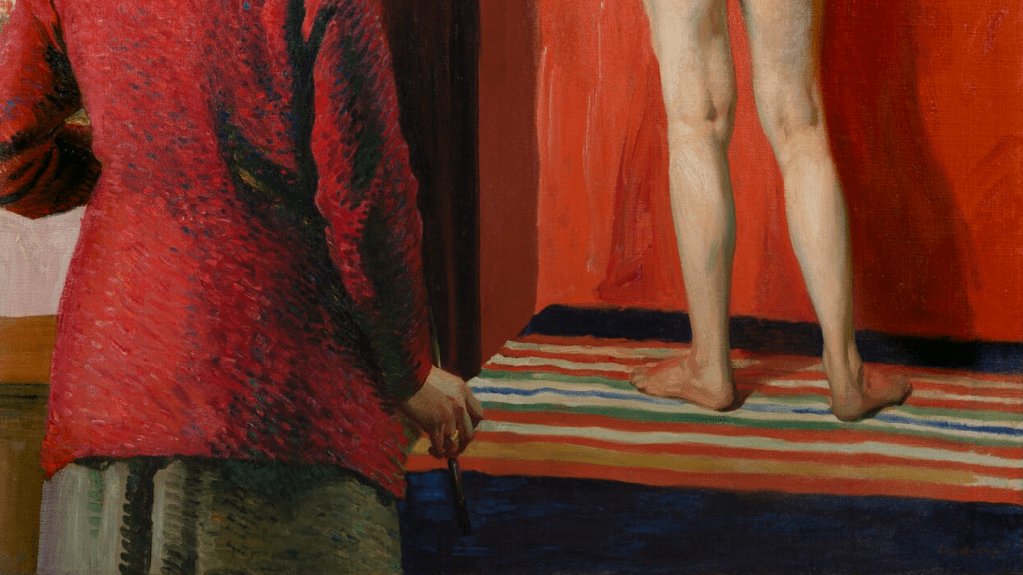
The inflection of Knight’s right wrist means that her hand is held away from her hip, so that she will not get paint on her skirt. It also serves to draw attention to this hand, and to the gold ring on the fourth finger. It looks like a wedding band, even if it is on the right hand (I don’t think she was looking in a mirror to see what her own back looked like: the clothing itself does not reflect her appearance, and she may well have got someone else, possibly even the same model, to model for the back – so I don’t think that this is her left hand as seen in a mirror). She was born Laura Johnson in 1877, taking her husband’s name when she married artist Harold Knight in 1903, at the age of 26. They were both born in Nottingham, and met at the Nottingham School of Art, where Laura’s mother taught.
In some of her early works Knight experimented with the pointilliste technique of George Seurat, and she continued to return to it when it suited her – as it does here in the separately coloured brushstrokes which define ‘The Cornish Scarlet’. In this case, the brushstrokes are perhaps closer to the Impressionist tache (meaning blot, patch or stain) – a short, broad mark which emphasizes the making of the image. The brushstrokes do not allow us to confuse the painting of the cardigan for the thing itself: it is undoubtedly a painting. What you are looking at, the brushstrokes say, is the work of an artist. How appropriate that she uses this technique as part of her own image, given that she is the person who made it.
If the depiction of herself – or at least of her clothing – focusses on colour, the depiction of the model is all about form. In the detail above, look how the precise tonal shifts tell us the exact structure of the feet, the slight lift of the right heel from the rug, the width of the Achilles tendon, and the structures of the muscles and the backs of the knees.

Looking at this detail I am more convinced that there is a cloth hanging over the screen – the vermillion appears to wrap around the dark frame. And the painting of this cloth is entirely different to that of the cardigan – extremely ‘painterly’, with long, broad, flowing brushstrokes painted wet-on-wet and blending in with each other. Although not part of the image that she has painted of herself, the use of a different ‘style’ of painting is surely another way in which she is inviting us to enjoy her skills as an artist, demonstrating as it does her ability to choose the brushstroke according to the nature of the material she is representing: here the vermillion cloth is broad, and flows downwards, just like the paint. The subtle but precise modulation of flesh tones continues, defining the curve of the spine and flexion of the muscles, as well as delineating the model’s long, slim fingers. Compared with the impressionistic image seen in Knight’s unfinished painting of the model, this might start to appear like photorealism – but the brushstrokes never let us forget that it is a painting. The canvas she is working on is still clearly unfinished, though. She may have started to paint the model’s shadow on the screen, but not the lit area: the white background remains, and is precisely what allows Knight’s bold profile to stand out so clearly. She is, effectively, in contre-jour – ‘against the day’: her face is depicted in shadow against a light background.
When first exhibited in 1913, at the Passmore Edwards Art Gallery in Newlyn, Cornwall (where the Knights were then living), this self portrait – then called The Model – was well received. But later it was apparently turned down by the Royal Academy for their Summer Exhibition, and instead was seen in London at the Grosvenor Gallery, where reviews were mixed, to say the least. The Telegraph Critic, Claude Phillips, called it ‘harmless’ and ‘dull’ (which it is not, in my humble opinion). However, he seems to have been in two minds, as he also thought it ‘vulgar’, saying that it ‘repels’. As a work which was, he had decided, ‘obviously an exercise’, he thought it ‘might quite appropriately have stayed in the artist’s studio’. So what was his problem with it?

I think that if we focus on this central section we might get a good idea. One of the first things to remember was that women had little or no access to life drawing classes. At Nottingham, the men and women (or girls – Knight studied there for around six years from the age of 13) had been segregated, and the women did not draw from the nude. The model in this painting is Laura’s friend, and fellow artist in Newlyn, Ella Louise Naper. So for one thing, this is a bold statement declaring that women should have access to the same education as men [at the Royal Academy, women gained access to life drawing classes in 1893, as we shall see on Monday]. However, the painting also creates some surprising juxtapositions. The light comes from the left – you can see Naper’s shadow on the screen to her right – and, given that Knight turns to the right, her profile is entirely in shadow. Nevertheless, it stands out clearly thanks to the brightly illuminated canvas. The negative space created by the artist’s profile – the brilliant white patch of canvas – is similar in form to the equivalent area in red around the model’s left side, with a startling echo from Knight’s nose to Naper’s breast. And, as Naper is standing on a platform, her brightly-lit buttocks are more or less on a level with Knight’s shadowy face, surely enough to make any self-respecting (male) critic blush.

As a whole, the contrast between the two women is intriguing. One clothed, the other naked; one has both arms down, the other up; the artist on the left is turned to the right, the model on the right is turned to the left. Their poses, with the shoulders on a diagonal going back into the space, echo each other, inverting only the arms, with Naper’s left arm hiding her profile. Laura Knight, despite the shadow on her face, is the one we can identify, but the various echoes and inversions could lead us to think about substituting one figure for another. With this comes the realisation that the artist herself might easily look the same as the model if she weren’t wearing clothes. I suspect it is this that made men uneasy. It was one thing for them to paint naked women – they could tell the difference between artist and subject – but in this painting, the difference is not so clear. In addition to this, of course, was the fact that Knight’s acknowledged skill was clearly a threat to the men’s supremacy.
One last question: what painting is Knight actually working on? We know that it is not finished, but we only see part of it. Nevertheless, what we do see is entirely consistent with the idea that the work she is painting is the finished self portrait itself, if we assume that we only see around 40% of it – the section which includes the vermillion cloth. Laura Knight is taking a break from painting herself painting herself painting a model – her painted image in this painted image is beyond the frame. Having said that, I do have a sneaking suspicion that she would finish the red screen first.
[Sadly this complexly-conceived portrait is not in Now You See Us – but happily at home in the relatively recently refurbished National Portrait Gallery. Another painting you won’t get to see is one of her most famous, Ruby Loftus Screwing a Breech-ring, as it dates from 1943, which is too late for Tate’s survey. However, I’ve left this link in (from the original post) as it will take you to a wonderful contemporary newsreel clip. If nothing else, it’s worth watching to see Knight being handed a cigarette by the presenter, and both of them lighting up in the Summer Exhibition itself. It also demonstrates how remarkably accurate her portrait of Loftus is. The painting dates from Knight’s time as a war artist in the 1940s. Before Now You See Us I hadn’t realised is that there were also women working as war artists during the First World War: I will look at some of their paintings on Monday.]
 dr richard stemp
Enjoyable post – thank you Richard! I am reading‘Thunderclap’ at the moment and recommend it too. Enjoy your holiday.
LikeLiked by 1 person
Thank you! Holiday enjoyed! And yes, I’m looking forward to reading ‘Thunderclap’ again!
LikeLike