
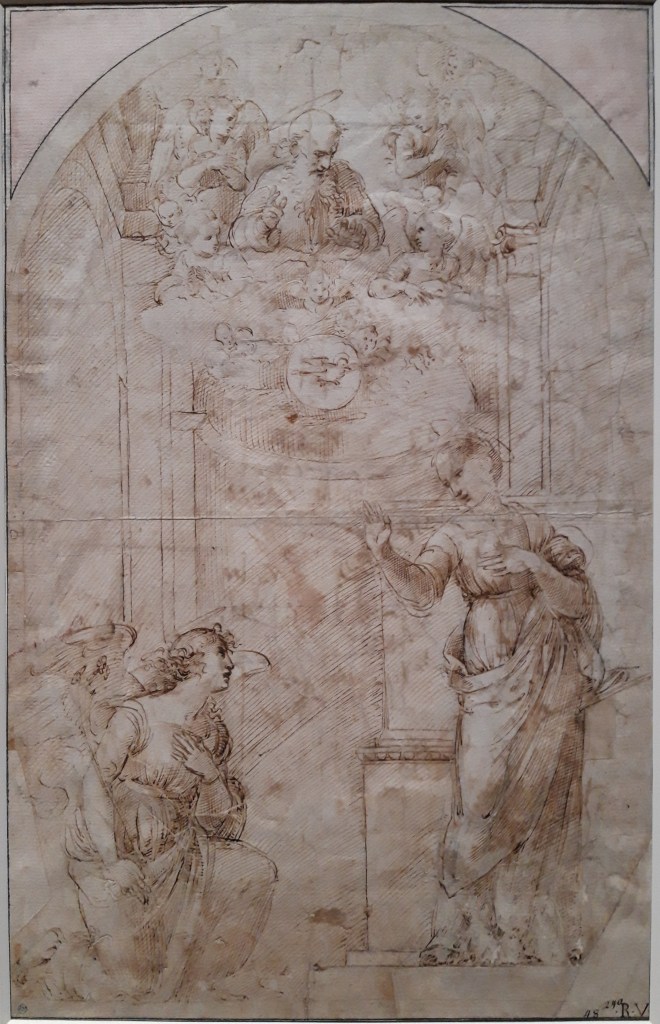
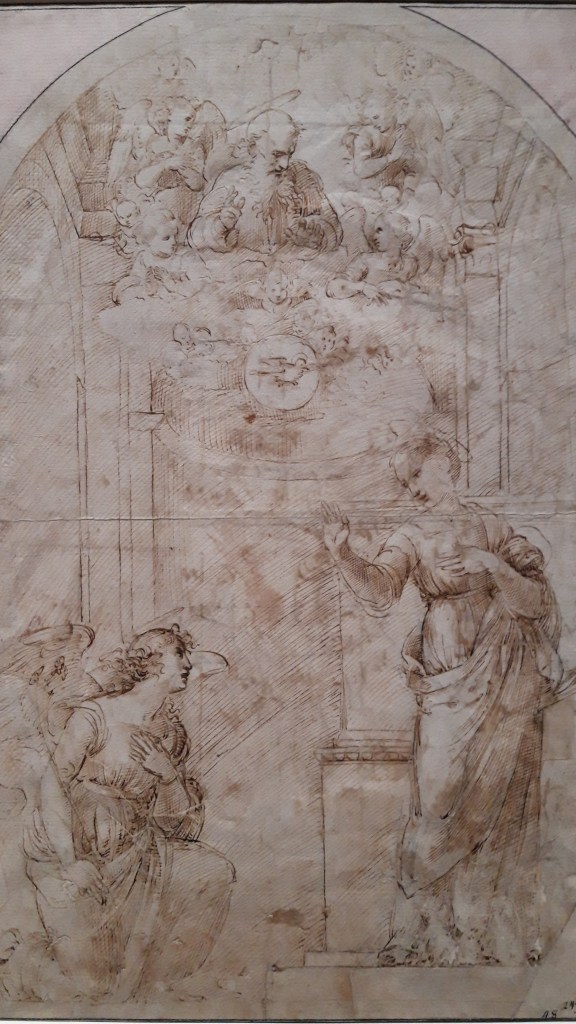
Raphael, The Annunciation, c. 1506-7. Nationalmuseum, Stockholm.
This week I had planned to write about a drawing by Raphael after a painting by Leonardo – but as predicted, I’ve run out of time. So instead, I will re-post an entry about a drawing by Raphael which may have been made for a painting by someone else… it’s not entirely clear. It comes from the period when the young artist was in Florence (c. 1504), and so is a perfect introduction to my talk this Monday 25 November at 6pm, covering the works by Raphael in the Royal Academy’s perfectly focussed exhibition, discussing them in the context of his early career. Next week I hope I will get to write about a painting he developed from the drawing I had wanted to talk about this week. As well as being inspired by Leonardo, the painting also took ideas from Michelangelo – thus making it the perfect introduction to the last talk in my series of four, Florence c. 1504, in which I will draw all of the ideas together and see how the works of all three artists relate to each other – and to the other paintings, books and ideas which are also exhibited at the RA. If you missed the first two talks (Michelangelo and Leonardo), I will be repeating them, in a slightly edited form, as a study evening for ARTscapades, on Tuesday 26 November, 5.00pm – 7.30pm. On 9 December I will introduce the other remarkable renaissance exhibition currently enriching the London scene – Drawing the Italian Renaissance at the King’s Gallery – details, as ever, are in the diary. If, rather than reading something old (today’s post was originally published in April 2022 as ‘Pre-Announced’), you would rather read something new, an entry I wrote for The Visual Commentary on Scripture is this week’s ‘Exhibition of the Week’. If you don’t know VCS, click on the link anyway: it’s a superb initiative, aiming to illustrate every section of the bible with a virtual, online exhibition.

The subject matter of today’s drawing is unsurprising, perhaps – The Annunciation – but what is remarkable is the quality of the drawing and the degree of finish. This is not a ‘sketch’, nor is it a working-through of ideas. It is a fully-fledged composition with almost every detail thoroughly considered and all the concomitant problems effectively resolved. What is surprising about that? Well, what is it a drawing for? Raphael made other drawings like this for altarpieces – but no such painting exists. In the catalogue of Raphael drawings, written by Paul Joannides (my PhD supervisor, as it happens), it is categorised as a ‘presentation drawing’, which can have two meanings, I suppose. Either it was made as a proposal for a project, and presented to a potential patron – effectively a way of saying ‘this is the work I could make for you’ – or as a drawing in its own right, to be given (i.e. presented, hence ‘presentation’) as an independent work of art. It was only during the Renaissance – at some point in the late 15th century – that drawing acquired this status. On the whole though, drawing was still used to make observations, to think through ideas, to develop forms, to plan compositions, and to transfer the ideas to the finished work.

There are other oddities. Usually the Annunciation takes place in a domestic setting – Mary’s room, usually her bedroom, or some private space where she has been contemplating the scriptures. However, in this instance the characters appear to be in a large building, presumably a church – although as the events depicted took place nine months B.C., and churches wouldn’t be legal for another 313 years, that would be entirely anachronistic. So it could be a synagogue or temple, I suppose. The angel Gabriel kneels in humble reverence of God’s chosen vessel, holding the by-then (then being Raphael’s time) traditional lily, symbol of Mary’s purity, in his right hand. His left hand rests on his chest as a sign of his heartfelt awe in the face of such beauty and perfection. Mary turns to greet him, standing in a classical contrapposto with the weight on her left leg and the right leg bent, the drapery pulling tighter around her right knee, her thigh illuminated by the bright light shining down from above.

In between them we can see a large, semi-circular apse, the architectonic structure that makes this look like a church, which is exactly the place where we would expect to see an altar. However, there is none there. Nevertheless, directly behind Mary, and off-centre, there is a large flat block of stone (presumably) on slightly broader base. It is too tall to be an altar, and its function is not clear. This should make us realise that the drawing is not, perhaps, as fully resolved as we first thought. It could be the base of a large column, although there is no column there – which could be a metaphor for the promised arrival of the Messiah, a tower of strength, if not, exactly, a column. To the right of Mary you may just be able to make out the rising diagonal of a reading desk – the drapery falling from her left arm falls from it (and while we are there, notice how her left hand is on her breast, just like Gabriel’s). She has been kneeling there, reading, and presumably praying. When the angel appeared she stood and turned round to greet him – her body turning 90 degrees, with the head completing the full 180.
The shadowy depth of the apse is conveyed in two ways. To the left, above the angel’s head, there are vertical lines, and then, overlapping these, are slightly curving diagonal strokes which appear to link the two figures, almost as if this is the energy binding them together. The slight curve shows us the way they were drawn, with Raphael holding the quill (this is a pen and ink drawing) and making long strokes like a compass, with his elbow at the centre of a circle and his hand tracing arcs around it at the full length of his forearm. Try this yourself, and if you are right handed – like Raphael – you will make this sort of curve, with the lines going from top right to bottom left (for the left-handed Leonardo, the diagonals go the other way). The angel’s wings are just sketched in, the right one fully visible, with the other crossing behind his head, so that the foremost curving outline (do wings have ‘elbows’?) projects to the right of his nose. Notice how, despite the subtlety of the shading, none of the three hands in the detail above (or, for that matter, Gabriel’s right hand in the previous detail) is shaded. They are defined by outline alone, forming bright highlights, this clarity serving to make them more expressive.

The arched top of the drawing is very subtly sketched in, and perfectly frames God the Father, who looks down at the action below while surrounded by clouds and a small delegation of the heavenly host. Equally spaced are five tiny heads of cherubim and seraphim, creatures so holy they do not need a body but appear just as heads with wings. They are disposed symmetrically, with one each at top left and top right, two more towards the bottom left and right, and a fifth, bottom centre of this detail – although, if you wanted to read the loops of cloud as further cherubim, I wouldn’t disagree. Then there are four winged youths, evenly spaced in a rectangular formation, hands held in prayer or resting on chest or cloud, with the Father central. He looks down to Mary, his right hand raised in blessing, the fore- and middle fingers separated, and thumb held apart – so delicately defined, for such a tiny detail. The left hand seems to hover, as if to calm – to calm the angel, perhaps? It’s as if he was worried about getting the words wrong, but I suspect he is following the divine instructions well, and is being reassured from above. Or maybe, to calm Mary – who, nevertheless, does not appear to be especially troubled at the angel’s saying.

The Father hovers above the apse. It is almost as if the roof of the church – or temple – has dissolved as he manifests his presence. Yet more cherubim and seraphim solidify from the clouds below the previous group, and below them all, at the centre of the semi-dome of the apse (but some way in front of it) is the Holy Spirit, a tiny dove with a tinier dove-sized halo, appearing against another, larger halo, the same size as the Father’s, but flat against the surface of the drawing rather than angled in space. Of course, it is not there at all. There is a circle drawn by the pen – quite firmly, as the light catches indentations made on the paper – but the halo itself is not there. That is just blank paper. It is possible that details like this halo – the glow around the Holy Spirit – were drawn first with a ‘blind stylus’ – i.e. a pointed object without any ink. The outlines were indented in the paper in a way that is almost invisible – and then traced over with pen and ink if they are deemed to be in the right place.
Overall, the position of God the Father directly over the circle enclosing the Holy Spirit looks like a practice run for the Disputa, one of the frescoes Raphael would later paint in the Vatican Palace (if you don’t remember it, there is a detail below, and I will show a full image on Monday). The position of the dove is slightly unusual, to my mind. If proceeding from the Father, I would expect to see it in between the Father’s head and Mary’s. However, I suspect its position speaks of an absence – or rather, of a future presence. The apse should contain an altar, and on the altar, during the Mass, at the Elevation of the Host, the bread becomes (in Roman Catholic belief) the actual body of Christ. And so Christ would eventually be physically present directly underneath the dove, forming a vertical axis of Father, Son and Holy Spirit. Again, this is equivalent to the monstrance containing the consecrated Host in the Disputa. I hope these two details appear side by side for you:

The space between Gabriel and Mary is, after all, full of grace. These are the words Gabriel is speaking in Luke 1:28. In the Vulgate, the Latin is ‘ave gratia plena Dominus tecum’. The King James version gives us ‘Hail, though that art highly favoured, the Lord is with thee,’ or, in the Douay-Rheims 1899 American Edition, about which I know little but seems a more accurate, and poetic, translation than some, ‘Hail, full of grace, the Lord is with thee’. Imagine these words written on the curving lines between Gabriel and Mary, and you will realise that the space between them is sanctified – it is, in itself, ‘full of grace’. This is the place where the Mass will one day be celebrated, and so where the body of the announced Messiah will be shared. Raphael is imagining Jesus between Gabriel and Mary, I think.

As for the function of the drawing – well, however highly finished it is, I don’t think it’s quite finished enough to be a drawing in and of itself, a work of art in its own right. There are still ideas which aren’t clear enough. I’m fairly sure that it is the design for an altarpiece, in which anything that is not yet specific would be resolved by colour. So much survives by Raphael: he was remarkably productive given that he only lived 37 years. In part, that was because of his skills as a draughtsman, and because he was an incredibly generous man. For example, as a teenager he designed the frescoes which Pinturicchio painted in the Piccolomini Library in Siena Cathedral, and later he also drew The Holy Family with a Pomegranate, which was then painted by Domenico Alfani. We shouldn’t be surprised if other things haven’t survived. Nevertheless, it seems likely that Raphael’s renown would mean that we would know about any altarpieces he painted himself, even if, by now, some no longer exist. But if this drawing were used by another artist the painting would not have had the same reputation, and neither its existence, nor its loss, would have been recorded in the same way. On the other hand, it could simply be that it was a project for an altarpiece that, for one reason or another (for example, the unexpected death of the patron) was never executed.
I don’t know the answer to this problem – but I don’t really mind. It’s such a beautiful drawing that I’m not too worried about what it was ‘for’. And trust me, it is far more impressive than the photos I have shown you would suggest. When I first wrote about it, in April 2022, it was in the Raphael exhibition at the National Gallery – and by now it will have returned to its home in Sweden. Nevertheless, there are more delights currently on view at the Royal Academy, which I will talk about on Monday, and even more at the King’s Gallery… but we’ll leave those for another week!
 dr richard stemp