
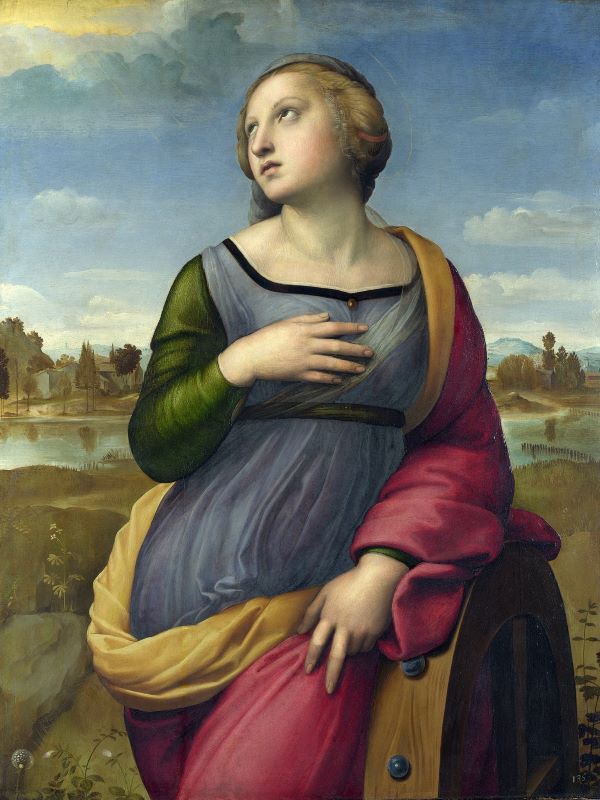
Raphael, St Catherine of Alexandria, about 1507. The National Gallery, London.
After discussing Michelangelo and Leonardo, I looked at Raphael on Monday, and so we are all set up for the last of my four talks relating to the Royal Academy’s ‘perfect’ exhibition, Michelangelo, Leonardo, Raphael: Florence c. 1504, this Monday 2 December. It will effectively be a virtual guided tour of the exhibition itself, looking at the connections between the three ‘titans of the Renaissance’, and the ways in which their work relates not only to that of the others, but also to the social, political and artistic life of Florence at the time. You could argue that the first three talks were artificial constructs, looking at individual artists with little or no reference to whatever else was going on around them – and, truth be told, most exhibitions are constructs of this type. This became all too clear on Monday while I was trying hard to talk about Raphael without mentioning the other artists who were in Florence at the same time. By the way, if you missed the Raphael talk, I will be repeating it, with some variation, for ARTscapades this Tuesday 3 December. The week after (9 December) I will introduce the other superb Renaissance exhibition with which London is currently graced, Drawing the Italian Renaissance at the King’s Gallery. The talk will, of necessity, be selective, as there is such a wealth of remarkable material – but I will choose the best, the most interesting, and, quite frankly, my favourites from among the treasure trove on display. I recommend going, getting your ticket stamped as a pass for the year, and then going back often! In the weeks after this I will return to the ‘colourful’ side of my Mono/Chrome series, by looking back from Vincent van Gogh (about whom I talked in October), to reconsider what I consider to be the later development of ‘romanticism’ in art, introducing first The National Gallery’s exhibition Discover Constable & The Hay Wain (16 December) and then Monet and London (23 December) at The Courtauld. Details are now online and on sale via those links, and can also be found on the diary.
Today, though, I want to think about a painting which is not in the Royal Academy’s exhibition, but which does date from Raphael’s time in Florence, and shows so much of what he learnt from the great masters who were also present in the Tuscan capital. It is not known for whom it was painted, but given the small to medium-sized format (it measures 72.2 x 55.7 cm) it was presumably made for private devotion – or even, just conceivably, as a work of art, something that was beautiful in and of itself. This was still a relatively new concept in 1507.
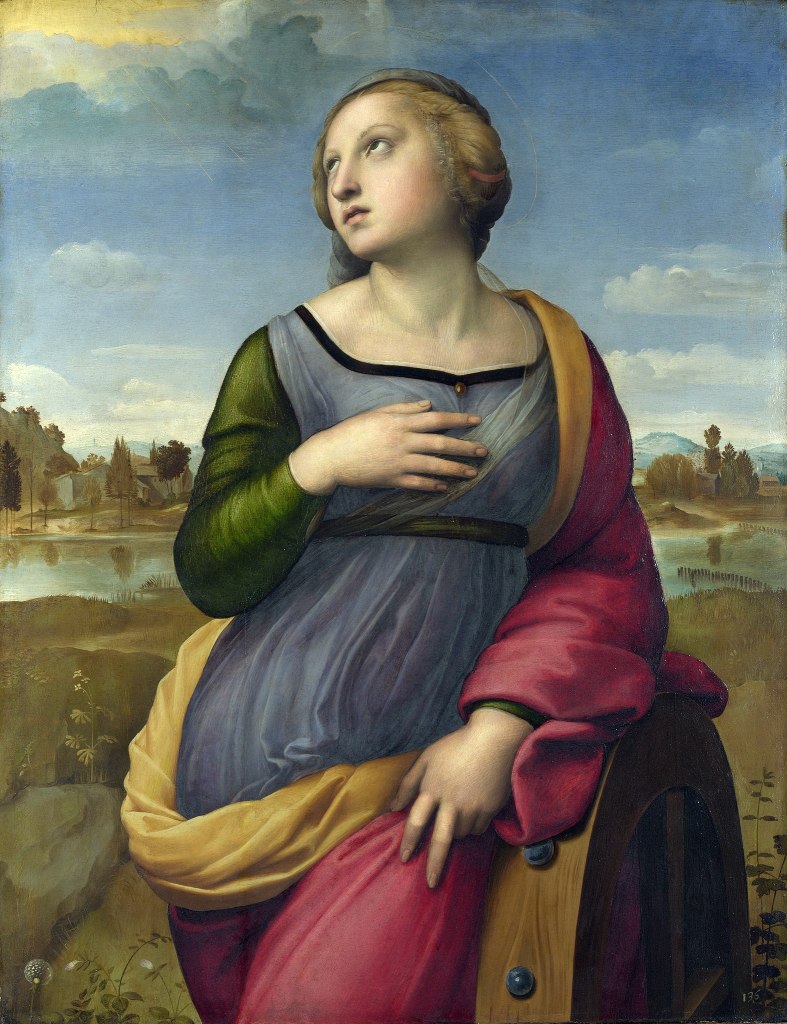
After her conversion to Christianity, the Emperor Maxentius tried to dissuade Catherine from her monotheistic ways, first by imprisoning her. In her captivity she was visited by the Emperor’s wife, whom she converted to Christianity, leading to the Empress’s immediate execution. Catherine had not been killed straight away, presumably because she was a virgin: the death of an ‘innocent’ was always frowned upon. The Emperor then sent 50 of his leading philosophers to persuade Catherine that she was wrong – but they failed. They were converted too, and likewise executed. She was then tortured with four spiked wheels, but God intervened and destroyed the wheels, so eventually the Emperor resorted to decapitation. Among other things Catherine is now the patron saint of philosophers (thankfully, as she could prove even them to be wrong), and her feast day is celebrated by various denominations of Christianity on either 24 or 25 November – so I’m a bit late for the festivities, but not by too much. Raphael gives us no sign of her imprisonment or suffering, although she does lean on a wheel, the instrument of her torture. She stands in a calm and peaceful landscape, with white, fluffy clouds floating in an otherwise clear blue sky, and she looks up over her right shoulder towards the sun shining at the top of the painting.

It was probably obvious earlier, but seen closer we can tell that this is not the sun, but the light of God shining down from above. Catherine’s sanctity is confirmed by the thin, gold ring of her halo which encircles her head. Similarly thins beam of light emanate from the golden glow in the top left corner – the love of God rewarding her devotion. The whites of her eyes show us that she is looking up and to our left, and we can see the underside of her chin, a result of the twist and tilt of her head as she looks towards the source of her inspiration. Her lips are slightly parted, as if she herself is inspiring, or ready to speak and witness to her faith. A small plait curves around a spiralling bunch of hair which is tied by a red ribbon as it curves around the back of her neck. At exactly the point where the lower edge reaches the flesh, a transparent veil emerges, its brightly lit hem curving over her shoulder and echoing the gleam of the foreshortened halo. The hem is also echoed by the concentric curve of the underlying bodice, and the golden yellow lining of her cloak which falls over her left shoulder. The top of her bodice appears to have a black trim – but chemical analysis shows this contains red and blue pigments, and was presumably intended to represent a purple velvet.

The buttercup yellow of the lining curves down and behind her waist at the level of a dark green belt, and then emerges under her right elbow, where it is illuminated by the light of God to appear a far paler yellow. The clouds, and the blue of the sky are reflected in the lake behind her, as are the freely painted trees and bushes. Buildings stand on either side, in front of distant, blue hills, and palings can be seen embedded in the lake, showing us, like the buildings, that this is a cultivated landscape. The cloak is a rich red, while her dress is lavender. Her right hand is held to her chest as a sign of her heartfelt devotion, and the fingers rest on the veil which crosses diagonally from her left shoulder down to the belt above her right hip.
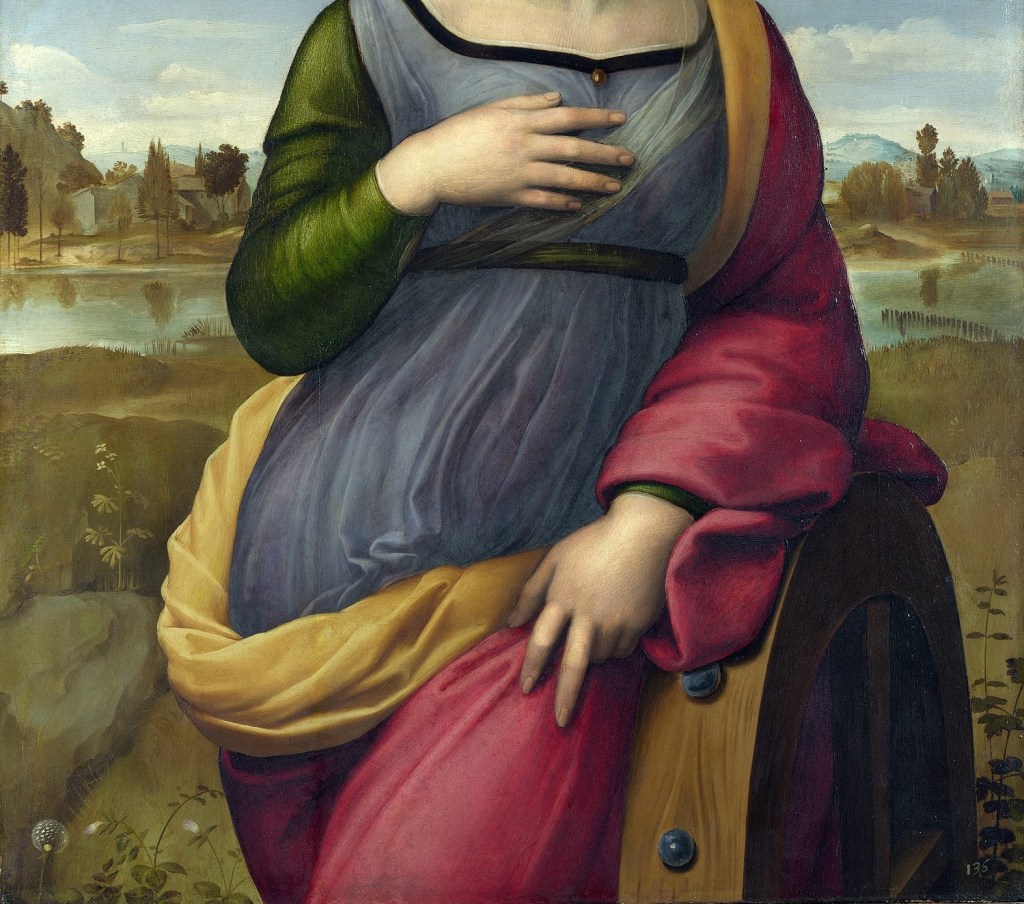
The folds in the yellow lining of the cloak spiral around, looping down and across her right thigh and then up again to be held under her left hand. Her left elbow rests on the wheel, which appears to have been disarmed: rather than the sharp spikes, it has rounded bosses – a sign, perhaps, that her faith has rendered it harmless. Or maybe, Raphael wanted a far calmer image than the violence of sharp spikes would have suggested. However, maybe that violence is indicated by the colour of her cloak, the deep red flowing from beneath the golden lining at the level of her shoulders – not so far from her neck, which would be severed from her head. The red then pourss along her left arm, with folds of drapery lapping over the wheel at front and back, before continuing down her left thigh to her right. The deep blood-red is also visible in the shadows between the spokes of the wheel.

Naturalistic plants appear at the bottom of the image – most notably a dandelion seed head in the left corner. The dandelion is interpreted as a bitter herb which is often associated with the death for Christ. Its presence here reminds us of Catherine’s suffering, and of her faith. It is strangely truncated though, emerging from nowhere, and the figure too seems to terminate abruptly. As it happens the painting has been cut down on all four sides – but not by much. The top, left and right of the image have a ‘barbe’, a sort of lip, or ridge of paint, implying that it was painted with an engaged frame. However, as the barbe is still there, we know that none of the image has been removed on these sides: all that has gone is the frame itself and the unpainted wood under the frame. However, there is no barbe at the bottom, so some of the painted surface must also have been removed – but there is no way of knowing how much. There is a cartoon for this painting in the Louvre, but it doesn’t extend to the bottom of the image. It stops just below the fingers of Catherine’s left hand, and it’s not clear where the design of the legs comes from. Raphael might have improvised them on the panel itself, based on his earlier preparatory drawings. If you want more information about this you can find the whole, detailed catalogue entry on the National Gallery’s website.

The position St Catherine adopts – her hips twisted to our left, her shoulders to our right, and the head back to our left, with the added flow of the drapery wrapping around her form – is a superb example of a composition which was common in the 16th century. Known as a figura serpentinata – a ‘serpentine figure’, it gives life and movement to the image, and, in a religious context such as this, can refer to the soul spiralling upwards towards God, almost like a flame. But where did Raphael get the ideas for this painting from? A couple of weeks ago I wrote about Leonardo’s drawings of Leda, at least one of which resulted in a painting, sadly now lost (see 233 – Leonardo, hatching ideas). I showed you a version of the one that he doesn’t seem to have painted. Today, as promised, I can show you the drawing Raphael made of the one that he did. Part of the Royal Collection, it is currently on view at the Royal Academy – this is just a detail.

The stance of the figures is remarkably similar, with the left shoulder of both figures angled away from us, and the right shoulder closer, and lower down. Each has a right hip which curves outwards, enveloped by another form – the gold lining for the Saint, and the wing for Leda. They both have a similar tilt of the neck to our left, but whereas St Catherine looks up, Leda looks out towards us.


Leonardo’s painting was last mentioned in 1625, when it was in the Château de Fontainebleau, not so very far from Paris. No one knows what happened to it, but it may well have been destroyed by someone who disapproved of the imagery and its implications. Nevertheless, it was popular in its day, and there are many copies of it – six or seven, at least, just counting the ones which survive. This version, from the Galleria Borghese in Rome, was painted by the Sienese artist Giovanni Antonio Bazzi, known as ‘Il Sodoma’. Raphael’s swan is, admittedly, more like a goose, and his Leda acknowledges us rather than looking bashfully to her progeny, but otherwise the relationship is clear. And it is not just the composition which his St Catherine owes to Leonardo, but the way in which so many details spiral – the plait, the hair around which the plait is wound, the curve of that hair around the neck, the folds of the golden lining of the cloak, not to mentioning the looping and flowing of the lining itself, and of the transparent veil. These are all things which obsessed Leonardo, and which he drew often. But Raphael’s observation of Leonardo’s work doesn’t explain everything – this is not just ‘Raphael, after Leonardo’. For the strong turn of St Catherine’s neck, for example, or the head foreshortened from below, we must look to Michelangelo. This is Raphael, after Leonardo, and after Michelangelo.
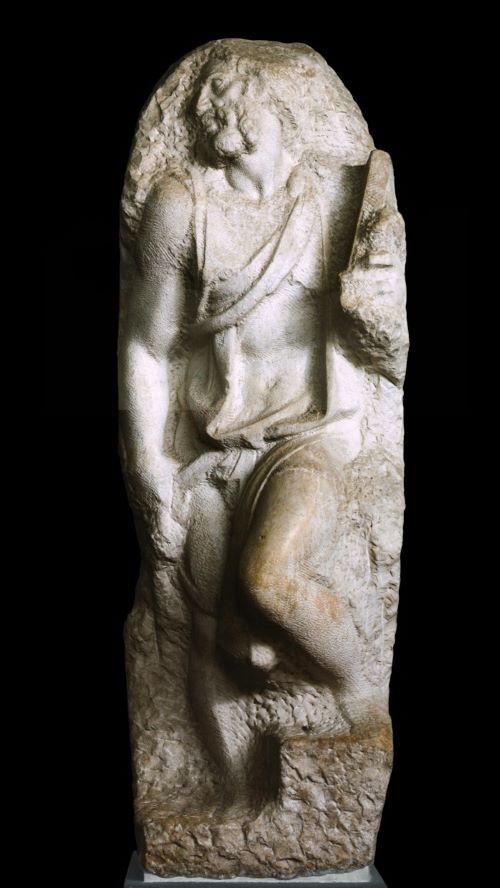
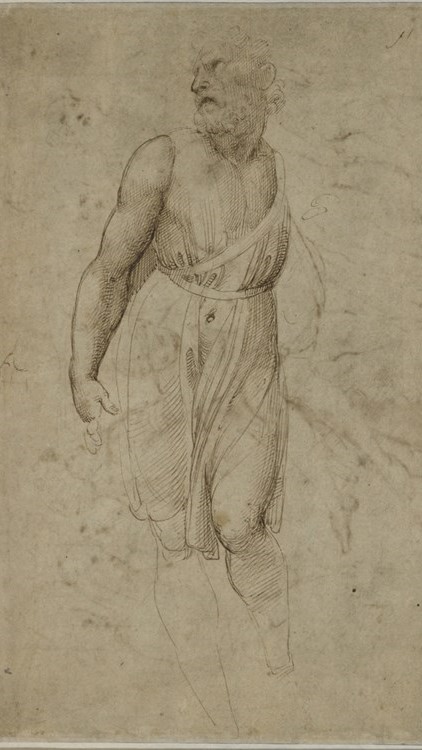
As the sculptor’s work on the David drew to a close, he was commissioned to carve a series of the Twelve Apostles for the cathedral of Florence. He was supposed to carve one a year, and he did at least get started on the St Matthew, but went no further – the unfinished sculpture is now in the Accademia in Florence, part of the avenue of unfinished works leading to the David. Eventually he managed to extricate himself from this commitment. Apart from anything else, Pope Julius II wanted a tomb – and then a ceiling – and then later Popes wanted other things: a façade, a funerary chapel, a library, a palace, a wall… Michelangelo always found it hard to argue with a Pope. We know that Raphael saw the unfinished St Matthew, because he drew it – and the drawing (above right) is now in the British Museum (but not in the RA exhibition). Raphael used this drawing for one of the figures in his Baglione Entombment, which was originally in Perugia, but stolen to order for Scipio Borghese, and so now in the Galleria Borghese, not far from the Leda above. But he also used the drawing for St Catherine.


Having clarified the anatomy and clothing of the St Matthew in his drawing, Raphael’s debt to the sculpture in the St Catherine is easier to see. The position of Catherine’s legs, with their exaggerated contrapposto, and the angle of her head, are clearly drawn from Michelangelo. Notice also how the strap across Matthew’s chest meets with one end of his belt, as Catherine’s veil does with hers. There is even a hint of Catherine’s belly button: St Matthew’s is seen clearly in the drawing. Raphael had come to Florence to learn, according to a much-disputed letter, and here we can seen him doing just that. This is really what the Royal Academy’s exhibition is about: precisely what drawing was ‘for’, whether it was used as a tool for learning, observing, or preparing, or as an art form in its own right. Raphael continued to learn when he got to Rome, to the extent that eventually Michelangelo complained in a letter that, “ciò che aveva dell’ arte, l’aveva da me” – ‘that which he had of art, he had from me’, to translate literally. This is clearly an exaggeration. Look at how much Raphael learnt from Leonardo, for example. Or from Perugino, before that. But then Raphael was a sponge: he saw, he absorbed, he learnt, and then he squeezed himself dry to produce something that was truly his own – always the sign of a great artist. And he gave to others in his turn. But he did learn a lot from Michelangelo. I even wonder if the left hand of St Catherine is actually derived from the Virgin’s hand in the Taddei Tondo – he certainly quoted that hand in another painting which I will show you on Monday. Maybe this is just a hand, though: I’ll let you compare and contrast, and decide for yourselves. As for the other lessons he learnt – and what Michelangelo and Leonardo shared with each other – well, that is what Monday‘s talk will be about.


And as we’ve been talking about Leda… I really would encourage you to go and see the Barbara Walker exhibition in Manchester! This is her large-scale drawing, The End of the Affair (2023). There’s nothing ‘bashful’ here – quite the opposite – but there is a soaking red…

 dr richard stemp