
Raphael, The Deposition, 1507. Galleria Borghese, Rome.
I will be talking about Women as Patrons in the Renaissance this Monday, 27 January at 6pm, and so today I want to take a look at one of the most famous of the relatively few works of art which actually was commissioned by a woman. One of the things we will think about is why there were so few, the answer being, of course, ‘men’. It’s slightly more subtle than that, but not much. We will also consider how some women came to be in a position where they were able to act as patrons, and think about why they may have chosen to do so. The following week (3 February) I will talk about the origins and implications of The Sack of Rome in 1527, which had a lasting impact on the History of Art, not to mention Western European history. However, my diary still isn’t pinned down thereafter. What I want to do is to explore the remarkable artistic talent of 14th century Siena by dedicating individual talks to four of its greatest artists: Duccio, Pietro and Ambrogio Lorenzetti, and Simone Martini. This will lead up to an introduction to the National Gallery’s forthcoming exhibition Siena: The Rise of Painting which will open on 8 March. I may start this series on 10 February, but, if I’m honest, I’m so behind with everything at the moment I may leave it until later: keep an eye on the diary (or these posts).
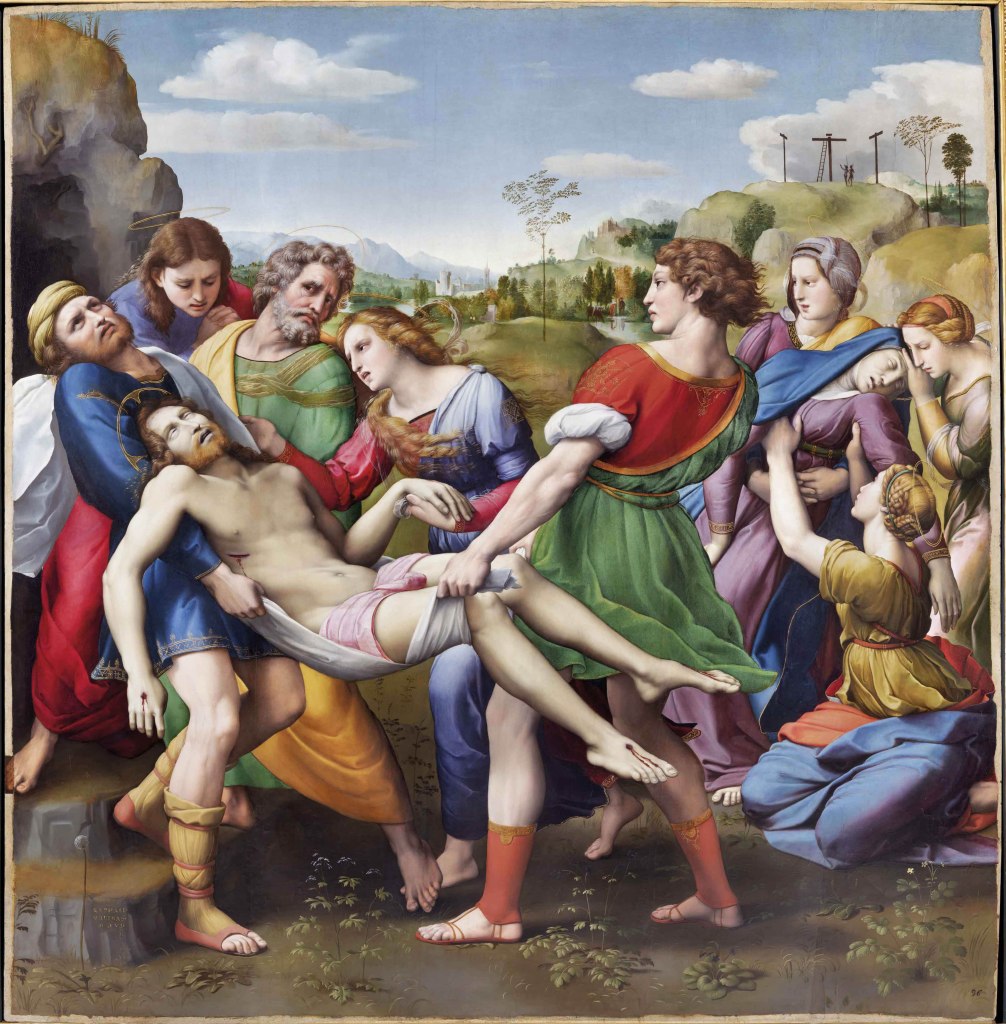
The body of the dead Christ is carried by two men, its weight implied by the way they lean to left and right. Three other people look on behind, as if they want to help in this arduous task, but are unable to do so. To the right, three women look after a fourth, who has fainted. All this takes place against a delicate landscape, which includes a hill topped by three crosses to the right, a valley with a river and lakes in the middle, and a rocky outcrop at the left. The foreground is far more barren, when compared to the verdant pastures in the background. The complexity of the groupings, the subtle interactions of the figures, and variety of actions suggest that the traditional title of this painting – The Deposition – is not strong enough to bear the weight of everything that is going on.

The action is divided into two principal groupings. In the foreground, to the left of the painting, is the predominantly male group around the body. The corpse is, in itself, the single most important element of the painting. It is aligned along the foreground plane so that it is closest to us, and so that we can see its full length. Raphael has subtly contrived to have the two men bearing the weight standing behind it, with only their nearer arms crossing in front of it, and only a little, even then. The body is cradled on white fabric, which the backward lean of the bearers pulls taut, thus supporting the dead weight. The fabric continues over the left shoulder of the man in blue and billows out behind him, to our left. This extensive length of cloth will become the shroud in which Christ will be buried. On the far left is a dark cave in the rocky outcrop: this is the tomb which, according to the bible, belonged to Joseph of Arimathea. According to Mark 15:46, Joseph ‘bought fine linen, and took [Jesus] down, and wrapped him in the linen, and laid him in a sepulchre which was hewn out of a rock, and rolled a stone unto the door of the sepulchre.’ Steps lead up to the tomb, and the man in blue takes a tentative step back and up with his left foot, looking up as he does so, his face subtly showing the physical – and mental – strain of carrying the precious load. I have little doubt that Raphael had taken the idea of including steps from Michelangelo, who frequently used them to enhance the tension within the bodies he was depicting, creating more dynamic forms, and adding to the psychological complexity. There is also drama in the combination of the legs alone, enhanced by the rich and brilliant colours that surround them. From left to right we see red, blue, green and yellow. It is no coincidence that the right hand of Christ – with its dark red wound – hangs in front of a deep shadow where three of these colours coincide. A woman steps forward to get closer to the Saviour, her left hand supporting his left, and her right poised near his head. Her legs echo those of the weight-bearing figure on the right. He must be moving from right to left, towards the tomb, but has to lean back to support the weight – this contradictory movement helps to express the difficulty of the task. A man in green, with a yellow toga, steps up to the left, and at the top of the steps another stands, hands clasped, looking down at the body. We shall see who they are later.

On the right of the image, a little further away, is the group of women. One has fainted – she wears a purple dress and a blue cloak. It is, of course, the Virgin Mary, and while she is usually depicted in blue and red, Raphael often seems to have had his eye on some of the earliest images which survive. Mary was often depicted in purple – the colour of the emperors of Byzantium – up until the 13th century, and the use of purple here emphasizes her status. Later she was also depicted fainting, either on the Via Crucis – the road to the Crucifixion – or at the foot of the cross. This was known as Lo Spasimo, ‘the swooning’, and shows that she too, like Jesus, suffered for us, thus underlining her vital role in our salvation. Lo Spasimo is most beautifully and profoundly depicted by Rogier van der Weyden in his Descent from the Cross in the Prado. After the Counter Reformation the subject lost its currency, particularly given the statement in John 19:25, ‘Now there stood by the cross of Jesus his mother…’. She stood there, it says, she did not faint. The implication of Lo Spasimo was that Mary was neither mentally nor physically strong enough to bear the grief, and the Counter Reformation seems to have abhorred weakness: this episode is rarely depicted thereafter. Notice how one of the three women with the Virgin kneels on the ground, twisting at her waist to face the swooning Mary, thus adopting the spiralling form, or ‘figura serpentinata’ which became more common with the development of Mannerism. Again, only one artist could have inspired Raphael.
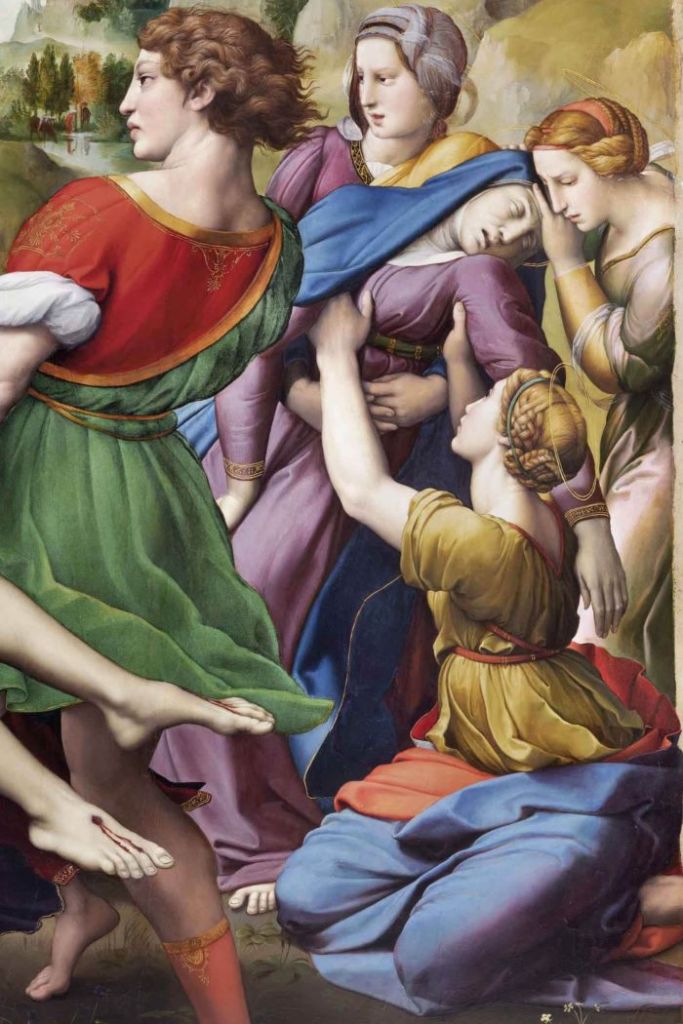

This is such a brilliant quotation it could easily be missed – if it weren’t so recognisable. In Michelangelo’s Doni Tondo the Virgin sits on the ground with her knees falling to her left, while she twists and reaches over her right shoulder to take the Christ Child from Joseph. Raphael’s figure is in a very similar position, although her arms are stretched out and up to take hold of the Virgin, and her hips are raised in accordance with this action. What I think is so brilliant about it is that Raphael has seen Michelangelo’s invention for the sculptural form that it is, and in his mind’s eye has taken a few steps around it and drawn it from a different angle. Michelangelo complained of Raphael that ‘everything he had in art he had from me’, but this shows that Raphael could use his own mind to complement, not just steal, Michelangelo’s vision. Intellectually this borrowing is also profound. In the Doni Tondo the Virgin reaches for the Redeemer, in the Deposition the woman reaches for the Co-Redemptrix (the feminine of co-redeemer). This was one of the many titles given to the Virgin, in this case stressing the vital role – already mentioned – which it is believed she had in our salvation. But who are the other women?

If we get closer we can see that all four have haloes – they are all holy – unlike the man who is carrying Christ, whose bright clothing and bold form grab our attention. We will come back to him, but for now it is worthwhile pointing out that his lean echoes Mary’s swoon, and that the green diagonal of his overshirt (which has an admittedly undefined relationship to the red robe) continues along the blue of Mary’s cloak, leading our eyes to her, and tying her into the composition. All four women are simply dressed, but dressed with great refinement – a sense of classic good taste. Well-cut clothes are complemented by minimal decoration in gold. The elaboration of the coiffures of the two on the right suggests that they have ample time on their hands, not to mention maids with nimble fingers. We are among the leading ladies of the society, and we’ll come back to that idea too. For now, it is worth quoting the whole of John 19:25 (I only included the first half of it above): ‘Now there stood by the cross of Jesus his mother, and his mother’s sister, Mary the wife of Cleophas, and Mary Magdalene.’ So, as well as the Virgin Mary, there was also her sister, Mary the wife of Cleophas. According to apocryphal sources, Mary Cleophas was actually the Virgin’s half-sister. Her mother Anne is supposed to have married three times, and to have had a daughter with each husband: the Virgin Mary, and two more daughters often known as Mary Cleophas and Mary Salome. But other Maries are also mentioned. Matthew 27:56 says that ‘Mary Magdalene, and Mary the mother of James and Joses, and the mother of Zebedees children’ visited Jesus’ tomb after his death. It would make sense that we are looking at these three women, given that the two mothers mentioned here are often identified as Mary Cleophas and Mary Salome. However, there is a slight problem…

The woman next to Christ with long, red hair flowing over her shoulder is undoubtedly Mary Magdalene (she too has a halo) – which makes the identity of one of the three women on the right uncertain. However, Luke 24:10 helps to resolve the problem. He explains that, ‘It was Mary Magdalene and Joanna, and Mary the mother of James, and other women that were with them, which told these things unto the apostles.’ So, it could be Joanna. Or one of the other women – Luke doesn’t specify how many there were: clearly quite a few. But what ‘things’ did they tell the apostles? Primarily, that Jesus had risen. I think this suggests that women were essential in conveying the message of Christianity… so why should there be any problem now with women priests? But let’s not get into that! At the ‘top’ of the grouping on the left is a young man with a halo, long hair and no beard – John the Evangelist, the youngest of the apostles, who had also been present at the foot of the cross according to the scriptures. Next to him in light green with a yellow toga is another saint (again, he has a halo). He is usually identified as Nicodemus, the man who brought precious spices to anoint Jesus’ body. However, it could equally well be Joseph of Arimathea, and some scholars suggest that it is. Nicodemus could be the man with the turban, although as he doesn’t have a halo, this seems unlikely… As so often, I need to do further research – but I suspect that it is not entirely clear anyway.

Jesus also has a halo – one that contains the shape of the cross, implied by the two curving forms at the crown of his head and by his right ear. A remarkable detail I had not noticed before is the pink colour of his loin cloth (but then, I don’t think I’ve seen the painting since it was conserved in 2019-20, and the colours of this photograph initially surprised me by their freshness). It reminds me of the Mond Crucifixion in the National Gallery, in which Jesus wears a red loin cloth – and again, Raphael was looking back to paintings from the late 13th Century, and making an allusion to the royalty of Christ as King of Heaven. The body shows the pallor of death, with the right hand hanging down – much as it does in Michelangelo’s Pietà. The left hand is supported by the Magdalene, and although the knees are bent, the feet do not hang lower – a sign of rigor mortis, perhaps? However, despite the pallor, I can’t help thinking that he looks asleep rather than dead. Of course, he will ‘awaken’. Images of the sleeping Christ Child remind us that he will wake up soon, and are symbolic of the later death and resurrection of the adult Christ. This is also hinted at in Michelangelo’s Pietà, which also has the head lolling back, the left shoulder tilted towards us and the left foot higher – thus making more of the body visible – so I can’t help but see Buonarroti as Raphael’s inspiration once more.


But who is the un-haloed bearer of Christ on the right? And what significance does the landscape have, if any? Well, ‘there is a green hill far away’ (to quote the hymn): Golgotha, on which stand three crosses. A ladder still leans against the one in the middle, and two centurions, one with a spear, stand there in contemplation and awe. But this painting is not a Deposition – the body must have been taken down some time ago. The crowds have dispersed and the body has been carried some considerable distance. It is also not quite an Entombment, as the group is not quite at the tomb. All present are lamenting, but it is not exactly a Lamentation either, in which the focus is on the dead body and the lamenting figures. It is, effectively, a combination of all three iconographies. The Galleria Borghese’s website even gives it an alternative title: ‘Deposition (The Carrying of the Dead Christ to the Sepulchre)’ a subject which is almost unprecedented. However, this is, more or less, the title of one of the National Gallery’s paintings by (surprise, surprise) Michelangelo: ‘The Entombment (or Christ being carried to his Tomb)’.
Whatever else it includes, today’s image is a painting of a dead man, and of a mother’s grief. That has led some people to identify the handsome youth bearing the body of Jesus as a portrait of Grifonetto Baglione, son of the patroness, Atalante. They were members of the family who ruled over Perugia, a city which tumbles across several hills high above the River Tiber, some way before it reaches Rome. And although the town perched on the hillside to the left of the young man’s head does not resemble any particular view of Perugia, it may well be intended to represent the city in some way. A track appears to lead from the brow of the young man, in between two ranks of trees, curving up the hill to the left, with a single traveller approaching the town below a prominent palace.
The story of the Baglione family is a complex one. Powerful and wealthy, it was not at peace within itself – and there were frequent struggles for dominance between two separate branches of the family. As well as being a member of the Baglione family by birth, Atalante was also the daughter of a countess, a remarkably high-ranking member of society – which may well have a bearing on the appearance of the Three Maries who accompany the Virgin. She married another member of the family, Grifone Baglione, who was killed in exile in 1477. Her son Federico, born shortly after his father’s death, took his nickname ‘Grifonetto’ from his father – ‘the little Grifone’ – and it is worthwhile bearing in mind that the griffin is one of the symbols of Perugia. As a young adult he was determined to take control from the more powerful branch of the family. According to the family chronicle, on 3 July 1500, together with other family members, he broke into one of the Baglione palaces to kill his cousin Giampaolo where he was sleeping. However, Giampaolo escaped, climbing out of the window and over the roof… On returning home Grifonetto’s mother Atalante refused him admission to the house, presumably angry and frustrated by the continuation of the feud. So he headed back into town – only to be killed by Giampaolo, or, others say, another cousin, Carlo. Grifonetto’s dead body was stripped naked and left on the street in full view of the people of Perugia, a sign of his ultimate humiliation. It was left to his mother, Atalante, and wife, Zenobia, to have him buried. He was only 23, but prior to his death he had gained burial rights in a chapel dedicated to St Matthew in the Perugian church of San Francesco al Prato. However, when Atalante came to commission an altarpiece for the chapel from Raphael some years later, she did not choose a subject relevant to St Matthew, but one telling the story of a mother accompanying the naked body of her dead son on the way to his burial – the relevance is only too clear. Originally there were also three predella panels showing the theological virtues, Faith, Hope and Charity, which are now in the Vatican Museum, and a painting above the main panel with God the Father blessing, which is still in Perugia, in the Galleria Nazionale dell’Umbria. All in all, the horrendous story is rendered acceptable to God, and the mother’s unimaginable grief – and guilt, having turned her son away from home – resulted in great beauty. But the criminal origins of the painting were followed – coincidentally, surely – in a criminal ‘coda’. Contrasting the way this is explained by the Galleria Borghese and Wikipedia is intriguing, I think. According to the museum, “The work remained in the Umbrian city for a hundred years, until one night, with the complicity of the friars, it was secretly smuggled out and sent to Rome to Pope Paul V, who gifted it to his nephew Scipione Borghese (1608).” However, Wikipedia suggests that, “The painting remained in its location until, in 1608, it was forcibly removed by a gang working for Cardinal Scipione Borghese, nephew of Pope Paul V.” Either way, I think it’s fair to say it was stolen to order…

At the bottom left of the painting we can see Raphael’s signature, ‘RAPHAEL · URBINAS · MCVII’ – ‘Raphael from Urbino, 1507’. This is inscribed next to the seed head of a dandelion. While the juice of the plant itself was used for its healing properties – a ‘salve’ that became symbolic of ‘salvation’ – all seeds resemble dead things. When planted, though, they give rise to new life. The seeds contain the promise of the resurrection of the body, not just for Jesus, but also, ultimately, Grifonetto – which, for his grieving mother, Atalante, must itself have been some kind of ‘salve’. I have said nothing as yet about how Atalante came to be a patroness, but I’m afraid I’ll have to leave that until the talk on Monday.
 dr richard stemp
What a wonderful blog on my favorite Raphael painting. Thank you! Also thank you very much for including the links to the predella and the panel of ‘God the Father blessing’. This is the first time I have ever heard about how the painting may have appeared in its original context. Fascinating.
I haven’t seen it in person since it has been conserved either but I hope to someday soon. Thanks again for sharing your knowledge of these wonderful works.
LikeLike
Thank you! I’m so glad… and I’d love to see a reconstruction of its original appearance. I actually went to San Francesco al Prato last year, but at some point it must have been burnt out, and is now an empty shell which has been converted into a modern performance venue. And once it had not one, but two Raphaels – both commissioned by women.
LikeLike
Hard to believe the same man painted the Deposition and the Coronation of the Virgin (thanks for sending me down that rabbit hole). While they are both beautiful they look so different to me. Another rabbit hole- I looked up San Francesco al Prato online. I see what you’re talking about but it still looks atmospheric nonetheless. I will have to put it on my bucket list too. Thanks again.
LikeLiked by 1 person
It was a rapid change, wasn’t it? From being totally Perugino’s man, to falling under the spell of Michelangelo – and yet, remaining himself.
San Francesco al Prato is intriguing – I don’t know the full history, but it had had a huge, 18th century makeover before becoming a ruin, and it must have sat open to the air for quite a while… It is indeed evocative, and a ghost of the Oddi Altarpiece is projected onto the wall where it stood – though not at the right scale, as I remember. Next door the Oratory of San Bernardino is well worth a visit, too – and it’s not a bad walk down the hill to the edge of town.
So glad you liked the post! Thank you.
LikeLike
Thank you Richard…. your weekly expositions are always so enlightening & much appreciated….but…. this one is exceptionally impressive & all your information is stunning : lots of time will be spent digesting it…….. thank you so much
LikeLiked by 1 person