
Ambrogio Lorenzetti, Maestà, c. 1335. Museo di Arte Sacra, Massa Marittima.
Siena: The Rise of Painting 1300-1350 at the National Gallery is undoubtedly the most beautiful exhibition I have seen for many years, and I can’t wait to tell you all about it this coming Monday, 24 March at 6pm. It charts, as the title suggests, the rise of painting to become ‘top art form’, taking over from the work of goldsmiths and enamellers which had flourished in the 13th century. As my recent talks have outlined, the exhibition ‘stars’ four main artists: Duccio, Simone Martini, and the brothers Pietro and Ambrogio Lorenzetti, although the exhibition includes much more besides. I will cover as much as I can this Monday, and then the following week (31 March) I will come back to Ambrogio Lorenzetti. As yet, I haven’t dedicated an individual talk just to him. Details about the subsequent talks, introducing exhibitions at the Courtauld (From Goya to Impressionism) and the National Portrait Gallery (Edvard Munch) will be posted soon in the diary.
To make up for the delay in talking about Ambrogio, I’m going to have a look at one of his paintings today. It is not in the exhibition, but I do hope to go and see it in Massa Marittima with Artemisia next year, as a daytrip during a visit to Siena itself. This is actually an entry I first posted back in 2021, about a year into the blog. As it happens, the fifth anniversary of the first post was yesterday.
Evidence about the two Lorenzetti brothers is scarce, although both were, in all probability, born in Siena (Pietro around 1280, and Ambrogio about a decade later). It is possible – but by no means certain – that they both trained with Duccio. Ambrogio spent some time in Florence, as did Pietro, who also worked in Cortona, Assisi, and Arezzo. It may well have been in Florence that they became familiar with the work of Giotto, whose naturalism and solid humanity influenced both brothers, although neither ever let go of the lyricism inherent in Sienese practice. They worked alongside one another on the façade of the Hospital opposite Siena Cathedral (although sadly these frescoes have not survived), and each painted an altarpiece for the cathedral as part of the elaboration of the themes of Duccio’s Maestà. As there is no mention of either brother after 1347 it seems likely that both died during the Black Death. Today, I would like to look at the Maestà which Ambrogio painted for one of the churches in Massa Marittima, famous enough to have been mentioned by Vasari, but lost for centuries. It turned up in 1867 in the attic of the Convent of Sant’Agostino, where it had been split into 5 sections, and, although some of the altarpiece has probably been lost, to look at it today you would never know that for a while the panels were used as a bin used to clear ashes from a fireplace.
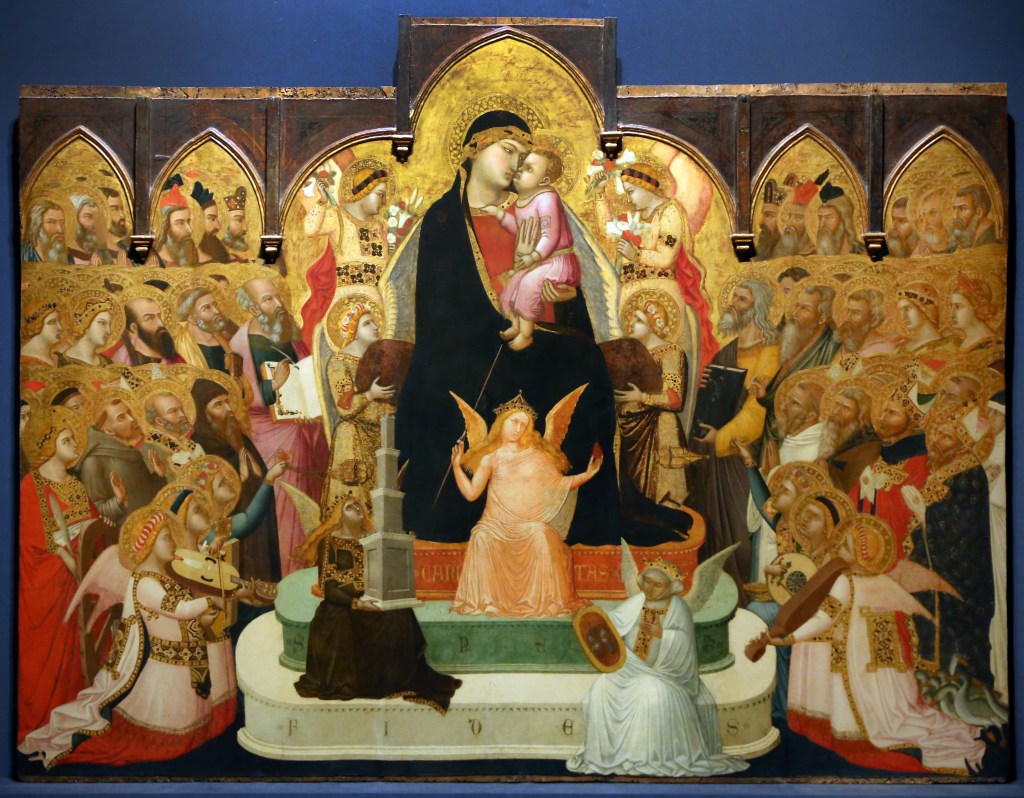
Maestà means, quite simply, ‘Majesty’, and as the title for a painting it implies the full majesty and splendour of the Madonna and Child enthroned in the Court of Heaven. Ambrogio pulls out all the stops, packing the firmament with more saints than you will ever have seen, and, for that matter, more than you could identify, or even count. They are arranged in three ranks, although precisely how this works physically is by no means clear. It could simply be that all the saints at the bottom are really short, although there could be three platforms on which they stand. However, apart from the six angelic musicians – three on either side – who are clearly kneeling, or the three figures sitting on the steps, it is not at all obvious what is supporting any of these people. But then, they are souls in heaven, so the question is immaterial, in more senses than one. You can see the front row of each of the ‘ranks’ of saints quite clearly, and this disguises the number of people who are present – until you look closer.

You might start to see that the halos overlap like waves, each ‘rank’ of saints being three or four deep. You might also realise that there is, actually, no throne. The steps are the only solid element. The cushion on which Mary is seated is actually supported by a pair of angels, whose inner wings are raised. The stone-grey feathers suggest the back of a throne – but there is nothing there. It is a matter of faith: you know there must be a throne, and so you believe it. At the very top, another pair of angels is preparing to scatter flowers in celebration of the Virgin, who is herself associated with so many different flowers, although the splendour and majesty is subtly undermined by the oh-so-human affection demonstrated by mother and child. They bump noses, slightly cross-eyed, and yet maintain what is, under the circumstances, an almost comical gravity. This is God made Man in a very real sense, and a detail to the left suggests that Jesus has only just been born: as yet, nothing has happened to write about.
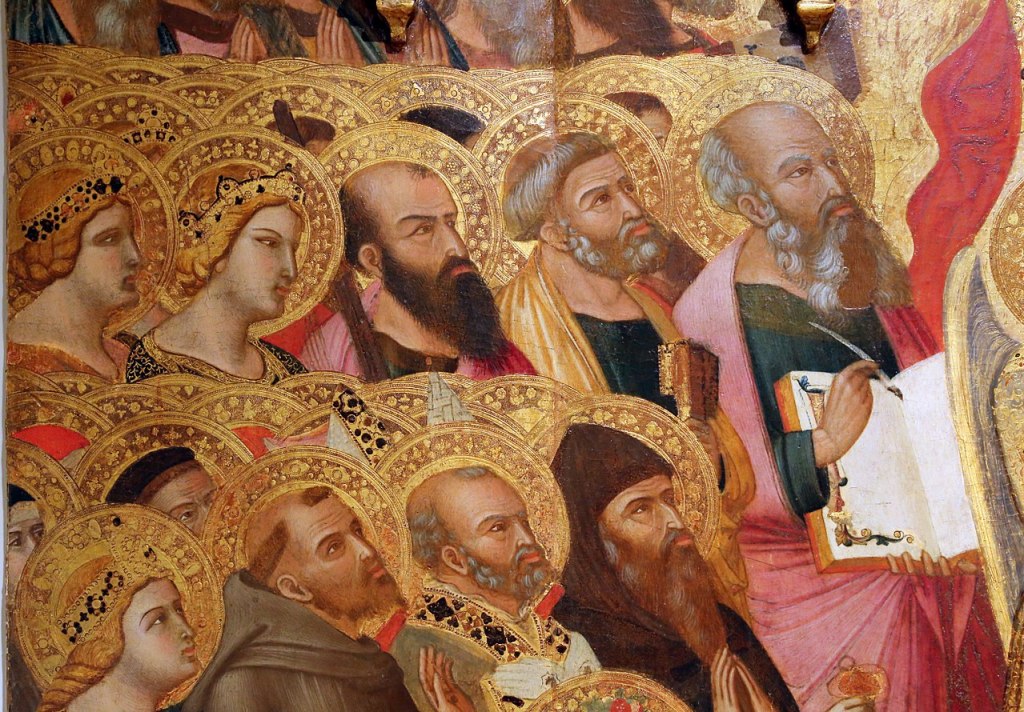
John the Evangelist stands in the position of honour at the right hand of the throne (that is, on our left – although on the right of this detail). He is poised to write the opening of his gospel, ‘In the beginning was the Word’ – but as yet the page is blank, apart from the illuminated initial ‘I’. His quill is held delicately between thumb and forefinger, all of the feathery bits removed as was the practice at the time. The beautiful and elaborate illumination is made up of scrolling leaf-like forms reaching down the left hand side of the left hand page of the otherwise empty spread, looking for all the world like the sort of decorated paper you can still buy in Tuscany today. Standing next to him is St Peter, with the keys to the Kingdom of Heaven, and then St Paul, sword held informally over his shoulder. Although the halos are gold leaf (would it be possible to count them?) his sword was silver, but it has tarnished to black. Behind and below these three most of the saints cannot be seen, let alone identified, but at the bottom left is St Catherine of Alexandria (see the full painting above for her wheel), and next to her, St Francis, in the brown Franciscan habit.

In the foreground, and forming the foundations and support of the spiritual throne, are three steps, each of which is a different colour, with a figure dressed in the same colour sitting on it. The white, green and red steps are labelled ‘FIDES’, ‘SPES’, and ‘CARITAS’ respectively – Faith, Hope and Charity. The three figures are personifications of the three ‘Theological Virtues’ which I first discussed back in April [2020] (see Day 42 – Some Virtues and Day 45 – Virtues, again…). The relevant biblical text is, of course, the first epistle of St Paul to the Corinthians, chapter 13, which ends with verse 13:
And now abideth faith, hope, charity, these three; but the greatest of these is charity.

Faith sit on the lowest step and holds her left hand to her chest while looking at a painting – or a decorated shield, perhaps? – on which we can see two faces looking left and right, both bearded, the former with a shorter beard. What we can’t see, hovering above the heads, is a dove – the Holy Spirit – but technical analysis must confirm that it was there, as this is identified as an image of the Holy Trinity, the very thing in which Faith believes. She wears a gorgeously fashionable, beautifully painted semi-transparent wimple, held in place with a crown. She also has gold work on her bodice for which the gold leaf was applied, then tooled (circular ‘punches’ of different sizes have been pressed, or tapped, onto the gold leaf to create indentations) and then, in part, painted. A pair of wings spreads out behind her, crossing the top, red step, which is delicately decorated. This is another way of using gold. In this case the leaf was applied to the panel, and the red painted over it. Much of the decoration you can see – including the ‘TAS’ of ‘CARITAS’ – was revealed by scratching away the red paint to reveal the gold underneath, a technique known as sgraffito – which, like modern-day ‘graffiti’, means ‘scratched’ (even if today graffiti is applied with a spray can).
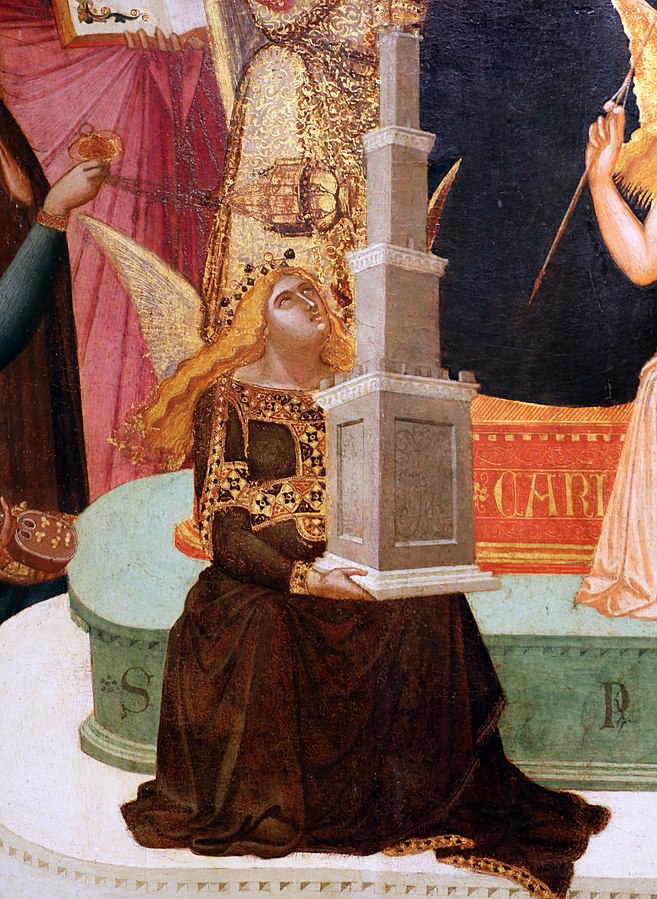
Hope sits on the middle, green step. Unfortunately her robe has discoloured, and looks more brown than green now. Usually we would expect her to look up towards heaven, hands joined in prayer, but here she supports a tower, representing the Church. The image of the Virtues in this painting is derived from a 12th Century French theologian called Peter the Chanter. Faith forms the foundation of the Church, Hope lifts it towards Heaven, and Charity, which St Paul says is ‘the greatest of these’, sits at the top, expressing the burning passion of the unqualified love of – and for – God.

An ethereal pink, rather than the richer vermillion of the step, Charity has a more spiritual feel than the other two, partly because she is all but monochrome, and partly because she lacks the naturalistic, contemporary dress of her companions. In her right hand she holds an arrow, or dart – more like the pagan Cupid, perhaps – and in her left, a heart, just as Giotto’s Charity does in the Scrovegni chapel (See Day 45) .
Colour symbolism is notoriously unreliable in art, but the common understanding that white, green and red stand for Faith, Hope and Charity is given its fullest and clearest exposition in this painting. It was this symbolism which led the colour combination to be so widely used – by the Medici in Florence, the Gonzaga in Mantua and the Este in Ferrara, for example. Raphael’s portrait of Pope Julius II (in the National Gallery) also uses precisely these colours: so many virtuous people. As for modern Italy – well, the tricolore was inspired by the French tricolore (different pronunciation!) Apparently the Italian press (or equivalent) had mis-reported the French Revolutionary colours as red, white and green (rather than blue), and the Italian nationalists adopted these instead – and stuck with them. Subsequently they have become associated with the Theological Virtues, although that was not the original intention. However it would have been driven home by reference to the Divine Comedy, for centuries the second most widely-read book in Italy. When Dante first encounters the semi-divine Beatrice, to him the paragon of virtue, towards the end of the Purgatory (Canto XXX, 28-33), she wears precisely these colours:
‘within a cloud of flowers which rose from the angels’ hands within and without, a lady appeared to me, girt with olive over a white veil, clothed, under a green mantle, with the colour of living flame’.

I can’t help thinking that, in Ambrogio’s Maestà, Charity looks like a ‘living flame’ – and that the angels at the very top of the painting scatter flowers in much the manner that Dante describes. Between Dante and Peter the Chanter, much of the imagery of this altarpiece can be explained. But how much of this would Lorenzetti have known? In 1347 he appeared before the Council of Siena and impressed them ‘with his words of wisdom’. So he must have been learned, a reputation which lasted long enough for Vasari to mention it in the 16th Century. But someone else must have suggested the elements to be included – and in particular, precisely which saints he should paint – although by no means all of them would ever have been identified. As yet, we do not know who that was. I shall leave you with one more saint, though, as it is one you have probably never seen before – and may never encounter again.
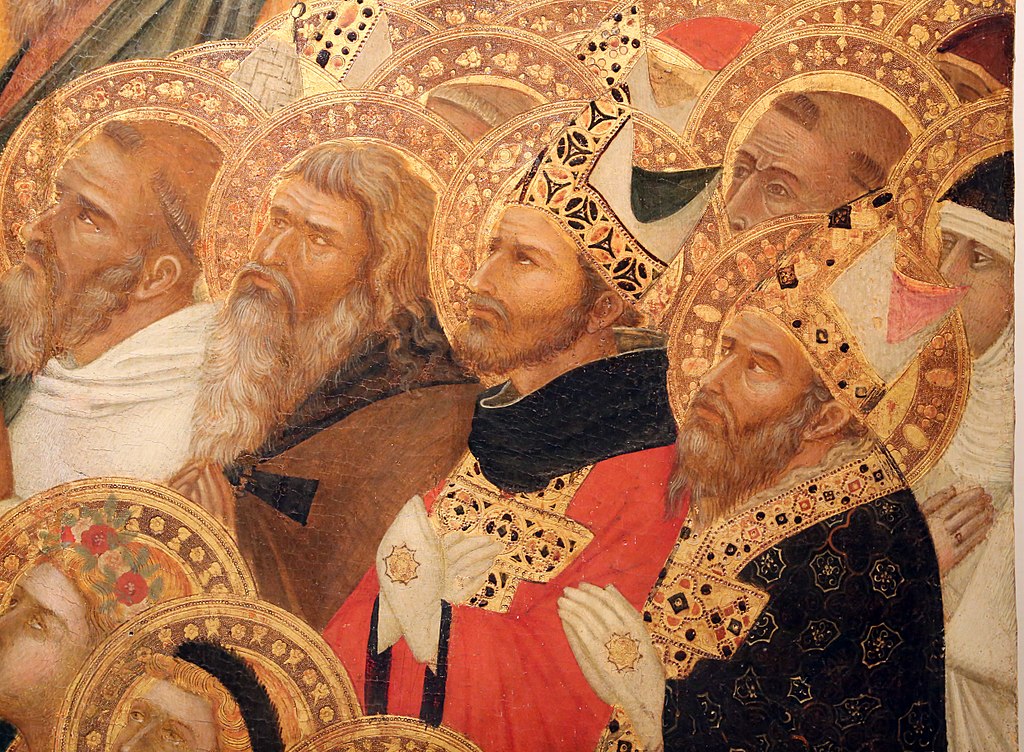
On the far right of the painting is a bishop in black. It is San Cerbone, the patron saint of Massa Marittima, and dedicatee of their cathedral: he is believed to have been the bishop in the middle of the sixth century. Once appointed to the diocese, his flock were soon disappointed because he always said mass at daybreak, which was far too early for most. After a while he was summoned to Rome to explain his behaviour to the Pope, and on the way he tamed a gaggle of wild geese with the sign of the cross. They followed him all the way to Rome, only flying off again when he made the sign of the cross a second time. He may have to do it again, though, as the geese have just rushed into the bottom right-hand corner of the painting. That’s how we know who this is.

This Monday, when I talk about the National Gallery’s glorious Siena exhibition, I will include the few images by Ambrogio Lorenzetti which are included, but will discuss his work as a whole – including his masterwork, the Allegory of Good and Bad Government – the week after. I do hope you can join me for either – or both – of these talks!


Many thanks for your wonderful blogs. I am keenly awaiting my trip to London to see the Siena exhibition. If you have time, I would be hugely grateful if you could possibly help me with a completely different query. I have been looking at reproductions of Artemisia Gentileschi’s Self-Portrait as an Allegory of Painting and am fascinated by her necklace on which hangs what looks like a mask. I am sure you will have seen this painting in the Royal Collection and wonder whether you have any views on the significance of the mask pendant. What might the mask refer to? With best wishes, Jacquie Meredith
LikeLike
Hi Jacquie,
It is a mask, and it is a reference to the artifice of painting – what looks like a face isn’t really a face. The personification of Painting is taken from Cesare Ripa’s ‘Iconologia’ originally published in 1595. The best thing I can do is refer you to my post on the painting:
I hope this helps!
LikeLike
Thank you so much for your very helpful response. Yes indeed, it is most helpful.
Best wishes, Jacquie
LikeLike
Hi Richard,
Thanks for this blog on Ambrogio Lorenzetti. I visited this exhibition two weeks ago. Wow, frankly. Most beautiful and glorious as you so aptly, I think, put it. My favourite painting is the little one by Simone Martini – Christ discovered in the Temple. What a gem, what a pose.
Looking forward to your lecture this Monday.
Cheers
Andrew
LikeLike
Thanks, Andrew, and yes! It’s great to have it in my new local museum… or rather, to know that it will be back in the North West of England at the end of June!
LikeLike
Yes, you are indeed lucky to have that wonderful painting somclose
LikeLiked by 1 person
Hi Richard,
Fascinating blog below. Many thanks. Elaine (we met at Blue Wine evening) and I went Siena last week, absolutely amazing
Exhibition. Satiated with beauty and wonderment. Especially with the extraordinary 4-leaves ivory showing Christ carrying the Cross, (first upper left two leaves): Then the Crucifiction and taking the body off the cross (upper and lower extreme right leaf).
What really took us aback was Mary in the bottom right leaf – her face covered with her veil. It looks as though she is behind strangled with it! Obviously protecting her from seeing Christâs body but we wondered if you had seen anything like this elsewhere?
LikeLike
Sorry Richard, sent before finished! Photos of top two right hand leaves: Mary head bowed, then turning her head away. Then bottom right, Mary face covered: Itâs quite extraordinary.. and the man in top right of picture is interestingâ¦.
We just wondered what your thoughts might be on it!
Best. And so many thanks for fascinating talks and writings.
Roz (Rosamond Perrott) PS: and the tenderness of Christâs look at Mary in upper 2nd left leaf is mind-blowing. Carved in ivoryâ¦.- how?? I see tiny bits of pigment showing – was it all coloured originally?
LikeLiked by 1 person
Hi Roz,
Thank you for this – unfortunately, even if it says you can attach images, it never seems to work. My own photo of this ivory isn’t adequate, so I will have to have another look when I’m back in the exhibition. I think Mary’s position is an expression of her anguish, as I can see it looks very distorted. And you are right, parts of the ivory would have been very richly coloured – but I’m afraid I’m not expert on ivories, so I don’t know how much!
Best wishes,
Richard
LikeLike