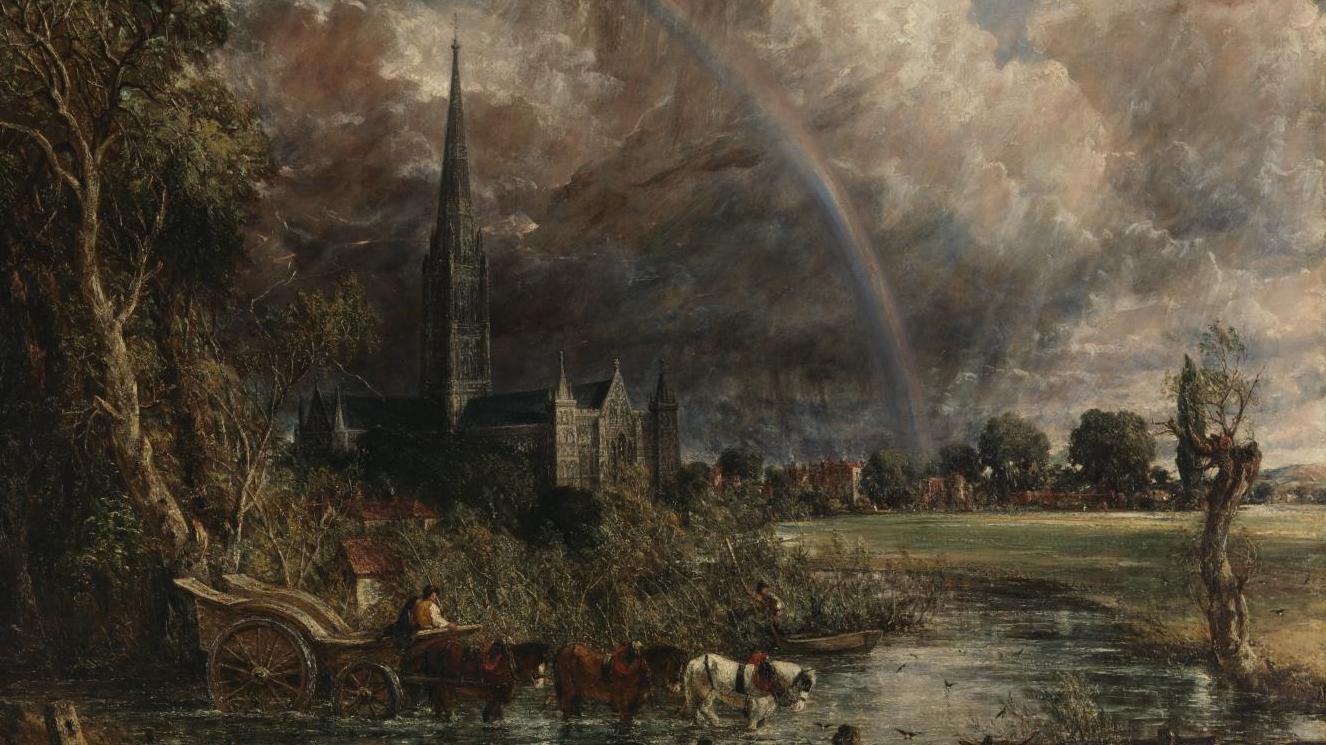
John Constable, Salisbury Cathedral from the Meadows, 1830-31. Tate Britain, London.
Happy New Year! I’m looking forward to getting going straight away, and even before Christmas has officially ended. On 5 January 2026 at 6:00pm (which is the 12th Day of Christmas) I will be talking about Tate’s superb Turner & Constable exhibition, which is worth seeing for a superb selection of works from both artists, including many which haven’t been seen in the UK for decades, if not for more than a century. It is also worthwhile for the exploration of the ways in which the careers of thee two artists intertwined. I find it astonishing that there has never been a large-scale exhibition looking at the relationship between Turner and Constable before: they had so much in common, and yet were so remarkably different, they were colleagues, and rivals, and yet, also… but we’ll talk about that on Monday.
This will be followed by another Tate exhibition, Theatre Picasso, on 12 January. I will then give two talks on Scandinavian artists. The Danish Anna Ancher, whose works are currently exhibited so beautifully at the Dulwich Picture Gallery, will be on 29 January, and the great Swedish painter Anders Zorn will be the following week, 2 February. An exhibition of his work is just about to close in Hamburg, but as it is then travelling to Madrid (where his stylistic relationship to Joaquín Sorolla will become all the more clear) it will still be topical!
In the spring I’ll be giving three talks related to The Courtauld, and the first will be on 9 February, covering the superb selection of paintings from the Barber Institute in Birmingham which are on loan to the former – as The Barber in London – while the latter is being refurbished. But back to Turner & Constable – well, Constable, at least. It’s an old blog, as you know, but edited considerably while still retaining references to the days of lockdown.
I originally wrote the post in May 2020 as Picture of the Day 47 – Salisbury Cathedral, and reposted it in January 2022 as Return to the Rainbow, partly because I needed to correct a mistake I had made, which was all the more embarrassing because somewhere, in an admittedly obscure publication, I had committed the error to print. I’m posting it for a third time because it has become relevant in a whole new way…
Sometimes a painting is asking to be talked about. I heard on the radio, shortly before I originally wrote this, that the foundation stone of Salisbury Cathedral was laid on 28 April 1220 – 800 years before the post. This, in itself, made me think about today’s painting, but then I had been reminded of it the day before while writing about the Pathetic Fallacy (Day 46 – Psyche III). Having said that, it was already in my mind. The preceding week I had been challenged to include three words in my blog – ‘crepuscular’, ‘vicissitudes’ and ‘antidisestablishmentarianism’. I succeeded with the first two in POTD 41 and 42. This is the only painting I can think of for the third.

On October 23, 1821, Constable wrote to his friend, John Fisher, saying that, ‘It will be difficult to name a class of landscape in which the sky is not the key note, the standard of scale, and the chief organ of sentiment’ – by which he meant that the sky would set the emotional tone of the painting. This is, as close as you could reasonably want, a statement acknowledging something that would not be named for another 35 years: the Pathetic Fallacy. It was defined, and discussed at length, by John Ruskin in the third volume of his Modern Painters, published in 1856. We use the word ‘pathetic’ in such a different way now. Back then it was related to feeling, as in pathos, and not to being weak. It was a mistake, or fallacy, Ruskin said, to attribute feelings (pathos) to inanimate objects – such ideas would be the imaginings of an unhinged mind. However, he did go on to say that, poetically speaking, this was not a bad thing, as long as the emotion it produced was genuine: ‘Now, so long as we see that the feeling is true, we pardon, or are even pleased by, the confessed fallacy of sight, which it induces’. Even if it gets the name of an error, the Pathetic Fallacy is one of the essential tools of the artist’s – and poet’s – craft.
It came into play a decade after Constable’s letter, when he worked on this particular painting. His wife Maria had died in 1829, and Fisher wrote to him suggesting that he might want to paint Salisbury Cathedral as a way of occupying himself during his grief – effectively a form of therapy – saying, ‘I am quite sure that the “church under a cloud” is the best subject you can take’.
Before I go any further, I should clear up a potential source of misunderstanding. Constable had two friends called John Fisher, one of whom was also a patron, and both of whom lived in Salisbury. One, the patron, was Bishop of Salisbury, and the other, with whom Constable corresponded more regularly, and in whom he confided, was the nephew of the Bishop, and was an Archdeacon at the Cathedral. This can only have led to confusion in the 19thCentury, and it still does today.
Constable’s letter of 1821 had been written after a summer of ‘skying’, as he called it – going out onto Hampstead Heath and painting the sky, so he could get better at it, and it would become easier, and more natural for him. He was already familiar with the weather. He was the son of a corn merchant who owned mills, and young John often had to man them himself. You need to know when a storm is coming, because if you don’t disable a windmill it could be destroyed. As a result he was entirely adept at reading the weather. By the autumn of 1821, he was also adept at painting it. He favoured a contrast of light and dark, of blue sky and cloud, so that the ground itself would be a patchwork of sunlight and shadow. But the sky in today’s painting is more than usually stormy: he really does seem to have taken Fisher’s suggested title, the “church under a cloud” to heart. Indeed, so bad is it, that lightning is striking the roof of the North Transept – the part of the church to the left of the crossing if you are looking at the High Altar.

Is this an autobiographical reference? I would say ‘yes’, particularly given that Fisher had suggested this very subject in his letter of August 1829. But other things were going on at the time, things in which both Johns – Constable and Fisher (Jr) – were particularly interested. In 1829 the Catholic Emancipation Act was passed, and both thought this might pose a threat to the Church of England, the Established Church. Not only that, but debates were already underway for what would become the Reform Bill of 1832, one result of which was to give the vote to a large number of nonconformists. Another threat, perhaps, to the Established Church. Indeed, one subject for debate was that the church should actually be disestablished, a notion strongly contested by both Constable and Fisher, who were both ardent supporters of antidisestablishmentarianism. The church was under more than one cloud. In the painting it appears as a physical storm, with lightning striking the roof of the church. Constable himself was undoubtedly going through ‘Stormy Weather’ after the death of his wife. And ‘The Church’ as a whole – not just this building – was going through its own political storm, a result of changes in political thought. Would the Established Church survive?
The answer would seem to be given to us by the rainbow. As we saw in POTD 37 – Noah, the rainbow is a symbol of hope and optimism, given to Noah as a sign of God’s covenant that he will never again destroy the earth, as he had with the deluge. Constable acknowledges this symbolism, and with it, tells us that not only will he personally be alright – he will survive his grief – but also that he knows that the church will ride the political storm. However, the rainbow was not part of Constable’s original plans for the painting: it was not in his first sketches. It is an idea which came to him later on. It is certainly not something he witnessed first hand. No one ever has – nor ever could. [Or that’s what I thought when I first wrote this post – and I’m going to leave the next paragraphs so you can see what I said first time around…]
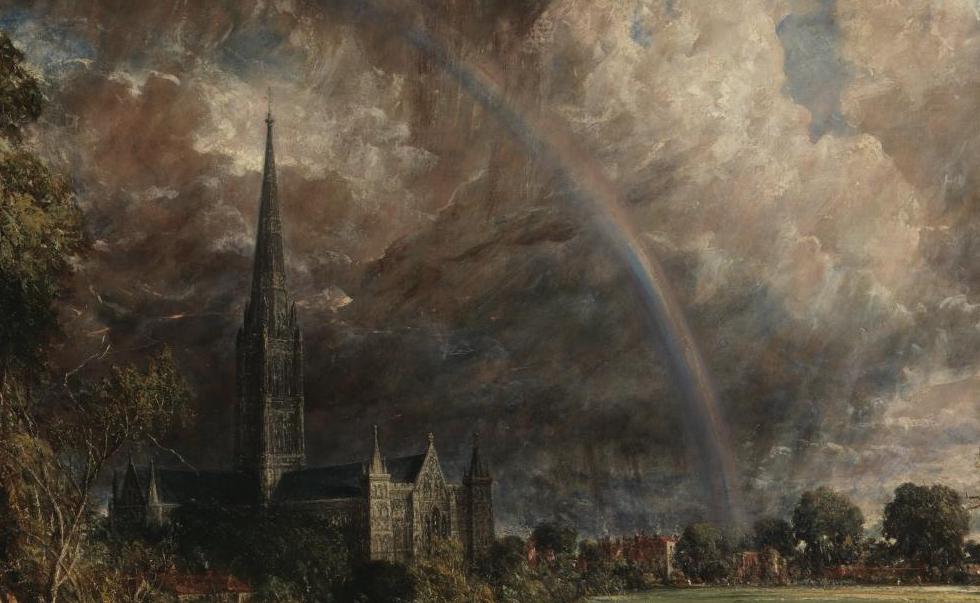
How can I be so sure? Well, it comes down to the geography of the church, which is, as churches should be, orientated: the altar faces the East (POTD 38). The North Transept sticks out to the left of the building – where we see the lightning strike – and the façade of the Cathedral that is so clearly visible (Constable was a master at manipulating light) is at the West End. The rainbow forms an arc of a circle (following the science of optics it cannot do otherwise), which appears to stretch from Northeast to Southwest, given that it cuts across the Cathedral on a diagonal. I don’t know if you know this, but you only get a rainbow when it is both rainy and sunny, and if you are looking at a rainbow, then the sun must be behind you. The sunlight travels over your head into the rain, and the light reflects back from the back of the raindrops. As it enters and leaves each raindrop it is refracted, each wavelength of light being refracted by a different amount, thus splitting white light into a rainbow. The light then comes back towards you, and makes it look as if the rainbow is in front of you. Here’s a diagram, thanks to the Met Office:
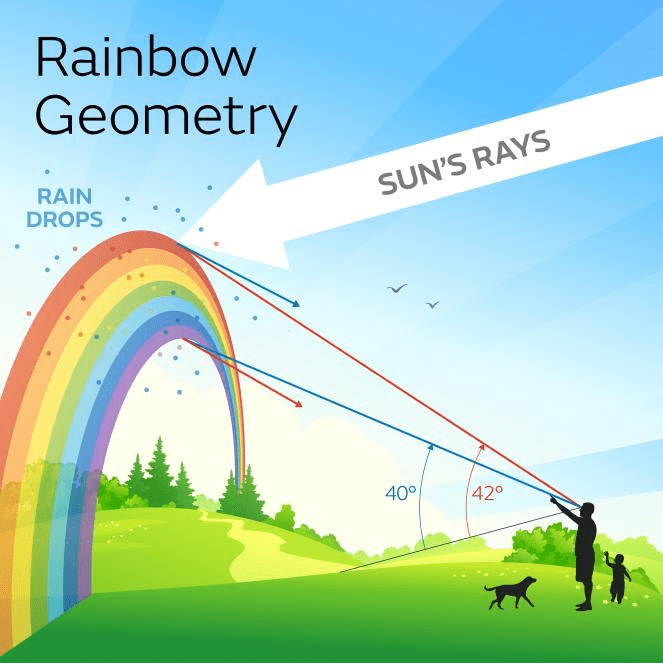
So, if we are looking at the rainbow as Constable has painted it, the sun must be behind us, i.e. in the Northwest. But Salisbury, and indeed, the whole of Europe, is in the Northern hemisphere, and so the sun never gets anywhere that is not South. It is impossible to see a rainbow in this position. But that doesn’t matter. This isn’t science, this isn’t a photograph, this is art – and the rainbow expresses hope. After all, the spire of the Cathedral passes in front of the darkest area of cloud and then up into the light. Again, this is a symbol of optimism.
Nowadays Salisbury Cathedral has gained something of a reputation as the must-see building for any self-respecting Russian spy, and they are not wrong – it is a fantastic building. The spire is the tallest in the country, and the cloister and cathedral close are also the largest in the land. The main body of the church is remarkably coherent stylistically, having been completed in a mere 38 years – not long for a building of this size that was started 800 years ago. It is well worth the visit, and, once we can travel again, I would recommend that you go. We are all “under a cloud” at the moment, but like Noah, like Constable – and like Salisbury Cathedral – we will get through it.
By the way, Constable was not being careless when he chose to paint the rainbow here. It’s worthwhile remembering that other myth about rainbows – that there is a pot of gold at its end. Even if this is, in itself, unscientific (were there no ground in the way a rainbow would form a complete circle, and so it wouldn’t have an ‘end’) there isn’t gold at the end of this rainbow, but lead. Or rather, a house, called Leadenhall. Which is precisely where Archdeacon John Fisher lived. I’ve said it before: art is alchemy, turning base metal into gold. Constable is not only showing us his gratitude to Fisher, he is also reminding us where true value lies. The gold at the end of the rainbow is friendship.
OK – so that’s what I said back in April 2020. But compare and contrast the following:

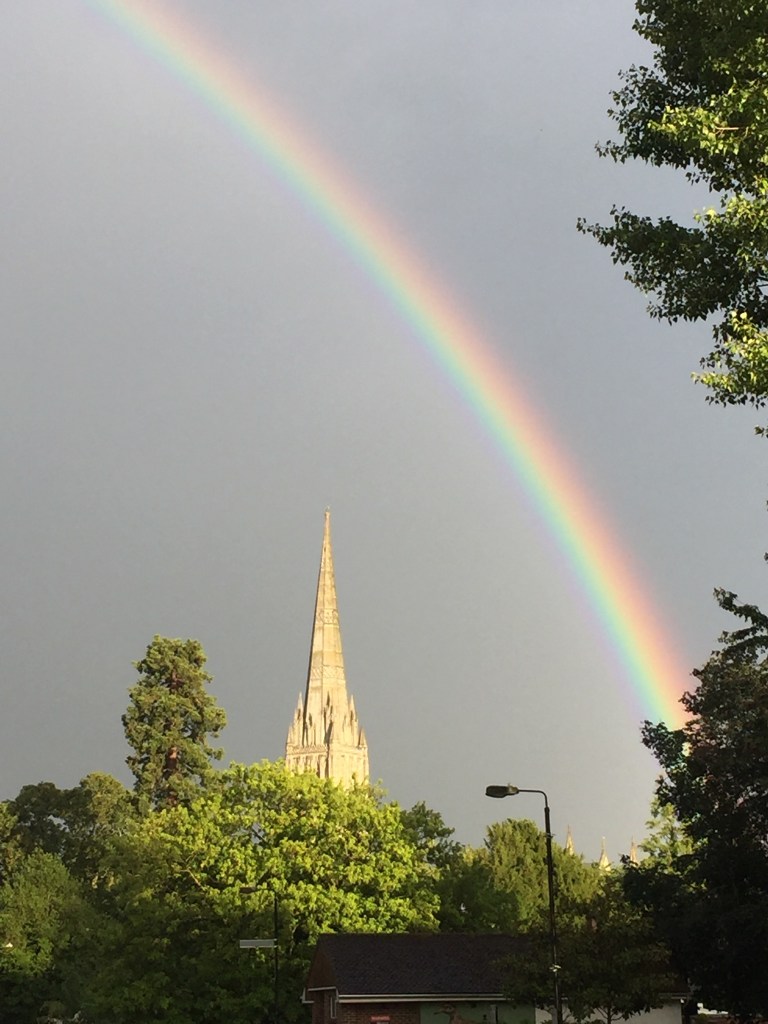
When I set up these blogs I see the images in a certain way, but I know that sometimes they shift: I do hope you are seeing them side by side. I am incredibly grateful to Brian Plummer – a resident of Salisbury and one of the trustees of the Salisbury Museum – who both took and sent me the photograph on the right. Clearly Salisbury has changed a bit in the last two centuries, but this is the cathedral seen, if not from exactly the same place, at least from almost exactly the same angle. To the right of the lamppost, and just above the trees, you should be able to see the very tops of the pinnacles of the façade, which is in the same relationship to the spire as it is in the painting… and a rainbow can be seen very clearly arcing around them. I still can’t entirely explain how this is possible! The physics are right, and the Met Office diagram confirms the fact: if you are looking at a rainbow then the sun should be behind you. Or rather, if you are looking at the centre of a rainbow while facing it flat on, the sun must be behind you. But you could then turn away from it, and still look over your shoulder to see it… the sun wouldn’t be behind you then. That’s not a very good explanation, but it must be something like that. We humans don’t exist as infinitesimal points in space, after all, and we also have a tendency to move around and look all around us as we go. It is probably relevant that a rain drop is a small sphere – so maybe the ‘behind you’ idea of the sun can relate to a wider arc… Whatever the explanation, it doesn’t get away from the fact that Constable would never have stood outside painting one of his ‘six footers’ in the rain, nor does it take away from the idea that the rainbow in his painting is primarily a symbol. He may well have seen a rainbow here, or hereabouts, and then adjusted it to curve so beautiful around the other forms in the composition to land on Fisher’s house…
However (and this is me coming back to the painting in 2025), it is worthwhile pointing out that even if rainbows can, and do, occur in this geographical location, this particular rainbow is impossible in Constable’s painting: the sun is in the wrong position to create it. The light is coming from the upper right corner of the painting, and the sun might even be too high for a rainbow to form. I’m not the only person to say that – here’s a link to an article in The Guardian from about 11 years ago, in which John Thornes, an emeritus professor of applied meteorology at Birmingham University, says as much. However, I have recently learnt (and probably should have known before) that the rainbow was only added after the painting was first exhibited in 1831. This idea is expounded by a Tate Research Publication from 2017, in an introductory essay by Amy Colcannon, the main curator of Turner & Constable. To make things clearer, I’m just going to quote from that:
The absence of any mention of the rainbow in descriptions by critics reacting to the painting on its debut showing in 1831 – critics who, as detailed below, fixated on the ‘chaos’ of Constable’s sky – as well as our knowledge from Constable’s correspondence that he reworked the painting after its debut, point towards the possibility that the rainbow was a posthumous tribute, added after Fisher’s death on 25 August 1832.
The painting has a very important place in the current exhibition as Constable himself chose to exhibit it in the same room as a painting by Turner in the Royal Academy’s Annual Exhibition of 1831. The critics had a field day, as the comparison between the two paintings summed up everything they had always said about the two artists, with one of them referring to ‘Turner’s fire and Constable’s rain’ while another talked of ‘Fire and Water … the one all heat, the other all humidity’. But of course, it is comparisons like this that we will be discovering on Monday – so I do hope you can join me!
 dr richard stemp
Thank you so much Richard – a really interesting post, although I did remain mildly puzzled after yesterday’s version, but thought it was possibly my own befuddlement (struggling with a flu-like bug!).
Hope you are well and many good wishes for 2026.
Gillian xx
LikeLiked by 1 person
Dear Richard, I wish you and Wayne a very happy New Year, and love, Fiona
LikeLike
And to you, my dear – hope to see you soon!
LikeLike
I have bought a ticket for Monday but had no message. It happened before and I missed the talk John Parsloe
>
LikeLike
Hi John,
The problem might be that you are using two different email addresses – Margaret’s for this message, and your own gmail address for the ticket – it might be that you’re looking for the ticket at the wrong address. I will email both addresses hoping that you will get my email at one of them…
LikeLike