
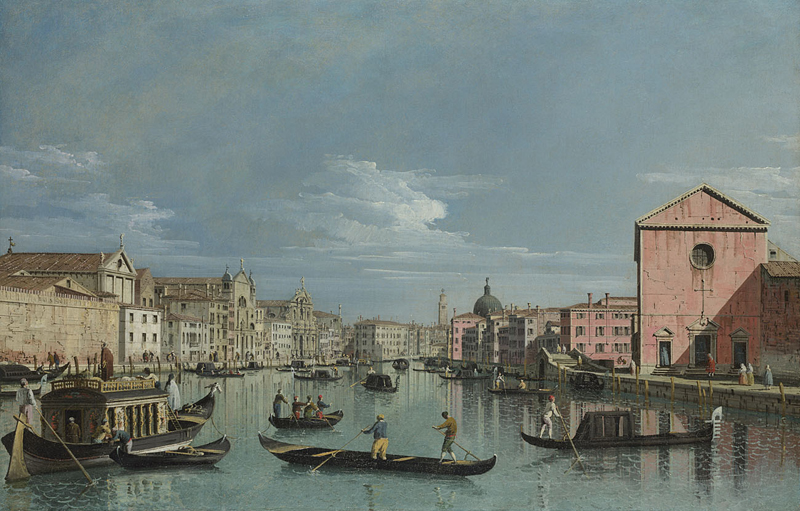
Bernardo Bellotto, Venice: Upper Reaches of the Grand Canal facing Santa Croce, about 1738. The National Gallery, London.
After visiting Vienna to see the beautiful and well-crafted exhibition Canaletto & Bellotto, which I will talk about this Monday 20 April at 6pm, I returned to England for a few days before heading off on holiday to Naples and Ischia. There was so much wonderful to see there, but there’s no time to talk about that now! I got back late on Monday night, and am ready and raring to go. After Canaletto & Bellotto I have planned the following four talks:
27 April – A View of One’s Own (Landscapes by British Women Artists at The Courtauld)
4 May – Konrad Mägi – (Dulwich Picture Gallery)
11 May – Michelangelo and Rodin (The Louvre)
18 May – Martin Schongauer (The Louvre)
All of this is in the diary. Alternatively, the links above will take you to Tixoom for more information and booking. One of the above – Martin Schongauer – is directly related to the trip to Strasbourg and Colmar from 5-8 June which I am leading with Artemisia, and closer to the time (Monday 1 June) I will also give a talk on Matthias Grünewald, whose Isenheim Altarpiece we will be seeing in Colmar.
Given that I’m talking about Canaletto & Bellotto on Monday, this is an ideal opportunity to re-post a blog from September 2021. At the time, the National Gallery was displaying it’s newly acquired Bellotto, putting it into context with a beautifully focussed exhibition entitled Bellotto: The Königstein Views Reunited. Back then I thought it would be a good idea to look at one of Bellotto’s earliest views, dating from the years before he travelled to Dresden, where the Königstein views were painted (that trip to Dresden will form a small part of the talk on Monday), and the post seems even more relevant now. It looks back to the days when Bernardo Bellotto was still working with his uncle, Giovanni Antonio Canal, also called Gianantonio Canal, but who we know better as Canaletto. And no, I don’t really think he was called Uncle Gianni…
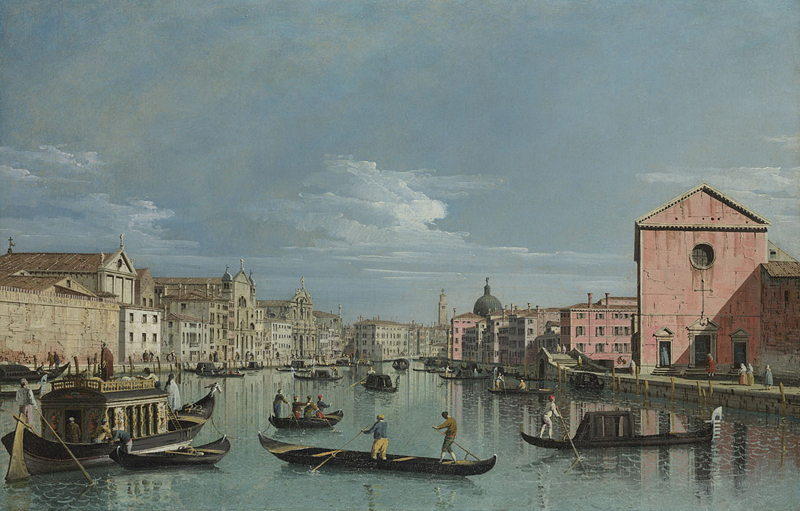
Personally, I think this is a lovely painting. It’s unassuming enough, I suppose, and perhaps there isn’t really much to distinguish it from so many of the views of Venice which now enrich the walls of museums across the world, but it was the only Bellotto that the National Gallery had until its purchase of The Fortress of Königstein from the North in 2017. This might seem strange, given that Bellotto was every bit as good as his uncle, and the National Gallery owns at least 14 of his paintings. Why did the British value Bellotto so far below his uncle? Who can say? But it is worthwhile remembering that, while Canaletto spent most of his time working in his native city – the haunt of many a Grand Tourist – Bellotto did not. And the little time Uncle Gianni was out of the country, he was in England – hence his pre-eminence in the UK, perhaps. Not only that, but we do have a tendency to narrow our gaze. You want a view of Venice? You want Canaletto! He’s the main man, he’s the famous one, get the best. Only I’m not convinced that he always was the best: there are times when I’d rather have a Bellotto – or a Guardi.
So, what do I like about this painting? Well, it’s charming, it’s clear, well painted, well composed, and it sparkles with light, and with the life of Venice. As with so many of the vedute – or ‘views’ – it appears to assume an impossible viewpoint. We seem to be at the same height as the people on the bridge that can be seen on the right of the canal – only we also seem to be in the middle of the Grand Canal. However, there is not, nor there never was, a bridge just here – although there is, admittedly, a kink in the canal. More of that later. We face the church of Santa Croce directly (it’s on the right), with its simple, apparently neo-classical façade. Now, however often you have been to Venice, I can guarantee that you have not been to this church. How can I be so sure? Well, it was destroyed in 1810: a communal garden now takes its place (see the photograph below). We can see gondoliers on the water, and people walking along the fondamenta – the canal-side path. A be-wigged aristocrat in red stands in the shadows at the foot of the steps to the church, and a hooded figure emerges from the left-hand door. Further back two people cross the bridge, and beyond that we can see the dome of San Simeon Piccolo, completed by architect Gianantonio Scalfarotto in 1738 as a neo-classical echo to Longhena’s baroque Santa Maria della Salute at the other end of the Grand Canal. The date of this church gives us a clue to the date of the painting. In the distance is the campanile (bell tower) of San Geremia – St Jeremiah. In the western church it is not usual to call an old testament prophet ‘Saint’, although it is in the orthodox church. The name of this, and other, Venetian churches reminds us of Venice’s connections with Byzantium. The view – with the exception of the absent church – is not altogether different today.


On the other side are three – or, arguably, four – more churches, only one of which survives.
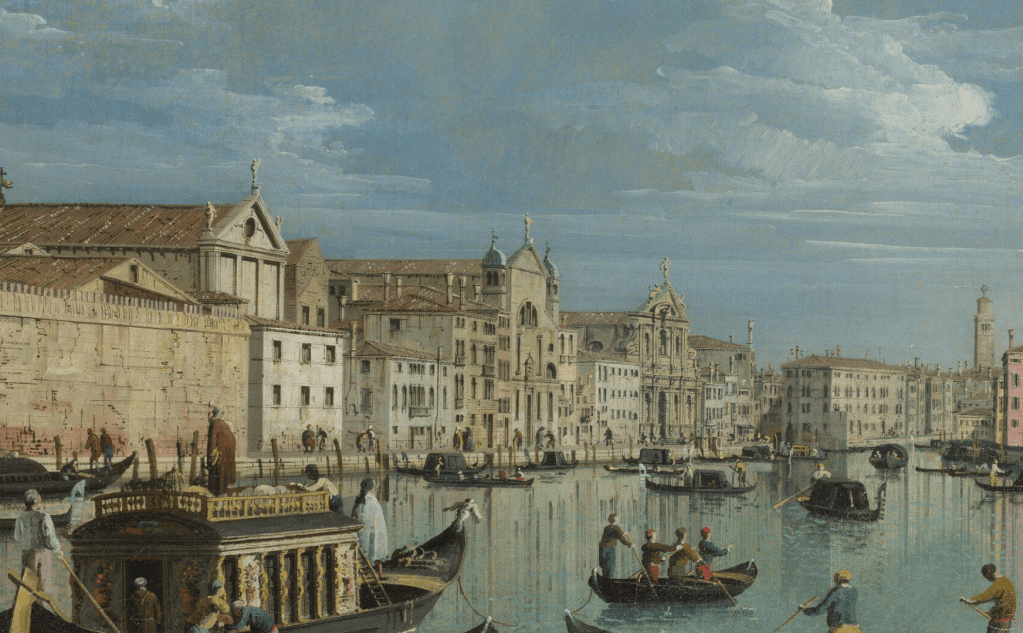
From left to right they are the convent of Corpus Domini, which is more-or-less hidden by the surrounding wall. Further back is the taller renaissance façade of the Scuola dei Nobili – strictly speaking, a confraternity, although, as they all did, the complex would have included a consecrated chapel. This is followed by Santa Lucia, and finally, Santa Maria di Nazareth, known universally as the Scalzi, being the home of the Discalced (or ‘barefoot’) Carmelites. Its late-baroque façade was designed by Giuseppe Sardi and completed in 1680. This is the only surviving church from those on the left of the painting. Nowadays it is a familiar sight, because it is, after San Simeon Piccolo, the second church you would see when emerging from the railway station. And if you have been to Venice by train, you may remember that the station is called Venezia Santa Lucia – which is the main reason why the buildings here have changed so much. In 1861 the Austrian overlords destroyed Santa Lucia (the church) to build the first railway station, at the end of a new land bridge. This was then re-built between 1936 and 1952 (it took a long time because the war slowed things down) to a final design by Paolo Perilli.

This is the best photograph I can find of Bellotto’s view now – with the station on the left, the Scalzi covered in scaffolding, and the campanile – and dome – of San Geremia in the distance. But this is telling: there is hardly a hint of the right bank of the canal, and only a glimpse of the portico of San Simeon. The vedutisti – the artists who painted the vedute – were experts at combining viewpoints, and this was something that Bellotto would have learnt as an essential part of his training. What we see in the images may look real, but if we were there we would have to look from one side to the other to see it all.
Just visible in the background of this photograph – crossing in front of the brightly-lit palazzo – is a relatively ‘new’ bridge, built by the Austrians across the Grand Canal. This helped to connect the station to the city, and facilitated the movement of troops, who were needed to control the revolting Venetians. In 1848 there had indeed been a revolt, when the locals briefly took control of their own city. It didn’t last long: the Hapsburgs took back command the following year, and remained in charge until 1866 when Venice joined the newly-united (or, at least, uniting) Italy – even if most Venetians still don’t believe that they really are the same as other Italians.
It would help us to understand our painting if we looked the other way. Here is a painting by Canaletto, which is also in the collection of the National Gallery: The Grand Canal with S. Simeone Piccolo painted shortly after the Bellotto, in around 1740. In case you were worried, the final ‘e’ of ‘Simeone’ is not a typo – nor is its absence above: the ‘e’ is Italian, but not Venetian, like ‘Canal’, Gianantonio’s family name. It was because he was the son of another Canal – Bernardo – that he was called ‘little Canal’, i.e. ‘Canaletto’.
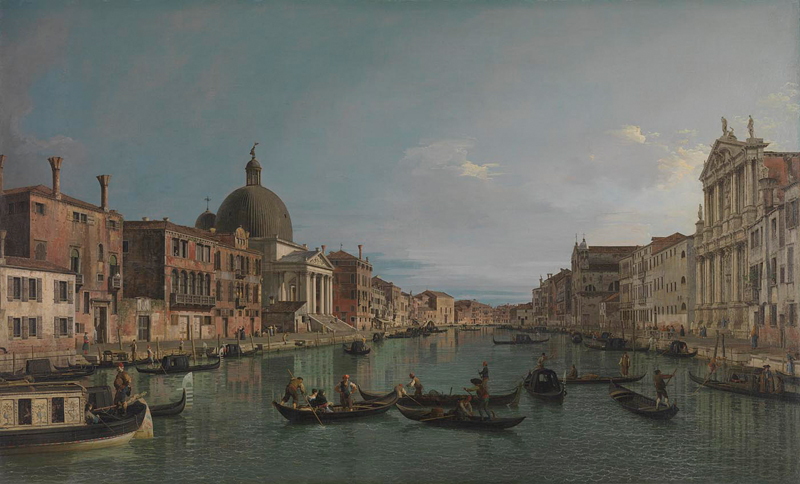
We can see some of the same buildings – San Simeon is on the left, with the far simpler bulk of Santa Croce in the distance, just before the kink in the canal which means that the fondamenta curves round to our right – providing the viewpoint for Bellotto’s painting. Then on the right we can see the baroque façade of the Scalzi, and the projecting mass of Santa Lucia. Compare that with the view today – at least of the right-hand side of the canal, from more or less this point of view (where now there really is a bridge).
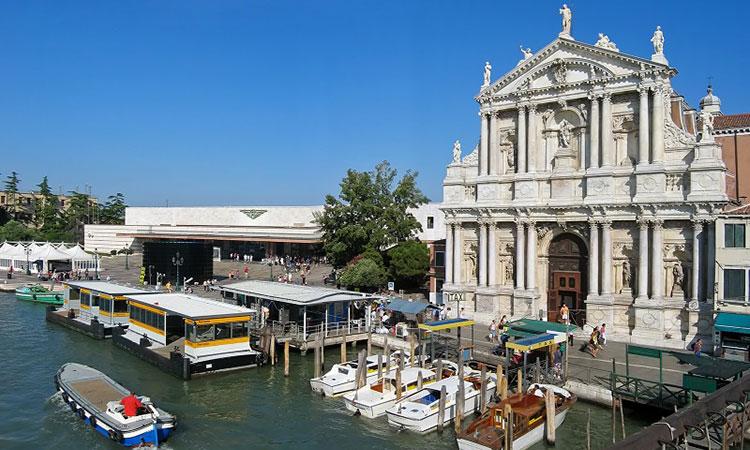
Enough said.
Apart from the skill, and the beauty of the painting, I love the historical content of Bellotto’s work – the documentation of the life and fabric of the city. I have little doubt that both of these paintings were created – in part, at least – to document one of the city’s latest landmarks – San Simeon Piccolo. The Bellotto is also interesting because he would have been young at the time it was painted. Born in 1722, he was the third child of asset manager Lorenzo Antonio Bellotto and Fiorenza Domenica Canal. He was named after his maternal grandfather, Bernardo Canal, a theatrical scene painter. He trained, of course, with his uncle, Canaletto (Fiorenza’s brother), and already by the age of 16 he was registered as a member of the Fraglia dei Pittori – the Venetian painters’ guild. It was around this time – 1738 – that our veduta was painted. He was sixteen. How could he have got to this level so quickly? Well, manual skill can easily be learnt with enough application and an early start, but the conceptual skill? He had help. His painting was based on his own preparatory drawing, now in the Hessisches Landesmuseum, Darmstadt. Sadly, I can’t find an image of it – but not to worry, as Bellotto’s own drawing was actually based on one by his uncle, which is now in the Royal Collection. Compare and contrast:

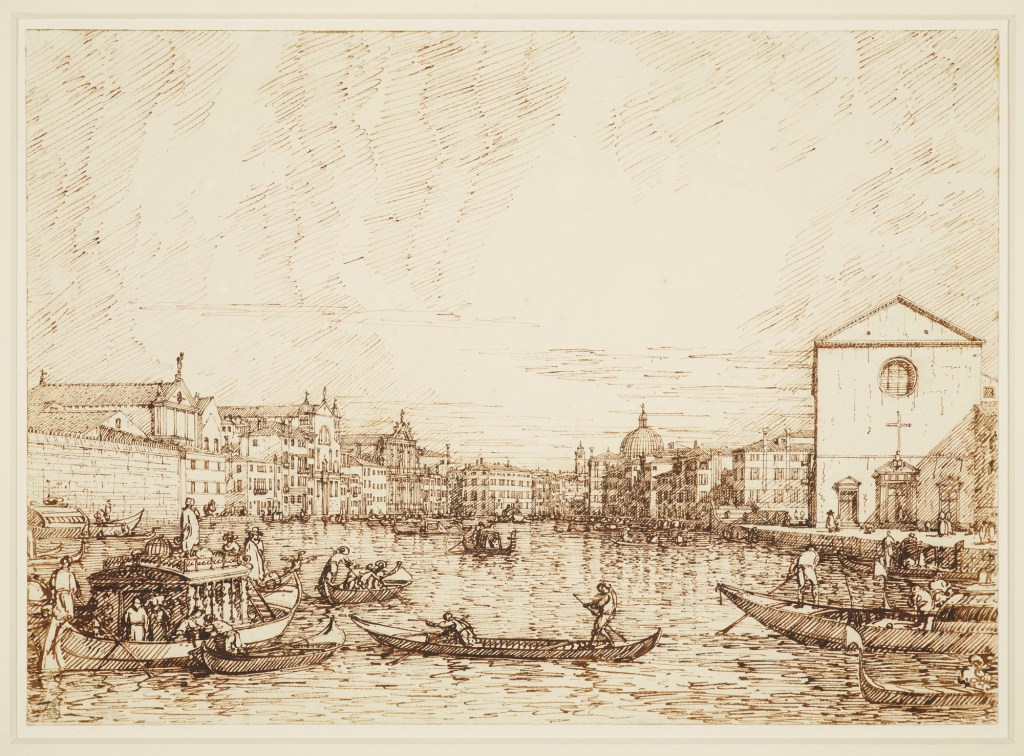
The composition is almost exactly the same, of course, plus or minus the odd gondola, although Bellotto makes the distant campanile slightly more prominent. This is how you learn – by copying the master. You study his original sketches, see how he combines them into a coherent composition, and copy that compositional drawing, just to make sure that it has all sunk in. I would like to see Bellotto’s version of the drawing, though, as I’d like to see how he sketches the sky. I have no doubt that both artists were right handed. Apart from the obvious fact that most people are, and always were, and, if they weren’t, were often made to be, in Canaletto’s sky the lines go from top right to bottom left – the default direction for right handed people sketching. For Canaletto, this is not a regular angle, though, with the lines varying from 45˚ to the horizontal at the top right and left, and varying across the centre to something more like 25˚. You get a similar variety of brushstrokes in the skies of Canaletto’s paintings. However, one of the stylistic features of Bellotto – to my mind, at least, I’ve never heard anyone else mention it – is that the brushstrokes in the blue of the sky are often an almost obsessive 45˚- which I hope you can see in this detail. It looks as if there is an almost imperceptible rain.

The detail also shows the thickness of the paint in the clouds. This three dimensional ‘paste’ is given the Italian name impasto, and is one of the ways in which Bellotto’s paintings differ from those of Canaletto, who does not use impasto to the same degree. Other differences include larger canvasses, more magisterial views, and a different palette. It can be cooler, and more silvery, or darker, with a greater use of browns. The latter is certainly true for the Viennese paintings, which I will be talking about on Monday. However – we will start in back home with Uncle Gianni in Venice, with bright and luminous paintings not unlike today’s.
 dr richard stemp
Fascinating, as always.
LikeLike