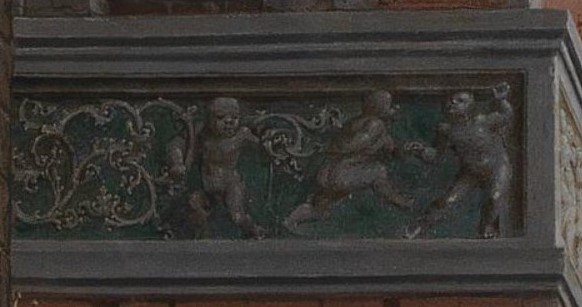
Today’s window opens up to reveal a relief carving, which functions as part of a frieze that continues around the corner of one of the walls. On the 3rd, one of the elements of the ruins was a very tall, round-topped arch – we can see that arch springing from the base of the frieze on the right of the detail. And yesterday, we saw a capital, which is on the other side of the tall arch from this relief – they occupy a similar position within the painting, and must, therefore, be equivalent in some way. Whereas the capital was on top of a red, highly polished, cylindrical column (of circular cross-section), this relief supports the two grey stone bases of two square, red marble columns. I’m not sure what the significance of this parallel is, but it might simply reflect the way in which buildings were constructed. Certainly, in England, cathedrals such as Salisbury and Durham have similar architectural details picked out in dark, fossiliferous limestones (rather than red) – Purbeck and Frosterley respectively, in these cases.
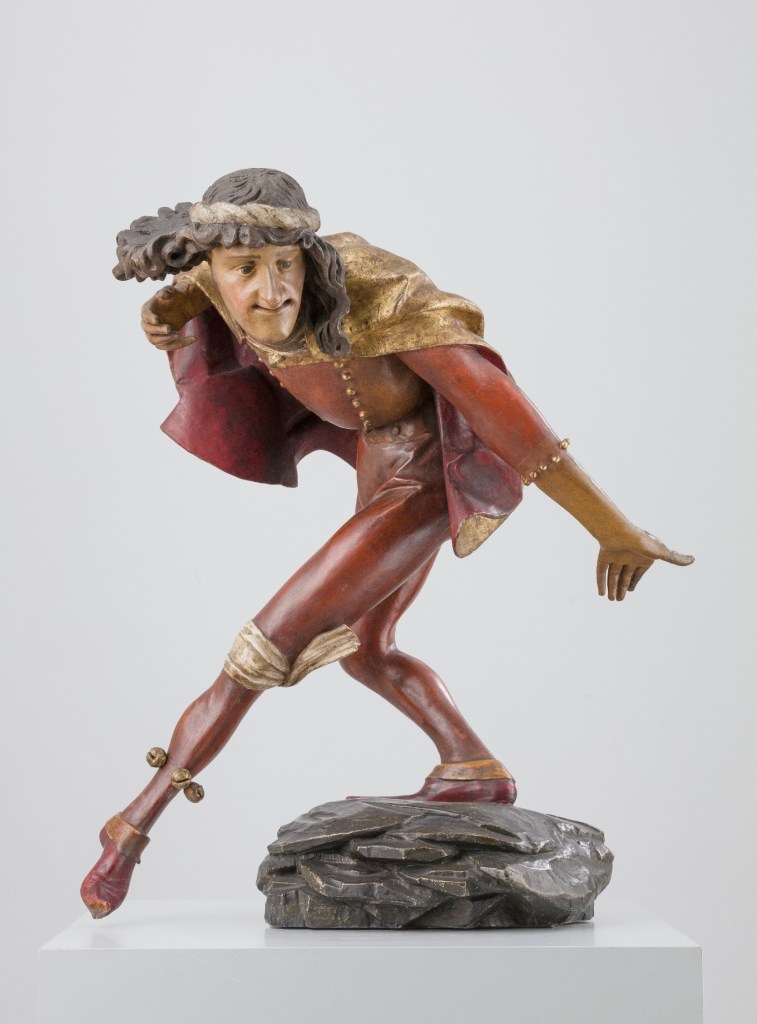
The relief itself, on the side facing us, shows a stylised plant – some sort of vine – and three boys dancing. In Italy they would be called putti. A putto is, quite simply, a ‘boy’, from the Latin putus (an alternative to the more familiar puer, I believe). They are not cherubs – they do not have wings – so there is nothing to suggest that this relief is supposed to be religious in and of itself. The lack of ‘religiosity’ is perhaps enhanced by the dancing itself, which is a little grotesque. Looking at them up close they really reminding me of something – a late-15th/early-16th century drawing of boys – or possibly cherubs – dancing, probably from Germany, but I can’t quite place it. If anyone has any ideas, please let me know! However, they do remind me of Erasmus Grasser’s wonderful Morris Dancers, carved for Munich Town Hall in 1480. Compare these two with today’s relief, for example (OK, I cheated a little, and flipped the one on the left – I couldn’t find a photo taken from the other side).
I must write a full blog about them one day. I’ve always liked the sound of Grasser: they tried to stop him from becoming a member of the guild, describing him as a ‘disruptive, promiscuous and disingenuous knave’. And yes, you’re right, Morris Dancing in Germany! It clearly isn’t as English as we thought it was: the word itself is derived from ‘Moorish’ after all – more cultural influence from elsewhere…
As for the vine – well, I confess that I was expecting it to look more like a grape vine when I was picking out the detail, but not because of the sacramental significance. However, having said that, the reference could be entirely relevant. Have a look at this mosaic, for example.
It can be found in Rome – or rather, just outside the city walls (but well within the 20th Century suburbs) – and it shows a grape harvest. Surely a display of Bacchic revelry? Well no, it comes from the 4th Century Mausoleum of Costanza, next to the church of St Agnes ‘outside the walls’ – and so it is an early Christian mosaic. The fact is, when Christianity was legalised in 313 and Christians were finally allowed to build public places of worship and to decorate them, they had very little experience of doing so – and based their building designs, and their decorations, on the prevalent Roman styles. So this could easily be read as a celebration of Bacchus, the God of Wine, or it could also celebrate the Blood of Christ, and, for that matter, the Christian community as being at one with Jesus (as in Christ’s statement in John 15:5, ‘I am the vine, ye are the branches’). The meaning of the mosaic could vary according to its context, if it weren’t for the fact that, in this case, its context is fixed by its location within a church. Not so with today’s detail. Like yesterday’s capital, it is there to remind us that the old order – in this case the Roman Empire – will pass away. But it can also be read as evidence that the new order – Christianity – will continue. And it may well be for this reason that the whole frieze is in such good condition, and is supporting the two square columns. For this relief, much thanks…
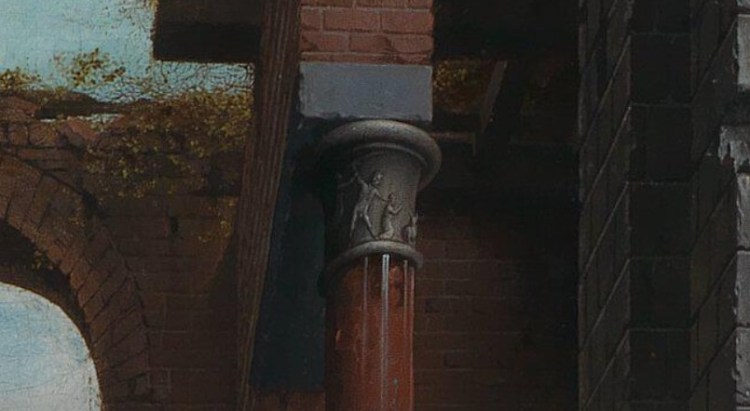
Today we are looking at another column, and like the one yesterday, it might be made from Rosso di Verona, although seeing it like this, I doubt it. It’s a deeper red, for one thing, and it has dark, almost black veins in it. Not only that: it has a very high shine, and Rosso di Verona cannot be polished so finely. The light reflecting off the column appears as vertical white lines, and, apart from the degree of polish, the highlights tell us that, miraculously, the column is not worn or eroded. Despite the change and decay we see all around, it is perfectly smooth and shiny, and, judging by the way in which the artist has painted the reflections, almost perfectly cylindrical.
But that’s not what interests me today, apart from the fact that it implies that there is something special about this column: why has it survived so well? Why is our attention drawn towards it? I’m assuming the intention is, in turn, to draw our attention towards the grey capital at the top. This capital is historiated – by which I mean it is decorated with figures that are significant in some way, rather than being purely, well, decorative. Four figures are visible. Directly above the brightest highlight on the column is a kneeling person, facing to the right with their hands raised in prayer. Behind them (to our left) and directly above the less prominent highlight on the column is a standing figure with its legs far apart. One hand – the left – is on the kneeling person’s shoulder, and the other is raised in the air. A slightly curved line is carved just below the top of the capital – a sword, which the standing figure is holding. But the raised arm is grasped firmly by the hand of a third figure, round to the left, and in the shadows. This figure seems surprisingly high up, and its legs curve round underneath it, rather than touching the ground. Sketched in at the very top left you might just be able to decipher a wing: it is an angel. And then, at the base of the capital, on the far right, is a small creature. Again, it is above one of the highlights on the column, a sign that the column – and the light reflecting off it – are there to draw our attention to these figures. This is the story of Abraham and Isaac, told in the Book of Genesis, Chapter 22:1-13:
And it came to pass after these things, that God did tempt Abraham, and said unto him, Abraham: and he said, Behold, here I am. And he said, Take now thy son, thine only son Isaac, whom thou lovest, and get thee into the land of Moriah; and offer him there for a burnt offering upon one of the mountains which I will tell thee of. And Abraham rose up early in the morning, and saddled his ass, and took two of his young men with him, and Isaac his son, and clave the wood for the burnt offering, and rose up, and went unto the place of which God had told him. Then on the third day Abraham lifted up his eyes, and saw the place afar off. And Abraham said unto his young men, Abide ye here with the ass; and I and the lad will go yonder and worship, and come again to you. And Abraham took the wood of the burnt offering, and laid it upon Isaac his son; and he took the fire in his hand, and a knife; and they went both of them together. And Isaac spake unto Abraham his father, and said, My father: and he said, Here am I, my son. And he said, Behold the fire and the wood: but where is the lamb for a burnt offering? And Abraham said, My son, God will provide himself a lamb for a burnt offering: so they went both of them together. And they came to the place which God had told him of; and Abraham built an altar there, and laid the wood in order, and bound Isaac his son, and laid him on the altar upon the wood. And Abraham stretched forth his hand, and took the knife to slay his son. And the angel of the Lord called unto him out of heaven, and said, Abraham, Abraham: and he said, Here am I. And he said, Lay not thine hand upon the lad, neither do thou any thing unto him: for now I know that thou fearest God, seeing thou hast not withheld thy son, thine only son from me. And Abraham lifted up his eyes, and looked, and behold behind him a ram caught in a thicket by his horns: and Abraham went and took the ram, and offered him up for a burnt offering in the stead of his son.
For Christians, this story, telling of Abraham’s decision to sacrifice his ‘only son Isaac’ because of his love for God, was seen as a pre-figuring God the Father’s decision to sacrifice his only begotten son, Jesus, because of his love for humankind. The interpretation gains strength from the phrase, ‘God will provide himself a lamb for a burnt offering’, as Jesus was greeted by John the Baptist with the words, ‘Behold the Lamb of God, which taketh away the sin of the world’ (John 1:29). The inclusion of this relief sculpture, with Isaac kneeling in prayer, Abraham’s arm raised and ready to strike, the angel preventing him, and the ram, caught in a thicket (or so we must imagine), to the right, reminds us that Jesus, the little baby depicted at the base of the column, was born to die; that he was the Messiah prophesied in the Jewish scriptures; and that we are now at the beginning of the ‘new order’. It’s a lot of weight for a small carving to bear, but that is what makes this column so special: its weight-bearing capacity – whether that is physical or allegorical.
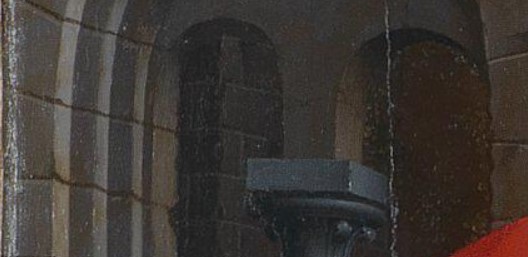
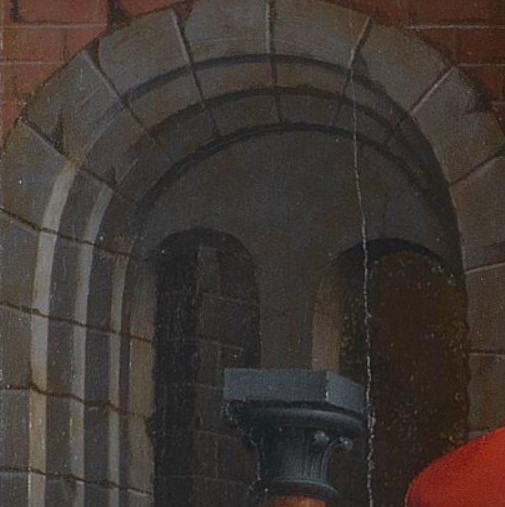
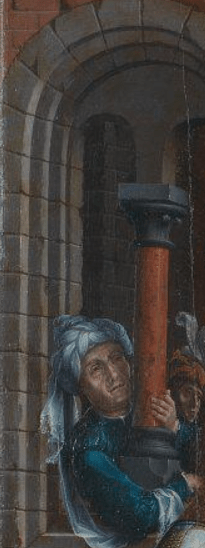
This is a window – but it’s not just a window, it’s a biforate window – which means that it’s a window with two openings (from the Latin bi- for ‘two’ and foratus, meaning pierced). There might be quite a few words today. For example, this biforate window uses stilted arches. The central division is made up of a column – you can just see the very top of it, a warm orangey-red, at the bottom of the detail. The shaft of this column is topped by a capital (from the Latin caput, meaning ‘head’), carved with stylised leaves (though not the acanthus of the classical Corinthian order [or ‘style’]). Above the capital is a square slab, known as the impost. Now, above the impost there is a vertical, square, cylindrical element before the arches on either side start to curve out towards the edges of the window. The point where an arch starts to curve, is the point where the arch is said to spring. A stilted arch is one which springs some distance above the impost. Effectively, it is an arch on a stilt.
All very well and good, you might say, but so what? Well, the nature of the arch can tell us the age of the building, and the types of buildings used in a painting can tell us more about where it was made – and when. In Italian Renaissance paintings the ruins (see yesterday) depicted in paintings of the Nativity tend to be ruins of classical architecture. They are saying that the birth of Jesus means that the Roman Empire is destined to fail… although they are also saying that the artists really admired classical architecture. Indeed, their contemporaries who were architects were trying to emulate, and even surpass it. Modern buildings, for the Italians, had round-topped arches, just like the ones they saw in ancient Roman ruins.
However, in the North of Europe the artists – and architects (although I should probably say ‘builders’ – precisely when ‘architects’ take over is not entirely clear) – had different interests. Buildings were still being constructed with pointed ‘Gothic’ arches way into the 16th Century. So modern buildings had pointed arches, whereas old buildings had round ones. But these were not classical buildings – they were Romanesque, with full, broad, round arches, with rounded edges, a bit like classical architecture, but after Christmas when they’ve eaten and drunk too much and could do with going on a diet and doing a bit of exercise. In the UK we might call it Norman, as it was the Normans who really introduced the Romanesque to Britain, in cathedrals such as Durham and Canterbury and Rochester and Lincoln and Winchester and Ely and Peterborough and… so on. But stilted arches are arguably Pre-Romanesque, with examples going back to the 9th century – although they do continue through to the 12th, in some cases. So the painting shows us not just an old building, but a very old building, as far as the Gothic-loving audience would have been concerned. The ruined state of it might suggest as much, but the architectural style confirms it. No wonder Jesus has come to rebuild!
However, it is clearly loved. You may be familiar with the notion of tree huggers – but how many of you have ever hugged a column? I have been known to, in moments of architectural excitement, and it’s a useful thing to do as a group if you want to work out how large some particularly impressive classical examples are. But whether the man you can see below is hugging the column because of his admiration for Pre-Romanesque architecture, or because he loves what could be Rosso di Verona – a wonderful, orangey-red stone rich in the fossils of ammonites, and transported all the way from the eponymous Italian city – so well out of the way either of Bethlehem or the original home of this painting – or, maybe, because he wants to squeeze through the biforate window to get a better view of the Christ Child, I’ll let you decide.
Rest assured, ruins are not mentioned in any biblical account of Christmas – but nevertheless, they are a common feature in paintings. I’ve written about them recently, as it happens, long after Christmas, when Jesus, Mary and Joseph had already returned from their flight into Egypt, and were settling down to what could have been normal family life (115 – Role Models).
But if ruins weren’t mentioned, what are they doing there? After all, we know full well that Jesus was born in a stable, don’t we? We do, but we’re wrong – at least as far as the bible is concerned. There’s no mention of a building at all – apart from the building where Christmas didn’t take place (‘the inn’). Early apocryphal gospels suggest that the holy birth took place in a cave, and there are plenty of paintings which show that, mainly from the 13th and 14th centuries, although the idea does survive into the Renaissance in a few examples. All the bible says is that Mary ‘…brought forth her firstborn son, and wrapped him in swaddling clothes, and laid him in a manger; because there was no room for them in the inn.’ (Luke 2:7) The fact that a manger is a food bowl (from the French, manger, ‘to eat’) tells you what a remarkable story this is, even if you don’t believe it. Let’s face it, the Son of God, who is God (it’s a mystery) becomes a human baby and they put him in an animal’s feeding trough – what greater humility could there be? Anyway, the assumption must have been, because the ox and the ass were there as well (more of them another day), that this manger must have been in a stable. But no – here the birth has taken place amidst ruins.
There are several reasons for this. And now I’m going to quote from myself to save time (apologies if you’ve just read 115, I’m repeating myself): ‘In Nativity scenes the symbolism is quite specific: it relates to at least two texts in the bible, and early Christian theology. During the Sermon on the Mount (Matthew 5:17) Jesus says, ‘Think not that I am come to destroy the law, or the prophets: I am not come to destroy, but to fulfil,’ and in John 2:19 he also says, ‘Destroy this temple, and in three days I will raise it up.’ In St Augustine’s The City of God, written in the early 5th Century, the author suggests that as Christianity continued to grow, the Roman Empire would fall. All three of these ideas add up to the same thing – Jesus hadn’t come to destroy the old order, whether that be Judaism or Rome, but to rebuild it – and that is the idea that the ruins represent.’ Not only that – ever since the fall, when Adam and Eve had failed to resist temptation, the world had been in a state of decay. We grow old and die, and buildings crumble into dust.
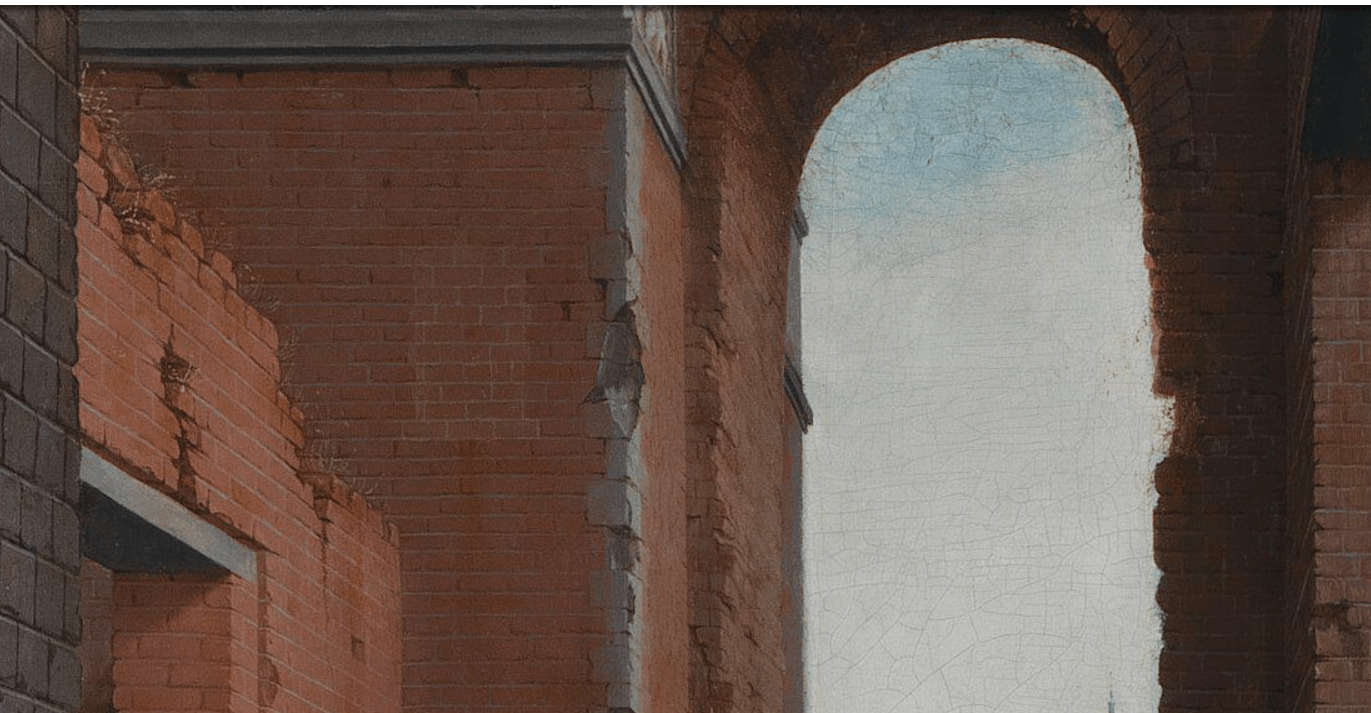
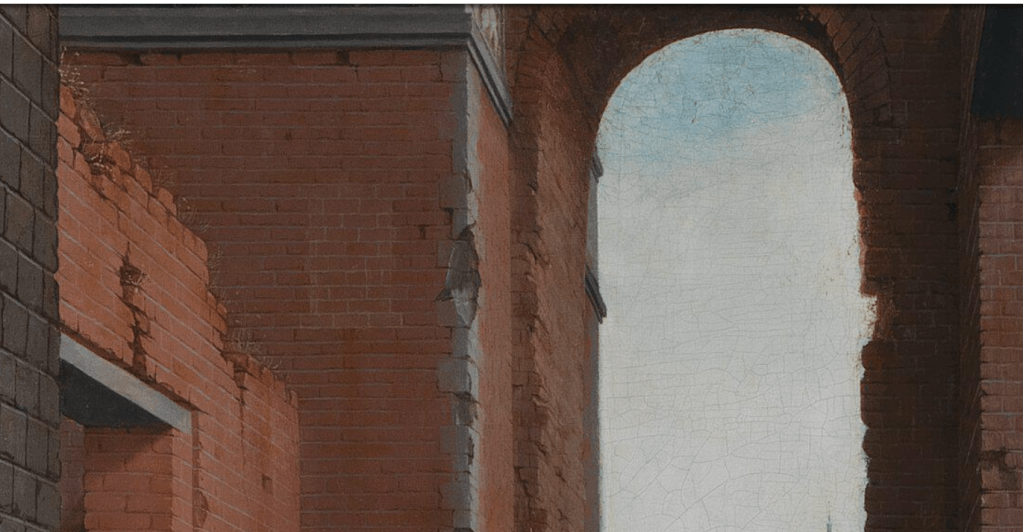
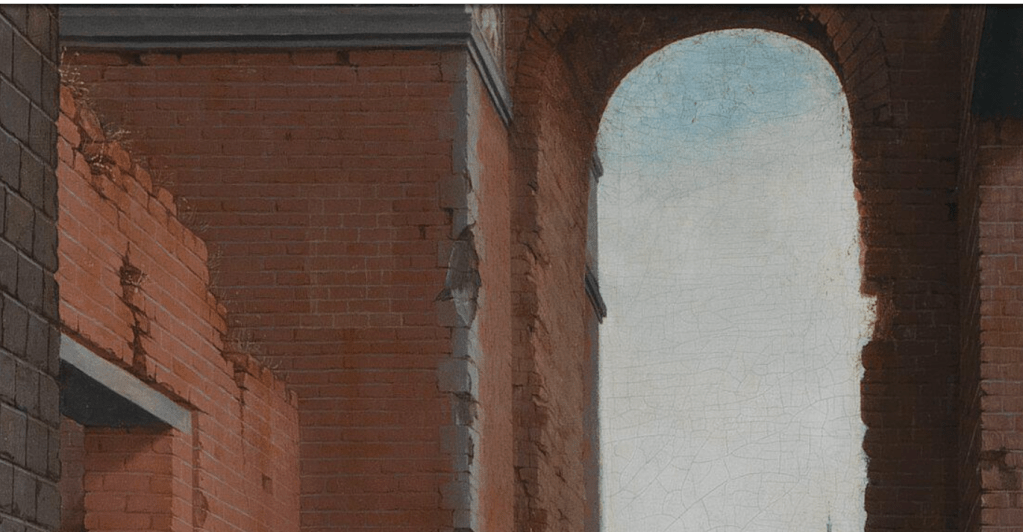
They are quite splendid ruins. We see the edge of a stone structure on the far left, and, leading away from that, the remains of a brick wall with a doorway in it. A stone lintel was set in place to support the wall above it, but that has cracked in any case, and only a few courses of bricks survive. The rest of the wall fell away long enough ago for plants to have sprouted all the way along the top. This wall seems to be an addition to the one further back, as the bricks are not meshed with those of the far wall – and we can see that other alterations have taken place. There is a bricked up window, for example: both the bricks and mortar are paler in colour, less weathered. The corner of this wall is made up of stones, larger and on the whole greyer than the bricks, and these have cracked, chipped and broken away. The cornice above has survived better, and continues beyond the monumental semi-circular arch beyond. The rounded arch is significant, but we’ll find out why tomorrow!
What it comes down to is that in this painting, as in the bible, there is something old and something new – the building is old, and represents the old order. Jesus is new, and has come to rebuild, to put the world to rights.
Angels have just as much as a right as the star to be present at the Nativity. They are mentioned in all four gospels, as it happens, although Mark only mentions them when Jesus is tempted by the devil, and John has one stirring the waters of the pool of Bethesda, and more appearing at the resurrection. It’s only in Matthew and Luke, then, that they are connected with Christmas.
For Matthew, the angel (which one is not specified) is tasked with communicating with Joseph. When the recently espoused old man found out that his young wife was pregnant, and knew, in the way that you would, that the child was not his, ‘Then Joseph her husband, being a just man, and not willing to make her a public example, was minded to put her away privily. But while he thought on these things, behold, the angel of the Lord appeared unto him in a dream, saying, Joseph, thou son of David, fear not to take unto thee Mary thy wife: for that which is conceived in her is of the Holy Ghost.’ (Matthew 1:19-20). Then after Jesus was born, the angel – or an angel – returns: ‘…the angel of the Lord appeareth to Joseph in a dream, saying, Arise, and take the young child and his mother, and flee into Egypt, and be thou there until I bring thee word: for Herod will seek the young child to destroy him.’ (Matthew 2:13). A third visitation followed some years later: ‘But when Herod was dead, behold, an angel of the Lord appeareth in a dream to Joseph in Egypt, Saying, Arise, and take the young child and his mother, and go into the land of Israel: for they are dead which sought the young child’s life.’ (Matthew 2:19-20). However, what is sometimes assumed to be a fourth visit was not necessarily from an angel. Having been told to return to Israel, there is an intervention to tell him, effectively, that he was going the wrong way… he had already been worried: ‘But when he heard that Archelaus did reign in Judaea in the room of his father Herod, he was afraid to go thither: notwithstanding, being warned of God in a dream, he turned aside into the parts of Galilee’ (Matthew 2:22). While we’re at it, it was not necessarily an angel that told the Magi to avoid Herod, as Matthew again says they were ‘warned of God in a dream‘ (Matthew 2:20). Direct intervention is a posibility.
Notice that Joseph had as many as four dreams. This is surely one of the reasons why he is painted asleep so often – he would have to be, to receive all these divine revelations. And apart from that, he was very old. It doesn’t say so in the bible, but it does in the Golden Legend, written in the 1260s (see Day 31 – The Suitors Praying), and that idea probably came from the Protevangelium, a second century text that didn’t make the final cut, as far as the bible was concerned.
However, Matthew does not mention angels at the Nativity – that is down to Luke. Not only does Luke talk about the angel’s appearance at the Annunciation – nine months before Christmas when the whole thing started – but he is also very specific about the angels at the Nativity, in this passage which you probably know very well, Luke 2: 8-14:
And there were in the same country shepherds abiding in the field, keeping watch over their flock by night. And, lo, the angel of the Lord came upon them, and the glory of the Lord shone round about them: and they were sore afraid. And the angel said unto them, Fear not: for, behold, I bring you good tidings of great joy, which shall be to all people. For unto you is born this day in the city of David a Saviour, which is Christ the Lord. And this shall be a sign unto you; Ye shall find the babe wrapped in swaddling clothes, lying in a manger. And suddenly there was with the angel a multitude of the heavenly host praising God, and saying, Glory to God in the highest, and on earth peace, good will toward men.
Today’s angels are just two of the ‘multitude of the heavenly host’. People usually get the number of angels in this painting wrong, as it happens, and draw conclusions from their miscounting – I’ve done it myself – but more of that another day.
How would an artist know what to paint? We should assume that none of them had ever seen a real angel, after all (I could be wrong, of course). Like most angels painted in the North of Europe in the early 16th Century, it is likely that these were inspired by carved, wooden angels (see, for example, Day 70 – The Annunciation, again). Certainly, the way their long robes fly around them suggests the crisp lines and taut folds that can be created by a skillful chisel, and held up by the tensile strength of wood, rather than flowing fabric fluttering in the wind. While we’re at it, these robes were clearly designed to be flown in: they would be completely impractical for the solid ground. You’d trip over the hems before you’d even taken one step.
The colours are a delight – slightly misty as they are flying at some distance: the artist clearly had an awareness of atmospheric perspective. I particularly like the combination of blue and rose-pink in this detail. Why does everyone think that angels should be in plain white from top to bottom these days? It’s a relatively recent development (sorry, I haven’t researched this one – if you know when ‘white’ became the new ‘glorious’ for angels, please let me know – my guess would be the 19th Century), and I far prefer the rainbow colours of old. Their gestures are also wonderfully expressive – one is in prayer, hands joined at the fingertips, and the other is astonished, hands out in awe at the wonder of the incarnation. God has become a little baby. How beautiful.
It’s been a long time since I had my own advent calendar, so I thought this year I would make one, and send it to you. Each day I will send you a detail of a painting. They will all be from the same painting, but I won’t tell you what it is until we get to Christmas. I’m sure many of you will recognise it though (sorry, no prizes for getting it right!). Some days I might even expand the ‘window’ it into a full blog entry, in the way that sometimes there are bigger pictures, but that’ll be a surprise (for you and me alike!) if it happens. I’m starting with
The Star
The star is one of the first signs of Christmas, and to those who didn’t know Mary and Joseph, the first sign that something remarkable was going to happen, so it makes sense to start here. It is also one of the relatively few things we associate with Christmas, and with images of the Nativity, that is actually mentioned the bible – although only in the Gospel According to St Matthew. When the wise men get to Herod’s court, they ask him ‘Where is he that is born King of the Jews? for we have seen his star in the east, and are come to worship him.’ (Matthew 2:2). However, perturbed he was, Herod told them that his men suggested that the ‘new king’ might be found in Bethlehem, and the Magi took this advice: ‘When they had heard the king, they departed; and, lo, the star, which they saw in the east, went before them, till it came and stood over where the young child was.’ (Matthew 2:9) – or, in the words of ‘The First Noel’,
This star drew nigh to the northwest,
o'er Bethlehem it took its rest;
and there it did both stop and stay,
right over the place where Jesus lay.
There has been a lot of conjecture about what this ‘star’ might have been – Giotto paints it to look remarkably like a comet (see Day 87 – The Childhood of Christ), and it is widely believed that this reflects the apparition of Halley’s comet in 1301. As it happens, Halley’s Comet was also visible in 11BC, and there was another very bright one seen in 5BC – and it does seem possible for other historical reasons that Jesus may well have been born 4 or 5 years before himself (the calendar probably wasn’t set up that accurately – there’s no ‘year 0’ for a start…). Alternatively there was a bright nova – a new star – recorded in 4BC. Here’s a link to an article about The Astronomical Explanations written by Victoria Gill for the BBC back in 2012.
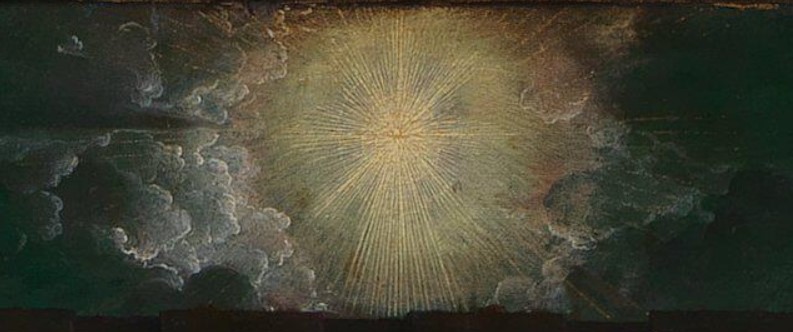
This star certainly isn’t a comet. It radiates the most brilliantly from an undefinable centre, beams of light spreading in all directions, and causing faint, circular haloes as it passes through drops of water vapour. It bursts through the clouds, illuminating their inner edges, and in some cases stretching beyond them. It is unlike any star that has ever been seen – but then, Jesus was only born the once.
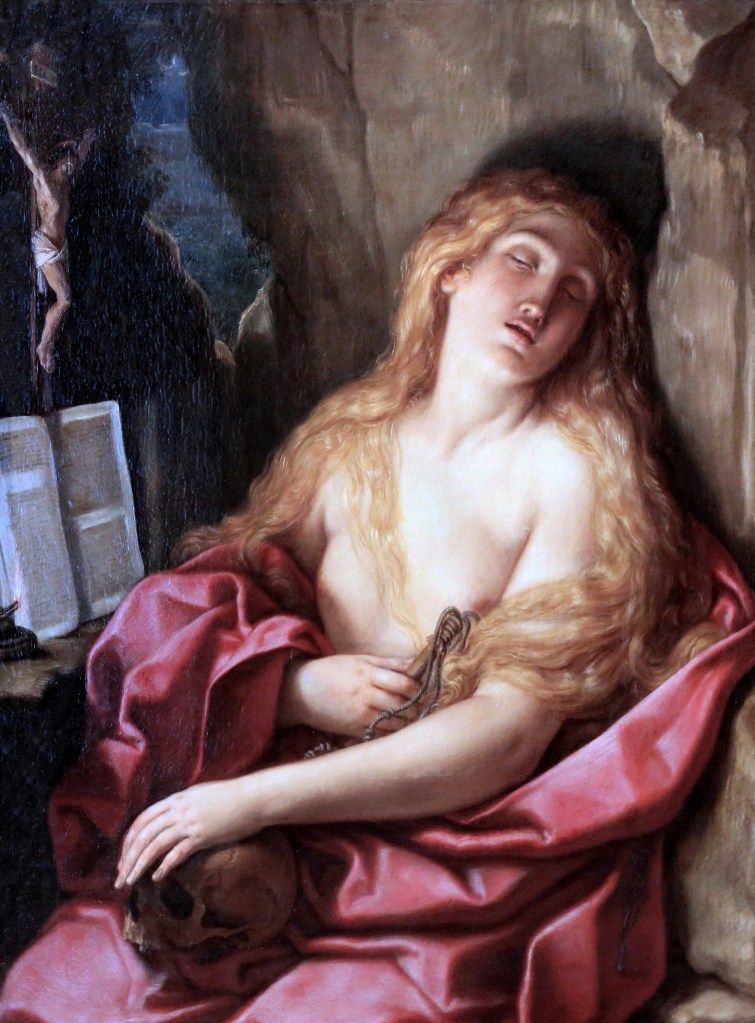
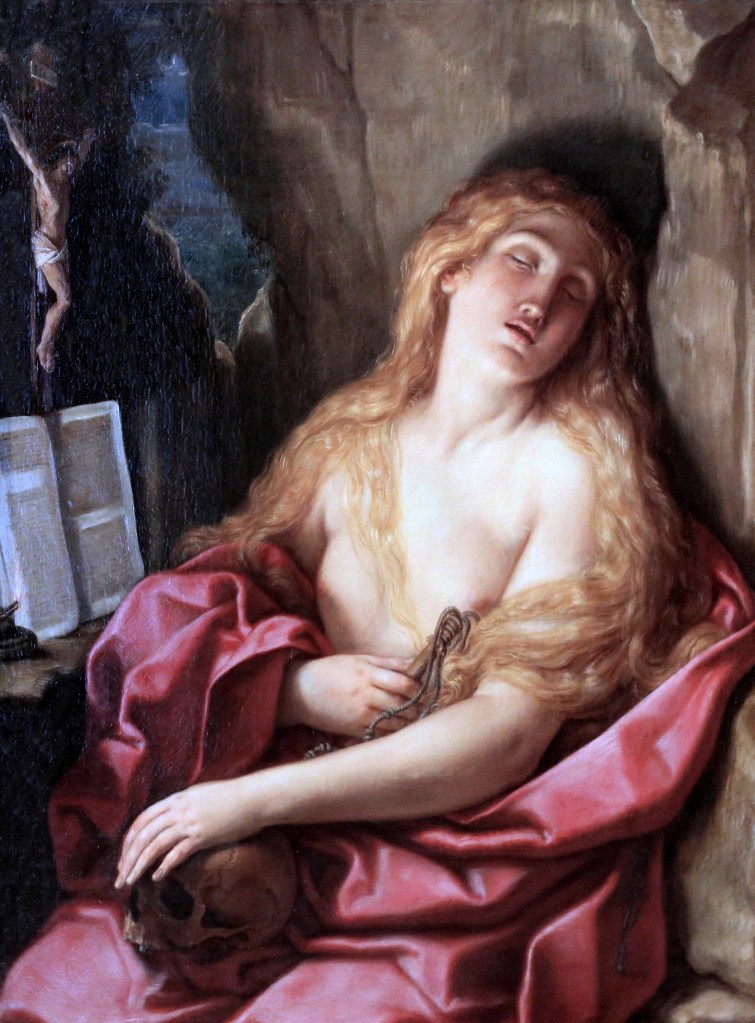
Typical! You take a subject as sensitive and emotive as the penitence of Mary Magdalene, a woman struck with remorse at her sinful past, an existence spent earning money from the debauchery of the flesh, and you turn it into an excuse for men to stare at a display of the very flesh that has caused her downfall, a voluptuous, sensuous image that contradicts the very nature of the profound changes in this woman’s life, and that goes as far as to question the title of the painting itself. In short you objectify her. Typical indeed, and only to be expected from a paternalistic society in which men paint for men, for their own private pleasure. But before you get too outraged, there is just one small problem with this attitude…
Elisabetta Sirani, The Penitent Magdalene, 1663. Musée des Beaux-Arts et d’Archéologie, Besançon.
The problem is, that it was painted by a woman – Elisabetta Sirani. It questions the notion that art might be gendered – or, to put it another way, that women might paint women in a different way than men would. It is one of the paintings I’ll include in my online talk this Wednesday evening, 2 December – Purity, Temptation, Sin and Repentance: Four Women on the Path to Redemption – there’s plenty of time to sign up if you’re around. I’m not saying that painting isn’t gendered, by the way, but… well, it’s complicated.
Sirani was a very successful artist. I have talked about her before, back in May, with Picture Of The Day 62 – Portia, but, in case you don’t have time to read up about her there, here’s a brief reminder. She was born in 1638 in Bologna – and that was where she seems to have spent her entire life. It’s quite possible she never left the city. I say entire life, but she died, tragically young and under unexplained circumstances, at the age of 27, leaving behind over 200 paintings. Like her older contemporary, Artemisia Gentileschi, she was trained by her father, who was an artist, and like Artemisia her earliest surviving work was painted when she was 17. By 20 Elisabetta was already enormously successful, and soon after she founded an academy for women artists. Her early death was mourned by artists and intelligentsia alike, and she was buried in great pomp in San Petronio, Bologna’s most important church, alongside the city’s most famous artistic son, Guido Reni, who had trained her father.
If we can believe what we see in this painting, having repented and mended her ways, Mary Magdalene has retreated to a cave to read the bible and contemplate Christ’s sacrifice on the cross, while meditating on death, and mortifying the flesh. This should not be in doubt. The bible stands open at the left of the painting on a ledge which also supports a candle stick. We can just see the base of the candle, though not the flame itself, which illuminates the scene with a supernatural brilliance.
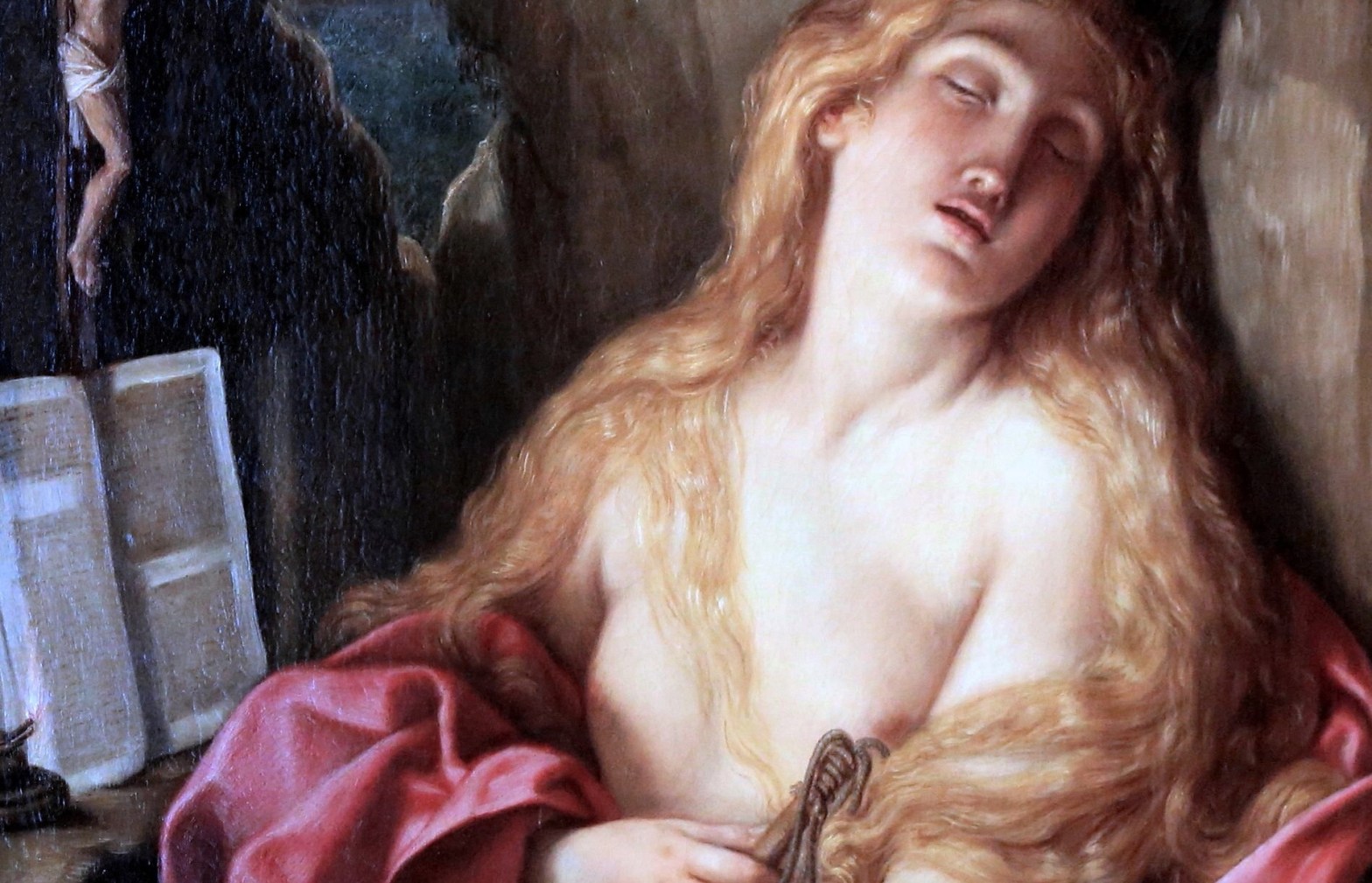
The precise fall of this light is beautifully traced across the painting, while a second light source, the moon, silvers the edges of the cave, and can just be glimpsed in the sky outside. Within, the candle illuminates the underside of the right arm of the delicately carved and coloured crucifix, against the base of which the bible is leaning. The wound in Christ’s chest is lit, revealing a dash of red blood, as are the side of his face around the eye socket, and his halo. The light even flicks across the edges of the titulus attached to the top of the cross, on which the letters I.N.R.I. (Iesus Nazarenus Rex Iudeorum – Jesus of Nazareth, King of the Jews) are summarily sketched. It also casts a shadow from the surprisingly low-slung loincloth, and defines the firm thigh muscles of the saviour’s tautly bent right leg. It’s not just the Magdalene who is sensuously depicted. The candle illuminates Mary’s chest and neck, models the contours of her face with delicate sensitivity, and casts a shadow onto the wall of the cave behind her. Her golden hair glows around her face, falling copiously over both shoulders.
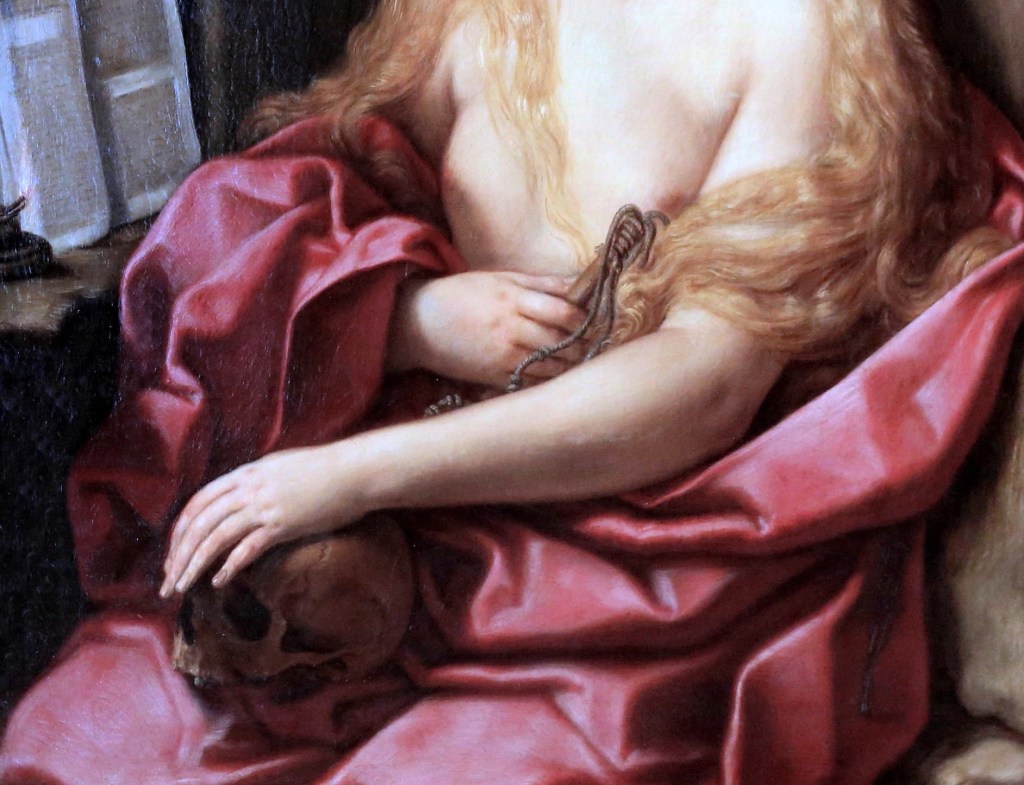
A strand of hair crosses her chest, and lies between her breasts, while another wraps around her left arm, and under the knotted cat o’ nine tails. She holds the whip in her right hand, the end of its handle resting provocatively close to her left nipple (the other nipple is caressed by a shadow from her pink robe, which frames, but doesn’t clothe, her torso). Her left hand is poised on top of a skull, the symbol of her meditations upon death and of the transience of flesh, which sits almost too comfortably in her lap.
To understand the extreme sensuality of this painting, surely it would be useful to know more about the life of Mary Magdalene? The problem is that none of it is in the bible. What we are looking at is a fiction, but one that was believed for well over a millennium. If we do go as far as to read the bible, we will find the first mention of the Magdalene in Luke’s Gospel, at the beginning of Chapter 8. Here are the first two verses:
And it came to pass afterward, that he went throughout every city and village, preaching and shewing the glad tidings of the kingdom of God: and the twelve were with him, And certain women, which had been healed of evil spirits and infirmities, [including] Mary called Magdalene, out of whom went seven devils…
Immediately before this, in chapter 7, Jesus was at dinner with the Pharisee Simon, when the following episode occurred – I’ll give you verses 37 and 38, and the very last verse of the chapter, verse 50:
And, behold, a woman in the city, which was a sinner, when she knew that Jesus sat at meat in the Pharisee’s house, brought an alabaster box of ointment, And stood at his feet behind him weeping, and began to wash his feet with tears, and did wipe them with the hairs of her head, and kissed his feet, and anointed them with the ointment…. And he said to the woman, Thy faith hath saved thee; go in peace.
Of course, there is no connection between this episode, and the fact that, immediately afterwards, in the next chapter, Mary Magdalene is mentioned for the first time. Or is there? Well, if you keep reading, and presuming you’ve already read Matthew and Mark, after Luke you would get to the Gospel According to St John. And this is what you would read in Chapter 11, verses 1 & 2:
Now a certain man was sick, named Lazarus, of Bethany, the town of Mary and her sister Martha. (It was that Mary which anointed the Lord with ointment, and wiped his feet with her hair, whose brother Lazarus was sick.)
Now, Luke doesn’t say that his ‘woman… which was a sinner’ was called Mary, but she has done exactly the same thing – so maybe she was called Mary, and maybe indeed she was the sister of Lazarus and Martha. However, in the next chapter (12), in the first three verses, John tells us:
Then Jesus six days before the passover came to Bethany, where Lazarus was, which had been dead, whom he raised from the dead. There they made him a supper; and Martha served: but Lazarus was one of them that sat at the table with him. Then took Mary a pound of ointment of spikenard, very costly, and anointed the feet of Jesus, and wiped his feet with her hair: and the house was filled with the odour of the ointment.
So, is John’s mention of the event in Chapter 11 referring to what would happen later in Chapter 12, or what we might already have read in Luke 7? Mary would certainly become associated with precious ointment. Mark’s Gospel, chapter 16, verse 1, tells us that after the Crucifixion,
And when the sabbath was past, Mary Magdalene, and Mary the mother of James, and Salome, had bought sweet spices, that they might come and anoint him.
And this is why Mary always has a jar with her after she has visited Jesus’s tomb in paintings of the Noli me tangere, which is recounted in John 20 – have a look back to the version by another of Italy’s great 17th Century women, Galizia Fede: 104 – Don’t touch!
Basically, we are discussing the identities of three people: (1) Luke’s ‘woman… which was a sinner’ from Chapter 7; (2) ‘Mary, called Magdalene’ from Luke, Chapter 8, and (3) Mary, sister of Martha and Lazarus, from John, Chapters 11 & 12. However, way back in 591, the year after he became Pope, Gregory the Great delivered a homily for Easter in which he conflated these three women, and Mary Magdalene was identified as the sister of Martha, a former sinner who had repented, only to became one of Christ’s most ardent followers. It wasn’t until 1969, under Pope Paul VI, that the Roman Catholic Church finally recognised them as three separate people. But for the History of Art that is almost irrelevant: from 591 – 1969, as far as the Roman Catholic Church was concerned, Mary Magdalene was a repentant sinner. And for most people, that meant a repentant prostitute. That effectively includes the whole of European art since the fall of the Western Roman Empire (less a century or so), which includes everything in the National Gallery in London, for example. For that matter, it also includes today’s painting from the Musée des Beaux-Arts et d’Archéologie, Besançon. But why would a woman like Elisabetta Sirani, who knew all too well the problems that women faced, choose to paint the Magdalene like this? Well, I’m afraid I’ll have to leave you to think about that. People are more complex than we might expect. I’ll talk about just some of the complexities this Wednesday, 2 December, at 6.00pm UK time: Purity, Temptation, Sin and Repentance: Four Women on the Path to Redemption – I look forward to seeing you there, or somewhere else, sometime soon!
Correggio, The Madonna of the Basket, about 1524, National Gallery, London.
Hello again! And before we get to Correggio, an apology – for those of you who are able to come to The Scrovegni Chapel from top to bottomI got the timings wrong on the last blog: the talks are from 14.00 – 15.00 UK time. At least they were right on the diary page, and if you got as far as booking with ARTscapades you would have seen the right times there: thanks to those of you who noticed the mistake!
So now to Correggio, and a charming painting I referred to when answering a question during a National Gallery talk recently, but didn’t have an image to hand. The question was about the Madonna breastfeeding – an issue I covered not so long back when discussing Artemisia, and Mary. One of the reasons for its representation was to show the Virgin as a good role model – and in today’s painting Joseph joins her. And before you get all 21st Century on me (or 20th Century, for that matter, but some people are still catching up) I know that gender roles have changed – as have our ideas about gender itself – but this is a painting from the 16th Century. It will be just one of many works I will include in the short course I am giving for the Wallace Collection (most of them from the Wallace itself) on 2 and 3 December from 11.00 – 13.00 (and yes, I’ve got the time right, I just checked!) on The Childhood of Christ in Art.
At first glance this might appear to be any other image of the Madonna and Child, an image which does not encapsulate any specific part of the biblical narrative, but is a devotional abstraction, on the whole, meant to illustrate the nature of the relationship and to emphasize the respect due to the Son of God and his mother. However, this is not an iconic Madonna and Child Enthroned, let alone a Maestà, in which the full ‘majesty’ of Mary, and the respect due to her as Queen of Heaven, is shown through the use of symbolic props (e.g. a crown), furniture (a throne) and supporting cast (the heavenly host, assembled in serried ranks). No, she is sitting on the ground, in all humility. The word in itself is related to sitting on the ground, as it has the same root as humus, meaning earth. She is seated at the foot of a tree, which takes up the top left hand corner of the picture, and I can’t help thinking that the two trunks – one broader, on the left, and another narrower, on the right, are in some way related to the figures of Mary and Jesus, who appear to have the same relative age, width and position as the two trunks: they represent strength, and our future growth. The ground is green, growing with lush vegetation, which adds to the sense of pleasant harmony created by the apparently smiling mother holding her son, still too young to be fully coordinated, who is sitting on her lap. She wears her traditional colours – a red robe, albeit seen here as a powdery pink, with a blue cloak, just visible on the left of the painting beneath her elbow. Jesus’s gesture, with his arms reaching out in both directions, forms a diagonal that is continued by the grassy slope on which they are seated, alongside which is a path, with a low stone wall on the other side, leading to a rough wooden fence.
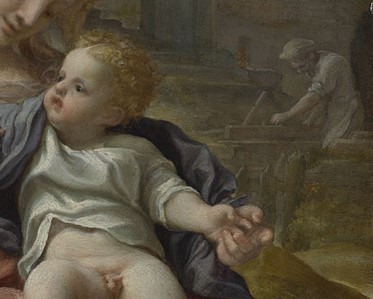
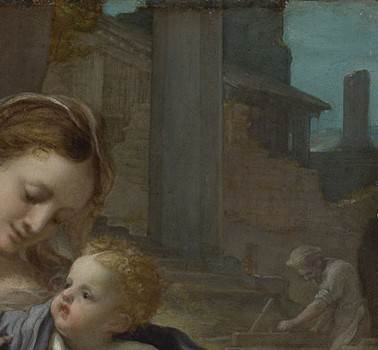
Beyond the fence we see the carpenter Joseph at work, using a plane to smooth a post, or something similar. Correggio’s control of atmospheric perspective (the way in which the air, or atmosphere, affects the way we see distant objects) is superb, and Joseph is painted almost in monochrome, as if the air were misty, or full of dust. He appears to be marginalised, a subsidiary part of the painting: this would have been Correggio’s intention. Poor Joseph, he is excluded from the verdant garden in which Mary and Jesus share such an intimate relationship. But then, when you remember that the word ‘paradise’ is derived from an Old Iranian word meaning ‘walled enclosure’ – or effectively, ‘garden’ – not only is the garden, but also the wall, explained. Jesus, as Son of God, is already – and is always – in paradise, even if temporarily with us on Earth. Mary, free of sin (see Picture Of The Day 71 and POTD 72 – The Immaculate Conception), would never have to suffer the penalty of expulsion. Joseph, on the other hand, as a descendant of Adam and Eve, is excluded from paradise until Christ’s sacrifice redeems him. Not only that, but, unlike Mary, he is not physically related to Jesus – he may be Christ’s stepfather, and an honourable man, but he has no exemption from damnation should Christ’s mission fail. Which, admittedly, we know it won’t.
As for Jesus’s brief period, ‘temporarily with us on Earth’, what exactly was he? God? Or man? The answer, settled as early as 451 at the Council of Chalcedon, was that Jesus was both God and man – he had two ‘natures’ – but as mere humans, this is difficult for us to reconcile. Even if we accept he was the Son of God, and for that matter, as part of the Holy Trinity, God himself, how could he be like any other man while down on Earth? Well, it helps to show him naked, so that we can see that he was like any other man, which is why there are so many images of the Baby Jesus inadequately clad. By the time the Counter Reformation came along, the theology seems to have been secure, but the nudity of Our Lord, even at this tender age of innocence, was deemed, in contemporary parlance, ‘inappropriate’ – and so nappies were introduced, or skirts lengthened.
Behind Joseph – and so you could argue, even further from paradise – there are a whole array of ruins. Steps lead up from him past the base of a half-column, attached to stone pier, behind which are the remains of a rough stone wall, the lower part of which is still covered in plaster. Further back still is a collection of columns topped by a sloping roof (a memory of the unstable stable in Bethlehem, perhaps?) then another, more massive, ruined wall, and the base of yet another column. In Nativity scenes the symbolism is quite specific: it relates to at least two texts in the bible, and early Christian theology. During the Sermon on the Mount (Matthew 5:17) Jesus says, ‘Think not that I am come to destroy the law, or the prophets: I am not come to destroy, but to fulfil,’ and in John 2:19 he also says, ‘Destroy this temple, and in three days I will raise it up.’ In St Augustine’s The City of God, written in the early 5th Century, the author suggests that as Christianity continued to grow, the Roman Empire would fall. All three of these ideas add up to the same thing – Jesus hadn’t come to destroy the old order, whether that be Judaism or Rome, but to rebuild it – and that is the idea that the ruins represent. Notice that Joseph is hard at work, part of the process of rebuilding.
So Joseph, marginalised as he is, is a good role model, working hard to support wife and family, while also furthering God’s purpose. Mary, too is a good mother. In the bottom left hand corner is the basket which gives the painting its name, beautifully woven, and, for that matter, beautifully painted. In it are a pair of shears, or scissors, a ball of thread and some cloth. Mary’s skills as a seamstress are not mentioned in the bible, but the implication is that, like all good mothers, she must have stayed at home and made clothes for her son. One of the many stories about her – in the apocryphal 2nd Century Protoevangelium – relates to her activities in the temple as a child. After she was presented to the temple (POTD 73 – Mary), and before she found a suitable husband (POTD 31 – The Suitors Praying), she spent her time with the other virgins spinning thread and weaving the veil of the temple. Lots were drawn to see who would spin which colour, and Mary was chosen to spin the purple – the colour associated with royalty – which, as she would become Queen of Heaven, was entirely apt.
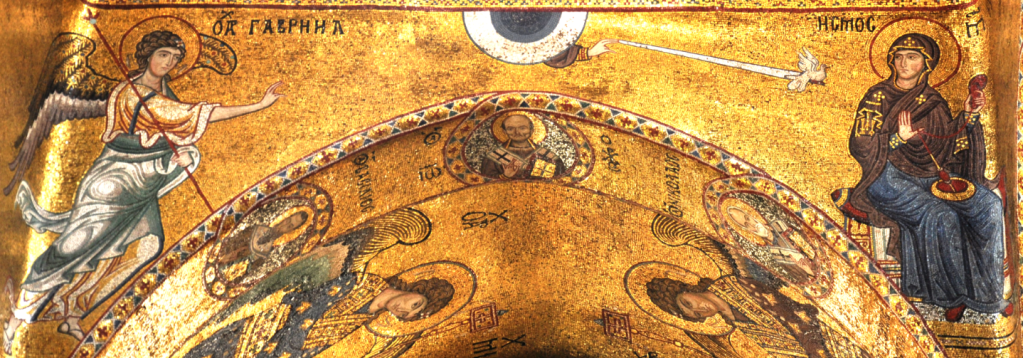
In this 12th Century mosaic Annunciation from ‘La Martorana’ in Palermo we see Mary, wearing the imperial purple, in the process of putting down the thread she has been spinning as Gabriel approaches. We might not see this as purple, but the meaning of the word itself was not fully defined for centuries, and could refer to almost anything between red and blue. This thread needs to be distinguishable from her own clothing, but also to look rich – and it works on both counts.
When we look back to Correggio’s painting, we can see what Mary has been making – a coat in Correggio’s typically muted colour range, but definitely purple: this is the boy born to be king, after all. So far he has only managed to put his right arm into its sleeve, and as his little hand emerges, it seems to be blessing. But also, with both arms extended, and that right arm going upwards from the shoulder, it seems clear that Jesus already knows when his arm will find that position again. Which might make us question what it is that the carpenter Joseph is actually working on? And is Mary really smiling – or has Jesus’s gesture temporarily stopped her in her tracks, as she bows her head and takes a breath, aware of the implications? In order to rebuild this tiny temple, it would first have to grow to adulthood, only to be destroyed: one day in the future this baby will be nailed to the cross. All of the family know this. It is part of the process of rebuilding.
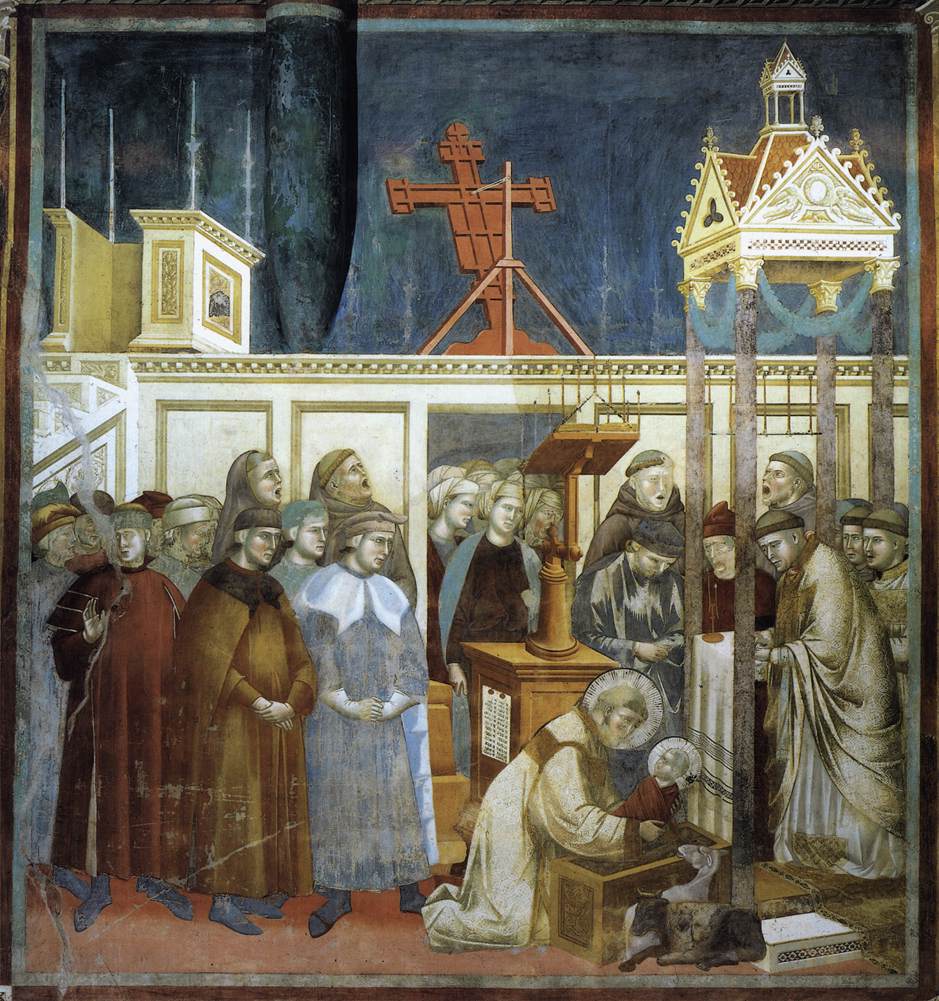
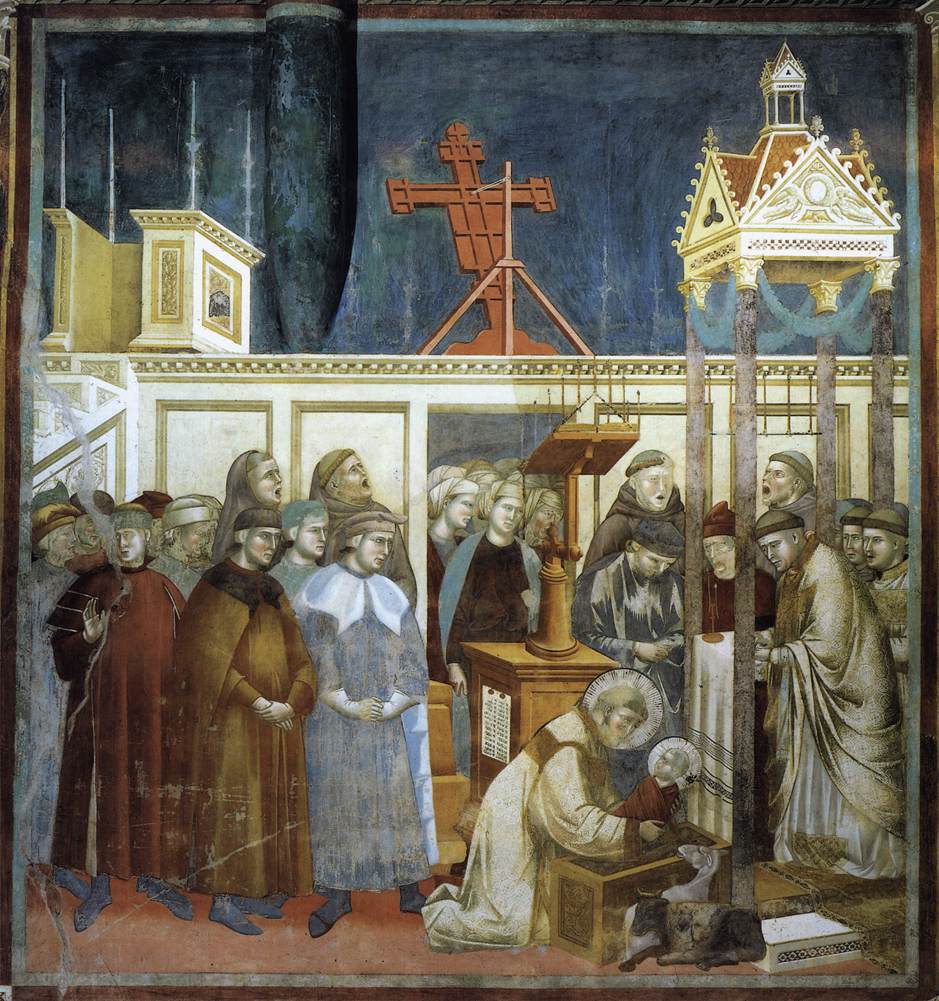
Giotto, The Institution of the Crib at Greccio, 1297-1300, Upper Church, San Francesco, Assisi.
I’m thinking about Giotto again for a number of different reasons. The first is that Giotto is, quite simply, always worth thinking about. The second is that I am about to embark on a short course, a series of three lectures entitled The Scrovegni Chapel from top to bottom, which is the first project of a new venture, ARTscapades, which aims to raise money for museums and galleries – and you can contribute simply by booking tickets for their events. If you click on the title above it will take you to the page for the first of the talks, which is on Tuesday 17 November between 2pm and 3pm UK time. The 2nd and 3rd talks will be on the following Tuesdays at the same time (these and other upcoming events are listed in my diary). Another reason to think about Giotto is that I was delighted to receive a copy of Laura Jacobus’s Giotto and the Arena Chapelas an early Christmas present from my wonderful sister… thank you! Just in the nick of time, you could say. I might even have time to read it before Tuesday!
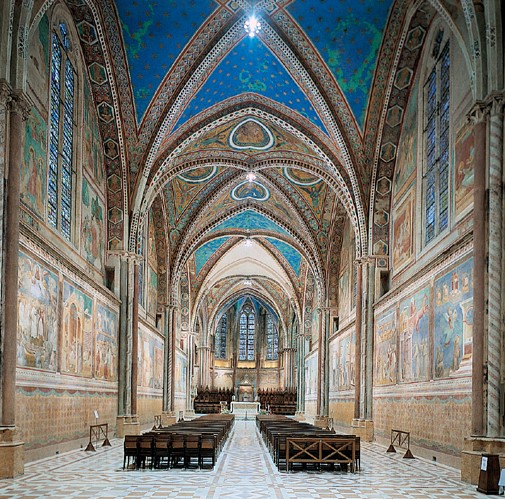
But for today I want to move away from Padua, and head to Assisi, the town in which St Francis was born, and where he died. There is a sequence of 28 frescoes in the Upper Church of San Francesco devoted to the life of the saint which run along the bottom of the walls, just above the fictive tapestries. At least 25 are believed to have been painted by Giotto himself – although not everyone is convinced, with some art historians identifying the hands of at least three different anonymous masters, the Master of the Legend of St Francis, the Master of the Obsequies of St Francis, and the Cecilia Master. Having said that, there are those who believe that they were all designed by Giotto, even if he didn’t paint them himself. It’s one of those art historical problems which may never be resolved – so let’s not worry about it too much, and look at the painting instead.
I’ve chosen this image as I have often used it to illustrate the way in which medieval churches ‘functioned’. You should always be careful about using paintings as source material, though, because the artist is trying to tell a story, and not to explain the nature of ecclesiastical architecture. However, for someone like Giotto, who may himself had a hand in the design of the Scrovegni Chapel, such details were important – and the more the viewers believed that the building depicted was real, the more they were likely to believe the story that was being told. This particular narrative takes place in a church, and we find ourselves in the chancel, with the high altar to our right. It is surrounded by four columns which support a canopy. The most famous example of this type of structure is Bernini’s baldachino in St Peter’s, with its twisted Solomonic columns, so called because it was believed that the temple of Solomon had columns like this – indeed, it was believed that St Peter’s had one of the originals. However, for most medieval churches standard cylindrical columns sufficed. The structure as a whole is called a ciborium – the same name that is given to the covered cup used to contain the host during the Eucharist. The baldachino is a ciborium, as it happens, but gets this name from its canopy, which imitates the fabric that all good baldachins should have. As well as ‘crowning’ the altar, a ciborium is there to frame it, and enhance its status. Like the covered cup, it effectively protects and ‘contains’ the host.
To the left of the altar we see a lectern, or reading desk, surrounded by a number of singing Franciscans. We know they are singing, as all of their mouths are open at the same time, and it seems unlikely that so many Franciscans would be so unruly as to talk at the same time as their brothers. Lecterns such as this would often be used for hymnals, with the music being as large as possible – with all books being written by hand there would only be one for the whole choir, although they would not all read it from a distance. Much of the music would have been learnt by heart, and a choirmaster could indicate the flow of the music through appropriate gestures. Gathered around the altar are a number of clerics – the officiating Priest, for example, who turns away from the altar to look down at a haloed cleric – St Francis – who has taken a baby – also with a halo – from a wooden box. Next to the box are two animals – a goat and a diminutive cow, it seems – and nearby are a number of laymen, who appear to be well-dressed: aristocrats and successful merchants, presumably. Behind these people is a wall, and peering through a hole in the wall are a group of women.
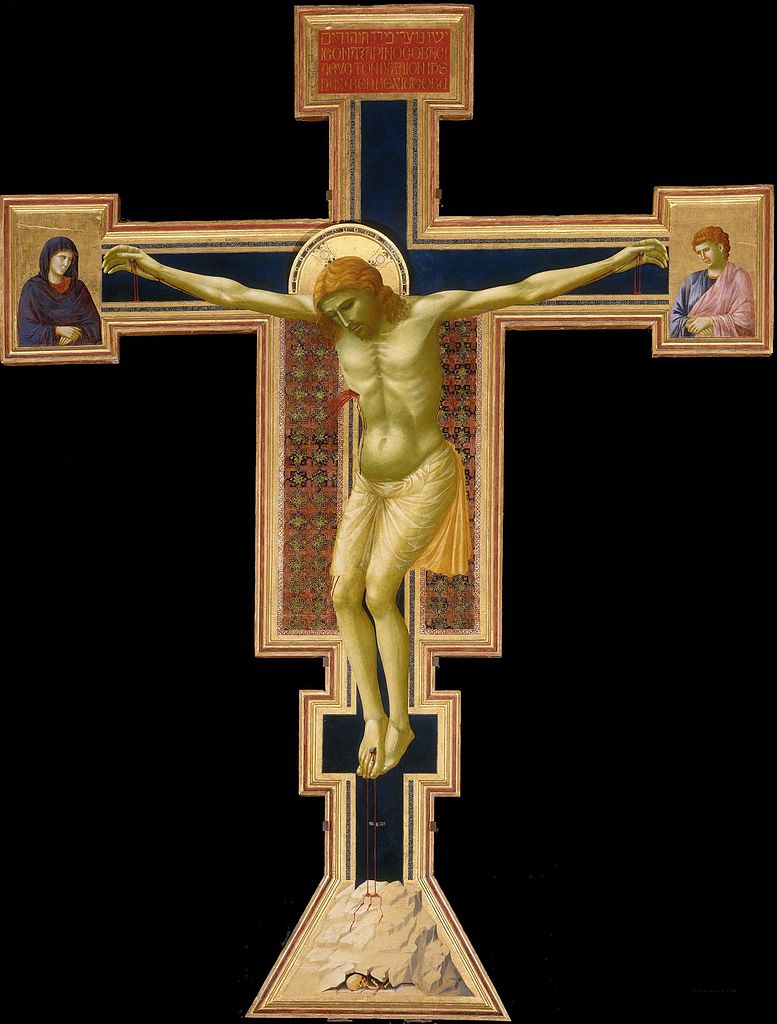
The nature of this ‘wall’ is made clear by the features which top it, most importantly a cross, leaning away from us, and hanging from a simple support – a vertical post, held up by two diagonals, with a chain, or rope, attached from its apex to the heart of the cross. The brown colour, and the shape of the batons, tell us that this is wood, and that we are looking at the back of a painted crucifix, the medieval English name for which was the Rood. Having identified this, we realise (if we hadn’t before) that this ‘wall’ is what in Britain would be called a ‘Rood Screen’ – or choir screen. You might assume that the space beyond the screen – the choir, or chancel – was only accessible to the clergy. But no, the screen was more ‘porous’, and certain people were granted privileged access. However, it is only men who are allowed beyond the screen – the women are excluded, which is why they are left peering through the door. The same situation prevails to this day in much of the Orthodox Church, which continues the use of a ‘screen’, called an iconostasis (‘stand for icons’) to enclose the Holy of Holies. If you want to know what the crucifix looks like from the front, it was almost certainly meant to resemble Giotto’s own painting in Santa Maria Novella in Florence, which probably dates from the same decade as the fresco. I’d love to show you a photo of the back of this painting, to show you that the wooden support was put together in the same way, but I cannot find an image online… Why is the back of a painting not interesting enough to warrant this? It was interesting enough for Giotto to paint in his fresco, after all!
At the top left of the fresco is a pulpit, the idea being that the clergy could preach to the congregation without leaving the chancel. There is a staircase leading up to it, visible above the heads of the men on the far left. The word ‘pulpit’ is derived from its location, coming from the word pulpitum, meaning a scaffold, or platform – a raised structure from which to speak (I discuss all the elements of church ‘furniture’ in my book The Secret Language of Churches and Cathedrals, by the way – I’ve just edited the link to go to the new bookshop.org – supporting local bookshops rather than corporate internationals). Now, although Giotto’s intention is to tell a particular story, part of his storytelling technique is to give the narrative a convincing location, and Italian churches really did look like this. Indeed, the Scrovegni Chapel originally had such a screen cutting across what now appears as a continuous nave, and this had a pulpit with a staircase leading up to it. However, do you remember ever seeing a choir screen, or rood screen, in an Italian church? Run through all the ones you’ve visited in your mind’s eye! I can only think of one, off the top of my head, and that is in the Frari in Venice. The fact is that most choir screens in Italian churches were removed as a result of the Counter Reformation, enabling the congregation to participate more fully, as they would have greater access to the liturgy. As a result, when new churches were built, starting with Palladio’s glorious Redentore (also, coincidentally, in Venice), the choir was constructed behind the altar, so that it wouldn’t be in the way. In several churches the choir, which was originally in front of the altar, was moved behind, after an extension had been built at the back of the church. I’ve never known why the choir in the Frari was not destroyed. It is a fantastic choir, though, and maybe that was reason enough.
You may be wondering what the curious structure between the back of the crucifix and the pulpit is. Quite simply, it is part of the church, the base of a corbel supporting one of the overlying structures. Of course, you may also be wondering what exactly is going on in this fresco.
The story dates back to Christmas 1223, and was first told in Thomas of Celano’s Life of St Francis. The Order of Friars Minor (‘Franciscans’) was founded by St Francis in 1209, and Thomas joined six years later: he would have known Francis, although probably not well. His ‘Life’ was commissioned by Pope Gregory IX in 1228, the year in which Francis was canonised. This was only two years after his death, a mark of the high regard with which he was held (by means of a contrast, although St Dominic died five years before St Francis, he was not canonised until six years after). Thomas completed his first version of the biography within a year, and wrote a second, fuller version, some 17 years later. Here is a link to a 1926 translation of the relevant section, Chapter 30, of the first text. However, it seems likely that Giotto relied on the Life of St Francis written in 1260 by St Bonaventure – also a Franciscan, but too young to have known the founder (the link is to a translation from 1904).
According to Bonaventure, “It happened in the third year before his death [i.e. 1223], that in order to excite the inhabitants of Greccio to commemorate the nativity of the Infant Jesus with great devotion, St. Francis determined to keep it with all possible solemnity; and lest he should be accused of lightness or novelty, he asked and obtained the permission of the sovereign Pontiff. Then he prepared a manger, and brought hay, and an ox and an ass to the place appointed.” From this it is quite clear that we are not talking about a conventional Christmas Crib – these are real animals, not models. Back to Bonaventure: “The brethren were summoned, the people ran together, the forest resounded with their voices, and that venerable night was made glorious by many and brilliant lights and sonorous psalms of praise” – and indeed, we can see all the Franciscans singing.
“The man of God [St. Francis] stood before the manger, full of devotion and piety, bathed in tears and radiant with joy; the Holy Gospel was chanted by Francis. Then he preached to the people around the nativity of the poor King; and being unable to utter His name for the tenderness of His love, He called Him the Babe of Bethlehem…
A certain valiant and veracious soldier, Master John of Greccio, who, for the love of Christ, had left the warfare of this world, and become a dear friend of this holy man, affirmed that he beheld an Infant marvellously beautiful, sleeping in the manger, Whom the blessed Father Francis embraced with both his arms, as if he would awake Him from sleep.”
At this point, everything becomes hypothesis. Thomas of Celano mentions ‘a lifeless child’ – but not a doll – and both say that Francis acted as if to rouse him from sleep. This is not unlike a number of Renaissance paintings in which it is clear that the sleeping child is a premonition of the future dead Christ – and in the same way that sleep is followed by waking, Christ’s death is followed by his resurrection. The message is clear. By recreating the situation of the Nativity in all its humility, Francis enabled his followers to believe in the story – and to believe in it so entirely that they could see the Christ Child himself there among them. What Giotto is doing is essentially the same: painting the narrative with as much naturalism as he could muster, to make the miraculous appearance of the divine infant entirely natural. Such is the power of art.
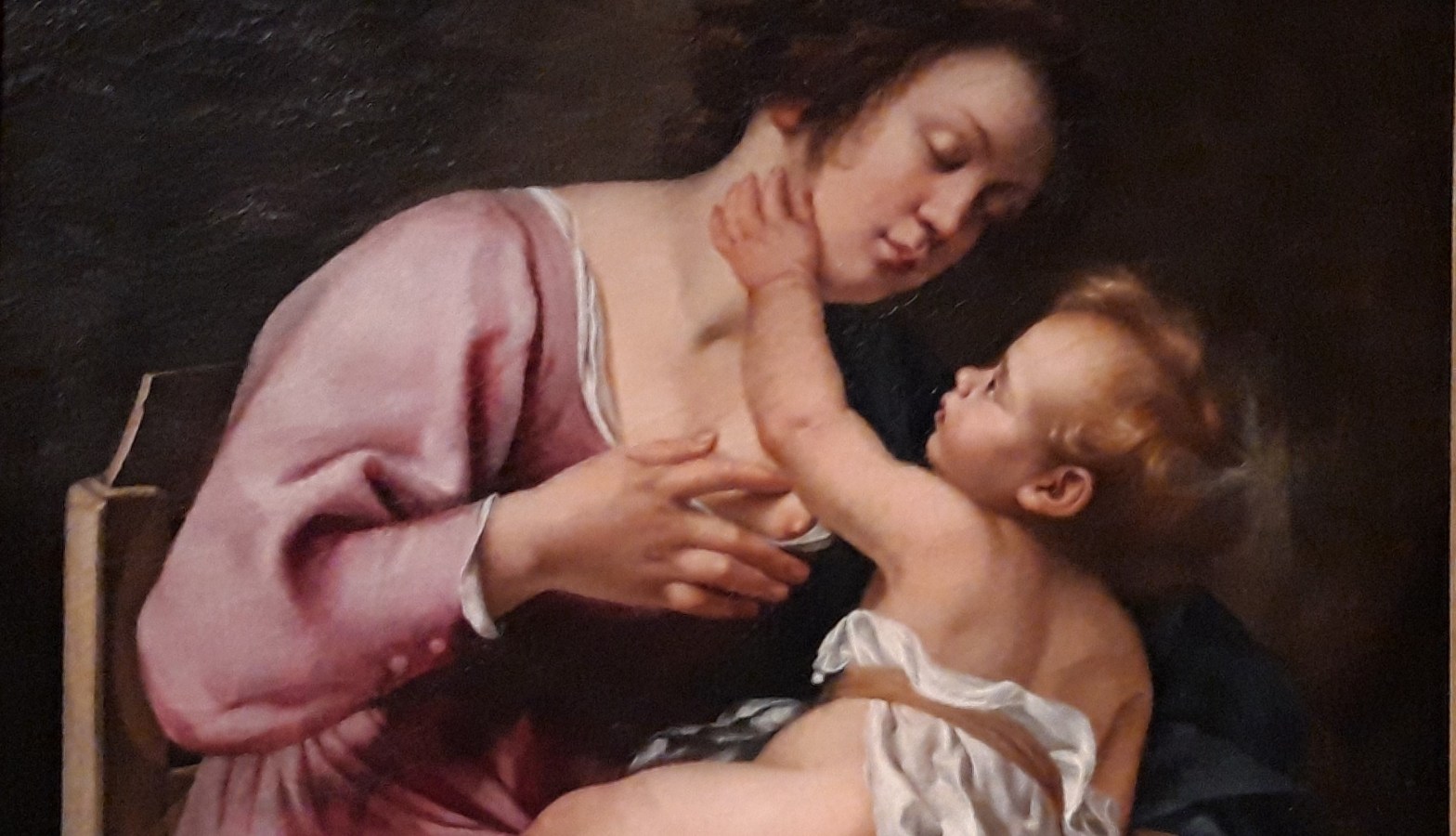
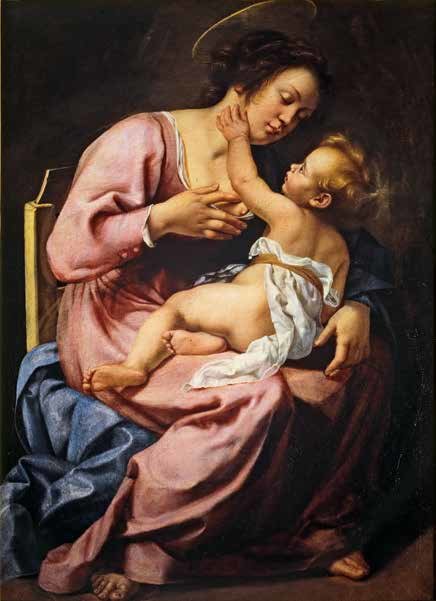
Artemisia Gentileschi, Madonna and Child, c. 1613-14. Galleria Spada, Rome.
Hello! It’s been a while… over a month, bizarrely enough, although I can’t tell whether time is going quickly or slowly. The time has been filled with numerous adventures, I’m glad to say, including two trips to Venice, one working, one holiday, and both a joy! I’ve also managed to take in a number of exhibitions, including a return visit to Titian at the National Gallery, and a first encounter with the NG’s glorious Artemisia, the inspiration for today’s musings. I continue to make plans for the future, plans which, as you will realise, are constantly subject to change. Among the most exciting is A Flash Trip to Stockholm, 2 – 5 November – and if you’re free and want to get away while we still can, please do join us. For a reminder of just one of the things we will see, have a look back to Picture Of The Day 36 – St George. More of the plans later on – let’s concentrate on Artemisia.
She truly was a remarkable woman, and a great artist. I’ve already written about her twice (POTD 17 and POTD 69), but she is always worth coming back to, and if you haven’t managed to make it to the exhibition, it really is worthwhile. Her strength of character is well known, and frequently discussed, and the fortitude and determination of the women she paints is also rightly celebrated, notably in a number of images of Judith and Holofernes. But amidst the focus on her personal life and misfortunes, on her strength and on the strength of her subjects, and on her genuine understanding of the plight of women which was born of personal experience (something which no male artist could possibly have had, of course), I can’t help thinking that today’s painting has not received the attention it deserves. Apart from anything else, I think it is a wonderfully beautiful image, its delicacy, and the affection it depicts, matched by a beautifully conceived composition.
The Madonna fills the full space of the painting, bringing her closer to us, and making the subjects more immediate, more ‘present’. The Christ Child sits on her lap in a position more sophisticated than we would expect for a toddler – but then, this is the Son of God.
She sits on a low chair, and in order to prevent her son from slipping off her lap, her feet are tucked to one side, so her right thigh remains horizontal. Her left knee is not so strongly bent, allowing the child to lean on her left thigh, which is slightly higher. The overlapping zig-zags of her legs – one in dark shadow, and another in brilliant light (the chiaroscuro developed by the recently-deceased Caravaggio being used to full advantage) is then echoed by the ‘v’ of her blue cloak, lying over the seat of the chair, swept back by her leg, and curving out and around, a fuller expression of the folds seen in the pink robe. She is seated on this cloak, and we see it again tucked around her right arm, framing the leg in the dark shadows, and enclosing the form of the child. Her left arm supports him, but doesn’t hold him – almost as if she is wary of the touch, and the gap between her thumb and forefinger opens up toreveals a deeply shadowed hollow, allowing the brilliant white fabric loosely held around Jesus – a hint of the shroud to come, perhaps? – to shine out.
There is another deep void between them, a dark shadow that makes them look entirely sculptural, and seems to represent the gap in their respective experience – she would have been little more than a girl, whereas he is the Son of God. And it is he who bridges the divide, his left arm reaching up to touch her neck with delicacy and with concern, as he looks into her eyes with ineffable love. There is a sense of divine understanding in this look, and in this gesture, which, like the elegant way in which he reclines, is far beyond his human years. Mary looks down with humility, as she offers her breast between her middle- and forefingers. The thin, white hem of her chemise, seen again at her wrist, create another link to him, as this hint of whiteness echoes the white fabric which enfolds him.
The dark space between them forms a diagonal which reaches to the top right corner of the painting. Their torsos and her legs are roughly parallel to this line, while his arm, and the gaze between the two, follow an opposing diagonal. That this was a hard-won composition can be seen from the numerous pentimenti – or changes – which are now visible: a phantom elbow and some transparent drapery curving out from her waist can be seen against the back of the simple chair, and the dark background around their heads appears to be filled with other ghostly presences, almost as if adding to their sanctity, which is defined by their haloes, hers almost solid, his, an undefinable glow.
Artemisia Gentileschi, Madonna and Child, c.1613-14. Galleria Spada, Rome.School of Marcantonio Raimondi, Holy Family, c.1515-34. Royal Collection Trust.
Hard-won, yes, but not entirely original, as it happens. Ultimately it is derived from a print attributed to the School of Marcantonio Raimondi, the first engraver to base his works on other people’s paintings, and usually, on Raphael’s. It shouldn’t surprise us that Artemisia was inspired by a print. The painting is dated ‘About 1613-14’ in the catalogue of the National Gallery’s exhibition, although some authorities date it earlier – around 1609 – when Artemisia would have been 16. I don’t doubt the catalogue’s later date. Apparently, X-Rays of this painting suggest that, as well as the Raimondi engraving, a later painting which she would have seen in Florence was probably another source for this image, and she didn’t get to Florence until late 1612 or early 1613. But something that is worth bearing in mind is that, as a woman, she would not have been able to move freely through the city, and certainly, as a girl, should would not have been allowed out on her own. So her first knowledge of art would have come directly from her father, Orazio, who trained her, and from small, portable works of art – such as prints – which could have been owned, or borrowed, by the family. But she has not simply copied the print. Apart from the obvious omission of Joseph, she extends the reach of the child to touch his mother’s neck, tucks his right elbow within her enfolding arm, and ensures that they look at each other. Artemisia alone is responsible for the intimacy, and for the love between mother and son, that are such important features of the composition.
Why these changes? Should we read something about Artemisia’s own life from them, as people tend to with so many of her paintings? Probably not. Dating from her early years in Florence, shortly after she married and moved away from Rome, her experience as a mother at this stage was short-lived and harsh. She had five children, but only two of them survived infancy, and only one reached adulthood. The first, Giovanni Battista, was born in September 1613, but lived little more than a week. The second, Agnola, arrived in December of the following year, but died before she could be baptised. This means that by the time the Madonna was painted, Artemisia would have had next to no personal knowledge of breastfeeding. Of love, and of loss, on the other hand, she was only too aware.
The subject itself is more common than you might realise: the Madonna Lactans – the Madonna breastfeeding, or about to feed. It was popular in medieval times, and survived into the 16th Century for a number of reasons. One, which seems oddly contemporary, is that some were aware of the benefits of maternal breastfeeding, and were concerned that aristocratic women were all too willing to hand their babies over to wet nurses. But that is probably irrelevant here. The genre is one of the ways in which Mary could be shown as a good role model for all women: a good mother, not only pure, but also willing to stay at home and look after her baby. However, feeding the infant Christ can also be seen as the source of some of her influence. Recently I’ve become particularly interested in a rather unusual painting attributed to Lorenzo Monaco (I have no doubts about the attribution – I can’t imagine who else it would be by) which is currently in the Cloisters in New York, but which was originally painted for Florence Cathedral.
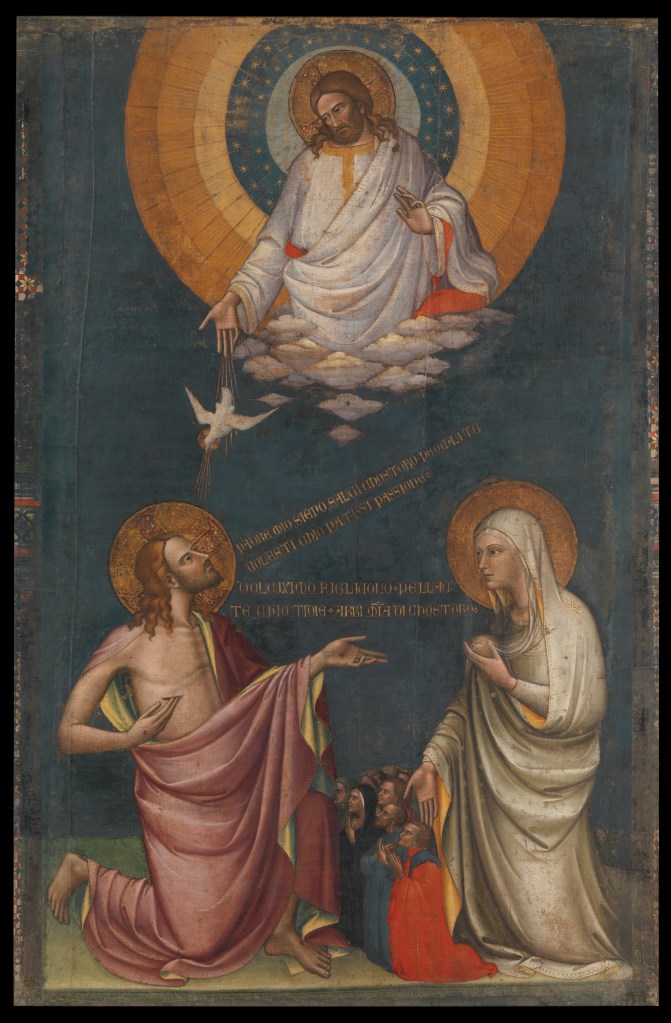
Attributed to Lorenzo Monaco, The Intercession of Christ and the Virgin, before 1402. The Cloisters, New York.
The painting shows the Holy Trinity, with God the Father at top centre, gesturing towards God the Son at bottom left, the Holy Spirit flying between, as if released from the Father’s right hand. Christ gestures to the wound in his chest, while indicating his mother, who holds something in her left hand, and gestures to a group of diminutive individuals kneeling in prayer before Jesus. The gestures tell us they are interceding with the Father, asking him to be merciful to us mere mortals. Jesus asks him something, referring to the wound, and to his mother, in support of his request, while Mary’s concern is for the people. The text, written onto the background, makes everything clear.
“My Father, let those be saved for whom you wished me to suffer the Passion,” says Jesus, as Mary addresses him: “Dearest son, because of the milk that I gave you, have mercy on them.” Even from the detail above it might not be entirely obvious that Mary is displaying her right breast. For one thing, accuracy with human anatomy was never Lorenzo’s concern, and for another, it is not something you would expect to see in a church. But what the painting really makes clear is that Mary’s physical nourishment of Jesus with the milk from her breast was seen as an equivalent of the way in which Jesus nourishes us spiritually with the blood and water that flowed mingled down from the wound in his chest. She shares his role in our redemption, and as such, was given a wonderful title, Co-Redemptrix, which went out of fashion in the 16th Century. I’m not at all sure that Artemisia would have been aware of any of this as she painted her Madonna. For her, and for her audience, the intimacy between mother and son, and the devotional nature of the image, would have been its chief charms. More abstruse elements of theology are all very well and good in a church, but wouldn’t make art sellable to the great and the good of 17th Century Florence, Artemisia’s target audience. Nevertheless, the theology of the Madonna Lactans hovers somewhere in the background of this beautiful image.
I discussed these ideas at length recently in my short course for the National Gallery, inspired by their exhibition Sin: the art of transgression. If you missed that, I will be reshaping the highlights into an online talk for Art History Abroad on 2 December. It’s not on their website yet, but as soon as it is I will put a link on my diary page. I am also starting to think about a short course looking at the ways in which Jesus is represented in the Wallace Collection, which should happen at about the same time – the beginning of Advent. More details of this, and of the National Gallery’s Stories of Art: Module 3 – on the 16th Century – when I have them, although Stories of Art will start on Wednesday 6 January for 6 weeks. In the meantime, do come to Stockholm if you’re free. If not, then until the next time, farewell!



















 dr richard stemp