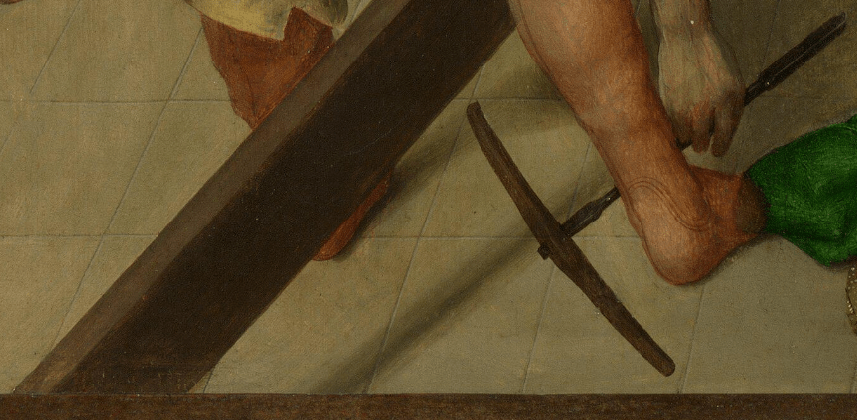
We haven’t met this scrawny child before. We saw the boy in the improbable hat yesterday, having first seen him over a week ago (Lent 7), but this is the first time we have seen his companion, who is possibly his baby brother. As I said when we first met the elder boy, ‘one of the features of this artist’s style is that he (or maybe she?) couldn’t do children,’ painting them instead ‘like small, gnarled adults’. This is a case in point. The boy sits on his mother’s lap, reaches round to take hold of her belt, and looks out at us. Like yesterday’s carpenter, he is one of the very few people in the painting looking at us. Perhaps, in this case, he is seeking our help, or perhaps, on behalf of the artist, he is there to provoke our sympathy.

It’s hardly surprising that he looks like a ‘small, gnarled adult’ – what we see is a mass of underdrawing, diagonal lines of shading which seem to have little or no relevance to this boy’s face – until you realise it is not visible on his cheeks, which are lighter. It was just a rough guide, and never meant to be seen. While we’re there, it’s worth pointing out that the shading goes from top right to bottom left, which tells me that the artist was right-handed (it’s a result of the natural movement of the wrist) – but we would have guessed that anyway. His mother is clearly wealthy: she wears a red robe (unlike blue, which was the most expensive pigment for painting, red was the costliest fabric to wear), and it is richly lined with fur, which in itself is beautifully painted, however abbreviated the technique – or maybe, especially given the abbreviated technique. You can see how it’s done, without it being ‘showy’, which is impressive in its own right. At this point, it would be worthwhile reminding you who his mother is.

Having said that, I suggested two days ago (Lent 16) that, ‘there really is no way of knowing’ who she is, ‘apart from being one of the many women who followed Jesus,’ but I gave no evidence that such women were there. I also said that, ‘it is now obvious that it is [Jesus’s] arrest and torture which are upsetting her, not to mention his inevitable death.’ However, I think there could be another allusion here, and one which would explain the presence of the child on her lap – even if it really doesn’t need an explanation. It comes from Luke’s description of the events following Jesus’s trial. They led him away, ‘And’, according to Luke 23:27-28,
…there followed him a great company of people, and of women, which also bewailed and lamented him. But Jesus turning unto them said, Daughters of Jerusalem, weep not for me, but weep for yourselves, and for your children.
I think this woman is one of the ‘Daughters of Jerusalem’ who is bewailing and lamenting him. But I suspect she is also weeping for herself, and for her children. Which is why, in this detail, the children are there – and why the baby looks at us, inviting us to weep for him, with her.