118 – Epiphany in Ravenna

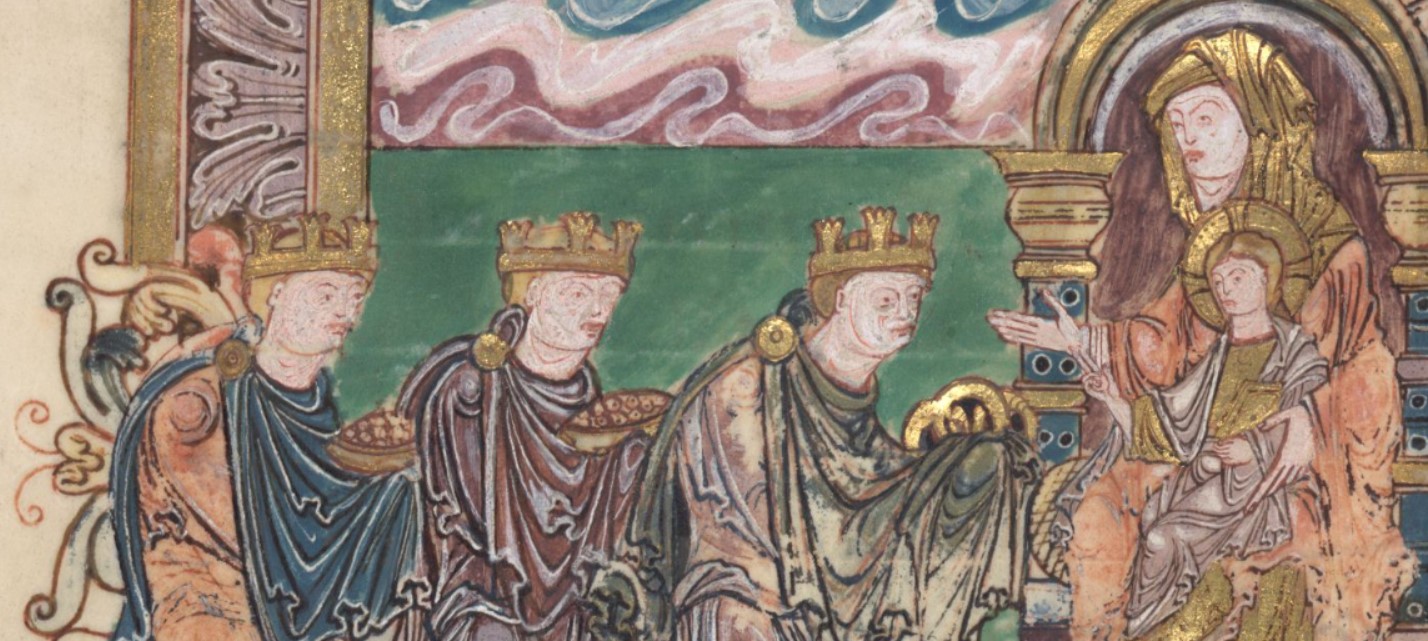
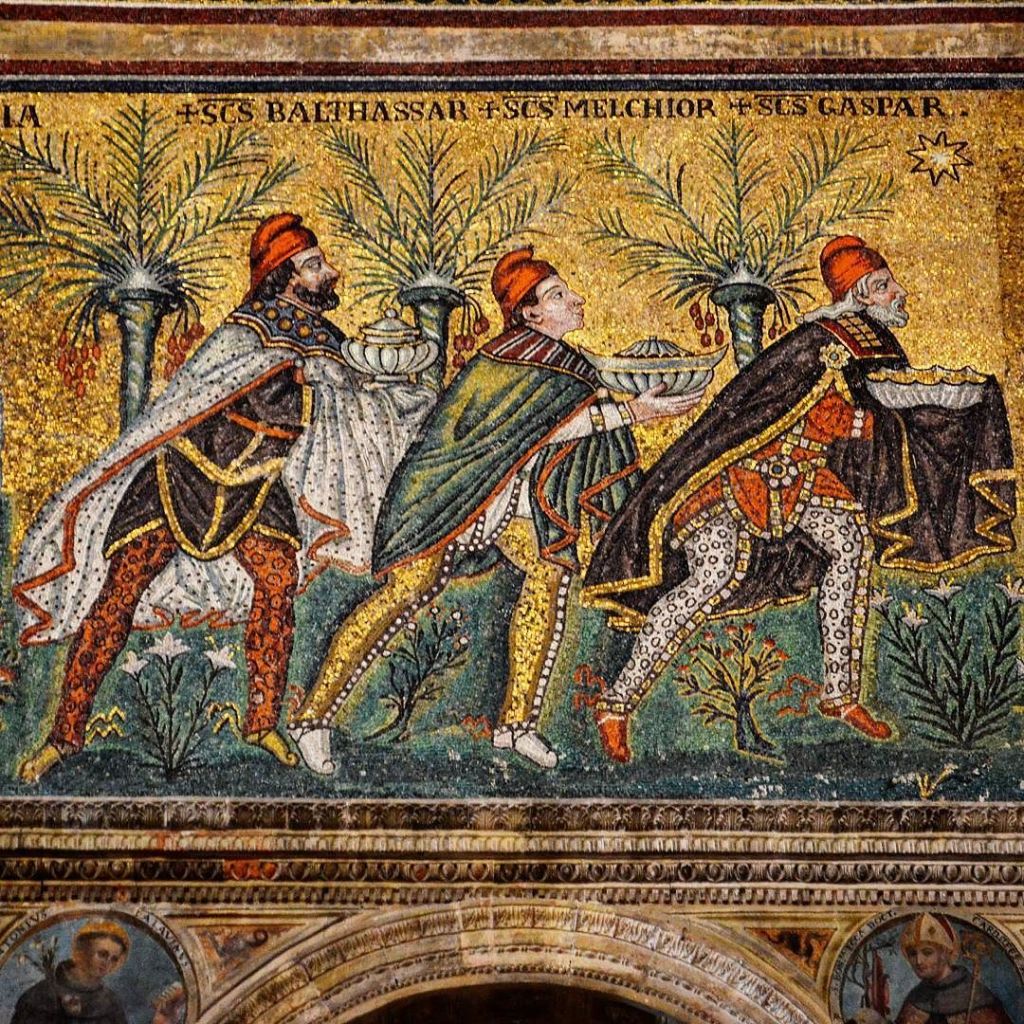
The Adoration of the Magi, c. 504/560 and later. Sant’Apollinare Nuovo, Ravenna.

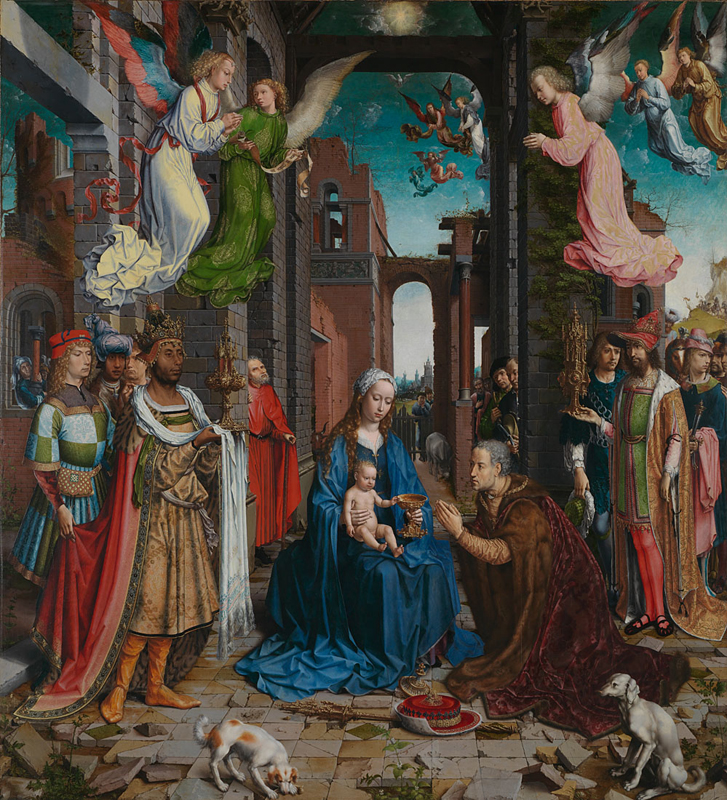
It’s Epiphany – a moment of sudden and great revelation – and today celebrates the moment at which the wise men recognised Jesus as the Boy Born to be King, their gifts of gold, frankincense, and myrrh usually interpreted as gifts suitable for a king, and more specifically, relevant to his royalty, his deity and to his inevitable death, respectively. But if you read the Advent Calendar, you’ll know all that already. If you didn’t but want to, you can start from the top if you click on this link: An Advent Calendar – 1. I still have things to say about the Gossaert painting, matters arising from observations you made and questions you asked (for which, much thanks), but I’ll get back to that soon, I hope. First, I’d like to talk about this mosaic. I discussed it briefly in a talk about The Adoration of the Magi just a few days before Christmas, and it will feature, even more briefly, in a talk I am giving tomorrow. It will be ‘briefly’ as, believe it or not, its splendour is all but outshone by many other marvels in Ravenna. There is still time to sign up, if you’re free tomorrow evening (7 January at 6:00 GMT), and are interested in Revealing Ravenna – just click on the link. For now, I just want to talk about part of one wall in one of the city’s churches.

The Magi are shown in the way that Romans would have shown barbarians paying tribute to the Emperor. They wear Phrygian caps, which the Greeks had associated with non-Greek-speaking peoples – i.e. barbarians. The Romans adopted this idea, along with so many others, from the Greeks, and as the Magi were seen as coming from ‘elsewhere’ it made sense for them to wear them too. In the earliest representations of the Magi, dating from the late 3rd and early 4th centuries, this is how they were dressed. However, in Republican Rome there was another hat, the pileus, which was soft, and made of felt. It was given to freed slaves. In the 18th Century the association of the pileus with the Republic, and with freedom, was revived – only they seem to have confused hats (maybe someone picked up the wrong one from the cloakroom), and the Phrygian Cap became associated with the Republic, and with freedom. That is why it becomes the symbol of Liberty during the French Revolution. But back to Ravenna.

The church in which this mosaic can still be seen was built and decorated for King Theoderic the Ostrogoth, who was King of Italy, and nominally ruling on behalf of the Emperor in Constantinople. He was Christian, but an Arian – a doctrine associated with Arius, a priest from Alexandria – and believed that Jesus was indeed the son of God, begotten of God the Father, but that he had not always existed – he was created by God the Father, and so was subordinate to him, and therefore not ‘of the same substance’. Although Arianism had been deemed heretical at the first ever ecumenical council at Nicaea in 325, it had a fairly long life – and was especially associated with Germanic tribes like the Goths and Vandals. And if Theoderic was an Arian, then the church, when it was dedicated to Christ the Redeemer in 504, was an Arian church.

The Magi are about to present their gifts to the Madonna and Child, who are enthroned near the altar. They are on the north wall, so the altar is to our right, and the Magi are approaching the altar every bit as much as they are approaching Jesus: theologically they are equivalent. The Virgin wears the Imperial Purple – at the time this mosaic was made, Ravenna was the capital of the Roman Empire in the West – and an association between the Empire and God was highly desirable. They are flanked by two pairs of angels, but Joseph is nowhere to be seen. Oddly, given that this was originally an Arian church, the humanity of Christ is not being stressed. You will notice that there is a marked change in background in between the angels and the magi: this mosaic has been altered. This occurred some time around 560, by which time Constantinople had ‘liberated’ Ravenna from the Arian rulers. Emperor Justinian’s general Belisarius had recaptured Ravenna in 540, and, with the death of the Archbishop Maximian in 557, Justinian seems to have thought it was a good idea, under the new Archbishop Agnellus, to finally remove any threat from the Goths and to eliminate Arian worship – thus ending over 60 years of successful ‘convivencia’, to use the Spanish term. Between 557 and 565 nine churches were ‘reconciled’ with Orthodox Christianity – meaning that they were re-dedicated to the Catholic rite. This happened to Christ the Redeemer, which was rededicated as St Martin – who just happened to be an arch anti-Arian. Three centuries later – in 856, to be precise – the relics of an early bishop, Apollinare, were brought from a basilica in nearby Classis and installed in San Martino and the church was re-dedicated again as Sant’Apollinare Nuovo. It has been known as ‘the New Sant’Apollinare’ for over a thousand years, now, which doesn’t make it seem that ‘new’.

In the process of the first re-dedication, the mosaics were altered. The upper two tiers – showing the life of Christ, and a series of saints and prophets – were left as they were, and would have been completed some time around 504 when the church was dedicated (whether or not they were finished in time for the dedication is not clear).  Below them, we see the Magi approaching the Virgin and Child, leading a procession of 21 virgin martyrs. Scholars do not agree on the date of this procession. Some see it as essentially the original mosaic from around 504, whereas others see the almost-identical, if not monotonous, depiction of the saints as indicative of a later date, in this case about 560 – or whenever it was that the re-dedication to St Martin occurred.

The procession is led by St Eufemia. However, the pole position was originally taken by Queen Audefleda, sister of Clovis, King of the Franks, and wife of King Theoderic, who was a master of the diplomatic marriage. Theoderic himself was depicted opposite his wife leading a procession of male (but potentially still virgin) martyrs: his figure was repurposed as St Martin (the arch anti-Arian), whereas she became St Eufemia. They might have changed the whole figure, or maybe just the head. Or even, just the name… As a saint, Eufemia may not seem very prominent these days, but the choice was deliberate. She came from Chalcedon, where in 451 a council affirmed the heretical nature of Arianism by asserting that the Son was of one substance with the Father – and so not created by him – and also, that he had two natures – human and divine – in one person. Eufemia’s relics were still in Chalcedon in 560 (later they were moved to Constantinople), and so her inclusion at the head of the procession affirms the primacy of orthodox beliefs over heretical.

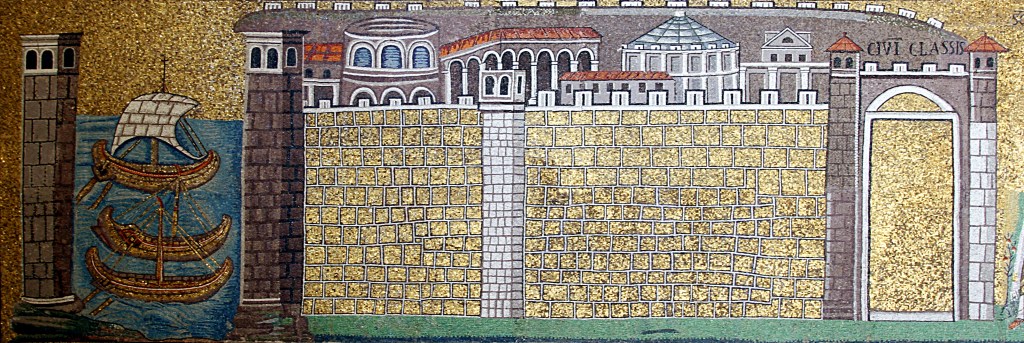
The magi, and presumably the saints as well, have processed from the port of Classis (now Classe) – the name is set above the gateway on the right. The port was part of ‘greater Ravenna’, and was one of the secrets of its success. It had a harbour larger in area than Ravenna itself, inland but very close to the sea: the possibilities for trade were endless, and secure. When the mosaic was first made, members of the royal court – and probably Queen Audefleda herself – were standing in front of the golden walls of Classis. Once Theoderic, the Ostrogoth and Arian, was gone, his presence was no longer required, and nor was anything else associated with him. The figures were chipped out, and replaced with more golden stones – bright and shiny, perhaps, but a little uninteresting compared to the rest of the mosaic. The ‘restorers’ were not entirely thorough, though, and they left four pairs of feet behind, which can still be seen in early photographs. However, in the early 20th Century a later set of restorers decided to finish the job, and removed the errant feet – which I think is a great shame, let alone an act of cultural vandalism: allow the work its history, even if it is untidy. And don’t let the Vandals loose on Ostrogoth feet.

We see three ships in the harbour. I would love to think that this is how the wise men arrived, as in the traditional carol ‘I saw three ships come sailing in’, but that seems unlikely! Potential origins for that carol apparently include the coat of arms of Wenceslaus II of Bohemia (r. 1278-1305), which had three ships on it, or the ships that took the relics of the wise men up the Rhine to Cologne after Frederick I ‘Barbarossa’ ‘liberated’ them from Milan in 1164. However, in the carol the magi weren’t even in the ships. Who was in those ships all three? Joseph and his Fair Lady. Which implies that they could only have been camels, the ships of the desert, as Bethlehem is some 129 km from the sea. But, as so often, that’s another story.

If restorers were still tinkering with these mosaics in the early 20th Century, what are we to make of the Magi? Sadly, the north wall was badly damaged. It’s hardly surprising. An 8th century earthquake caused the collapse of the apse, which was just to the right of this section of the mosaic. The ruins were still visible in the following century, when the historian Agnellus (no relation of the archbishop above), transcribed the inscriptions from the apse mosaics as he saw them, still lying where they had fallen – which implies that the church had been open to the elements for a hundred years or so. However, he also described the three wise men and what they were wearing, and this description was used by restorers in the 19th Century. It is to them that we owe the current appearance of this section of the mosaic. The calligraphy of the names is far too ‘modern’ for a 6th century mosaic, I suspect, and even the spelling is too close to the modern variants. The faces and gifts are also a little too naturalistic, perhaps. The costume is every bit as fantastic as it would have been, though. The most fanciful bit of design, to my mind, are the tights – which should surely inspire every nativity play in the realm – and they are original. With such magnificence it is hardly surprising that the wise men were soon to be called kings – although that didn’t happen for another couple of centuries. Maybe I’ll come back to it when I come back to the Gossaert. But until then, here’s wishing you a Happy New Lockdown. Sorry, I think I meant ‘Year’.

117 – St Thomas Becket

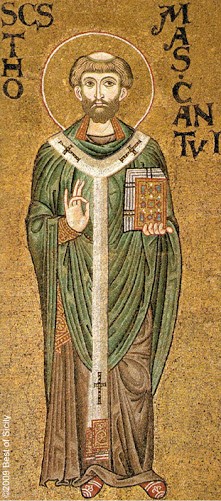
St Thomas Becket, c. 1178-89. Monreale Cathedral, Sicily.

Thomas Becket, Archbishop of Canterbury, was murdered on 29 December 1170 – eight hundred and fifty years ago. I wanted to mark the occasion. I’m not going to talk much about him, or about his relationship with King Henry II, the man who has always been blamed for his death, but I wanted to look at one of the many images that resulted from his murder. Some would say ‘his martyrdom’, as he died as a result of his attempts to defend The Church. Among other problems, he resisted the king’s attempts to weaken the Church’s ties to Rome, and to give the king more authority over its affairs – exactly what Henry VIII would achieve three and a half centuries later. Whatever the precise nature of their disagreement(s), and whatever ensued, Thomas was canonised in February 1173, little more than two years after his death. Clearly the church wanted Thomas: canonisation would have acted as a warning to Christian monarchs not to get above themselves, as they would certainly never get above God.

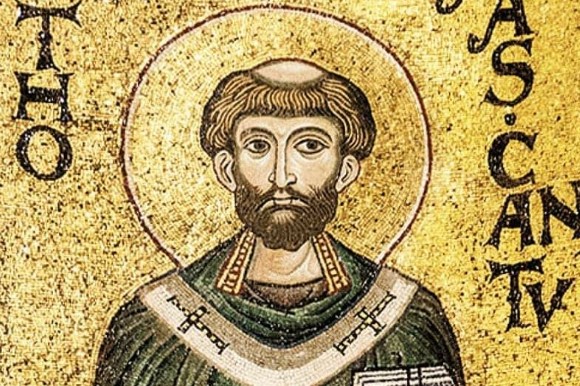
This image, in mosaic, comes from the Cathedral of Monreale, just outside Palermo, in Sicily. Although plans for this grandiose building, high on a hill overlooking the Sicilian capital, might have been afoot as early as 1166, construction probably didn’t get going until 1174, and was completed – along with the majority of the interior decoration – by 1189. As this detail comes from the apse, behind the high altar, it would have presumably have been one of the first parts of the decoration to be completed – it would be safe to date it to the late 1170s or early 1180s in any case, and possibly within a decade of the Saint’s canonisation. This seems remarkably quick, given the distance between Canterbury and Palermo – but the cult of St Thomas spread for many reasons, not least of which were the multitude of miracles performed in his name. In this detail we see him with his right hand held in one of several gestures of blessing, holding a book in his left hand. It has a gold cover, and is encrusted with jewels. He certainly owned such books, and insisted on taking a particularly special one with him when he went into exile. A recent hypothesis attempts to identify it among the manuscripts in the library of a Cambridge college – you can read about that here (thanks to my sister Jane Wickenden for bringing this to my attention).

Thomas is bearded and has taken the tonsure: to prevent worldly vanity, the crown of the head was shaved – it was a sign of humility, and of obedience to the church, and was done to mark entry into certain religious orders. As a practice it continued as late as 1973, when it was abolished by Pope Paul VI. His name is inscribed on either side of his head: ‘THO’ to the left, and ‘MAS’ to the right. The ‘SCS’ is short for ‘Sanctus’ – Saint – whereas the ‘CANTVR~’, is an abbreviation for ‘Canterbury’ in Latin – the ‘Civitate Cantuariae’, or ‘City of Canterbury’, according to The Domesday Book of 1080, a century before the mosaic was made.

This mosaic is no mere detail – it is a full length image of the saint. There is no suggestion that this is anything like a ‘portrait’, though. It is a ‘representation’, giving people a visual image as a focus for their devotions, especially if they should wish to ask this man to intercede on their behalf. But why would anyone in Sicily want to do that? Surely there were enough local saints to go round?

To understand the reasons behind his inclusion, we need to know a bit more about the cathedral itself, and its patron. It was built for William II of Sicily, who ruled from 1166-1189. He had effectively been planning the building since his coronation, and it was sufficiently completed by the time of his death for him to be buried there. He was only 12 when he succeeded his father, and reached his majority in 1171, following the regency of his mother. He married in 1177 – at the age of 23 – to the eleven-year-old Joan of England, sister of Richard I, ‘the Lionheart’, thus becoming the son-in-law of the villain of the piece, Henry II. Not only does this show William’s standing within European politics, but it also explains the presence of an English saint in a Sicilian cathedral. Who better to ask for a hand in getting God’s forgiveness for his father-in-law’s sins, than the man best placed to forgive him? Perhaps the inclusion of St Thomas shows that William was aware of Henry II’s faults, but knew that, with the right approach, he would not be found guilty by association. In actual fact, the connection is more direct, and the mosaic helped to get William out of an awkward bind: he was friends with both sides. When Thomas fled England in 1164 to avoid the wrath of the King (taking his book with him), some of his family and friends also thought it would be safer to keep out of the way – and ended up in Palermo at the court of King William II. Both kings were Norman, after all, so there were bound to be connections. Subsequently Thomas wrote to the Palermitan court in gratitude for the hospitality shown to his kin. The marriage had been planned before the murder, but delayed, first because Joan was too young, and then because of the murder. Only after 1174, when Henry II was forced to do penance at Thomas’s tomb – already one of the great pilgrimage destinations of Europe – was the royal match back on the cards.

St Thomas is in good company. He stands in between St Sylvester – Pope when the Old St Peter’s was founded in Rome (later elaborations, extent by the time of the mosaic, suggest that he cured the Emperor Constantine of leprosy, and was given the rule of Rome in return) – and St Lawrence, an early church deacon, martyred in 258: later images would never show him without his grill. Just round the corner is St Nicholas – who later morphs into Father Christmas. It could so easily be a seasonal selection of saints: Silvester’s feast day is 31 December (nearly there…), and Thomas’s is today. St Nicholas doesn’t quite fit in, though – he is celebrated on 6 December – early for Christmas, although not for Advent. However, St Lawrence proves that this isn’t a calendar, as such: his feast day falls on 10 August.

Not only is Thomas in good company, but he is in a remarkably prominent position: in the apse behind the High Altar. You can see Sylvester and Thomas just to the right of the window. At the top of we see the Pantocrator – the ‘ruler over all’ – or ‘almighty’ – with Jesus holding an open bible in his left hand and blessing with his right, just as Thomas does below (and while we’re here, note the early appearance of the pointed arch – this is an influence from Islamic culture: Sicily was refreshingly multi-cultural). Directly below the Pantocrator, the Virgin Mary sits enthroned, wearing the Imperial purple. The colour makes the connection to Byzantium clear, and, if you could see them, the inscriptions confirm this. Unlike the saints around Thomas, they are in Greek, rather than Latin. The Christ Child is enthroned, in his turn, upon Mary’s lap, and the pair are flanked by the Archangels Michael and Gabriel. On either side of them stand Sts Peter and Paul – the two heads of the Church after Christ: St Thomas stands directly underneath St Paul. The mosaic emphasizes the nature of the Apostolic Succession – authority passes from Jesus, via Peter, to the later Popes.

I could keep pulling back from here, showing you more and more gold, and more and more splendour – apparently something like 2,200 kg of gold was used for the mosaics which, with the exception of the high wainscoting, cover every wall in the cathedral. However, I’ll just leave you with one last view of the chancel, with Thomas still clearly visible (once you know where he is) just above the High Altar (wherever church liturgy has decided it should be). I for one am looking forward to the British Museum’s exhibition Thomas Becket: murder and the making of a saint which will open, after some delay, on 22 April. It will have many beautiful things – but, for obvious reasons, not this mosaic. You’ll just have to go to Sicily to see it. There are many other reasons why I’m looking forward to 2021 – and I’ve just updated the diary page if you want to see what they are. Meanwhile I shall wish you a continued Happy Christmas. We’re only on day five after all, and there are a few more than five gold rings in this mosaic. Just try and count the haloes.

An Advent Calendar – 24

‘Myrrh’ –

Myrrh is mine; its bitter perfume
Brings a life of gathering gloom;
Sorrowing, sighing,
Bleeding, dying,
Sealed in the stone-cold tomb.

Once more John Henry Hopkins Jr. proves his knowledge of Origen. To complete the quotation that has built up over the last two days, ‘gold, as to a king; myrrh, as to one who was mortal; and incense, as to a God.’ (Origen of Alexandria, Contra Celsus, c. 248). So myrrh is a symbol for one who will die – it could hardly be otherwise, as one of its most common uses was in the process of embalming the dead. But Hopkins really rachets up the emotional key. I’ve always thought of We Three Kings as a stolid, but somehow jolly, Christmas carol – but this verse is entirely bleak, without the possibility, it would seem, of any respite from its ‘gathering gloom‘.

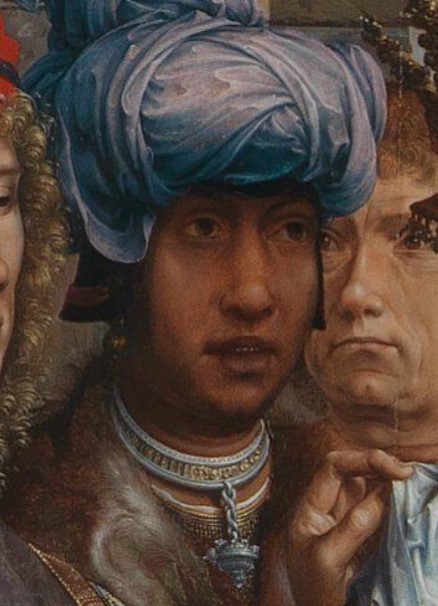
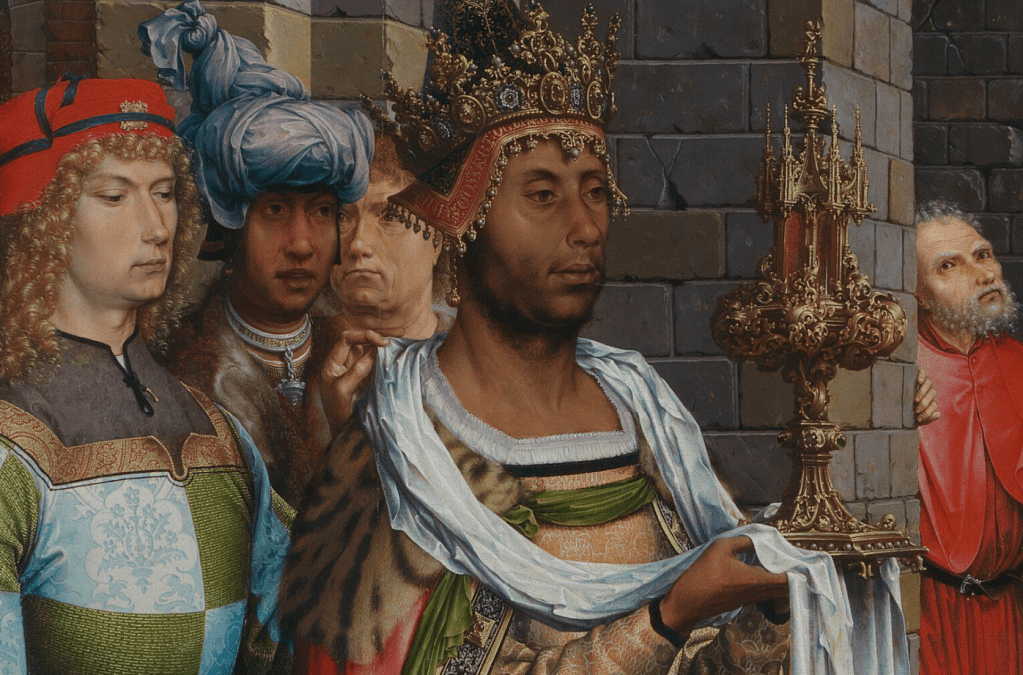
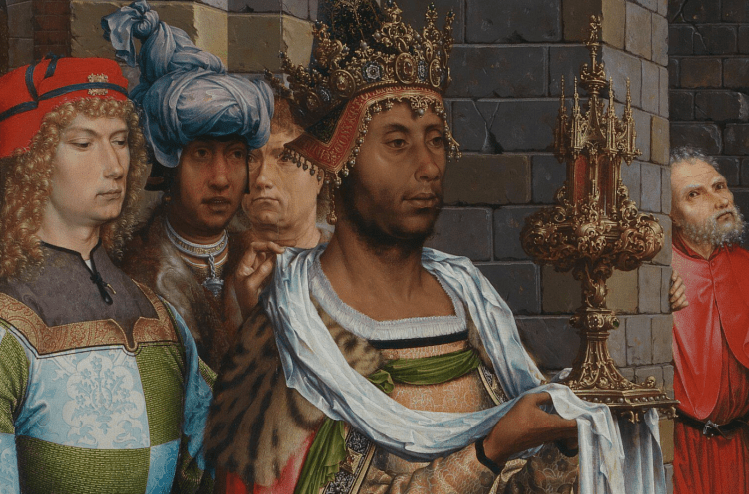
It is hardly surprising, then, that Balthasar should look entirely serious. Not only that, but he holds the gift with the reverence due to a ciborium, the name of the vessel used to preserve the consecrated host – in Catholic belief the actual body of Christ. Notice that he does not touch it, but holds it with the white, ceremonial stole around his shoulders, the one which his servant – or, at least, chief attendant – is adjusting. However, as it would traditionally be a priest that would wear such a stole, we must ask if Gossaert is suggesting that the Magi were, in some way, priests?

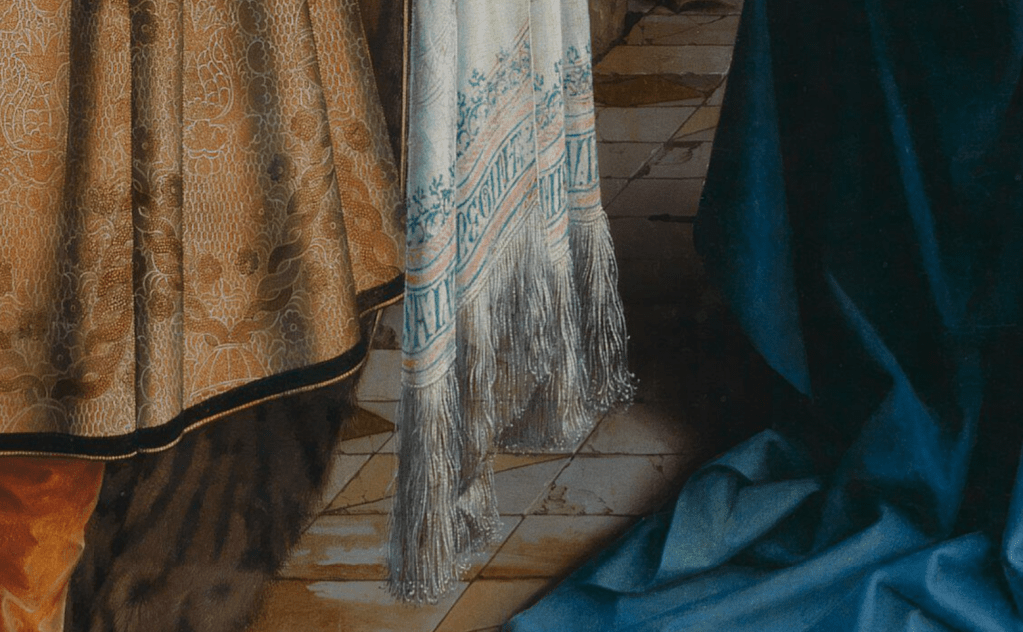
The ends of the stole are beautifully fringed, and also embroidered, bearing the inscription SALV[E]/ REGINA/ MIS[ERICORDIAE]/ V:IT[A DULCEDO ET SPES NOSTRA] (‘Hail, Queen of Mercy, our life, our sweetness and our hope’). The missing letters and words can be filled in as these are the opening lines of the 11th Century antiphon Salve Regina Misericordia, traditionally attributed to Hermann of Reichenau, although most scholars now doubt this (the link will take you to a YouTube recording, illustrated with a lovely detail from a painting by Signorelli – apologies again for any ads). This detail also shows us the remarkable diligence with which Gossaert painted Balthazar’s cloth of gold brocade, and the lynx fur which lines his cloak.

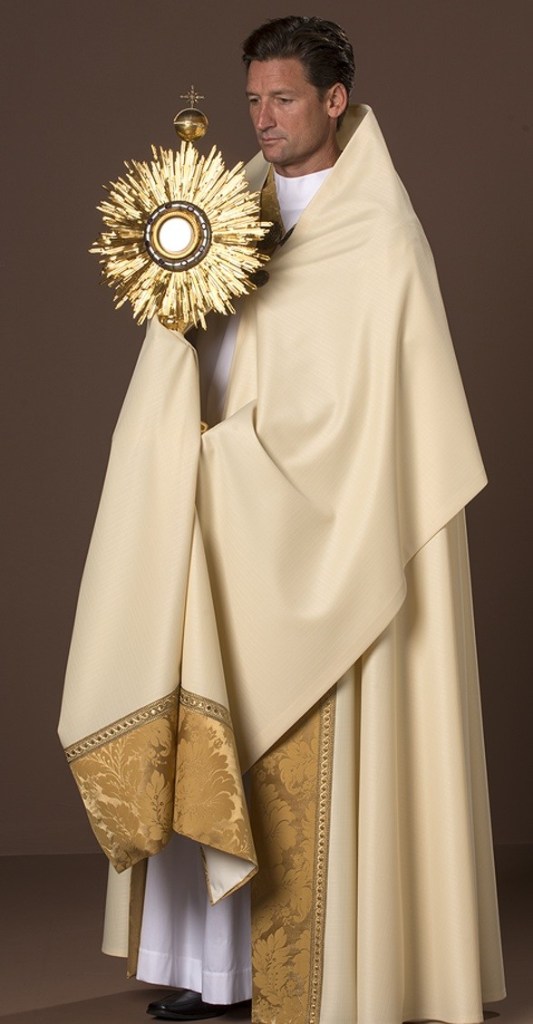
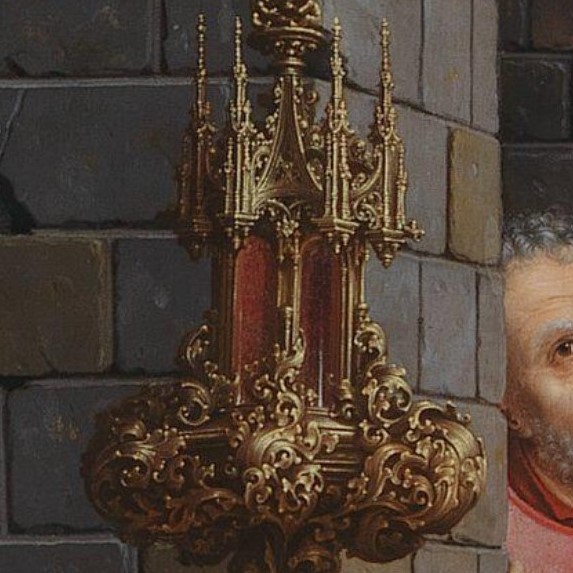
Yesterday I said Melchior’s container for the frankincense was like a reliquary – and then, perversely, illustrated the idea with a monstrance, an object designed to exhibit not a relic, but the consecrated host. I should really have said ‘monstrance’ in the first place, it would have been a better comparison, not just in appearance, but in function. If ‘incense owns a Deity nigh’, then what better way to show a deity, than with a monstrance? The wonderfully wrought vessel which Balthazar holds is every bit as impressive.

Once more it is made from gold, and, despite being held with two hands, it still appears to be suspiciously light – but then, any stress or strain in Balthazar’s hands would take away from the solemnity of the moment. As well as gold, at least one other material is used, and, in the same way that Casper’s gift was contained in a vessel with visual imagery, there are figures here too.

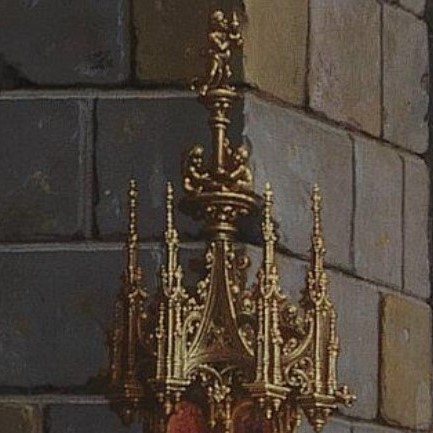
On the left, you can see the very top of Balthazar’s gift, with a miniature column flanked by two seated children. On top of the column there is a third figure, on his feet, stepping forward, and offering a gift. It is entirely self-reflexive: this object was made as a gift to be given. The detail on the right shows the central section. The red elements are part of the lid of the vessel. Just below them, behind the elaborate scrolling leaves, you can see a dark line which rings the object: it marks the join between the cup and its lid, which is ‘disguised’ by the stylised leaves. The gold is inset with a number of cut stones, polished to a shine, and the highlights suggest that they are carved into a series of niches under the gold gothic canopies. The mottled lighter and darker reds make me think that they are supposed to be porphyry, a substance associated with both royalty and death: the Byzantine emperors were buried in porphyry tombs, the name being equivalent to purple, the colour of their robes. So this is another reminder of Christ’s status as King, and of his destiny: to die on our behalf.

So, Myrrh – an omen of death – in a vessel decorated with porphyry – associated with death. There is no getting away from this – the Boy Born to be King was also born to die. We have seen this already. The image of The Sacrifice of Isaac carved on the capital atop the shiny red column is the image of an Old Testament patriarch prepared to sacrifice his only son, a foretelling, in the Christian context, of God the Father prepared to sacrifice his only son. The column itself would undoubtedly have reminded the devout of the column to which Jesus was tied for the flagellation. It is, bizarrely to our modern-day sensibilities, precisely this preparation for suffering and death that Christmas is all about. You can see it in the material values of the painting itself.

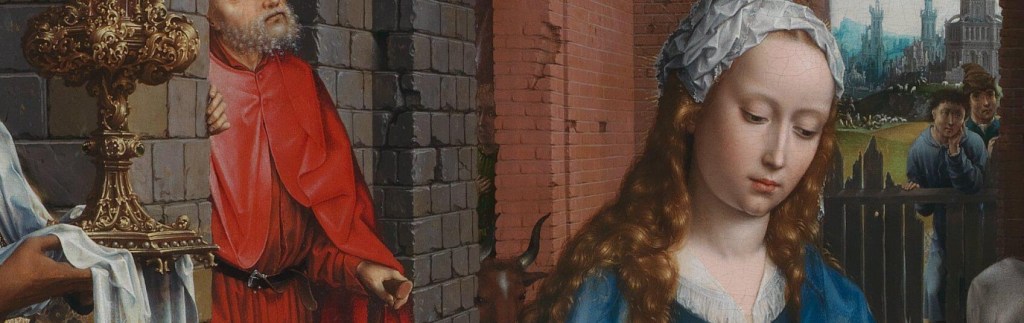
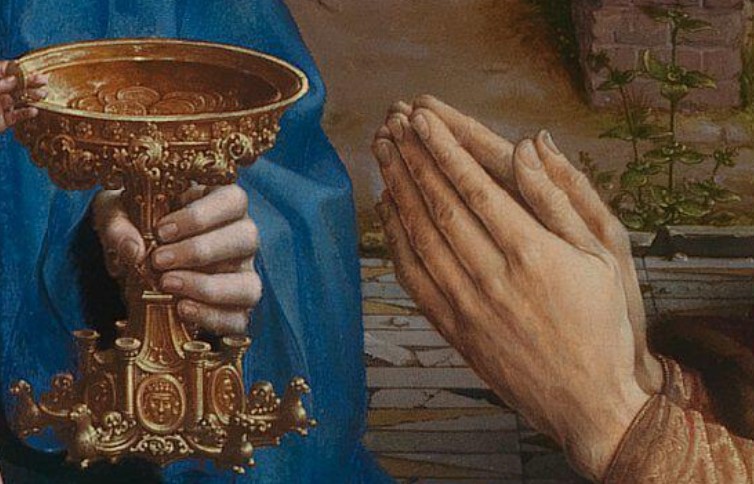
If not in the very background, then at least at the back of the foreground section, we can see the shepherds leaning on a wooden fence, the slats broken, or missing, a knot hole visible to emphasize its material nature. The wooden fence closes off a gap in the brick walls, the bricks being down to earth (like the shepherds) as they are little more than baked clay. Closer to us Joseph emerges from a gap in the stone walls: stone is more valuable, and potentially more enduring. It is solid, and reliable, just like Joseph. And if we keep moving forward we get to the gold – here it contains myrrh, elsewhere gold, elsewhere frankincense. All pretty valuable, all fit for a king, someone both god and man, eternal, yet born to die. And closer still – closer than the gold? What is the most valuable thing? From wood to brick, brick to stone, stone to gold – well, the most valuable thing would be Jesus himself. Now there’s a gift. He is embodied in the gift of gold, as the coins are just like wafers, the consecrated host, the body of Christ, gathered in the ciborium-like cup, ready to distribute to the faithful in front of the altar, in front of this painting.

And the carol? Well, the author was a rector, remember, he knew what he was talking about. Balthazar’s verse is entirely without hope, it seems, but it is only the fourth verse of five. There is one to go, and one which draws together the preceding three – all three of the gifts, and their meanings. And it goes that one step further, because, curiously, this carol is not about Christmas, in the end. It is about Easter.

Glorious now behold Him arise,
KING, and GOD, and SACRIFICE;
Heaven sings Hallelujah:
Hallelujah the earth replies.

And of these words, the most important is surely ‘arise’.

An Advent Calendar – 23

‘Frankincense’ –

Frankincense to offer have I, 
Incense owns a Deity nigh:
Prayer and praising
All men raising,
Worship Him, God on high.

We Three Kings was originally written to be sung by three men, each one representing a magus, and each verse was sung as a solo, explaining the choice of gift. The first and last verses were to be sung together. John Henry Hopkins, Jr., who wrote both words and music, was the rector of Christ Episcopal Church in Westport, Pennsylvania,  but he wrote the song for a Christmas pageant which was performed in New York in 1857. So it wasn’t originally intended for church services – or carolling – but nevertheless, as you will know, it has become enormously successful. Maybe that is because it is so entirely appropriate – and Hopkins clearly knew his Origen (or any one of the subsequent authors who took up his interpretation of the gifts). In the same way that the most common interpretation of gold – that it is a gift entirely suitable for a king – goes back to Origen at the very latest, so does the association between frankincense and godhead. Quoting from Contra Celsus (c. 248) again, ‘gold, as to a king… and incense, as to a God’.

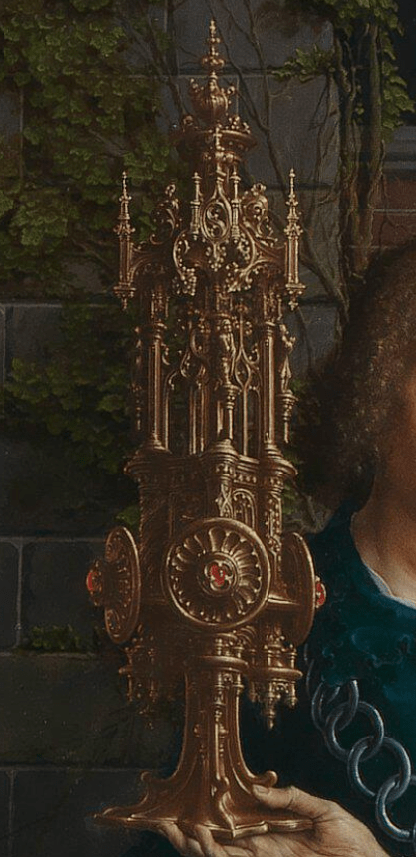
If the gift of gold was proffered in a container that outclasses the gift itself, the frankincense outclasses that too. This must be a heavy object, if it really is gold – and only the fact that Melchior can hold it effortlessly on his outstretched hand would lead us to think otherwise. He appears to have superhuman strength. Either that, or it is weightless: maybe its spirituality outweighs its physical heft. While the cup for the gold has a six-fold symmetry, here the symmetry is four-fold. The base is a scalloped square, and a third of the way up, at the ‘hip’ of the cup, there are four circular plates, like shields, each set with a red gemstone. Above this is a lid of some sort, although it looks more like the spire of a church, with openwork inspired by the tracery of gothic windows, topped by an elaborate crown. Rather than a cup, it is more like a reliquary, fashioned of precious materials to contain an even more valuable fragment of a Saint’s earthly remains. Compare it to the Belém Monstrance, made in 1506 in Portugal, for example:

Unlike yesterday’s gold, school children can offer little in the way of alternative interpretations for the Frankincense, I’m afraid, although they frequently call it Frankenstein by mistake (and even that will be a mistake, as, like most people, they will be thinking of the eponymous anti-hero’s monster). But the more down to earth of adult contributors have argued that Frankincense was simply a practical gift, particularly given that the stable probably smelt. Indeed, in the centuries on either side of the birth of Christ it was used to improve on personal odours – given that most people were a couple of millennia away from running water, let alone bathrooms. More recently its health benefits have been subject to scientific investigation, and it has been found to reduce the symptoms of arthritis, for example, and other forms of inflammation, as well as having some impact on immune response. Back in the first century, though, it would have been the smell that counted, and when it was burnt the smoke was seen as rising to god – whichever god you followed – hence its association with ‘a Deity nigh’.

An Advent Calendar – 22

‘Gold’ –

Born a King on Bethlehem plain, 
Gold I bring to crown Him again,
King forever
Ceasing never
Over us all to reign.

We know what the gifts are – it tells us in the bible. That is how we know there were gifts in the first place. They are in Matthew 2:11, which I quoted from when we met our first magus, but here is the whole verse:

And when they were come into the house, they saw the young child with Mary his mother, and fell down, and worshipped him: and when they had opened their treasures, they presented unto him gifts; gold, and frankincense and myrrh.

Notice that it doesn’t mention Joseph – and indeed, the earliest images of the Adoration of the Magi show them approaching Mary, with the Child seated on her lap, and Joseph is nowhere to be seen. Luke, however, does mention him, when the shepherds arrive: ‘And they came with haste, and found Mary, and Joseph, and the babe lying in a manger’ (Luke 2:16) – which just goes to prove that the Oxford comma is vital, or it would have had to be a very large manger. Maybe Matthew’s failure to mention Joseph explains why he is in the doorway in this painting – he might have been in the ‘back room’ when the Kings arrived… But I digress (and not for the first time).

So they brought three gifts: gold, frankincense and myrrh. But why these gifts? They are hardly suitable for a baby. Well, the first is fairly obvious. Earlier in Matthew (2:1-2) it says,

Now when Jesus was born in Bethlehem of Judaea in the days of Herod the king, behold, there came wise men from the east to Jerusalem, Saying, Where is he that is born King of the Jews? for we have seen his star in the east, and are come to worship him.

So they were looking for ‘he that is born King of the Jews’. And gold is one of the main symbols of Kingship. This is an interpretation which probably goes back as far as the gospel itself, but it was certainly written down in the third century. Origen of Alexandria wrote Contra Celsum around 248, after Celsus had written an excoriating criticism of Christianity. He was worried that it was taking people away from the established religion, and that its continued growth would inevitably lead to a collapse in moral values. Plus ça change – it seems that people have always been worried about that. Anyway, in his defence of Christianity Against Celsus, Origen says that the Magi brought ‘gold, as to a king’. And people have stuck with that interpretation ever since – it is certainly the version we are familiar with from the Christmas carol quoted above. Admittedly it was also suggested, and not without reason, that the gift of gold was entirely practical – after all, there was no room in the inn. With that much gold, they would be able to afford far better lodgings.

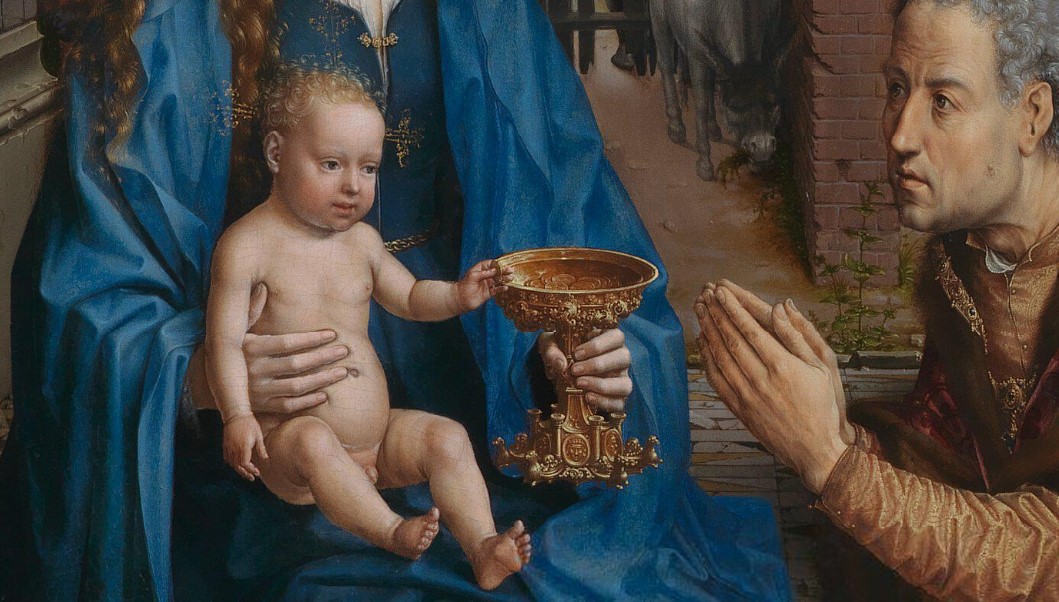
But neither is my favourite theory. Gossaert has shown the gift as made up of gold coins, one of which we can see held between the thumb and forefinger of the new-born babe. This precocious ability to co-ordinate his movements should not surprise us: this is the Son of God, after all. At one point, not long after the Magi would have headed home, the Gospel of Pseudo-Matthew (written, in all probability, in the first half of the seventh century) has Jesus say, ‘do not consider me to be a little child; for I am and always have been perfect’ – so holding a coin shouldn’t be a problem. However, surely the gold coins are only part of the gift – the ‘gift wrap’ is fairly impressive too! We saw the ‘label’ the other day – the lid of the cup, which is decorated with Casper‘s name. The cup itself must be made of more gold than the coins it contains, and is another wonderful example of the goldsmith’s craft. When set down it would rest on a hexagonal base, a small gold sheep projecting from each corner (just part of the future flock?), and in between there is a series of medallions appropriately decorated with images of Kings.

Anyway, the image of the Christ Child holding a gold coin once led a school group visiting the National Gallery – not one I was with, sadly – to interpret the painting based on their own personal experience. It’s what we all do. This was probably just as mobile phones were starting to take off, but certainly weren’t at all common. So what would happen if Jesus had wanted to phone home? Clearly the coins could be used for a phone box. After all, heaven is quite some long way away, and the rates must be exorbitant. Indeed, there is some evidence that he has already run up a rather worrying bill. What else would the angels you can see below be holding? And why else would they be looking so anxious? Not so much ‘Glory to God in the Highest’ as ‘How much?’ It’s perfect Art History. Look at the details, develop a theory, test it against the available evidence. These schoolchildren did all three – and I for one rather wish their theory had passed the test. Clearly the ‘looking’ is the most important part for the appreciation of art, although admittedly it won’t always glean accurate results for the histories of theology and technology. I’m sorry, I may have digressed again…

An Advent Calendar – 21

‘Mary’ –

Before I start, some breaking news: I will be giving an online lecture this evening (Monday 21 December) entitled ‘The Adoration of the Magi’ – I’m covering for my dear friend Nick Ross who, alas, is not well. Here’s wishing him a speedy recovery, and if you just happen to be free from 5.45 for a 6pm lecture (GMT), click on the link above. There are so many versions of the Adoration that I will make it my aim not to talk about this one! Enough said, back to the Calendar, and today, we have Mary.

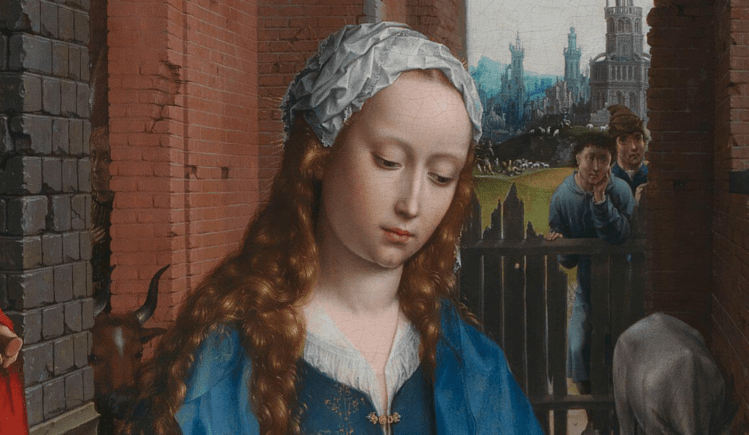
This image is standard across Western European art – a young, blonde, white woman, with a perfect complexion, dressed in blue. She wears blue for so many different reasons. The Catholic Church sees her as Queen of Heaven, and the skies are blue, for example. But also, there was a Marian hymn, dating from the 8th Century, called Ave Maris Stella – ‘Hail Star of the Sea’ (this link takes you to a recording by the Westminster Cathedral Choir – apologies for any adverts that precede it!) In the same way that sailors use stars to guide their way, Mary was seen as out guiding star through life. ‘Maris’, meaning ‘of the sea’, is a pun on ‘Maria’ – and the sea is also blue. And finally, as is well known, blue was the most expensive pigment, so it was a sign of the respect due to Mary that money was being spent on her depiction. However, this is not ultramarine, the most expensive blue, derived from lapis lazuli, but azurite, a naturally occurring basic copper carbonate. It was sometimes called ‘German blue’ as it was more readily available in the North of Europe, which is probably why Gossaert used it. It was still fairly pricey, but nowhere near as expensive as ultramarine. Curiously, the is no difference between the paint used for her cloak and that on the robe. However, the cloak was painted directly onto the white ground, whereas the robe was painted over a layer of grey – so on the surface the former looks lighter than the latter, even though the paint is the same colour: it’s the background showing through which makes the difference.
Blue is by no means universal. For the Assumption and Coronation of the Virgin she often wears white, and whereas in Italy she regularly wears a blue cloak over a red robe, in the North of Europe this is usually reversed – a red cloak over a blue robe. Or sometimes, just red one red. Red is associated with royalty, so again affirms her status as Queen of Heaven, and is ultimately derived from Byzantine paintings (which evolve into Orthodox icons), in which Mary wears the Imperial purple.

As this was painted in Northern Europe, the fact that she is blonde should not surprise us – Gossaert is painting for a local audience, and they want something that they can understand, something that is familiar. This is one of the features of the painting that helps it to communicate. Even in Italy, where the majority of the population are dark haired, Mary is blonde, more often than not – and there are numerous reasons for that. Just one was St Bridget’s vision of the Nativity, in which she saw the Virgin, ‘with her beautiful golden hair falling loosely down her shoulders’. St Bridget was from Sweden, so it is hardly surprising that she had this image of Mary in her mind, even if she was in Bethlehem at the time. Her vision was widely promoted, because as a whole it supports the idea of the Virgin Birth – but this really isn’t the place to go into all of that.

Not only does Mary have a perfect complexion, but she is the epitome of beauty for the time. Here is a quotation from ‘Le Testament’, by François Villon (1431-63?), which you can find in The Penguin Book of French Verse, I.  A fifteenth century poem, admittedly, but it still seems entirely apt for the early 16th:  

…that smooth forehead,
that fair hair,
those arched eyebrows,
those well-spaced eyes,

… that fine straight nose,
neither large nor small,
those dainty little ears,
that dimpled chin,
the curve of those bright cheeks,
and those beautiful red lips.

Her beauty, and the perfection of her complexion, express the idea that Mary was free of sin. Although I couldn’t say if either Gossaert, or the patron of the painting, believed in the Immaculate Conception, by the early 16th Century most Christians would have believed that Mary was free of sin, whatever the divine mechanism that allowed this. And as I’ve already written about it extensively, I’m just going to direct you back to Day 71 – The Immaculate Conception and Day 72 – The Immaculate Conception 2.

Mary’s perfect beauty is brought into focus by the comparison with Jasper/Casper, the eldest magus – comparing their faces enhances the suspicion that his is a portrait, whereas hers, an ideal. And she is ideal. She is also, as it happens, the only female in the painting. I don’t know what contemporary teaching on angels is (although some of you have tried to enlighten me), but back then they would all have been considered male, an extension of the priesthood, which was all male. Now, if you’d excuse me, I have to prepare a lecture! More tomorrow…

An Advent Calendar – 20

‘Joseph’ –

Oh, Joseph! Poor Joseph! Always off to one side, half in the shadows, but with so much responsibility. Of course, the bible says next to nothing about him – apart from the fact that he was of the house of David, and was thought to be Jesus’s father. So almost everything we know must come from elsewhere. This is how Gossaert chooses to depict him:

An old man, with his left hand resting on a staff, his right against the wall, as he keeps out of the way, half-hidden in the doorway. Half-hidden, yes, but clear for all to see, as he is in such a bright red robe. On the whole bright colours were associated with wealth (we have already seen the shepherds in their dull, monochrome clothing), but here we need to know he is important, so he must stand out. Hence the bright red. However, this is not an excessive display – only one colour, after all, and, unlike the kings and their entourage, no patterns, no elaboration, no jewellery – no accessorizing. A functional belt, yes, and some pattens – outdoor overshoes – but that’s all.

Why so old? Well, apocryphal texts say as much. In the Protoevangelium of St James, dating to the second half of the second century, it says that when Mary was 12, they decided to find a husband for her. Long story short, according to verse 9, ‘And the priest said to Joseph, You have been chosen by lot to take into your keeping the virgin of the Lord. But Joseph refused, saying: I have children, and I am an old man, and she is a young girl.’ In Chapter 8 of the Gospel of Pseudo-Matthew, probably written in the first half of the seventh century (and certainly no later than the ninth), this ‘lottery’ happened when Mary was fourteen. When told that he had been chosen, ‘Joseph began bashfully to address them, saying: I am an old man, and have children; why do you hand over to me this infant, who is younger than my grandsons?’ This inevitably fed through to the Golden Legend, put together in the 1260s, where, in the description of The Nativity of Our Blessed Lady, we read that, ‘Joseph, of the house of David, was there among the others, and him seemd to be a thing unconvenable, a man of so old age as he was to have so tender a maid.’ This last quotation is from William Caxton’s translation of 1483 – ‘unconvenable’ means ‘inappropriate’. It was probably the Golden Legend which was Giotto’s source when he came to illustrate the Betrothal of the Virgin in the Scrovegni Chapel. If you’d like to read more about the story, and the nature of the ‘lottery’, see Day 31 – The Suitors Praying. Given the insistence in all three of these texts that Joseph was an old man – indeed, one even says he had grandchildren older than Mary – we should not be surprised to see him like this in the paintings.

And why so retiring? Well, he accepted his role as a guardian thanks to the intervention of an angel. According to the Protoevangelium, having become betrothed to Mary, Joseph had travel for work. He returned after about six months, before their marriage had been consummated, only to find her pregnant.  The Gospel of Matthew (1:19-21) takes over from there (or rather, the Protoevangelium filled in before this point):

Then Joseph her husband, being a just man, and not willing to make her a public example, was minded to put her away privily. But while he thought on these things, behold, the angel of the Lord appeared unto him in a dream, saying, Joseph, thou son of David, fear not to take unto thee Mary thy wife: for that which is conceived in her is of the Holy Ghost. And she shall bring forth a son, and thou shalt call his name Jesus: for he shall save his people from their sins.

Joseph, as we know, takes this responsibility on board: he looks after Mary, he cares for Jesus, he keeps them both safe. However, at no point is he warned, at the birth of his stepson, which will, for reasons beyond his control, take place in the vicinity of a manger, that they would be visited by angels, shepherds and an undefined number of wise men/kings, not to mention their various retinues. I can’t help thinking that he’s keeping out of the way until everyone has gone away again, and things get back to normal. Which, of course, they never will. And, of course, it’s not just the characters in the painting. We are there too, looking in, and Joseph knows that. He must do, he is looking out at us, just like the hidden angel, who is further to the right. In many ways Joseph is the most human, the most approachable person in the story – he is the one most like us – and so it is hardly surprising that he should be the person whose glance brings us into the circle of those gathered around the new-born child. And to me it is hardly surprising that he should be the person who would like us all to go back home.

An Advent Calendar – 19

‘The First Magus’ –

I know – I’ve already talked about two magi, so why is this the First Magus? Well, because I’ve talked about them in reverse order of seniority. Balthazar has a thin, straggly, beard, and I suggested at the time that he was probably the youngest. What I didn’t mention yesterday, when talking about Melchior, is that he had a fine, full beard – and so must be, effectively, the ‘middle aged’ magus. Finally, we get to Casper – who, just to be perverse, doesn’t have a beard at all here: in most paintings his is the longest and whitest. That doesn’t stop him being the most senior – compare and contrast:

Seen next to Melchior, Balthazar’s beard is only the thinnest of whisps, whereas Melchior’s is not only thick, but dark, and lustrous. And Casper? Well, he doesn’t need a beard to show his age – the unmistakeable grey of the hair does that, as does the thinning, not to mention the wrinkles, the bags under the eyes, and other signs of sagging. He may not have a beard, but he does have stubble, a rather wonderful five o’clock shadow, picked out with the lightest specks of paint in different greys.

He even sports a hairy mole, a detail of such striking naturalism that it has often led to the suggestion that this is a portrait. The only contender for the subject would be the man who paid for the painting – the donor – for whom there are suggestions, but let’s not worry about that here. As a portrait, it would also explain why he doesn’t have Casper’s traditional long white beard.

He kneels in obeisance before the Boy Born to be King, the Son of God, and his crown and sceptre have been laid on the ground as a sign of deference. He is the first to do this because he is the most senior, although only Melchior’s servant has followed him in doffing his hat (you can see it here behind Casper’s back). The king is wearing a cloak made of a wonderful, burgundy-coloured, velvet brocade, lined with the softest, thickest fur (look at the rosette of hairs that fans out at his shoulder). He does look entirely European – but then, to my mind, so does Melchior. Perhaps I should say Caucasian, but if we are trying to decide whether Gossaert was following the idea that the kings came from Europe, Africa and Asia, it would be hard to pick which of the two matches the first and the last of these. He is not the only artist to fail to make this distinction: despite the number of different ethnic types available, artists rarely showed a magus who was recognisably Asian. However, the ‘three continents’ idea was not the only theory. As before, to make things simpler, I will quote from the Encyclopedia Britannica: ‘According to Western church tradition, Balthasar is often represented as a king of Arabia or sometimes Ethiopia, Melchior as a king of Persia, and Gaspar as a king of India’. (The spelling differences in the names are common – as are variations in the allocations of ages and origins.) Our Balthazar could conceivably be Ethiopian, but neither of the others would be recognisable as either Persian or Indian. But then, that was not necessarily relevant to the people who originally saw the painting.

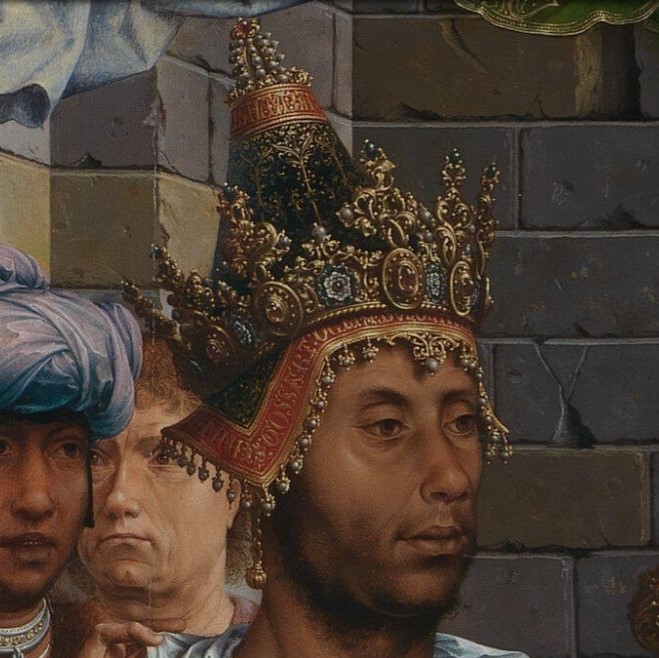
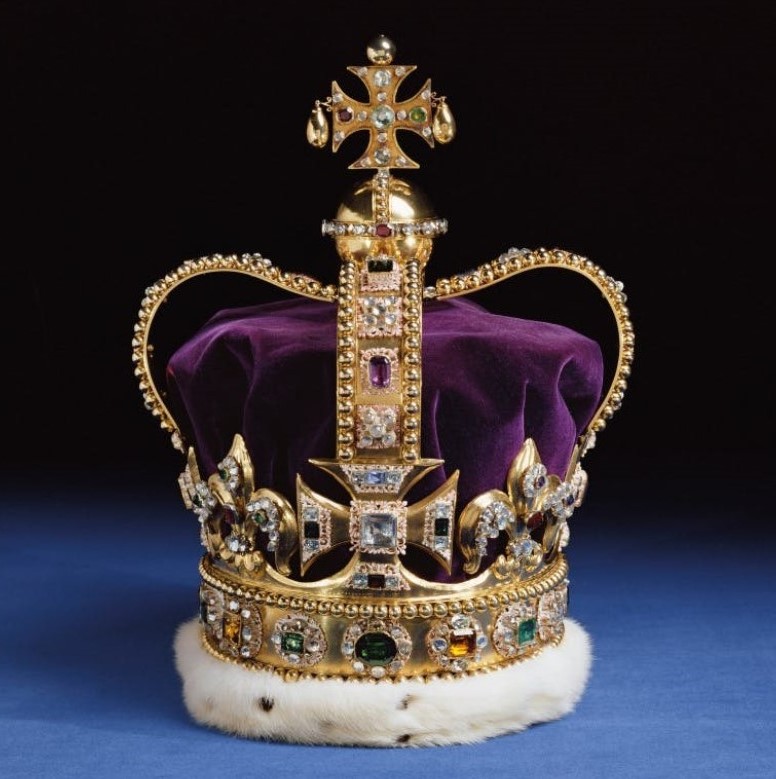
I would be hard pressed to recognise this as a crown – although as a hat it is extraordinarily plush. It is a royal hat, certainly, as it is lined with ermine, visible clearly on the upturned brim (which I would assume would be at the back). The hat itself is red velvet, with a band made of elaborate gold links with black tynes. It is topped with an elaborate gold tassel, and the brim is ringed by gold embroidery and pearls. The sceptre is a fantastically elaborate piece of contemporary goldsmithery, as is the object behind the hat, which just happens to be the lid of his gift, which has already been delivered.

Like Balthazar’s hat, it has an inscription, in this case ‘[L]E ROII IASPAR’ – King Jaspar – which is, oddly, another variant of the name Casper. I’ve often been disappointed to think that on the other side of this lid there is not nearly enough space to include the words ‘To Baby Jesus, Happy Christmas, with love from…’ But we’ll get to the gifts in a couple of days.

An Advent Calendar – 18

‘Another Magus’ –

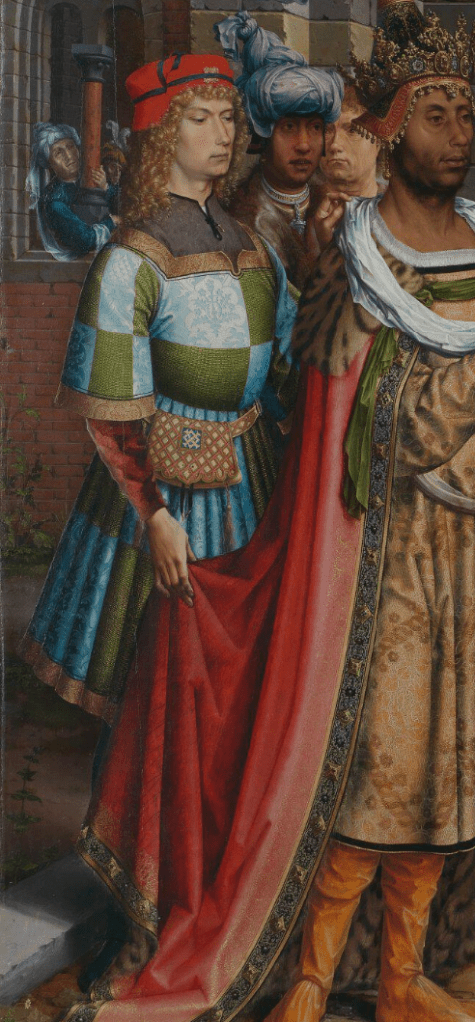
This is Melchior. I know this, because we have met Balthazar already, and tomorrow we will meet Casper – both of their names are included on the painting. Melchior’s is not, but by a process of elimination… He is arguably the most stylishly dressed of the three, but I make that assertion purely on the basis of one item of clothing: red tights. I consider these to have been the must-have fashion item for the well-dressed man in the late 15th/early 16th Centuries, and I’m sure I’ve mentioned the fact before (see Day 4 – Tobias and the Angel).

Like Balthazar, Melchior has two courtiers by his side, each of whom wears dark blue, edging on the darkest turquoise, and the same light olive green worn by Balthazar’s servant. Maybe green and dark blue are Melchior’s colours. Of the two, the one on the right is the more servile (would that be the right word for ‘the most obviously like a servant’?), as he holds the hilt of a very elaborate sword – presumably Melchior’s – and a pink cloak, which is presumably his own. He wears a matching pink hat, which, to my mind, qualifies for the description ‘jaunty’. He is also sporting quite wonderful light blue and white striped tights, which are only just visible. To our left of Melchior the other courtier wears plain white tights, with a green garter, the same colour as the crown of his hat, which is then surrounded by a turban-like brim made of flouncy white fabric, just like the sleeves of his shirt. Melchior wears a long sleeved cloak in cloth of gold, the sleeves reaching almost to the ground, cut to allow him to use his arms, and then tied with black laces at the elbow, below the hands, and at a level with his shins. It is lined with ermine – another clue that he is royalty.
His jacket is quite fabulous. Panels of green fabric lie on top of pink, with the hem of each panel trimmed with pearls. The bottom hem drips with gold ornaments, into each of which is set another pearl. They didn’t have lycra back then, so the knees of the tights are slightly baggy, but not too much – nothing undignified here.

Like Balthazar, Melchior wears a hat and a crown. The hat is red, conical, and topped with a gold tassel. It has a broad brim at the front and at the back, where it is turned up to reveal a blue lining. The brim is decorated in a similar way to the hem of the jacket, with smaller gold pendants and plenty more pearls. Like Balthazar’s, the crown is a gold ring, although more elaborately wrought, but with equivalent tynes set with jewels. His courtiers seem distracted – they pay little attention to the Baby Jesus, if anything looking the wrong way completely. This could be due to overcrowding – and the two faces on the far right, one fairly swarthy, but partly hidden, and another, just the edge of a profile, imply that there is a crush of people trying to get closer (the right side of this detail is the very edge of the painting). The servant in the pink hat could easily be the brother of Balthazar’s servant – although not quite so blonde, and with less lustrous and less curly hair. His attention is presumably taken up by the man in profile, who has rested his hand lightly on his shoulder. The turbaned man on horseback holds what appears to be a war hammer – there are several of these in the Wallace Collection (click on the link if you’d like to see what they look like), and I suppose you’d need to be on your guard making such a long journey. Maybe this is a body guard, or equivalent. I’m intrigued that his horse is one of only three beings in the painting who appear to be aware of our presence – it is definitely looking at us – the others being the hidden angel, and someone we haven’t met yet. I doubt this has any significance, but it does help to keep us involved.

If we are to judge by appearances, I don’t know where Melchior is supposed to be from – but let’s think about that tomorrow when we meet Casper. Have a great day – it’s only a week until Christmas!