O vos omnes qui transitis per viam, attendite et videte si est dolor sicut dolor meus.
The words from the Book of Lamentations (1:12) seem particularly apt today. This is a standard translation, adapted from the King James Version:
All ye that pass by, behold, and see if there be any sorrow like unto my sorrow.
The book itself laments the destruction of Jerusalem in 586 BCE, but this particular text was often sung in Holy Week. Here is a link to a recording of the Tudor Consort from 2003 – our century – singing the setting from 1585 – the same century as our painting – by Tomás Luis de Victoria.

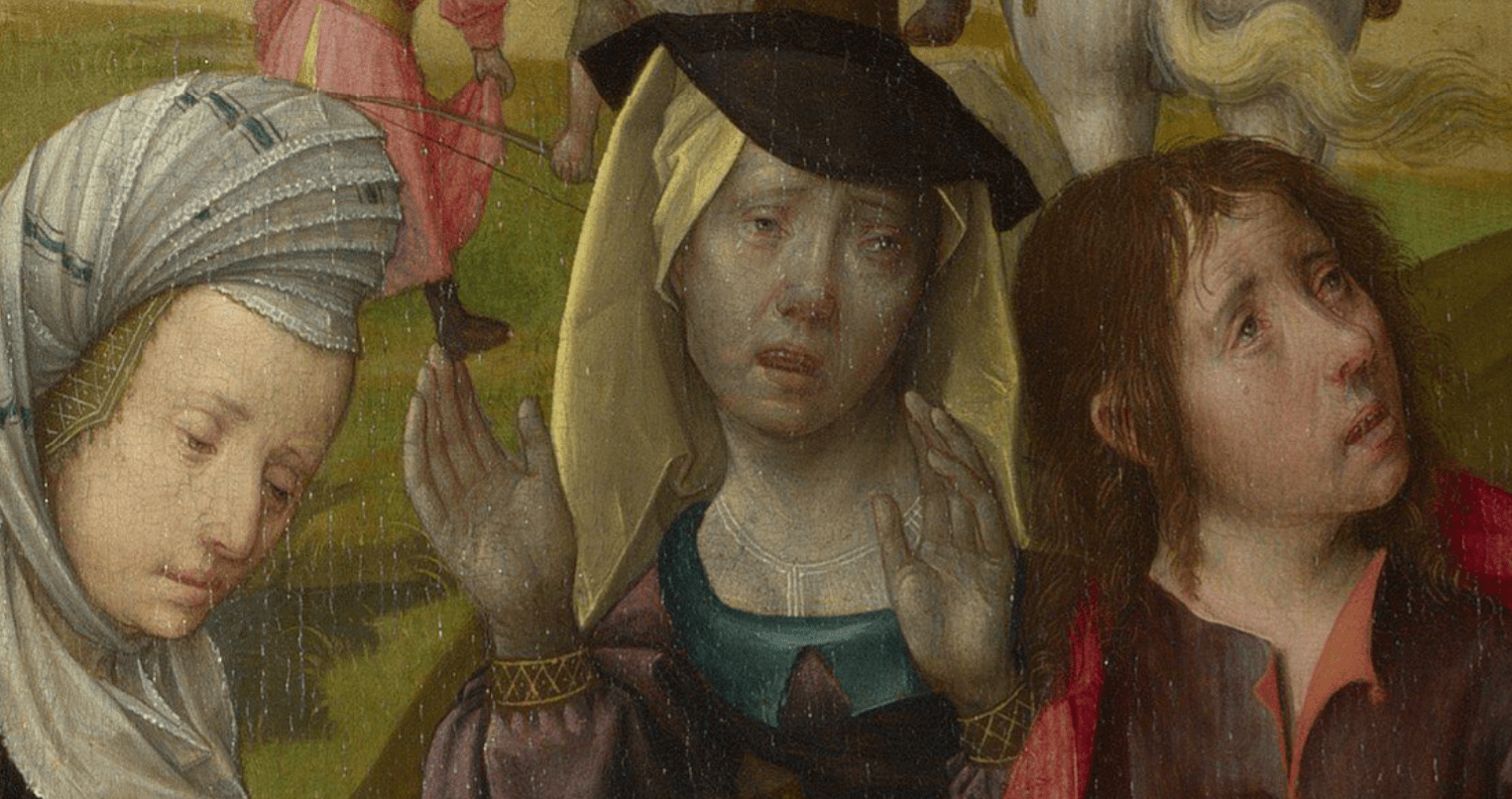
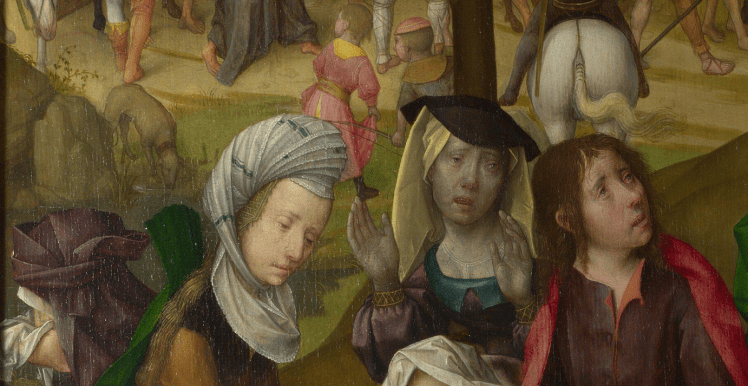
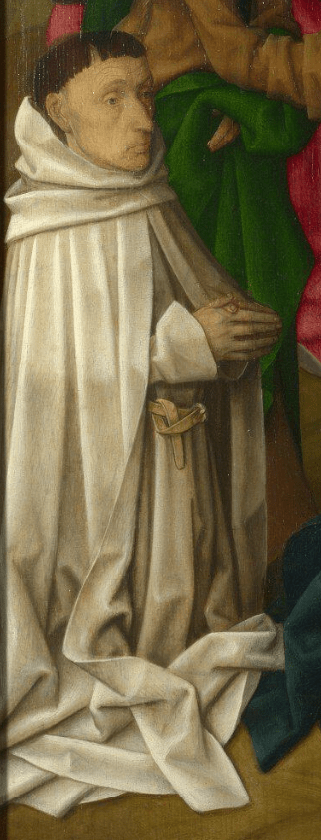
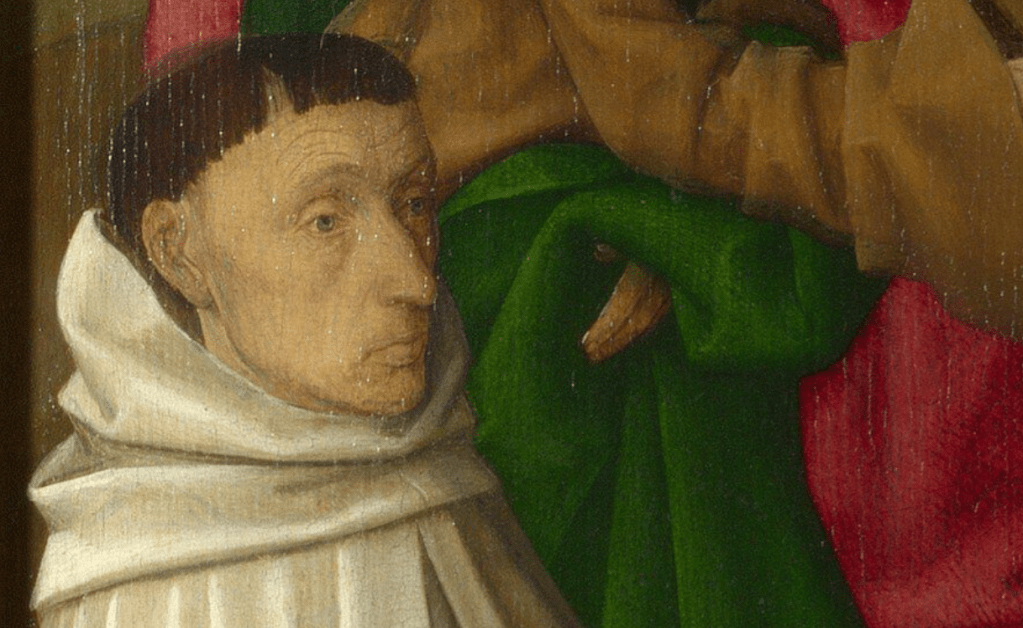
It is still over ten days until Holy Week, but seeing the Virgin’s face, this text, and its use in the liturgy, instantly sprang to mind. Mary is in a state of complete collapse. Her legs have folded beneath her and her arms hang limp, even with John supporting her left elbow. Her blue robe and blue cloak look especially sombre, and, although her state of mind is clear, her disorder is oh-so-subtly hinted at by her cuffs – one folded back neatly, revealing a grey lining, the other at full length half covering her hand. On the left we see the gesture of the turbaned Mary, who you might remember from yesterday, indicating the Virgin’s sorrowful face, as she looks down compassionately towards her. We see the donor’s praying hands: he is beside her, the material of their cloaks overlapping on the floor. He is contemplating her sorrows as much as the suffering of Jesus.
Mary’s presence at the Crucifixion is attested by all four gospels, but the most important source for us is John 19:26-27. As elsewhere in the book, John appears to be describing himself as ‘the disciple… whom he loved:’
When Jesus therefore saw his mother, and the disciple standing by, whom he loved, he saith unto his mother, Woman, behold thy son! Then saith he to the disciple, Behold thy mother! And from that hour that disciple took her unto his own home.
Apart from any normal human decency, these verses explain the care that St John shows to the Virgin: Jesus has told them, from the cross, to look after one another, to adopt one another, even. Often they are shown standing symmetrically on either side of the cross, Mary to our left, John to our right (giving Mary the higher status), but here, where The Good and The Bad are divided between Christ’s right and left, we see them together – with The Good.

The pallor of Mary’s face is extreme, as is the sense that every feature collapses every bit as much as her body – the eyebrows, mouth and even chin. The eyelids collapse, half covering her eyes, which are full of tears. The white veil covers her head, and wraps around in front of her chest, but her hair is left free. Her status as perpetual virgin meant that her hair was not subject to the same strictures as that of other women. It is not always covered as that of a woman of marriageable age should be: she was beyond reproach, and beyond suspicion. And if the image as a whole reminds me of Lamentations, this hair, tumbling loose, and free, reminds me of one of Shakespeare’s most brilliant conceits, from one of his lesser known plays: King John, which was probably written a decade after the Victoria setting I linked to above. One of the characters, Constance, is the mother of young Arthur, who has been taken captive by King John – who is certain to kill him. Constance enters in Act 3, Scene 4 with her hair in disarray – she has let it down, loosed it from its ‘imprisonment’, in the same way that she wants Arthur freed from his. She later puts them – her hairs – up again, saying,
But now I envy at their liberty,
And will again commit them to their bonds,
Because my poor child is a prisoner.
This does not last long – despair overcomes her, as she utters one of the most penetrating descriptions of loss.
Grief fills the room up of my absent child,
Lies in his bed, walks up and down with me,
Puts on his pretty looks, repeats his words,
Remembers me of all his gracious parts,
Stuffs out his vacant garments with his form;
Then, have I reason to be fond of grief?
Fare you well. Had you such a loss as I,
I could give better comfort than you do.
At this point she lets her hair down again:
I will not keep this form upon my head
When there is such disorder in my wit.
I think this perfectly expresses the image of the Virgin Mary which we see today.
All ye that pass by, behold, and see if there be any sorrow like unto my sorrow.