Jean-Antoine Watteau, L’Enseigne de Gersaint, 1720. Schloss Charlottenburg, Berlin.
I wanted to write about today’s painting last year, during the original ‘Picture of the Day’ – but somehow I ran out of days… But even if this is a year later than I had hoped, I’m glad, as I know so much more about it now, and there is no better way to start my ‘18th Century Spring’ as I am re-christening it (it is snowing outside as I write). It is a remarkable image in so many ways, and, in all probability, the very last painting of the man who, it could be argued, gave life to the art of the century: Jean-Antoine Watteau. Sadly his star has long-since waned, but he is due for a revival. Admittedly I am a relatively recent convert to his work, mainly because, until recently, I had failed to look. If I am honest, I have always found him hard to talk about, because the chief quality of his work is an inherent charm, and after that, after you’ve said ‘isn’t that charming,’ anything else you say runs the risk of counteracting the dream-like quality of much of his work, which is precisely where the charm itself lies. Like comedy, if you try to explain charm, it dies.
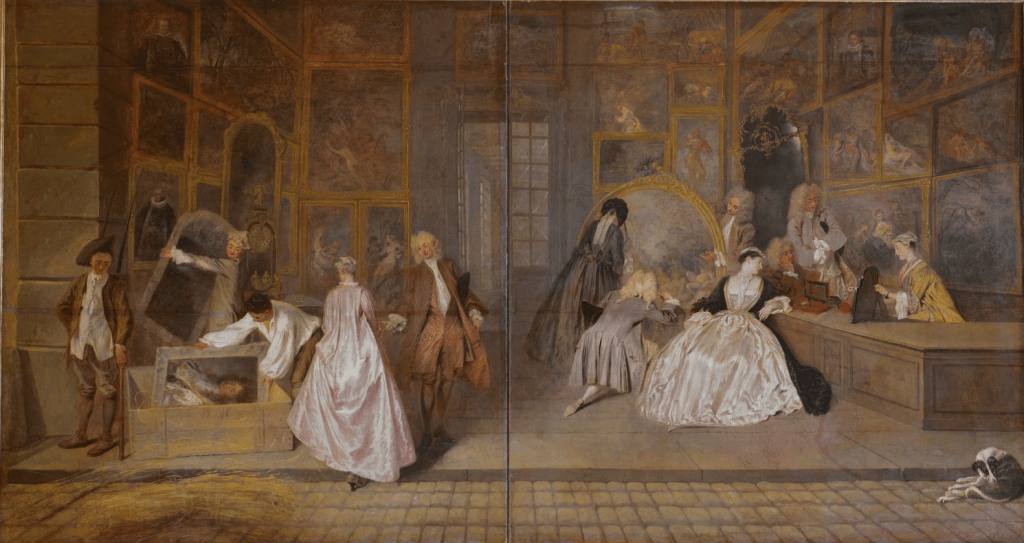
This, his last work, and one of his undoubted masterpieces, was a new departure. Watteau is known primarily as the originator of a new genre, the ‘fête galante’, in which people in elegant clothing – ball gowns, fancy dress and theatrical costumes – party in the countryside or in parkland settings. It is never clear whether the characters are actors, or ‘normal’ people in costume, or both, and it is never clear where, exactly, they are. The charm lies in this mystery, and in the romance, as couples mingle, flirt, and slip away into the hazy distance, for what ever purpose you, the viewer, imagine: Watteau never tells us. However, in this painting, we know exactly where we are. We’re in a shop. We know that from the title, which I have left in French deliberately, because ‘Gersaint’s shop sign’ is altogether too prosaic. But that is what it is. Or rather was – although not for very long: a shop sign. It was not commissioned by Edme-François Gersaint, a mere 26-year-old junior merchant when it was painted: Watteau volunteered the work, to keep himself busy, and ‘to warm his hands’, as he himself said. He was not well at the time. He had just returned from a few months – at the most, eleven – in England.
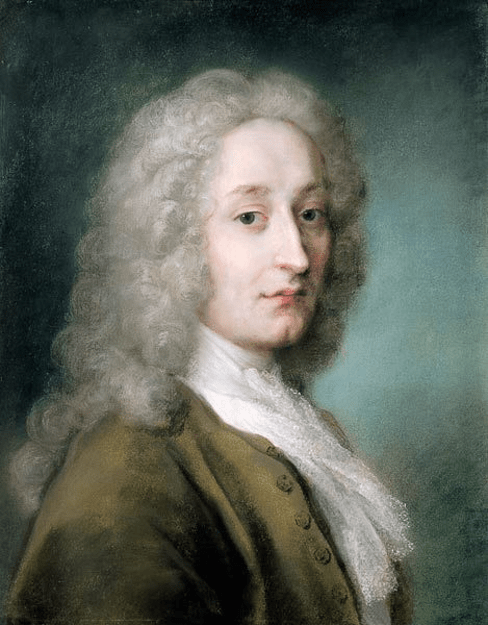
This is the only portrait we have of him, a pastel painted by Venetian artist Rosalba Carriera, when she was in Paris between April 1720 and March 1721. We know from a letter written to her, dated 20 September 1719, that Watteau was then in Paris. And according to her own journal entry from 20 August 1720 we know that, by then, he was back. In between those two dates he visited England. We don’t know why he went, but while he was there he got to know Dr Richard Mead, one of the leading physicians of the day, and a notable collector of art: at his death in 1754 he owned at least two of Watteau’s paintings, which may have been directly commissioned from the artist. We don’t know how or why they met, although as he was a specialist in tuberculosis, and as it was from this that Watteau was suffering when he returned to Paris in the late summer of 1720, the initial contact might have been a consultation. However, any medical advice Mead gave was not successful for long: Watteau died less than a year after his return. Carriera’s portrait thus dates from the final year of his life: he was only thirty-six. Artist and sitter were perfectly suited, though – the lightness of touch, both in mark-making and concept, and the lightness of the palette – pastel, in more ways than one – made them equivalents. She will be the subject of the first talk in my series Three Women in the 18th Century on Monday 19th April at 2pm and 6pm. If you would like to see more of her delicate and highly sought-after work, I do hope you will be able to make it – just click on the relevant time to book.
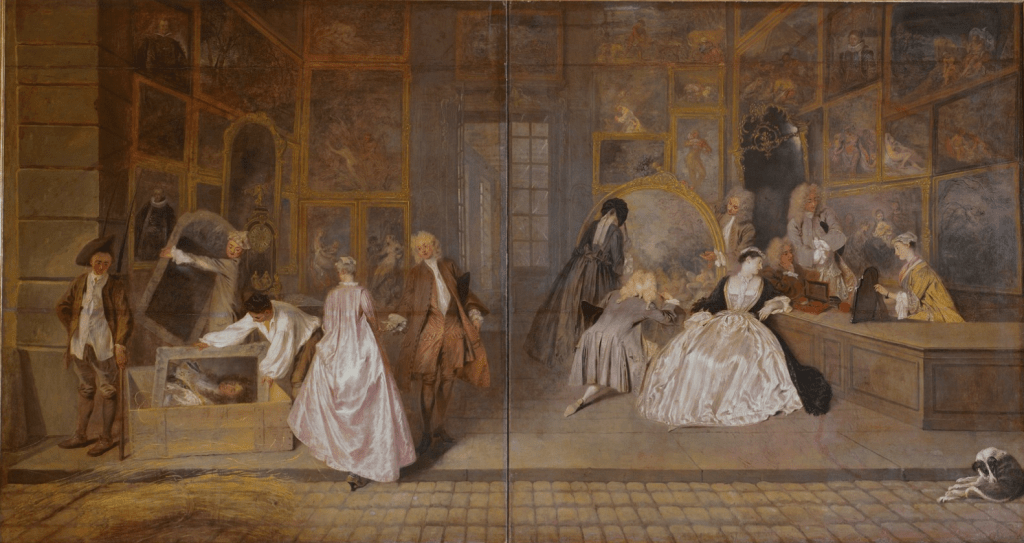
No wonder Watteau wanted to ‘warm his hands’: he was not well. He painted the image in a couple of weeks, and yet somehow managed to sum up the entire epoch. The painting suggests that we are out on the street, with the ‘fourth wall’ of Edme-François Gersaint’s shop removed so that we can see inside. In the foreground are the cobblestones of the road, with some straw, possibly for packing, lying to the left, and a dog – quoted from Rubens’s Marie de Medicis cycle – on the right. It is only this dog – and the hem of a lady’s skirts – which break the long line of the kerb stone which keeps us on the outside. But this same lady’s step, as she is handed into the shop by a young gallant, encourages us too to enter – with our eyes, at least.

Her luxurious pink silk dress shimmers in the daylight as she heads into the darkened space. It would be long enough to reach to the ground, were she on the level, but her step up allows us to catch a glimpse of her shoe, and just a hint of a green stocking. Despite the gentleman’s attentions she looks away from him, down to her left, as a painting – a portrait of Louis XIV – is boxed to be sent to its buyer – or perhaps, to be put into storage.


Follower of Hyacinthe Rigaud, Louis XIV, after 1701.
The Sun King had died five years earlier, when the reins of power were handed to his five-year-old great grandson – or rather, to the Duc d’Orleans, who would act as Regent until 1723, when the young Louis XV came of age. The whole court relaxed, packed up their formalities in Versailles and headed home to Paris. This collective sigh of relief, and the ensuing reminder of the pleasures of home living, resulted in a new, relaxed and even at times frivolous attitude to life and art, not to mention a renewed interest in interior decoration, and a style which we have come to know as the Rococo. Watteau was at the very forefront – as indeed was Rosalba Carriera, in Venice, for altogether different reasons. The idea of packing away the portrait – a bust-length image derived from Hyacinth Rigaud’s formal vision of le Roi Soleil from 1701 – is a metaphor that cannot be surpassed in poetic terms. The old, pompous, rigid rules are being dispatched to make way for newer, fresher ideas – and far more fun. This painting truly is a sign of the times.

On the right of the painting, the great and the good of Paris enjoy art as a sophisticated leisure activity. It is as if the inhabitants of the fêtes galantes had put on their day clothes, headed back into town, and are now set on taking art a seriously. However, if we look closely, well – plus ça change… The couple on the left of this detail are being shown a sizeable oval painting, and while the woman, standing on the left, may be paying close attention to the delicate portrayal of the branches and the foliage high up in the canopy of trees, her male companion, genuflecting in the face of high art, does so to get closer to a number of female nudes appearing en plein air. To the right of this painting three more amateurs – or ‘lovers’ – of art, dilettanti, ‘delighting’ in the finer things of life, pay close attention to a charming, smaller work. Or do they? We’ll see… The shop assistant might be none other than Madame Gersaint, wife of the proprietor, and daughter of Pierre Sirois, who just happened to be Watteau’s first dealer.
The shop was on the Pont Notre-Dame, which had been constructed between 1500 and 1507 as the first stone bridge across the Seine, leading from the Île de la Cité to the North Bank. Once the bridge was complete, a row of buildings was constructed along both sides, a total of sixty-eight identical houses which lasted from their completion in 1512 until they were destroyed in 1786. Gersaint moved into no. 35 in 1719 – the year before Watteau insisted he needed a sign – and years before he became one of the most innovative and influential dealers of the 18th Century. But he was by no means alone. The bridge was home to no fewer than 60 dealers in art and luxury goods at the height of its success: its importance to the 18th Century art market cannot be overestimated. Neither can its reputation. Members of the Académie Royal de Peinture et de Sculpture did not approve. According to a 19th Century historian of the by-then venerable institution, when it had been founded back in 1648,
It was decided that, upon pain of exclusion, all members of the academic body would refrain from having an open shop in which to display their works, from exhibiting them in the windows or other external parts of their residence, and from attaching to the latter any sign or inscription stating that they were on sale, and would do nothing that might confuse the honourable status of academicians with the mechanical and mercenary status of the masters of the community.
Or, as Gilles-André de La Roque said – more succinctly – in 1678: “there is nothing but nobility in painting when it is practiced without trade.” And yet, look at what Jean-Antoine Watteau, Academician, has done: he has painted a shop sign! Arguably, as far as the Academy was concerned, the lowest form of art. While giving an important role to painting as something worthy of attention, he is also undermining the founding principles of the establishment to which he himself belonged. This was an entirely different ethos to that of the Guild of St Luke, which had been founded by artists to ensure that they got the right price for their work. The guild also freely admitted women, apparently, unlike the Academy. Indeed, as many women as men seem to have held leases on the Pont Notre-Dame, sometimes inheriting their positions – and sometimes their status as peintresse – if their husbands died.
This is art, though, and however much of a political statement it might be, it is also a great exaggeration. Inventories showed that Gersaint initially sold far more furniture than paintings – and there certainly wasn’t as much space inside as Watteau’s masterpiece implies. Nevertheless, the painting was enormously successful. We know that from an almost-contemporary review, written a dozen years after the painting was completed, which appeared in the Mercure de France in 1732:
This Piece, which is 9 feet 6 inches wide by 5 feet tall, has always been regarded as the Masterpiece of this excellent Painter. It represents the Shop of a Dealer, which is full of various Paintings by the greatest masters (…). This famous Sign was on display for only two weeks; it was admired by the whole of Paris.
In his memoirs Gersaint also acknowledged the importance of this un-commissioned painting, saying, ‘We know what a success the piece was […] it drew the eyes of all the passers-by; and even the most skilful painters came several times to admire it.’ Indeed, as the Mercure de France stated, it was only on view for around two weeks. Although the canvas was always rectangular, the painting originally occupied only a segment of the surface – an arched curve can be seen cutting off the top corners, running close to the bottom of the paintings at the top left and right. These, and others, were added some time between 1720 and 1732, possibly by Jean-Baptiste Pater, Watteau’s only student. The painting was initially acquired by a man called Claude Glucq, who passed it on to Jean de Jullienne, one of Watteau’s main patrons, and the man responsible for communicating the artist’s genius by commissioning an extensive series of engravings. Before long it came to the attention of Frederick the Great of Prussia, one of history’s most notable collectors, and that is how it comes to be at the Schloss Charlottenburg now: it was first exhibited there as early as 1748.
The original curved shape of the painting relates to its intended location, and its function as a shop sign. There are various ideas of how it was attached, and most of them draw on the fact that each of the premises had an arch of an almost identical size and shape. This is what the bridge looked like in 1684, at the festivities which were held to celebrate the return to health of King Louis XIV in the January of that year. You would think the painting would slot nicely into one of those arches, just where the chandeliers are hanging.

In case you were wondering, the bridge was never this wide – this expansive perspective was created by the anonymous printmaker in order to impress on the viewer the magnificence of the spectacle. A recent computer simulation has suggested that originally the bridge actually looked more like this:
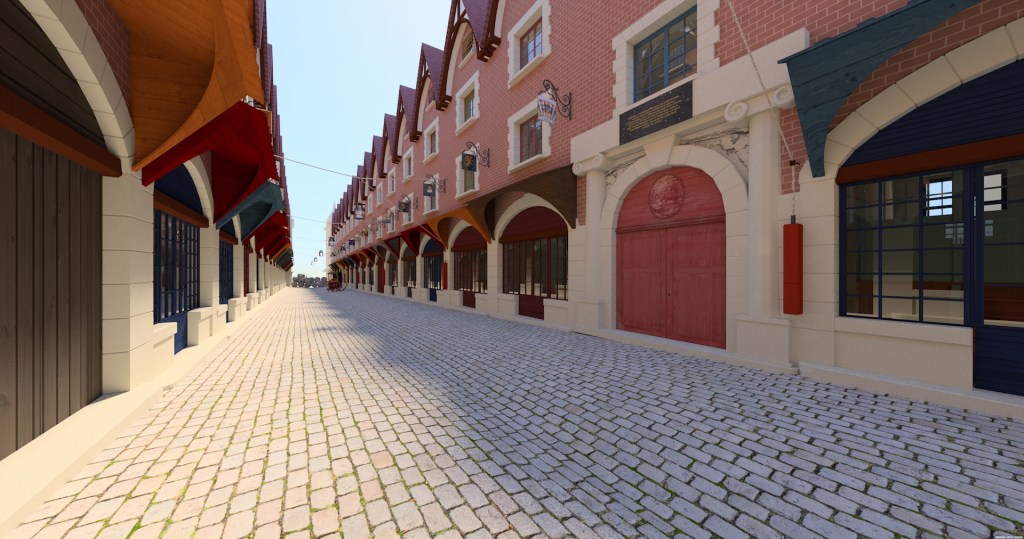
While each arch might still look like a good place for a painting, when the painted area was made rectangular, the sides were cut down – the curve does not reach its full extent. If the missing sections of the canvas were to be replaced to complete the curve, it would be too wide for one of those arches – and would also block the upper part of the doorway. However, if it weren’t inserted into the arch, but onto the canopy above it, it would fit perfectly.

All of this comes from a brilliant article from which I have derived much of the above information. So, if you have the time, and would like to know more about the history of the Pont Notre-Dame and the Parisian art market, I would recommend Sophie Roux’s Virtual Explorations of an 18th-Century Art Market Space: Gersaint, Watteau, and the Pont Notre-Dame published online by Journal 18 – a journal of eighteenth-century art and culture.
But let us finish with the painting. I questioned, above, whether the customers on the right truly were ‘paying close attention to a charming, smaller work.’ Have another look, and see what you think.

Hanging on the wall behind them is what appears to be a 16th Century Venetian altarpiece – a Nativity with the Mystical Marriage of St Catherine of Alexandria, perhaps. It is notable that the rapt attention of the customers, who are looking at the painting held by Madame Gersaint, echoes the heartfelt devotion of St Catherine herself, kneeling before none other than the Christ Child. What has so absorbed them? What could the painting show? How exquisite can it be to inspire such attention? TO be honest, the more I look, the less I am convinced that this is a painting. Madame Gersaint has her left hand on a stand, which hinges from the top of the elegant 18th Century frame, and I’ve never seen a painting that has a stand like this. Admittedly, I’m not an expert on how paintings were displayed in the 18th Century, but everything else I’ve seen suggests that they were hung on walls, much as we would do today, and that would include small paintings, the size of this object. However, just next to the elbows of the two seated customers is a box with an open, hinged lid, containing a brush, and another, similarly-coloured round or oval object – there is another one of these just next to the black frame. This is surely a vanity case. Which makes me think that the black frame with a stand is probably a mirror, and that these people are completely wrapped up in themselves. Watteau really was a gorgeous artist, a clever, and subtle man. He may be advocating art as a sophisticated leisure activity. He may be promoting the art market over the pretensions of the Académie. But he wasn’t above poking fun at the self-absorption of the haute-bourgeoisie. Buyer, beware!

Now that Lent is over, I am hoping to blog about once a week – as long as other commitments don’t get in the way. And I will, of course, continue talking! I do hope some of you can join me for Rosalba Carriera and the Power of Pastel on 19th April – not to mention the other two of the Three Women in the 18th Century, full details of which are on the diary page, along with information about everything else I am up to in the coming weeks. In the meantime, I trust you are enjoying the changeable weather: I’m glad to say that it has now stopped snowing and the sun has come out…