Day 78 – St Petroc

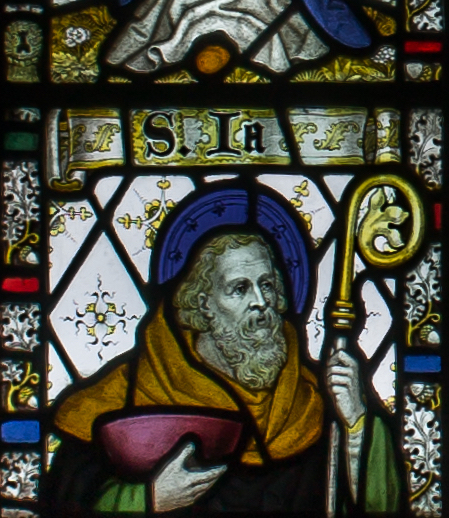
C. E. Kempe & Co. Ltd., St Petroc, 1914, St Olaf’s Church, Poughill.

It’s all too easy to forget precisely how many Saints there are – probably because I doubt that anybody even knows how many saints there are. The Vatican must have an exhaustive list, but several have come and gone, some of them because even the church has deemed them to be entirely fictitious. Not so St Petroc, and as today is St Petroc’s day, I wanted to think about him. If you’ve never heard of St Petroc – shame on you! He is one of the Patron Saints of Cornwall.

I’ve also chosen today’s image because there is, of course, more than one type of picture. I’ve focussed on paintings, I know, but I have occasional shown you pictures of sculptures, or even, on rare occasions, buildings. But never stained glass. It is something that has flourished in various eras across most of Europe, but it has been especially important in Britain – even though, given the Reformation (or reformations, as they happened at different times in the different nations of the Kingdom) much of our heritage of stained glass has been lost.  I imagine that for iconoclasts, ‘idolatrous images’ in glass were quite fun to deal with. There was the most extraordinary revival in ecclesiastical decoration in the 19th Century, though, as a result of a revival in the church, and then a change in taste. The Anglo-Catholic Revival developed from the Oxford Movement, and as William Morris was an undergraduate in Oxford, it would inevitably influence the development of the Arts and Crafts movement, at the tail end of which today’s window was made. 

This is just one panel from a larger window which illustrates a number of Cornish Saints. The various legends about St Petroc are rather confused, and, given their age, it is hard to know how much of the myth is true – after all, he was supposed to have died in 564 AD.  Or 594, depending on which source you read. According to the earliest life written about him, he was the younger son of a Welsh Chieftain, and he studied in Ireland. Either before or after a pilgrimage to Rome he found his way to Kernow (Cornwall to you and me – unless you are from Kernow of course) and founded a monastery at the mouth of the River Camel on the North Cornish Coast, which came to be known as Petroc’s-Stowe – or, as we now know it, Padstow. He also founded an Abbey in Bodmin, and became its first prior – hence the crozier in his hand, a stylised shepherd’s crook, with which he would symbolically look after his flock, yanking them back in when they strayed from the straight and narrow.  After his death his remains were initially revered in Padstow, but they were ‘translated’ (i.e. moved) to Bodmin some time around the year 1000. However, in 1177 a disillusioned priest called Martin stole them, and took them to the Abbey of St Meen in Brittany (Petroc may well have preached all over Brittany: there are many churches named after ‘Saint Perreux’). Thanks to the intervention of King Henry II the precious relics were returned, and were kept in a rather fine Sicilian/Islamic ivory casket until the Reformation, at which point, with the dissolution of the monasteries, they were thrown out. Fortunately the casket survived, and can still be seen in St Petroc’s, Bodmin.

A second Life of St Petroc, written in the 12th Century, was re-discovered in Germany in a library in Gotha in 1937. It describes the saint as ‘handsome in appearance, courteous in speech, prudent, simpleminded, modest, humble, a cheerful giver, burning with ceaseless charity, always ready for all the works of religion because while still a youth he had attained by watchful care the wisdom of riper years’ – however, that can have had no influence on this window, which dates from 1914, some 33 years before the rediscovery of the Gotha Life.

Photo: Jules & Jenny on Flickr

At the top we see two angels holding scrolls, and then, in the upper tier, Sts Ia, Olaf and Keyna. St Petroc stands at the left on the bottom tier, alongside Sts Wyllow and Sampson – I’m sorry, but apart from our man, you’ll have to look them up for yourselves! The inscription underneath the last has a dedication to the memory of William and Margaret Field, and their son Francis Trevoes, and bears the date ‘mcmxiv’ – 1914. If you can pin it down, you will probably find the window attributed to Charles Eamer Kempe – but as he died in 1907 that’s not very likely, even though the designs for stained glass windows could be kept and reused.  As it happens the term ‘stained glass’ is a misnomer: the only colour you can stain glass is yellow – so only the yellow details in today’s picture are actually stained. The rest is coloured glass, made by the adding various mineral salts to the molten glass. The details – all the black lines and decorations – are painted on with a form of enamel, and fired to make them bond with the glass.

Kempe himself was from East Sussex (his father Nathaniel developed Kemptown in Brighton) and had a typical upper class education – Rugby, and Pembroke College, Oxford. It was as an undergraduate that he was inspired to become an architect, having seen the decorations of the Oxford Union carried out by, among others, William Morris and Edward Burne-Jones. He had wanted to go into the church, but had a rather bad stammer, and decided he could minister better by designing that by preaching. He studied with leading ecclesiastical architect George Frederick Bodley, himself a student of Giles Gilbert Scott, and became Bodley’s assistant during the building of All Saints, Cambridge. The East Window there was designed by Burne-Jones and executed by Morris & Co. Kempe himself designed three of the church’s windows. However, he wasn’t with Bodley for long, as he set up his own studio in London in 1866, which went on to be one of the leading ecclesiastical designers of its time. His windows were especially sought after, renowned for the peacock wings of his angels (this isn’t a great example), and the richly jewelled apparel of the royalty and priesthood – look at the pearls on the depictions of Sts Olaf and Sampson, for example. After his death the studio continued under the name of C.E. Kempe & Co. Ltd, and a distant cousin, Walter Earnest Tower, took over as chairman. Stained glass designers don’t often put their names on their work, but use symbols as a form of ‘maker’s mark’. Kempe’s was a sheaf of golden corn, called a ‘garb’, which came from his own coat of arms (I said he was upper class…). When Tower took over, a black tower was superimposed on the maker’s mark – and you can see it on the panel with St Petroc, in the decorative border to the left of St Ia’s feet – at the very top left-hand corner of the detail on the left.

There are not that many images of St Petroc, and, as a result, his iconography varies. The Kempe studio chose to show him holding a bowl, with a tame wolf by his side. These attributes are best explained by the various myths which survive about the saint. Here they are, retold by Anna Chorlton – you can find the full story on the website Mazed – Traditional Tales from East Cornwall:

It was always raining in North Cornwall near the monastery. One day Petroc predicted the rain would stop the next day, but the next day the rain still fell in rivers. Petroc was mortified, his power of prophecy had failed, maybe he wasn’t such a good holy man anymore. He decided to go on a pilgrimage to become more holy, so he travelled to the Holy Land and then on to India. One day he was standing by the sea, it was so hot and he was dreaming of Cornish rain, when he saw a silver bowl in the water. Petroc climbed into the bowl and floated to an island. There he lived for seven years, every day eating one silver fish he caught in a pond. The fish returned every day to be eaten again.

One day the shining silvery bowl floated up on the sea again, and Petroc climbed in and sailed back to shore.

A wolf was waiting for him. It had guarded Petroc’s staff and sheepskin for 7 years while the saint was on the island. The wolf stayed as Petroc’s loyal companion till the end of his days.

Day 77 – Sofonisba Anguissola

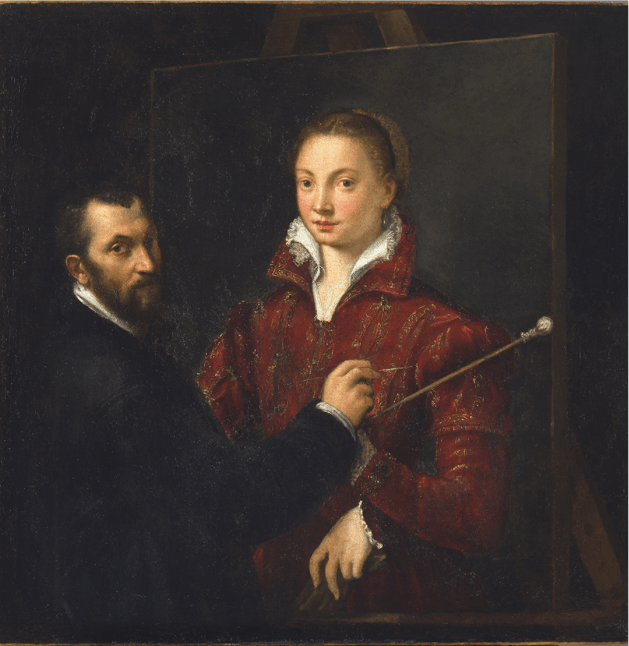
Sofonisba Anguissola, Bernardino Campi painting Sofonisba Anguissola, late 1550s, Pinacoteca Nazionale, Siena.

Who could not love this artist given her name? Quite apart from her talent, of course. I will come back to her very soon to explore her life and her work in more depth. But for now, I want to look at a painting which shows that, contrary to the assertions of many men over history (mainly artists who were protecting their pitch) women really did have the intellectual and conceptual ability to understand art and what art can do. 

It is a double portrait, as the ‘title’ suggests – but of course, this is only what some people choose to call it now. You can also find it listed as ‘Self Portrait with Bernardino Campi’ – but that really misses the point. What is remarkable is that, as far as I am aware, no one has ever thought this painting was by him – after all, he is the one painting. The self portrait by Judith Leyster (Picture Of The Day 34) was for years attributed to Frans Hals, because it is in a similar style to his, even though she herself is sitting there in front of an easel, holding a palette and around 18 paint brushes. Like the Leyster, we have a painting within a painting – in this case, a man painting a portrait of a woman – what could be unusual about that? It would make sense to assume that he was the artist. He looks towards his subject, painting the delicate details of her elegant dress. The padded end of his mahl stick (POTD 28) is propped on the very edge of the canvas so that he can rest his right wrist on it, thus keeping his hand steady to paint the details of the embroidery. His profile cuts across the left edge of his canvas and the easel can be seen projecting above it. The lower edge of his canvas can be seen, towards the bottom of the painting itself, and to the right we can also see the canvas stretched around the stretcher. As for the portrait he is painting, it is beautifully executed, and surely, almost complete. The subject wears a rich red, high-collared and sleeved bodice, embroidered with gold thread. Underneath this she has a white chemise, with its lace-trimmed collar standing up inside the collar of the bodice, delicately laced at the neckline. There is just a hint of a large drop-pearl earring, and her left hand droops at the wrist, holding a pair of deep red gloves, a sign of both class and sophistication. This is clearly a wealthy and successful woman. A beautiful executed portrait, in a perfectly standard painting, but it all seems perfectly normal. Until you remember that Sofonisba painted it.

Think about it this way: what are they looking at? He looks round towards us, but why? To catch our eye perhaps? To see if we approve of his efforts? Or is he looking at a mirror to catch his own reflection to paint his face? He would have had to do that to capture his own appearance, after all – but at the moment, he is painting Sofonisba’s dress – so he must be looking at her. And of course he’s looking at her, because it is she who is actually painting this, and, while his face was being painted, she must have been looking at him. And what about her? Who or what is she looking at? Well, if he’s painting the portrait, she must be looking at him, but, as she painted both subjects, she must be looking at herself, in a mirror: she had to, or she wouldn’t know what to paint.

If that hasn’t done you head in, here are a few more questions. Who is in charge here, and why? Whose face is clearer? Which character is more dominant? To my eyes – and it’s always worthwhile remembering that everyone sees things differently – Sofonisba stands out far more clearly than Bernardino. Her face is brighter, clearer, sharper. Her costume is richer – and brighter – whereas his black doublet fades into the background, and so does his hair and beard. He tones in. His face appears softer, the lights and shades more finely, and more subtly, blended. It is more painterly, I would suggest – and this makes her look more alert, more alive. He looks at us – and ultimately, whatever they were looking at during the course of the development of this work, the intention was to make it look as if they are looking at us, to make them seem more immediate and present – he looks at us with interest and understanding, but out of the shadows. By contrast, she is almost sphinx-like in her immoveable security. And she is higher up – which has always implied a higher status. When painting her face (if he were actually painting her), he would have to look up to her. And so he should – she is his creation. Not just in this imaginary portrait by him, which is actually by her, but in the person of Sofonisba herself. Because Bernardino Campi taught her to paint from the age of 14. She is everything he made her, and in this painting, probably painted when she was in her late 20s, she acknowledges that. But she also puts him in the shadow.  And if that’s not sophisticated enough, there is another suggestion: that she has painted each of the subjects in their respective styles. So she paints him how he would paint himself, whereas she paints herself, as she did quite often, using her own technique.

Conceptually I think this work is unparalleled before the 16th Century, and also, I suspect, for some time after. The self portrait by Catharina van Hemessen (POTD 28) is the first we have of an artist depicting themselves painting, and that was in 1548. I think it was Sofonisba who painted the second, in 1556. Today’s Picture would have followed a couple of years later. An artist painting someone else painting them. I might be missing the obvious, but I’m not sure I even know of any other examples – please tell me if you do! 

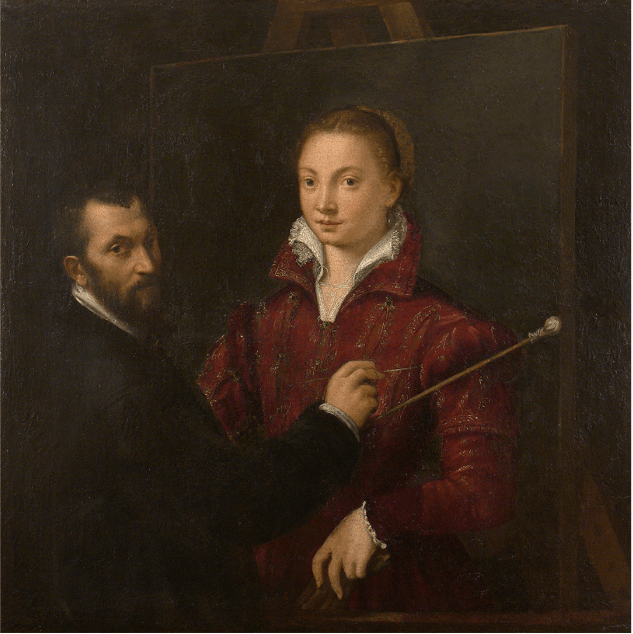
I would be more than happy to leave it here, but I should mention the painting’s curious history, partly because, if you were to look it up online or even – yes, it is possible – in a book, it might well look rather different. Look at the following three versions, and before you read any further, try and spot the differences.

I don’t know if you’ve ever visited the Pinacoteca Nazionale in Siena – it is the main art gallery, although people rarely go. There is so much else to see in the city, including genres of painting you can’t find anywhere else. There are frescoes extolling the virtues of Good Government, frescoes explaining the foundation of a hospital and all of its duties, and frescoes exploring the life of a fairly inconsequential Pope, and they are still on the walls for which they were painted, so why bother going to a museum? Siena is a city which really deserves more than the day trip it usually gets. But, until recently, the Pinacoteca has not been a great place to go – dingy, dirty even, with absolutely everything they could squeeze in hung on the walls in an endless sequence of shabby rooms. To be honest, I don’t know what it’s like now, because last March when I was there they were in the middle of refurbishing – probably the first time in seventy years or so it’s seen as much as a lick of paint. So by now it could be glorious. But I used to actively avoid taking my students there as it was one of those buildings that saps the spirit (I have a list). Had I spent more time there, I would have learnt how to cherry pick the best – but when I first went, this painting would never have made the cut. It was extremely dull. A black painting with two faces, two hands and a mahl stick. You could just about see the edge of the canvas and the easel, but it really was nothing remarkable. Until they cleaned and restored it in 1996, when they found out that Sofonisba was not originally wearing such a dark dress – but a wonderful red and gold one. But they also found out that she had two left hands. For five years, that is how they exhibited the painting – with one hand reaching up behind Bernardino’s, and the other lowered, holding her gloves. It was only six years after the first (recent) restoration that the conservators returned to the portrait and painted over the second hand – and so, since 2002, it has been exhibited as we have discussed it, the assumption being that Sofonisba must have intended it to be seen like that.

When you look at the details it only begs more questions. What would she have been doing? And why did she change her mind? And who changed her clothes? All of the answers to these questions must by hypothetical, but to me it looks as if she was reaching up to take the paintbrush. In Ovid’s Metamorphoses Pygmalion was a sculptor who fell in love with one of his own creations, and, having invoked Venus, goddess of love, the sculpture was brought to life – the power of art is that it can take on a life of its own. Here however, it is not love but talent that brings Sofonisba to life, taking over from her Master, like a relay runner taking the baton. A common topos – a regularly used phrase used almost conventionally – for a portrait was that ‘it only lacks a voice’. Well here, she may lack a voice, but she has come to life. Of course it’s possible that something else was going on, nothing to do with painting. Was she taking his hand? And if she was, would that have been appropriate? And what if she had meant to show herself taking his brush, but it looked as if she were going to take his hand? Maybe that’s why she changed it – or maybe she changed the position of the hand simply because it didn’t work, it looked too strange. Or maybe, she changed it because she looks more sophisticated holding the gloves. Whatever it was, it seems likely that she painted over the original hand, but over the years the change had become visible. Some paints fade, some change colour and some go transparent, revealing what are called pentimenti – changes of mind, as the artist ‘repents’ and repaints. So the second hand might have started to reappear. In the 19th century people didn’t like the ‘bright’ colours of earlier paintings, so to cover up the pentimento and make the whole thing look more balanced, more like an ‘old master’ painting, it could have been repainted, with a far darker dress for this respectable lady. Under most circumstances there would be no qualms about removing a 19th Century layer of paint from a 16th Century painting, but, having removed an earlier ‘overpaint’ which clearly wasn’t original, what are the ethics of covering up something that was? Was the first hand (or is that the second hand?) original though? Had it ever seen the light of day? Well, these are the choices that conservators and curators have to make. But rest assured, that hand hasn’t gone – it has just been disguised, covered up – and the conservators could get it back by taking off the new overpaint in a couple of days. Possibly quicker, but you never rush a painting, in case you damage it. I for one am happy to see it as it is now. And when I next have a chance to go to Siena, I will – and I hope to find it in a resplendent, newly decorated and refurbished art gallery!

Day 76 – Jan van Eyck

Jan van Eyck, The Annunciation, about 1434-6, National Gallery of Art, Washington D.C.

It’s Picture Of The Day 76, and this is the first time I’ve talked about Jan van Eyck. I should be sacked! Well, that aside, my reason to include him today is that I’m talking about him online tomorrow, and the publicity material includes an image of this painting. It wasn’t going to be in the lecture, so I thought I’d talk about it here instead! It is a fantastic thing, and I was very glad to see it at the exhibition in Ghent this year. It is an Annunciation – we are starting to build up a library of these: there will be another one on Saturday. I think everything else this week will be pagan in some way to balance things out! 

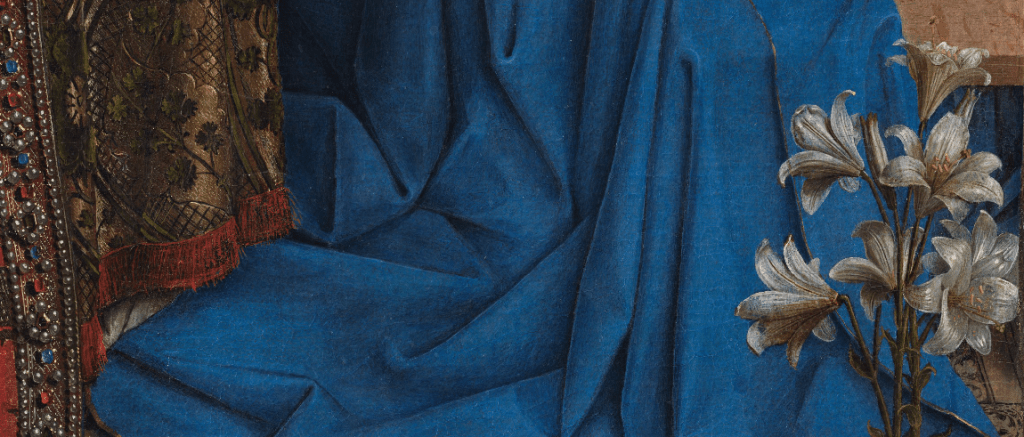
The picture is very tall and thin – which isn’t ideal for the formatting of this blog, I know – but implies that it might have been part of a larger ensemble. However, van Eyck created a number of small, devotional panels that fitted the taste of the times, which, especially in Northern Europe, was for private devotion at home. We see the Annunciation taking place in a church, and van Eyck was the first panel painter to do this. It relates to the idea that, as Mother of Jesus, Mary was effectively ‘home’ to him for the first nine months of his earthly existence (POTD 71). As the Church is also the House of God, there is an equivalence between Mary and the Church – she becomes elided with Ecclesia, the personification of the Church. That is why, in several paintings, although not so obviously this one, she is clearly out of proportion with her surroundings. Even here, were she to stand up, she would be roughly as tall as the arcade behind the angel. She has, as so often, been contemplating the scriptures, and Gabriel appears bearing his staff of office (POTD 70). No need to bring a lily for the expectant mother, as there is a vase full of them just in front of her lectern.

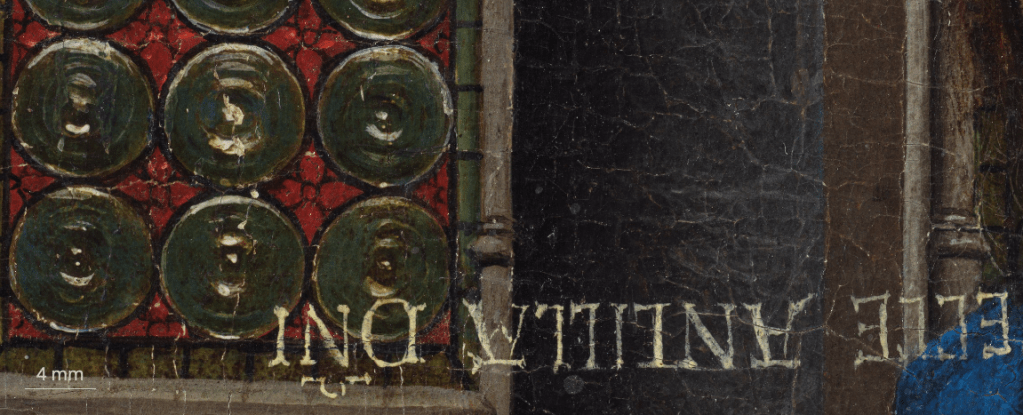
Mary wears a simple blue dress, matching her humility, whereas Gabriel is dressed in the most remarkable finery – ecclesiastical robes, as if the choirs of angels were a branch of the priesthood higher than the Pope, with richly coloured fabrics encrusted with pearls and jewels. He greets Mary with the traditional words Ave Gratia Plena – ‘Hail, Full of Grace’ and she responds Ecce Ancilla Domini – ‘Behold the Handmaid of the Lord’ – her humble acceptance of God’s chosen role for her. But she is replying to God, so she replies backwards, and upside down, making it easier to read for anyone looking down from heaven. The Holy Spirit appears from above, swooping down with urgency on beams of golden light, as the Light of the World comes into the world. Mary’s face is framed by three windows, symbolic of the Holy Trinity. Jesus is the second person of the Trinity, and the Holy Spirit is the third. God the Father’s presence is implied by the light coming through the window at the top left of the painting. The windows behind Mary are also a miracle of painting. The are constructed out of  ‘bullseye glass’, which was made by putting a blob of molten glass on a rod, and rotating it to spin it out into a flat disc. These circular sections are the very centre of those discs, where the glass can still be relatively thick, so that they act as irregular lenses, refracting the light from outside to show the sky at the top and the plants and buildings indistinctly at the bottom, the latter gradually filtering out as you go up the windows, apart from the places where the most extremely curved glass acts to make the dark areas still visible. They look almost photographic.

When you get in closer, you can see precisely how he did it, with a darker base colour painted over by tiny blobs and arcs of lighter paint. Simple when you know how, until you look at the scale – which I have left in – and realise that each individual bullseye is less than 1cm in diameter. These details come from my new favourite toy – a truly wonderful website called Closer to van Eyck – click on the link for hours of fun zooming in to see the most breathtaking detail. The interstices between bullseyes are filled with red glass painted to have four petals – the stylised flower almost certainly intended to stand for the Virgin, whose response can be seen here, each letter carefully and delicately painted on a tiny scale. 

The significance of the three windows behind Mary becomes particularly evident when you look to the top of the church interior, where there is just one window. The stained glass has a single figure underneath two multi-winged angels which are standing on wheels. These are Thrones, from the third choir of angels after Seraphim and Cherubim. I really must go through the angelic choirs properly one day soon! The single figure could easily represent God the Father, although his presence is implied, as we’ve seen, by the light coming through the window at the top left. The stained glass image, though, is in some ways more representative of the Old Testament idea of God, Jehovah, in his singular presence. He holds the bible – although I can’t read which words are written there, and stands on a globe. On either side are murals. I find it truly astonishing that van Eyck was so aware of the Romanesque style of painting, with its simplified, linear forms, densely packed folds, and broad arcing outlines. To the left the murals illustrate the discovery of Moses, as he is handed to Pharaoh’s daughter (POTD 21), a precursor of the Annunciation, in which Jesus is effectively ‘given’ to Mary. On the right, Moses receives the Ten Commandments from God. This is also relevant to what is going on below, as the Law of Moses will be transcended by the Grace of Christ.

If you get in closer, you can even read the words ‘non’ in some of the commandments – ‘thou shalt not’! And the globe on which Jehovah is standing is divided by the equator, with the lower half clearly labelled ‘ASIA’. As we saw in POTD 70, a monarch’s orb is divided into the three continents that were known in medieval times. 

The relationship of the Old Testament to the New is also explored at the bottom of the painting. Van Eyck has painted the floor to look like it has been decorated with sgraffito. There are various different techniques which use this term, but they are all related to the idea of scratching. Here the lines of the imagery have been incised into the marble floor, and then filled with a dark pigment, to make them stand out. The rectangular tiles show scenes from the Jewish scriptures. The clearest image is at the bottom of the painting, to the left of the footstool with its wonderful brocade cushion. It shows soldiers standing in a tent on the left, with someone chopping off the head of a very large man on the floor at the right – this is the story of David and Goliath, and stands for the triumph of good over evil. In the tile above that we see Samson pulling down the pillars of the temple, killing himself and many of the Philistines in the process. To the left of that image, but mainly covered by the angel’s robes, Goliath is killing even more Philistines in battle. The implication is that God will triumph. In the roundels at the corners of the decorative borders are the signs of the zodiac. The Church has had an ambivalent attitude towards astrology over the course of its history, but, when accepted, it is as a sign that that God has dominion over the whole cosmos, which he had, after all, created. One quite credible reconstruction of the decoration of this floor suggests that Gabriel has positioned himself on top of Aries, the sign which includes 25 March, the Feast of the Annunciation, whereas Mary is on top of Virgo – the Virgin. Overall, the references to the Old Testament at both the top and bottom of the painting suggest that the Annunciation marks the beginning of the New Order – the Law of Moses will be superseded by the Grace of Christ, and Jehovah, although still relevant, would be better understood in terms of the Holy Trinity.  

Obviously very few people would ever have understood all of these references – but then, a painting of this size would always have had a small audience, and the person for whom it was painted would have got it all – indeed, the patron probably specified precisely what van Eyck should paint. It was the artist’s skill to bring it to life, to make it look real – so that we would believe it. However, his style is almost too real, too crystal clear, every single detail is so specific – it becomes almost hallucinatory, which is precisely the point. The truth which he was illustrating should be clearer, brighter, more intricate than our normal everyday world, which, compared to heaven, was, for the theologians, as much of an illusion as this painting: our world won’t last (there are angels ripping it up in POTD 38). But the painting functions as a door into eternity, and the permanent reality of heaven – and an incredibly beautiful ‘door’ at that.

There is still time to sign up for my lecture tomorrow night, Wednesday 3 June at 6pm British Summer Time. I will be looking at other paintings by Jan van Eyck to explore the ways in which he used illusion to convince us that what we are seeing is true. Just click on the words Art History Abroad for more information.  

Day 75 – Pentecost II

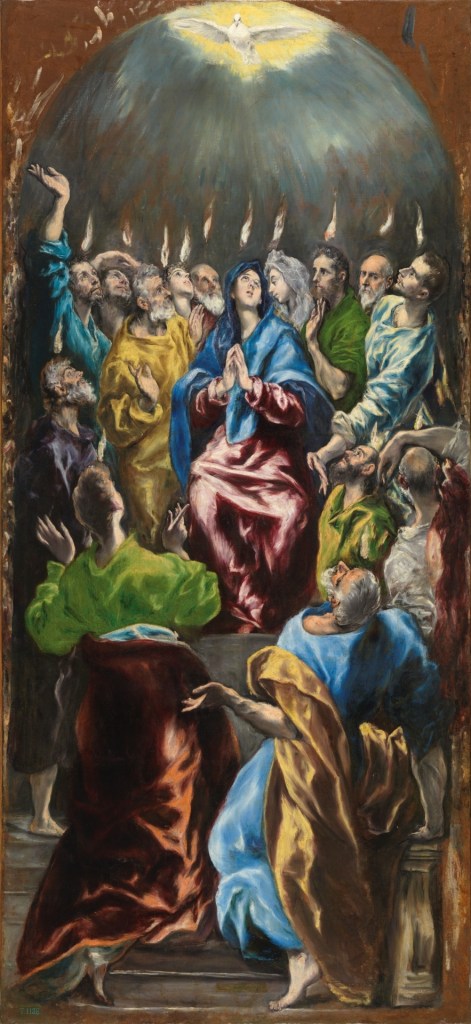
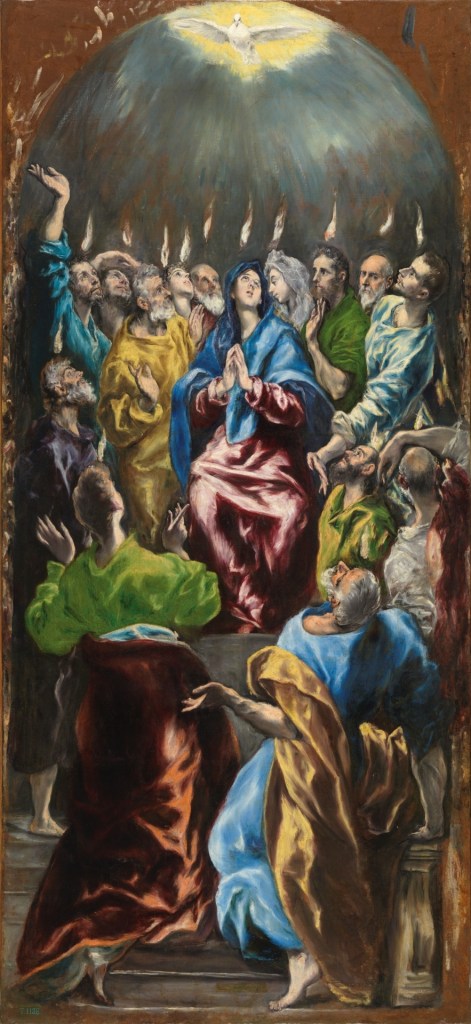
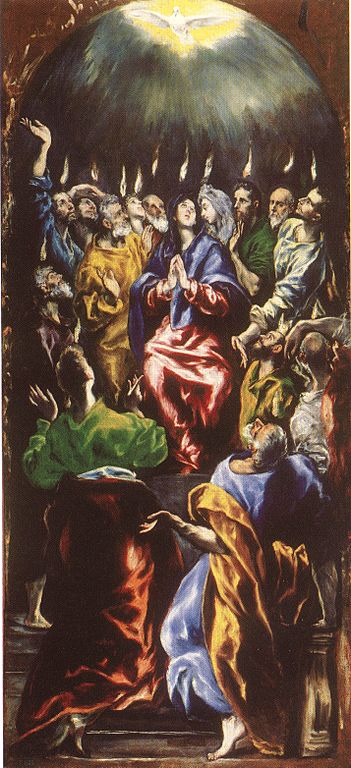
El Greco, Pentecost, 1596-1599, The Prado, Madrid.

To be honest, I couldn’t decide which picture to show you yesterday, either the painting by Plautilla Nelli (Picture Of The Day 75), or this one – so I decided I would talk about both. The theological content of the painting has been covered just as much as I wanted to then, though, so if you missed it, have a read of that first!

The basic ideas are of course similar to the two versions we saw yesterday. The Virgin Mary is central and surrounded by the apostles, who not only frame our view of the Virgin, but also allow our access to the group. Like Plautilla Nelli’s version, the tongues of flame rest above the heads of everyone present, although the mood is far more like the ecstatic transport of inspiration evoked by Botticelli, even if his broad, curving lines are replaced by El Greco’s flame-like, etiolated forms. I would like to say that the proportions of the figures are directly related to the subject matter, but by this stage in his career everyone El Greco painted was equally immaterial, expressing a religious fervour which is unparalleled in Western art.  His style does fit especially well here, though, and seems to predict the behavior of people in contemporary evangelical churches who are speaking in tongues – about which, of course, El Greco would have known nothing. As ever, I am intrigued by the number of people present: fifteen. The Virgin Mary, and the twelve Apostles, certainly – as in Botticelli – but also a couple of additions, although not as many as in Nelli’s painting. 

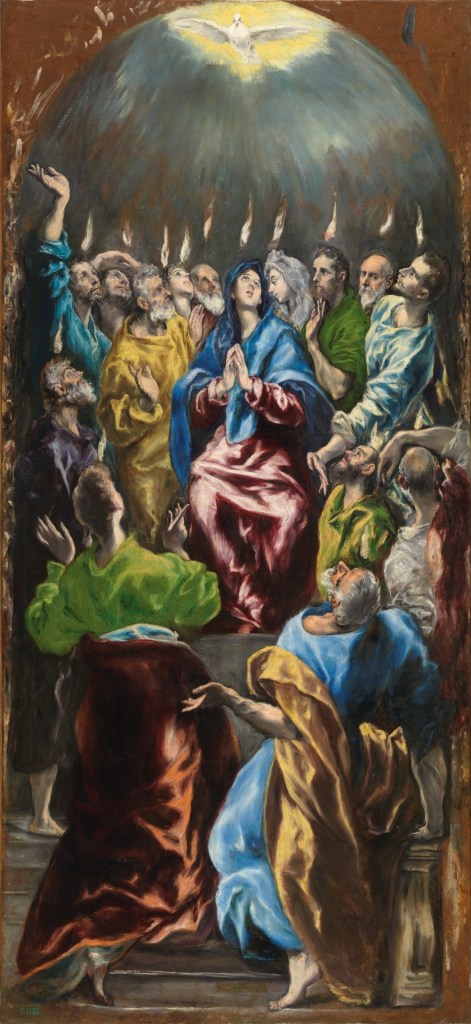
The peculiar appearance of this image relates to its structure. It is oil paint on canvas, and would originally have been framed with a semi-circular arch – so the brown sections top left and right would not have been visible. As it is, we can see how the artist used these spaces to wipe his brush clean from time to time. The dove of the Holy Spirit appears at the very apex, glowing in a yellow which was one of El Greco’s favourites – he often used it to structure the image, as we will see below. Rather than beams of light, it is the brushstrokes themselves which link the dove to the apostles, painted freely and thinly, with the rich, red-brown ground showing through, adding to the flickering of the tongues of flame. The gestures of the group add to this flickering, each hand appearing like another flame, blowing in the wind, as the apostles look around, at each other and upwards – with one exception: the face second from the right. This is always assumed to be a portrait, looking out at us. It is either El Greco himself (although it doesn’t look that much like the self portrait in his masterpiece, The Burial of the Count of Orgaz), or his friend, Antonio Covarrubias. It doesn’t look that much like him either, though. The other ‘excess’ person is Mary Magdalene, just to our right of the Virgin. To be honest, there is nothing to identify her – no jar of ointment, no flowing red hair – but there isn’t another single woman it could be. The apostle on the far left in blue lifts up his hand, connecting the main mass of the group to the sky, and so up to the Holy Spirit, and his gesture is echoed by the man in light blue on the far right, whose arm stretches downwards.

The arm reaching down connects the upper group with those lower in the composition. Given the tall, thin proportions of the painting, El Greco has to be extremely inventive in the way he fits everyone in. The hand that reaches into the lower group frames the face of the man in green looking up. He is the lynchpin, holding the top and bottom of the painting together, as El Greco keeps us looking up and down to draw the two halves of the painting into one whole. A man next to the apostle in green, wearing red and white, reaches his arm over his head, and looks into the painting, encouraging us to do the same – and at the bottom, two more people encourage us to look both in and up. On the left is a very young man in green and red (it’s a credit to El Greco’s art that he can make the back of someone’s head look so very young): this is St John the Evangelist. And on the right, leaning back, gesturing, in his traditional yellow and blue, is St Peter.

Notice how Peter’s yellow cloak reaches down to the very bottom of the painting. The yellow is picked up by the robes of the apostle just beside the Virgin, and then by the divine glow around the Holy Spirit: the yellow ties the whole painting together. Similarly John’s green ties him to the two apostles next to Mary, at both shoulder and knee height. The reds remain in the lower half of the painting. John and Peter seem transported, the one foot of each that we can see has just the toes touching lightly on the ground, and there is a progression of gestures upwards, from Peter’s left hand, through both of John’s, to the man in pale blue reaching down and the one in mid-blue reaching up.

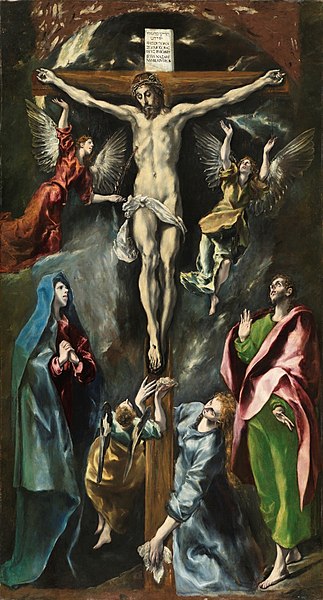
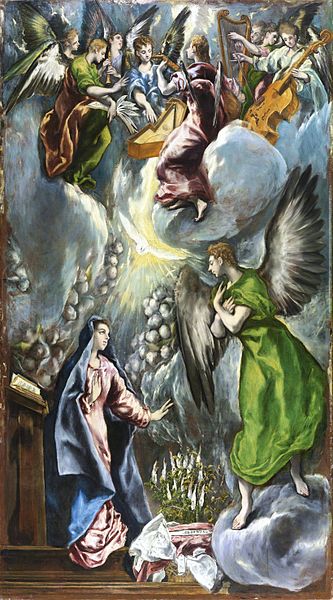
This is an example of El Greco at his very best, I think. If you want to catch up on his personal history, I talked about him a bit in POTD 19, but, in brief, Domenikos Theotokopoulos was born on the island of Crete in 1541, grew up there and trained as an Orthodox icon painter. Crete was part of the Venetian Republic, and in 1567 he moved to La Serenissima, where they couldn’t pronounce his name (well, that’s the assumption), so everyone called him ‘The Greek’ (although he was Cretan, all members of the Orthodox Church were referred to as ‘Greek’). He was hugely influenced by contemporary Venetian art, notably the works of Titian, and especially by the free-flowing, highly spiritual forms of Tintoretto. He moved to Rome in 1570, and then to Spain in 1577, settling in Toledo, the headquarters of the church in Spain (even now it stands in relationship to Madrid in the same way that Canterbury does to London). Today’s picture comes from his most important commission in Madrid, though, the altarpiece for the chapel of the Colegio de la Encarnación de Madrid, which was also known as the Colegio de doña María de Aragón. As a result, the ensemble is referred to as the Doña María de Aragón Altarpiece – although this is academic, as the altarpiece was dismantled in 1810 as a result of the Napoleonic suppression of religious orders. Five of the paintings are still in Madrid, and a sixth (bottom left) has somehow ended up in Bucharest. There is no known record of the original appearance of the altarpiece, although it is known to have included seven paintings and five sculptures – the seventh painting and all of the sculptures are presumably lost, or have not yet been identified. However, it seems likely that the lost painting went under the Annunciation, in the centre at the bottom. The surviving images were probably arranged something like this.

At the top, we see the The ResurrectionThe Crucifixion and Pentecost, and underneath The Adoration of the ShepherdsThe Annunciation, and The Baptism of Christ. This is a very rapid summary of Jesus’s life, death, and afterlife.

The remarkable thing about El Greco’s unique style was that, however popular it was with a particular clientele during his lifetime, it had no particular impact on other contemporary artists. However, it would ring true for so many painters in the 20th Century. Picasso’s blue and rose periods would have been almost unthinkable without El Greco, for example. On the Prado’s website you can find a video relating to their exhibition ‘El Greco and Modern Painting’, which they mounted for the 4th Centenary of the master’s death in 2014. I’ll leave you with one of my own comparisons chosen at random, though: Picasso’s Acrobat on a Ball of 1905.

Day 74 – Pentecost

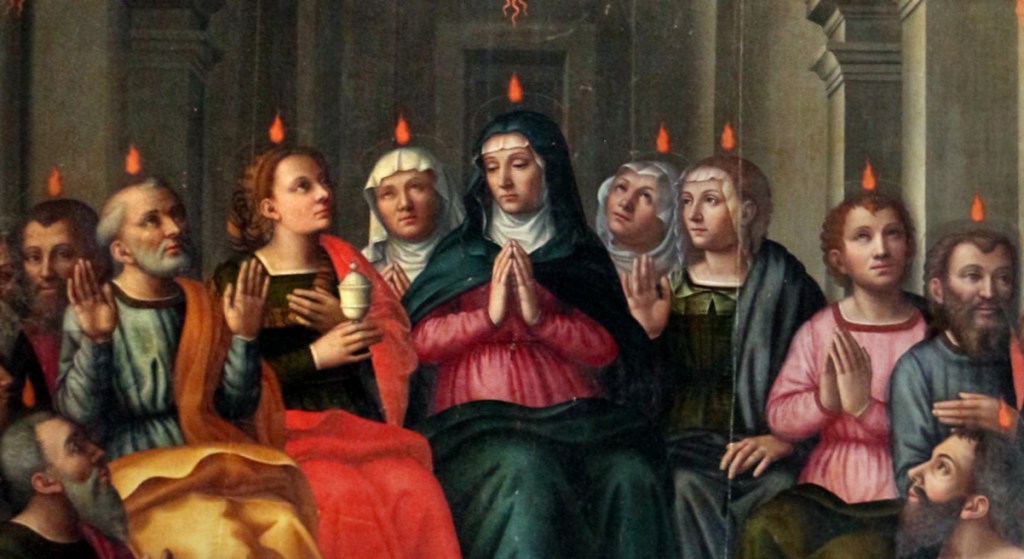
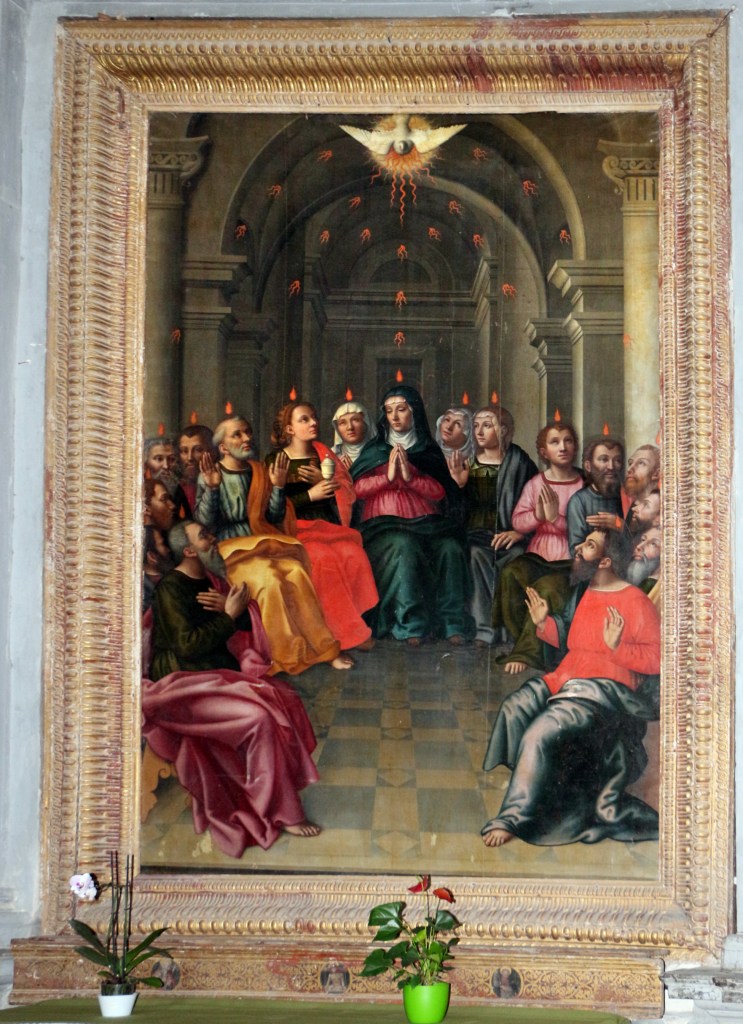
Suor Plautilla Nelli, Pentecost, 1554, San Domenico, Perugia.

Today is Pentecost, fifty days after the Resurrection, and ten days after the Ascension. According to the Acts of the Apostles, 2: 1-4:

And when the day of Pentecost was fully come, they were all with one accord in one place. And suddenly there came a sound from heaven as of a rushing mighty wind, and it filled all the house where they were sitting. And there appeared unto them cloven tongues like as of fire, and it sat upon each of them. And they were all filled with the Holy Ghost, and began to speak with other tongues, as the Spirit gave them utterance.

Not only did the Spirit give them utterance, but people of all nations could understand them in their own languages – the Apostles had been given everything they needed to go out and preach the Word of God. Jesus had announced this occurrence just prior to his Ascension (Picture Of The Day 64), when he said ‘But ye shall receive power, after that the Holy Ghost is come upon you: and ye shall be witnesses unto me both in Jerusalem, and in all Judaea, and in Samaria, and unto the uttermost part of the earth’ (Acts 1:8). We have seen a painting of Pentecost already – in the dome above the crossing in Ottobeuren Abbey (POTD 58) – but that was part of an entire decorative scheme. So today I want to focus on this remarkable altarpiece.

You may well be wondering, ‘what is so remarkable about that?’ and I wouldn’t blame you. It’s not the greatest painting I have ever shown you, and not only is it not terribly famous, it is almost completely unknown. As a result I don’t think it has been cleaned or restored for years, although the colours are both rich and intense. There are certainly no good photos of it to be found online – I suspect there aren’t any anywhere, for which I can only apologize. 

We see the apostles and Mary gathered in an upper room, seated in a horseshoe, leaving space for our approach. Their hands are held together, crossed in front of their chests, or held up, inflected at the wrists – all standard gestures of prayer at the time. Apparently in silence, they sit in their own private worlds, or look around at each other, or up towards the appearance of the Holy Spirit. The gestures are somewhat awkward – wooden even – which adds to the solemnity of the occasion, and to the sense that each individual is experiencing this event in their own way. We are pulled into the space by the strongly drawn perspective of the tiled floor, a combination of pale jade green and off-white squares, triangles, and rectangles. The architecture is High Renaissance in style, flanked by columns, and leading back between square piers supporting round arches to a distant doorway, which frames Mary’s head. Both this, and the perspective, make her the focus of our attention. There are seventeen people present, and, as with Perugino’s Ascension (POTD 64), I find the number surprising. Just before the descent of the Holy Spirit, in the last verse of Acts Chapter 1, Matthias was chosen to take the place of Judas – so there are now twelve apostles again, and, with the Virgin Mary, this makes thirteen. This is precisely the combination we see in a painting by Botticelli and his workshop from the Birmingham Museum and Art Gallery.

Painted on a monumental scale – the figures are more or less life size – it is not in a terribly good condition, unfortunately, and has been cut down on all sides. We do not know its original location, although it would have been an altarpiece, and, judging by the size and scale of this remaining element, quite an impressive one. It was painted some time between 1495 and 1505, when Botticelli and his art had come under the influence of the visionary Dominican preacher Girolamo Savonarola, who preached the end of the world (due in the year 1500), and the Bonfire of the Vanities. He had it in for the Renaissance, and wanted to destroy all the portraits, the pagan texts and images, the excess jewellery, clothing, and hair extensions… among other things. His followers were known as the piagnoni – or ‘cry babies’. Botticelli’s brother was definitely one of them, and Botticelli was inclined to be – his paintings changed, losing their elegant refinement, and taking on an almost visionary feel – the proportions shift, the figures grow, and the characters become more emotive, charged with an inner energy. All twelve of the apostles – Matthias included – are seated on a circular bench around the Virgin Mary, raised up on her own circular dais. Again, a space has been left so that we have access, and can participate in the event. The room is square, with three panels on each visible wall, implying that there would be another three where the picture surface is – twelve panels in all, one for each apostle. It is a symbolic space. Golden beams come down from the Holy Spirit, who is sadly absent, just one result of the poor condition of the painting.

Botticelli’s golden beams represent the ‘cloven tongues like as of fire’, which sat upon each of them’, an idea captured with both striking clarity and decorative elegance in today’s picture. The Holy Spirit appears in the form of a dove with a halo behind it and stylised flames licking out in every direction, although longer below. Scattered downwards are symmetrically arranged ‘cloven tongues’ which seem to sit on the surface of the painting – as if they had been applied in gold leaf. Behind them we see the carefully worked out perspective, but the ‘real world’ seems unconnected to the Spirit’s intervention. This is an other-worldly event we are witnessing, after all.

The tongues of fire really do sit upon each of the people present. And when we get this close, we can see who they are. On the left, hands raised, wearing yellow and blue with short grey hair and short grey beard, is St Peter. And on the right, with no beard, wearing pink and green, is St John the Evangelist, the youngest of the apostles. Indeed, he is the only man without a beard. In between Peter and John – and this is what is remarkable about the painting – there are five women. The Virgin Mary is in the centre, and to the left, with red hair, and wearing a scarlet cloak, is Mary Magdalene. She is carrying the jar of precious ointment with which she washed Christ’s feet in the house of Levi, and with which she was going to anoint his body in the tomb.

The Acts of the Apostles does not specify how many people were present at Pentecost, but earlier, after the Ascension, the eleven apostles had returned to Jerusalem and went to an ‘upper room’ – probably that represented in this picture. Acts 1:14 says, ‘These all continued with one accord in prayer and supplication, with the women, and Mary the mother of Jesus, and with his brethren’. Now, I’m not sure that we have the ‘brethren’ in this painting, unless they are counted among the apostles, but we do have ‘the women, and Mary the mother of Jesus’. It’s just that ‘the women’ are not usually represented. Who were they? Apart from the Virgin, and Mary Magdalene, the three others are potentially a third Mary, Joanna and Susanna. The first of these was with Mary Magdalene at the Resurrection (Matthew 28:1), while the other two are mentioned by Luke as people who supported Jesus (Luke 8:3).

Why do artists never include them? Well, my guess would be that none of the other artists were women. Suor Plautilla Nelli (1524-1588) is Florence’s first known woman artist. At the age of 14 she was put into a convent by her parents – hence the title ‘Suor’, meaning ‘Sister’ – standard practice at the time, as most families couldn’t afford dowries for more than one daughter. She entered the Convent of Santa Caterina on Piazza San Marco (it’s not there anymore), just over the square from San Marco itself, where Savonarola had made his mark as Prior. The nuns were overseen by the monks of San Marco, and although Savonarola was long dead (having organised the Bonfire of the Vanities, he was subjected to the same fate in 1498) his teaching lived on. He recommended that nuns should draw to stop them from becoming idle, and Nelli taught herself to paint: she never received any formal training, apparently. She is one of relatively few women mentioned by Vasari in The Lives of the Artists, and he thought that she, ‘would have done marvellous things if, like men, she had been able to study and to devote herself to drawing and copying living and natural things’. She seems to have become the chief artist for the Dominicans in Florence. If so, she was taking over this unofficial role from Fra Bartolomeo, whose work influenced her own in its broad, balanced, classicising forms – incredibly different from the ecstatic energy of late Botticelli, however much both were influenced by Savonarola.  She certainly inherited Fra Bartolomeo’s drawings, and possibly a lay figure – an articulated doll used as a model by artists – which was just as well, as, being a nun, she would never have had the opportunity to do life drawing from the nude. She even trained a number of her fellow nuns to work as her assistants, ending up with a sizeable workshop. By the end of the 16th Century, a third of the known women artists in Florence were Dominican nuns. Although she couldn’t sell her work, the convent could – and although she couldn’t leave the convent, her work travelled far afield: this Pentecost made it to Perugia, and is still to be found there, languishing in the Church of San Domenico. I shall finish with a rather sad photograph showing it falling out of what could be the original frame, with a couple of desultory plants sitting beside it. It looks even less remarkable here – until you stop and realise that, not only is the Virgin the focus of the painting (that was entirely traditional), but that there are four other women present, and they push the men to the edges. With five women taking centre stage and touched by the Holy Spirit, thus endowed with the ability to be heard and understood across the world, it is almost as if Suor Plautilla Nelli were advocating the ordination of women to the priesthood. 

Day 73 – Mary

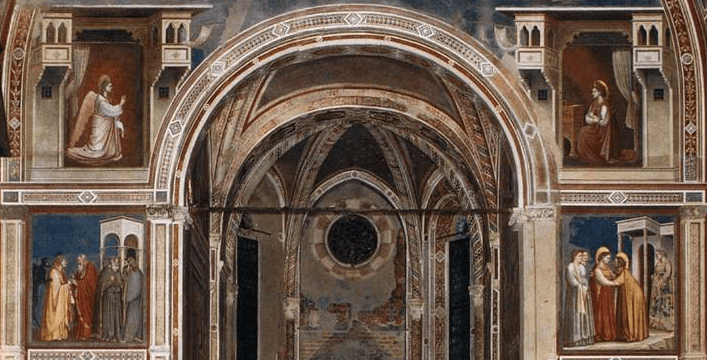
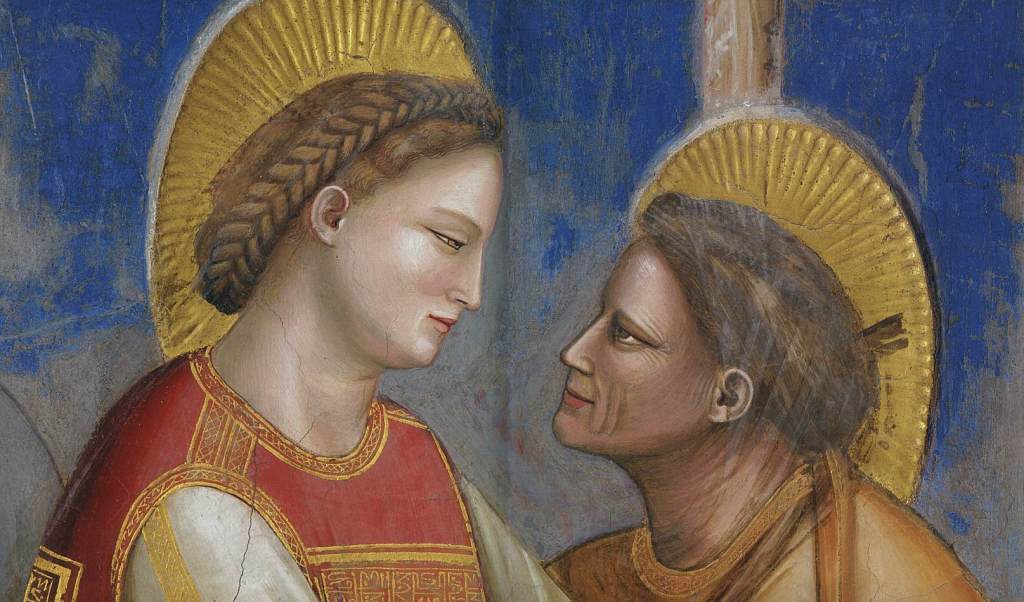
Giotto, Stories from the Life of the Virgin, c. 1305, Scrovegni Chapel, Padua.

Welcome back to Scrovegni Saturday – we’re well into the story. Joachim has been rejected from the temple, and as William Caxton put it back in 1483, ‘And then Joachim, all confused for this thing, durst not go home for shame’ (POTD 66). Meanwhile, Anna is waiting at home, and an angel has announced the birth of a daughter. Joachim (not Zacharias – yes, I did stick in the wrong name last week…) gives a sacrifice to God, which is accepted, and an angel tells him to go and meet his wife at the Golden Gate. Will he go? Of course he will!

Joachim and Anna meet outside the Golden Gate to the City of Jerusalem and embrace. Giotto gives us no doubt of the fact that they are together, and united, as he doesn’t leave a single gap between the two forms. With the haloes on top of their heads, the self-contained arching form resembles nothing so much as the Golden Gate itself – which was probably Giotto’s intention. One of the epithets applied to Mary was Porta Coeli – the ‘Gate of Heaven’ – as the birth of Christ meant that we could be admitted into the presence of God. Joachim and Anna are part of that journey – the gate to the gate, if you like. 

Neither of them has come unaccompanied. One of the shepherds has made what I assume is a rare visit to the big city, probably just to make sure that Joachim actually gets there. I love the way he is slightly sheepish, just emerging into the scene from behind the picture frame: people think this type of ‘photographic’ cut-off originated with the Renaissance in the 15th Century, but as with so many other things, they learnt it from Giotto. Anna is chaperoned by her maid, who we last saw dutifully spinning on the porch. She is carrying an expensive fur-lined coat, presumably in case Joachim is chilly. As it is, he is dressed remarkably like Jesus, with a red cloak over a blue robe. There must be a reason for this – his role in our salvation is the most likely thing I can think of at the moment, but if I come up with a better idea, I’ll let you know!

And the kiss! Ah – the kiss! Always one of the true joys of this chapel, given the way he firmly clasps her shoulder, and she tenderly cradles his head between her hands, running her fingers through his beard. They go almost cross-eyed, looking at each other in such close proximity, and there is that sense of a nose-bump, narrowly avoided, as their lips touch. They just touch, with no sense of parting, and certainly no tongues – the ultimate chaste kiss. It was at this moment, some people believed, that the Virgin Mary was conceived. But very few people ever thought this – hers was not a virgin birth. However, it does represent the Immaculate Conception (POTD 71 &72), given the chastity of Anna and Joachim’s love. And let’s face it, you’re not going to show the conception in any other way, this is a chapel, for heaven’s sake, not the Palazzo Te (POTD 44 & 53). Look at the delicate transparency of Anna’s veil – and the careful attention paid to every single grey hair of Joachim’s head. It’s a miracle. It’s also the point in the story when things start to get interesting in terms of the arrangement of the paintings. 

First of all, we have a cast of characters – quite apart from Joachim and Anna, we have the shepherd, and the maid, who reappear from earlier paintings.

Also, we have a complete story – ‘Chapter 1’, if you like – starting with Joachim’s rejection from the temple, and ending here with his acceptance at the Golden Gate. Both buildings are angled inwards, each with its own entrance. Joachim’s role as protagonist is done now: he has come home, and his part of the story is over. At this point, we have to cross the chapel, and start at the top of the left-hand wall.

‘Chapter 2’ starts with the Birth of the Virgin. Mary has been born, and is washed and swaddled by two midwives, who are sitting on the ground: one of them is the trusty maid, showing her true value to the household, as she can perform more than one role. Anna sits up in bed, covered by a sheet and a rather grand bedspread. No, they didn’t have twins, this is a continuous narrative, with different stages of the story shown together. The maid was preparing a finer fabric to wrap around the swaddling clothes, and duly prettified and safely contained, Mary is presented to her mother. Friends have come round to visit the newborn miracle, and yet another turns up with a gift at the door. And if you think you recognise the setting, you would be right.

It is the same house that we saw on the opposite wall. I wouldn’t mind betting that it was the maid who took out the chest and bench to allow more guests to visit. Like all good theatre designers, Giotto has allowed the furniture to be flexible. It is the same: the same bedspread, the same curtain hanging from the same frame, but slightly shifted to enhance the narrative. The lighting is different, too: it’s the same building, but at a different time of day. In fact, it is night time: it looks dark through the window. I know the sky is still blue, but that is ‘heavenly background’ as much as anything else. It also needs to fit in with the other frescoes, and wouldn’t look that good if it were all black. Notice that, whereas Anna was kneeling in prayer, looking to the right (the direction of the narrative), it is now Mary who is handed over to the right. This is her story.

According the Golden Legend, when Mary was three, Anna and Joachim took her to the temple. This is from Caxton’s translation:

…they brought her to the temple with offerings. And there was about the temple, fifteen steps to ascend up to the temple, because the temple was high set. And no body might go to the altar of sacrifices that was without, but by the steps.  And then our Lady was set on the lowest step, and mounted up without any help as she had been of perfect age, and when they had performed their offering, they left their daughter in the temple with the other virgins, and they returned into their place. 

Two things are actually different here – one is that there are only 10 steps, rather than 15, and the other is that Mary has not set off on her own. Like any small child on their first day at school Anna has had to encourage her all the way to the top. Mind you, faced with that priest I don’t suppose most 3-year-olds would have been that keen. There’s no particular reason why Giotto should diverge from the text – but then, there was no particular reason why he should stick to every detail.

The Golden Legend doesn’t specify what the ‘offerings’ were, but they were clearly heavy. Joachim doesn’t carry them himself – they have a servant for that – and even though they only fill one basket, the servant is bent low by the weight. Giotto attempts a particularly daring foreshortening, quite hard to read from a distance, and one of the most unusual views of the human figure I know before the 16th Century.

It is the same temple as we saw in the very first painting – and yet we are on the other side. You see the same ciborium or ‘canopy’ over the altar, and the same raised pulpit, high enough over the screen for the entire congregation to see. These are features of medieval churches, of course, rather than having anything to do with Solomon’s temple, or, for that matter, a synagogue. One of my friends said it reminded him of a piece of theatrical scenery on wheels, and he’s absolutely right – Giotto has simply turned it round. I say ‘simply’ – this is a rather complicated thing to do, and, if we’re honest, it is another one of those theatrical tricks where it looks like the same building, but in reality it is slightly modified.

Mary lives with the other virgins (small ‘v’) in the temple until she is 14, when all of the others find suitable spouses. This is where I started back on the very first Scrovegni Saturday, POTD 31. If you re-read that, you will get the long story – but here it is, short. All the eligible bachelors were asked to come to the temple with rods, and place them on the altar. Nothing happened, so they put out a second call, and it turned out that an old guy called Joseph hadn’t come forward. When he did, his rod flowered, and a dove landed on it – so he got to marry Mary. The rest were furious. At this stage, they are only being betrothed – i.e. engaged – the wedding was to follow some time later. Now you might want to argue that this is not the same temple we saw before, but the reason for this comes from Caxton’s text. He talks of  ‘the altar of sacrifices that was without’ – which is the one under the ciborium, and the one which Joachim had attempted to go to before. For this part of the story we are clearly at an altar that is ‘within’.

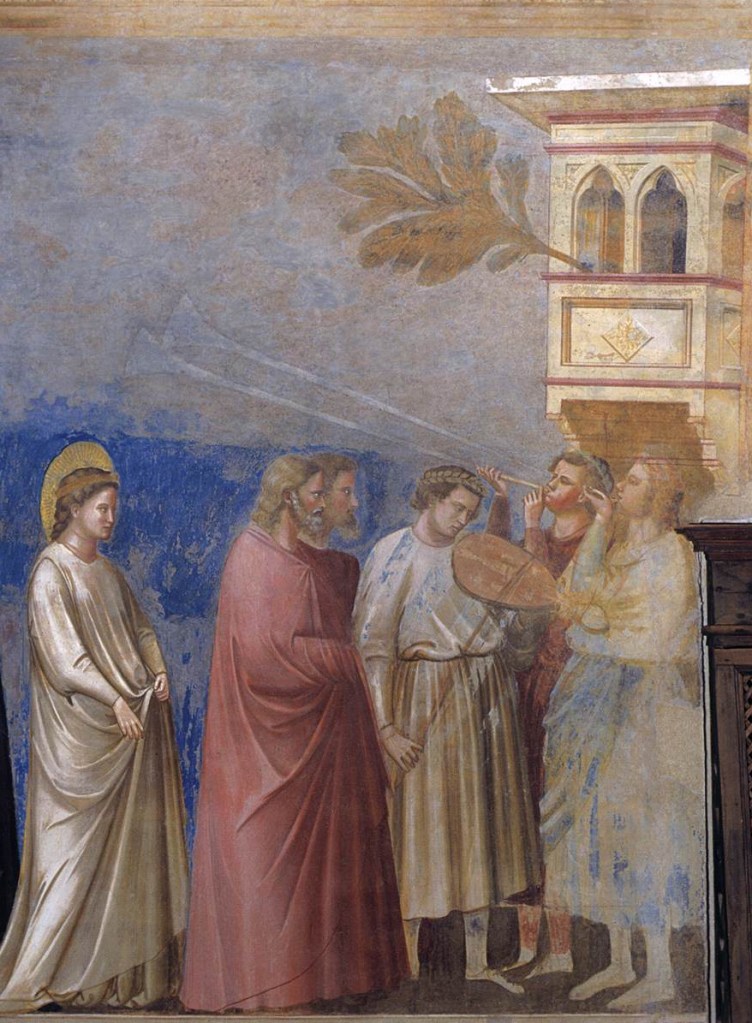
After the betrothal, Mary was taken in procession to the house of her parents, followed by the other virgins, and led by a viol player, and a couple of elders. She is welcomed home by two ceremonial trumpeters. I’m afraid I don’t know why this particular part of the fresco is in such a bad condition – it is due to humidity, but I don’t know why that should have been so bad here. It might have something to do with the part of the Scrovegni Palace which was, until the 19th Century, behind this wall, or whatever happened to this bit of the wall when the Palace was destroyed. The two trumpets were clearly painted a secco – after the plaster had dried – meaning that the paint was not bound to the wall, and has completely gone. Alternately, they could have been gilded, although why the gold should go here, and not on the haloes, I don’t know. A bay window from the house makes it onto this wall: we’ll see more of that when we come back next week.

p.s. As suggested yesterday, I will be giving two online lectures this week:

• if you want to tune in to Artemisia on Monday morning at 11am, please email trish@summerleazegallery.co.uk

• if you would like to sign up for Seeing is Believing: van Eyck and the Art of Illusion at 6pm this Wednesday, 3 June, please go to the Art History Abroad website by clicking on the words Art History Abroad! Mix yourself a cocktail before you sign on – I will!

I’ll start updating the ‘diary’ on the website soon…

Day 72 – Immaculate Conception II

Diego Velázquez, The Immaculate Conception, 1618-19, National Gallery, London.

Don’t worry, this isn’t going to be a series! But it is a chance to talk about a very beautiful painting… and to bring us up to date with the doctrine of the Immaculate Conception. I explained yesterday (Picture Of The Day 71) that there were two main theories – one that Mary had been conceived with sin, and later ‘sanctified’, the second, that she was conceived free from original sin. The latter is the doctrine of the Immaculate Conception, whereas the former is seen as the ‘Maculist’ doctrine. The adherence to these two doctrines was divided between the two leading Mendicant orders, with the Franciscans originating and then promoting the theory of the Immaculate Conception, while the Dominicans held firmly to the Maculist doctrine. The Spanish got increasingly worked up about this, and eventually King Phillip III (who is rarely mentioned in the annals of Art History) lobbied Pope Paul V (Uncle of Scipio Borghese, who owned many sculptures by Bernini, e.g. POTD 56, so is) to have the Doctrine of the Immaculate Conception declared dogma – i.e. an item of faith that is incontrovertibly true. Paul V didn’t go that far, but in 1617 he did issue a decree forbidding any public defence of the Maculist doctrine of sanctification. And the following year, Diego Velázquez painted this beautiful image.

You might think that it couldn’t look more different from the painting we saw yesterday, but, bearing in mind that Carlo Crivelli was working in the late 15th Century, and we are now in the early 17th, and given the vast stylistic difference, they are remarkably similar. Both feature the Virgin Mary, alone, standing, and praying. And in both, she has long blonde hair – this is certainly what counts as ‘blonde’ (‘rubia’, as it’s the Virgin) in Spain.  The fact that her hair is allowed to hang freely, undressed (even if it is partially covered in the Velázquez), implies that this woman is not of marriageable age – or, at least, not yet married – the implication being that she is a virgin.

Her hair seems to blow slightly in the breeze – and a sense of gentle movement flows throughout her entire body, with her young face, entirely unmarked by any blemish (the immaculate complexion?), turned slight to our left, with her hands inflected to our right. She looks down, with modesty and humility, her face illuminated from above and to the left – it’s so delicately painted that even her eyelashes cast a shadow. It is an entirely ‘sculptural’ depiction: young Diego may have started his training painting sculptures, which might have helped him to model form when painting on a flat surface. He was still young when he painted this – twenty, at most, when it was completed. Mary herself has a faint glow, with a gentle light radiating from her head, which is surrounded by a ring of twelve stars. And to her left and right there is a yellow glow on the inside of the clouds.

She stands on the moon, an inverted crescent, which becomes transparent, allowing a view of the distant mountains, and the landscape is populated with various symbols of her perfection – a fountain, a temple, trees and a ship. They are all there, although, if I’m honest, I can’t see them all on my rather shiny screen! Many of these derive from the Song of Solomon. For example, 4:15 mentions ‘A fountain of gardens, a well of living waters’. Yesterday I quoted the figure of ‘Wisdom’ from the book of Proverbs – she also speaks in Ecclesiasticus, and in 24:13 says, ‘I was exalted like a cedar in Libanus, and as a cypress tree upon the mountains of Hermon’ – hence the tall trees. I won’t go into everything, though. Overall, however, the imagery comes from the Book of Revelation, 12:1-3:

And there appeared a great wonder in heaven; a woman clothed with the sun, and the moon under her feet, and upon her head a crown of twelve stars: And she being with child cried, travailing in birth, and pained to be delivered. And there appeared another wonder in heaven; and behold a great red dragon, having seven heads and ten horns, and seven crowns upon his heads.

Not all of this will appear that relevant just yet… but the key part is the first verse ‘a woman clothed with the sun, and the moon under her feet, and upon her head a crown of twelve stars’. This vision of the Woman of the Apocalypse, who gave birth and defeated the ‘dragon’, was interpreted very early on as representing the Virgin Mary, and it was in this specific form that the doctrine of the Immaculate Conception would be represented in paintings. The National Gallery’s example is one of two related paintings, which Velázquez made as part of the same commission. Here is a detail of the second, John the Evangelist on the Island of Patmos.

It shows a surprisingly young, and Hispanic-looking, John the Evangelist, looking up to precisely the image evoked by the verses quoted above, even if the stars seem to have shifted towards the dragon.

When seen with the Immaculate Conception it becomes clear that they are a pair – John is having the very vision which will become the iconography of the other painting.  But this doesn’t explain the youth of John. Apart from historical reasons why the Book of Revelation couldn’t have been written by John the Evangelist, about which, if I’m honest, I know nothing, it was supposed to have happened late in his life, after a couple of attempts to martyr him. By the time he gets to Patmos he is usually shown as an old man with a long white beard. Here, he is still represented as if he were the youngest of the apostles. One theory to account for this is that the two models for John and Mary were the artist himself and his new, young wife: he married Juana Pacheco on 23 April 1618, five and a half weeks short of her sixteenth birthday. He was marrying his master’s daughter, in the same way that he would marry his elder daughter Francisca to one of his pupils, Juan Bautista del Mazo, when she was only 14… 

I mentioned Francisco Pacheco, Velázquez’ master, back in POTD 20, saying that, as well as painting, ‘His job was to make sure that the religious images were not heretical’ – and yes, he was involved with the Spanish Inquisition. I bet you weren’t expecting that, even though I have mentioned it before… Many of his thoughts and ideas were eventually published in ‘The Art of Painting’, which came out in 1649, five years after his death. Pacheco’s guidelines for the correct depiction of the Immaculate Conception are especially relevant:

Our Lady should be painted as a beautiful young girl, 12 or 13 years old, in the flower of her youth. She should be painted wearing a white tunic and a blue mantle. She is surrounded by the sun, an oval sun of white and ochre, which sweetly blends into the sky. Rays of light emanate from her head, around which is a ring of twelve stars. An imperial crown adorns her head, without, however, hiding the stars. Under her feet is the moon.

Velázquez follows most of these guidelines, if not all – there is no imperial crown, for example, although he does paint her tunic an imperial purple, rather than white. It’s worthwhile comparing Diego’s image with one painted by his master at about the same time.

Pacheco does include the imperial crown, but even he doesn’t paint a white tunic. There are some of the same symbolic elements at the bottom of the image as well, with a few extra for good measure, not to mention a portrait of the donor, Miguel Cid, a poet. This was painted in 1619, so potentially after the version by Velázquez, but there is little reason to doubt that the nature of the imagery – the iconography – was defined by the master. It’s just the style: what becomes immediately clear is that Velázquez was an infinitely better artist. All of the elements may be the same, or similar, but even in one of his earliest paintings Velázquez shows himself to be free of the last vestiges of Mannerism to which Pacheco is clinging. However artificial and symbolic the representation of the Immaculate Conception could appear, Velázquez manages to make it flow, and look entirely natural, and extremely beautiful.

The two images by Pacheco and Velázquez were undoubtedly painted in the rush of enthusiasm that flowed from Paul V’s decree of 1617 – and Pacheco painted several more. But this enthusiasm was not restricted to Spain, and spread across the whole Hispanic world.

Here, for example, is a detail from an announcement of the decree, dated 31 August 1617, which was published in Lima – it comes from the National Library of Peru. The coat of arms of Paul V Borghese, with its eagle and dragon (POTD 56) appears top left, and that of the Kingdom of Spain is top right. In the centre is an image of the ‘Immaculate’ not unlike these paintings. As it happens the name Immaculada is popular to this day, and Concepción is not unknown… But for Paul V the Immaculate Conception was still a doctrine, and not dogma. It was Pope Pius IX who finally declared it to be an essential belief for all Roman Catholics, and made the Feast of the Immaculate Conception (8 December) a holy day of obligation, on which all Catholics are supposed to attend mass. And that didn’t happen until 1854. By this stage the doctrine had been around for half a millennium… 

p.s. 1 If you had been expecting the Spanish Inquisition, you will have known that I was referring to Monty Python. I’ve always been a fan, but hadn’t seen any for years – decades even – and re-found them on NetFlix, where all four series and all of the films can be found. Their brand of surreal, irrational lunacy seems to fit the present time, even if issues of gender and race are problematic half a century on. I have always known that the foot that comes down at the end of the credits is taken from Bronzino’s Allegory with Venus and Cupid in the National Gallery, but I hadn’t realised what a regular visitor to the Gallery the animator Terry Gilliam must have been – there are figures taken from the collection peppered throughout the early series. I was especially delighted to see God the Father from Crivelli’s Immaculate Conception (yesterday’s POTD) appear at the end of the credits of series 1 to castigate a female nude. 

p.s. 2 I have finally been dragged kicking and screaming into the 21st Century, and have agreed to give a couple of zoom talks this week. The first, on Artemisia Gentileschi, is for the Summerleaze Gallery in Wiltshire. To be honest, I’m not quite sure how it’s going to work, but if any of you would like to join at 11.30 (UK time) on Monday morning, please email Patricia Scott Bolton on trish@summerleazegallery.co.uk and she will let you know! I’ll tell you about the second, currently scheduled for 6pm on Wednesday, if it happens, and if I’m allowed to!

p.s. 3 Inevitably the gradually easing of lockdown will mean that I’ll have to go and earn a living, which will mean less time, which will mean it might not be possible to sit and write about a Picture every Day… but I’m still thinking about that. Meanwhile, as I’ve said before (though not for a long time), if there’s anything you’d like me to talk about, please let me know!

Day 71 – The Immaculate Conception

Carlo Crivelli, The Immaculate Conception, 1492, National Gallery, London.

Right. I warned you (Picture Of The Day 66). I have to talk about the Immaculate Conception, and anyone who has ever been anywhere with me knows I go on about this all the time, because, quite simply, it is the most misunderstood aspect of Catholic theology. And trust me, it has almost nothing to do with Jesus.

Carlo Crivelli, about 1430/5 – about 1494 The Immaculate Conception 1492 Egg on wood, 194.3 x 93.3 cm https://www.nationalgallery.org.uk/paintings/NG906

Carlo Crivelli’s painting is the first known altarpiece to depict this idea – although that does depend on how you define ‘depict’ – both versions of Leonardo da Vinci’s Virgin of the Rocks were painted for the Confraternity of the Immaculate Conception in Milan, for example. It may not be immediately clear that Crivelli is depicting this particular aspect of the Virgin Mary – indeed, it might not be obvious that this is Mary at all, as she doesn’t have her main attribute, the symbol which helps us to identify her – Jesus. Before the end of the 15th Century it was very unusual to see Mary on her own. She is standing in a niche which seems to double as an altar, with flowers on either side. Fruit and vegetables hang from a cane, over which is thrown a pink cloth, which frames her body and goes under her feet. Her hands are joined in prayer, with God the Father looking down from heaven, while two angels fly in between, holding a banner. It will be easier if we look at it from top to bottom.

The figure of God the Father is beautifully foreshortened, not unlike Uccello’s version in The Sacrifice of Noah (Picture Of The Day 37), although the right way up. He appears from the blue-ish clouds, the colour echoed in his cloak, which flows out on either side almost more like a thick, crumpled foil than fabric, its hem creating the most wonderful, erratic, inflected line, as the colours shift from the green lining to the blue outer side. Above, or behind, his head are a host of angels, red heads with wings – these are the Seraphim, the highest rank of the 9 choirs of angels, and closest to the throne of God. Below them we see two ‘regular’ angels, from the choir closest to humans. Also, under God the Father’s hands, is the dove representing the Holy Spirit. In other circumstances we would expect to see the third person of the Holy Trinity, God the Son, below – but instead, we see Mary, his mother.

The two angels look up to God, while simultaneously holding both a scroll and a crown over Mary’s head. The crown, like Mary’s halo, and the sun and moon on either side, are tooled into the background. After the gold leaf had been applied and burnished, small metal tools were held against the surface of the gold and tapped with a hammer, thus denting it slightly. When candles were lit in front of the painting, the light would catch the different surfaces of the gold, so that the halo, crown, sun and moon would shimmer. The crown also has details painted on – there is a spherical ruby towards the left, given light and shade, and a white highlight, to make it look three dimensional – whereas the tooling actually is three dimensional. Crivelli’s use of gold leaf even at the end of the 15th Century often makes people think that he was an out of date artist, clinging on to medieval ideas, but he was actually playing with them in a far more sophisticated way. Look at the foreshortening, after all. 

It is, of course, the scroll which is the most important feature for our understanding of this painting – and indeed, for the understanding of the concept of the Immaculate Conception. It reads:

VT•INMENTE•DEI•ABINITIO•CONCEPTA•FVI•ITA•ET•FACTA•SVM.

Which roughly translates as: ‘In the same way that, from the beginning, I was conceived in the mind of God, so have I been made’. The implication is that God always knew that Mary would exist. The idea comes from various biblical texts, the most relevant probably being some verses in the book of Proverbs, in which the character of ‘Wisdom’ is speaking. This is Proverbs 8: 22-23, although the relevant section carries on until verse 35, if you want to look it up. As ever, I am quoting from the King James Version: 

The Lord possessed me in the beginning of his way, before his works of old. I was set up from everlasting, from the beginning, or ever the earth was.

Another relevant text is in the Song of Solomon, 4:7:

Thou art all fair, my love; there is no spot in thee.

The relevance of this becomes clearer if we see the same verse in Latin: Tota pulchra es amica mea et macula non est in te – the Latin version of ‘spot’ is ‘macula’ – so if there is no ‘spot’, there is no ‘macula’ – i.e. Mary is ‘Immaculate’ – without a mark or stain. She is free of Original Sin. 

There are obviously quite a few leaps of faith here. First of all the biblical texts, both from the Old Testament – i.e. the Jewish Scriptures – do not mention Mary at all. But the assumption of the early Christian theologians was that the Jews had been on the right track, but, as they were born before Jesus, it was not surprising that they had not quite understood God’s message in the right way. Every verse of the scriptures was sifted to find any possible relevance to Christianity, the main aim being to prove that Jesus really was the prophesied Messiah. But along the way, it also became important to find texts that were relevant to Mary too. And that was because of a fundamental problem: Original Sin. The argument goes that, because of the Fall, all descendants of Adam and Eve do wrong. Jesus came to Earth, became human, died as a sacrifice to forgive us for our sins, and triumphed over death, so mankind is redeemed. But in order to become human, he had to be born, and all humans were sinful. How could the Son of God – God himself in one person of the Trinity – be born of something sinful? This was a proposition that many theologians could not tolerate. The only solution was that Mary must have been free of sin in some way – although before Christ’s triumph over death, how was that possible? There were two main theories: 1) Mary was conceived with sin, and somehow, through a special dispensation, God cleansed her of sin in the womb or 2) she was conceived free of sin, without stain or mark, immaculately. The Immaculate Conception. The latter theory was favoured by the Franciscans, and given far greater prominence by Pope Sixtus IV, himself a Franciscan, who instituted the Feast of the Immaculate Conception in 1476. The feast day is 8 December, nine months before the Birth of the Virgin, which is celebrated on 8 September. What should be clear from this is that the Immaculate Conception refers to the Conception of the Virgin Mary within her mother Anna’s womb, free from Original Sin. As I said, it has almost nothing to do with Jesus (at this stage). How that conception was achieved is not necessarily part of the issue, but most theologians believed that it was a standard sexual conception, with Joachim and Anna somehow not entertaining any sinful thoughts or carrying out any sinful deeds. And just in case I have not made myself clear enough, listen very carefully, I shall shout this only once: THE IMMACULATE CONCEPTION IS NOT THE SAME AS THE VIRGIN BIRTH.

What it comes down to is that God knew that giving people freedom of action meant that mankind would sin, and so would have to be redeemed, so Jesus would have to be born, so Mary would have to be free of sin, so he conceived her in his mind before the world began. That’s what the banner means. On to the rest of the painting.

We see Mary surrounded by fruit and flowers, vegetables and vessels – all are symbolic. Mary is fertile – unexpectedly as a Virgin, maybe – but all of the fruit and flowers can refer to that in some way. However, for some, the symbolism is far more specific. The apple, far left, is the standard symbol for original sin, even though there is no mention of an apple in the Book of Genesis. However, it is far easier to say ‘apple’ than ‘the fruit of the tree of the knowledge of good and evil’, so the apple has always got the blame. However, some people blamed the fig, the orange, or even the quince. Other fruits are available. The oversized gerkin is a bit of a problem, but something with which Crivelli was obsessed – it occurs in many of his paintings. I favour its identification as a gourd, mentioned in the Book of Jonah, towards the end of which Jonah sits in the shade of a gourd tree as God forgives the people of Nineveh. If the apple represents sin, then the gourd represents forgiveness. On the other side there are pears – which in some way represent the birth of Christ, and Mary’s fertility, although I’ve never found a convincing reason why. This is the point at which people google it and tell me what they’ve found, imagining I’ve never thought of doing that – well, I’ve just found a website that says that the pear is a symbol of marital fidelity, but that same site says that grapes are a symbol of ‘lewdness and lustful thoughts’, which implies that the author knows absolutely nothing about Christian art, or, for that matter, Christianity – so don’t believe everything you read online. Which, I suppose, would include this blog… oops. Moving on – the peach. Well, it’s a sweet fruit with a stone from which life will grow. I’m going for Mary, containing Jesus – that’s certainly the symbolism of the hazelnut (which is not in this picture, I know…). 

And then, the flowers: roses – white for purity and red for passion, as in the passion of Christ, the red being his blood. Also, Mary was described as a ‘rose without thorns’ – the beauty, but without the sin, effectively. And the lilies – well, the white of her purity, which is made explicit in another verse from the Song of Solomon, 2: 2: 

As the lily among thorns, so is my love among the daughters.

And, as I suggested, the vessels are also symbolic. They contain water, and Jesus is the water of life, and he was in Mary’s womb for 9 months – so they are both symbolic of Mary, the ‘vessel’ containing Christ. The glass vase is more profound. Light passes through glass without breaking it, in the same way that Jesus, the light of the world, passed through Mary, without breaking her virginity. Stained glass in churches is even richer in symbolism, as the light passes through the coloured glass and takes on its colour, in the same way that the light of the world passed through Mary, and took on her humanity. 

The cloth behind Mary reminds us that she is royal – she will be crowned Queen of Heaven – and a royal court was always established by hanging a cloth of honour, in front of which the monarch stood or sat. It hangs down, and falls over the step, so it also functions as a type of ‘red carpet’, and Mary doesn’t have to sully her feet on the ground.

Finally, at the very bottom left, we see Crivelli’s signature: KAROLI CHRIVELLI VENETI MILITIS PINXIT 1492 – ‘Painted by Sir Carlo Crivelli from Venice, 1492’. He was very proud to have come from Venice, one of the great centres of art, even though he didn’t hang around there long enough to paint anything. He was also inordinately proud his knighthood, awarded the year before this painting was completed. He also liked to play games with reality, and here he is pretending that his signature is written on a piece of paper which he has attached to the marble step with six blobs of red wax. Quite a few artists played this game, which makes us think that maybe artists really did this. It is one of the suggestions why so many German paintings are not signed: it is possible that they were, but that the pieces of paper with the names on have all fallen off. He really shows his brilliance with illusionism here – look at the subtle shift in the patterning of the fabric from silver to grey as it goes over the step, and the shift back to silver again as the pressure of Mary’s foot makes the cloth wrinkle and catch the light. The toe of her pink slipper sticks over the step and into our space… she is there with us. All of this is done to make her present, to make us believe in her, and to help us to understand the concept of the Immaculate Conception. It’s flawless.

Day 70 – The Annunciation, again

Veit Stoss, The Annunciation, 1517-18, St Lorenzkirche, Nuremberg.

It’s been over two months since I last discussed The Annunciation. Back then it was the calm, rational, yet mystical version by Piero della Francesca, which is at the heart of his True Cross cycle (Picture Of The Day 7). I’m surprised I haven’t talked about more versions, there are so many. But on Sunday, I was talking about Mercury’s caduceus – his staff of office (POTD 67) – and I said that the Archangel Gabriel used to have one too – a staff of office, that is, not a caduceus. As far as I’m aware, Mercury is the only person to have one of those. From classical to medieval times – and beyond – messengers showed their authority to convey messages by carrying a staff or rod, and this is what Gabriel holds in early representations of the Annunciation. He still does in Veit Stoss’s magical polychrome sculpture in the Church of St Laurence – the Lorenzkirche – in Nuremberg, even though that doesn’t really class as ‘early’

The sculpture hangs from the vaulted ceiling on a chain, and has done almost constantly since it was completed in 1518. At one point there was a petition to replace the chain with a hemp rope, as that would be cheaper, but, although the petition was successful, the rope broke. It was also taken down and stored during the Second World War, which was just as well, given that the church was completely gutted. The ceiling you see here dates from the 1950s, but gives an entirely convincing sense of the lofty heights of the brilliantly illuminated medieval church. The stained glass is also original – like the Annunciation it was removed and preserved – as was the elaborate candelabrum to the right of the image, which is topped by a small sculpture of the Virgin Mary. The candelabrum was commissioned at the same time as the Annunciation, and was intended to illuminate it. The patron was a local businessman – and council member – Anton Tucher, who had a particular devotion to the rosary. The candelabrum was there so that people could see the Annunciation in the hope that it would facilitate their prayers.

The dedication to the rosary explains the structure of the ensemble, which is made up of many different sculptures. Gabriel and Mary are central, perhaps a little too close for comfort given the nature of their exchange, and they stand not on the floor, but on the outstretched cloak of an angel. They are surrounded by a rosary, which is made up of a ring of small, stylised roses, with five circles arranged around it. There are another two of the roundels top left and right, with everything overseen by God the Father, perched on a cloud. Hanging from the bottom is a serpent, an apple in its mouth. Closest to the devout, this would be a constant reminder about the need for prayer. Hanging around the rosary is another string of prayer beads: seven gold beads punctuate sequences of black: there are three of the latter at either end, and then six sets of ten black beads. A rosary would usually have six sets like this, although only one would hang free, with the other five sets looped together. The same structure is replicated by the ring of roses. Although you can only see eight of these in between the roundels, if you look from the back, there are in fact ten – it’s just that each roundel hides two of them. This is a real sign that this is a devotional work, as there is nowhere where you could see the two hidden roses clearly. You say – or ‘tell’ – the rosary by running it through your fingers and saying a prayer on each bead. On each of the large beads (represented by the gold ones on the hanging chain, or by the roundels) you would say the Lord’s Prayer (“Our Father…”), and on each of the smaller ones, a “Hail Mary” – which is a version of the angelic salutation to the Virgin Mary, the very reason why the Annunciation is the central image. While saying the “Our Father” you should meditate on one of the mysteries – but I’ll tell you what those are later. Despite my frequent exhortations to ‘go round the back’ of sculptures (e.g. POTD 68), there is relatively little to be learnt here – although if you move around the full 180˚ of the ‘front’, the relationship between Gabriel and Mary will constantly change.

Gabriel looks a little duller here, because this photo was taken before a relatively recent cleaning – and yes, the sculpture has been cleaned and restored numerous times: it would have to be. You will know from your own homes how soon the dust settles. And given that there is a candelabrum that used to be piled high with candles not so far away, it would also have been covered in soot. But all that aside, it is in a remarkably good condition, because from the very beginning the sculpture had its own big, green bag which was only taken off during Mass and on special feast days. The process was expensive, and as a result the frequency with which this happened gradually decreased. And then in 1525 Nuremberg became Protestant, just seven years after the sculpture was completed, so it’s surprising that it survived at all. However, rather than destroy it, they just left it in its bag. It’s only relatively recently that it has been on display all the time. 

The angel Gabriel comes as a messenger from God the Father, who sits atop the sculpture, symbolically outside the world, above the clouds, in heaven. He blesses with his right hand, and holds an orb in his left. The orb represents the world, divided by a loop around the centre (the equator, effectively), and with an additional loop going round the bottom (usually, though, it goes across the top). Thus the globe is divided into three – Europa, Africa and Asia, the three known continents. OK, by the time Stoss carved it, the Americas had been ‘discovered’, but no one ever thought to change the orb. The cross on top represents God’s dominion over the world. When the orb is held by a monarch, it stands for that monarch’s dominion over their particular part of the globe on God’s behalf. Beams of heavenly light radiate out below God, but we can’t see those in this detail. Gabriel is mid-announcement, his lips open, and a look of awe in his eyes – Mary truly is as beautiful as he had been led to believe. His right hand points up, symbolically, towards God, and he holds his staff of office in his left. This really is a staff of office – there is no hint that it might be even slightly like a lily. Around it is wrapped a scroll, bearing the angelic salutation in full – ‘Ave gratia plena dominus tecum etc.’ – ‘Hail, full of grace, the Lord is with thee’. The ‘Mary’ was added later for the prayer, and for the sake of clarity.

Gabriel and Mary don’t exactly look at each other – a bit like a skype call or Zoom, they appear to be on the same screen, and yet in different places. They are not quite looking at each other – or the camera. Despite their physical proximity, they should be imagined as being further apart, and facing towards each other – Stoss has abbreviated the space as a result of the requirements of the ensemble. On hearing the greeting – or, given that Gabriel is still speaking, while listening to him – Mary appears duly humble. Her left hand holds the book she was reading – the Jewish scriptures – against her lap, and it presses on the blue lining of her gold cloak, although I can’t help thinking that, with the surprise, she is letting it slip to the ground. Her right hand goes towards her chest as a sign of her humility, although it hasn’t got there yet – it stands free of her torso, a fantastic piece of carving. In all of the ensemble the the wood is carved deeply, notably around the draperies where corners always stand free, looking almost paper thin. To prevent th cloaks falling over the rosary, they are held up by angels, who are multi-tasking: they also ring bells in celebration. This is quite a noisy sculpture. The Holy Spirit has landed on Mary’s head, almost like Philip Larkin’s ‘faint hint of the absurd’. I’m not sure why Stoss chose to do this: he is happy for angels to be mounted on rods, why shouldn’t the dove do the same? It could well be a sign that, as the dove has landed, this is the very moment of conception. The roundels are, I hope, clear enough to read here. They are relief carvings of scenes from the lives of Mary and Jesus, arranged in a sequence starting at the bottom left, just below Gabriel’s feet.

On the left we see the Nativity, with the baby Jesus lying on the floor, in between Mary and Joseph, both kneeling and praying.  On the right, Mary and St Peter kneel on either side, with others in the background. The Holy Spirit flies, wings outstretched, at the top of the image – this is Pentecost, when the Holy Spirit descended and the Apostles went out to preach to the world (POTD 58 – we’ll hear more about it on Sunday). 

On the left, after the Nativity, comes the Adoration of the Magi. The eldest magus kneels and hands the gift of Gold to Jesus, who sits on Mary’s lap and leans over to touch it. The other two Magi stand behind – the middle-aged one bends over from the left, and the young, black king looks out above Jesus’ head. As well as the three ages of man, the Magi also came to represent the three continents – thus linking to the orb above. To the right we see the Ascension of Christ (POTD 64), which precedes Pentecost by ten days. Mary and Peter kneel on the ground looking up as Christ’s feet, and the hem of his robe disappear behind the top of the roundel.

Finally, at the top, we have the Resurrection (POTD 25) – which completes the cycle. Or rather, it links the images on the left and right, a clockwise narrative, from the Nativity and the Adoration of the Magi, through the Resurrection and on to the Ascension and Pentecost. The two additional scenes continue the story of Mary, with the Death of the Virgin (often referred to as the ‘Dormition’ – as she didn’t so much die as go to sleep – more of that another day), and then, in the top right, an image which combines several different ideas. Mary and Jesus are both crowned as Queen and King of Heaven, with swirling blue around them. Within this is the notion of Mary’s Assumption into heaven, and her subsequent Coronation. There are also angels with a viol and a lute – more music to add to the bells. 

Almost all of these roundels are taken from the ‘mysteries’, those events that should be contemplated while saying an “Our Father” on the larger beads. There were, traditionally, three sets of ‘mysteries’, although Pope John Paul II added a fourth. I’ll just list the traditional three, which were the Joyful, the Sorrowful, and the Glorious Mysteries:

Joyful: the Annunciation; the Visitation; the Nativity; the Presentation at the Temple and the Finding of Jesus in the Temple.

Sorrowful: the Agony in the Garden; the Flagellation; the Crowning with Thorns; the Carrying of the Cross and the Crucifixion and Death of Christ.

Glorious: the Resurrection; the Ascension; the Descent of the Holy Spirit (Pentecost); the Assumption of the Virgin and the Coronation of the Virgin.

Notice, however, that the Adoration of the Magi doesn’t actually feature here – so, although all of the other roundels represent ‘mysteries’ of the Rosary, this should really be elided with the Nativity.

Having said that, listing the mysteries does make this sculpture seem more academic than it really is. What comes across more than any thing else, given the rich colours and the flights of angels, the clanging of bells and sweet angelic music, is that The Annunciation is a truly joyous event. The ‘sorrowful mysteries’ are completely omitted and there is the recognition that, with the Annunciation, Salvation is on its way. So let’s finish with some entirely joyous angels!

Day 69 – Artemisia, Painting

Artemisia Gentileschi, Self Portrait as the Allegory of Painting (La Pittura), c. 1638-9, Royal Collection Trust, London.

It’s a while since I last talked about Artemisia Gentileschi – way back in Picture Of The Day 17 – so I thought we should re-visit her to see how she’s getting on in lockdown. There is still no sign of the museums opening, though, and the exhibition at the National Gallery is still on hold – it is yet possible that it will open… You could, of course, order the catalogue directly from the National Gallery – it has great essays and superb illustrations.

This particular painting is always worth thinking about, as it shows just how brilliant Artemisia was – in many different ways. For one thing, it is a self portrait, so it gives us some idea of what she looked like. It’s perhaps not the best self portrait from this point of view, and that is because of the point of view: it is extremely unusual. She paints herself from high up, and from off to one side. It’s hard to know how she could have seen herself from this angle – it would take at least two mirrors set up in the right positions. It’s still not going to be easy though. Unlike some of the other self portraits we’ve seen of women painting – notably Judith Leyster and Elisabeth Vigée Le Brun (POTD 34 and 55 respectively) – she hasn’t bothered too much about her appearance. She may be wearing a rather wonderful green bodice, beautifully painted, but she has rolled up her sleeves and is wearing an apron. Who wouldn’t, while painting? Well, judging from most self portraits, most artists! And her hair is a bit of a mess! She has, however, put on some jewellery: a gold chain, with a pendant.

The pendant is the real clue to this painting’s meaning – it is a mask. It looks like a face, but is only the image of one, in the same way that this looks like Artemisia, but is only a portrait… This necklace is one of the ways of identifying this as an Allegory of Painting. Even in this detail we can see so much. Her left hand holds a few paintbrushes and a palette – one of the more ‘old fashioned’ rectangular ones, from our point of view. What is not so easy to identify is the object she is leaning on, the sort of stone slab used to mix her pigments – the coloured powders that give the painting its vitality – with the oil – the medium which binds the pigment; makes it liquid, so that you can actually paint; adheres the pigment to the support (usually, by this period, a canvas); and dries to protect it. Artemisia’s palette, brushes, and the stone slab form a stable foundation on which this portrait rests – they are the foundation of her art, after all – and it is here that she has chosen to sign the painting, using the initials A.G.F. – Artemisia Gentileschi Fecit – or ‘made this’, in Latin. Not only that, but she is showing us her technique. The left arm may now be a little worn with age, but it was always fairly thin – sketchy even – showing her skill at building up an image with an economy of means. Once the canvas was attached, taut, around the stretcher, she would have primed it, painting a dull brown ground layer of paint all across the surface: if you look at the areas of shadow between the green folds of the sleeve, that is the ground – particularly clear in the curving fold that comes up from the flash of white cuff, and curves down again just below the cord with which she has tied up her sleeve. This is something she could have learnt from her father, or directly from the work of Caravaggio, who often used this shorthand: not so much painting the shadow, as leaving it absent.

As for her hair, well, would you bother with that if you were hard at work? The fact is, this is another feature that helps to identify the subject of the painting. Artemisia is drawing on the Iconologia written by Cesare Ripa, an emblem book that describes the way in which personifications should be represented – a sort of ‘Handbook of Allegories’ . The first edition was published, without any pictures, in 1593, with a second illustrated edition following ten years later. ‘Painting’ is described thus:

A beautiful woman, with full black hair, dishevelled, and twisted in various ways, with arched eyebrows that show imaginative thought, the mouth covered with a cloth tied behind her ears, with a chain of gold at her throat from which hangs a mask, and has written in front ‘imitation’. She holds in her hand a brush, and in the other the palette, with clothes of evanescently coloured drapery.

Clearly, Artemisia has chosen some, if not all, of this description. Beautiful – well perhaps that was not for her to say – but with black hair, certainly. In other self portraits she has auburn hair with a wonderful sheen, beautifully dressed – whereas here it is ‘dishevelled, and twisted in various ways’, showing the distraction of the artistically inspired. The eyebrows are not arched – but this allows a wonderful passage of paint across the forehead: a thickly loaded brush was pulled across to pick out a highlight, emphasizing the light within, the power of her intellect. Or perhaps it was just showing us the form – like the little white fleck that shapes of the tip of her nose.  Her mouth is not covered with a cloth, of course. Ripa wanted to show that painting is mute, it speaks through the eyes, and not through the ears, but that wouldn’t make for a good self portrait. It also wouldn’t have allowed us to see the wonderful, pensive, slight parting of the lips (I almost expect to see the tip of her tongue. like you do with children when they concentrate). However, she does have the ‘chain of gold at her throat from which hangs a mask’. We don’t need the word ‘imitation’ – Ripa was always guilty of over-egging the pudding – the mask is sufficient. It is a symbol of imitation, yes, but it was also a symbol of deceit (POTD 32), and what is painting, if not deceit, trying to show us something that is not real?

Scholars have argued about the background of this painting – even though there is almost nothing there to argue about. There is vertical line, which is not so much a line as a change of tone. This could be the corner of a room, with two walls meeting. Or the lighter area might be a blank canvas, about to be painted. If it is, then we have an even more sophisticated possibility. Artemisia holds the paintbrush between thumb and forefinger just below the top left corner of this blank canvas, with the tip of the brush just about to touch very close to its left-hand edge. And what do we see in the self portrait just below the top left corner, very close to its left-hand edge? Well, the tip of the paint brush. Artemisia is about to start painting by depicting the very paint brush that we can see her holding. Which just shows us how clever she was. And it has to be ‘she’. Ripa tells us that ‘Painting’ is a beautiful woman – and that’s because, in Italian, ‘Painting’ is La Pittura, a feminine noun. Artemisia’s male contemporaries simply couldn’t have painted this. Apart from anything else, it would never have occurred to them.