Day 74 – Pentecost

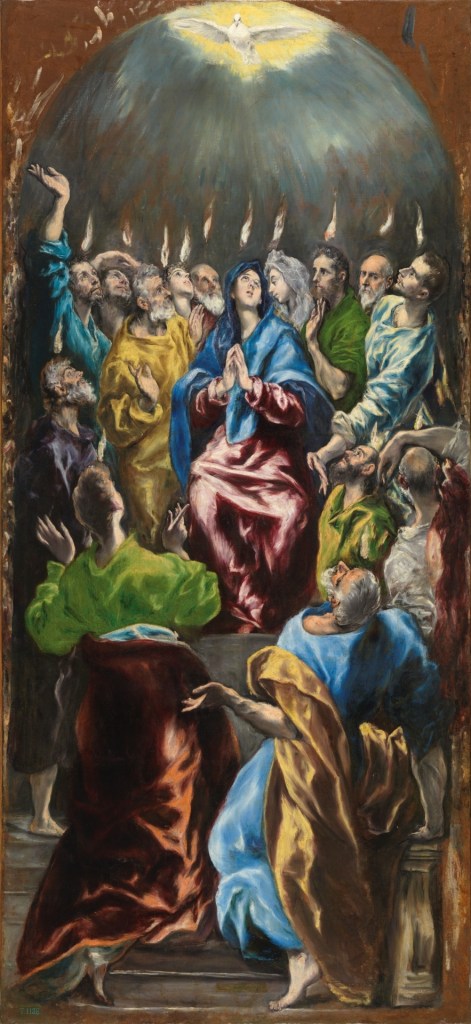
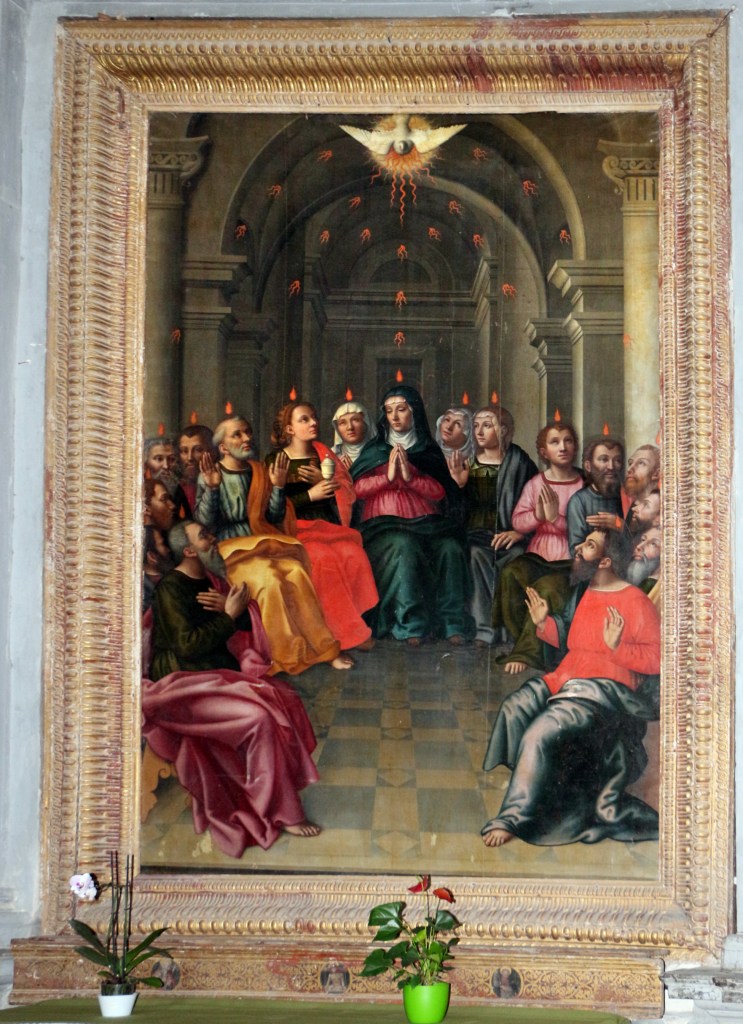
Suor Plautilla Nelli, Pentecost, 1554, San Domenico, Perugia.

Today is Pentecost, fifty days after the Resurrection, and ten days after the Ascension. According to the Acts of the Apostles, 2: 1-4:

And when the day of Pentecost was fully come, they were all with one accord in one place. And suddenly there came a sound from heaven as of a rushing mighty wind, and it filled all the house where they were sitting. And there appeared unto them cloven tongues like as of fire, and it sat upon each of them. And they were all filled with the Holy Ghost, and began to speak with other tongues, as the Spirit gave them utterance.

Not only did the Spirit give them utterance, but people of all nations could understand them in their own languages – the Apostles had been given everything they needed to go out and preach the Word of God. Jesus had announced this occurrence just prior to his Ascension (Picture Of The Day 64), when he said ‘But ye shall receive power, after that the Holy Ghost is come upon you: and ye shall be witnesses unto me both in Jerusalem, and in all Judaea, and in Samaria, and unto the uttermost part of the earth’ (Acts 1:8). We have seen a painting of Pentecost already – in the dome above the crossing in Ottobeuren Abbey (POTD 58) – but that was part of an entire decorative scheme. So today I want to focus on this remarkable altarpiece.

You may well be wondering, ‘what is so remarkable about that?’ and I wouldn’t blame you. It’s not the greatest painting I have ever shown you, and not only is it not terribly famous, it is almost completely unknown. As a result I don’t think it has been cleaned or restored for years, although the colours are both rich and intense. There are certainly no good photos of it to be found online – I suspect there aren’t any anywhere, for which I can only apologize. 

We see the apostles and Mary gathered in an upper room, seated in a horseshoe, leaving space for our approach. Their hands are held together, crossed in front of their chests, or held up, inflected at the wrists – all standard gestures of prayer at the time. Apparently in silence, they sit in their own private worlds, or look around at each other, or up towards the appearance of the Holy Spirit. The gestures are somewhat awkward – wooden even – which adds to the solemnity of the occasion, and to the sense that each individual is experiencing this event in their own way. We are pulled into the space by the strongly drawn perspective of the tiled floor, a combination of pale jade green and off-white squares, triangles, and rectangles. The architecture is High Renaissance in style, flanked by columns, and leading back between square piers supporting round arches to a distant doorway, which frames Mary’s head. Both this, and the perspective, make her the focus of our attention. There are seventeen people present, and, as with Perugino’s Ascension (POTD 64), I find the number surprising. Just before the descent of the Holy Spirit, in the last verse of Acts Chapter 1, Matthias was chosen to take the place of Judas – so there are now twelve apostles again, and, with the Virgin Mary, this makes thirteen. This is precisely the combination we see in a painting by Botticelli and his workshop from the Birmingham Museum and Art Gallery.

Painted on a monumental scale – the figures are more or less life size – it is not in a terribly good condition, unfortunately, and has been cut down on all sides. We do not know its original location, although it would have been an altarpiece, and, judging by the size and scale of this remaining element, quite an impressive one. It was painted some time between 1495 and 1505, when Botticelli and his art had come under the influence of the visionary Dominican preacher Girolamo Savonarola, who preached the end of the world (due in the year 1500), and the Bonfire of the Vanities. He had it in for the Renaissance, and wanted to destroy all the portraits, the pagan texts and images, the excess jewellery, clothing, and hair extensions… among other things. His followers were known as the piagnoni – or ‘cry babies’. Botticelli’s brother was definitely one of them, and Botticelli was inclined to be – his paintings changed, losing their elegant refinement, and taking on an almost visionary feel – the proportions shift, the figures grow, and the characters become more emotive, charged with an inner energy. All twelve of the apostles – Matthias included – are seated on a circular bench around the Virgin Mary, raised up on her own circular dais. Again, a space has been left so that we have access, and can participate in the event. The room is square, with three panels on each visible wall, implying that there would be another three where the picture surface is – twelve panels in all, one for each apostle. It is a symbolic space. Golden beams come down from the Holy Spirit, who is sadly absent, just one result of the poor condition of the painting.

Botticelli’s golden beams represent the ‘cloven tongues like as of fire’, which ‘sat upon each of them’, an idea captured with both striking clarity and decorative elegance in today’s picture. The Holy Spirit appears in the form of a dove with a halo behind it and stylised flames licking out in every direction, although longer below. Scattered downwards are symmetrically arranged ‘cloven tongues’ which seem to sit on the surface of the painting – as if they had been applied in gold leaf. Behind them we see the carefully worked out perspective, but the ‘real world’ seems unconnected to the Spirit’s intervention. This is an other-worldly event we are witnessing, after all.

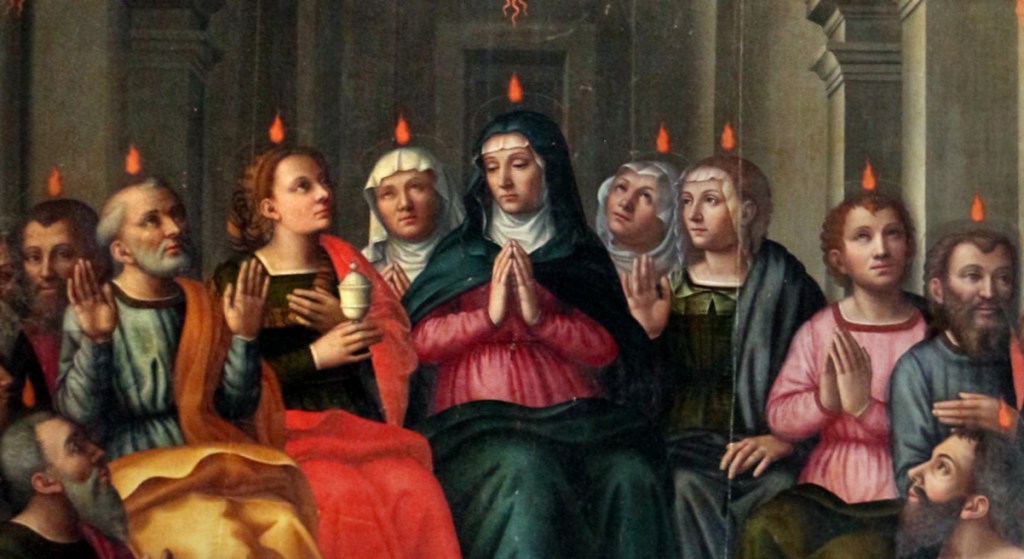
The tongues of fire really do sit upon each of the people present. And when we get this close, we can see who they are. On the left, hands raised, wearing yellow and blue with short grey hair and short grey beard, is St Peter. And on the right, with no beard, wearing pink and green, is St John the Evangelist, the youngest of the apostles. Indeed, he is the only man without a beard. In between Peter and John – and this is what is remarkable about the painting – there are five women. The Virgin Mary is in the centre, and to the left, with red hair, and wearing a scarlet cloak, is Mary Magdalene. She is carrying the jar of precious ointment with which she washed Christ’s feet in the house of Levi, and with which she was going to anoint his body in the tomb.

The Acts of the Apostles does not specify how many people were present at Pentecost, but earlier, after the Ascension, the eleven apostles had returned to Jerusalem and went to an ‘upper room’ – probably that represented in this picture. Acts 1:14 says, ‘These all continued with one accord in prayer and supplication, with the women, and Mary the mother of Jesus, and with his brethren’. Now, I’m not sure that we have the ‘brethren’ in this painting, unless they are counted among the apostles, but we do have ‘the women, and Mary the mother of Jesus’. It’s just that ‘the women’ are not usually represented. Who were they? Apart from the Virgin, and Mary Magdalene, the three others are potentially a third Mary, Joanna and Susanna. The first of these was with Mary Magdalene at the Resurrection (Matthew 28:1), while the other two are mentioned by Luke as people who supported Jesus (Luke 8:3).

Why do artists never include them? Well, my guess would be that none of the other artists were women. Suor Plautilla Nelli (1524-1588) is Florence’s first known woman artist. At the age of 14 she was put into a convent by her parents – hence the title ‘Suor’, meaning ‘Sister’ – standard practice at the time, as most families couldn’t afford dowries for more than one daughter. She entered the Convent of Santa Caterina on Piazza San Marco (it’s not there anymore), just over the square from San Marco itself, where Savonarola had made his mark as Prior. The nuns were overseen by the monks of San Marco, and although Savonarola was long dead (having organised the Bonfire of the Vanities, he was subjected to the same fate in 1498) his teaching lived on. He recommended that nuns should draw to stop them from becoming idle, and Nelli taught herself to paint: she never received any formal training, apparently. She is one of relatively few women mentioned by Vasari in The Lives of the Artists, and he thought that she, ‘would have done marvellous things if, like men, she had been able to study and to devote herself to drawing and copying living and natural things’. She seems to have become the chief artist for the Dominicans in Florence. If so, she was taking over this unofficial role from Fra Bartolomeo, whose work influenced her own in its broad, balanced, classicising forms – incredibly different from the ecstatic energy of late Botticelli, however much both were influenced by Savonarola.  She certainly inherited Fra Bartolomeo’s drawings, and possibly a lay figure – an articulated doll used as a model by artists – which was just as well, as, being a nun, she would never have had the opportunity to do life drawing from the nude. She even trained a number of her fellow nuns to work as her assistants, ending up with a sizeable workshop. By the end of the 16th Century, a third of the known women artists in Florence were Dominican nuns. Although she couldn’t sell her work, the convent could – and although she couldn’t leave the convent, her work travelled far afield: this Pentecost made it to Perugia, and is still to be found there, languishing in the Church of San Domenico. I shall finish with a rather sad photograph showing it falling out of what could be the original frame, with a couple of desultory plants sitting beside it. It looks even less remarkable here – until you stop and realise that, not only is the Virgin the focus of the painting (that was entirely traditional), but that there are four other women present, and they push the men to the edges. With five women taking centre stage and touched by the Holy Spirit, thus endowed with the ability to be heard and understood across the world, it is almost as if Suor Plautilla Nelli were advocating the ordination of women to the priesthood. 

Day 73 – Mary

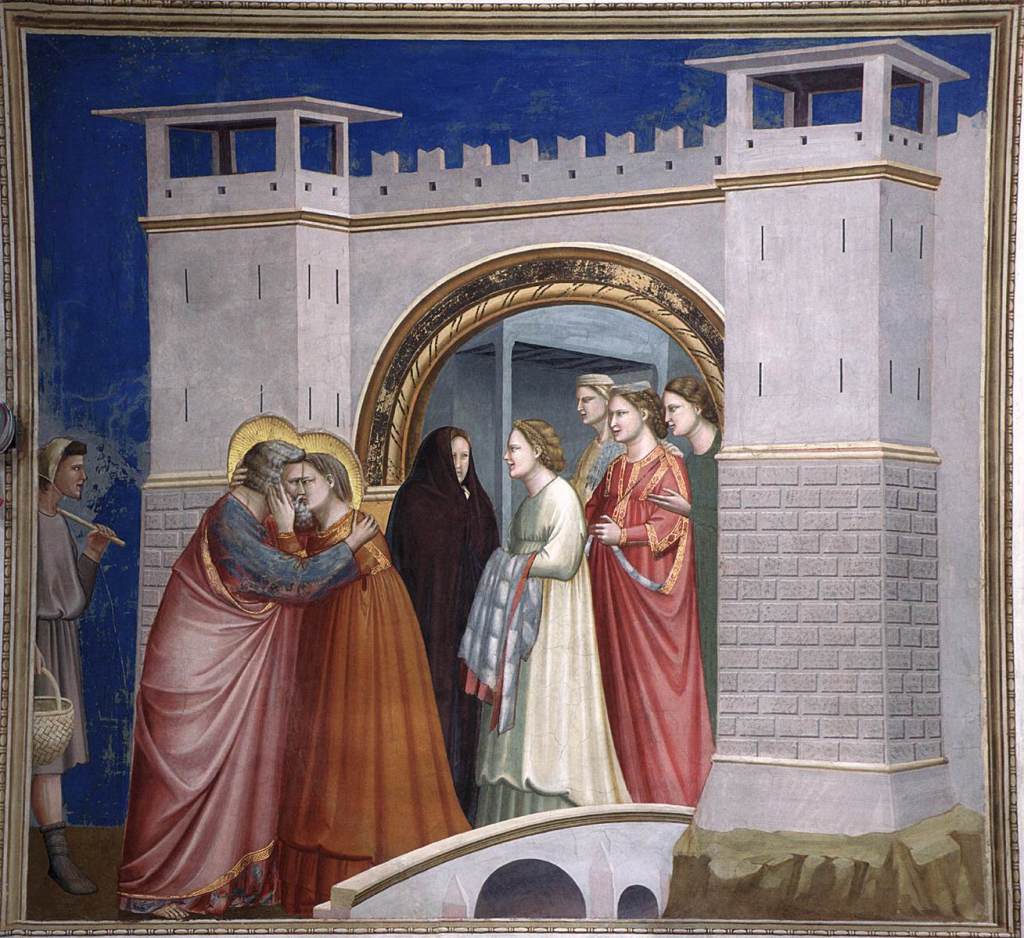
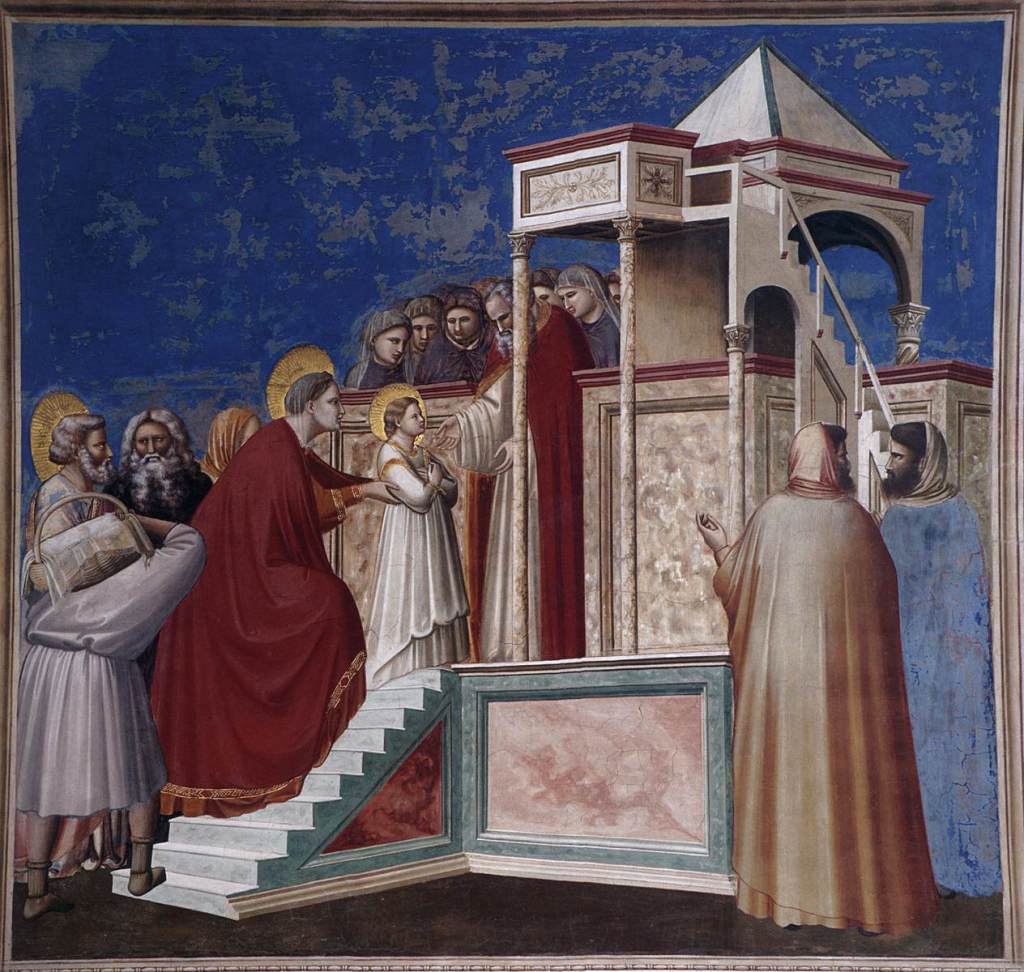
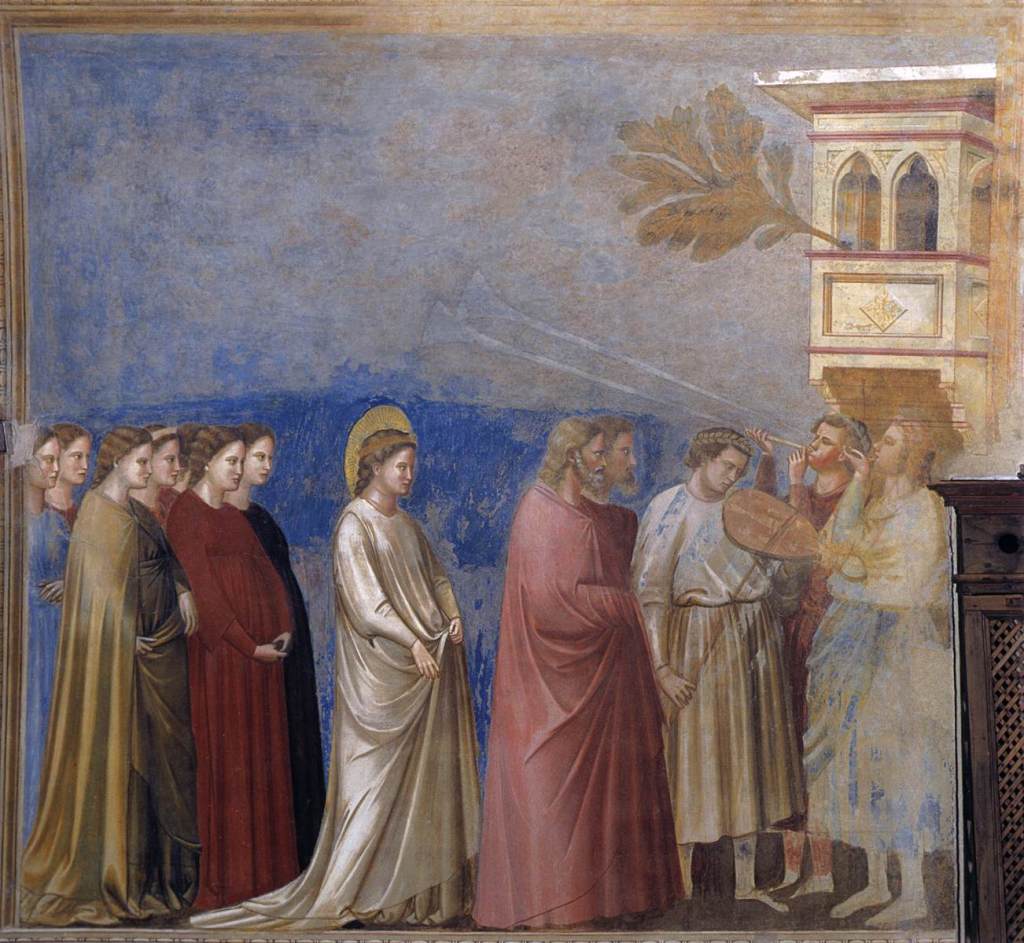
Giotto, Stories from the Life of the Virgin, c. 1305, Scrovegni Chapel, Padua.

Welcome back to Scrovegni Saturday – we’re well into the story. Joachim has been rejected from the temple, and as William Caxton put it back in 1483, ‘And then Joachim, all confused for this thing, durst not go home for shame’ (POTD 66). Meanwhile, Anna is waiting at home, and an angel has announced the birth of a daughter. Joachim (not Zacharias – yes, I did stick in the wrong name last week…) gives a sacrifice to God, which is accepted, and an angel tells him to go and meet his wife at the Golden Gate. Will he go? Of course he will!

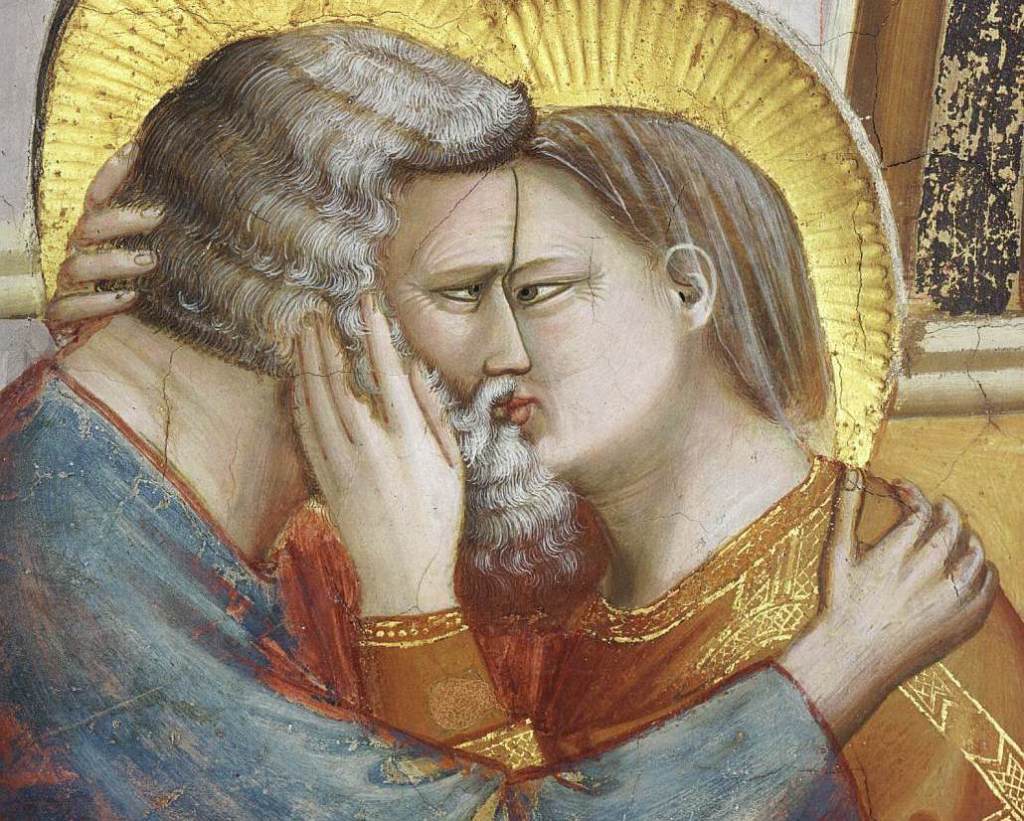
Joachim and Anna meet outside the Golden Gate to the City of Jerusalem and embrace. Giotto gives us no doubt of the fact that they are together, and united, as he doesn’t leave a single gap between the two forms. With the haloes on top of their heads, the self-contained arching form resembles nothing so much as the Golden Gate itself – which was probably Giotto’s intention. One of the epithets applied to Mary was Porta Coeli – the ‘Gate of Heaven’ – as the birth of Christ meant that we could be admitted into the presence of God. Joachim and Anna are part of that journey – the gate to the gate, if you like. 

Neither of them has come unaccompanied. One of the shepherds has made what I assume is a rare visit to the big city, probably just to make sure that Joachim actually gets there. I love the way he is slightly sheepish, just emerging into the scene from behind the picture frame: people think this type of ‘photographic’ cut-off originated with the Renaissance in the 15th Century, but as with so many other things, they learnt it from Giotto. Anna is chaperoned by her maid, who we last saw dutifully spinning on the porch. She is carrying an expensive fur-lined coat, presumably in case Joachim is chilly. As it is, he is dressed remarkably like Jesus, with a red cloak over a blue robe. There must be a reason for this – his role in our salvation is the most likely thing I can think of at the moment, but if I come up with a better idea, I’ll let you know!

And the kiss! Ah – the kiss! Always one of the true joys of this chapel, given the way he firmly clasps her shoulder, and she tenderly cradles his head between her hands, running her fingers through his beard. They go almost cross-eyed, looking at each other in such close proximity, and there is that sense of a nose-bump, narrowly avoided, as their lips touch. They just touch, with no sense of parting, and certainly no tongues – the ultimate chaste kiss. It was at this moment, some people believed, that the Virgin Mary was conceived. But very few people ever thought this – hers was not a virgin birth. However, it does represent the Immaculate Conception (POTD 71 &72), given the chastity of Anna and Joachim’s love. And let’s face it, you’re not going to show the conception in any other way, this is a chapel, for heaven’s sake, not the Palazzo Te (POTD 44 & 53). Look at the delicate transparency of Anna’s veil – and the careful attention paid to every single grey hair of Joachim’s head. It’s a miracle. It’s also the point in the story when things start to get interesting in terms of the arrangement of the paintings. 

First of all, we have a cast of characters – quite apart from Joachim and Anna, we have the shepherd, and the maid, who reappear from earlier paintings.

Also, we have a complete story – ‘Chapter 1’, if you like – starting with Joachim’s rejection from the temple, and ending here with his acceptance at the Golden Gate. Both buildings are angled inwards, each with its own entrance. Joachim’s role as protagonist is done now: he has come home, and his part of the story is over. At this point, we have to cross the chapel, and start at the top of the left-hand wall.

‘Chapter 2’ starts with the Birth of the Virgin. Mary has been born, and is washed and swaddled by two midwives, who are sitting on the ground: one of them is the trusty maid, showing her true value to the household, as she can perform more than one role. Anna sits up in bed, covered by a sheet and a rather grand bedspread. No, they didn’t have twins, this is a continuous narrative, with different stages of the story shown together. The maid was preparing a finer fabric to wrap around the swaddling clothes, and duly prettified and safely contained, Mary is presented to her mother. Friends have come round to visit the newborn miracle, and yet another turns up with a gift at the door. And if you think you recognise the setting, you would be right.

It is the same house that we saw on the opposite wall. I wouldn’t mind betting that it was the maid who took out the chest and bench to allow more guests to visit. Like all good theatre designers, Giotto has allowed the furniture to be flexible. It is the same: the same bedspread, the same curtain hanging from the same frame, but slightly shifted to enhance the narrative. The lighting is different, too: it’s the same building, but at a different time of day. In fact, it is night time: it looks dark through the window. I know the sky is still blue, but that is ‘heavenly background’ as much as anything else. It also needs to fit in with the other frescoes, and wouldn’t look that good if it were all black. Notice that, whereas Anna was kneeling in prayer, looking to the right (the direction of the narrative), it is now Mary who is handed over to the right. This is her story.

According the Golden Legend, when Mary was three, Anna and Joachim took her to the temple. This is from Caxton’s translation:

…they brought her to the temple with offerings. And there was about the temple, fifteen steps to ascend up to the temple, because the temple was high set. And no body might go to the altar of sacrifices that was without, but by the steps.  And then our Lady was set on the lowest step, and mounted up without any help as she had been of perfect age, and when they had performed their offering, they left their daughter in the temple with the other virgins, and they returned into their place. 

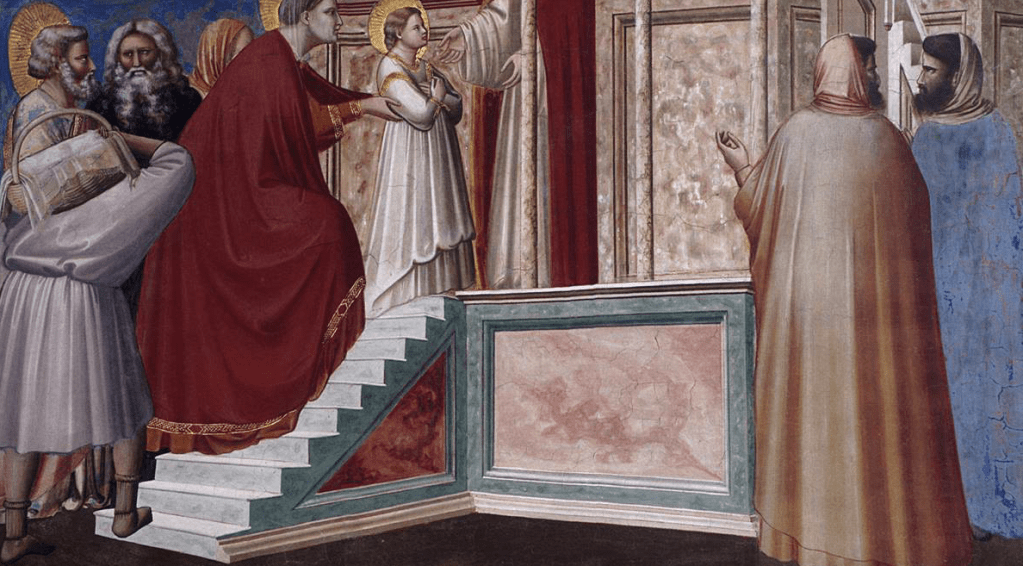
Two things are actually different here – one is that there are only 10 steps, rather than 15, and the other is that Mary has not set off on her own. Like any small child on their first day at school Anna has had to encourage her all the way to the top. Mind you, faced with that priest I don’t suppose most 3-year-olds would have been that keen. There’s no particular reason why Giotto should diverge from the text – but then, there was no particular reason why he should stick to every detail.

The Golden Legend doesn’t specify what the ‘offerings’ were, but they were clearly heavy. Joachim doesn’t carry them himself – they have a servant for that – and even though they only fill one basket, the servant is bent low by the weight. Giotto attempts a particularly daring foreshortening, quite hard to read from a distance, and one of the most unusual views of the human figure I know before the 16th Century.

It is the same temple as we saw in the very first painting – and yet we are on the other side. You see the same ciborium or ‘canopy’ over the altar, and the same raised pulpit, high enough over the screen for the entire congregation to see. These are features of medieval churches, of course, rather than having anything to do with Solomon’s temple, or, for that matter, a synagogue. One of my friends said it reminded him of a piece of theatrical scenery on wheels, and he’s absolutely right – Giotto has simply turned it round. I say ‘simply’ – this is a rather complicated thing to do, and, if we’re honest, it is another one of those theatrical tricks where it looks like the same building, but in reality it is slightly modified.

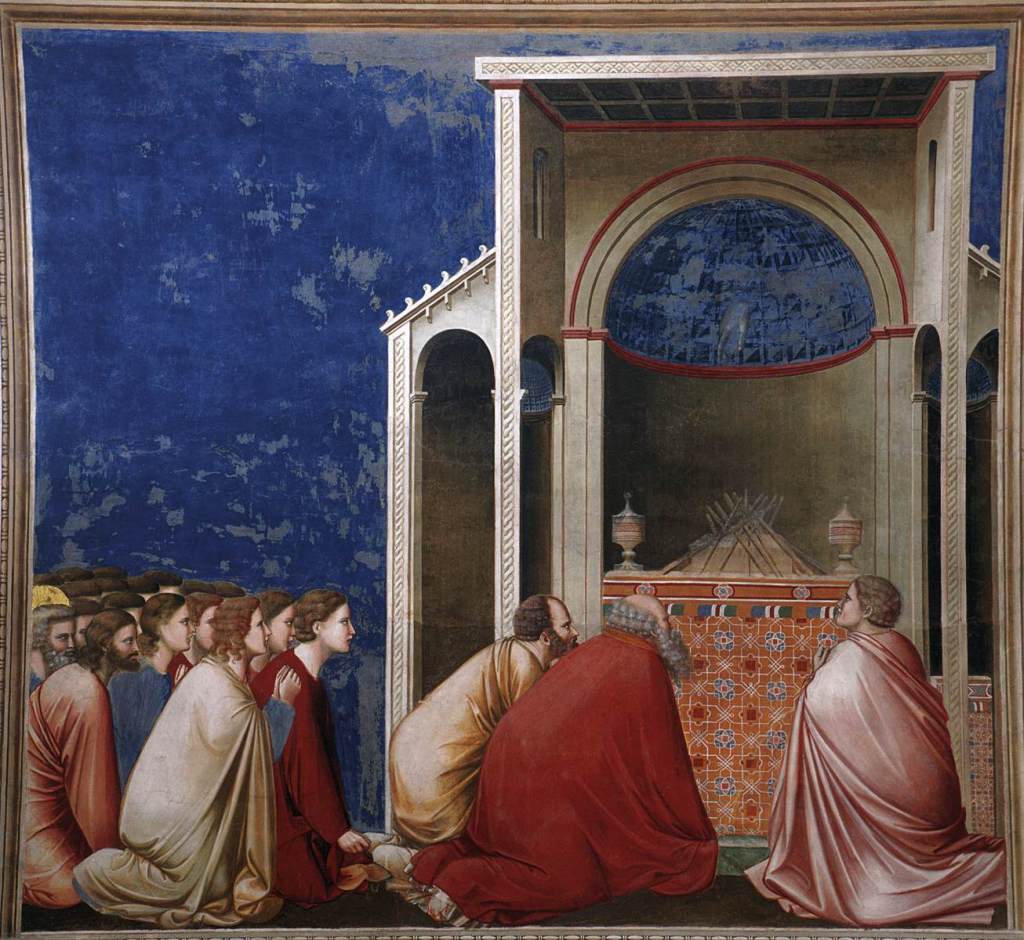
Mary lives with the other virgins (small ‘v’) in the temple until she is 14, when all of the others find suitable spouses. This is where I started back on the very first Scrovegni Saturday, POTD 31. If you re-read that, you will get the long story – but here it is, short. All the eligible bachelors were asked to come to the temple with rods, and place them on the altar. Nothing happened, so they put out a second call, and it turned out that an old guy called Joseph hadn’t come forward. When he did, his rod flowered, and a dove landed on it – so he got to marry Mary. The rest were furious. At this stage, they are only being betrothed – i.e. engaged – the wedding was to follow some time later. Now you might want to argue that this is not the same temple we saw before, but the reason for this comes from Caxton’s text. He talks of  ‘the altar of sacrifices that was without’ – which is the one under the ciborium, and the one which Joachim had attempted to go to before. For this part of the story we are clearly at an altar that is ‘within’.

After the betrothal, Mary was taken in procession to the house of her parents, followed by the other virgins, and led by a viol player, and a couple of elders. She is welcomed home by two ceremonial trumpeters. I’m afraid I don’t know why this particular part of the fresco is in such a bad condition – it is due to humidity, but I don’t know why that should have been so bad here. It might have something to do with the part of the Scrovegni Palace which was, until the 19th Century, behind this wall, or whatever happened to this bit of the wall when the Palace was destroyed. The two trumpets were clearly painted a secco – after the plaster had dried – meaning that the paint was not bound to the wall, and has completely gone. Alternately, they could have been gilded, although why the gold should go here, and not on the haloes, I don’t know. A bay window from the house makes it onto this wall: we’ll see more of that when we come back next week.

p.s. As suggested yesterday, I will be giving two online lectures this week:

• if you want to tune in to Artemisia on Monday morning at 11am, please email trish@summerleazegallery.co.uk

• if you would like to sign up for Seeing is Believing: van Eyck and the Art of Illusion at 6pm this Wednesday, 3 June, please go to the Art History Abroad website by clicking on the words Art History Abroad! Mix yourself a cocktail before you sign on – I will!

I’ll start updating the ‘diary’ on the website soon…

Day 72 – Immaculate Conception II

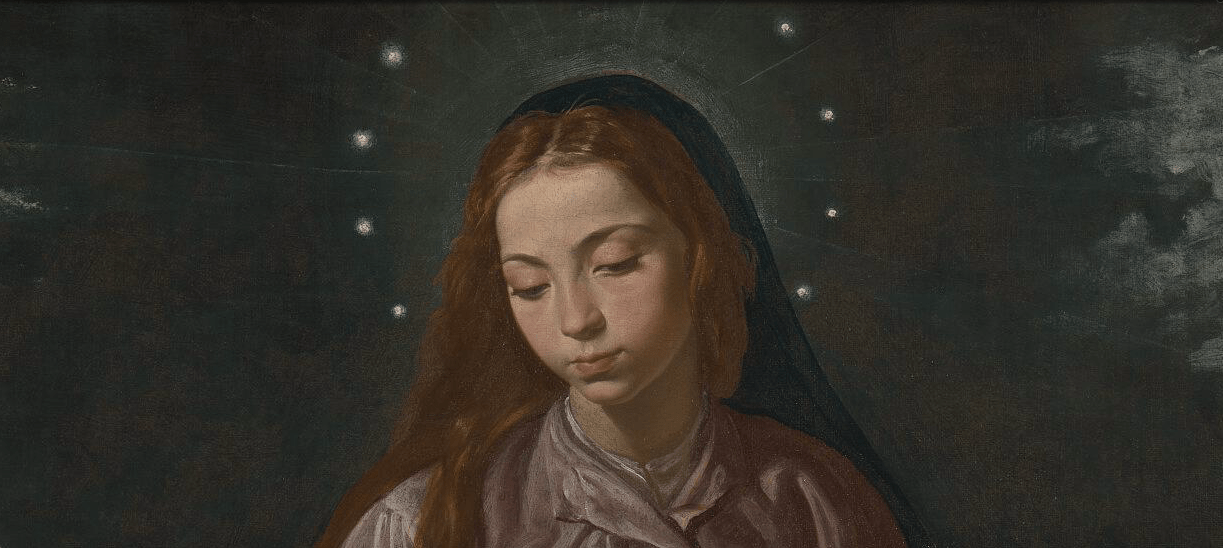
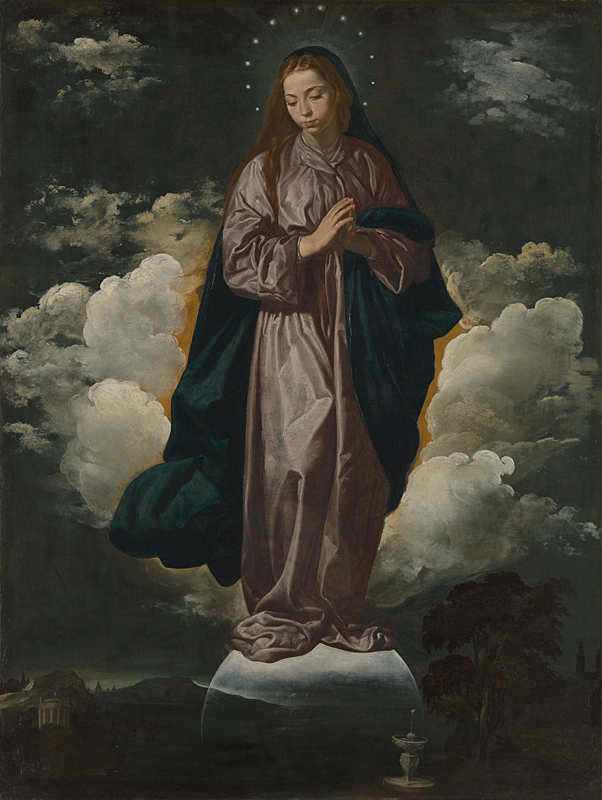
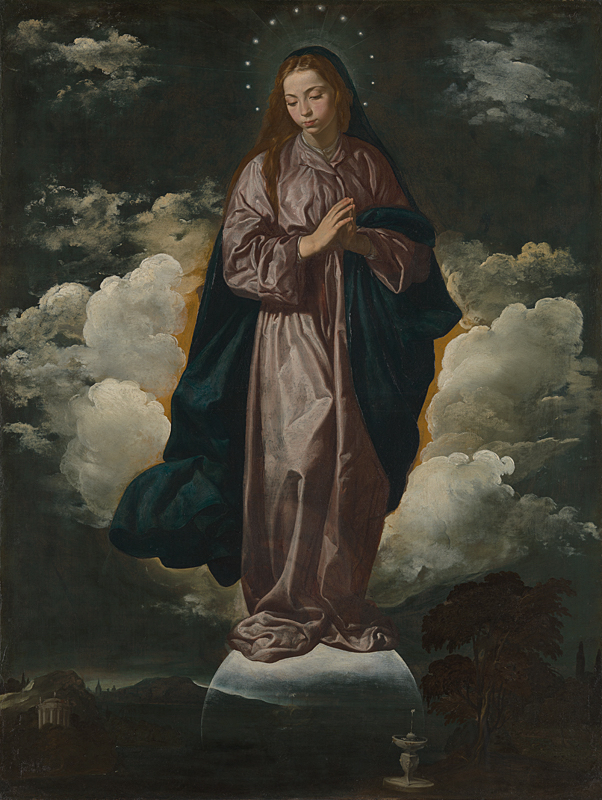
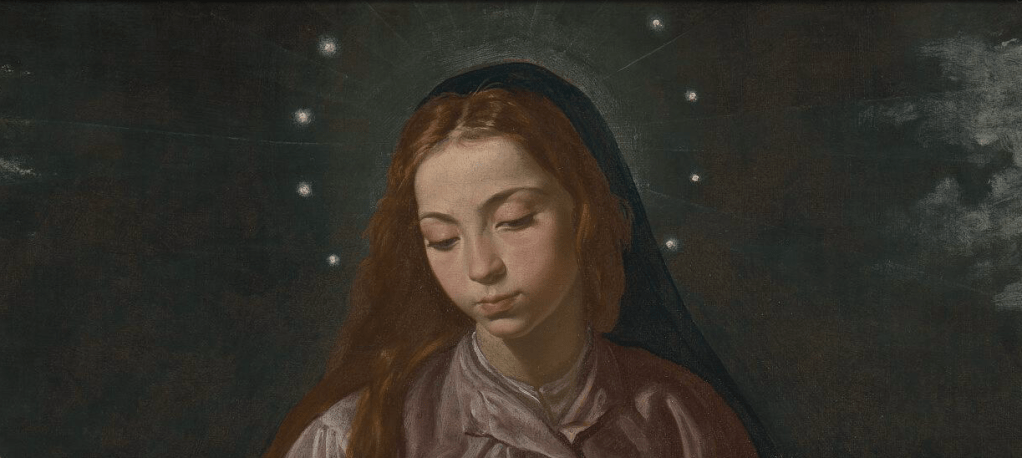
Diego Velázquez, The Immaculate Conception, 1618-19, National Gallery, London.

Don’t worry, this isn’t going to be a series! But it is a chance to talk about a very beautiful painting… and to bring us up to date with the doctrine of the Immaculate Conception. I explained yesterday (Picture Of The Day 71) that there were two main theories – one that Mary had been conceived with sin, and later ‘sanctified’, the second, that she was conceived free from original sin. The latter is the doctrine of the Immaculate Conception, whereas the former is seen as the ‘Maculist’ doctrine. The adherence to these two doctrines was divided between the two leading Mendicant orders, with the Franciscans originating and then promoting the theory of the Immaculate Conception, while the Dominicans held firmly to the Maculist doctrine. The Spanish got increasingly worked up about this, and eventually King Phillip III (who is rarely mentioned in the annals of Art History) lobbied Pope Paul V (Uncle of Scipio Borghese, who owned many sculptures by Bernini, e.g. POTD 56, so is) to have the Doctrine of the Immaculate Conception declared dogma – i.e. an item of faith that is incontrovertibly true. Paul V didn’t go that far, but in 1617 he did issue a decree forbidding any public defence of the Maculist doctrine of sanctification. And the following year, Diego Velázquez painted this beautiful image.

You might think that it couldn’t look more different from the painting we saw yesterday, but, bearing in mind that Carlo Crivelli was working in the late 15th Century, and we are now in the early 17th, and given the vast stylistic difference, they are remarkably similar. Both feature the Virgin Mary, alone, standing, and praying. And in both, she has long blonde hair – this is certainly what counts as ‘blonde’ (‘rubia’, as it’s the Virgin) in Spain.  The fact that her hair is allowed to hang freely, undressed (even if it is partially covered in the Velázquez), implies that this woman is not of marriageable age – or, at least, not yet married – the implication being that she is a virgin.

Her hair seems to blow slightly in the breeze – and a sense of gentle movement flows throughout her entire body, with her young face, entirely unmarked by any blemish (the immaculate complexion?), turned slight to our left, with her hands inflected to our right. She looks down, with modesty and humility, her face illuminated from above and to the left – it’s so delicately painted that even her eyelashes cast a shadow. It is an entirely ‘sculptural’ depiction: young Diego may have started his training painting sculptures, which might have helped him to model form when painting on a flat surface. He was still young when he painted this – twenty, at most, when it was completed. Mary herself has a faint glow, with a gentle light radiating from her head, which is surrounded by a ring of twelve stars. And to her left and right there is a yellow glow on the inside of the clouds.

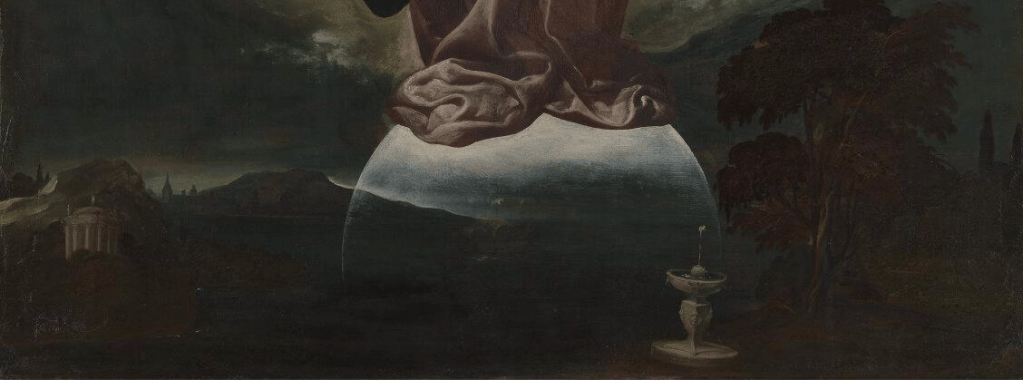
She stands on the moon, an inverted crescent, which becomes transparent, allowing a view of the distant mountains, and the landscape is populated with various symbols of her perfection – a fountain, a temple, trees and a ship. They are all there, although, if I’m honest, I can’t see them all on my rather shiny screen! Many of these derive from the Song of Solomon. For example, 4:15 mentions ‘A fountain of gardens, a well of living waters’. Yesterday I quoted the figure of ‘Wisdom’ from the book of Proverbs – she also speaks in Ecclesiasticus, and in 24:13 says, ‘I was exalted like a cedar in Libanus, and as a cypress tree upon the mountains of Hermon’ – hence the tall trees. I won’t go into everything, though. Overall, however, the imagery comes from the Book of Revelation, 12:1-3:

And there appeared a great wonder in heaven; a woman clothed with the sun, and the moon under her feet, and upon her head a crown of twelve stars: And she being with child cried, travailing in birth, and pained to be delivered. And there appeared another wonder in heaven; and behold a great red dragon, having seven heads and ten horns, and seven crowns upon his heads.

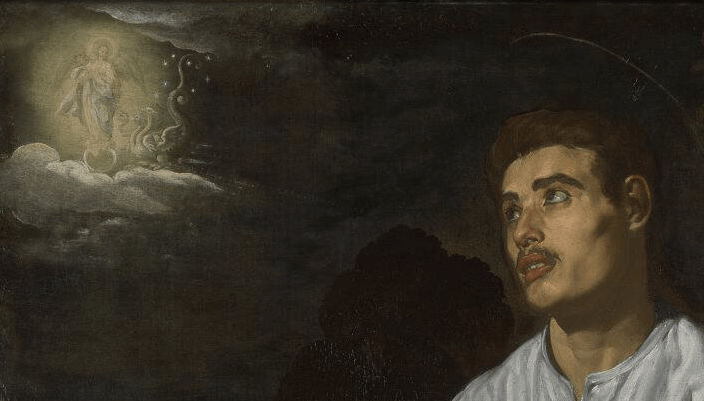
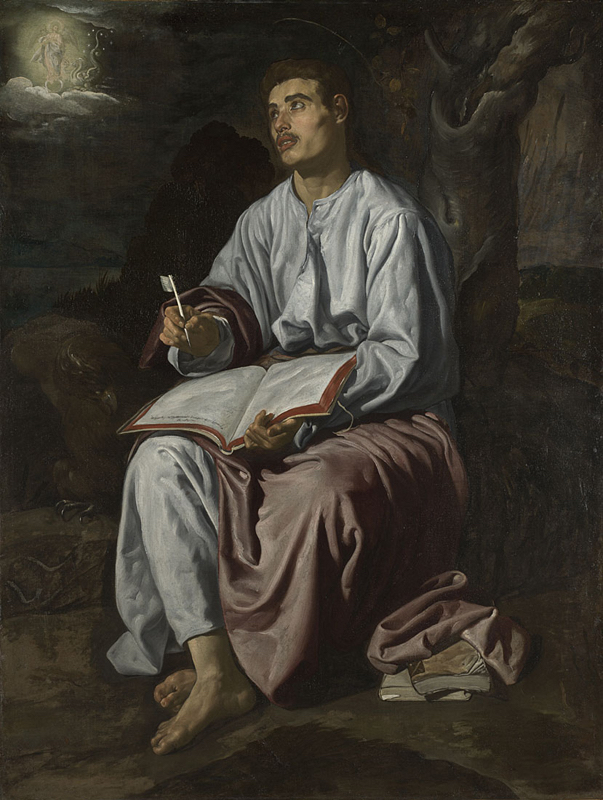
Not all of this will appear that relevant just yet… but the key part is the first verse ‘a woman clothed with the sun, and the moon under her feet, and upon her head a crown of twelve stars’. This vision of the Woman of the Apocalypse, who gave birth and defeated the ‘dragon’, was interpreted very early on as representing the Virgin Mary, and it was in this specific form that the doctrine of the Immaculate Conception would be represented in paintings. The National Gallery’s example is one of two related paintings, which Velázquez made as part of the same commission. Here is a detail of the second, John the Evangelist on the Island of Patmos.

It shows a surprisingly young, and Hispanic-looking, John the Evangelist, looking up to precisely the image evoked by the verses quoted above, even if the stars seem to have shifted towards the dragon.

When seen with the Immaculate Conception it becomes clear that they are a pair – John is having the very vision which will become the iconography of the other painting.  But this doesn’t explain the youth of John. Apart from historical reasons why the Book of Revelation couldn’t have been written by John the Evangelist, about which, if I’m honest, I know nothing, it was supposed to have happened late in his life, after a couple of attempts to martyr him. By the time he gets to Patmos he is usually shown as an old man with a long white beard. Here, he is still represented as if he were the youngest of the apostles. One theory to account for this is that the two models for John and Mary were the artist himself and his new, young wife: he married Juana Pacheco on 23 April 1618, five and a half weeks short of her sixteenth birthday. He was marrying his master’s daughter, in the same way that he would marry his elder daughter Francisca to one of his pupils, Juan Bautista del Mazo, when she was only 14… 

I mentioned Francisco Pacheco, Velázquez’ master, back in POTD 20, saying that, as well as painting, ‘His job was to make sure that the religious images were not heretical’ – and yes, he was involved with the Spanish Inquisition. I bet you weren’t expecting that, even though I have mentioned it before… Many of his thoughts and ideas were eventually published in ‘The Art of Painting’, which came out in 1649, five years after his death. Pacheco’s guidelines for the correct depiction of the Immaculate Conception are especially relevant:

Our Lady should be painted as a beautiful young girl, 12 or 13 years old, in the flower of her youth. She should be painted wearing a white tunic and a blue mantle. She is surrounded by the sun, an oval sun of white and ochre, which sweetly blends into the sky. Rays of light emanate from her head, around which is a ring of twelve stars. An imperial crown adorns her head, without, however, hiding the stars. Under her feet is the moon.

Velázquez follows most of these guidelines, if not all – there is no imperial crown, for example, although he does paint her tunic an imperial purple, rather than white. It’s worthwhile comparing Diego’s image with one painted by his master at about the same time.

Pacheco does include the imperial crown, but even he doesn’t paint a white tunic. There are some of the same symbolic elements at the bottom of the image as well, with a few extra for good measure, not to mention a portrait of the donor, Miguel Cid, a poet. This was painted in 1619, so potentially after the version by Velázquez, but there is little reason to doubt that the nature of the imagery – the iconography – was defined by the master. It’s just the style: what becomes immediately clear is that Velázquez was an infinitely better artist. All of the elements may be the same, or similar, but even in one of his earliest paintings Velázquez shows himself to be free of the last vestiges of Mannerism to which Pacheco is clinging. However artificial and symbolic the representation of the Immaculate Conception could appear, Velázquez manages to make it flow, and look entirely natural, and extremely beautiful.

The two images by Pacheco and Velázquez were undoubtedly painted in the rush of enthusiasm that flowed from Paul V’s decree of 1617 – and Pacheco painted several more. But this enthusiasm was not restricted to Spain, and spread across the whole Hispanic world.

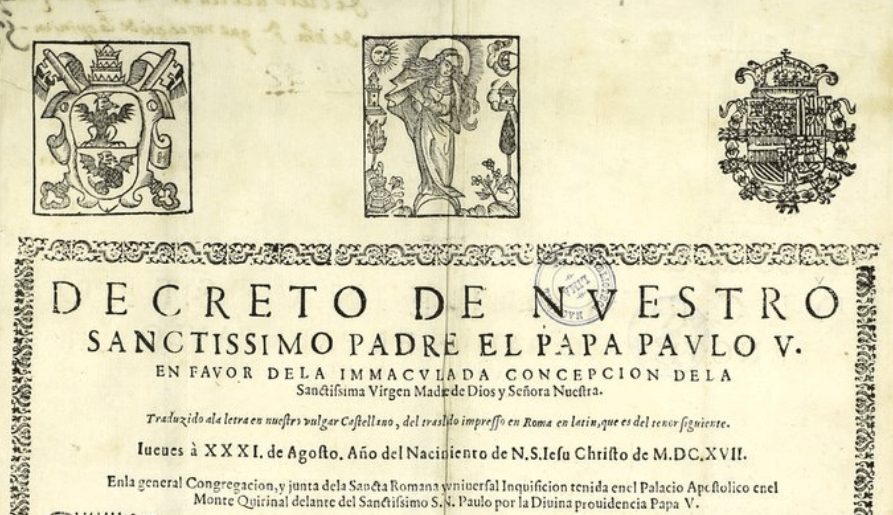
Here, for example, is a detail from an announcement of the decree, dated 31 August 1617, which was published in Lima – it comes from the National Library of Peru. The coat of arms of Paul V Borghese, with its eagle and dragon (POTD 56) appears top left, and that of the Kingdom of Spain is top right. In the centre is an image of the ‘Immaculate’ not unlike these paintings. As it happens the name Immaculada is popular to this day, and Concepción is not unknown… But for Paul V the Immaculate Conception was still a doctrine, and not dogma. It was Pope Pius IX who finally declared it to be an essential belief for all Roman Catholics, and made the Feast of the Immaculate Conception (8 December) a holy day of obligation, on which all Catholics are supposed to attend mass. And that didn’t happen until 1854. By this stage the doctrine had been around for half a millennium… 

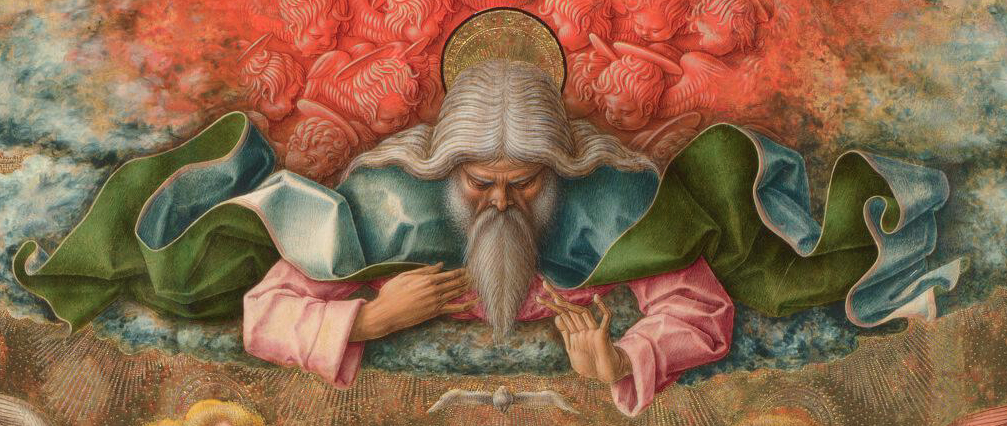
p.s. 1 If you had been expecting the Spanish Inquisition, you will have known that I was referring to Monty Python. I’ve always been a fan, but hadn’t seen any for years – decades even – and re-found them on NetFlix, where all four series and all of the films can be found. Their brand of surreal, irrational lunacy seems to fit the present time, even if issues of gender and race are problematic half a century on. I have always known that the foot that comes down at the end of the credits is taken from Bronzino’s Allegory with Venus and Cupid in the National Gallery, but I hadn’t realised what a regular visitor to the Gallery the animator Terry Gilliam must have been – there are figures taken from the collection peppered throughout the early series. I was especially delighted to see God the Father from Crivelli’s Immaculate Conception (yesterday’s POTD) appear at the end of the credits of series 1 to castigate a female nude. 

p.s. 2 I have finally been dragged kicking and screaming into the 21st Century, and have agreed to give a couple of zoom talks this week. The first, on Artemisia Gentileschi, is for the Summerleaze Gallery in Wiltshire. To be honest, I’m not quite sure how it’s going to work, but if any of you would like to join at 11.30 (UK time) on Monday morning, please email Patricia Scott Bolton on trish@summerleazegallery.co.uk and she will let you know! I’ll tell you about the second, currently scheduled for 6pm on Wednesday, if it happens, and if I’m allowed to!

p.s. 3 Inevitably the gradually easing of lockdown will mean that I’ll have to go and earn a living, which will mean less time, which will mean it might not be possible to sit and write about a Picture every Day… but I’m still thinking about that. Meanwhile, as I’ve said before (though not for a long time), if there’s anything you’d like me to talk about, please let me know!

Day 71 – The Immaculate Conception

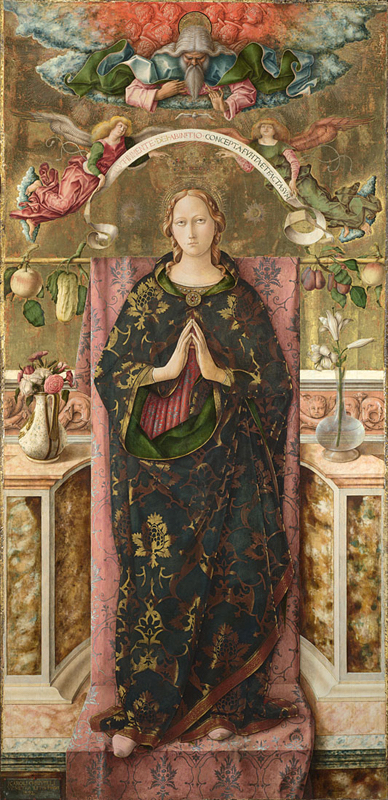
Carlo Crivelli, The Immaculate Conception, 1492, National Gallery, London.

Right. I warned you (Picture Of The Day 66). I have to talk about the Immaculate Conception, and anyone who has ever been anywhere with me knows I go on about this all the time, because, quite simply, it is the most misunderstood aspect of Catholic theology. And trust me, it has almost nothing to do with Jesus.

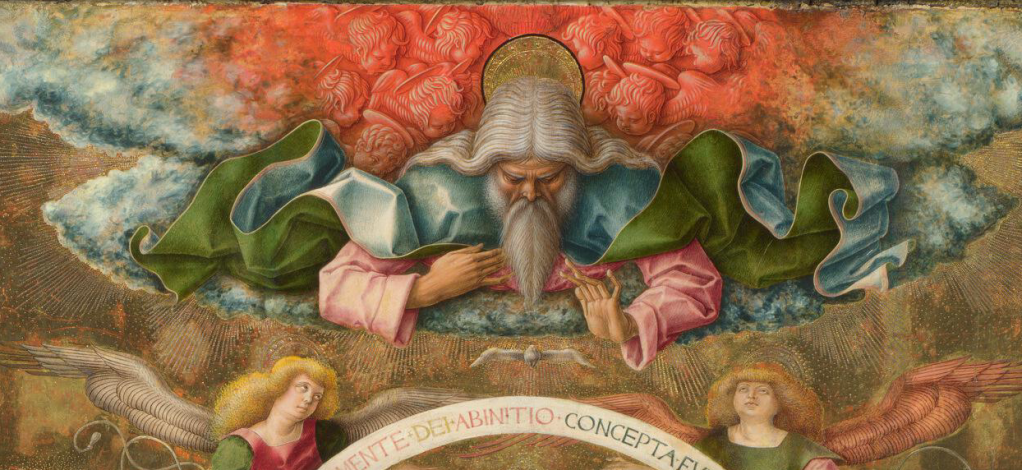
Carlo Crivelli, about 1430/5 – about 1494 The Immaculate Conception 1492 Egg on wood, 194.3 x 93.3 cm https://www.nationalgallery.org.uk/paintings/NG906

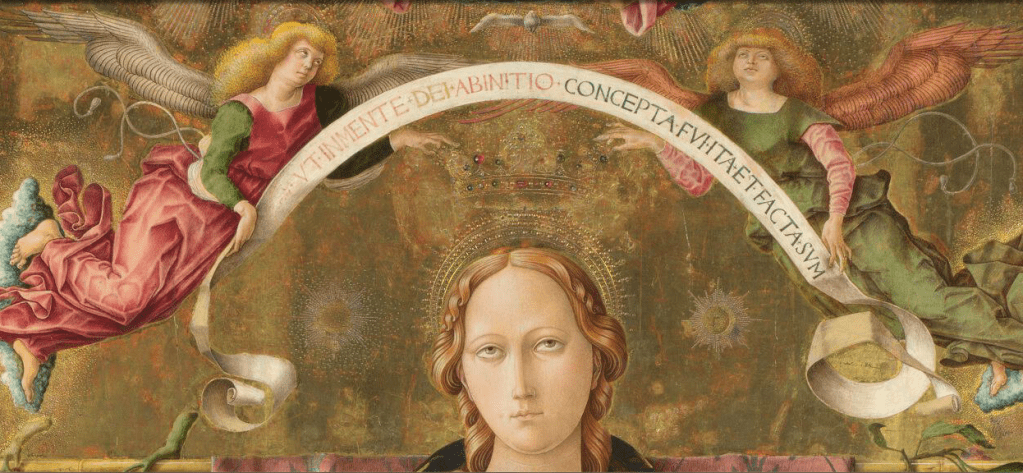
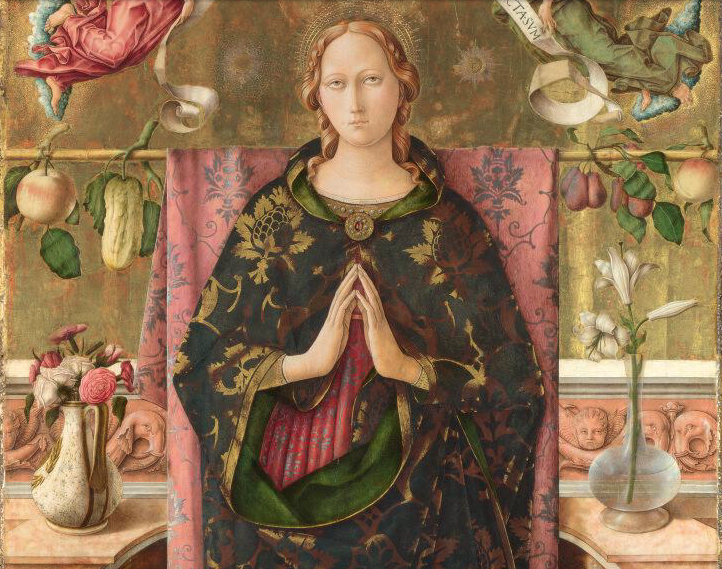
Carlo Crivelli’s painting is the first known altarpiece to depict this idea – although that does depend on how you define ‘depict’ – both versions of Leonardo da Vinci’s Virgin of the Rocks were painted for the Confraternity of the Immaculate Conception in Milan, for example. It may not be immediately clear that Crivelli is depicting this particular aspect of the Virgin Mary – indeed, it might not be obvious that this is Mary at all, as she doesn’t have her main attribute, the symbol which helps us to identify her – Jesus. Before the end of the 15th Century it was very unusual to see Mary on her own. She is standing in a niche which seems to double as an altar, with flowers on either side. Fruit and vegetables hang from a cane, over which is thrown a pink cloth, which frames her body and goes under her feet. Her hands are joined in prayer, with God the Father looking down from heaven, while two angels fly in between, holding a banner. It will be easier if we look at it from top to bottom.

The figure of God the Father is beautifully foreshortened, not unlike Uccello’s version in The Sacrifice of Noah (Picture Of The Day 37), although the right way up. He appears from the blue-ish clouds, the colour echoed in his cloak, which flows out on either side almost more like a thick, crumpled foil than fabric, its hem creating the most wonderful, erratic, inflected line, as the colours shift from the green lining to the blue outer side. Above, or behind, his head are a host of angels, red heads with wings – these are the Seraphim, the highest rank of the 9 choirs of angels, and closest to the throne of God. Below them we see two ‘regular’ angels, from the choir closest to humans. Also, under God the Father’s hands, is the dove representing the Holy Spirit. In other circumstances we would expect to see the third person of the Holy Trinity, God the Son, below – but instead, we see Mary, his mother.

The two angels look up to God, while simultaneously holding both a scroll and a crown over Mary’s head. The crown, like Mary’s halo, and the sun and moon on either side, are tooled into the background. After the gold leaf had been applied and burnished, small metal tools were held against the surface of the gold and tapped with a hammer, thus denting it slightly. When candles were lit in front of the painting, the light would catch the different surfaces of the gold, so that the halo, crown, sun and moon would shimmer. The crown also has details painted on – there is a spherical ruby towards the left, given light and shade, and a white highlight, to make it look three dimensional – whereas the tooling actually is three dimensional. Crivelli’s use of gold leaf even at the end of the 15th Century often makes people think that he was an out of date artist, clinging on to medieval ideas, but he was actually playing with them in a far more sophisticated way. Look at the foreshortening, after all. 

It is, of course, the scroll which is the most important feature for our understanding of this painting – and indeed, for the understanding of the concept of the Immaculate Conception. It reads:

VT•INMENTE•DEI•ABINITIO•CONCEPTA•FVI•ITA•ET•FACTA•SVM.

Which roughly translates as: ‘In the same way that, from the beginning, I was conceived in the mind of God, so have I been made’. The implication is that God always knew that Mary would exist. The idea comes from various biblical texts, the most relevant probably being some verses in the book of Proverbs, in which the character of ‘Wisdom’ is speaking. This is Proverbs 8: 22-23, although the relevant section carries on until verse 35, if you want to look it up. As ever, I am quoting from the King James Version: 

The Lord possessed me in the beginning of his way, before his works of old. I was set up from everlasting, from the beginning, or ever the earth was.

Another relevant text is in the Song of Solomon, 4:7:

Thou art all fair, my love; there is no spot in thee.

The relevance of this becomes clearer if we see the same verse in Latin: Tota pulchra es amica mea et macula non est in te – the Latin version of ‘spot’ is ‘macula’ – so if there is no ‘spot’, there is no ‘macula’ – i.e. Mary is ‘Immaculate’ – without a mark or stain. She is free of Original Sin. 

There are obviously quite a few leaps of faith here. First of all the biblical texts, both from the Old Testament – i.e. the Jewish Scriptures – do not mention Mary at all. But the assumption of the early Christian theologians was that the Jews had been on the right track, but, as they were born before Jesus, it was not surprising that they had not quite understood God’s message in the right way. Every verse of the scriptures was sifted to find any possible relevance to Christianity, the main aim being to prove that Jesus really was the prophesied Messiah. But along the way, it also became important to find texts that were relevant to Mary too. And that was because of a fundamental problem: Original Sin. The argument goes that, because of the Fall, all descendants of Adam and Eve do wrong. Jesus came to Earth, became human, died as a sacrifice to forgive us for our sins, and triumphed over death, so mankind is redeemed. But in order to become human, he had to be born, and all humans were sinful. How could the Son of God – God himself in one person of the Trinity – be born of something sinful? This was a proposition that many theologians could not tolerate. The only solution was that Mary must have been free of sin in some way – although before Christ’s triumph over death, how was that possible? There were two main theories: 1) Mary was conceived with sin, and somehow, through a special dispensation, God cleansed her of sin in the womb or 2) she was conceived free of sin, without stain or mark, immaculately. The Immaculate Conception. The latter theory was favoured by the Franciscans, and given far greater prominence by Pope Sixtus IV, himself a Franciscan, who instituted the Feast of the Immaculate Conception in 1476. The feast day is 8 December, nine months before the Birth of the Virgin, which is celebrated on 8 September. What should be clear from this is that the Immaculate Conception refers to the Conception of the Virgin Mary within her mother Anna’s womb, free from Original Sin. As I said, it has almost nothing to do with Jesus (at this stage). How that conception was achieved is not necessarily part of the issue, but most theologians believed that it was a standard sexual conception, with Joachim and Anna somehow not entertaining any sinful thoughts or carrying out any sinful deeds. And just in case I have not made myself clear enough, listen very carefully, I shall shout this only once: THE IMMACULATE CONCEPTION IS NOT THE SAME AS THE VIRGIN BIRTH.

What it comes down to is that God knew that giving people freedom of action meant that mankind would sin, and so would have to be redeemed, so Jesus would have to be born, so Mary would have to be free of sin, so he conceived her in his mind before the world began. That’s what the banner means. On to the rest of the painting.

We see Mary surrounded by fruit and flowers, vegetables and vessels – all are symbolic. Mary is fertile – unexpectedly as a Virgin, maybe – but all of the fruit and flowers can refer to that in some way. However, for some, the symbolism is far more specific. The apple, far left, is the standard symbol for original sin, even though there is no mention of an apple in the Book of Genesis. However, it is far easier to say ‘apple’ than ‘the fruit of the tree of the knowledge of good and evil’, so the apple has always got the blame. However, some people blamed the fig, the orange, or even the quince. Other fruits are available. The oversized gerkin is a bit of a problem, but something with which Crivelli was obsessed – it occurs in many of his paintings. I favour its identification as a gourd, mentioned in the Book of Jonah, towards the end of which Jonah sits in the shade of a gourd tree as God forgives the people of Nineveh. If the apple represents sin, then the gourd represents forgiveness. On the other side there are pears – which in some way represent the birth of Christ, and Mary’s fertility, although I’ve never found a convincing reason why. This is the point at which people google it and tell me what they’ve found, imagining I’ve never thought of doing that – well, I’ve just found a website that says that the pear is a symbol of marital fidelity, but that same site says that grapes are a symbol of ‘lewdness and lustful thoughts’, which implies that the author knows absolutely nothing about Christian art, or, for that matter, Christianity – so don’t believe everything you read online. Which, I suppose, would include this blog… oops. Moving on – the peach. Well, it’s a sweet fruit with a stone from which life will grow. I’m going for Mary, containing Jesus – that’s certainly the symbolism of the hazelnut (which is not in this picture, I know…). 

And then, the flowers: roses – white for purity and red for passion, as in the passion of Christ, the red being his blood. Also, Mary was described as a ‘rose without thorns’ – the beauty, but without the sin, effectively. And the lilies – well, the white of her purity, which is made explicit in another verse from the Song of Solomon, 2: 2: 

As the lily among thorns, so is my love among the daughters.

And, as I suggested, the vessels are also symbolic. They contain water, and Jesus is the water of life, and he was in Mary’s womb for 9 months – so they are both symbolic of Mary, the ‘vessel’ containing Christ. The glass vase is more profound. Light passes through glass without breaking it, in the same way that Jesus, the light of the world, passed through Mary, without breaking her virginity. Stained glass in churches is even richer in symbolism, as the light passes through the coloured glass and takes on its colour, in the same way that the light of the world passed through Mary, and took on her humanity. 

The cloth behind Mary reminds us that she is royal – she will be crowned Queen of Heaven – and a royal court was always established by hanging a cloth of honour, in front of which the monarch stood or sat. It hangs down, and falls over the step, so it also functions as a type of ‘red carpet’, and Mary doesn’t have to sully her feet on the ground.

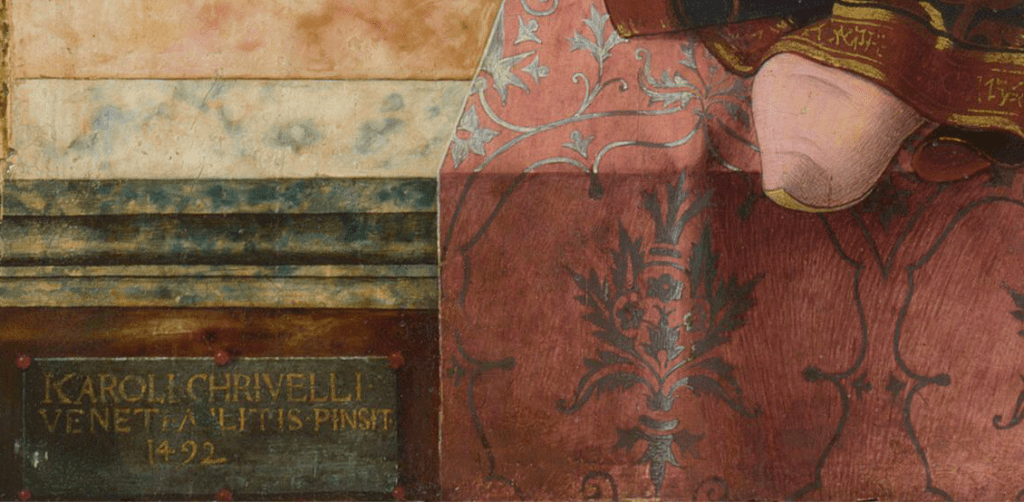
Finally, at the very bottom left, we see Crivelli’s signature: KAROLI CHRIVELLI VENETI MILITIS PINXIT 1492 – ‘Painted by Sir Carlo Crivelli from Venice, 1492’. He was very proud to have come from Venice, one of the great centres of art, even though he didn’t hang around there long enough to paint anything. He was also inordinately proud his knighthood, awarded the year before this painting was completed. He also liked to play games with reality, and here he is pretending that his signature is written on a piece of paper which he has attached to the marble step with six blobs of red wax. Quite a few artists played this game, which makes us think that maybe artists really did this. It is one of the suggestions why so many German paintings are not signed: it is possible that they were, but that the pieces of paper with the names on have all fallen off. He really shows his brilliance with illusionism here – look at the subtle shift in the patterning of the fabric from silver to grey as it goes over the step, and the shift back to silver again as the pressure of Mary’s foot makes the cloth wrinkle and catch the light. The toe of her pink slipper sticks over the step and into our space… she is there with us. All of this is done to make her present, to make us believe in her, and to help us to understand the concept of the Immaculate Conception. It’s flawless.

Day 70 – The Annunciation, again

Veit Stoss, The Annunciation, 1517-18, St Lorenzkirche, Nuremberg.

It’s been over two months since I last discussed The Annunciation. Back then it was the calm, rational, yet mystical version by Piero della Francesca, which is at the heart of his True Cross cycle (Picture Of The Day 7). I’m surprised I haven’t talked about more versions, there are so many. But on Sunday, I was talking about Mercury’s caduceus – his staff of office (POTD 67) – and I said that the Archangel Gabriel used to have one too – a staff of office, that is, not a caduceus. As far as I’m aware, Mercury is the only person to have one of those. From classical to medieval times – and beyond – messengers showed their authority to convey messages by carrying a staff or rod, and this is what Gabriel holds in early representations of the Annunciation. He still does in Veit Stoss’s magical polychrome sculpture in the Church of St Laurence – the Lorenzkirche – in Nuremberg, even though that doesn’t really class as ‘early’

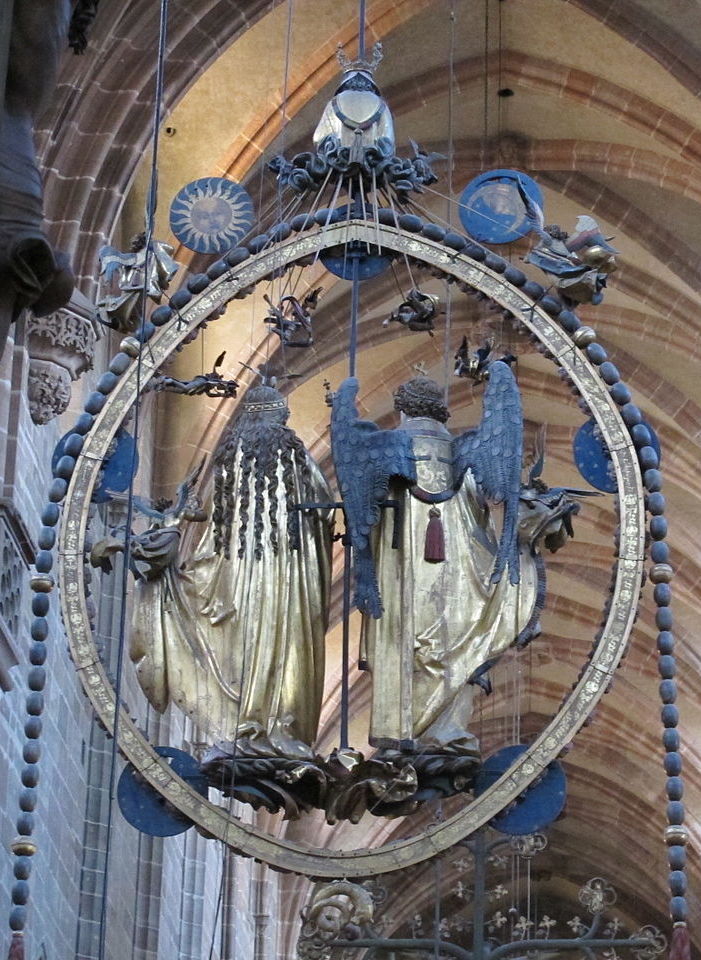
The sculpture hangs from the vaulted ceiling on a chain, and has done almost constantly since it was completed in 1518. At one point there was a petition to replace the chain with a hemp rope, as that would be cheaper, but, although the petition was successful, the rope broke. It was also taken down and stored during the Second World War, which was just as well, given that the church was completely gutted. The ceiling you see here dates from the 1950s, but gives an entirely convincing sense of the lofty heights of the brilliantly illuminated medieval church. The stained glass is also original – like the Annunciation it was removed and preserved – as was the elaborate candelabrum to the right of the image, which is topped by a small sculpture of the Virgin Mary. The candelabrum was commissioned at the same time as the Annunciation, and was intended to illuminate it. The patron was a local businessman – and council member – Anton Tucher, who had a particular devotion to the rosary. The candelabrum was there so that people could see the Annunciation in the hope that it would facilitate their prayers.

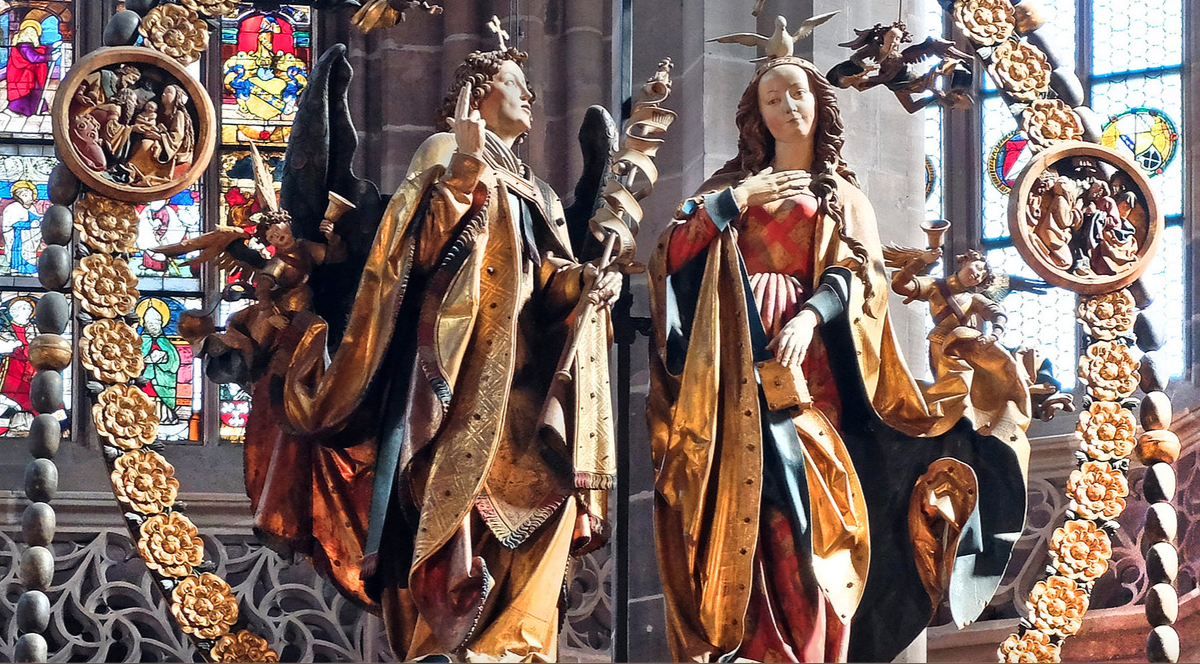
The dedication to the rosary explains the structure of the ensemble, which is made up of many different sculptures. Gabriel and Mary are central, perhaps a little too close for comfort given the nature of their exchange, and they stand not on the floor, but on the outstretched cloak of an angel. They are surrounded by a rosary, which is made up of a ring of small, stylised roses, with five circles arranged around it. There are another two of the roundels top left and right, with everything overseen by God the Father, perched on a cloud. Hanging from the bottom is a serpent, an apple in its mouth. Closest to the devout, this would be a constant reminder about the need for prayer. Hanging around the rosary is another string of prayer beads: seven gold beads punctuate sequences of black: there are three of the latter at either end, and then six sets of ten black beads. A rosary would usually have six sets like this, although only one would hang free, with the other five sets looped together. The same structure is replicated by the ring of roses. Although you can only see eight of these in between the roundels, if you look from the back, there are in fact ten – it’s just that each roundel hides two of them. This is a real sign that this is a devotional work, as there is nowhere where you could see the two hidden roses clearly. You say – or ‘tell’ – the rosary by running it through your fingers and saying a prayer on each bead. On each of the large beads (represented by the gold ones on the hanging chain, or by the roundels) you would say the Lord’s Prayer (“Our Father…”), and on each of the smaller ones, a “Hail Mary” – which is a version of the angelic salutation to the Virgin Mary, the very reason why the Annunciation is the central image. While saying the “Our Father” you should meditate on one of the mysteries – but I’ll tell you what those are later. Despite my frequent exhortations to ‘go round the back’ of sculptures (e.g. POTD 68), there is relatively little to be learnt here – although if you move around the full 180˚ of the ‘front’, the relationship between Gabriel and Mary will constantly change.

Gabriel looks a little duller here, because this photo was taken before a relatively recent cleaning – and yes, the sculpture has been cleaned and restored numerous times: it would have to be. You will know from your own homes how soon the dust settles. And given that there is a candelabrum that used to be piled high with candles not so far away, it would also have been covered in soot. But all that aside, it is in a remarkably good condition, because from the very beginning the sculpture had its own big, green bag which was only taken off during Mass and on special feast days. The process was expensive, and as a result the frequency with which this happened gradually decreased. And then in 1525 Nuremberg became Protestant, just seven years after the sculpture was completed, so it’s surprising that it survived at all. However, rather than destroy it, they just left it in its bag. It’s only relatively recently that it has been on display all the time. 

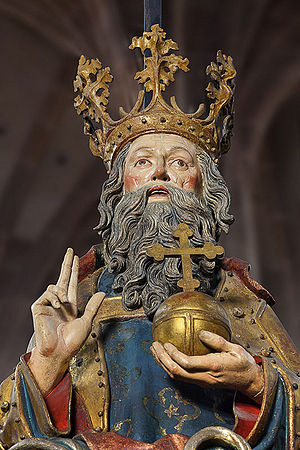
The angel Gabriel comes as a messenger from God the Father, who sits atop the sculpture, symbolically outside the world, above the clouds, in heaven. He blesses with his right hand, and holds an orb in his left. The orb represents the world, divided by a loop around the centre (the equator, effectively), and with an additional loop going round the bottom (usually, though, it goes across the top). Thus the globe is divided into three – Europa, Africa and Asia, the three known continents. OK, by the time Stoss carved it, the Americas had been ‘discovered’, but no one ever thought to change the orb. The cross on top represents God’s dominion over the world. When the orb is held by a monarch, it stands for that monarch’s dominion over their particular part of the globe on God’s behalf. Beams of heavenly light radiate out below God, but we can’t see those in this detail. Gabriel is mid-announcement, his lips open, and a look of awe in his eyes – Mary truly is as beautiful as he had been led to believe. His right hand points up, symbolically, towards God, and he holds his staff of office in his left. This really is a staff of office – there is no hint that it might be even slightly like a lily. Around it is wrapped a scroll, bearing the angelic salutation in full – ‘Ave gratia plena dominus tecum etc.’ – ‘Hail, full of grace, the Lord is with thee’. The ‘Mary’ was added later for the prayer, and for the sake of clarity.

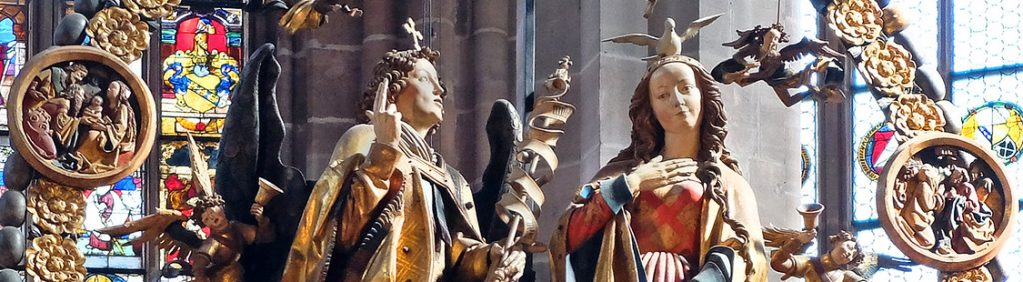
Gabriel and Mary don’t exactly look at each other – a bit like a skype call or Zoom, they appear to be on the same screen, and yet in different places. They are not quite looking at each other – or the camera. Despite their physical proximity, they should be imagined as being further apart, and facing towards each other – Stoss has abbreviated the space as a result of the requirements of the ensemble. On hearing the greeting – or, given that Gabriel is still speaking, while listening to him – Mary appears duly humble. Her left hand holds the book she was reading – the Jewish scriptures – against her lap, and it presses on the blue lining of her gold cloak, although I can’t help thinking that, with the surprise, she is letting it slip to the ground. Her right hand goes towards her chest as a sign of her humility, although it hasn’t got there yet – it stands free of her torso, a fantastic piece of carving. In all of the ensemble the the wood is carved deeply, notably around the draperies where corners always stand free, looking almost paper thin. To prevent th cloaks falling over the rosary, they are held up by angels, who are multi-tasking: they also ring bells in celebration. This is quite a noisy sculpture. The Holy Spirit has landed on Mary’s head, almost like Philip Larkin’s ‘faint hint of the absurd’. I’m not sure why Stoss chose to do this: he is happy for angels to be mounted on rods, why shouldn’t the dove do the same? It could well be a sign that, as the dove has landed, this is the very moment of conception. The roundels are, I hope, clear enough to read here. They are relief carvings of scenes from the lives of Mary and Jesus, arranged in a sequence starting at the bottom left, just below Gabriel’s feet.

On the left we see the Nativity, with the baby Jesus lying on the floor, in between Mary and Joseph, both kneeling and praying.  On the right, Mary and St Peter kneel on either side, with others in the background. The Holy Spirit flies, wings outstretched, at the top of the image – this is Pentecost, when the Holy Spirit descended and the Apostles went out to preach to the world (POTD 58 – we’ll hear more about it on Sunday). 

On the left, after the Nativity, comes the Adoration of the Magi. The eldest magus kneels and hands the gift of Gold to Jesus, who sits on Mary’s lap and leans over to touch it. The other two Magi stand behind – the middle-aged one bends over from the left, and the young, black king looks out above Jesus’ head. As well as the three ages of man, the Magi also came to represent the three continents – thus linking to the orb above. To the right we see the Ascension of Christ (POTD 64), which precedes Pentecost by ten days. Mary and Peter kneel on the ground looking up as Christ’s feet, and the hem of his robe disappear behind the top of the roundel.

Finally, at the top, we have the Resurrection (POTD 25) – which completes the cycle. Or rather, it links the images on the left and right, a clockwise narrative, from the Nativity and the Adoration of the Magi, through the Resurrection and on to the Ascension and Pentecost. The two additional scenes continue the story of Mary, with the Death of the Virgin (often referred to as the ‘Dormition’ – as she didn’t so much die as go to sleep – more of that another day), and then, in the top right, an image which combines several different ideas. Mary and Jesus are both crowned as Queen and King of Heaven, with swirling blue around them. Within this is the notion of Mary’s Assumption into heaven, and her subsequent Coronation. There are also angels with a viol and a lute – more music to add to the bells. 

Almost all of these roundels are taken from the ‘mysteries’, those events that should be contemplated while saying an “Our Father” on the larger beads. There were, traditionally, three sets of ‘mysteries’, although Pope John Paul II added a fourth. I’ll just list the traditional three, which were the Joyful, the Sorrowful, and the Glorious Mysteries:

Joyful: the Annunciation; the Visitation; the Nativity; the Presentation at the Temple and the Finding of Jesus in the Temple.

Sorrowful: the Agony in the Garden; the Flagellation; the Crowning with Thorns; the Carrying of the Cross and the Crucifixion and Death of Christ.

Glorious: the Resurrection; the Ascension; the Descent of the Holy Spirit (Pentecost); the Assumption of the Virgin and the Coronation of the Virgin.

Notice, however, that the Adoration of the Magi doesn’t actually feature here – so, although all of the other roundels represent ‘mysteries’ of the Rosary, this should really be elided with the Nativity.

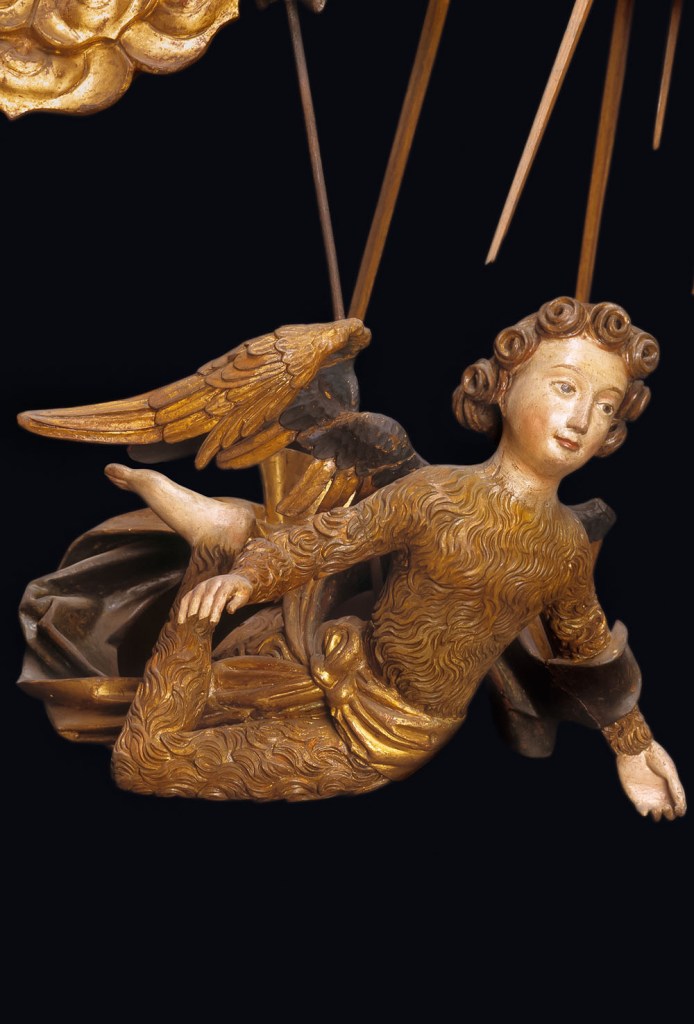
Having said that, listing the mysteries does make this sculpture seem more academic than it really is. What comes across more than any thing else, given the rich colours and the flights of angels, the clanging of bells and sweet angelic music, is that The Annunciation is a truly joyous event. The ‘sorrowful mysteries’ are completely omitted and there is the recognition that, with the Annunciation, Salvation is on its way. So let’s finish with some entirely joyous angels!

Day 69 – Artemisia, Painting

Artemisia Gentileschi, Self Portrait as the Allegory of Painting (La Pittura), c. 1638-9, Royal Collection Trust, London.

It’s a while since I last talked about Artemisia Gentileschi – way back in Picture Of The Day 17 – so I thought we should re-visit her to see how she’s getting on in lockdown. There is still no sign of the museums opening, though, and the exhibition at the National Gallery is still on hold – it is yet possible that it will open… You could, of course, order the catalogue directly from the National Gallery – it has great essays and superb illustrations.

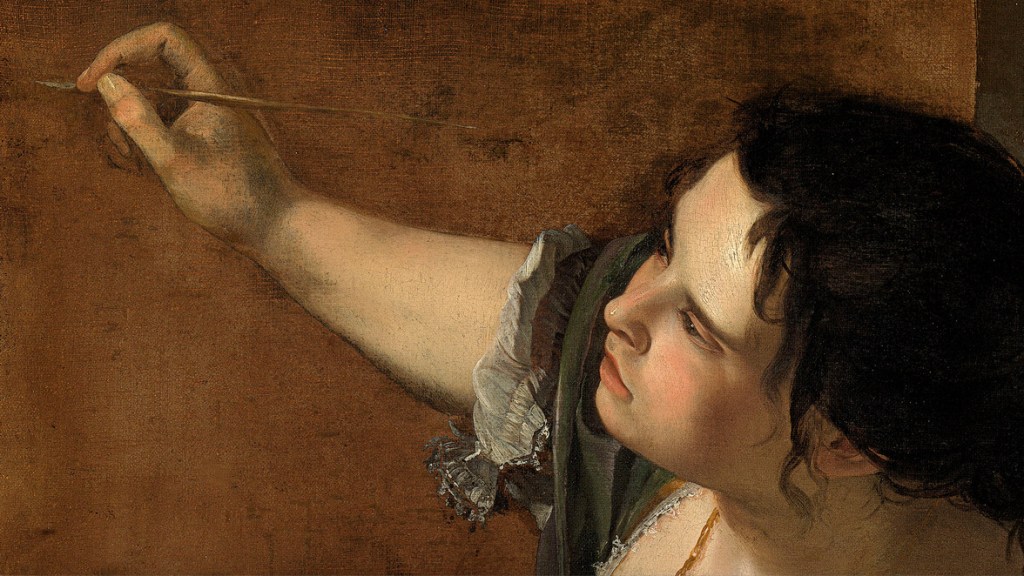
This particular painting is always worth thinking about, as it shows just how brilliant Artemisia was – in many different ways. For one thing, it is a self portrait, so it gives us some idea of what she looked like. It’s perhaps not the best self portrait from this point of view, and that is because of the point of view: it is extremely unusual. She paints herself from high up, and from off to one side. It’s hard to know how she could have seen herself from this angle – it would take at least two mirrors set up in the right positions. It’s still not going to be easy though. Unlike some of the other self portraits we’ve seen of women painting – notably Judith Leyster and Elisabeth Vigée Le Brun (POTD 34 and 55 respectively) – she hasn’t bothered too much about her appearance. She may be wearing a rather wonderful green bodice, beautifully painted, but she has rolled up her sleeves and is wearing an apron. Who wouldn’t, while painting? Well, judging from most self portraits, most artists! And her hair is a bit of a mess! She has, however, put on some jewellery: a gold chain, with a pendant.

The pendant is the real clue to this painting’s meaning – it is a mask. It looks like a face, but is only the image of one, in the same way that this looks like Artemisia, but is only a portrait… This necklace is one of the ways of identifying this as an Allegory of Painting. Even in this detail we can see so much. Her left hand holds a few paintbrushes and a palette – one of the more ‘old fashioned’ rectangular ones, from our point of view. What is not so easy to identify is the object she is leaning on, the sort of stone slab used to mix her pigments – the coloured powders that give the painting its vitality – with the oil – the medium which binds the pigment; makes it liquid, so that you can actually paint; adheres the pigment to the support (usually, by this period, a canvas); and dries to protect it. Artemisia’s palette, brushes, and the stone slab form a stable foundation on which this portrait rests – they are the foundation of her art, after all – and it is here that she has chosen to sign the painting, using the initials A.G.F. – Artemisia Gentileschi Fecit – or ‘made this’, in Latin. Not only that, but she is showing us her technique. The left arm may now be a little worn with age, but it was always fairly thin – sketchy even – showing her skill at building up an image with an economy of means. Once the canvas was attached, taut, around the stretcher, she would have primed it, painting a dull brown ground layer of paint all across the surface: if you look at the areas of shadow between the green folds of the sleeve, that is the ground – particularly clear in the curving fold that comes up from the flash of white cuff, and curves down again just below the cord with which she has tied up her sleeve. This is something she could have learnt from her father, or directly from the work of Caravaggio, who often used this shorthand: not so much painting the shadow, as leaving it absent.

As for her hair, well, would you bother with that if you were hard at work? The fact is, this is another feature that helps to identify the subject of the painting. Artemisia is drawing on the Iconologia written by Cesare Ripa, an emblem book that describes the way in which personifications should be represented – a sort of ‘Handbook of Allegories’ . The first edition was published, without any pictures, in 1593, with a second illustrated edition following ten years later. ‘Painting’ is described thus:

A beautiful woman, with full black hair, dishevelled, and twisted in various ways, with arched eyebrows that show imaginative thought, the mouth covered with a cloth tied behind her ears, with a chain of gold at her throat from which hangs a mask, and has written in front ‘imitation’. She holds in her hand a brush, and in the other the palette, with clothes of evanescently coloured drapery.

Clearly, Artemisia has chosen some, if not all, of this description. Beautiful – well perhaps that was not for her to say – but with black hair, certainly. In other self portraits she has auburn hair with a wonderful sheen, beautifully dressed – whereas here it is ‘dishevelled, and twisted in various ways’, showing the distraction of the artistically inspired. The eyebrows are not arched – but this allows a wonderful passage of paint across the forehead: a thickly loaded brush was pulled across to pick out a highlight, emphasizing the light within, the power of her intellect. Or perhaps it was just showing us the form – like the little white fleck that shapes of the tip of her nose.  Her mouth is not covered with a cloth, of course. Ripa wanted to show that painting is mute, it speaks through the eyes, and not through the ears, but that wouldn’t make for a good self portrait. It also wouldn’t have allowed us to see the wonderful, pensive, slight parting of the lips (I almost expect to see the tip of her tongue. like you do with children when they concentrate). However, she does have the ‘chain of gold at her throat from which hangs a mask’. We don’t need the word ‘imitation’ – Ripa was always guilty of over-egging the pudding – the mask is sufficient. It is a symbol of imitation, yes, but it was also a symbol of deceit (POTD 32), and what is painting, if not deceit, trying to show us something that is not real?

Scholars have argued about the background of this painting – even though there is almost nothing there to argue about. There is vertical line, which is not so much a line as a change of tone. This could be the corner of a room, with two walls meeting. Or the lighter area might be a blank canvas, about to be painted. If it is, then we have an even more sophisticated possibility. Artemisia holds the paintbrush between thumb and forefinger just below the top left corner of this blank canvas, with the tip of the brush just about to touch very close to its left-hand edge. And what do we see in the self portrait just below the top left corner, very close to its left-hand edge? Well, the tip of the paint brush. Artemisia is about to start painting by depicting the very paint brush that we can see her holding. Which just shows us how clever she was. And it has to be ‘she’. Ripa tells us that ‘Painting’ is a beautiful woman – and that’s because, in Italian, ‘Painting’ is La Pittura, a feminine noun. Artemisia’s male contemporaries simply couldn’t have painted this. Apart from anything else, it would never have occurred to them.  

Day 68 – Psyche, a coda

Antonio Canova, Psyche revived by Cupid’s Kiss, 1787-93, Louvre, Paris.

I know, Cupid and Psyche are living happily ever after, but I couldn’t leave them without one last look back, and without one last, truly beautiful image of Psyche. This is a sculpture by Antonio Canova, the great master of neo-classical simplicity. 

As often with Canova, there are two versions of Cupid and Psyche. This one is in the Louvre, and was originally commissioned by Colonel John Campbell. He was a Welsh politician and art collector, who, after the death of his father when he was just 15, and his grandfather when he was 24, found himself remarkably well off, and he headed off on the Grand Tour at the relatively late age of 30. He travelled to Italy and Sicily for the next five years. It was while he was there that Campbell commissioned this sculpture from Canova, who was four years younger than him – 30, when this sculpture was commissioned in 1787. However, it seems that Campbell never received it. Joachim Murat, Napoleon’s brother-in-law, acquired it in 1800, and after his death in 1824 it passed to the Louvre. A second version was commissioned by Prince Nikolai Yusupov in 1796. They were a highly sophisticated family. They had a superb art collection, and a rather fantastic palace in St Petersburg, which even had its own theatre. The palace and theatre are still there, but after the Revolution, the Canova ended up in the Hermitage.

I could have talked about this sculpture two weeks ago, when discussing Sir Anthony van Dyck’s Cupid and Psyche (Picture Of The Day 54), as the two works represent the same moment – but let’s face it, they are rather different, and both deserve a moment to themselves. We’ve got to the point in the story when Psyche was carrying out the last of her tasks, and had collected some of Proserpina’s ‘Beauty’ to take to Venus, but she opened the container and fell into a death-like sleep. Now Cupid has awoken her with one of his arrows, and they embrace… In many ways, it’s that simple, and the sculpture itself looks effortless. But ‘effortlessness’ turns out to be the result of a lot of hard work. The main aim of neo-classicism was not to be bold, and daring, and original, trying to find new solutions to problems, but to look for something essential, an idea that looks as if it has always been there, and then to pare it down even further, to simplify it and to make it clear. This might appear to be a somewhat disingenuous intention, especially as this particular sculpture manages to be both original and daring. Cupid reaches around Psyche, and, as she sits up, he supports her head in his right hand, while his left goes around her torso. She stretches up to hold his head, her arms forming a loop, in a similar way to his, which curl around her. The two are encircled by each other, two halves of the sign for eternity, promising the continuity to come. She lies on one hip, he kneels, balancing with one foot lower down the rock, her body forming a continuous line with one wing, his extended leg with the other. Their bodies form a pyramid, which, with his wings, becomes a cross – ‘X’ marks the spot. The wings themselves are carved so thinly, and the arms are entirely free from their bodies: this really is daring carving, puncturing a single piece of Carrara marble and turning it into the softest of flesh.

And it is thin – look how translucent those wings are. The excavation of the forms really pays off when Canova’s sculptures are lit well, and preferably, by natural daylight. The light falls on different surfaces, emphasizes some features, and blurs certain boundaries: the play of light and shadow defines everything this sculpture is about, caressing the surfaces, touching the sculpture lightly as they touch each other. But how do you work out such a complex composition? As any couple will understand, it’s not always easy knowing where to put all four arms, and when there are wings as well…

It’s always best to start with a drawing – although that might seem counterintuitive for a three-dimensional object like a sculpture. Canova’s work is conceived to be seen in the round, although there is usually a principal viewpoint. That is what he is developing in this drawing. You can see that the basic composition is already in place: the long curve from Psyche’s right foot – at the bottom right of the pyramidal composition – up to her right hand above Cupid’s head; the fact that her hips are twisted towards us, so we get as full a view of her body as possible; and the framing of their faces by the loop of her arms. We also see the full extension of Cupid’s right leg as he leans over her, kneeling on his left knee, with his left arm reaching around her torso. There is even a sketched suggestion of the drapery underneath her. The only thing that Canova was to change was the position of the wings. In the drawing they spread out across them, almost like a protecting canopy. They are more horizontal than in the sculpture, where they are far more awake and alert. You could even argue that in the drawing they represent Psyche’s lethargy, whereas in the sculpture they are far more vital: they are Cupid’s wings, after all, and reflect his energy at this point in the story.  They also come to have a more defining role in the composition, with its overlapping diagonals, continuing the lines of the two bodies, and bringing the couple together.

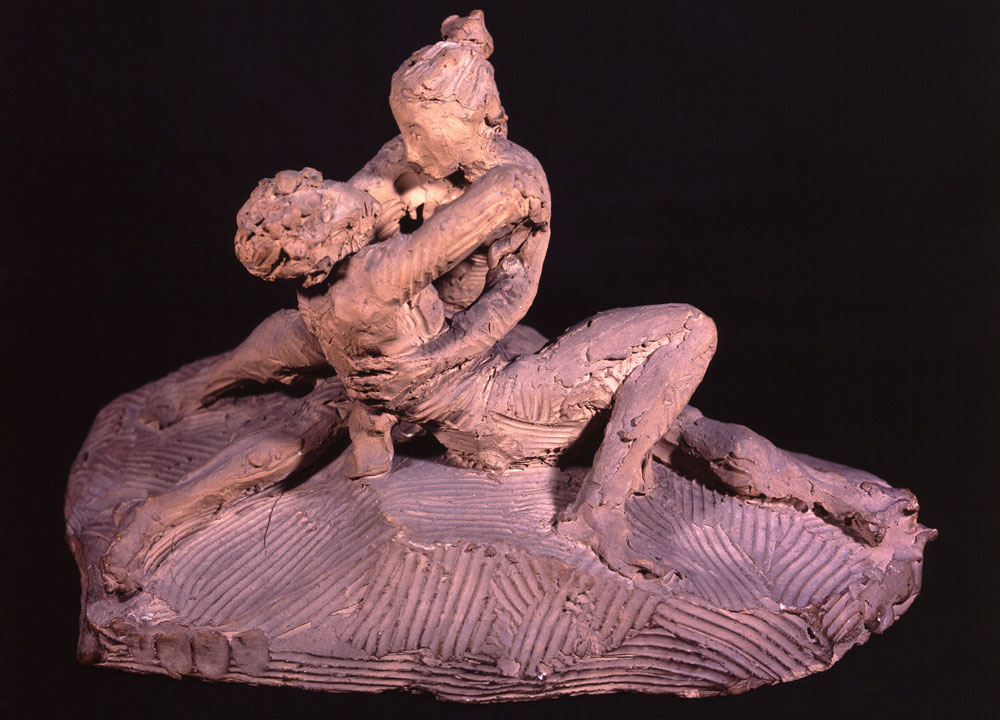
Having decided on your basic compositional structure on paper, you then have to check that it would really work in three dimensions – hence the use of clay. Often the small clay models were fired – thus making them terracotta – which meant they could be kept. There was always more than one reason to do this. Canova was aware that a sculpture could only be owned by one person – but that it was always possible to make a second version. So it was enormously useful to hold onto all of the developmental stages in case you wanted to go back and reassess the finished product. The best place to see this is the Museo Canova in Possagno, the small town in the Veneto where he was born, which has a remarable display of sketches, working models and plaster casts. Another reason to ‘save’ the bozzetto (POTD 42 & 51) was that Canova, like many artists since the 16th century, was very well aware of his development as an artist, and the process of evolution of each individual piece – and that the process itself was saleable. Terracotta bozzetti were collectable in a similar way to drawings.

However, looking at the bozzetto above, you realise pretty quickly that this is not the finished composition. It is the female figure – Psyche – who is sitting more upright, and has the male – Cupid – in her arms. Although one of his legs is extended, and the other bent, he is sitting on the ground, rather than kneeling. It is more as if she is caring for him, rather than him waking her up. Indeed, it could be that this predates the drawing – and that, when commissioned to carve a sculpture showing Cupid and Psyche, Canova originally thought of a different episode in their story: this looks more like Cupid swooning – although without the wings. They really would be tricky in clay. It could be that he abandoned his idea, and went back to the drawing board – so the drawing might have come after this terracotta. That aside, it does at least show you what the process of development would be: the creation of a rough, terracotta model of a potential composition. The limbs are built up with small pieces of clay, and modelled by hand, or with a number of different tools. The most obvious here was something like a comb, a toothed spatula, which has been used to scrape the base into its current form. There could easily have been several bozzetti like this. Each would not necessarily have taken too long to make, and, being clay, were relatively cheap. Clay is also extremely malleable, so adjustments can be made as you look, and, working on a small scale, you can turn the model around in your hands and check every angle to see that all possible viewpoints work. In this way you would eventually arrive at a definitive composition. The next stage would be to turn the bozzetto into a stone sculpture.

Having decided on the composition, and how it would work in every detail, Canova would then make a full-scale model in plaster. This one was made for Prince Yusupov’s sculpture – as I said, the sculpture itself is in the Hermitage in St Petersburg. However, the plaster modello has ended up in the collection of the Metropolitan Museum of Art in New York. It might look as if it is not in a terribly good condition – or that the complexions of both Cupid and Psyche have suffered from some terrible skin disease, as it is covered all over in small spots. These are, in fact, metal pins, which have been inserted into the surface of the plaster, and there are more pins where the surfaces are more complex – notably on Cupid’s left hand, just below Psyche’s breast. These are measuring points for the stonemasons. Yes – Canova didn’t carve the marble himself. Don’t feel disappointed – the same is true of many, many sculptors. Rodin did not carve The Kiss, for example, and even Bernini had a helping hand with the leaves on Apollo and Daphne (POTD 56). The stone masons were expert at replicating the precise appearance of the modello, as it was primarily a mechanical exercise. To do this, they used a pointing machine, which measures the height, depth and distance from left to right of each pin that has been inserted, and helps them carve the marble to the same depth at each point. If you’d like to see how it works, there is a good video from the Smithsonian Institute, Carving a Marble Replica using a Pointing Device – other longer videos are available!

However, this process does not complete the work – it is just roughing out the forms – the finish would have been done by Canova himself, and he insisted on doing this in private, so that no one could see his secrets. How, precisely, did he get that wonderful silky finish? That’s where the real skill lay…

I’m including this photograph as a real lesson in looking at sculpture. It is solid, it is three dimensional, and you can move round it. But all too often, with Canova especially, people only bother to look at the ‘front’ – they never get beyond the ‘principal viewpoint’. It was only when I went round the ‘back’ of the Three Graces that I realised what a brilliant artist he was – he has thought about every point of view. There are several clues to that in this photo. It is only from this side that you can see the vase lying behind Psyche that would originally have contained Proserpina’s ‘beauty’ – and lying next to it, to the right, and pointing towards her, is the arrow that Cupid used to wake her. It is only from this angle that you can see his quiver, for that matter, still full of arrows – that crowd is lucky he’s busy at the moment or there could be mayhem. And quite apart from those details, the sculptural mass of the composition, the way the two forms stretch in towards each other, his, taut and leaning down, hers, limp but reaching up, can only be appreciated fully from this side, without the complexity of the interlocking arms and the incidental distractions of their faces. And here’s the real clue: just under her right foot, projecting beyond the base, there is a handle sticking out, and that would originally have been used to turn the sculpture round. OK, so now there is no one to turn the sculpture for you, and you have to make the effort yourself, but do. Walk around, look at every possible viewpoint, get closer and further away. And never worry about going round ‘the back’. You might learn something.

Day 67 – Psyche VII: ‘Celebration!’

Raphael, The Council of the Gods and The Wedding Banquet of Cupid and Psyche, 1518-19, Villa Farnesina, Rome.

Oh dear – I was wondering last week if we were nearing the end of the story of Cupid and Psyche (Picture Of The Day 43, 44, 46, 53, 54, 60), on what has gradually evolved into ‘Psyche Sunday’, and I fear that things are not yet resolved. Mercury had flown down from Olympus, leaving nothing to the imagination, Psyche had been gathered up by him to be taken to meet ‘the family’, and now – well, it’s all over bar the shouting. 

Just a reminder of where we are: in the loggia of the Villa Farnesina, with Raphael’s scheme sadly incomplete, but still entirely enchanting. Last week we talked about the paintings in the pendentives, and today we will look up to the ceiling itself and the two fictive tapestries. Both are ‘hung’ in the pergola, garlanded with fruit and flowers, with the chords tugging at the decorative borders so that their edges are scalloped. They are arranged so that, as we enter the loggia and look up, we see them the right way round – the ‘ground’ in the tapestries is towards the villa. Psyche has been summoned by Jupiter to appear before the gods, but she has not yet been accepted. If I’m right, though, and it’s all over bar the shouting, let’s look at who’s shouting!

One of the things I realised when I wrote my book about the Renaissance was that Raphael was very good at cataloguing. If you want to see all the Greek and Roman philosophers, look at The School of Athens. If you are interested in Christian Theologians you’ll find them on the opposite wall in La Disputa. All of the Sibyls are in his fresco in the Chigi Chapel – yes, same Chigi – in Santa Maria della Pace. And if you want a painting with all of the Olympian gods, then this is it. Well, most of them are here. To be honest, as with most meetings, not everyone is really that involved. At the moment the debate is going on between Venus and Cupid, who are both putting their arguments to Jupiter at the far right of the image. 

The King of the Gods and Goddesses has his right foot up on the globe: we are not so much under his thumb, as ground down under his heel. He sits with elbow on knee and chin on hand, the ultimate gesture of ‘the thinker’, made explicit by Rodin centuries later. With one knee up, foot forward, the other down, foot back, and one mature, muscular shoulder also forward, he could easily be a reconstruction of the Torso Belvedere (POTD 48) – or simply inspired by the prophets and sibyls painted by Michelangelo on the Sistine Ceiling. He has a robe of royal purple wrapped around his legs, with his eagle sitting between them, happily joining in (well, he had helped Psyche with one of the tasks – POTD 53). To our right of him, in blue and yellow, with a peacock behind her in the bottom right-hand corner, is his consort, Juno, Queen of the Gods and Goddesses. On the far right, standing at full height, wearing a feathered helmet which takes her to the full height of the ‘tapestry’, a spear in her left hand which goes out of view, is Minerva, Goddess of War and Wisdom. Her tall, straight figure closes the composition at the right, and she looks down, thus directing our attention to the focus of the debate. Juno does the same, as does a third woman, with a crescent moon in her hair. This is Diana, the Chaste Goddess of the Hunt, and Goddess of the Moon. I’m afraid I’m only going to use the Latin names today – ‘when in Rome’, as they say – and I’m also simplifying their areas of responsibility. These changed over the millennia of Greek and Roman history in a way that is too complex to capture simply. All three are looking down towards Cupid, who, as in previous episodes, is not the chubby baby beloved of many, but the sort of adolescent who is bound to fall in love – what he believes is true love – and the sort of love that he knows adults are bound not to understand. His wings identify him, as he gestures towards Jupiter, trying desperately to tell Jupiter what true love is (as if either would know…). Next to Jupiter is another bearded, mature man who clasps a three-pronged spear, or trident. This is Neptune, the God of the Sea. And besides him a man with a two-pronged spear, or bident – Pluto, God of the Underworld, with Cerberus, the three-headed dog at his feet. It’s a bit like having the head of the UK Government, with the heads of the governments of Scotland and Wales… Jupiter ruled over everything, not just the sky. Imagine if the Head of the UK Government was as much of a philanderer as Jupiter, though, and tried to advise someone on love. I mean, what do you do when someone has broken the rules?

Neptune and Pluto look distrustfully at a topless woman. This is Venus, Goddess of Love and Beauty, here only defined by her nudity. Well, at least she’s covered up a bit. As much as the men have, anyway. The other three women present are entirely decently clad, though – you can’t be inappropriately clad in Council. Or use the wrong tone. Venus points a finger of blame at Cupid, and tries the ‘innocent eyes’ trick with Jupiter. But will it succeed?

Behind Venus, and keeping an eye on her (well, they’d had an affair) is Mars, God of War, in his armour. His shield rests on the floor, in between him and Apollo, God of the Sun and inspirer of the muses, who has clearly spent a lot of time at the gym, and just as much time tending to his long blonde hair. His left hand rests on what is probably meant to represent his lyre. He points to Venus – or maybe to Mars – while looking to our left. Raphael does this to move our attention along the composition, but Apollo is clearly telling somebody something. He is either conveying the latest developments in the debate, or simply gossiping about Mars’ and Venus’ affair. Next to him is another blonde ephebe. This is a Greek word for a young man in military training, usually about 18-20 years old, although it comes to stand for ‘young man’, or ‘youth’, or, for that matter, ‘pretty boy’. He has vine leaves and grapes in his hair, which indentifies him as Bacchus, God of Wine. However, Raphael does this for ease of identification, as traditionally Bacchus would have ivy in his hair. Titian gets that right! To our left of Bacchus is another mature man with grey hair and beard, huge muscles and a large club. He could, just like Jupiter, be a reconstruction of the Torso Belvedere. And like Jupiter he rests his chin on his hand. Well, like father like son, I suppose – this is Hercules, Jupiter’s favourite illegitimate son, although he seems strangely old to be the latest arrival in Olympus. To the left of him, dressed in what could be workman’s clothing, with a big pair of tongs over his shoulder, is Vulcan, the God of Fire, who worked in the forge making all the armour and weaponry. There are also two River Gods lounging on the ground – that’s what they do – and the one on the right has his arm over a lion. I can’t for the life of me think which river he represents. There used to be a sculpture of the River Tigris in Rome, which had a tiger, but that got re-carved to look like a she-wolf, thus re-purposing it to represent the Tiber. Raphael could have been thinking of that. A century or more later, Bernini would use a lion as a symbol of the Nile, but this is not the Nile.

The River God on the left is leaning on a sphinx – so that must be the Nile. To the left of Vulcan we see Janus, God of doorways and boundaries, looking back to the past (the old face on the right) and forward to the future (the young face on the left) – and the future is Psyche. Mercury, in his winged helmet, has just arrived with her, and hands her a welcoming drink. In the other hand he holds his caduceus – his staff of office. There are all sorts of tales about this, but it basically identifies him as the Messenger of the Gods. He carries it in the same way that Gabriel used to carry a messenger’s staff, until that got swapped for a lily (but I don’t think I’ve mentioned that yet). He would use it to part the clouds, when flying on a mission, and once, when he saw two serpents fighting, he ‘zapped’ them with it, and they curled up around it and died… Meanwhile, an amoretto clings to Psyche’s legs. That’s not Cupid, remember, he’s at the other end of the fresco. Or ‘tapestry’, rather.  What does she get to drink? It is ambrosia, the food of the Gods (whatever happened to rice pudding, by the way?) The fact is, while we have been looking at them all and chatting away amongst ourselves, they have been discussing her, trying to calm down the disagreement between Venus and Cupid, and generally trying to placate Venus, which was never easy. However, despite what seemed like insurmountable difficulties they have decided that Psyche can stay! So she gets to drink ambrosia, and to be immortal. There’s nothing left but to celebrate.
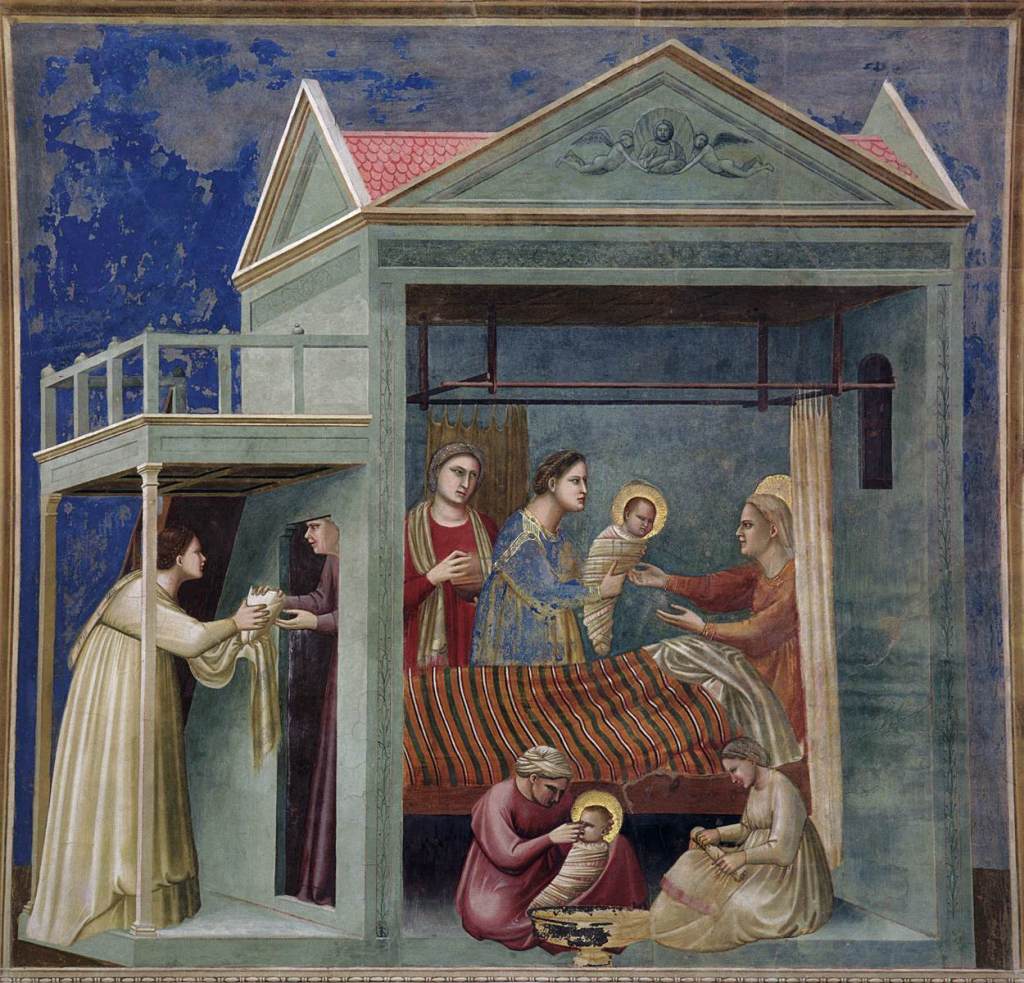
And it is the wedding feast that we see in the ‘tapestry’ on the left – the same gods, although not as easy to identify: tridents and bidents have been left at the door it seems – although not clubs – and war has been banished (so no Mars). But there are a few additions. Some of them are seated at the banqueting table, as wine is poured and garlands are brought, while on the left, others have already broken away to the ‘mingling’ phase of the party.

Cupid and Psyche are seated at the far right of the image, still very much in love and peering into each others eyes, while the Three Graces appear at the top right to anoint them, thus auguring their future success and happiness. Jupiter is next to them, dutifully ensconced with his wife Juno who is holding on to him firmly – although, as she looks away he accepts a drink from Ganymede, his cupbearer. Well, that’s one word for it, I suppose, but that’s another story. But this is the banquet – what about the marriage itself? Well that was painted by Giulio Romano in the centre of the ceiling of the Sala di Psiche in the Palazzo Te in Mantua (POTD 42). The most extreme version of da sotto in su I know, we look right up past them, their whole bodies foreshortened, as they stand on clouds above our heads, surrounded by all the Gods. They reach across the space between them and hold hands, with Mars and Mercury flanking Cupid – you can see right up Mercury’s skirt. Way up in the sky Jupiter is holding a thunderbolt, and next to him is Juno, who is also, somewhat ironically, the Goddess of Marriage and Childbirth. She raises her hands in blessing, and they were indeed blessed: in due time Psyche gave birth to a daughter, called Pleasure. The shouting is over: Psyche, representing the head, and Cupid, the heart, are now safely together, and when your head and your heart are in the same place and want the same things, then you can be sure you will live happily ever after. 

Day 66 – Joachim and Anna

Giotto, The Story of Joachim and Anna, c. 1305, Scrovegni Chapel, Padua.

Time to get going with the stories! From the past few weeks we know, when looking down the chapel towards the altar, that the Last Judgement (Picture Of The Day 38) is behind us, with the Virtues at the bottom of the walls on our right (POTD 45 & 59), while the Vices are opposite them on our left (POTD 52 & 59). 

Well, the story starts at the far end of the top tier of the right-hand wall as we look towards the altar. As we mentioned last week there are windows on the right but not the left (that is where the Scrovegni Palace used to be), but they don’t reach to the top of the walls – which means there is more space for the narrative. There are six scenes at the top level (you can only see four in this photo), although we’ll only have time for the first five this week. The story progresses in an anti-clockwise direction – from left to right – and all movement in the paintings moves from left to right too. We start with the story of Joachim and Anna, who will become the parents of the Virgin Mary – although at this point, they have no idea what’s coming.

Indeed, the story starts with childlessness and rejection. It may be obvious to us that Joachim is holy, given his big golden halo, but he is turned away from the Temple because, as an elderly man with no child, he must be cursed by God. When looking at the fresco in situ, the painted temple would be seen in relation to the altar of the Chapel itself, as it faces the same direction. Both are to our left, when looking directly at the wall, which is on the right in the photo above. The Temple acts as a closure to everything that went before. Joachim can only leave. He may look over his shoulder, but his body is already facing right. Indeed, he is already at the right-hand side of the picture: the story has already begun. He doesn’t have far to go, but then, he cannot go far, he doesn’t have the energy. He just steps through to the next scene, out into the countryside, with two sceptical shepherds and their flock of indifferent sheep. He couldn’t face going home. He wraps his hands in his cloak and looks down in shame, although he is still facing towards the right. The rocks form a plateau behind his head, which connects him to the shepherds, even if there is a gap between them. The high rock seems to close off the painting to the right, as if there is no way out. The sheepcote itself is a dead end – and is a reflection of the screen around the Holy of Holies in the Temple: the sheepcote’s door is opposite the gap in the screen. The rock on the right is also a reflection of the tabernacle, which closes the left-hand side of the first picture. In both, the animals are eloquent.

In the first, Joachim clasps the sacrificial lamb he has taken with him, cuddling it more like a pet, or a comfort blanket. Like him, it is rejected, although if it knew, it would probably be far happier about the fact. Joachim’s face wrinkles with betrayal and incomprehension, while the priest frowns, pushing Joachim’s back, pulling at the hem of his cloak: he didn’t want to have to do this, but he had hoped it would be easier. He’s been at the job a long time, and has a longer, greyer beard than Joachim’s – it’s quite soft by the look of it. There are white lines along the folds of his green sleeve, suggesting that it has faded with service.

The only sign of hope as Joachim seeks solace in the open air is the sheep dog, who approaches him, looking up with concern, and lifting a paw in an act of consolation. The sheep remain unmoved.

Meanwhile, Anna is at home, kneeling in prayer, facing to the right. She too is holy – and it is fascinating to see that Giotto has started to think of a halo as a solid object, a three-dimensional form which looks different from different angles. In other places in the chapel it is simply a flat disk, gilded to reflect the natural light and represent the glow of sanctity. He’s good at the observation of everyday life though, Giotto: look at the bench by the bed, and the chest under the window – not to mention the curtain hanging from the rail above the bed – so he must have stopped to think how he would observe a halo if he could, or for that matter, an angel flying through a window. It’s a master class in foreshortening. 

This is an annunciation – though not the Annunciation – as the angel has come to tell Anna that she will have a daughter. Oh the irony: as yet, she doesn’t know that their childlessness is the very reason that Joachim has not come home. Anyway, it must have been something of a surprise. Looking at the wrinkles on her face she was – as Zacharias would later say of his wife Elizabeth when the birth of their son John the Baptist was announced – ‘well stricken in years’. However, they clearly have a comfortable life, living in a fine house with a pediment, and able to afford a rich red robe with gold decoration, and even a servant, spinning on the patio in far plainer clothes.

Joachim settles on a course of action. If he is cursed by God, God must be appeased – and so he sacrifices a lamb (possibly the same one we saw earlier) on an open air altar.  The shepherd on the left is dressed in earth tones, like the background, with the downward swoop of the rocks drawing our attention to Joachim, who kneels (facing to the right) on an upward sloping rock. He is in pink – as is the angel on the right and the altar in between them – the colour creates a relationship between them, their mutual gaze full of tension. They form a pyramid with a hand that appears from Heaven – it is God: Joachim’s sacrifice has been accepted, and the angel has come to tell him so. Given the relief, he can now sleep. And as there is no movement in sleep, he doesn’t need to face to the right – although the angel does: it is the angel who is moving the story forward. The curves of the angel’s materialising body and outstretched arm are echoed in the rocks below. Joachim sleeps outside the sheepcote that we saw in the second image, with the same rock behind: Giotto always has a very secure sense of place. The other rocks may look different, but then, the dynamic of the scene is different too. Two shepherds look on as the angel flies in to greet Joachim while he sleeps – he is dreaming, and the angel tells him to meet his wife by the Golden Gate. But will he go? Well, I’ll have to talk about the Immaculate Conception first, and that may take some time – so we’ll find out next week. But just in case you were wondering if all this is all that remarkable – well, so far this week there has been some good and straightforward story telling. The further into the story you get, though, the more complex are the relationships between the paintings. And we’ve only just begun!

Day 65 – Venice

Canaletto, Venice: The Basin of San Marco on Ascension Day, about 1740, National Gallery, London.

Yesterday was Ascension Day, and in Venice that always used to be one of the great days of the year. The celebration, known in the Venetian dialect as the Festa della Sensa, was associated with two historical events. On 9 May in the year 1000 the Venetians defeated the Slavic pirates who were threatening the Dalmatian coast, thus allowing the Venetians to begin their domination of the Adriatic Sea. The second took place in 1177, when the Doge welcomed both Pope and Holy Roman Emperor, who signed a treaty ending years of dispute between the two powers. In gratitude the Pope gave the Doge a ring he had blessed as a reward, a sign of Venice’s dominion over the sea. This was commemorated every year during the Festa della Sensa, which was also known as the Sposalizio del Mare – or ‘Marriage of the Sea’. The Doge was rowed out into the Venetian lagoon, where he threw a ring overboard, symbolically marrying the sea to La Serenissima – ‘The Most Serene Republic’, as Venice was known. The two were interdependent – Venice relied on the sea for its defence, for its trade, for its food, and the sea needed Venice… well… to defend it from everyone else, I suppose. I’m not sure that anyone had actually ever asked the sea if it wanted to marry Venice, but given that the relationship contained within it the age-old assumption that marriage is equivalent to domination, it seems unlikely.  All that aside, this is what the Festa looked like around the year 1740.

Canaletto, Venice: The Basin of San Marco on Ascension Day, about 1740 https://www.nationalgallery.org.uk/paintings/NG4453

This is surely Venice as we see it now – or, at least, Canaletto’s great skill was always to capture Venice in a way that makes us think that this is how we see it now, although, in all probability, it never looked quite like this even when he painted it. But the wonderful thing is, most of these buildings are still there, and still look the same. Even the campanile, or bell tower, of San Marco looks the same, and that fell down at the beginning of the 20th Century. They rebuilt it, though, as a replica of the original. During the ceremony, the Doge would leave his palace on foot, and walk the relatively short distance to the Molo, or quay. He would progress to the State Barge, or Bucintoro, which is that great, gold galleon next to the quay in the middle of the painting. OK, I know it’s not a galleon, but I like alliteration (you might have noticed). When Enobarbus described Cleopatra’s vessel, he could have been describing the Bucintoro:

The barge she sat in, like a burnish'd throne, 
Burned on the water: the poop was beaten gold…

Nobody is entirely clear where the name bucintoro  (the ‘c’ is pronounced as in ‘butcher’) comes from, but a burcio was a traditional vessel used on the Venetian lagoon, and oro means gold. It could have been that. the English translation is ‘Bucentaur’, but I’ve never known it used in print. Canaletto paints the bucintoro with the dazzling shorthand of his mature style, using two tones of ochre, a darker one for the ground, and a lighter for the carved decoration – which is elaborate: there are figures all the way along. Towards the prow there are angels blowing trumpets, and, atop a vast shell, two figures carry a sword and a wreath, both in some way representing Venice: the figure with the sword is almost certainly Justice, one of the chief virtues Venice claimed. Remembering that Portia’s speech starting ‘the quality of Mercy is not strained’ occurs in a courtroom in Venice, I do wonder if Shakespeare ever got there… it has been suggested. To get to the bucintoro the Doge would have passed between the two columns which are visible behind the prow, the one on the right topped with the winged lion of St Mark, since 829 the main patron saint of Venice, and that on the left the earlier patron, that saint who killed a dragon, what was his name? Oh yes! Of course, St Theodore. And if you’ve never heard of St Theodore, you aren’t the only one. The theory is they sent people off to Alexandria to bring back the remains of St Mark, because a better-known saint would bring in more pilgrims. For which, read tourists. It seems to have worked. Behind the barge is the Biblioteca Marciana – the library of St Mark’s – and to the left of that, slightly set back, but also built out of stone, the Mint.

The Doge’s Palace is, of course, one of the most famous buildings in Venice. It started life as a defensive castle more or less at the mouth of the Grand Canal, its chapel dedicated to St Mark. The present façade dates to the 15thCentury. The arcade at the bottom is called the broglio, and you might hang around there to chat to your friends, or even to plot. If you did, in the broglio, that would be an imbroglio – one the many words we owe to Venice. The bridge on the right crosses the little canal, or rio, which goes under the Bridge of Sighs – people sighing because it leads to the prison, the plain, bulky, and impenetrable building on the far right of the painting. And to the left of the Palace, just next to the far end of the broglio, you can just see the temporary wooden structure erected for spectators eager to see the Doge leaving the Palace (the door is around the corner there, opposite the base of the campanile) and heading to the Bucintoro.

On the far right of this detail is the column topped by the statue of St Theodore. Just above him and to the left is a rather large chimney: that is the chimney of the Mint, where the furnace would melt the metal for the coin of the republic to be struck. The Italian word for Mint is ‘Zecca’, a word which comes from the Arabic ‘sicca’, meaning the die used to strike a coin, or even the coin itself. Being on the sea, the trade with ‘the East’ was always hugely important for Venice, and much of their dialect – and, for that matter, Italian as a whole – reflects this. They made some very small coins there, and, as you may know from tortellini, Italian diminutives use the ending ‘-ino’. So a very small coin, from the Zecca, was called a Zecchino – which is where we get the word ‘sequin’. Beyond the Mint is a red brick building which, however many times you have been to Venice, you will not remember. It is the grain store, and you won’t remember it because it spoilt Napoleon’s view from the apartments on St Mark’s Square across the lagoon – so he had it knocked down. There is now a fairly non-descript garden in its place. For now, let us leave it there, and imagine what it would be like to approach Venice from the sea. The first building you would pick out would inevitably be the Doge’s Palace, its grand, imposing bulk getting more solid the further up it goes, almost as if it was itself floating on the waves. It is the source of power. To the right is the prison – so if you, as a visitor, do wrong, that is where you would end up. Would that be true Justice – which was, as we’ve said, one of Venice’s favourite Virtues? Well, yes, because on the other side of the Palace is the Library – so the Justice of the ruling class is based on the knowledge held in the Library. Next to that, is the Mint – they are a wealthy state – and then the grain store – they are also a well-fed state. And not only that, they are watched over by St Mark, who rests just behind the Palace in the Basilica which developed from the small castle chapel. So as you approach you see a powerful, just, and knowledgeable state, wealthy, well-fed, and strong, ready to punish any threat to its stability. You’d be on your guard when you stepped off your boat.

Just to the left of the mouth of the Grand Canal we see the wonderful Church of Santa Maria della Salute – St Mary of Good Health – built at the request of a grateful public to thank the Virgin Mary for saving them from the plague of 1630-31. However it took 50 years to build, partly because in the 17th Century, Venice was not especially wealthy. Its heyday had long gone, starting with the Fall of Constantinople, over which it had had a tight hold, in 1453. By the 16th Century the Portuguese had the most important trade routes, only to be pipped at the post by the Spanish. By the 17th Century it was the Dutch, and the British in the 18th… By the time this view was painted Venice had no real trade, but, as it was a merchant city to its very core, it had to sell. 

Canaletto, Venice: The Basin of San Marco on Ascension Day, about 1740 https://www.nationalgallery.org.uk/paintings/NG4453

So it sold itself. And the great ceremonies which had held society together for centuries became the great tourist attractions, and Canaletto painted them for the Grand Tourists to take back home with them. There are more views of Venice by Canaletto in one room of the National Gallery in London than you will find in all of the public collections in Venice put together. He even painted the tourists themselves – look at the boat in the bottom left: just under the yellow parasol a tour guide is pointing out the main features of the city to his attentive clients. That could have been me! And if you think tourism is bad now (well, not just now, of course) then look at this.

All across the pavements of the Molo, and in the arcade above the broglio – every dot a different face, every dash another hat. I love this detail: if you were to get in even closer, you would think it was the work of an abstract artist of the 1950s – it has both a wonderful sense of freedom, and an unnerving precision. And if you think tourists are bad now – well – back then they had no fear.