Day 35 – Judith and Holofernes

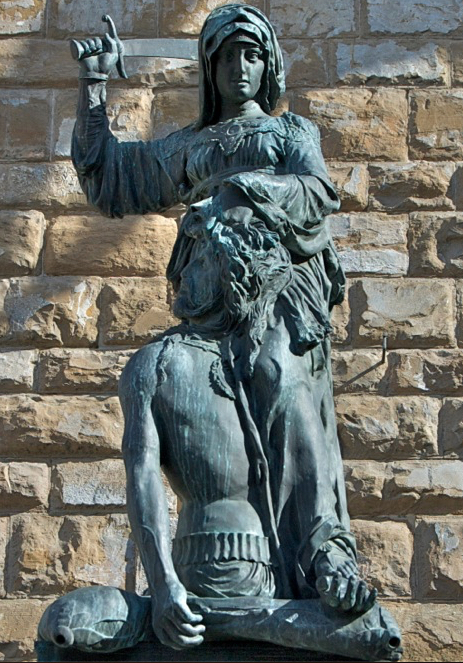
Donatello, Judith and Holofernes, late 1450s, Palazzo Vecchio, Florence.

Talking about Judith Leyster yesterday I was reminded that I had said, when talking about Artemisia Gentileschi’s Judith Beheading Holofernes (Picture Of The Day 17), that I would talk about Donatello’s version of the same story – so here it is. And for those of you who have only joined recently, yes, today’s picture is a picture of a sculpture. Several pictures, in fact, although I’m astonished at the bad quality of many of the photographs online!

You can catch up on the story back in POTD 17, but, shortish story shorter, Judith was as Israelite in the city of Bethulia, which was besieged by an army headed by Holofernes. She crept out of the city, pretending to defect to the enemy camp, and having accepted his invitation to dinner, she dressed herself up, joined him, and, once he had drunk ‘far more wine than he had drunk on any other day in his life’ (that’s from the Book of Judith), she took down his sword and chopped off his head, taking it with her when she went back home. Hardly lady-like, you might think. His troops, on finding the headless body the next morning, fled – and thus, she saved her people.

Donatello’s version really doesn’t hold back. It is arguably the first and finest two-figure sculpture of the 15thCentury (hmmm…. I have another couple of suggestions for finest), and almost certainly the first sculpture that is truly ‘in the round’ – i.e. intended to be seen from all directions – since classical antiquity, that is. Cast out of bronze, Donatello has come up with a remarkably compact composition. This helps to save on the bronze, and also helps with the casting. The extremities of arm and sword are remarkable – it’s quite something to get the bronze that far out from the main ‘body’ of the sculpture. Having said that, this sculpture was cast in 11 parts, mainly to help with the gilding, only a little of which remains (notably on the sword). They are posed on a triangular base (see below), atop a cushion. His legs hang down, drunk, or lifeless, and she stands above him. She has grasped his hair in her left hand to yank him up, while her right hand is wielding the sword above her head, ready to swing it down and chop into his neck. 

A word of advice – whenever you are looking at a sculpture of a person, try and get into the character’s eye line. This photograph is taken from exactly the right angle – she is looking directly at us, and we can see the determination in her face. As it happens, this is a photograph of the replica which is currently displayed outside the Palazzo Vecchio – the original (seen here in the more obviously bronze-coloured photographs) is displayed inside, safe from the weather and pollution. I’m showing the replica because the strong sunlight and the verdigris – the green colour that forms as a result of the copper in the bronze – serve to make the forms clearer in any but the best photos.

While she is fully dressed, including elements that look almost like armour, which are decorated with putti (boys) and vases, he is down to his shorts – which allows Donatello to show his ability at depicting the male body. It looks as if Holofernes’ left shoulder has been dislocated – it hangs so unnaturally behind him.  Notice that Judith is standing on his right hand – a wise precaution, as, if he were to regain consciousness, he might reach for his weapon, or reach for her, to pull her down. But, if her left foot is on his right hand, where is her right foot? 

Next tip for looking at sculpture – keep moving. If it was intended to be freestanding, as this one was, look at it from all possible angles. This is why sculpture has never been as popular as painting – it takes just that little bit more effort. And it always loses out with photography, if there aren’t enough good photographs from enough different angles. If you do get round the other side – or have a good photograph – you will find that her right foot is firmly planted in his groin. She has clearly assessed the various threats he poses and has disarmed him both physically and sexually. Feet planted firmly, she has grabbed his hair, yanked him upright, and prepares to chop. This requires some concentration, and you can see she is biting her upper lip.

You can also see how Donatello did the drapery. Having made the figure of Judith, he then soaked a cloth in slip – a very liquid form of clay, mixed with a lot of water – and wrapped it around her head. A mould of this was then made, and used to produce a wax version of the sculpture. The wax is then encased in what becomes a second mould, melted, and replaced with bronze. This is known as the lost wax method. Quite early in the process – just before the first mould was made – the slip fell off the fabric covering her forehead, and the weave of the original cloth, underneath the patterned hem, was cast in bronze.

So far, so good. Or so bad, depending on how you look at it. She is poised to chop at his neck – what next? Look back at the black and white photographs – the angle of his neck is rather extreme. And that’s because – well, you might just be able to see in the left-hand image – she has already hacked at the neck. There is an enormous gash there. So she’s going in for the second chop. And she will keep going, swing after swing, until the head is finally severed. That takes some determination. 

Now look at the base they are on. It is triangular, thus encouraging us to keep looking around the sculpture, because there is no predominant side. It is decorated with scenes of bacchic revelry performed by winged cherubs. So much frivolous mayhem underneath such horror. The contrast between the revelry of the base and the violence of the sculpture only serves to heighten the drama. And this is where Donatello chooses to sign the sculpture – along the seam of the cushion. There are holes in the corners. It is meant to be a wine sack. The holes also imply that this sculpture was originally a fountain. I’d like to think of it in light of some of the stories about the Marcus Aurelius, an equestrian statue in Rome. Apparently, from time to time the horse was plumbed up for festivities so that water came from one nostril and wine from the other. I’d love to see red wine coming out of this fountain. Or maybe that’s going too far.

Who would want a thing like this? Well, the Medici, apparently. We don’t know it was definitely commissioned by them, but the first account of it places it in the garden of the Medici Palace. There was an inscription on it reading,

Kingdoms fall through luxury, 
Cities rise through virtues;  
Behold the neck of pride 
Severed by the hand of humility.

The sculpture was therefore seen as an allegory of pride and humility. The popularity of the subject in Florence is not unrelated to the popularity of the story of David and Goliath, which, ever since the Florentine defeat of the far larger Milanese army at the beginning of the 15th century, had been seen as a symbol of the triumph of virtue over strength. Judith and Holofernes represents the same idea. But how does this fit in with its Medici ownership? Another inscription stated,

‘Piero son of Cosimo de’ Medici has dedicated the statue of this woman to that liberty and fortitude bestowed on the republic by the invincible and constant spirit of the citizens’.

There is no little irony in this. Since 1434, when Cosimo il Vecchio had returned from exile, the Medici were the de facto rulers of Florence. Piero is nominally upholding the republican ideal, while actively working against it. And this was remembered when, in 1494, the Medici were expelled from Florence. Most of the their property was confiscated, including Donatello’s sculpture of Judith and Holofernes, which was then erected outside the Town Hall on a new base. This had – and has – it’s own inscription:

‘Placed here by the citizens as an example of public well-being’. 

In other words, ‘tyrants beware, we’ll chop your heads off’. In other words, ‘Medici beware’. When talking about art, we often ask ‘what does it mean?’ This exaple just goes to demonstrate that the meaning of art can change. And it continued to change – the Judith didn’t stay put. When Michelangelo completed his David, ten years after the Medici had been exiled, it was decided it shouldn’t go atop the cathedral as originally intended. A debate ensued.  Where should it go? Somewhere more visible than that, surely? In the end, it replaced the Judith, outside the Town Hall. The Judith was sidelined, only to return to a nearby position centuries later. One of the arguments for replacing it with the David went as follows:

‘The Judith is a deadly symbol, and unfitting for us whose emblems are the cross and the lily. Besides, it is not proper that a woman should kill a man, and, above all, it was erected under an inauspicious star, as ever since then things have gone from bad to worse’

Clearly it is not good that a woman should kill a man – although they don’t consider the morality if the situation were reversed. Having said that, and having seen the sculpture, you can see why the men of the committee were unnerved by the Judith. She is absolutely terrifying. This just goes to show how brilliant Donatello was.

Day 34 – Judith Leyster

Judith Leyster, Self Portrait, c. 1630, National Gallery of Art, Washington D.C.

For JW≈ – and any Dutch mothers I know.

Yesterday we looked at Rembrandt trying to be someone else in 1640, but here, ten years earlier, with have an artist at the height of her powers and very happy to be herself: Judith Leyster. And so she should be – her talent was recognised when she was still a teenager, and continued until well after she stopped signing her paintings. Just look at this – she was brilliant. Whereas yesterday we were thinking about the way that the composition of a self portrait is partly governed by the way you paint it, especially when you are trying to pretend that you are not painting it, today Leyster is dealing with the problems of actually showing herself painting. Although for her, there don’t seem to be any problems: she makes it look easy!

There is, as I have said before (Picture Of The Day 28), a disproportionate number of self portraits of artists at their easels which are by women. The common assumption is that men didn’t have to prove that they could paint, whereas women did. It might be this that led to the suggestion that this work was painted to celebrate Leyster’s admission to the artists’ guild in Haarlem, in the Netherlands, in 1633. She was one of only two women painters ever to be admitted as Masters. Not only that, but she took on three pupils of her own. When one of them left her to enter the studio of Frans Hals – he wanted a Mister as a Master – Leyster took the boy’s mother to court seeking compensation for her loss of earnings – and won! However, the style of the painting and the style in which she is dressed both suggest it is a slightly earlier work, from around 1630, when she would have been 21 at most. She was born in Haarlem in 1609, where her father was a brewer, with an establishment called the ‘Ley-Ster’, or ‘Lode Star’ – i.e. the star that leads the way, or North Star. ‘It is the star to every wandering bark’ as Shakespeare put it – although, of course, he was talking about love. The family took its name from the brewery, and she often signed her works with a star: JL~*

She might have trained with an artist called Pieter De Grebber – she is certainly mentioned alongside him in 1628 when Samuel Ampzing wrote a paean ‘in praise of the City of Haarlem in Holland’, where she was said to have ‘good and keen insight’. At that stage, she was 19. Twenty years later, Theodore Schrevel wrote a similar panegyric, in which he stated, 

‘There also have been many experienced women in the field of painting who are still renowned in our time, and who could compete with men. Among them, one excels exceptionally, Judith Leyster, called “the true Leading star in art.”’ 

Leading star she might have been, but by this stage she had hardly signed any of her work for 12 years. That is, not since 1636 – the year in which she married. But that doesn’t mean she stopped painting. She married another artist, Jan Miense Molenaer, and seems to have worked as his assistant – it would have been easier to do business that way. Not only that, they had five children. Or rather, let’s put it this way, she had five children. That can stop you painting. After her death (1660) the inventory of her estate included paintings by ‘Mrs Molenaer’ – and almost immediately her own name was forgotten.

In this particular painting she goes all out to show us what she can do. She sits at her easel, paintbrush in her right hand and palette in her left. Now, given what I said yesterday, the fact that her right shoulder is foremost, and that she looks towards us, would suggest that she was right-handed. And indeed she is holding the brush in her right hand. However, given that she was looking at a mirror at the time, and not us, that would have been her left hand holding the brush. Having said that, we know full well that artists don’t always paint what they see – and they were fully capable, when they chose to do so, of altering what they saw in the mirror to make it look like it should in real life. So she has shown herself as right-handed, as I have no doubt she was. 

Indeed, her right hand is the closest thing to us, thus emphasising that this is where her skill lies. It’s not just her hand, but also her forearm that is in the foreground, parallel to the picture plane, extended towards the painting, beautifully and richly dressed. This is the hand that can paint that sleeve. Look at the intricate buttoning and the turned back, transparent cuff with its broad lace trim. This is an expensive item of clothing – which in itself speaks of her success – and a breath-taking passage of painting, nonchalantly thrown off as if it is incidental. Her hand sits in front of her broad, starched collar, with yet more expensive lace extended around it. It circles her neck, and makes her head stand clear, and although she would have been looking at her own reflection, she convinces us that we are the focus of her attention. That’s how relaxed she is, elbow poised on the back of the chair, glancing out while working, looking at us with her lips slightly parted, slightly smiling. Now try and think of all the paintings you know where someone is smiling or laughing. Very few, I imagine, because there are very few – it’s a very hard thing to get right. And she does it twice in one painting.  Who wouldn’t admire this young, happy, confident – and brilliantly talented – woman?

And yet – would she really have dressed like this while painting? Of course not! It’s about as impractical as you can get. But she does say – look at me, I’m painting; I know it’s a man’s job, but I can do it too while remaining perfectly lady-like. She also tells us she is a successful and respectable member of society, boosting her social status in the way that male artists always did, while also showing us, unlike them, that she was hard at work – or rather, showing us that, for her, this work was easy, her talent came naturally. Castiglione called this ability to carry off difficult tasks with apparent ease sprezzatura, but that can wait for another day.

How good is she? Well, very good. She has a firm grip on her palette, but has not bothered much with the smears of paint that sit there. However, she does manage to hold onto a cloth as well, not to mention a whole bunch of spare paintbrushes. I can’t see exactly how many there are, but I’ve seen it listed as ‘no fewer than 18’, and even as many as ‘22’. Why so many? Well, because she’s that good. That’s how subtly she can distinguish between tones and hues, with a separate brush for each, and between the finest brush, used for the delicate strokes of the lace, and the broadest, used for the slabs of paint on her skirt, as it blossoms out under her boned bodice. She is also no one-trick pony. Technical analysis has shown that the canvas she is working on originally showed an image of a woman’s face – possibly a portrait, and possibly this self portrait – but she changed her mind. By showing herself working on a painting of a musician she is demonstrating that she can work in two separate genres of painting – portraiture and genre (‘normal people doing normal things’). This is also a quotation from one of her earlier works, which we know was successful, as several copies survive: The Merry Company. It was sold by Christies in 2018, but I don’t know where it ended up.

There are other reasons for choosing this particular figure. Notice how her paintbrush is seen next to the bow of the violin. Not only is she saying that, like the musician who has practiced and mastered his art, she has practiced and mastered hers, but also she could be drawing a comparison between the arts. Both take us to other worlds, change our mood, and give us new insights. And like the effortless jollity of the fiddle player – in the context of The Merry Company he is probably a carnival performer – she has improvised this image for our delight. A common phrase used to describe a good portrait is ‘a speaking likeness’, and one topos – a Greek word commonly used to mean a rhetorical convention – which was often used for a portrait during the Renaissance and after was that ‘it only lacks a voice’, as if to say, it looks so lifelike it is almost real. As Leyster’s mouth is open, she could be speaking, and she is painting a man whose music we can imagine. The power of her image is that our sense of vision can evoke the sense of hearing – that’s how good she is.

So why was she forgotten? Well, she became Mrs Molenaer. The two did paint in a similar style, and, with her own name forgotten, many of her works were attributed to him. The rest were attributed to Frans Hals, who undoubtedly influenced her. He may have taken one of her students (he also had to pay a fine for taking a student from her, by the way, but then so did she, for not having declared her students to the Guild…), but they were friends. In 1631 she was a witness at the baptism of one of his children. It seems unlikely that she worked with or for him, but in the freedom of her brushwork, which at times borders on the reckless (as his certainly does), her work comes very close to that of Hals. This carried on until 1893. The Louvre had purchased a painting which was signed ‘Frans Hals’, but on closer inspection they realised that the signature was a forgery, covering up a strange doodle: JL~*. It was only then that her name was rediscovered. Despite this, it wasn’t until the late 20th Century that Leyster’s talent was fully appreciated, and even this painting was attributed to Frans Hals up until 1930. Yes, it depicts a woman painting, holding at least 18 paintbrushes, but, the Art Historians decreed, a man must have painted it. That’s how stupid some men are.

Day 33 – Rembrandt at 34

Rembrandt van Rijn, Self Portrait at the Age of 34, 1640, National Gallery, London.

A couple of days ago (Picture Of The Day 28) I posed a teaser: why would a right-handed artist tend to paint themselves so that their right shoulder appears to be closer to us? This self portrait by Rembrandt would seem to provide the ideal opportunity to explain. But first, I want to ask you another question. My impulse is to write ‘self portrait’ without a hyphen, and that is how the National Gallery writes it, but in most sources – including my annoying automatic spell-check (I know, I could switch it off, but…) suggests ‘self-portrait’, with a hyphen. I can’t for any reason imagine why it should have a hyphen. Can anyone enlighten me? The next question is: how do we know that Rembrandt was right-handed in the first place? Well, apart from the fact that most people are, and that, for centuries, left-handed people were forced to use their right hands (wait till Saturday for that), there is a way of telling. Look at this pen and ink drawing by Rembrandt.

It is a drawing of a painting he saw at an auction in Amsterdam in 1639, and a note to the top right of the sketch tells us it fetched 3,500 guilders – an enormous price at the time, apparently. It is a portrait of Baldassare Castiglione, author of The Book of the Courtier, and a good friend of Raphael, who painted it. Have a look at the tiny bit of shading on Castiglione’s forehead, and the shading on the far right of the image. Can you see that the diagonal lines go from top right to bottom left? These are the lines you automatically use for shading if you are right-handed. Southpaws like myself draw lines which go from top left to bottom right. Check out some drawings by Leonardo if you want to be sure! 

My choice of illustration is not coincidental, as Rembrandt was clearly influenced by Raphael’s portrait when he came to paint himself.

Rembrandt, 1606 – 1669 Self Portrait at the Age of 34 1640 Oil on canvas, 91 × 75 cm Bought, 1861 NG672 https://www.nationalgallery.org.uk/paintings/NG672

This is Rembrandt at the age of 34, painting himself in 1640 at the height of his fame. What we probably wouldn’t notice, though, is that he is not wearing his own clothes – this is not the fashion of 1640, it is more like 1520. Even from the sketch of the Castiglione portrait you can see the influence – one shoulder turned towards us, the same arm framing the figure in the foreground, a dark hat framing the face, and a white shirt helping to give shape to the chin. The two figures are facing in opposite directions, it’s true, but that’s because Rembrandt has also been influenced by at least two other paintings, and also because he is painting himself.

When executing a self portrait, you have to be able to see your reflection in a mirror, and also have the canvas in front of you. If you pick up your paint brush (try this at home, though not necessarily with a loaded brush…) and hold it on the canvas, you do not want to look at the mirror over your painting arm, it is awkward, and your arm and shoulder might get in the way. So you look over your other shoulder towards the mirror. If you are right-handed, therefore, you would be looking over your left shoulder. But, of course, you are looking in a mirror, so the image you see is a mirror image, and that shoulder, in a painting, would look like your right shoulder. And that’s what we see in this painting. And if you think about it, the arm at the back of the painting looks like a left arm – which means it was Rembrandt’s right arm while he was painting. Notice how this hand is hidden away behind the parapet – as he was painting with it, he couldn’t see what it looked like, so it was just easier to hide it away. 

If any of the above wasn’t clear, I’m sorry, but without being physically present, with a mirror, I can’t explain any further! In most of Rembrandt’s many self portraits he does indeed appear to be looking over his right shoulder – although he did occasionally ring the changes, and look the other way. 

Dürer was also right-handed. He painted three self-portraits, and this is the second, at the age of 26. Painted in 1498, not that long after his first journey to Italy, he shows all the self-confidence of a young and successful man, incredibly wealthy and very fashionable. There is nothing about this portrait that would tell you that the subject is an artist, however ‘arty’ he might appear. It’s a wonderful ensemble in black and white, with a pleated blouse emerging at the elbows and revealed across his chest – although not much of the chest is covered. It’s a rather louche, low cut affair, the amount of flesh visible only emphasized by the twisted black and white cord which holds his cloak around his back. And he’s so enormously pleased with that hair! This is Dürer as a young aristocrat, giving himself the status he was aspiring to, rather than that of the class into which he was born. But the arm resting across the parapet, the gaze towards us, and the square-cut blouse are all repeated by Rembrandt. At least the latter has the decency to keep his shirt on, and the square-cut item is more like a low-cut jerkin – the same sort, more-or-less, as the one worn by Castiglione in the Raphael portrait.

Rembrandt’s palette is far more like that of the Raphael, too – but then, this was the palette he was using from the late 1630s onwards – rich, warm browns. The Raphael was not the only painting to come up in auction in Amsterdam that year that Rembrandt saw – a Titian, then thought to be a portrait of the poet Ludovico Ariosto, but now believed to be a member of the Venetian Barbarigo family, also fetched a pretty price. By one of those odd coincidences, it has ended up in the National Gallery, along with the Rembrandt. Like Dürer, the subject sits with his arm resting on a parapet – or that’s what I thought until recently. The elbow isn’t quite resting, I don’t think, as if he has lifted it up to show off that gorgeous blue quilted sleeve to its best advantage. Indeed, for years this painting was known as Portrait of a Man with a Blue Sleeve – the sleeve would almost seem to be the true subject of the painting. The parapet was an innovation of 15thCentury Flanders. It helps to explain why we can’t see the sitter’s legs, and makes the image look more real. It is as if we are looking through a window at the subject, and as well as keeping us away, the parapet also acts as a bridge to connect our world to that of the sitter. Yes, two completely contradictory impulses, but it worked so well that artists kept using it. It makes a convenient shelf on which to rest an arm (or not quite, in the Titian), thus using the arm to frame the image. Rembrandt has slightly adjusted Titian’s conception. Notice how it is Mr Barbarigo’s right eye which appears to be looking directly at us: it is on the central vertical axis of the painting. It is as if he has just noticed us, but is paying us little heed. Rembrandt, on the other hand, is. It is his left eye which is on the central axis. He has turned his head to give us his full attention. It makes him look more open, and more sympathetic.

Rembrandt seems to be have been inspired by all three of these images when he painted himself, but why? Why is he in fancy dress as someone from the 1520s? The fact is, this is not simply a self portrait It is related to a genre of painting common in the Netherlands in the 17th Century known as a tronij (pronounced trony, roughly speaking), which derives from an old Dutch term for ‘head’. They look like portraits, but are really character studies, or paintings of characters, fictional or otherwise. Musicians were particularly popular, but so were characters such as soldiers or scholars. Sometimes these were specific – like Alexander the Great, for example, or St Paul. So here we have Rembrandt as someone from the 16th Century. He is deliberately comparing himself to Dürer, and comparing his talent to that of Titian and Raphael – a remarkable thing to do, on the face of it. By buying this portrait you would be getting three for the price of one: a painting by Rembrandt, an image of Rembrandt, and a tronij. It’s a great piece of marketing – an image of the best, by the best, in a long tradition of greats. Sadly for Rembrandt, he wasn’t always riding this high – but everything he had learnt stood him in good stead when the going got tough. And his art just got better and better and better.

Day 32 – Juno discovering Jupiter with Io

Pieter Lastman, Juno discovering Jupiter with Io, 1618, National Gallery, London.

I started writing Picture Of The Day on 19 March – so I’m now beginning the second month! To celebrate I want to return to several of the themes of POTD 1: Jupiter, a great god, but a bad man; cows – Jupiter had disguised himself as a bull in order to carry off the fair nymph Europa; and the best! In that very first picture, I nominated one of Titian’s fish as the Best Fish in Art. Since then, we’ve had the Best Cabbage (POTD 3) and the Best Eggs (POTD 20). Today, I’m proposing a slightly different category, and I’m very grateful to Pamela for reminding me about the Prettiest Cow in the National Gallery.

You might not have heard of today’s artist, Pieter Lastman, but he was really good, just lacking that final touch of genius that would make him famous today.  What he is most known for now is teaching someone who had that genius – Rembrandt van Rijn (more of him tomorrow!) I confess, I don’t know Lastman’s work that well, but there are two superb examples in the National Gallery in London, and I have talked about this one quite often. You might think, at first glance, that it doesn’t look at all like Rembrandt’s work – but that’s because we are more familiar with the mature paintings than with his first endeavours, which look far more like his master’s oeuvre: bright, clear, colours; crisp outlines; and clarity. In fact, nothing that would suggest his late work would be so profoundly moving. The Late Rembrandt exhibition at the National Gallery remains one of my favourite ever. There was to have been an Early Rembrandt exhibition at the Ashmolean in Oxford – I was looking forward to it immensely – but I don’t know, at this stage, if it will ever see the bright, clear light of day.

Pieter Lastman, 1583 – 1633 Juno discovering Jupiter with Io 1618 Oil on wood, 54.3 x 77.8 cm Presented by Julius Weitzner, 1957 NG6272 https://www.nationalgallery.org.uk/paintings/NG6272

In this particular painting Lastman shows himself to be a master storyteller – one of the things you will have realised I really appreciate in an artist. He gives us many clues as to what is going on. Now clearly, the focus of the painting is the cow – and I stand by the appellation, the Prettiest Cow in the National Gallery – or for that matter, in Art. Look at those deep dark eyes, eyes you could drown yourself in (a cliché, I know – and if anyone could tell me who said it first I’d be grateful) – but look at those delicate eyelashes too, fluttering at you. And yes, they are fluttering at you in particular. It’s almost as if Lastman has taken the words of renaissance theorist Leon Battista Alberti to heart: 

‘In a painting I like to see someone who admonishes and points out to us what is happening there; or beckons with his hand to see; or menaces with an angry face and with flashing eyes, so that no one should come near; or shows some danger or marvellous thing there; or invites us to weep or to laugh together with them. Thus whatever the painted persons do among themselves or with the beholder, all is pointed towards ornamenting or teaching the story’.

Notice how he says that the ‘painted persons’ interact with ‘the beholder’ – he knows that paintings can speak to us.  It just happens that, nearly two centuries after Alberti was writing, the ‘person’ interacting with us in this painting is a cow. Having someone in the painting looking at us strengthens our connection with it, and enhances our understanding of what is going on. More of Alberti’s ‘On Painting’ later in the week, I think. What exactly is the cow thinking though – well, that is a little more complex.

Just next to her is a boy with wings, a quiver tied round his back, and a bow discarded on the floor in front of him – this is Cupid, the little God of Love. So we already know that this is a painting about love.  He is holding one end of a pink cloth, the other end of which is held by a man with a rather curiously red face, wearing almost nothing but a fox fur which is almost wrapped round his waist.

On closer inspection you can see the redness of his face has a clear, sharp edge around the jawline, and around each eye, revealing flesh tones: he is wearing a mask. This tells us he is a personification of Deceit. Wearing a mask you are showing a second face – hence being two-faced. The wily fox was also seen as an emblem of Deceit. So we now know this painting is about love and deceit. And a cow. In the top left-hand corner is a woman sitting on a chariot pulled by two peacocks. This is Juno, Queen of the Gods and Goddesses, and wife of Jupiter (she was also his sister, but… well, let’s just try and conveniently forget that, as everyone else always has – Albert Square has got nothing on Olympus). Admittedly you would have to know your classical myths to know who this is, which might make it look like bad storytelling, but Lastman’s audience would have done, and would have instantly recognised her. With her left hand planted on the side of the chariot, and looking across the painting with some sense of – astonishment, I suppose, and slight confusion – she has an air of controlled indignation. She knew something was going on, but not exactly what. The other person in the painting, like Deceit, also has a red face. But this is the flush of embarrassment. Oddly Lastman shows us no visual clues as to this person’s identity (OK, so we’ve all read the title, but go with me…) but given the circumstances – an indignant Juno, Cupid, God of Love and Deceit, there is only one person it can be: Jupiter. And there he is, wearing absolutely nothing – OK, a blue cloth thrown over for the sake of decency – with his arm round a cow. She is exceptionally pretty.

But what is going on? The last time we saw him, Jupiter himself was the cow – or rather bull – disguised so he could creep up on the unsuspecting Europa. Well, things aren’t that different here. As I said, Jupiter was a great god, but a bad man. He would go after anything that moved, but the ‘anything’ usually knew to be wary as he was trouble, and if Juno found out she was worse. So Jupiter would disguise himself. He seems not to have used the same disguise twice – presumably people would catch on. And when he saw the beautiful nymph Io – actually she was a mere mortal – he came up with one of his most unexpected disguises – a cloud. There is a beautifully sensuous painting of this by Correggio in the Kunsthistorisches Museum in Vienna. And yet, I am more often reminded of E.H. Shepard’s illustration of Winnie the Pooh disguised as a rain cloud to get the honey from the bees…

Still, once Jupiter was safely disguised, Juno – one of whose responsibilities was the weather, it seems – noticed that it was cloudy and shouldn’t be, so realised her husband must be up to something. She jumped into her chariot, and got there as quick as she could. Having arrived, she has come to a sudden halt. One of the truly great things about this painting is the way in which the peacocks have slammed on the breaks – wings spread, legs thrust forward. How did Lastman know they would do that?! She looks over at her husband, understandable indignant, but he has already seen her coming and has transformed the poor girl into a cow. Cupid and Deceit try to cover her with the pink cloth. No wonder Juno is slightly confused. There is her husband, naked and blushing, with his arm around a farmyard animal. I really do think this is the origin of the phrase, ‘Who was that cow I saw you with last night?’

Now the more ornithologically minded among you might have noticed that the peacocks don’t quite look like the peacocks we would expect to see. This is Lastman being rather clever. Juno had had enough of her husband’s philandering, so she got the 100-eyed giant Argos to stand guard (having 100 eyes is very useful when you’re trying to find items in a catalogue shop warehouse, of course). Jupiter, understandably, didn’t want anyone keeping an eye on him – let alone 100 eyes – so he got Mercury, messenger of the Gods, to kill Argos. Juno wasn’t letting it go, though, so she took the eyes from the dead giant and put them on the tails of her peacocks. So that’s why the peacocks don’t have any eyes on their tails in this painting – that bit of the story hasn’t happened yet!

And Io? Well, the accounts vary, but eventually, most say, she was transformed back into a human being. However, her name is most often mentioned nowadays as one of the moons of the planet Jupiter. When astronomers first discovered there were moons orbiting the largest planet in our solar system, they wisely looked back to the classical myths and chose names from those unfortunates who had come within the God’s sphere of influence. Io and Europa are just two. Now, you might think that contemporary astronomers are an entirely serious bunch (if not entirely Sirius), but when they planned a mission to explore Jupiter and its moons, what better name could they choose?  Launched in 2011 the probe arrived in 2016, and is still in orbit – and will be until July next year. With at least 9 different types of sensors and cameras, Juno is still keeping more than one beady eye on Jupiter and his lovers.

Day 31 – The Suitors Praying

Giotto di Bondone, The Suitors Praying, 1305, Scrovegni Chapel, Padua.

I ended yesterday’s Picture Of The Day with a lacuna. Apologies if I confused you, but I had said what was going to happen in the second sentence of the second paragraph… Today, I want to continue with a lacuna. Or rather, I want to talk about the earliest painting I know in which nothing is happening. I don’t mean a painting in which nothing is supposed to happen – like a still life – but a narrative painting, where ‘nothing happening’ is part of the story. It’s a dramatic pause, I suppose, and a brilliant example of Giotto’s skill as a storyteller. I’ve also chosen this because I have been asked to talk about the Scrovegni Chapel in Padua, which I am only too happy to do, the problem being that it could take me another week to get through it – so I might just pop back from time to time and celebrate the brilliance of this one building. If I were ever asked which one room in the world I would want to save, it would be this one. Not the Brancacci Chapel. ‘Cradle of the Renaissance’ it may be, but it is not as consistent. Not the Sistine Chapel, however remarkable, because Giotto’s storytelling is better. No, it would be this – the Scrovegni Chapel in Padua. If you haven’t been, make sure it’s the first place you go as soon as we are allowed to go anywhere.

The building was constructed as the family chapel attached to the Scrovegni Palace, but, as the palace was later destroyed, it is now freestanding. It was built next to the ruins of the Roman amphitheatre, or arena, so it is sometimes also called the Arena Chapel. It was painted from floor to ceiling by Giotto and his workshop, with the exception of the chancel, around the altar, and it was consecrated on the Feast of the Annunciation (25 March – see POTD 7) 1305. It is the most coherent, most brilliant piece of story telling I know, rich in narrative detail and theological profundity. It can, and should, be read in narrative order, but Giotto has built in echoes vertically and diagonally across each wall, and from one side of the chapel to the other. There are three tiers of stories. The top tier, starting at the altar (on the right of this picture) and coming towards us, tells the story of Joachim and Anna, parents of the Virgin Mary, and then on the left wall, going away from us, we see Mary’s upbringing and betrothal. The Annunciation then happens across the chancel arch – you might just see it in the distance (or right at the bottom of the blog). The middle tier is concerned with the Nativity, childhood and mission of Christ, and at the bottom is the Passion and Resurrection. As the stories get more important, they get closer to us, so we can see them more clearly.

But I want to start at the top, about half way along. The first picture I am showing you is at the top left of the overall view, although this is the third scene in, after the Birth of the Virgin and The Presentation of the Virgin in the Temple. Although discussed in the Protoevangelium of St James, and the Gospel of Pseudo-Matthew, books probably written in the 2nd and 7th Centuries respectively and excluded from the Bible, the direct source for this story is probably the The Golden Legend. This is a series of stories of the lives of the saints compiled by a Franciscan called Jacobus da Voragine back in the 1260s, and it became one of the most important textbooks for artists commissioned to paint saints. In the chapter celebrating the Feast of the Birth of the Virgin (8 September), Jacopo tells us how Mary grew up in the temple alongside other virgins (small ‘v’). When they were of age (thirteen), a suitor was found for each one – with the exception of Mary, who declined, saying that her parents had destined her for the service of God. But a voice came from the temple decreeing that every eligible bachelor should bring a rod, and lay it on the altar – which is precisely what they are doing here. A sign would then appear to tell them which one was deemed suitable to marry the most perfect Virgin (big ‘V’).  And look at them all – they’ve turned up in droves. 

The temple looks like stage scenery, cut-away to give us a sense of the space. It is not unlike a church, with the altar in a semi-circular niche, or apse. Two side aisles are sketched out symmetrically. Remember what this looks like, we will see it again. The High Priest stands behind the altar, which is beautifully arrayed with the most fabulous altar cloth, intricately patterned in orange, red and blue. The semi-dome in the apse appears to have been coffered the same blue as the sky – although it’s not in a great condition. Certain sections of the fresco were painted a secco – on dry plaster – and when an artist does that, rather than painting in buon fresco – on good, fresh plaster – i.e. wet – it doesn’t bond with the drying surface and has a tendency to flake off (see POTD 7). The High Priest and his assistant appear to be rather sheepishly placing the rods on the altar, while looking suspiciously at this foremost suitor. Both are clearly extremely old, age being measured by the length and candor of their beards. You will notice that all the eligible bachelors are beardless – and therefore young – with one exception. But he’s clearly the odd one out, as he also has a halo. He is wearing a blue robe and a yellow cloak. He’s at the back, as he clearly doesn’t stand a chance.

Scene 2: we are in the same place – the same church-like temple with a semi-circular apse and a hint of two side aisles. The storytelling in the chapel always goes from left to right – starting at the altar and moving around the chapel in a clockwise direction. If there is any movement within the scene, that always takes place from left to right as well, to keep us moving in the same direction. But not here. Nothing is happening. They are waiting. Praying. I love how eager some of them are. The man in pinkish red – next to the old guy with the halo – appears to be leaning forward on his hands, while the man in white looks like he has clenched his fists in an attempt not to bite his nails, and in the hope that he will be chosen. And the man in red – who looks especially young to me – could be holding his thumbs, thrusting his head forward, his arms held down ready to spring up when he is chosen, a starter on the 100m block. The priest has removed his headdress, and is abasing himself in front of the altar. That could be another of the suitors on the far right. Both he and the priest act as repoussoirs, framing the altar, and making us look towards it just like they do. The gap between them allows us to see the richly patterned altar cloth topped by the suitors’ offerings, and together suitor and priest form a pyramid completed by the stack of rods. But nothing happens. It’s the first pause in art, centuries before Pinter.

And yet, very faintly – very – a hand appears above the altar. It was probably painted a secco. God is waiting to choose. According to the Golden Legend, Joseph was there with the others – that’s him with the halo, of course – and he did bring a rod. But as he was so old, and the Virgin so young, he didn’t think it was appropriate for him to marry her. So although everyone else put their rods on the altar, he hid his. Finally, after a long, expectant, wait, the Priest consulted God, who pointed out that obviously someone hadn’t put his rod on the altar. 

When the Priest conveyed this message to the suitors, Joseph was finally persuaded that he should give it a go. As he headed towards the altar, his rod flowered, and a dove flew down and landed on it. If that’s not a sign I don’t know what is. I really don’t know what Freud would make of it. So Joseph was betrothed to the Virgin – Scene 3 – taking place in exactly the same place. Some of the other suitors look furious, and one, in red – possibly the very young, very eager one – has taken back his rod and is breaking it over his knee. On the right there are three virgins (small ‘v’), who will accompany Mary back to her father’s house. This Wedding Procession is in the next picture, and concludes the story on this wall.  The next thing to happen is the Annunciation. This is very clever – Giotto has planned his storytelling so well that he has got to the Chancel arch just in time. If you remember that the Chapel was consecrated on the Feast of the Annunciation, you will realise why it takes such a prominent position in the chapel. But more about that another time… maybe I will institute ‘Scrovegni Saturday’.

Day 30 – The Supper at Emmaus

Michelangelo Merisi da Caravaggio, The Supper at Emmaus, 1601, National Gallery, London. 

People often ask me what would be the best book to read as an introduction to renaissance art, and my answer is almost invariably ‘the Bible’. And its value is not restricted to the Renaissance. Most ‘Old Master’ painting was produced in a profoundly Christian world, and that outlook informs it all, in some way – although the relevance is hard to find in most paintings with classical subject matter. Nevertheless, it would be useful for this painting. Isn’t it odd how you don’t always know how things fit in? I’ve always known that ‘The Supper at Emmaus’ must happen after Easter – it has to happen after the Resurrection – but I hadn’t stopped to check exactly how long after the Resurrection it was. It turns out that it happened on Easter Sunday. According to Luke 24:13, ‘two of them went that same day to a village called Emmaus’. So I could have talked about this last Sunday – but I had another Resurrection in mind (Picture Of The Day 25).

Michelangelo Merisi da Caravaggio, 1571 – 1610 The Supper at Emmaus 1601 Oil and tempera on canvas, 141 x 196.2 cm Presented by the Hon. George Vernon, 1839 NG172 https://www.nationalgallery.org.uk/paintings/NG172

The two met Jesus on the road to Emmaus, but didn’t recognise him. On arrival they invited him to dine with them, and only when he broke bread did they click – at which point he disappeared. Their response is one of amazement. The man on the left – a repoussoir figure, pushing our eye into the depth of the painting (see POTD 27) – thrusts his head forward, and puts his hands on the arms of his chair to push himself up to get a better view. On the right the man throws out his arms in amazement – although this gesture has other implications. He could almost be saying ‘but I thought you’d been crucified’, demonstrating by acting out Christ’s position on the cross. The arms stretched wide also say ‘the room is this deep’. Caravaggio uses the foreshortened arms to give depth to the painting, and to lead our eyes from the foreground back to Jesus. In between the two astonished onlookers, it seems quite clear to me that the innkeeper, or waiter, standing at the back of the table having delivered the food, doesn’t have a clue what is going on, or why this man is waving his hands over the table.

So why didn’t they recognise him? I think a conversation I had with one of the school groups I took around the National Gallery is worth thinking about. If you want to get people of any age to look at paintings you should always start by asking them what they can see – then you can tell how much they already know, what their frames of reference are, and what interests them – and you can then develop those lines of thought, nudging them gradually in the right direction. It was a group of teenage boys. For anyone, the question ‘Who is the most important person in the painting?’ will always get you somewhere. In this case the answer that came back was, ‘The woman in the middle’. Always try to go with the flow. ‘And what’s going on?’ I asked. The reply: ‘They’re having an argument’. ‘Why?’ ‘She cooked a bad dinner’. I must confess, at this point I did have to disagree with them – the chicken in particular looks as if it has an especially crisp skin, and I can imagine it being tender underneath. Having got to this stage, I thought it would be worthwhile pointing out that the person in the middle of the painting was actually Jesus, at which point they all, spontaneously, adopted positions like the people in the painting. They were astonished, and acted accordingly, just like these men. Apart from one lad at the back who hadn’t been paying attention up until this point and had no idea what his mates were surprised about. He ended up looking like the innkeeper… 

So why didn’t they know it was Jesus? Apart from a cultural distancing from Christianity, that is. The disciples should have known, surely? Well, it doesn’t look like Jesus. Does he look like a woman? Not to me, but I can see what they mean. He doesn’t have a beard. Everyone knows Jesus had a beard. It’s in all the pictures. Well, not all of them. In the earliest images of Jesus as the Good Shepherd he is clean-shaven, but by the 10th Century he was almost always bearded. There is one notable exception, but more about that later on.

The other thing is, he’s not wearing his usual clothes. He usually wears a red robe with a blue cloak over the top – but here he’s wearing a white cloak. Why has he changed? Well, this is how he looks after the Resurrection. Here’s a detail from a painting by Jacopo di Cione in the National Gallery.

The shroud has been repurposed as a toga (see POTD 24), and that’s exactly why Caravaggio dresses him in white. This has the added advantage that the white of the shroud represents Christ’s purity. And the red? Well, his blood, his passion, his suffering… These are after all the colours of the flag he is carrying in this detail – the Cross of Christ Triumphant, the red of the passion on the white of his purity. It was adopted by the crusaders fighting in the holy land, who adopted St George, a soldier fighting for God as their patron. It is his flag too… and he became the Patron Saint of England some time in the 1340s. But more about him next week!

So, at some point in between the Crucifixion and his appearance on the Road to Emmaus Jesus has found time to shave and change his outfit. It’s hardly surprising they didn’t recognise him. But there are another couple of reasons, I suspect. Look at the way he is blessing the food. His right hand is raised, and the backs of the fingers and the thumb are just catching the glancing light, arriving as it so often does in Caravaggio from the top left of the painting. The left hand is cast in shadow. This brings me back to the other significant artist who painted Jesus without a beard. They both had the same name. No, not Caravaggio. Today’s artist was born in Milan, but brought up in Caravaggio, which is why he is ‘da Caravaggio’. On this basis I would be ‘Richard da Lewisham’ which somehow doesn’t quite have the same ring about it. His given name was actually Michelangelo, but we tend not to use that as it might get a bit confusing. However, the young Caravaggio (and dying at 39 he never got that old) must have grown up fully aware of the genius of his eponymous forebear, and probably wanted to emulate him if not surpass him. So look at this detail of Christ from the older master’s Last Judgement in the Sistine Chapel.

Yes, he is beardless. And look at the position of the hands. Usually in a Last Judgement Christ raises the souls on his right hand to Heaven, and damns those on his left hand. Michelangelo’s Christ seems merciless, and is only concerned with a forceful gesture of damnation for all, an unequivocal ‘Go to hell!’ The curmudgeonly master was known for his ‘terribilità’ – his ability to provoke awe or terror. The gesture is almost the same in Caravaggio’s painting, only relaxed. The right, blessing hand is now lower, at shoulder level, and catches the light. The left hand, used for damnation, is in shadow – no coincidence.

Michelangelo Merisi da Caravaggio, 1571 – 1610 The Supper at Emmaus 1601 Oil and tempera on canvas, 141 x 196.2 cm Presented by the Hon. George Vernon, 1839 NG172 https://www.nationalgallery.org.uk/paintings/NG172

Jesus also has a shadow behind his head. This could almost be another reason why he had not been recognised – there is no ethereal glow around this Saviour, it’s more like an anti-halo. I suspect that it might have something to do with the fact that he is just about to disappear. However, it is actually cast by the innkeeper’s head. Below and to the left you can see the shadow of his shoulder and arm – which then touches the arm itself at the elbow. This can only mean that the innkeeper’s elbow is resting on the wall. Look where arm and shadow meet: coming down in opposite diagonals, they touch and form a downward pointing arrow, pointing at Christ’s blessing hand – a very clever piece of direction from Caravaggio. Because the light is coming from the top left, the innkeeper’s face is in shadow – this could be symbolic of his confusion. To use the contemporary evangelical phrase, he hasn’t seen the light. Jesus seems to have leant forward to bless the bread, and before this, sitting upright, he would have been further back, in the innkeeper’s shadow. So what is happening here? He leans forward to bless the food, moves into the light, the two travellers see his face clearly for the first time – and they recognise him. And at this point, he

Day 29 – St Francis in the Desert

Giovanni Bellini, St Francis in the Desert, c. 1476-78, Frick Collection, New York.

The sun is still shining outside my window, as it is in this fabulous painting. It captures that wonderful sense of release you get when you’ve been cooped up inside all day, and finally step out into the fresh air, take a deep breath, and enjoy the world around you. This is how I feel each day as I head out for my daily walk, especially when the sky is blue, and particularly now that the traffic has dropped and the air is wonderfully clear.  St Francis has stepped barefoot into the light, holds his arms out as if to embrace it fully, and looks up to the sky.

He is not so very far away from civilisation: there is a walled town on the next hill, just on the other side of a river, but he is in a deserted place. On retreat from the world, he has constructed a study from the trunks of three types of tree – the colour of each is different – and a vine, which meanders upwards and forms a canopy of leaves over the top. A plank of wood projects from a low garden wall as a seat, and a lectern has been constructed with minimum care for joinery: a few 2x2s nailed together at right angles.  On the desk is a book, and a skull. Like any scholar of his day, St Francis meditates on death. But here, now, he is glorying in life.

There are signs of life throughout the painting. His raised garden bed grows medicinal plants. Behind the bench you can see iris leaves, and then the tall, pointed Great Mullein – or Aaron’s Rod (Verbascum thapsus – thanks, as ever, to the Ecologist) among others. There is also a fig tree starting to grow in the foreground, and plantains are taking root in the bare earth.

In the middle distance you can see a donkey, and a grey heron, ever vigilant. Just beyond them is a shepherd – the only other human in the painting – leading his flock just this side of the river. And most charming of all, underneath Francis’s right hand – a small rabbit, poking its head out of the burrow.

You can see the stigmata in Francis’s palms. It was said that, as a result of his special devotion to the Crucified Christ, one day he returned from his private devotions with an image of the cross – not painted on panel, or carved in wood, but in his own body. This is part of the account of the event given by St Bonaventure:

‘…as he was praying in a secret and solitary place on the mountain, Saint Francis beheld a seraph with six wings all afire, descending to him from the heights of heaven. As the seraph flew with great swiftness towards the man of God, there appeared amid the wings the form of one crucified, with his hands and feet stretched out and fixed to the cross. Two wings rose above the head, two were stretched forth in flight, and two veiled the whole body…

The vision, disappearing, left behind it a marvellous fire in the heart of Saint Francis, and no less wonderful token impressed on his flesh. For there began immediately to appear in his hands and in his feet something like nails as he had just seen them in the vision of the Crucified…. On the right side, as if it had been pierced by a lance, was the mark of a red wound, from which blood often flowed and stained his tunic.’

One interpretation of this painting is that it represents the Stigmatisation of St Francis – but as it is so completely different to every other depiction of the story, it can’t be that simple. In every other painted version St Francis is kneeling, one of his followers, Brother Leo, is present, and the seraph can be seen in the sky. Admittedly, this panel has been cut down, so there might once have been a seraph, which got lost in the process. However, to make the narrative clearer, beams of light usually stretch between the protagonists, and even if the seraph had gone, the beams would still be visible. Not only that, but there is no stigma on Francis’s one visible foot, and no wound in his chest.

St Francis founded the Order of Friars Minor, a group of mendicants who, it was intended, would live outside of towns and rely on the charity of others (I mentioned the other main mendicant order, the Dominicans, in #POTD 24). Following Christ’s exhortation to the Apostles not to worry about clothes or shoes, Francis wanted his followers to be similarly unconcerned about appearances, and to dress with utmost simplicity – effectively in sackcloth with a rope belt. The three knots you can see in the end of the rope stand for the three chief virtues of the order – chastity, poverty and obedience. And there are no shoes – although he does have some simple sandals which he has left under the desk.

He also has a piece of paper tucked into his belt. There is no way of knowing what this is, but it could easily be one of his own writings. One of the most famous texts is the Canticle of the Sun – also known as the Canticle of the Creatures. Here are two short excerpts:

Be praised, my Lord, through all your creatures, 
especially through my lord Brother Sun, 
who brings the day; and you give light through him. 
And he is beautiful and radiant in all his splendour! 
Of you, Most High, he bears the likeness.
Praised be You, my Lord, through Sister Mother Earth, 
who sustains us and governs us and who produces 
varied fruits with coloured flowers and herbs.

A second interpretation of the painting is that it is an illustration of this canticle – Francis has his mouth open, after all, and could easily be singing. He is also clearly enjoying the light of Brother Sun, while surrounded by ‘coloured flowers and herbs’. However, if Bellini had wanted the canticle to be the main subject of the painting, he would surely have included far more of the ‘creatures’ Francis wrote about: many are missing.

Yet another interpretation comes from the way that the Franciscans themselves saw their spiritual leader. As a result of his stigmatisation, and given that he had sought to follow Christ’s teaching, initially taking a group of 12 followers, he was given the title ‘Alter Christus’ – another Christ. But Jesus himself, as the leader of the disciples, was associated with Moses, the leader of the Jews. It followed on that Francis was also associated with Moses. And here we see him in the desert – just as Moses had taken the tribes of Israel through the desert – and, as God told Moses, he has constructed himself a tabernacle out of the branches and boughs of trees. Francis did live with the other members of the order, but would regularly go on private retreats. It was on one of these, on Mount La Verna in the Apennines, that he saw the Seraph, in much the same way that Moses saw God in a burning bush on Mount Horeb. Moses realised he was on holy ground, and took off his shoes – and Francis has done the same. But there is no Seraph here – is this interpretation really relevant to this painting? 

No Seraph, no – but there is tree in the top left-hand corner which almost seems to be bending towards Francis, its fresh, Spring leaves almost supernaturally illuminated. Could this be Francis’s version of the burning bush? He opens his body towards the tree – although his eye line is directly upwards, towards Heaven. 

The waterspout that you can see in the bottom left is another possible connection. At one point, in the wilderness, the tribes of Israel had no water. God told Moses to strike a rock with his staff, and when he did, water gushed forth. Directly below the spout there is a kingfisher, although you might be able to see it because it is so dark. And further down, to the right, you can see Bellini’s signature, painted on a trompe l’oeil strip of paper that looks as if it has been attached to the branches of a barren tree.

If Moses had a staff, so does St Francis, in the form of a walking stick, which he has left behind in the study. There are many stories told about this remarkable man. In one of them, his love for all God’s creatures led him to admire a tree – which bent over to greet him. That seems to be happening here. And in another, he struck his walking stick on the ground, and it took root and grew there. For many years, the resulting tree marked the spot. The stump of that tree still exists, apparently, although the Franciscans who will show it to you are fully aware that this is ‘just a legend’. They live on the Island of San Francesco del Deserto in the Venetian lagoon, where St Francis is supposed to have stopped off on his way back from visiting the Sultan of Egypt. The church on the island is, in all probability, the location for which this complex image was painted.

When interpreting art, we tend to ask the question, ‘what does it mean?’ and often there isn’t one, simple answer. Bellini would have taken advice from the patron, and from the Franciscans on the island – he might have had many ideas in mind. When the church was rebuilt in the second half of the 15th Century it was called ‘San Francesco delle Stimmate’ – so the stigmatisation must be part of the meaning. The saint’s joy in creation, as made clear in the Canticle of the Sun, is another. And so are the parallels between the saint and Moses in the wilderness. Bellini is clearly not representing the setting of the actual church: this is not an island in the Venetian lagoon. Having said that, the rocky outcrop on which Francis stands is like an island, surrounded by a sea of green grass. If anything, his retreat looks more like Mount La Verna, even if the walled town is the sort you’d seen in the Veneto – where Bellini was painting – rather than in Umbria, where St Francis settled. 

All of the possible interpretations of this painting are worth thinking about. Bellini may well have been hinting at them all, attempting a poetic evocation of the many rich threads that are woven through Francis’s life. I suspect there is yet one more way of thinking about it, though. This does overlap with the others. It comes from the name of the island: San Francesco del Deserto. Not ‘St Francis in the Desert’, like the name of the painting, but ‘St Francis of the Desert’. He is part of it, part of the desert, and is depicted in the middle of it. It is around him and in him. He is part of creation. And like St Francis back then, we are socially distanced now. We might even be self isolating. But we are not on our own, however lonely it might be at times: we are still part of a whole – part of the main, as John Donne said. No man is an island.

Day 28 – Catharina van Hemessen

Day 28 – Catharina van Hemessen, Self Portrait, 1548, Öffentliche Kunstsammlung, Basel.

I promised you something sunnier today, but it’s lovely and sunny outside anyway (well, it is up here), so I’ve put off that idea until tomorrow. And anyway, today is World Art Day! According to at least one website, ‘World Art Day is an international celebration of the fine arts, which was declared by the International Association of Art (IAA/AIAP), a partner of UNESCO, to promote awareness of creative activity worldwide. The first World Art Day was held on April 15th, 2012, a date chosen in honour of Leonardo da Vinci’s birthday’. So, Happy Birthday, Leonardo, but you get enough attention already. In honour of World Art Day, and to celebrate creative activity, particularly when you’re stuck at home, here is a self portrait: what else would artists do when self isolating?

It’s not just any self portrait, but the earliest known self portrait in which the artist shows themselves painting. That might not have been the first thing you noticed about it. I’m hoping you noticed the focussed attention of the artist looking towards us, right hand delicately holding the brush, while it is rested on a mahl stick to keep it steady. Later mahl sticks would have a padded end, so that they could be rested on the painting itself without scratching it. For the artist here, that isn’t a problem though, as the stick is rested on the frame. And yes, you might also have noticed that the painting is already framed, which was not unusual for panel paintings (this is oil on oak). Sometimes the panel and the frame were carved out of one plank, or in other cases, two opposite sides of the frame were part and parcel of the panel, with the other two were attached separately.  You might also have noticed that the painting has barely been started – so far only a face has been sketched in in the top left-hand corner – or that, back in the 16th Century, artists used rectangular palettes. However, I suspect that the first thing you noticed was that this is a woman painting.

It is no coincidence that the first self portrait to show an artist painting – at least, the first that we know of – was painted by a woman. Everyone knew men could paint. All the famous artists were men after all – or we used to think they were: see #POTD 14-17. Catharina van Hemessen was painting at a time before the first art schools – the academies – had been founded. In her day you became an artist by becoming an apprentice. Women couldn’t do this, because it meant going to live with a strange man when you were still, effectively, a child. Men, who were known to be artists, didn’t need to show that that is what they did. They had other concerns – being respectable, for example. So the vast majority of male self portraits show them dressed up, showing off their status and not their craft. Even Rembrandt, who painted more self portraits then anyone else before, and for several centuries after, only rarely showed himself holding a paint brush. X-ray analysis shows that, fairly often, he actually painted them out.

But women needed to let people know that they could do it – and what better way than by showing themselves in the act of painting. As a result there is a disproportionately large number of self portraits of artists painting which were executed by women. And Catharina was clearly proud of her work: a direct translation of the inscription on this example would be, ‘I Caterina de Hemessen painted me 1548’, and then, ‘Her age 20’. 

Catharina didn’t have to go and live with a strange man to become an artist, because she was already living with one. An artist, that is, not a strange man. Her father, Jan Sanders van Hemessen, had two daughters – but with no sons, who could he train to become his assistant, and take over the family business? Catharina was indeed trained by dad, and collaborated on a number of religious works. However, most of her own work seems to have been in the field of portraiture. Only 10 of her signed works survive, two of which are religious, and the rest, small-scale portraits. Other paintings have been attributed to her for stylistic reasons. There may well have been more religious works, but so much was destroyed in the waves of iconoclasm that passed through the Netherlands in the second half of the 16th century that it is hard to know. Her father’s work is full of bluster and posing, and is rather wonderful because of it. Hers is far more delicate, and really focuses on the details.

Look at the specificity with which she depicts the five paint brushes in her left hand, their shadows crossing her thumb, and on the way the paints have been worked across the palette, with the different shades of white and off -white she has blended to produce this painting. These tones can be seen in her headdress, the flesh tones and the white, chalk ground of the framed panel. She has also carefully observed the structure of the easel – the pegs which hold the shelf at the right level, and the unused holes beneath them, as well as the light and shade defining the form of the picture frame. And yet, she is only 20, she is still learning her craft.

The depiction of fashion would become one of her strong points. Above is a detail from her Portrait of a Woman in the National Gallery. The subtle patterning of the chemise is remarkable, as is the delicate lacing which ties it at the neck. The headdress, wired to hold it in place towards the back of the jaw, includes a semi-transparent veil, which reveals the slightly unruly wavy red hair. Painted just three years after the self portrait, the structure of this face is far more secure, the eyes deep within the sockets, shadowed bags beneath. Admittedly the unknown woman doesn’t look especially healthy – but you can’t fault the way she has been painted. A highlight along the ridge of the nose, and another at the rounded tip, define its form. The cheekbones, brow and slightly pouting mouth receive the same attention.

In  1554 Catharina married Christian de Morien, a musician – he was an organist in Antwerp Cathedral – and in 1556 the couple moved to Spain with her patron, Mary of Austria, a niece of Catherine of Aragon, and sister to Charles V. None of her paintings are dated later than 1554, though, so it is possible that she stopped painting when she got married – which is a tragedy, as she would only have got better.

I have always assumed that this self portrait shows her painting someone else – because her own face is in the top right, whereas the one she is working on is in the top left. But looking at it this morning I realised that this is exactly how she would have seen the self portrait when looking at it in a mirror. Rather than looking at us, she is, of course, intently looking at her own reflection. She has either adapted the composition to show herself painting with her right hand – or she could have been left-handed. For various technical reasons, most artists in self portraits appear to be looking over their right shoulders – but here she appears to be looking over her left. Which makes me think she was left handed. I tried explaining this once during a lecture, and failed to communicate why this should be so, until someone pointed out I could use the reflection in one of the windows in the lecture room to explain. I can’t do that here, so here’s a challenge: have a look in a mirror and work out why a right-handed artist would end up looking as if their right shoulder is closer to you. I will come back to this and explain what I mean at some point if it doesn’t make sense! 

If I’m right, and the painting in the painting is this painting, then not only was Catharina the first artist to paint herself painting, but she was also the first artist to paint herself painting herself. Happy World Art Day! 

Day 27 – Birds, Butterflies and a Frog among Plants and Fungi

Melchior d’Hondecoeter, 1636 – 1695 Birds, Butterflies and a Frog among Plants and Fungi 1668 Oil on canvas, 68.3 x 56.8 cm Presented by J. Whitworth Shaw, 1886 NG1222 https://www.nationalgallery.org.uk/paintings/NG1222

Day 27 – Melchior d’Hondecoeter, ‘Birds, Butterflies and a Frog among Plants and Fungi’, 1668, National Gallery, London.

Well, here’s a curious thing! In terms of the standard classifications of art, it’s hard to know where to put it. Given its size (68 x 57 cm) and its subject matter, it should be a Still Life painting – but there’s nothing still about it, although everything is very much alive. That’s one of the curious things about the term – the objects in Still Life paintings are still, certainly, but usually dead. Or inanimate. The French and Italians call the genre ‘dead nature’, and while the ‘objects’ in this painting are definitely all natural, yet not dead. So it’s neither ‘still life’ nor ‘nature morte’. You could argue that this is a small landscape I suppose – even if it is in a portrait format. And once we’ve got to this point, you realise that these ‘standard’ categories aren’t always especially helpful. Which is perhaps not entirely surprising, because Hondecoeter was painting in the 17th Century, before a lot of the language or art – or science for that matter – had taken on its apparently timeless fixity.

I’ve chosen this painting for a very specific reason. I received a request, which was in effect a challenge, to talk about a painting with fungus in it. And oddly, I could only think of two. So, if you know any more, please let me know! And for that matter, if you have anything you’d like me to talk about, let me know that as well.

Melchior d’Hondecoeter was initially trained by his father Gysbrecht, and probably also studied with his uncle Jan Baptist Weenix, who is far better known. Weenix specialised in painting grandiloquent mountains of dead things – usually game – which are more sumptuous than you might expect. One of the best places to see them is at the Wallace Collection in London. Melchior, on the other hand, preferred his birds alive. He was born in Utrecht some time around 1636, but moved on to The Hague at the age of 23, and then four years later, to Amsterdam. He was 31 when he painted today’s picture, and it’s considered an early work: he died, still in Amsterdam, some 30 years later.

As you can see from this example, not only did prefer his birds alive, but he liked them to have character. Indeed, he has given us the material for a three-act play set somewhere in a shady grove. The colouration suggests this will be a tragedy, the darkness of the palette creating an air of foreboding, but it’s not without a comic sub-plot. The main drama involves a bird, presumably a brambling, presumably minding its own business, until a frog hauls itself out of the pond – this is clearly an affront to common decency, and the brambling is doing its best to give it a good telling off. In artistic terms, the frog is what we would call a ‘repoussoir’ – something in the foreground of the painting, which encourages us to look further in. And we do: we follow the frog’s gaze only to see the brambling trying to scare it off.  Meanwhile, up on a branch another bird – possibly another brambling, or maybe a chaffinch, it’s hard to tell from this angle and with that much flapping – is joining it at a safe distance, giving the frog a piece of its own mind. Next: we cut to the comic sub-plot. A more than usually cocky sparrow, which, judging by its swagger, really does think it is the cock of the walk, stumbles across the scene by chance, followed at a distance by a slightly duller bird. The first, foppish sparrow is brought up short, and looks over to see if the frog is really as much of a threat as the brambling thinks. The birds and the frog are at an impasse, and this pause in the proceedings allows a snail to get away. They could so easily have eaten it. Meanwhile, butterflies and moths flutter around, a chorus only confusing matters further.

There are emperor moths, and on the far left, a faded small tortoiseshell butterfly. At the top, there is also a painted lady. As with many Still Life paintings, these species don’t always appear at the same time in the same place. It is an artistic construct, rather than a documentary, after all, even if it might be pretending to be the latter. Look at the tortoiseshell and the emperor near it, for example. They look almost as if they are deliberately displaying their wings so that we can identify them – and it is highly likely that Hondecoeter was painting them from specimens. He may have had a collection himself, but if not, he would certainly have known people who did – they were the very people he was painting for. In the 17th Century, interest in the natural world was very much on the increase. Anyone who was anyone would have had their own ‘wunderkammer’, or ‘chamber of wonders’. These were like prototype museums with all the curiosities of the natural world included: shells, minerals and crystals, butterflies and even stuffed birds. In the midst of all this there could be paintings, bringing the dead objects to life, and showing you animal, vegetable and mineral together.

Unfortunately, this is another classification that falls apart fairly easily. At the time it seemed like a clear division. But what about the fungus? Is it a vegetable? That really depends whether you are ordering a meal, or studying natural history, to be honest. At this point it is worth remembering Hamlet (as it so often is), and in particular his statement, ‘There are more things in heaven and earth, Horatio, than are dreamt of in your philosophy’. You only have to watch most David Attenborough documentaries to realise that (trust me – I live with an Ecologist, and I’ve seen most of them). For example, there is one thing that we know, that Hondecoeter probably didn’t: a fungus is not a plant. While most of us were growing up, ‘Fungi’ belonged to their own Kingdom – ‘Plants’ and ‘Animals’ being two of the others. After that it gets really confusing, because some countries, including the UK, assume there are five kingdoms, others, such as the US, say there are six. But by now, many scientists don’t believe in the concept of kingdoms at all, because not everything previously included in each kingdom is descended from a common ancestor – plants, animals and fungi are still separate branches on the evolutionary tree, but there are so many other branches. Slime molds, for example. And bacteria, which take up about a third of the evolutionary tree on their own. Don’t even start on viruses, they’re not even included. We might be obsessed with one right now, but they are not even classified as fully living things. They are somewhere in a grey area between being alive, and not being alive.

Anyway, back to the fungus. I don’t know what type Hondecoeter has depicted, I’m not a mycologist (someone who studies fungi), and neither is the Ecologist. But I do know that Fungi are everywhere, even though we don’t see them very often. Most plants co-exist with fungi, tiny ones, which attach themselves to the roots of the plants, and help them to feed. Most of the time fungi are out of view. Most of their substance is made up of a network of fine fibres almost invisible to the naked eye. But when they want to reproduce, the fruiting bodies appear out of the ground, or the tree trunk that the fibres have been living in. These fruiting bodies take on forms that vary from sombre to fantastical, and from delicious on toast to highly toxic, only to let off myriad spores and then disappear again. They live off dead material and are essential in breaking it down. Sometimes, of course, they live off living material too. I assume it is the former that led Hondecoeter to include them. Their role as autumnal harbingers of decomposition and decay adds to the sense of threat and foreboding in the painting. This isn’t a love story he’s telling us. Or, if it is, it must be a tragic one.

It’s also – like a more standard Still Life – about showing off. Hondecoeter is remarkably good at depicting the different textures, differentiating the patterns of the butterflies and the feathers of the birds, the glistening of the frog and of the snail. People often lament that nobody can paint like that nowadays. They can, to be perfectly honest, but it just doesn’t suit the way we live, it doesn’t say anything about life today. 

The fact that people don’t paint like this now was brought back to me by a sentence in a book I read recently, a novel, about a young scientist who had chosen his profession having been inspired by a documentary about a natural philosopher living in the 16th Century – only to find out that scientific life these days isn’t always so exciting:

‘To be a renaissance scientist, it was beginning to dawn on him, one first needed to live in the renaissance’.

The same is true of art. The quotation comes from a book called ‘Living with Annie’ by a friend of mine, Simon Christmas, and I really enjoyed it (yes, this is a plug). You can find my review here:

Annie, by the way, is a fungus. And it was Simon who challenged me. Tomorrow there will be more sunlight.

Day 26 – ‘La Tasse de Chocolat’

Nicolas Lancret, 1690 – 1743 A Lady in a Garden taking Coffee with some Children probably 1742 Oil on canvas, 88.9 x 97.8 cm Bequeathed by Sir John Heathcoat Amory, with life interest to Lady Amory by whom presented, 1973 NG6422 https://www.nationalgallery.org.uk/paintings/NG6422

Day 26 – Nicolas Lancret, ‘La Tasse de Chocolat’, probably 1742, National Gallery, London.

It’s Easter Monday, which is not a religious festival (unless you’re Orthodox, in which case Easter isn’t until next Sunday anyway), but a chance for the banks to have a holiday because they wouldn’t have been open yesterday anyway, so couldn’t have a day off then. I think that’s the logic. What better time to sit back and enjoy the chocolate? That’s why I’ve chosen this painting – traditionally known as ‘La Tasse de Chocolat’ – the Cup of Chocolate. However, as I have mentioned before (#POTD 9) most titles we have for paintings before the 19thCentury are either simply descriptions of what is painted, or nicknames applied in the 19th or early 20th Centuries which have never gone away. In the case of some 18th Century French paintings the situation is different – I might get back to that another day! In this case someone at the National Gallery had the original idea of actually looking at the painting and then looking at the real world, and realised that the servant on the far left is not holding a chocolate pot, but a coffee pot. So, I’m afraid that I’m cheating today, as the official title of this painting is now ‘A Lady in a Garden having Coffee with Children’ – which, it turns out, is the title it had when it was first exhibited at the Paris Salon of 1742. Tant pis!
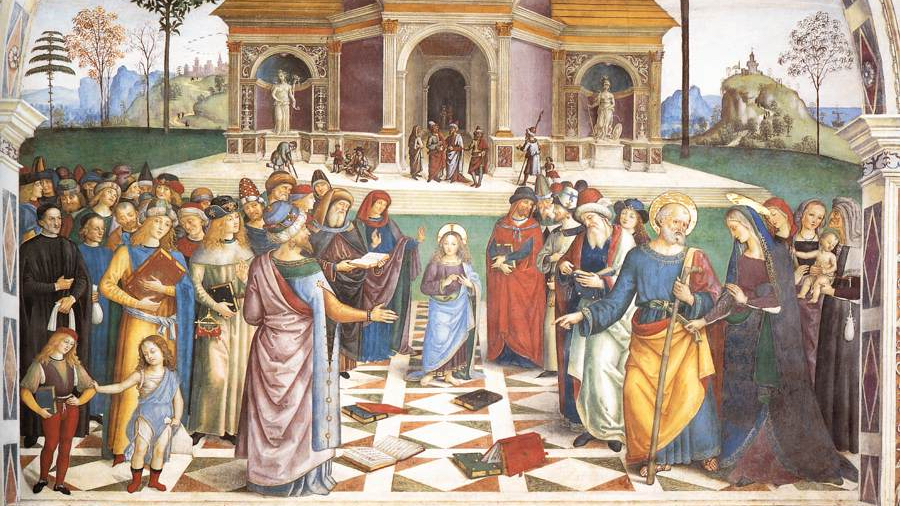
Lancret was one of the most important followers of Watteau, who is, sadly, slightly out of favour. His romanticising views of the life of leisure have come to seem a little pointless to some, but that is a great pity, as they are beautifully and delicately painted, with a wonderful sense of melancholy. Lancret appears to be quoting from him here, as two of the figures look remarkably similar to two in Watteau’s late, great masterpiece, ‘L’Enseigne de Gersaint’ – and yes, you’re right, it was a shop sign (though not for very long). Having said that, it is possible that Lancret has spent so much time looking at Watteau’s paintings that the older artist’s reflexes had become his own: the references might not be deliberate at all.

What is undoubtedly similar is the location. The official title says that they are in a garden – and a very fine one it is too. As a family unit, these people are undoubtedly entitled to gather together in a group larger than two, and I assume that, if the servant lives in, then there is no reason why he shouldn’t be there as well. And if this is their garden, they are truly blessed. There’s been too much ‘park shaming’ – as a friend called it – recently. It’s fine for those people with gardens to say ‘oh, they shouldn’t all be out in the parks’, but there are so many people living in cramped flats, often with too many other people: we must find a way to give them more space! With a garden like this one, there is no need – it looks more like a park anyway.

In Watteau, part of the magic is the ambiguity. You never know exactly where you are. The landscapes look like the countryside, but there are classical statues scattered around – it could be a park, or a run down estate, which has been left to go wild. Similarly, you can never be quite sure who the people he paints are. Are they off-duty actors? If so, why are they wearing their costumes out in the park? And why do they have costumes of different eras? The images are entirely poetic… and I will talk about one of them soon! Back to Lancret: he cuts down on the ambiguity, and keeps our feet just that little bit more on the ground. This could be a garden – an incredibly large one – or it could be a park, in good condition. The fountain flows into the circular pond, honeysuckle climbs up the wall, and flowers bloom in the vase. The Ecologist tells me they are all cultivars, by the way, double versions, more blousy than the natural forms. There is nothing unsophisticated about this garden.

The flowers appear to have been grown to accessorize with Madame’s outfit – that little ‘ping’ of deep salmon pink lifts our eyes to the top of the vase, and then back down to the mother’s dress. The yellow and white of the honeysuckle harmonize with the clothes of her younger daughter. Mum holds the coffee in her left hand (yes, I’d prefer it if it were chocolate, just for today, but it’s better that it’s coffee!), and delicately holds a spoonful towards the child, little finger suitably erect. The girl’s face is a joy – how exciting, to try coffee for the first time! But the parents aren’t taking any chances. The buttercup-yellow dress has been entirely swathed with an apron. If you think it’s hard to get coffee stains out now, just think how impossible it would have been in 1742.

It’s at this point that you might start to think, ‘But this is madness!’ Deliberately giving coffee to a young child? Surely you want to keep them calm and collected? Luckily, they have an enormous garden to run around in (and back then they didn’t need to socially isolate), but the last thing you would want if you were having a quiet breakfast in the garden is caffeine-pumped offspring. More important than this, though: how will the child turn out? Imagine the horror of appearing in public with children who were unsophisticated! And the sophisticated thing was to take coffee in the morning, and after lunch. This girl is learning what it means to grow up.

There’s a very good clue to this – the girl’s doll has been discarded, and lies, face down on the path. It is time to put away childish things. The doll’s dress has the same colours as the mother’s – deep salmon, jade green and ivory. But it’s in a different style: not just the stripes, but the cut, which is far more formal. And the dog? Well, it’s ignoring the proceedings entirely, grubbing away, ignoring the hollyhocks as well. But then, we know that dogs are not as sophisticated as humans.

It is a charming, delightful painting. It may appear inconsequential, but Lancret has clearly lavished attention on the composition. The trees in the top left lead our eyes down to the family group, the diagonal from the bottom right corner, through the dog, leads to the interaction between mother and child, and the sloping wall behind the mother’s shoulders follows her gaze towards the expectant girl.

The father – and the servant – are in an earthy brown which helps them to fade into the background. After all, what do men know about bringing up girls? The focus is definitely on the mother – and the colours across the painting remind us she is there. 

Enjoy your gardens, if you have them, and maybe give the people in the parks more space, as they might not. And enjoy your chocolate. Or coffee. Or, even better, both.