
John Singer Sargent, Lady Agnew of Lochnaw (Gertrude Vernon), 1892. National Galleries of Scotland.
Don’t believe what the critics say. And for the same reason, you shouldn’t believe what I say. No one can be expected to know everything. Critics very often have no time to think about what they’ve seen, and they could be having a bad day anyway. At least one of the reviews of Sargent and Fashion at Tate Britain (which I will be talking about this Monday, 4 March at 6pm) was excoriating, complaining that there were dresses in the way of the paintings. That man is an idiot. Most critics seem to want every exhibition to be old-fashioned, uninspired, ‘this is the artist and everything he stood for and certainly in chronological order’ type affairs (and yes, I used ‘he’ deliberately). There is still value in ‘dare to be square’ displays – I love them – but there is also enormous value in looking at things from different points of view. This is an exhibition about the relationship between John Singer Sargent and fashion. It does what it says on the packet. It never claims that it represents everything that could be said about Sargent, nor would that be possible in one exhibition. Just reading one or two of the labels is enough to convince you that (a) the curators know what they are talking about and (b) fashion is a quintessential feature of Sargent’s practice. So why would you complain about the dresses? Rant over, but just in case you’re worried, on Monday not only will I show you some glorious painting but also some wonderful clothes.
Until recently I hadn’t realised that Sargent and Fashion was originally supposed to open in Boston in 2020, and then transfer to Tate Britain in 2021, but of course… global pandemic. The same is true of Angelica Kauffman, which did successfully open in Germany in 2020, but failed to make it to the Royal Academy. At the time it seemed like it had been lost for ever, but it opens in London today (2 March), and will be the subject of my next talk, on 11 March. That will be followed by The Virgin and Child… and other relatives, the third leg of my Stroll around the Walker. I’ve timetabled it for 18 March even if the following week, 25 March (the Feast of the Annunciation), might have been more appropriate. However, it looks like I might finally be moving into the new Liverpool home that week, and it would probably be an idea to settle in and make sure the WiFi is working before I plan any more talks! For anything else, including the last couple of places on the March In Person Tours (there will be more in April) see the diary.
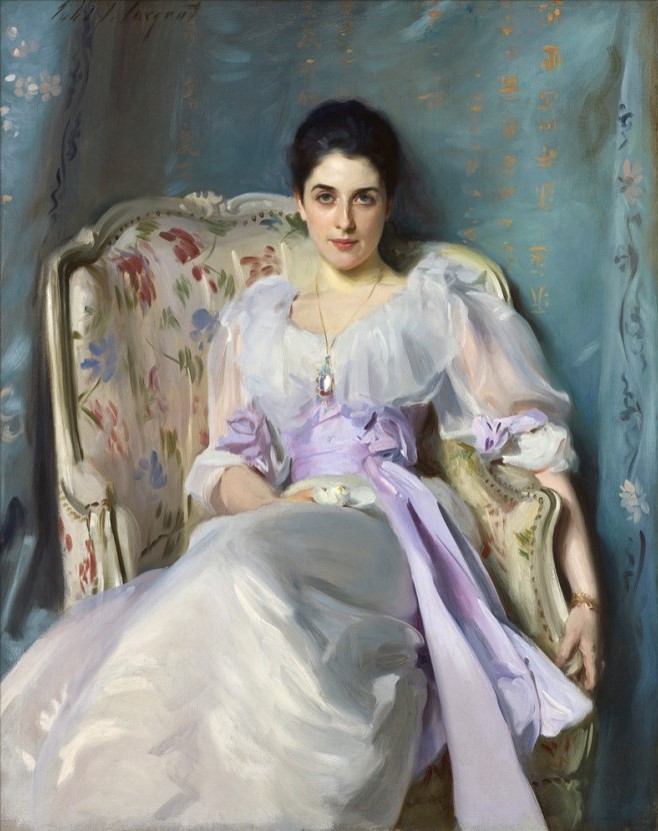
This has long been one of my favourite paintings by Sargent, and I stop by to look at it whenever I am in Edinburgh. Why do I like it so much? Well, I think it looks fantastic. Sometimes even art historians have to admit that personal taste feeds into things, and whatever I do to understand a work of art and what makes it tick, on occasion pure aesthetics take over. That certainly happens here: I’d be happy to stop at this point, and invite you to sit and look at this photograph for the next five minutes instead of reading – but of course you’d do far better to go and see the object itself. I love the colours – the pale blue of the back cloth, subtly shifting tone as it undulates around the off-centre chair, the ivory dress, rendered opaque or semi-transparent according to its location, and especially the lilac sash wound around the waist and trailing off to the bottom right. I also love the sitter’s commanding gaze, and her relaxed pose – although, as so often with Sargent, she may not be quite so relaxed as you might, at first glance, suppose.

I’m using a different digital file for the details – the previous image is truer to colour, as far as I can remember, but not particularly high resolution, so from now on the colours will be slightly subdued. The photographs (and details) in the Tate Britain catalogue are fantastic, by the way, and allow you to see Sargent’s technique superbly. The different essays and articles are also superb, although, as so often, I’ve spent most of my time just looking at the pictures.
The subject of today’s painting is Lady Agnew of Lochnaw. Born Gertrude Vernon in 1864, she married Sir Andrew Noel Agnew, 9th Baronet of Lochnaw, at the age of 25. Three years later, in 1882, Sir Noel commissioned this painting, and it was completed in the same year after just six sittings – which was very few, for Sargent. It was exhibited at the Royal Academy Summer Exhibition in 1893, and is the painting which did more than any other to make Sargent successful in Britain. He had settled definitively in England in 1886, but the ‘locals’ were initially wary of commissioning portraits from someone whose somewhat scandalous reputation had followed him from Paris, and who might paint them in too damnably French a manner. It’s said that Lady Agnew was recovering from flu when she first arrived at Sargent’s studio, and the first thing she did was to slump into a chair – so he painted her just like that. I doubt it somehow: his work shows a very practiced nonchalance, what the 16th century Italian author of The Book of the Courtier, Baldassare Castiglione, called sprezzatura – the ability to perform a complicated act with apparently little effort. The ‘apparently’ is important here: every brushstroke looks easy, but would be impossible without years of experience – and enormous talent.
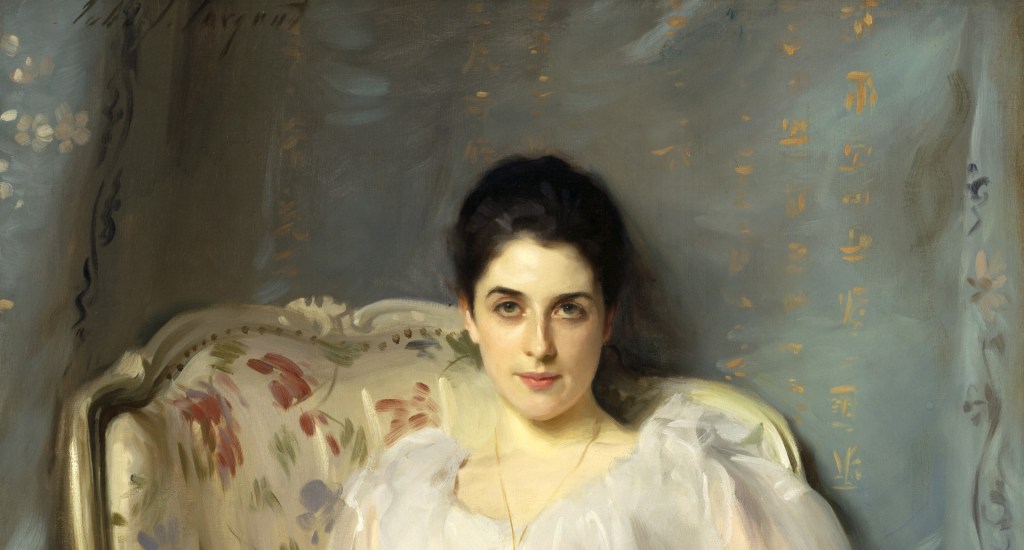
The chair, and its precise position, are very important. It is pushed to the left of the painting, and angled out towards our right. Seating Lady Agnew in the back corner puts her face right in the middle of the painting. A pale blue Chinese silk hangs behind the chair (it looks sadly drab in this detail, but see above), and hangs very close – as if the chair has been pushed back into it (see the way it is shadowed on the left of the image), or even hung over the chair like a canopy – as if this were, in fact, a throne. This is perhaps overstating Lady Agnew’s status – baronets are at a level just below the five ranks of the British nobility. The signature is at the top left of the painting (‘John S. Sargent’), and orangey-yellow Chinese symbols can be seen in vertical columns, most clearly on the right of the painting.

I’ve described Lady Agnew’s gaze as ‘commanding’ – but it is not directed towards us. She looks over our head – which implies that she was not actually looking at Sargent during the sitting. Her right eyebrow is slightly raised, and there is an intriguing echo between her two eyebrows and the two curving elements of the chair frame which spring from a central feature. This is typically rococo furniture, and genuine at that, dating back to the 18th century. As one of Sargent’s studio props it features in more than one painting – including another in the exhibition which I will show you on Monday of a far plainer woman, who, even so, is quite brilliantly painted. Or, at least, her dress is… The patterned upholstery is suggested by free brushstrokes, each short, broad mark implying the petal of a flower, or a leaf. There are also some longer, thinner cream brushstrokes, running vertically, which tell us that the fabric had a sheen. Lady Agnew wears a pendant on a thin, gold chain, the rectangular, facet-cut stone held in a gold mount. In other photographs – and the painting itself – the lilac colour makes me think it was an amethyst.

It took some time – as it often did – to decide what Lady Agnew would wear. In the end, they settled on a relatively simple white dress, accessorized with a lilac sash at the waist and matching ribbon in the sleeves. The choice of white was probably deliberate. When he was a student in Paris Sargent had got to know Whistler, who later would be one of the people who suggested he would do well to settle in England. He needed a studio and, not coincidentally, took one recently vacated by Whistler himself at 31-33 Tite Street. Oscar Wilde lived at No. 34 – not directly opposite, as a result of the vagaries of British numbering of houses (and the numbers have changed since the 19th century), but a little further along the road. Back to the point: maybe Sargent and Lady Agnew chose a white dress in homage to Whistler’s ‘Symphonies in White’. It’s important to remember that every portrait is a form of collaboration between the artist and their subject. Like all paintings, a portrait is a form of conversation, or negotiation, allowing both sides to get what they want. Quite apart from the subject’s appearance, there is the correct representation of status and character, or, for the artist, the chance for a bravura display of painterly skill. As often as not, though, Sargent’s subjects would come up with a number of alternative outfits and he would choose the one that he wanted. As often as not, he went for one of the simpler choices in black or white.

There is so much going on in this detail – a wonderful confluence of colour and forms all apparently licked onto the canvas with freedom and expertise – exactly that ‘bravura display of painterly skill’ I mentioned above. The broad sash encircles Lady Agnew’s waist, and is tied in a bow above her left hip. The edges of the sash catch the light, while a deep shadow is cast between the bow and the arm of the chair. The ribbon in her left sleeve bunches the fabric together: above the ribbon it is semi-transparent, and we see the flesh tones through it, while below it is the same opaque creamy ivory as the rest of the dress. Lower down we see the arm clearly, the flesh tones no longer modified by the fabric. However, her arm falls behind the arm of the chair, which casts shadow onto the flesh – and as a result, not so much of it can be seen after all. Her right wrist is also partially hidden – in this case, thanks to the rise of the left leg, which is crossed over her right. We can just see the ‘heel’ of her thumb, and the beginning of her index finger holding a magnolia blossom. The broad, looping petals which fall away from the central cluster on either side are typical of this flower. The curve of the petals is not unlike the exaggerated curve at the end of the arm of the chair.
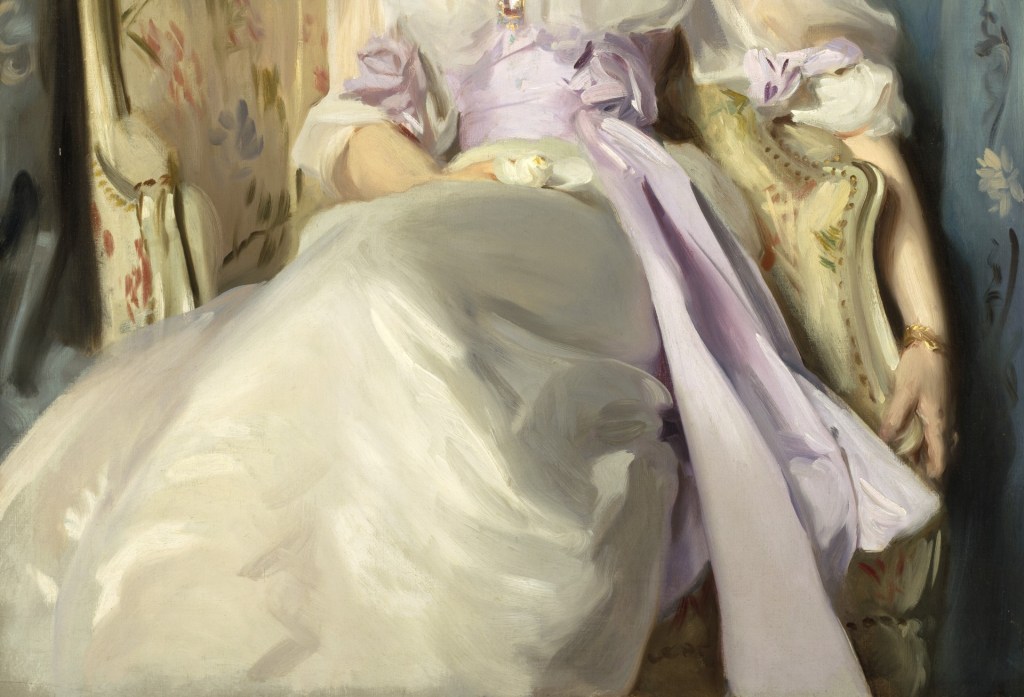
Some artists excel in the painting of white – Raphael, for example, and Sargent’s contemporary (and friend) Sorolla. The skirt is one of the passages which exemplify this, and reminds us that white rarely looks purely white. Here it moves between ivory and cream, with broad, bold, lighter highlights. There are also grey shadows which convey the almost metallic sheen of the fabric. Some of the ‘white’ is also lilac, coloured along the right of the legs by light reflecting from the sash. The sash itself flows in long fluid strokes towards the bottom right, creating pools of shadow in its dialogue with the skirt, while the forms of Lady Agnew’s left arm continues their conversation with the arm of the chair.

I started by saying that I love the colours in this painting – and I do – but I also love the complexity of forms. The previous detail (which overlaps with the one just above) demonstrates this, but it is seen at its best here. The sash forms a continuous, steep diagonal flowing from the waist to the bottom of the painting, folding over the seat of the chair, but otherwise with simple, strong lines. On either side are the ‘dialogues’ and ‘conversations’ I’ve just mentioned, a syncopation of forms created by the edge of the skirt as it folds into shadow, and the curves of the arm of the chair with their rococo combination of broad and tightly inflected curves. Lady Agnew’s left arm hangs down, brilliantly illuminated between the shadow cast on the blue, Chinese fabric and the dark space between her arm and that of the chair. The light on the chair arm is enhanced by a lick of creamy paint just next to her sparkling gold bracelet. The bow in the sash is level with the ribbon in her sleeve, and with the bunching of the sleeve which the latter causes, each of these features getting paler as you move to the right. The shadows in the grooved folds of the bunched, lower section of the sleeve echo those in the moulding of the kink in the arm of the chair just below. This kink hides part of her arm, and casts shadow onto it, while lower down her hand hides the bottom part of the moulding. Her thumb and forefinger echo and frame the curve of this moulding at its lowest extremity. The extension of her arm, and the way in which she is grasping the chair, suggests to me that she was maybe not quite as relaxed as her overall pose might suggest. There is a tension here which matches that in her raised right eyebrow.

If we look back at the painting as a whole we can see that everything is very carefully placed. The forms flow down from the waist, with the legs leading to the bottom left corner, and the sash spreading in the opposite direction. Her torso, central, is entirely upright. The extended left arm frames the right edge of the painting, a role performed on the left by the side of the chair. As I said above, seated in the back corner of the chair Lady Agnew’s face is in the middle of the painting – but it’s more specific than that. Her right eye, the pendant, and the magnolia all lie on the central vertical axis, a geometrical rigor belied by the apparently spontaneous pose. Sargent is in total control, while making everything look entirely natural, free, and even improvised. This is sprezzatura – and, as we shall see on Monday, it was a practiced nonchalance that he had perfected by the time he completed his very earliest paintings.
 dr richard stemp
I agree that this particular critic was having a bad day. An almost instant disapproval of a new way to look at art. Not the usual blockbuster exhibition that takes little effort or analysis on the part of the critic.
I would love to see other examples of clothes in portraits. Ingre’s Madame Montissier and her dress (which I believe was changed during the long duration of the commission to the Lyonnaise flowered silk in the final painting) would be my choice
I’m looking forward to Monday’s lecture
Barbara
LikeLike
Thank you, Barbara – Madame Moitessier is indeed and intriguing example – and not just because of the dress. When the painting was started her daughter was also in the painting – although she was ‘lost’ fairly early on, and must have been a grown woman by the time that painting was finally completed!
LikeLike
This is not a comment on this painting but a complaint about a previous one.blog 216
What a waste of my time. Took 15 minutes to get in, contact kept being lost, blurring and fading . Altogether infuriating.I’ve never experienced this with your blogs before. I love Sargent but am loathe to sign up for another waste of time.
Sorry but there it is,
Vivien E McCormick
LikeLike
Hi Vivien,
I’m sorry you’ve had problems – but are you talking like one of the Zoom talks, rather than one of the blogs? A blog is a piece of writing online which you read, it wouldn’t be blurry, and it wouldn’t take time to get in.
Assuming that you are actually talking about one of the Zoom talks, no one else reported any problems, I can only assume there’s a problem with Zoom on your device, or possibly with your WiFi provider. Unfortunately there is nothing I can do about that.
Wishing you better luck with any online encounters you have in the future,
Richard
LikeLike
Thanks for replying. No it wasn’t your blog it was the Monday talk on the 12th February. I should have complained at the time but I went out for supper instead!
I clicked as instructed but it didn’t connect so I tried zoom which turned out to be difficult. I’ve done loads of your talks and they’ve been fine so I don’t know why it behaved as it did.
The Walker is a lovely gallery- as is Lady Lever’s in Port Sunlight- and the Picton library etc is a tremendous asset.
Enjoy living in Liverpool though it has much changed since the swinging sixties!
Ciao,
Vivien
LikeLike
To be honest, there would have been no point in complaining to me at the time, as the problem was nothing that I could have dealt with, and nothing to do with me either – but you did well to go to supper!
LikeLike
YES! A long time favourite of mine also – a copy has been in my house for years. And an excellent riposte to the grumpy and ill founded Guardian review
LikeLiked by 1 person
Dear Richard Stemp,
Thank you, thank you! For several things. Firstly, for my ‘re-discovering’ you! I came to many of your talks at the Nat Gal before their appalling behaviour in 2018…. I particularly missed you and Karly Allen.
From that time, I owe you especial thanks for advice given when I asked you after one of those talks: “I’m going to Pisa for a concert and if I only have time to see one thing what should it be?” Without hesitation you replied: “The Camp Santo! The sarcophagi!”, and waxed lyrical with such enthusiasm it was the first thing I did. And the second and third! And when I returned the following two years. I’ve never forgotten.
So I was delighted to see/hear your fascinating and very illuminating talk on Liotard last Tuesday. I’ve been to that exhibition twice and looked long and hard – especially at the breakfast picture. Just gorgeous. But even so I hadn’t noticed several things you pointed out. And your article now on the Sarjent exhibition is wonderful. I had ‘wondered’ about the Guardian review – it was so vitriolic! Your detailed ‘look’ at Lady Agnew is rivetting. I love the way you draw attention to form, composition, colour, and the finest of details. I’ve had a long gaze at her gaze – and I find it slightly quizzical as well as commanding… almost challenging… “I’m not just a woman in a pretty dress you know” … or maybe I’m reading too much into it!
Anyway, many thanks for adding such pleasure to my artistic viewings. Looking forward to Monday.
Best regards.
Roz Perrott
LikeLiked by 1 person
Thank you Roz – I’m so glad you enjoyed the talk, the post, and the sarcophagi – I hope you managed to ‘compare and contrast’ with the pulpit in the Baptistery!
And thank you for taking the time to say so – it means a lot to me!
LikeLike
What a wonderful, beautiful, irresistible painting! It’s like an illustration of Dostoyevski’s saying “It’s beauty that will save the world.” Looking at this painting is like taking a healing bath in beauty.
How much have we lost in today’s world.
Thank you very much for your sensible and inspiring notes on this painting.
LikeLike
Thank you, Petra – it is indeed wonderful!
LikeLike
Thank so much for such an interesting post on John Singer Sargent’s painting of Lady Agnew of Lochnaw. I had read the grumpy article in the Guardian before visiting the exhibition and, like others who have posted above, after I had visited wondered what on earth his beef was about! I really enjoyed seeing some of the garments first hand and seeing how he had painted the fabrics, as well as how he had pinned and manipulated some of them on his sitters. The exhibition never claimed to be anything other than a detailed look at the relationship between the subject, the artist and the fashionable clothes they were painted in. A refreshing take on this aspect of his work. Maybe the critic was having a dyspeptic day – I hope it doesn’t put anyone off visiting an innovative and enjoyable exhibition.
Good luck with your forthcoming move
Gillian (Sandham)
LikeLiked by 1 person
Thank you, Gillian! I’m afraid I’ve had problems with him before – this is the worst, but not exactly a one off! But it doesn’t seem to be putting people off! Hope all’s well with you.
LikeLike
The Daily Telegraph review was pretty awful to0 – something about some men thinking clothes and fashion are too trivial to merit serious attention I’m guessing.
I’m late reading this blog but better late than never, and I do hope your move went ok and wasn’t too stressful.
love Fiona
I
LikeLike
I hadn’t heard that – they really don’t know what they’re talking about!
Sadly the move is still stressful, partly as it hasn’t happened. We finally exchanged contracts on Monday, and will move next week!
See you soon!
Rx
LikeLike
Whew!
LikeLike