
Jan van Eyck, The Annunciation, about 1434-6, National Gallery of Art, Washington D.C.
I first posted today’s blog as Picture Of The Day 76 in June 2020, when I was astonished that I hadn’t yet written about Jan van Eyck – about ten weeks into lockdown. Well, worse than that, I haven’t written about him in the six and half years since. As you’ll realise, everything I write now is based not on whim (as it could be back then), but on what I’m looking at now – and what a joy to be looking at van Eyck again, and looking forward to the National Gallery’s upcoming exhibition. It has inspired two talks, starting this Monday, 23 November at 6pm with Van Eyck I: The Works, which will include everything – as far as is possible – that is not on show at the National Gallery. Then, on 30 November, I will introduce that exhibition with Van Eyck II: The Portraits. We will then continue my slow journey to the present day with Van Hemessen & Father on 7 December, Renoir & Love (14 December) and finally, for this year, on 21 December, Painting the French Riviera, the gloriously sun-filled show at the Royal Academy.
If you missed my Bayeux Tapestry talks, or would like a recap, I am starting a three-week course for the National Gallery today (Wednesday)! Called Hastings to Hockney: Narrative and nationhood in British art, it will cover an idiosyncratic range of imagery connecting the tapestry to Hockney’s A Year in Normandie, via Holbein, Hogarth, Turner and van Dyck – among others! Even if you’re not free this afternoon, you can still join the course later on. As they have several members of the IT team poised ready to record and post the talks online (unlike me, stuck in my office on my own), they do record their talks – so you would be able to catch up over the next few weeks.

The picture is very tall and thin – which isn’t ideal for the formatting of this blog, I know – but implies that it might have been part of a larger ensemble. However, van Eyck created a number of small, devotional panels that fitted the taste of the times, which, especially in Northern Europe, was for private devotion at home. We see the Annunciation taking place in a church, and van Eyck was the first panel painter to do this. It relates to the idea that, as Mother of Jesus, Mary was effectively ‘the house of God’ for the first nine months of his earthly existence (POTD 71). As the Church is also known as the house of God, there is an equivalence between Mary and the Church – she becomes elided with Ecclesia, the personification of the Church. That is why, in several paintings, although not so obviously this one, she is clearly out of proportion with her surroundings. Even here, were she to stand up, she would be roughly as tall as the arcade behind the angel. She has, as so often, been contemplating the scriptures, and Gabriel appears bearing his staff of office (POTD 70). No need to bring a lily for the expectant mother, as there is a vase full of them just in front of her lectern.
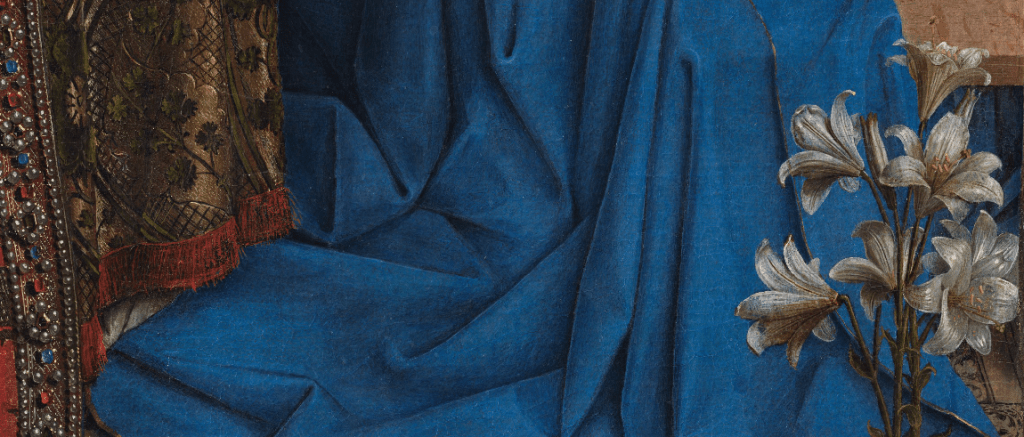

Mary wears a simple blue dress, matching her humility, whereas Gabriel is dressed in the most remarkable finery – ecclesiastical robes, as if the choirs of angels were a branch of the priesthood higher than the Pope, with richly coloured fabrics encrusted with pearls and jewels. He greets Mary with the traditional words Ave Gratia Plena – ‘Hail, Full of Grace’ and she responds Ecce Ancilla Domini – ‘Behold the Handmaid of the Lord’ – her humble acceptance of God’s chosen role for her (these are quotations from Luke 1:28 and 1:38 respectively). But she is replying to God, so she replies backwards, and upside down, making it easier to read for anyone looking down from heaven. The Holy Spirit appears from above, swooping down with urgency on beams of golden light, as the Light of the World (Jesus) comes into the world. Mary’s face is framed by three windows, symbolic of the Holy Trinity. Jesus is the second person of the Trinity, and the Holy Spirit is the third. God the Father’s presence is implied by the light coming through the window at the top left. The windows behind Mary are also a miracle of painting. The are constructed out of ‘bullseye glass’, which was made by putting a blob of molten glass on a rod, and rotating it to spin it out into a flat disc. These circular sections are the very centre of those discs, where the glass can still be relatively thick, so that they act as irregular lenses, refracting the light from outside to show the sky at the top and the plants and buildings indistinctly at the bottom, the latter gradually filtering out as you go up the windows, apart from the places where the most extremely curved glass acts to make the dark areas still visible. They look almost photographic.
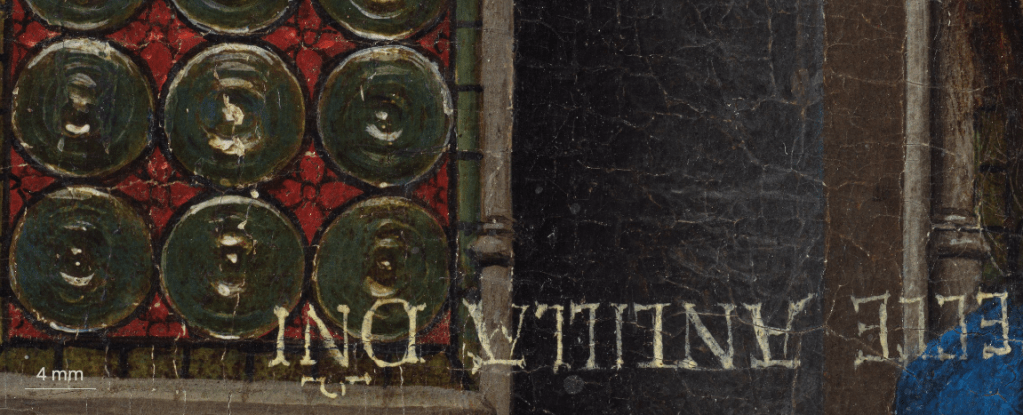
When you get in closer, you can see precisely how he did it, with a darker base colour painted over by tiny blobs and arcs of lighter paint. Simple when you know how, until you look at the scale – which I have left in – and realise that each individual bullseye is less than 1cm in diameter. These details come from my new favourite toy – a truly wonderful website called Closer to van Eyck – click on the link for hours of fun zooming in to see the most breath taking detail. The interstices between bullseyes are filled with red glass painted to have four petals – the stylised flower almost certainly intended to stand for the Virgin, whose response can be seen here, each letter carefully and delicately painted on a tiny scale.

The significance of the three windows behind Mary becomes particularly evident when you look to the top of the church interior, where there is just one window. The stained glass has a single figure underneath two multi-winged angels which are standing on wheels. These are Thrones, from the third choir of angels after Seraphim and Cherubim. I really must go through the angelic choirs properly one day! The single figure could easily represent God the Father, although his presence is implied, as we’ve seen, by the light coming through the window at the top left. The stained glass image, though, is in some ways more representative of the Old Testament idea of God, Jehovah, in his singular presence, ruling over the world: indeed, he is standing on a globe. He also holds the bible, and although it doesn’t seem possible to read what is written, it probably includes alpha and omega (A and Ω), the first and last letters of the Greek alphabet, mentioned several times in the Book of Revelation referring to God’s omnipresence and timelessness.
On either side of the window there are murals. I find it truly astonishing that van Eyck was so aware of the Romanesque style of painting, with its simplified, linear forms, densely packed folds, and broad arcing outlines. To the left, the murals illustrate the discovery of Moses, as he is handed to Pharaoh’s daughter (POTD 21). This is a precursor of the Annunciation, in which Jesus is effectively ‘given’ to Mary. On the right, Moses receives the Ten Commandments from God. This is also relevant to what is going on below, as the Law of Moses will be transcended by the Grace of Christ.

If you get in closer, you can even read the words ‘non’ in some of the commandments – ‘thou shalt not’! And the globe on which Jehovah is standing is divided by the equator, with the lower half clearly labelled ‘ASIA’. As we saw in POTD 70, a monarch’s orb is divided into the three continents that were known in medieval times.

The relationship of the Old Testament to the New is also explored at the bottom of the painting. Van Eyck has painted the floor to look like it has been decorated with sgraffito. There are various different techniques which use this term, but they are all related to the idea of scratching. Here the lines of the imagery have been incised into the marble floor, and then filled with a dark pigment, to make them stand out. The rectangular tiles show scenes from the Jewish scriptures. The clearest image is at the bottom of the painting, to the left of the footstool with its wonderful brocade cushion. It shows soldiers standing in a tent on the left, with someone chopping off the head of a very large man on the floor at the right – this is the story of David and Goliath, and stands for the triumph of good over evil. In the tile above that we see Samson pulling down the pillars of the temple, killing himself and many of the Philistines in the process. To the left of that image, but mainly covered by the angel’s robes, Goliath is killing even more Philistines in battle. The implication is that God will triumph. In the roundels at the corners of the decorative borders are the signs of the zodiac. The Church has had an ambivalent attitude towards astrology over the course of its history, but, when accepted, it is as a sign that that God has dominion over the whole cosmos, which he had, after all, created. One quite credible reconstruction of the decoration of this floor suggests that Gabriel has positioned himself on top of Aries, the sign which includes 25 March, the Feast of the Annunciation, whereas Mary is on top of Virgo – the Virgin. Overall, the references to the Old Testament at both the top and bottom of the painting suggest that the Annunciation marks the beginning of the New Order, when the Law of Moses will be superseded by the Grace of Christ, and Jehovah, although still relevant, would be better understood in terms of the Holy Trinity.
Obviously very few people would ever have understood all of these references – but then, a painting of this size would always have had a small audience, and the person for whom it was painted would have got it all – indeed, the patron probably specified precisely what van Eyck should paint. It was the artist’s skill that brought it to life, though, and made it look real – so that we would believe it. However, van Eyck’s style is almost too real, too crystal clear, every single detail is so specific. It becomes almost hallucinatory, and that is precisely the point. The truth which he was illustrating should be clearer, brighter, more intricate than our normal everyday world, which, compared to heaven, was, for the theologians, as much of an illusion as this painting: our world won’t last (there are even angels ripping it up in POTD 38). But the painting functions as a door into eternity, and the permanent reality of heaven – and an incredibly beautiful ‘door’ at that.

This is just one of many paintings by Jan van Eyck which will not be included in the National Gallery’s exhibition, which focuses on the independent portraits. I will try and include all of the others – including the majestic Ghent Altarpiece – in my talk on Monday – but I can’t guarantee that I will be able to go into such great detail. I will try, though!

