Lent 25

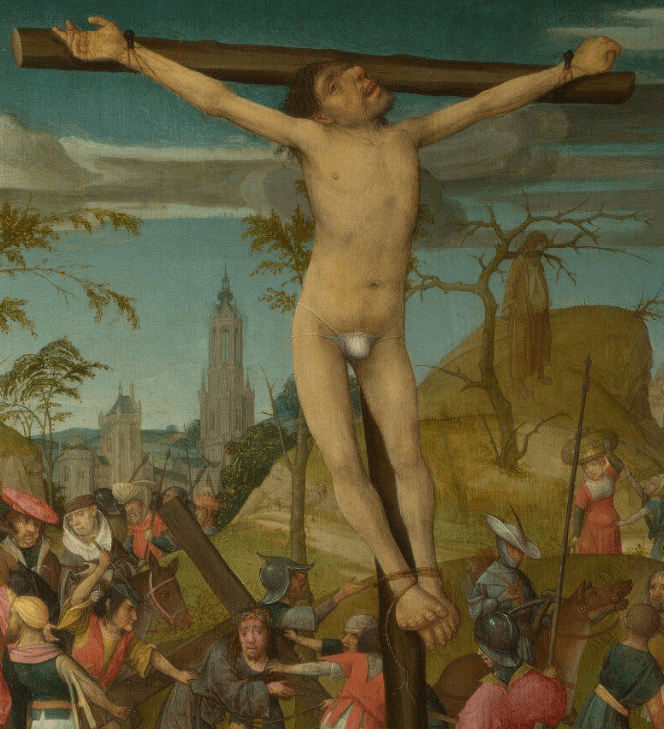
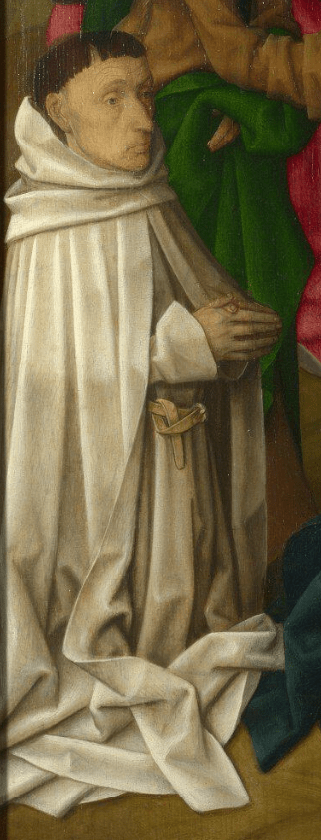
We were talking about anachronism just a couple of days ago (Lent 23), and if it seemed unlikely that the Via Crucis would skirt around a church, it is even less likely that it would pass someone who looks like a monk, as they came even later. He’s not a monk, as it happens, but we would be hard pressed to tell the difference these days. He kneels, in prayer, his hands joined in front of his waist, the thumbs rather charmingly crossed. Below the flared white sleeves is his white belt, with the end that has been fastened through the buckle wrapped around the main length to form a knot. It loosely gathers his long white robe, which is covered by an equally long white hooded cloak, parted at his chest by the praying hands. It lies over his right forearm, the subtle modulation of light and slightly-less-light revealing the precise position of his arm, then falls to the ground in elaborate folds.

He is not a monk, as he does not live a life of seclusion: he is a Premonstratensian canon, an order founded in Prémontré, near Laon, in 1120. His duties would have been to preach and carry out pastoral ministry in parishes not far from his abbey. In England they were known as the White Canons, and you can see why. But why would a Premonstratensian canon be kneeling in our painting? What role does he play? Well, if you look carefully, and consider the direction of his gaze, he is not playing a role at all.

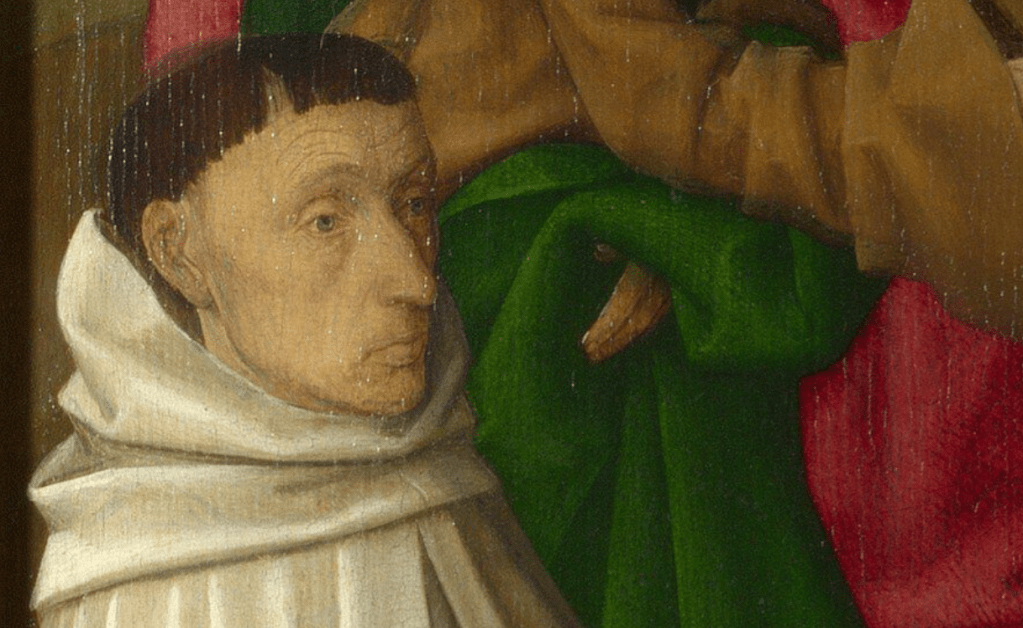
When founded, the order was one of great austerity, imposing additional statutes to the Rule of St Augustine, which was strict enough already. We could have guessed as much from this portrait. He has a rather pinched face, with hollow cheeks, a long, thin, slightly hooked nose, and hollow eyes. The skin appears tight across the temples. He has been enjoying great austerity, I would say. The ragged haircut – possibly tonsured on top – shows his humility in the face of human vanity, and his look is one of total concentration on his devotions. Both his face and his torso are angled towards us ever so slightly, so that we can see him better, and as a result we can tell that he is looking straight ahead, focussed on something in the distance – or into the middle distance, as he focusses on his own contemplation.

All of this means that he is not involved in the action of the painting – he is not looking towards it, but rather, out, and away. He is thinking about it, even praying about it, but it is almost as if he is not there. Or even, as if the action of the painting is one big thought bubble. This is the portrait of a man thinking about, meditating upon, the passion of Christ. It is, of course, a donor portrait: this is the man who gave, or donated, money (hence ‘donor’) to have it painted. In other words, he is the patron of the painting. For many years there was no real idea as to who he might have been, but recently, I believe, it has been suggested that he could be Herman van Rossum, who was the provost of a convent in Koningsveld, near Delft, at the beginning of the 16th Century. Our painting would originally have been housed there, but, since the convent was all but destroyed in 1572 – presumably in the war with Spain – you will not be able to visit today. Below is a print which shows what the ruins looked like in 1680. As far as I can tell, it was just outside the city walls, not far from the position from which Vermeer painted his View of Delft (Lent 23), its place now taken by a 20th Century (?) housing estate.

Coenraet Decker, A View of the Ruins of Kongingsveld Cloister, 1680. Rijksmusem, Amsterdam.

This portrait of Herman van Rossum has offered us a moment of contemplation, a pause before we too contemplate the rest of the story. But his attitude tells us one way of responding to these events: the attitudes and behaviours of those present will also tell us how to respond, as we shall see in the next few days.

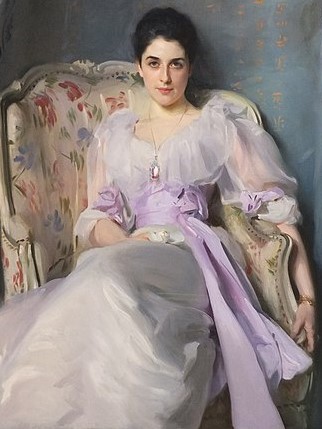
The origins of portraiture in Western art lie in images of donors, like the one we have seen today. They showed appearance, yes, character, sometimes, and in this case, belief. From this point onwards portraiture found many new forms, and rapidly left its sacred setting to find an increasing number of secular spaces. I will be talking about some truly wonderful examples from the 19th Century – created by some fabulous masters of the colour white, as it happens – this coming Wednesday, 17 March at 6pm GMT. If you are interested, and available, you can book via this link to the Art History Abroad website: Painting in Parallel – Sargent, Sorolla and Zorn.

Lent 24

I have often wondered about this group of exiles – I’m never entirely clear where they are supposed to be, or what they are doing there. They form no part of the narrative with which I am familiar, and so, from my point of view, they are open to interpretation. However, their identity is not. They are so far away that the details are not precise – partly, you might think, because of the perspective, and indeed, they are so small that the detailing would be tricky for any but the most meticulous artist. And, as you may have noticed, the Master of Delft prefers a broader brushstroke to, say, Jan van Eyck. But then, compared to Jan van Eyck, most artists do!

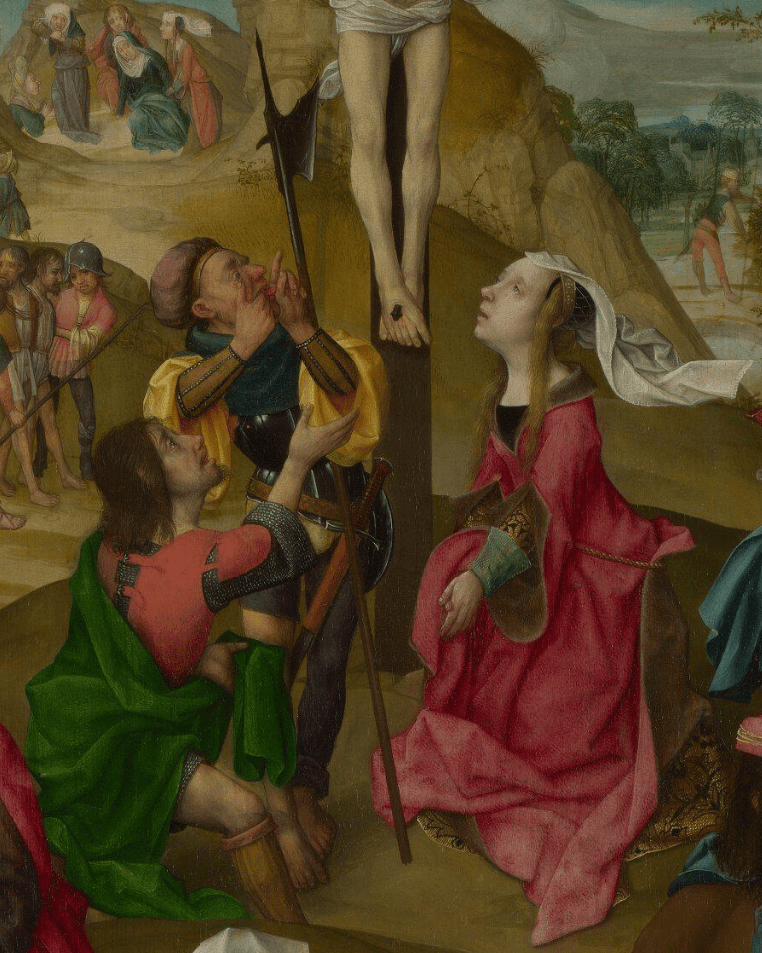
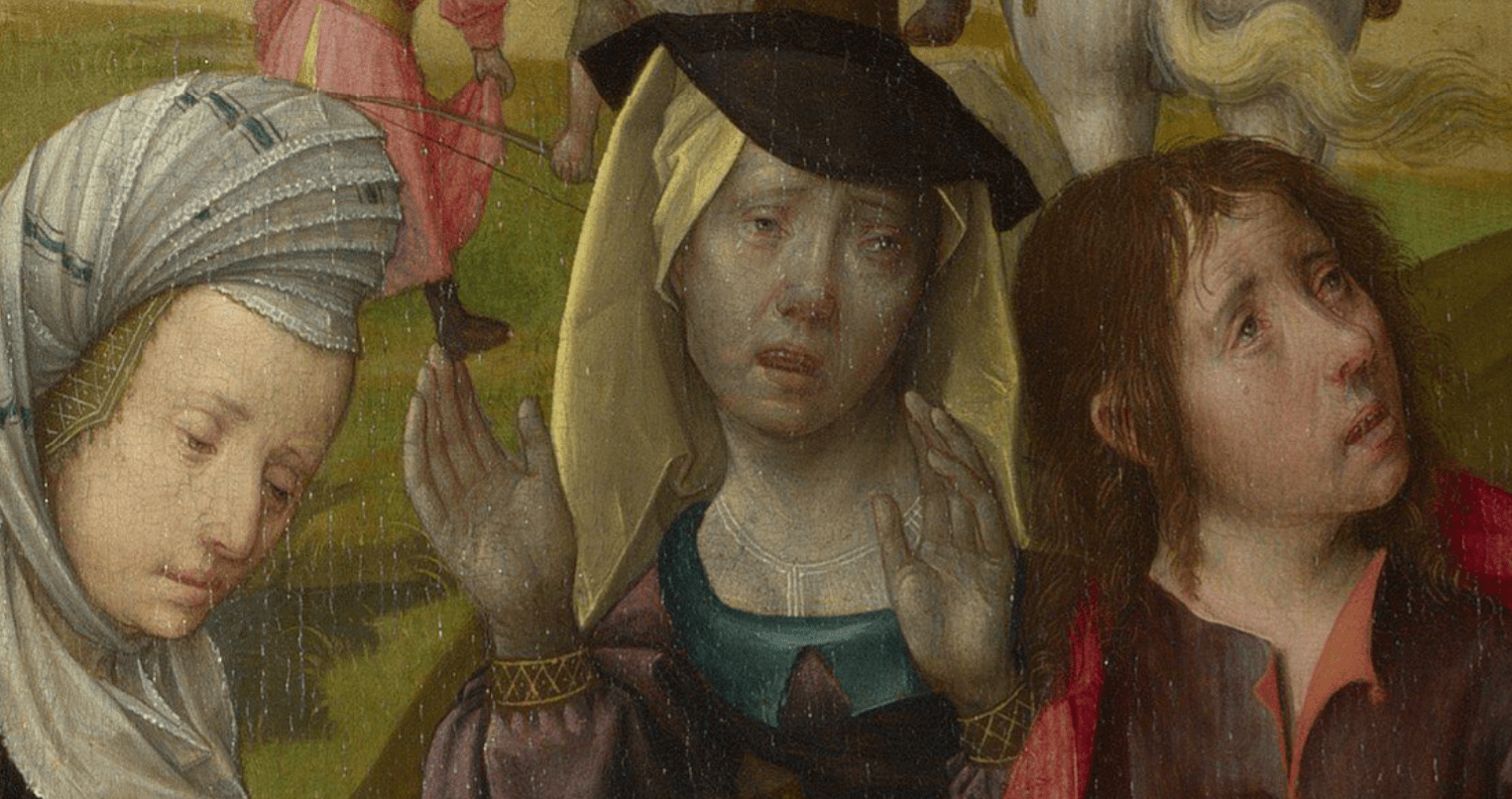
Slumped in the centre is the Virgin Mary, wearing a blue robe and blue cloak, the latter of which goes over her head and partially covers her white headdress, or veil. This falls down one side of her head, wraps around and goes over her chest thus framing her face, which, however small, is full of sorrow. Her posture is unclear – she might be collapsing, fainting from grief, or she may simply be sitting on a small mound, leaning on her right hand. Behind her, supporting her morally if not actually physically, is St John the Evangelist. We know it must be a man as his long hair is neither covered nor dressed, and John, who usually wears red, is the constant companion of the Virgin at the Crucifixion. Behind her, holding her left hand, is a woman in red, her white headdress flying out behind her, suggesting that there is a strong breeze. Her red hair hangs in long bunches on either side of her face. This is Mary Magdalene, who has her hair dressed, but not entirely covered, a hint of the disreputable past which the Catholic Church attributed to her for the vast majority of church history – from 591 to 1969, to be precise. I know I’ve lectured about this more than once this year, but I’m sure I have also written about it. However, I can’t track it down to give you a link, so I shall come back to the subject again!

Gathered together we see the Virgin Mary, St John the Evangelist and St Mary Magdalene – with two other women. One is dressed in purple, which might suggest a royal connection, but I suspect that here it is an artistic choice to distinguish her from the others. She has a white headdress, black collar or cloak, and yellow, possibly gold sleeves. Her gesture of clasped hands and extended elbows is one used to suggest extreme grief. The other woman, presumably on her knees behind the left-hand hillock, leans in towards the Virgin with a gesture of concern. A clue to their identity can be gleaned from Mathew 27: 55-56,

And many women were there beholding afar off, which followed Jesus from Galilee, ministering unto him:  Among which was Mary Magdalene, and Mary the mother of James and Joses, and the mother of Zebedees children.

I wrote about these women at some length, and not a little confusion, some time ago (see 109 – Death and Resurrection – despite what I say it may help…). In medieval tradition ‘Mary the mother of James and Joses’ was identified with Mary Cleophas, who John (19:25) says was Jesus’s ‘mother’s sister’. Did you know the Virgin had sister? At this point in the narrative Mark 15:40 says much the same as Matthew:

There were also women looking on afar off: among whom was Mary Magdalene, and Mary the mother of James the less and of Joses, and Salome.

This text was used to identify ‘the mother of Zebedees children’ with a woman known as Mary Salome. The relationships were explained (in the Golden Legend, among other places) by the story that, after the Virgin Mary had been born, her father Joachim died, and Anna married a man called Cleophas. They had a daughter they named Mary. When Cleophas died, Anna married a third time, to a man called Salomas, and they too had a daughter called Mary. So gathered in this group are four Maries and a John, the Maries being the Virgin, the Magdalene, Mary Cleophas and Mary Salome – though of the last two I would hesitate to say which is which. But what about the questions which opened this post? Where are they? And what are they doing? Quite simply, in four words from Mark, they are ‘looking on afar off.’ As yet, they haven’t summoned up the courage to get closer. But they will.

Lent 23

One of the curiosities of this particular painting is that the Via Crucis passes by a church. ‘What’s that doing there?’ you might ask. After all, Jesus hasn’t been crucified yet, let alone risen from the dead – he has followers, yes, but you couldn’t call that ‘Christianity’, not at this point. And apart from anything else, it wouldn’t be legal for Christians to worship publicly – and so to build anything like a church – until the Edict of Milan some 280 years later. But it’s not there for historical accuracy – it is there for the ‘modern’ observer, back in the 16th Century. Such anachronisms were commonplace, and we’ve already seen quite a few, without commenting on the fact. All of the fashions, however fanciful (because they are meant to evoke foreign lands) and all of the weaponry represented, is derived from contemporary examples – or, as I think I mentioned in Lent 7, from the not-too-distant past. It is there to make the appearance of the story familiar to the viewer, so they can understand what they see, and find it easier to believe. It is also there to remind us that Christ’s sacrifice is all part of God’s plan: it will allow the construction of churches, and, as a result, facilitate our redemption.

However, it’s not just any church. This is the New Church in Delft, the tower of which was completed in the form we see here in 1496. This gives us a useful terminus post quem for the painting. A ridiculous term to use these days, but I’ve used it now, and anyway, you never know when it might come in useful. It means the date ‘after which’ (post quem) the painting must have been ‘finished’ (terminus – this has nothing to do with the stations of the cross…). But wait a minute, I hear you say. Well, the ones who were paying attention, anyway. We already have a terminus post quem of 1509, as the painting quotes from Lucas van Leyden’s The Flagellation of Christ, which was dated that very year (Lent 17). So the New Church does not help us to date our painting. But it does tell us something about the artist. He (or she) was in Delft. And to be honest – and I might as well tell you now, we are more than half-way through Lent, after all – that is all we know about him. Or her. The fact is, we don’t know who painted this painting, so we call the them ‘The Master of Delft’ – almost certainly male, but as Caterina van Hemessen was to have a career as an artist a few decades later, there is the very slimmest possibility that this was painted by a woman – and her workshop. Although that possibility is really very slim.

The church itself has a notable presence in art. It is one of the major features of Carel Fabritius’s 1652 painting A View of Delft with a Musical Instrument Seller’s Stall. The curious perspective is a sign that Fabritius was experimenting with optics: originally the painting might have been part of a perspective box, which, when viewed from the right angle (usually a hole on one side of the box) would make the image ‘look right’.  This could be surprising when compared to the way we see it now, but that was the point: it’s a trick, or game – another form of illusion. Between the dates of the two paintings more building has happened – the roof of the central section of the church has been raised, and a flèche, a type of small spire, has been added. And the church no longer has the round chapel beyond the apse which is shown in our detail – but I don’t think that was ever there. I think it might have been a nod to the ‘Holy Sepulchre’ in Jerusalem, the church that marks the spot where Jesus is believed to have been buried. But that’s just a guess. If you were to see the Nieuwe Kerk today it wouldn’t look quite the same, as an extra section was added to the top of the tower in 1872. However, the tower – in its original form – is also clearly visible in Vermeer’s magisterial View of Delft, painted less than a decade after Fabritius’s version. You can see it two thirds of the way from left to right, brilliantly lit by the sun.

It has this prominence in Vermeer’s work as the church housed the tomb of William the Silent, the figurehead of the Dutch revolt against their Spanish overlords – but that’s another story. As it happens, I am due to talk about Vermeer – and music, this time – some time soon, and will give you more information when I can. Of course, the details of all of my talks are included on the diary page, so you can keep checking there if you are interested.

Meanwhile, back in the 16th Century (or should that be the 1st?), the procession towards the cross continues, with Pilate, the chief priests and soldiers following the condemned with their backs to the church – which might be significant. But there are none of Christ’s followers or family. They seem to have been excluded.

Lent 22

This is the Via Crucis – ‘The Way of the Cross’. So we know now, now it is confirmed (as if we didn’t know before) what the outcome will be. Jesus is carrying his own cross, with two guards, mainly out of view, pulling him on, and another behind grabbing the same grey-blue robe we have seen him in before and pushing him on, threatening to strike him with something blunt… I can’t see what it is but it doesn’t matter, it could easily be a wooden spoon, but whatever it is, it is being used as some form of goad. Another guard gestures ever onwards, his back to us, looking over his left shoulder, with a yellow headdress knotted at the front. Although I didn’t show it to you in full, this is the same type of headdress as the snub-nosed guard we saw in Lent 16, whose gesturing hand pointed the way in Lent 19 – that detail does at least show the knot at the front of his headdress – which was red. Nevertheless, I suspect this is supposed to be the same man – his chain mail collar changed to red fabric, the full sleeves now slashed. He’s a type, not a person though, so it doesn’t really matter if the assistants didn’t match the outfits from one appearance to the next.

Following the condemned are the ‘great and the good’ of Jerusalem. Or, to put it another way, the guilty parties responsible for Christ’s imminent death. At least Pilate tried to have him released, according to John, but nevertheless, here he is at the front of the procession of presiding dignitaries. We last saw him standing outside his palace in the same outfit (Lent 14): the wide hat, bound with a scarf, a tall plume sticking up from its centre, the full-sleeved pink robe, with a green collar. It doesn’t look as green here – it is more like ochre, perhaps – and it doesn’t have the same detailing. But then, we are further away. He also holds his long, slim, staff of office in his right hand – with which he still manages to point – as well as gesturing with his left: ‘Keep him moving,’ perhaps. Behind him in the procession are two plump men elaborately dressed – one with a broad-brimmed red hat, another with something more like a purple pillbox, and a high, white, wrap-around collar. I suspect the latter was the man in the red hat, hands on the balcony, who we saw with Pilate at his Palace. Both of these men following Pilate must be chief priests.

The gospels say little about the Via Crucis – and the accounts we have, the tales which form the Stations of the Cross (which will have to wait for another day) – are not in the bible. No falling, no falling a second time, no Veronica wiping his face. The three synoptic gospels say that a man called Simon of Cyrene was pressed into service to follow Jesus and carry the cross, but there is no sign of him here. Luke also describes the attendant crowds, including the ‘Daughters of Jerusalem’ (Lent 18), as well as telling us that the two thieves were led away with him (Lent 19) – they are just a few steps in front. But John doesn’t mention this. He doesn’t mention Simon of Cyrene either, saying (19:17),

And he bearing his cross went forth…

So it is John who inspires this image. The T-shaped cross is lodged over his left shoulder, weighing him down, the length of it parallel to the angle of his back. Its left ‘arm’ is held in place by his left hand, which we can just see above the arm of the guard pulling him on, and supported by his right arm which reaches around in front. With the crown of thorns still embedded in his scalp, he turns his head towards us with a look of utter pathos. As one of the increasing number of the cast of characters aware of our gaze, he looks towards us and into our souls, evoking our sympathy, and reminding us that we are the reason for – we are the cause of – his suffering.

Lent 21

Two men in their shirts and pants, with one, possibly both, also wearing a waistcoat. Their legs are bare. A rope goes around the older man’s shoulders, and they are led by two guards – one with a helmet, another with a spear. We cannot see the arms of the two prisoners – maybe their hands are tied behind their backs. One has grey hair and a grey beard, another brown hair and a short, straggly beard. We are back with the two thieves, being led to their deaths, and yet, they do not look the same. At some point, between approaching the city gate and arriving at the green hill without the city wall someone has thought to find them something more to wear. Maybe it was decided, before they even left town, that it wouldn’t do to have thieves wandering around in just their pants. Humiliation is one thing, but a shred of decency for the sake of the onlookers might not go amiss. Not only that, though – there has been time for the older thief’s hair to grow, and, conversely, for the younger one to get a haircut, darken his hair, and grow a beard, however straggly. Check back to Lent 19 if you want to be sure. They have also swapped sides, and changed guards, but neither of those things are problematic.

How are we to account for these differences? We already know that this is a continuous narrative – a painting in which the same characters appear more than once, rather like a medieval comic strip – as we have already seen both Jesus and Judas twice (Jesus in Lent 10 and Lent 15, and Judas in Lent 11 – alive – and Lent 13 – dead). But a continuous narrative will only work if the characters look the same – or if there is no chance of mistaking their identity. This image falls into the latter category: there are no other malefactors in the story at this point, so they must be the two thieves. Nevertheless, it would have been easy enough to make them look the same. My suspicion (and I have already mentioned, though I don’t remember when, that I had one) is that the artist had a very loosely organised workshop, and got his (or her) assistants to paint the figures in the background – but without making sure that they consulted one another. If I’m right, then he (or she) gave them a remarkably free rein – we will see more examples later on, and it might explain why Judas was dressed as Jesus (Lent 11). A simple misunderstanding…

Whoever painted these figures was undoubtedly highly skilled – look at the carefully placed highlights which give perfect definition to the shape of the helmets, and the remarkable translucent, chiffon-like overshirt of the guard at the back. Or am I giving the artist/assistant undue credit? Maybe this translucence reveals another pentimento. That’s probably more likely, on reflection. Still, I like the careful delineation of the saddle on the white horse in the foreground of the detail, and the flecks of paint that create the texture of the hair of the guard in dull blue with his back to us.

The two thieves are followed by a brown horse, with a rider who is wearing a very jaunty hat, which I think we will see again. We will certainly see a hat of the same model, but as yet I can’t decide whether it is meant to be the same rider, especially as we now know that characters might change their clothes. He looks down and gestures, and it is a gesture that is all too familiar. If I didn’t know better I would suggest that he is checking his phone, but, as mobiles hadn’t been invented back then, his hand is empty. Given that I am clearly talking nonsense – as so often before – I’m afraid I don’t know what that gesture means, but it could be a character trait. The next man we will see with the same hat does something similar. The brown horse is braying in the ear of the older thief. I know, donkeys bray, but that’s what it looks like this horse is doing. I think even the animals don’t respect these men. Who can blame them? Even with their shirts on they look no more respectable than they did the last time we saw them. Who knows what they’ll be wearing next…

Lent 20

There is a green hill far away,
Without a city wall,
Where our dear Lord was crucified,
Who died to save us all
.

Written by Cecil Frances Alexander as one of the Hymns for Little Children in 1848, this hymn, so familiar to me from my youth, became more famous when it was included in the Appendix of the very first Hymns Ancient and Modern, published twenty years later. When I was one of the Little Children it always intrigued me. Why would a hill need a city wall? And what did it mean for it to be without one? It took a while, a greater understanding of vocabulary, and encountering churches such as St Botolph without Aldgate (in London although just without the ‘City’) to understand what it meant. We don’t use the word to mean ‘outside’ any more – and indeed, I’ve just found an updated version of the hymn that replaces ‘without’ with ‘outside’. Pity. For the Scottish, the variant ‘outwith’ is still in common parlance, although, despite nine months living and working there, I have heard it used more often since being outwith Scotland.

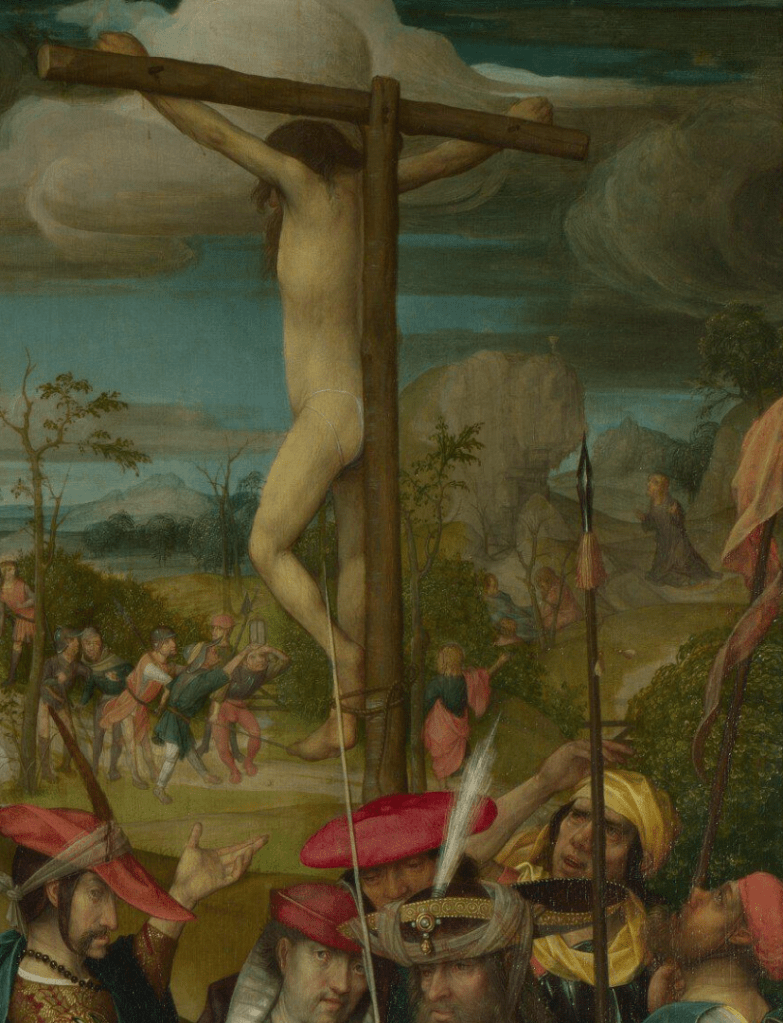
Today we head without the city walls, never to return. We are, following yesterday’s instruction, following the white horse. Its rider looks over his shoulder to check we are following – and the more I look, the more people I see returning our regular scrutiny. The man on the other white horse, for example, is gazing towards us, though I can’t for the life of me work out what he might be thinking. His horse, on the other hand, clearly has his eye on his brown companion. Impatience? Admiration? I’m sorry, I don’t speak Horse.

Why are we leaving the city? There is a historical reason. The Romans didn’t like dead bodies, and didn’t want them inside the city – and Jerusalem was part of the Roman Empire. Pontius Pilate was the Roman prefect, after all, and even 33 years before the events we are witnessing you may recall that, just before Christ’s birth, ‘it came to pass… that there went out a decree from Caesar Augustus that all the world should be taxed’ (Luke 2:1). That was the whole Roman world, of course. Because the Romans didn’t like dead bodies, their deceased were buried without the city walls. As an illustration, the catacombs I have visited most often are at the church of Sant’Agnese fuori le Mura – St Agnes without the Walls. And when St Peter was buried, it would have been in a necropolis next to the Circus of Nero (where he was executed), on a hill just outside the walls of ancient Rome. When they came to build the first St Peter’s in the fourth century, they sliced off the top of the hill so that they could build a church directly over what they believed (and still believe) to be the exact spot. Now, if they didn’t like dead bodies within the city walls, they would also have to head without for executions.

Not only is the green hill ‘without a city wall’, it is also, like St Botolph without Ludgate, without one of the city gates. Of course, if there’s a wall, there must be gates, and it is through one of them that the man on the first white horse is passing. We can see the track heading off into the distance towards the blue hills you might remember from Lent 4, echoed by the curve of the trumpet from Lent 6. But is this the green hill far away that we can see rising up to the right of the track? I don’t think so: there is no one about – no activity, no preparation, nothing. So I suspect we are not going that way. Head through the gate, and turn right. Follow that horse.

Lent 19

Two men in their pants. It doesn’t look promising. They are clearly prisoners – both have their hands tied behind their backs, and the same rope is used for both – they are tied together. They have their backs to us: this, together with several other details, tells us to keep moving. The guard who holds them (with boots over his hose – he’s respectable enough) gestures towards the rear end of a white horse, while looking towards someone else – maybe it was supposed to be the man on the brown horse, but the eyeline isn’t quite right. He’s clearly asking advice, or giving instructions: follow that horse. And in the bottom right-hand corner of the detail, we see the hand of the man who, three days ago (Lent 16), I said we would follow. He too gestures upwards, towards the rump of the white horse, effectively. So: it is time to go.

I only gave you the first half of John 19:17 the other day. This is it in full, together with the following verse:

And he bearing his cross went forth into a place called the place of a skull, which is called in the Hebrew Golgotha: Where they crucified him, and two other with him, on either side one, and Jesus in the midst.

These scantily clad men are the ‘two other,’ and in the same way that the artist belittled the carpenter in Lent 17 by having his hose fall down, the authorities in Jerusalem have stripped these two men nearly naked to humiliate them on the way to their deaths. The effect is in no way comic. Look at them closely – we will see them again, but they will not look the same. One is old – grey hair and beard – the other, younger, with a full head of light brown, shoulder-length hair, not unlike Jesus’s. You should also note the cut of their underpants, as, for some inexplicable reason (I have my ideas) this will change. They become known as the two thieves, the ‘Good’ and the ‘Bad’ – but more of them another day. For now, it is worthwhile pointing out that they appear in all four of the gospels, suggesting that they are important. Like John, in the verses quoted above, Matthew and Mark both mention them at the time of the crucifixion, but Luke (23:32) introduces them earlier. After discussing the crowds following Christ – including the ‘Daughters of Jerusalem’ we mentioned yesterday, he goes on to say,

And there were also two other, malefactors, led with him to be put to death.

Here they are, then, being ‘led with him, to be put to death,’ and over the next few days we shall see where they go.

Lent 18

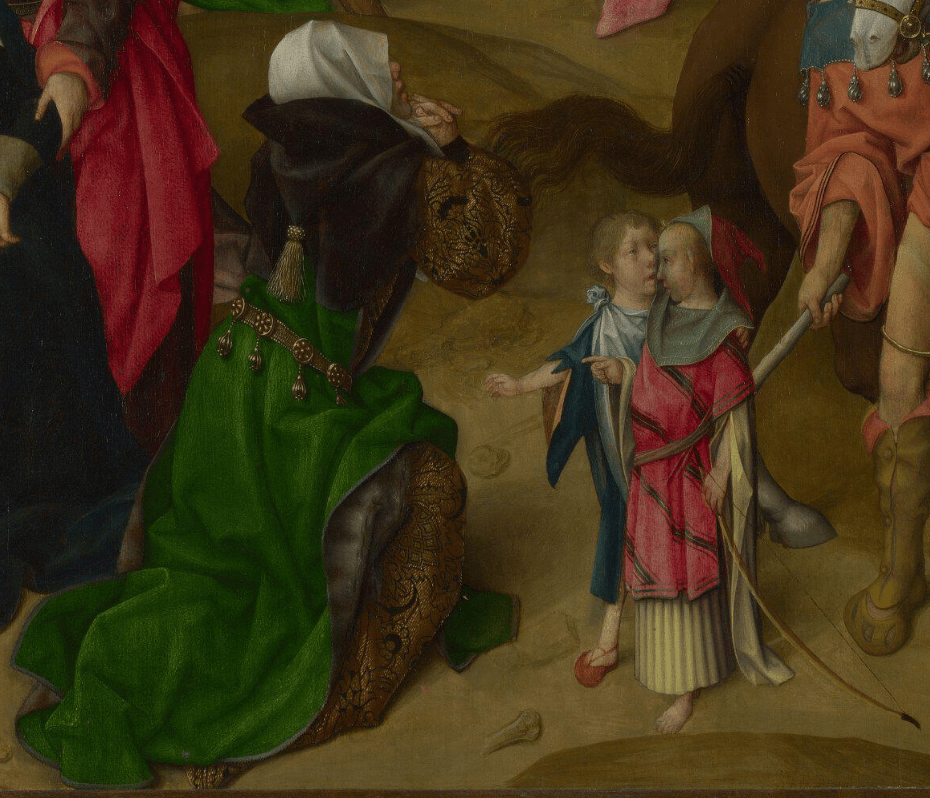
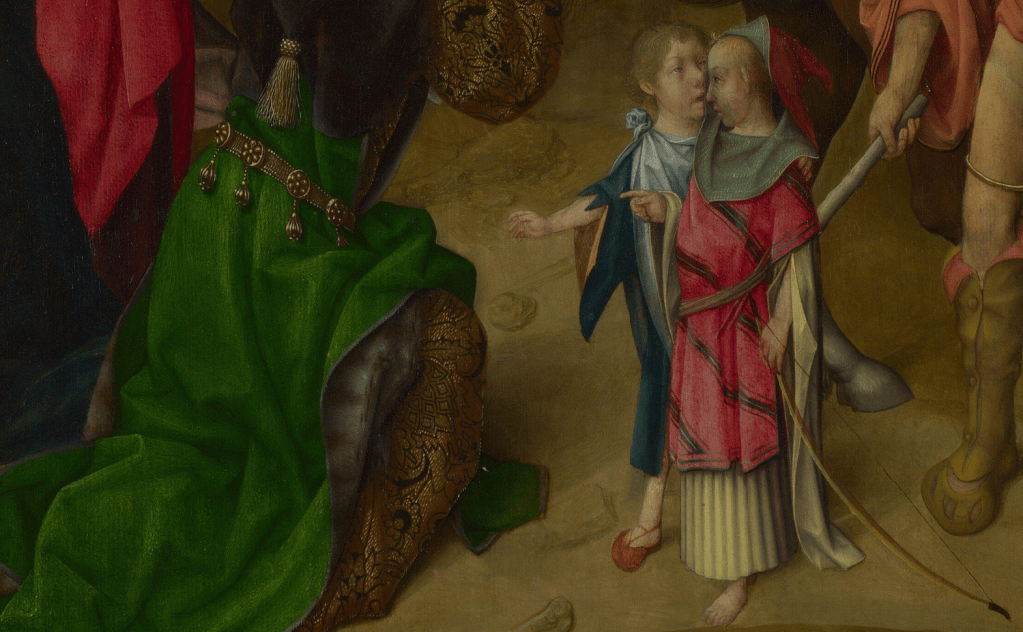
We haven’t met this scrawny child before. We saw the boy in the improbable hat yesterday, having first seen him over a week ago (Lent 7), but this is the first time we have seen his companion, who is possibly his baby brother. As I said when we first met the elder boy, ‘one of the features of this artist’s style is that he (or maybe she?) couldn’t do children,’ painting them instead ‘like small, gnarled adults’. This is a case in point. The boy sits on his mother’s lap, reaches round to take hold of her belt, and looks out at us. Like yesterday’s carpenter, he is one of the very few people in the painting looking at us. Perhaps, in this case, he is seeking our help, or perhaps, on behalf of the artist, he is there to provoke our sympathy.

It’s hardly surprising that he looks like a ‘small, gnarled adult’ – what we see is a mass of underdrawing, diagonal lines of shading which seem to have little or no relevance to this boy’s face – until you realise it is not visible on his cheeks, which are lighter. It was just a rough guide, and never meant to be seen. While we’re there, it’s worth pointing out that the shading goes from top right to bottom left, which tells me that the artist was right-handed (it’s a result of the natural movement of the wrist) – but we would have guessed that anyway. His mother is clearly wealthy: she wears a red robe (unlike blue, which was the most expensive pigment for painting, red was the costliest fabric to wear), and it is richly lined with fur, which in itself is beautifully painted, however abbreviated the technique – or maybe, especially given the abbreviated technique. You can see how it’s done, without it being ‘showy’, which is impressive in its own right. At this point, it would be worthwhile reminding you who his mother is.

Having said that, I suggested two days ago (Lent 16) that, ‘there really is no way of knowing’ who she is, ‘apart from being one of the many women who followed Jesus,’ but I gave no evidence that such women were there. I also said that, ‘it is now obvious that it is [Jesus’s] arrest and torture which are upsetting her, not to mention his inevitable death.’ However, I think there could be another allusion here, and one which would explain the presence of the child on her lap – even if it really doesn’t need an explanation. It comes from Luke’s description of the events following Jesus’s trial. They led him away, ‘And’, according to Luke 23:27-28,

 …there followed him a great company of people, and of women, which also bewailed and lamented him. But Jesus turning unto them said, Daughters of Jerusalem, weep not for me, but weep for yourselves, and for your children.

I think this woman is one of the ‘Daughters of Jerusalem’ who is bewailing and lamenting him. But I suspect she is also weeping for herself, and for her children. Which is why, in this detail, the children are there – and why the baby looks at us, inviting us to weep for him, with her.

Lent 17

In the words of comedian, actor and writer Arabella Weir, ‘Does my bum look big in this?’ Not only does this man bend over to give us a chance to contemplate an answer, but he also turns round to look us in the eye – indeed, he is, I suspect, one of the very few people in the painting who do look at us, aware of our presence, thus inviting our participation in the events depicted. His gaze connects us to the painting, while the plank, or beam, which he is holding with his left hand leads our eye in further, as we saw in Lent 9. We now know, of course, that this plank, or beam, is part of the cross. His right hand reaches down, arm fully stretched, to pick up his auger (not his pick), which he will use to make guide holes at the bottom and on both arms of the cross, so that later it will be easier to drive in nails. There are other paintings where you can see this in action. The boy with the improbable hat (Lent 7) is pointing to the auger, acknowledging its relevance, and also helping to structure the painting: his gesture parallels the length of the beam, and helps to keep our eye looking into the painting, and to the right, the direction that Jesus will soon travel on his way to Calvary.

There is something comical about bottoms, particularly when they are displayed so brazenly. They imply a sense of vulnerability, I think, especially when your hose is down. We could see, even in the small detail in Lent 9, that the left leg had collapsed. Someone suggested that the hose looks almost more like thigh-length boots – and it does. But this shouldn’t be a surprise: our mistake is to confuse ‘hose’ with ‘tights’ – thin, almost evanescent – but hose was intended to fully clad the legs – not only to cover them, but to keep them warm. Before lycra, and even before elastic, they could be tied up with garters, but were often attached to the bottom of the doublet with laces – rather like shoe laces, with pointed metal caps (‘aglets’) to stop them fraying. Perhaps for that reason they were called ‘points’. When Malvolio decides to dress precisely how he believes, in error, that Olivia wants him to, in Shakespeare’s Twelfth Night, he says he will be ‘point-devise the very man’ – he means that he will be ideally dressed and perfectly presented. Not this man here: no points, so his hose has fallen down. It reminds me of the Whitehall farces – and no, I am not referring to contemporary politics, and no, I am not old enough to have seen any of them. But I know that, in these ‘classic’ comedies at the Whitehall theatre in the 50s and 60s, usually starring Brian Rix, there was usually a point where the hapless hero’s trousers would fall down, and it would always get a laugh. We are meant to laugh at this man – he is our comic chorus, like the Porter in the ‘Scottish Play’ or the Gravedigger in Hamlet. He is there to warm us up, to grab our attention, to get our emotions moving, to lower our guard – because later we should weep.

And it’s not just the bottom. He shares something in common with the right-hand sculpture adorning the palace which we saw in Lent 5, about which I said, ‘his buttocks are turned towards us… and… there is more than a hint of testicle’. Fine. Dress how you like. But don’t stand astride a plank. Or beam. If the man at the other end lifts it up much higher, there will be a nasty accident. This is part of the comedy, and it is also one of the ways in which the cruelty of these men is undermined – they are ugly, low and laughable. However, hardly anyone is paying attention to him – apart from us, perhaps. A child at the bottom of the Scala Santa looks up towards Jesus and waves. He really shouldn’t be here, as he has wandered out of another image, but seems to be morbidly interested in Christ’s suffering: as the Dutch used to say in the 17th Century (and maybe they still do), ‘Soo voer gesongen, soo na gepepen’ – ‘As the old sing, so the young pipe’. He’s been given a bad example.

Our artist is quoting from a print of The Flagellation by Dutch painter and printmaker Lucas van Leyden, probably as the design for a small stained glass panel, a vignette that would sit in the middle of a plain glass window. It was part of a series now known as The Circular Passion, and is dated 1509. This tells us something important: our painting must date from 1509 at the very earliest… but probably later.

Lucas van Leyden, The Flagellation from The Circular Passion, 1509. Metropolitan Museum of Art, New York.

Lent 16

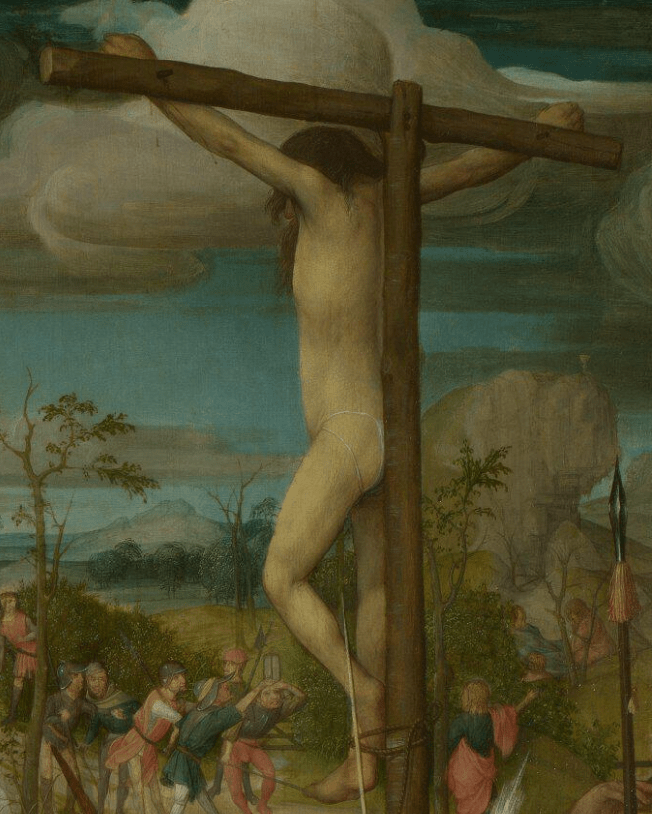
We’ve seen enough of the painting now to start meeting people again, and to put them into context – the woman weeping, and the improbable hat of the child next to her (Lent 7) can be seen in the bottom right – and now we know why she is weeping. Whoever she is – and there really is no way of knowing, I think, apart from being one of the many women who followed Jesus – it is now obvious that it is his arrest and torture which are upsetting her, not to mention his inevitable death: her head is right next to the cross, after all. The man we saw in the act of derision (Lent 8) was clearly deriding Jesus. Someone astutely commented that that detail reminded them of ‘an Ecce Homo scene’ (I’m sorry, I don’t have a name, only a group…), and they were more-or-less right. Ecce Homo means ‘behold the man’, words spoken by Pontius Pilate, as related in the Gospel of John, 19:5,

Then came Jesus forth, wearing the crown of thorns, and the purple robe. And Pilate saith unto them, Behold the man!

It is at this point, according to John, that the chief priests and officers call for Christ’s crucifixion, but Pilate claims to ‘find no fault in him’. Then the people also call for him to be crucified. Pilate tries every way possible to have him released – speaking again to Jesus, arguing with the priests, and confronting the public, but to no avail. Eventually he submits, and, in the words of John 19:16-17,

Then delivered he him therefore unto them to be crucified. And they took Jesus, and led him away. And he bearing his cross went forth…

And this is the precise moment we see – a stage further on from the Ecce Homo, but with the same rabble, who have been roused to the heights of passion, anger, derision: you may remember that yesterday I mentioned that ‘the chief priests moved the people’ (Mark 15:11) – i.e. they had turned them against Jesus. There are, at least, a few good people moved to tears amongst the crowd. We also read yesterday how Mark told us ‘they put his own clothes on him’ (Mark 15:20) before taking him away, which is why he no longer wears the ‘purple’ mentioned by John, above, and also by Mark. In today’s detail he is being led down some steps to pick up the cross.

These are not just any steps, as it happens, they have an important place in church history. It is widely believed that St Helena, the mother of Constantine the Great, went on a pilgrimage to the Holy Land, and brought back many relics. One of the things she somehow acquired and had shipped back to Rome was an entire staircase, made up of steps which were supposed to lead to the Praetorium, the very steps up which Jesus walked to face Pilate, and the ones he is about to be led down now. The originals look rather different.

Still a vital pilgrimage destination, since the 18th Century the Scala Santa – or ‘Holy Staircase’ – has been clad in wood, and for much longer than that it has only been climbed on your knees. I’ve done it three or four times… I won’t go into its historical authenticity, but, as one website I’ve just seen suggests, ‘believers need no further proof and sceptics may never have enough proof’. I will go as far as to say I’m with the sceptics – and archaeologists. Nevertheless, this is what the steps in our painting represent. One of yesterday’s unexplained gestures now makes sense: the guard we saw on the left had unaccountably grabbed hold of Jesus’s robe. It turns out he was holding it up so that Jesus wouldn’t trip over while going down the steps. Whether this was an act of kindness, or simply a practical expedient, I shall leave you to decide.

Another detail I love here: the guards are clearly well rewarded. I’ve already commented on their elaborate clothing, but look at the purse of the man holding the rope. We see another pentimento, and in this case it tells us that the purse was originally smaller. It seems that, after taking on this job, he needed a bigger one, which was painted over the first.  The rope shows us, subtly, the direction of travel – down to the right – and then the cross takes over: in a couple of days we will head off from the top right of this detail – the cross points the way. The man holding it up has the typical grimace, and ugly distortions of form, seen throughout this rabble. It is not the ugliness of everyday life, as someone understandably asked me yesterday, but an expression of the inner character of these people. The idea – now rejected, thank goodness – was that the exterior appearance reflected the interior qualities. We see it again with the man at the very top right. He wears the finest clothes – the decorative chain mail around his collar appears like sewn pearls, and the silvery sleeve is tailored to an elegant fullness – and yet he has a ridiculous snub nose: the perceived ‘ugliness’ of his facial features would reflect the supposed ugliness of his mindset. He does, however, know which way we are going, and in a couple of days we shall follow his lead.